All Hail Chaos Summary, Characters and Themes
All Hail Chaos by Sarah Rees Brennan is a fantasy novel about readers who enter the fictional world that once gave them comfort and discover that imagined characters possess real fears, desires and moral agency.
The story follows Rae as she tries to repair the damage caused by changing a familiar narrative, only to become trapped between a resurrected Emperor, an approaching god and competing versions of destiny. Mixing political conflict, dark romance and self-aware storytelling, the book examines what happens when people are treated as heroes, villains or supporting figures instead of individuals capable of choosing their own paths. It’s the 2nd book of the Time of Iron series and sequel to Long Live Evil.
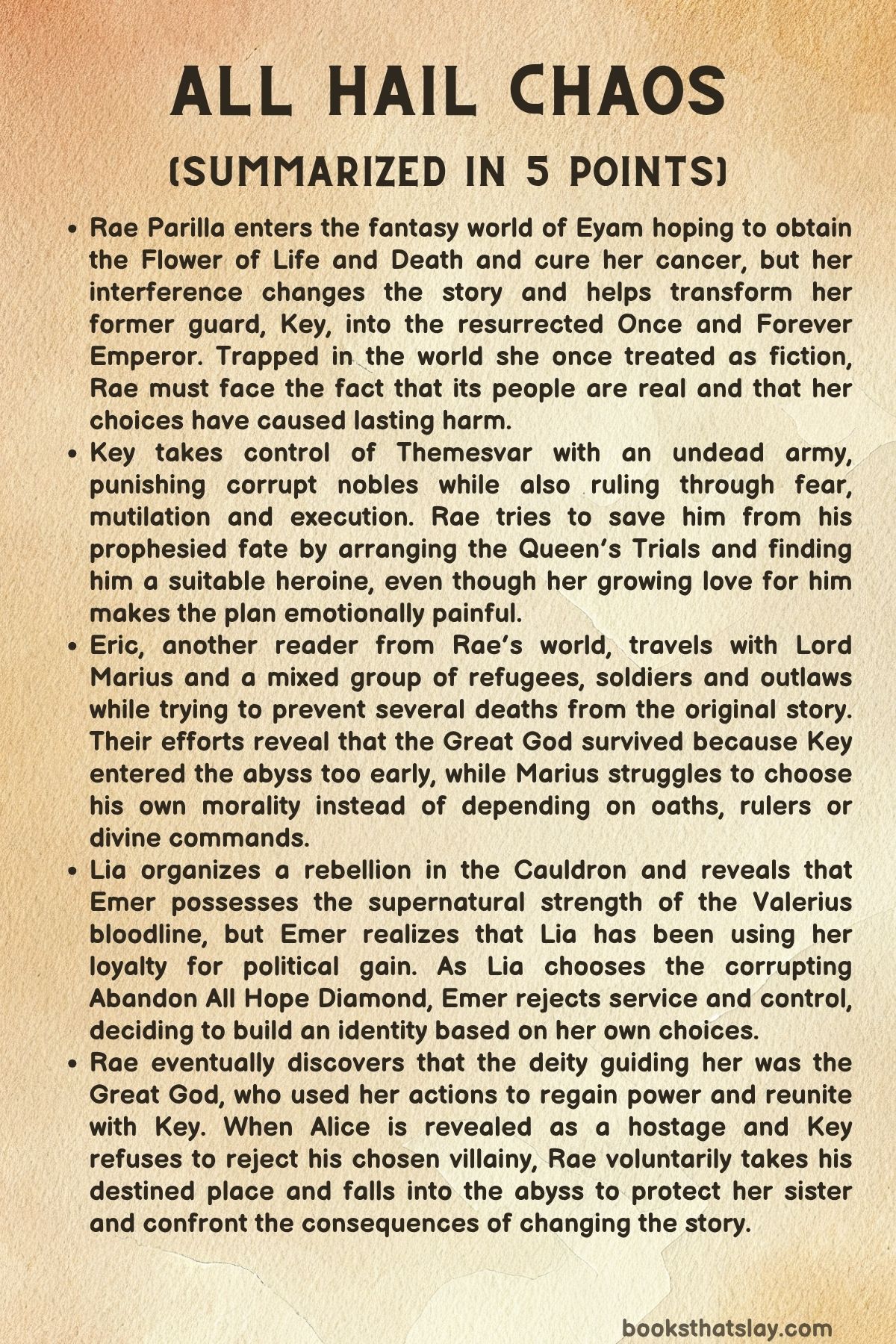
Summary
Sixteen-year-old Alice Parilla sits beside her dying sister Rae in a hospital room, reading their favourite fantasy series, The Once and Forever Emperor. Alice notices that the books have changed: characters who should be dead are alive, familiar events have disappeared and the story no longer follows the version she remembers.
Rae has entered the world of Eyam after being offered the chance to steal the Flower of Life and Death and cure her cancer. Instead of treating Eyam as a real place, she initially views its inhabitants as fictional characters whose suffering matters less than her survival.
Her interference causes Key, the guard she recruited into her villainous team, to be murdered and thrown into the abyss. Key returns as the Once and Forever Emperor, commanding the dead and possessing powers that make him nearly impossible to oppose.
Key demands that Rae become his queen. Although Rae once admired the Emperor as a fictional villain, she is frightened by the resurrected man and by the anger he directs toward everyone who humiliated, exploited or betrayed him.
Prime Minister Andras Pio attempts to preserve the government after Key’s undead army destroys much of the royal court. He recognizes Key as Emperor while quietly studying Rae, whose magical oath of blood and gold gives her temporary authority over him.
Rae tries to retrieve the Flower of Life and Death from Horatia Nemeth, only to discover that Horatia has already used it to save her twin sister Hortensia. The remaining portion cannot heal Rae or reopen the portal to her world, leaving her trapped in Eyam without a clear route back to Alice.
Elsewhere, Lord Marius Valerius travels with Eric, the Golden Cobra, and a company of refugees rescued from Themesvar. Eric is another reader from Rae’s world, while Marius is the legendary White Knight whose loyalty, violence and self-hatred made him Eric’s favourite character.
Marius has betrayed King Octavian and sworn an oath to Eric. He struggles with the Valerius bloodlust, an inherited power that makes him extraordinarily dangerous and convinces him that he will eventually destroy anyone he loves.
Desperate for guidance, Rae calls upon the deity she believes created Eyam. A divine presence speaks through a corpse and offers her a bargain: she must help Key defeat his enemies, find true love and escape the final prophecy, after which Rae will be sent home.
Rae accepts and decides to arrange a heroic romance for Key. She casts herself as the temporary villainous fiancée who must eventually surrender him to a worthy heroine, allowing her to ignore the possibility that she genuinely loves him.
Lia and Emer, two of Rae’s former allies, hide in the Cauldron with the blacksmith Forge. Lia plans to rescue Rae, while Emer grows increasingly troubled by Lia’s secrecy, manipulation and willingness to use other people’s loyalty.
Key begins ruling Themesvar through a mixture of protection, vengeance and terror. He opens his court to common petitioners and punishes abusive nobles, but his punishments involve mutilation, execution and forced resurrection as members of his undead army.
His ghouls also prove unstable. A corpse attacks and kills a woman who had welcomed Key as a divine protector, showing that his control over the dead can fail when their hunger overwhelms his commands.
Rae proposes restoring the Queen’s Trials so that potential heroines can be brought before Key. Pio revives the ancient and lethal version of the competition, turning Rae’s romantic plan into a series of genuine dangers.
Rae selects Lady Glacia, a shy young woman of Tagar ancestry who resembles the overlooked heroines of adventure stories. She also distrusts Lady Ninell Almassy, Pio’s intelligent niece, because Ninell reminds Rae of a friend who abandoned her during her cancer treatment.
During the first Trial, Rae abandons the official course and steals an enormous roc from the royal menagerie. Key rescues her when she nearly falls into the abyss, masters the creature and declares Rae the winner because she has provided him with a weapon against Tagar’s mechanical dragon.
Rae succeeds in drawing Key’s attention toward Glacia, but she is devastated when he claims to feel attracted to the young woman. Her jealousy reveals that she no longer regards her engagement as a temporary performance.
Peace negotiations with Tagar deteriorate after Key threatens to execute Princess Vasilisa, whom he holds hostage. Vasilisa loves Fabianus Nemeth, while her brother, King Ivor, has promised her to the brutal warrior Torhell Merac in exchange for military support.
At Ancilley Manor, Eric attempts to save Marius’s sister Caracalla from the fiery death she suffers in every version of the original story. Their situation worsens when Lucius, Marius’s resurrected childhood friend, arrives as a servant of the surviving Great God.
Eric discovers that the First Duke of Valerius was the Great God in mortal form. The Valerius bloodline was created to provide future bodies for the deity, making Marius, Caracalla and their father possible vessels.
The disabled Duke of Valerius willingly invites the Great God into his body. Lightning strikes Ancilley, supernatural fire consumes the manor and Marius’s mother Eumineda sacrifices herself so that Caracalla can survive the fate originally assigned to her.
Before Marius leaves, Eric commands him to live, make his own moral decisions and become the hero he personally believes is right. This order forces Marius to stop treating obedience as an escape from responsibility.
In Themesvar, Rae and Key grow physically and emotionally closer. Key offers Rae the power to survive without apology, while Rae asks him to remove her cursed necklace and call her by her real name, Rachel.
The second Queen’s Trial requires the contestants to drink a potion that reveals their true hearts. Ninell forces Rae to swallow the potion, leaving Rae vulnerable to questions that may expose her identity and knowledge of another world.
Key brings Rae’s mother Katalin and grandmother Dian back from exile. Katalin immediately realizes Rae is not her daughter Rahela, and the truth potion forces Rae to confirm that accusation publicly.
Key names Glacia the winner of the Trial. Soon afterward, however, Rae discovers Glacia dead beside him, and Key admits killing her without remorse.
Rae frees Vasilisa with Fabianus’s assistance. When Key catches them, he kills Fabianus by tearing out his heart and breaks the oath that once allowed Rae to command him.
Rae finally understands that the deity who offered her the bargain was the Great God rather than the Great Goddess. The God’s Eye necklace linked her to Key’s enemy, meaning her efforts to save the Emperor have helped guide the older god back into power.
Rae escapes through the Maidens’ Tower, but Ninell cuts her rope. Before Rae strikes the ground, Ivor catches her with his metal dragon and carries her to the Tagar camp.
Ivor knows that Rae comes from another world because he found scientific writings left by a previous outsider. Rae protects herself by announcing a false engagement to him, giving Ivor a politically neutral bride who may help end the conflict between the Merac and Starost factions.
Meanwhile, Lia organizes a rebellion among the people of the Cauldron. She reveals that Emer possesses Valerius blood and presents her as a living weapon capable of challenging both the nobility and the Emperor.
Emer realizes that Lia concealed her heritage until it became politically useful. Although she agrees to enter the palace with the rebels, she does so primarily because she wants to reach Rae.
Eric, Caracalla, Ink and the minstrel Merel travel to the Oracle. The dying Oracle reveals that she also came from another world and has witnessed many altered versions of the story, but the Great God’s followers have prevented her from summoning the Goddess.
The Great God seizes Ivor’s dragon and captures Caracalla and Ink. Ink is later revealed to be Alice, who entered Eyam to save Rae and attempted to protect Caracalla by taking the role of the stable girl.
Marius arrives at the Tagar camp with an army made from refugees, soldiers, farmers and former bandits. He brings the divided Tagar forces under temporary command as Key and the Great God prepare to face one another outside Themesvar.
While everyone watches the apparent divine battle, Lia leads the Cauldron rebels into the palace. She finds the Abandon All Hope Diamond and chooses to wear it despite Emer’s warning that the jewel is controlled by the Great God.
Emer offers Lia honesty, equality and a relationship free from service, but Lia prefers supernatural power that cannot be taken away. Emer finally leaves her, refusing to remain another person’s servant or weapon.
Key and the Great God appear to fight across the ruined plain, but the confrontation ends with Key embracing his father. The Great God promises to restore order, while Lia appears beside him as his new priestess.
Rae convinces Key to destroy the God’s Eye embedded in his sword. Key does so but refuses to blame the jewel for his cruelty, declaring that he chooses villainy and wants Rae to love him without demanding that he become a conventional hero.
The Divine Order presents Alice and Caracalla as hostages. Rae remembers that a person may voluntarily take another individual’s place in a destined sacrifice.
Key was originally supposed to descend into the abyss and confront the Great God. To protect Alice and restore that missing part of the narrative, Rae steps from the battlements and falls into the abyss, leaving the conflict between choice, prophecy and divine control unresolved.
Characters
Rae Parilla, also known as Rachel and Lady Rahela
Rae is the central force of All Hail Chaos, and her development is shaped by the painful difference between knowing a character’s story and respecting that character as a real person. She enters Eyam as a dying young woman willing to manipulate fictional lives for a cure, but she gradually understands that every change she makes produces suffering she cannot dismiss as imaginary.
Her strongest trait is her ability to convert fear into performance. She adopts the identity of a flamboyant villainess, uses dramatic gestures to control attention and treats romantic and political situations as recognizable narrative patterns.
That instinct helps her survive, but it also prevents her from seeing individuals clearly. Glacia becomes a heroine, Ninell becomes a treacherous rival and Key becomes a doomed romantic figure long before Rae considers what any of them personally want.
Rae’s relationship with Key exposes her central contradiction. She wants to save him from the fate written for him, yet she repeatedly tries to replace his decisions with a better story of her own design.
Her final choice marks a significant moral change. Instead of assigning sacrifice to someone else, she voluntarily takes the place that destiny originally reserved for Key, accepting the consequences of entering and altering his world.
Key, the Once and Forever Emperor
Key is simultaneously an abused servant, a feared criminal, a resurrected god and a man determined never to be powerless again. His violence is rooted in years of exploitation, class humiliation and the knowledge that aristocrats considered his life less valuable than their comfort.
In All Hail Chaos, his rise exposes the cruelty hidden beneath Eyam’s respectable political order. He listens to servants and punishes nobles who believed themselves untouchable, but his justice becomes terrifying because it allows no investigation, proportion or possibility of mercy.
Key’s attachment to Rae combines devotion, resentment, desire and possession. He remembers serving outside her door, learning from her and being treated as someone worthy of attention, yet he also remembers that her manipulation contributed to his murder.
He repeatedly asks Rae to accept him without changing him. This demand contains emotional honesty, but it also becomes an excuse to reject responsibility for murder and cruelty.
By destroying the God’s Eye while still declaring himself a villain, Key refuses the comforting explanation that an outside power caused all his actions. He insists on ownership of his choices, even when those choices make love with Rae dangerous and morally unstable.
Alice Parilla, also known as Ink
Alice begins as the sister left behind in a hospital room, watching Rae disappear into a story that has begun rewriting itself. Her love for Rae is shaped by dependence, admiration and the memory of a sister who always protected her.
After entering Eyam as Ink, Alice attempts to influence the narrative quietly. She disguises herself as a stable worker, joins Marius’s refugees and tries to protect Caracalla from the fate she remembers.
Alice’s admiration for Marius is sincere but idealized. She sees the celebrated White Knight rather than the frightened man who associates love with violence and heroism with obedience.
Her presence also reverses the sisters’ original roles. Rae once acted as Alice’s protector, but Alice now enters danger to rescue Rae from a world whose rules have become unpredictable.
When Alice is exposed as a hostage, she becomes the emotional reason Rae finally accepts sacrifice rather than manipulation. She represents the personal life Rae has been trying to return to and the bond that remains stronger than any fictional role.
Lord Marius Valerius
Marius is a legendary warrior who has spent his life fearing that his strength makes him monstrous. He possesses the Valerius battle rage, extraordinary physical power and a capacity for violence that brings him both satisfaction and shame.
His devotion to honour initially appears noble, but it often functions as a method of avoiding personal judgment. Marius longs for kings, gods or magical oaths to tell him what to do because obedience allows him to escape responsibility for wanting anything himself.
His relationship with Eric transforms that pattern without immediately freeing him from it. He betrays Octavian, swears himself to Eric and accepts those choices as acts of villainy, yet he also admits that he would make them again.
Marius’s deepest growth begins when Eric commands him to live and form his own moral judgments. This order forces him to recognize that heroism cannot be reduced to serving the correct authority.
His decision to oppose the Great God shows that he is beginning to act according to conscience rather than tradition. He remains dangerous, but the story suggests that violence does not determine his morality as completely as he believes.
Eric, the Golden Cobra
Eric is another reader transported into Eyam, but his response to fictional characters differs significantly from Rae’s. He recognizes that narrative knowledge gives him power, yet he repeatedly tries to use that power to rescue people whom the original story discarded.
His greatest strength is his ability to gather outsiders. Refugees, outlaws, soldiers, workers and performers follow him because he offers them purpose without demanding that they fit respectable definitions of loyalty or virtue.
Eric’s compassion is not free from mistakes. He accepts Marius’s oath without initially understanding how completely Marius interprets it, and his efforts to change Caracalla’s fate unintentionally help the Great God gain a vessel.
His relationship with Marius is weakened by incompatible ideas of love. Eric sees control over another person’s will as morally unacceptable, while Marius sees surrendering that will as the highest form of trust.
Eric ultimately gives Marius a command designed to end dependence rather than strengthen it. By ordering Marius to live and choose for himself, Eric attempts to turn magical ownership into personal freedom.
Lia
Lia possesses beauty, intelligence and an extraordinary ability to make others believe that following her is their own idea. She presents herself as gentle and compassionate, but she constantly studies people for secrets, weaknesses and potential usefulness.
Her desire to rescue Rae appears genuine. However, she gradually treats Rae’s danger as an opportunity to gather influence, organize resistance and place herself at the centre of political change.
Lia’s treatment of Emer reveals the cost of her leadership. She conceals Emer’s Valerius heritage and then announces it publicly when the revelation can provide the rebellion with a powerful symbol.
She fears dependence because affection, admiration and loyalty can disappear when people become disappointed. The Abandon All Hope Diamond attracts her because it promises power that does not require continuing consent.
Her choice of the jewel over Emer is therefore consistent with her deepest insecurity. Lia would rather possess guaranteed authority than risk an equal relationship in which another person remains free to leave.
Emer
Emer begins as a devoted servant whose identity is built around protecting Lia and Rae. She has been trained to regard obedience as safety, even though the people she serves repeatedly hide information from her and use her loyalty.
The discovery of her Valerius heritage explains her heightened senses, strength and violent instincts. More importantly, it forces her to question the story she was told about her childhood and Katalin’s supposed kindness.
Emer’s growing connection with Forge introduces a new model of affection. Forge does not demand service or unquestioning loyalty, and she treats Emer’s anger as reasonable rather than as a betrayal.
Emer’s separation from Lia is one of the book’s clearest acts of personal liberation. She offers Lia equality, honesty and companionship, but refuses to remain when Lia chooses supernatural control.
Although Emer possesses the physical strength of a legendary warrior, her most important victory is learning to leave. She begins defining herself through her own decisions rather than through the needs of the women she loves.
Forge Strike
Forge represents the political and moral knowledge of the Cauldron. She understands that law often protects aristocrats while leaving poor people, criminals, servants and sexual minorities dependent on solidarity and reputation.
Her history with Lia gives her insight into Lia’s charm and ambition. Forge recognizes that Lia can make manipulation feel like love because those around her want to believe in her goodness.
Forge’s treatment of Emer is notably different. She provides information, warns her about danger and allows her to make decisions without demanding obedience.
Her developing romance with Emer is therefore based on possibility rather than ownership. Forge sees Emer as an intelligent person capable of choosing her future, not merely as a warrior or servant.
She also complicates simple divisions between criminals and respectable citizens. Her community may exist outside aristocratic law, but it often possesses a clearer sense of mutual responsibility than the royal court.
Prime Minister Andras Pio
Pio is a political survivor who believes stability is usually more important than moral purity. When Key destroys the existing monarchy, Pio immediately reframes the catastrophe as a transition of power and begins adapting the government to its new ruler.
His intelligence allows him to understand both Key’s danger and Rae’s influence. He recognizes that their engagement may provide a means of controlling the Emperor, though he consistently underestimates the emotional volatility between them.
Pio accepts cruelty as one of the ordinary costs of government until Key’s violence destroys the Nemeth family. Fabianus’s death and Hortensia’s grief transform political calculation into personal horror.
His relationship with Ninell also reveals a more protective side. He promotes her interests but remains alert to the possibility that she is pursuing schemes beyond his knowledge.
By the end, Pio realizes that he spent his life climbing toward power only to reach a realm where human strategy has little meaning. His tragedy is not that he lacks intelligence but that intelligence cannot manage gods who reject all limits.
King Ivor
Ivor is a scientist, monarch and political manipulator whose intelligence is hidden beneath his reputation as a cold northern ruler. He combines writings from another world with Tagar magic to construct a metal dragon.
Unlike Rae and Eric, he did not enter Eyam through a portal. His knowledge comes from studying evidence left by an earlier outsider, making him proof that ideas can cross worlds even when people do not.
Ivor’s treatment of Vasilisa shows the moral weakness beneath his rational image. He allows her to become a bargaining object in the conflict between Meracs and Starosts, even while privately resisting the same factions’ control over his own marriage.
His false engagement to Rae is based on mutual leverage rather than affection. Both understand that the arrangement solves political problems, yet Rae is aware that stories often transform declarations against love into romantic complications.
Ivor becomes a valuable ally because he can understand unfamiliar systems without immediately dismissing them. His dragon, however, also demonstrates that technology cannot protect its creator when divine power takes control.
Princess Vasilisa
Vasilisa is repeatedly treated as a political possession by the men around her. Ivor promises her to Torhell, Key holds her as a hostage and both sides describe her future in terms of military advantage.
Despite this treatment, she remains observant, practical and emotionally courageous. Her love for Fabianus is not based on his public reputation but on her understanding of the loyalty hidden beneath his frivolous behaviour.
Vasilisa responds to captivity by gathering information and sustaining her connection with Fabianus. After escaping, she helps unite Tagar’s divided forces by presenting the coming divine conflict in personal and political terms.
Her offer to help Rae escape Eyam is compassionate, but it also reflects her own desire for a life beyond inherited duty. Vasilisa understands why Rae might want freedom because she has spent much of her life being assigned to other people’s plans.
Fabianus Nemeth
Fabianus is initially dismissed as decorative, foolish and harmless. His fashionable behaviour and apparent frivolity conceal loyalty, courage and considerable fighting ability.
He tends to Vasilisa in secret despite the danger of defying Key. He also helps Rae free her, knowing that the act may place him directly against the Emperor.
Fabianus’s death is especially significant because it exposes the failure of Rae’s belief that Key can be redirected through love. Key kills him deliberately, even after Rae invokes the oath that once gave her authority.
His murder also forces Pio and the Nemeth family to confront Key’s reign as a personal catastrophe rather than a political problem. Fabianus becomes proof that courage may exist beneath an unserious exterior and that Key’s vengeance destroys people who are not his original oppressors.
Horatia Nemeth
Horatia is defined by her devotion to her twin sister Hortensia. When forced to choose between keeping her promise to Rae and saving Hortensia, she uses the Flower of Life and Death on her sister.
Her decision is selfish from Rae’s perspective but understandable within the emotional reality of the book. Horatia chooses the person she loves over an agreement made with someone she does not fully trust.
She later helps Rae recruit contestants for the Queen’s Trials because she recognizes the debt created by Rae’s earlier actions. However, she refuses to offer herself as a potential bride because Key’s mutilation of her father makes cooperation emotionally impossible.
Horatia demonstrates that gratitude does not erase injury. She can owe Rae assistance while still rejecting Rae’s attempt to draw her family further into the Emperor’s dangerous court.
Hortensia Nemeth
Hortensia survives a ghoul bite through the Flower of Life and Death, but her recovery remains incomplete. The silver light surrounding her body suggests that she exists between restored life and supernatural preservation.
Her willingness to save part of the Flower for Rae shows generosity even during her own crisis. Rae’s refusal to take the damaged portion creates a bond of mutual recognition between them.
After Fabianus is killed, Hortensia’s controlled exterior collapses. She packs the family’s belongings while carrying her brother’s blood and trying to manage her dying father’s unanswered questions.
Her private confession that she once imagined marrying Pio reveals a longing for quiet safety beneath her disciplined personality. The possibility is destroyed before it can become real, emphasizing how Key’s rule eliminates ordinary futures as well as lives.
Lady Glacia
Glacia is shy, intelligent and fascinated by romantic adventure stories. Rae immediately recognizes her as someone who appears suited to the role of an overlooked heroine.
Rae offers Glacia friendship and encouragement, but her kindness is compromised by her intention to use Glacia as a replacement love interest. Glacia is treated less as a complete person than as a narrative solution to Key’s fate.
During the Trials, Glacia displays genuine courage despite intense fear. Her advice about meeting Ivor on neutral territory also proves that she possesses independent judgment rather than merely fitting Rae’s romantic expectations.
Her murder exposes the danger of reducing people to roles. Rae imagines Glacia will be protected by heroic conventions, but Key never agrees to participate in that story.
Lady Ninell Almassy
Ninell is intelligent, controlled and politically ambitious. Her actions often appear hostile, particularly when she forces Rae to drink the truth potion and later cuts the rope beneath the Maidens’ Tower.
Rae’s judgment of Ninell is influenced by memories of Marlowe, the friend who abandoned her during cancer treatment. This emotional association causes Rae to assume Ninell’s motives before fully understanding them.
Ninell knows how to perform competence within courtly structures. She succeeds in the Queen’s Trials, makes Key laugh and offers advice that impresses both the Emperor and Pio.
Her precise goals remain uncertain. She may seek power, revenge or protection within a court where survival depends on anticipating the next change in authority.
Caracalla Valerius
Caracalla begins as a lonely girl waiting at Ancilley Manor for Marius and the Golden Cobra. She believes Marius is an unquestionable hero and imagines marriage to Eric as her escape from family violence.
Her expectations collapse when she learns that Eric never considered their childhood arrangement a real engagement. The humiliation makes her vulnerable to Lucius, who offers a path toward freedom through her father’s death.
Caracalla nevertheless demonstrates considerable bravery. When told that she dies in every version of the manor fire, she offers to accept that fate rather than allow another person to be sacrificed.
Her survival represents a successful alteration of destiny, but it is purchased through Eumineda’s death. Caracalla escapes the role of tragic maiden while carrying grief, guilt and a new awareness that stories about heroic families conceal abuse.
Duchess Eumineda
Eumineda has spent years living in fear of her husband. Her failure to protect Marius and Caracalla earlier causes deep guilt, but fear has never erased her love for them.
During the manor fire, she refuses to let either child become the required sacrifice. She asks Eric to use Marius’s oath and prevent him from taking Caracalla’s place.
Eumineda enters the burning manor with an enchanted sword and confronts the Great God inside her husband’s body. Her act transforms her from a passive victim of the Valerius household into the person who finally resists its central source of violence.
Her sacrifice also corrects Marius’s mistaken belief that Caracalla feared him. Eumineda reveals that Caracalla always saw her brother as a hero, giving Marius a truth capable of challenging years of self-hatred.
Lucius
Lucius appears as the restored version of Marius’s beloved childhood friend. His familiar voice and memories make him more dangerous than an ordinary ghoul because he can appeal directly to Marius’s nostalgia.
He presents himself as a representative of religious order, but Eric exposes his history of treason. Lucius sabotaged a royal carriage to advance Octavian’s inheritance and later dismisses the deaths he caused as a youthful error.
Lucius manipulates Marius by offering certainty, obedience and escape from moral responsibility. He also exploits Caracalla’s humiliation by suggesting that her father’s death will grant her freedom.
Whether Lucius truly planned to betray the Great God remains uncertain. His shifting explanations show that he values survival and power more than any consistent loyalty.
Torhell Merac
Torhell is a powerful warrior whose reputation combines bravery, savagery and emotional instability. His sabretooth tiger and sacred axe make him an imposing figure even before he challenges Key’s undead forces.
His feud with the Starost family is driven by grief and wounded pride. After losing the expected chance to defeat Count Solas directly, Torhell turns unresolved rivalry into continuing violence against Solas’s people.
He respects strength more readily than rank. When Marius defeats and criticizes him, Torhell responds with admiration rather than humiliation.
Torhell represents a form of heroic masculinity that has lost any controlling purpose. Courage, loyalty and martial skill remain present, but without self-restraint they become excuses for endless conflict.
Lady Mabeth
Mabeth is the experienced political leader of the Merac delegation. She approaches negotiations with clear demands and refuses to be intimidated by Key’s supernatural display.
Her position requires her to manage Torhell’s aggression while defending the interests of her family and military faction. She understands that his reputation is useful but also recognizes that his uncontrolled behaviour can destroy any chance of peace.
Mabeth’s authority contrasts with the treatment of younger women such as Vasilisa. She operates within the same dynastic system but has acquired enough age, status and experience to speak rather than be exchanged.
Her presence shows that Tagar is not a unified enemy. It contains competing leaders whose rivalries are as dangerous as the conflict with Eyam.
Katalin
Katalin is Rahela’s mother and the woman responsible for raising Emer. Her return exposes how completely Rae differs from the daughter whose identity she has occupied.
She notices changes in Rae’s voice, movements, relationships and behaviour almost immediately. Her accusation is cruel in its public intensity, but her conclusion is accurate.
Emer’s discovery of her Valerius heritage casts Katalin’s earlier actions in a darker light. What appeared to be the rescue of an abandoned child may have been a long-term attempt to acquire a useful source of supernatural power.
Katalin understands family primarily through possession, expectation and strategic value. Her sharp perception does not produce compassion because she evaluates people according to how well they fulfil assigned roles.
Lady Dian
Dian is Rae’s grandmother and an experienced observer of power. Unlike Katalin, she does not react impulsively when Rae’s identity is questioned.
She studies the court and recognizes that Key’s rejection of Rae has not produced the outcome Pio expected. Her conversation with the minister suggests that she is already considering new alliances.
Dian represents an older form of political manipulation. She does not rely on spectacle like Rae or popular affection like Lia, but on patience, information and the ability to wait until others reveal their weaknesses.
Her calmness makes her potentially more dangerous than openly hostile characters. She understands that survival at court often depends on remaining useful after the apparent centre of power has shifted.
Conn
Conn is the young guard ordered by Octavian to cut Key’s throat. His action is not motivated by personal hatred but by obedience to royal authority.
After Key returns, Conn approaches him expecting punishment. Rae saves him through the oath of blood and gold, though Key makes clear that being spared does not mean being forgiven.
Conn later becomes a committed servant of the Emperor. His loyalty may arise from fear, guilt, admiration or a desperate need to believe that Key’s survival gives meaning to the violence he committed.
He illustrates the moral danger of obedience within Eyam. Conn carries out orders under Octavian and later under Key, allowing the identity of his master to replace independent judgment.
King Octavian
Octavian is dead for most of the book, but his rule continues to shape the conflict. He represents the aristocratic order that used servants, demanded obedience and treated Key’s life as expendable.
His command leads directly to Key’s murder. By ordering Conn to cut Key’s throat, Octavian helps create the resurrected Emperor who later destroys his monarchy.
Octavian’s friendship with Marius complicates his role. Marius remembers him as a childhood companion and feels guilty for knowing that Eric anticipated his death without warning him.
The contrast between private affection and public injustice is central to Octavian’s legacy. He may have inspired loyalty in individuals while still governing through a system built on inequality and violence.
Merel
Merel first appears to be an impoverished and emotionally distant minstrel. Eric recognizes him as someone who becomes important in later versions of the story and encourages him to perform his own music.
His song honours people excluded from heroic narratives. This aligns him with Eric’s broader effort to gather those whom traditional stories treat as disposable.
Merel is also far more dangerous than his appearance suggests. His skill with knives allows him to kill members of the Divine Order and damage the stolen dragon.
His relationship with Eric is brief but important because it forces Caracalla and Ink to confront forms of desire excluded from their social understanding. Merel exists outside respectable expectations and refuses to apologize for the identities or abilities he conceals.
The Oracle
The Oracle is revealed as the first outsider sent into Eyam. She has lived through many altered timelines and served as the voice of the Great Goddess.
Her knowledge gives her a tragic understanding of narrative change. She knows that preventing one death may create another and that stories extended indefinitely tend to accumulate loss.
Unlike Rae, the Oracle no longer believes fate can be managed through simple knowledge of events. Her warnings emphasize consequences, uncertainty and the limits of any reader’s control.
Her death removes one of the few people capable of explaining the conflict between the gods. Even in her final moments, she provides Eric with a route toward the Goddess and attempts to preserve the possibility of choice.
The Great God
The Great God is the ancient power behind the dead, the God’s Eyes and the Valerius bloodline. He seeks continued existence through bodies, worship and systems of obedience.
His greatest weapon is his ability to present domination as order. He attracts people who are exhausted by uncertainty and promises them a world in which roles, hierarchies and duties are fixed.
He manipulates Rae by pretending to be the Great Goddess and offering a bargain tailored to her desire to save Key. He also uses Lucius, the Divine Order, Lia and the Duke of Valerius as instruments of return.
His reunion with Key reveals that the apparent conflict between them may have been another form of recruitment. Instead of defeating his father, Key embraces the authority that appears to explain his suffering and confirm his power.
The Great Goddess
The Great Goddess is associated with creation, doors between worlds and the possibility of stories changing through human choice. Her absence allows the Great God to imitate her and manipulate Rae.
The Oracle’s history suggests that the Goddess has repeatedly brought outsiders into Eyam. Her reasons remain uncertain, raising questions about whether she offers freedom or merely introduces new agents into an ongoing divine struggle.
Unlike the Great God, she does not appear directly to demand obedience. However, the lives disrupted by the portals demonstrate that indirect influence can still cause enormous harm.
The Goddess represents authorship without complete control. She may create possibilities, but once readers enter the story, their decisions produce consequences that neither prophecy nor authorship can fully contain.
Themes
The Ethics of Treating People as Characters
In All Hail Chaos, knowledge of a fictional narrative becomes a dangerous form of power because Rae and Eric enter Eyam believing they understand the people around them. They know past events, expected deaths, romantic pairings and hidden identities, but this knowledge encourages them to classify individuals before listening to them.
Rae repeatedly assigns roles such as hero, villain, rival, true love and tragic sacrifice. Glacia becomes valuable because she resembles a heroine, while Ninell becomes suspicious because she resembles someone who hurt Rae in another world.
The consequences reveal that recognizing a pattern is not the same as understanding a person. Glacia’s supposed narrative protection does not save her, and Key refuses to become the redeemed hero Rae imagines.
Eric is more compassionate, yet he also makes decisions based on remembered outcomes. His attempt to prevent Caracalla’s death helps create the conditions in which the Great God gains a body.
The book therefore questions the moral authority of readers, authors and prophets. Knowledge of someone’s possible future does not create ownership over that person’s present choices.
Rae’s final decision represents a change in how she uses narrative knowledge. Instead of selecting another person to fulfil a necessary role, she volunteers to take the place herself.
Choice, Destiny and the Burden of Responsibility
Nearly every major character struggles between assigned destiny and personal choice. Key is told he is the Emperor and divine child, Marius is told he is a Valerius weapon, Caracalla is destined to die in the manor fire and Rae believes she must perform the role of villainous fiancée.
Characters often seek relief through obedience. Marius wants Eric, Lucius or a god to command him because following orders seems safer than accepting responsibility for his own desires.
Key responds differently by claiming complete ownership of his villainy. His declaration is a rejection of prophecy and magical corruption, but it is not genuine moral freedom because he uses choice to defend cruelty rather than evaluate it.
Lia also chooses power, yet her decision is shaped by fear that love and loyalty can be withdrawn. The God’s Eye offers certainty, allowing her to avoid the vulnerability required by Emer’s proposal of equality.
The strongest acts of freedom require accepting consequences rather than merely rejecting a role. Eumineda enters the burning manor willingly, Emer leaves Lia despite emotional pain and Rae takes Key’s place in the abyss.
Destiny may establish the circumstances of sacrifice, but the moral meaning changes when the person involved chooses freely. The story treats responsibility as difficult precisely because no prophecy, oath or authority can remove it.
Love, Possession and Freedom
Love in the novel is frequently confused with ownership. Key wants Rae to remain with him, Marius gives Eric authority over his will and Lia expects Emer’s devotion to continue even when she withholds truth.
Key’s attachment to Rae is intense, but his promise of protection contains an implied demand that she accept his violence. He says she is free to leave while acting as though her departure is emotionally and practically impossible.
Marius’s oath creates a different version of the same problem. He experiences obedience as trust, while Eric understands that a relationship cannot be equal when one person possesses magical control over the other.
Lia believes affection is unreliable because people may stop loving her when she disappoints them. Her decision to wear the God’s Eye replaces the uncertainty of mutual love with the certainty of supernatural influence.
Emer and Forge provide a contrasting model. Forge warns Emer, respects her anger and allows her to make choices without treating disagreement as betrayal.
The book presents freedom as an essential part of meaningful love. Eumineda protects her children without demanding repayment, Eric commands Marius to choose for himself and Emer leaves Lia while still caring about her.
Love becomes destructive when it demands surrender of conscience. It becomes protective when it accepts that the loved person may decide differently or walk away.
Power, Class and Revolutionary Violence
Key’s rise exposes the violence already present within Eyam’s social order. Aristocrats who accepted exploitation as normal are horrified when the former servant gains the power to judge them.
His rule initially contains a form of social justice. Common petitioners enter the palace, abused servants are heard and nobles discover that status no longer guarantees protection.
However, Key replaces institutional injustice with personal terror. He executes people without trials, raises corpses as servants and treats fear as proof of authority.
The Cauldron rebellion develops from genuine grievances against hunger, exploitation and aristocratic law. Forge understands that respectable institutions rarely protect the poor, while Lia recognizes that the collapse of monarchy creates an opportunity for change.
Yet Lia’s leadership repeats the same pattern she claims to oppose. She uses Emer as a weapon, converts suffering into personal influence and ultimately joins the Great God in exchange for secure power.
The story refuses to suggest that existing authority deserves preservation simply because revolution can become violent. Instead, it asks whether liberation is possible when new leaders inherit the old desire to control others.
Power changes its symbols throughout the novel, moving from crowns to divine swords, revolutionary crowds and enchanted jewels. Its danger remains constant whenever rulers value obedience more than consent, judgment or human life.