Losers: Part II Summary, Characters and Themes
Losers: Part II by Harley Laroux is an adult romance about five people attempting to build a permanent relationship while confronting trauma, prejudice, family control, and violent threats.
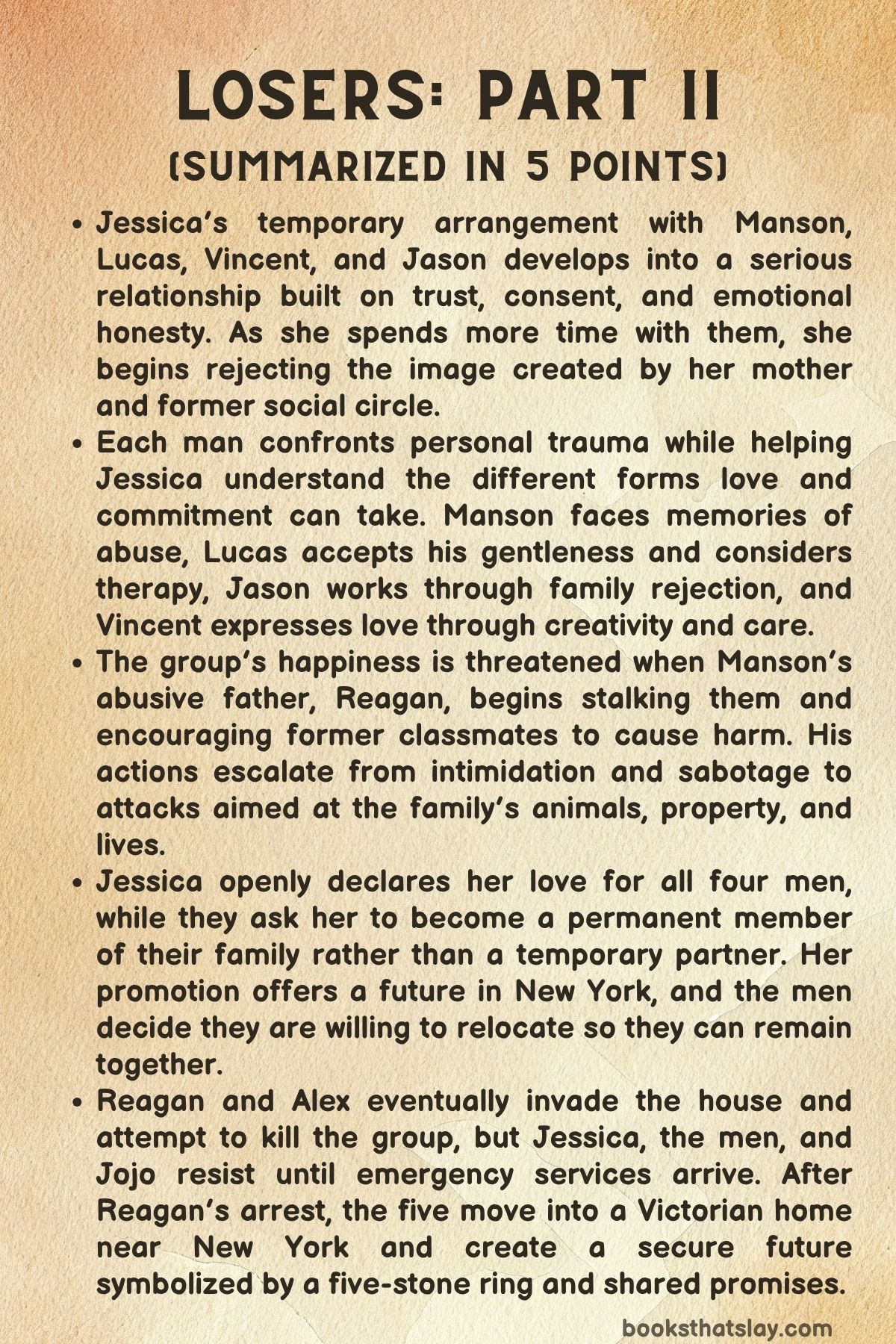
Jessica’s bond with Manson, Lucas, Vincent, and Jason develops beyond its unusual beginning into a committed partnership shaped by consent, communication, and emotional honesty. As Jessica rejects the identity others designed for her, each man faces painful memories that continue to influence his behavior. Their growing love gives them a reason to imagine a future outside Wickeston, but Manson’s abusive father and several hostile former classmates place that future in serious danger.
Summary
During his senior year, Manson lives under the shadow of his abusive father, Reagan, whose return after a long absence restores the fear that has controlled much of his childhood. Manson refuses opportunities that would separate him from Lucas, Vincent, and Jason because the four boys have already become the only family he trusts.
At school, Manson and his friends are treated as dangerous outsiders by students and administrators. After Kyle and Alex attack him, Manson hides in the girls’ restroom, where he unexpectedly finds Jessica crying over Kyle’s betrayal.
Years of hostility briefly give way to honesty as Manson recognizes that Jessica is as unhappy beneath her polished image as he is beneath his controlled exterior. Jessica suddenly asks him to kiss her, creating a secret connection that neither of them is prepared to understand.
In the present, Jessica has become involved with Manson, Lucas, Vincent, and Jason after damaging her car and agreeing to repay them through a negotiated arrangement. The five travel to a mountain cabin for a weekend designed to explore Jessica’s fantasies and determine whether their relationship can become something more permanent.
The men carefully enact a consensual abduction scenario in which Jessica temporarily gives up control. Although the experience is intentionally intense, established boundaries and constant attention to her reactions allow her to surrender without fearing that her trust will be violated.
Jessica realizes that submission gives her relief from the pressure to behave perfectly. She has spent years obeying her mother’s expectations and maintaining a socially acceptable identity, but the difference between forced obedience and chosen surrender becomes increasingly clear to her.
After the opening roleplay, the men care for Jessica, prepare food, and help her recover. Their tenderness shows that their intimate practices are inseparable from responsibility, communication, and affection.
Jason speaks with Jessica privately and tells her that the completion of her car repairs will not end his desire to keep her in his life. Jessica apologizes for the cruel remarks she made about his sexuality and appearance in high school, and Jason admits that her behavior contributed to his insecurity.
He also remembers seeing how harshly Jessica’s mother treated her. Although this context does not erase the harm Jessica caused, it helps Jason understand how she learned to direct judgment toward others before beginning to direct it against herself.
The weekend includes mountain drives, swimming, films, shared meals, and private conversations. Jessica discovers that she enjoys ordinary companionship with the men as much as the adventurous experiences that first brought them together.
Her connection with each man develops differently. Manson offers structure and commanding certainty, Lucas combines aggression with hidden tenderness, Vincent brings humor and creative openness, and Jason understands how dominance and submission can exist within the same person.
Jessica also witnesses the bonds among the four men. Vincent’s love for Jason is strengthened rather than threatened when Jessica shows Jason affection, while Manson’s authority over Lucas and Jason is based on years of trust rather than simple control.
Manson remains troubled by Reagan’s reappearance. He believes he must protect the entire group from his father, hostile neighbors, and former classmates, but Vincent reminds him that leadership does not require him to hide every sign of fear.
Vincent later helps Manson surrender control through carefully negotiated restraint. Jessica supports him through the experience, seeing that his willingness to become physically vulnerable is a greater expression of trust than any command he gives.
Jason and Lucas also discuss the suffering that shaped them. Jason remembers being rejected by his religious family because of his sexuality, while Lucas explains that he never doubted Jason’s strength but wished he had not been forced to become strong through pain.
A flashback shows Lucas helping Jason shave and dye his hair during their teenage years. The transformation allows Jason to reject the obedient identity his family imposed upon him and begin presenting himself according to his own desires.
Jessica later visits Vincent’s family home and expects to be judged for loving four men. Instead, Vera and Stephan welcome her without demanding that she defend or define the relationship.
Watching the men interact comfortably with the Volkov family shows Jessica what acceptance looks like. Stephan’s reference to new love forces her to admit that her feelings have already moved beyond attraction and experimentation.
The return to Wickeston brings renewed pressure. Reagan begins appearing near the men’s house, leaving cigarettes and watching the property to prove that he can reach them whenever he chooses.
Jessica’s mother, Charlene, attempts to arrange a date between Jessica and Greg Fall. Jessica objects, but she eventually attends while secretly turning the evening into an experience controlled by herself and Manson rather than by her mother.
Greg talks over Jessica and treats her like an accessory. After enduring enough of the dinner, Jessica directly condemns his behavior and refuses to continue participating in an arrangement made without her consent.
Manson later surprises her with roses, wine, and cake. He confesses that repairing her engine was never truly about collecting a debt and admits that he has loved her for years.
He does not demand an immediate answer because he wants her response to be freely chosen. Jessica spends the night with him, gradually accepting that she does not want the relationship to end when her BMW is repaired.
Danger escalates when Lucas follows Jessica and Julia at a shopping center after learning that Reagan may be encouraging others to target the group. Two women place stolen perfume in Lucas’s bag, knowing that security personnel will be more likely to suspect him.
Lucas panics when guards grab him, and an armed officer interprets his fear as aggression. Jessica persuades him to comply, promises not to leave him, and then uses the confidence she once used to intimidate others to demand that the security footage be reviewed.
The recording proves Lucas was framed. Afterward, Lucas admits that the high-school fight leading to his expulsion began because Alex was boasting about private photographs of Jessica.
Another memory reveals that Lucas also protected Jessica from Mr. Kotham, a predatory teacher. Without telling her, he frightened the teacher into resigning after seeing how uncomfortable Jessica was around him.
The threats surrounding the family become more organized. Dante warns Manson and the others that someone may be planning to kill Manson and Lucas rather than merely damage their cars or disrupt their work.
At an illegal automotive sideshow, Nate challenges Manson to race and insults Jessica. Manson realizes that Nate and several other men are positioning themselves for an attack, but police suddenly raid the gathering.
During the escape, pursuing vehicles strike or chase the group’s cars. Lucas deliberately draws the most aggressive pursuer away from Manson and Jessica, leaving them terrified until he returns home alive in his damaged vehicle.
The incident makes separation increasingly difficult. Jessica begins spending more time at the men’s house, where Lucas teaches her basic vehicle maintenance and includes her in a part of his life that he takes seriously.
Manson eventually enters the locked room where much of his childhood abuse occurred. Jessica and the others help him sort through the belongings, preserve the few meaningful memories, and remove objects connected to his father’s violence.
Inside that room, Jessica tells Manson she loves him. Her declaration changes the meaning of the space because it is no longer only evidence of what Reagan did to him but also proof that Manson survived and created a loving family.
Reagan soon appears outside Jessica’s parents’ house, frightening her until Manson and Jason arrive. The incident confirms that Reagan is willing to target Jessica because of her importance to his son.
Vincent takes Jessica to an abandoned mansion where he once painted elaborate murals. One of the paintings depicts a blonde princess, revealing that Jessica remained in his imagination even when they appeared to hate each other.
Vincent tells her that he loves her, and Jessica returns his feelings. He reassures her that her relationships with the four men do not need to develop identically because honesty matters more than forcing every bond into the same pattern.
Jessica’s happiness leads to another confrontation with Charlene, who demands a drug test and insults the men without knowing them. Jessica refuses, announces her intention to pay rent and move out, and warns that constant control will destroy their relationship.
Jason later takes Jessica to the house where his parents still live. He explains how their rejection convinced him that love could disappear whenever he failed to meet expectations.
Jessica tells Jason that she loves him, breaking through the emotional boundaries he has maintained for protection. Jason responds that he loves her with an intensity that frightens him because she has become part of the family that saved him.
Lucas’s confession follows after he and Jessica rescue an abandoned kitten. He explains that his father once forced him to abandon a stray animal and taught him that compassion was evidence of weakness.
Jessica insists that gentleness is one of Lucas’s greatest strengths. Lucas tells her he loves her and later decides to begin therapy because he no longer wants merely to survive his trauma when he has a future worth protecting.
The family’s danger becomes undeniable when poisoned meat is found around the property, apparently intended for the dogs. Security footage shows Reagan planting it, prompting Manson to begin creating a legal record even though he doubts the authorities will stop his father.
When Jessica’s repaired BMW is finally completed, the men remove any remaining connection between the car and her place in their lives. They collectively ask her to become part of their family, and she accepts.
Jessica receives the promotion that may take her to New York, while the men reveal that they are willing to move with her. Their future is no longer organized around a debt but around a shared commitment.
They celebrate at Club Tris, where the men once learned about consent, technique, and community. Jessica sees that their confidence developed through education and experience rather than instinct.
The club allows Jessica and Lucas to be publicly visible in their chosen submissive roles without facing the condemnation common in Wickeston. Jessica feels accepted rather than shamed, while Lucas begins challenging his expectation that attention will always become hostility.
The threat outside their relationship continues. During a hike with Julia, Jessica is confronted by Alex and Nate, who blame Manson and Lucas for the sideshow chase and threaten to use her as revenge.
Jessica fights back but injures her ankle. Julia takes her to the men’s house, where the four react with fear and fury when they learn that she has been grabbed and threatened.
Manson, Lucas, and Jason confront Alex and Nate at Billy’s Bar. They beat both men, and Manson cuts a permanent warning into Alex’s back, crossing the boundary between controlled consensual violence and actual vengeance.
Alex refuses to accept responsibility and continues blaming Jessica. Reagan then reveals that he paid Alex and Nate to pursue Manson and Lucas during the sideshow, hoping the chase would result in their deaths.
That night, Alex enters the property and grabs Jessica while Reagan spreads gasoline through the house. Reagan plans to burn everyone alive and disguise the murders as an accidental fire.
Jojo attacks Alex, allowing Jessica to escape, but Reagan catches and strangles her. The men awaken and intervene, with Vincent caring for Jessica while Manson nearly kills his father.
Emergency services arrive before the house can be ignited. Reagan and Alex are arrested, Jessica receives treatment, and security footage provides evidence of the planned attack.
Jessica’s father thanks all four men for saving her and accepts their declaration that they love her. Even Charlene’s hostility briefly gives way to gratitude when she understands how close her daughter came to dying.
Two months later, the family prepares to leave Wickeston. Reagan faces prosecution, Nate cooperates with investigators, and Alex attempts to obtain a plea agreement.
Near New York, the five tour a restored Victorian house that seems capable of holding their shared future. The men later reveal that they have purchased it and present Jessica with a key, a five-stone ring, and a written promise of devotion.
Because conventional marriage cannot include all five partners, the ring becomes their own symbol of permanence. Jessica accepts, and the family begins a life defined not by Wickeston’s judgment but by the commitments they have chosen.
One year later, they are living together in their New York home. Lucas continues therapy, Cherry has grown into a healthy cat, and the family can discuss careers, reconciliation, and possible parenthood without believing that happiness will be taken from them.
The men give Jessica a locking collar that represents their shared responsibility for her safety and emotional well-being. Surrounded by the people she loves, Jessica understands that she has not simply escaped her former life; she has actively created a home where every part of her can be accepted.
Characters
Jessica Martin
Jessica is the emotional center of Losers: Part II, and her transformation depends on recognizing the difference between an identity chosen freely and one constructed to satisfy other people. At the beginning, she is still influenced by the social image she maintained in high school, her mother’s standards, and the fear that unconventional desires will make her unworthy of respect.
Her involvement with the four men gives her a space in which she can examine her desires without automatically condemning them. Submission becomes meaningful because it is chosen, negotiated, and supported by people who consider her safety more important than their own satisfaction.
Jessica is not limited to a submissive role. She discovers that she also enjoys confidence, authority, and the ability to challenge Lucas, Jason, and the others, showing that her growth involves accepting a flexible identity rather than replacing one restrictive label with another.
Her apologies to Jason and Lucas demonstrate increasing moral awareness. She does not excuse her high-school cruelty by pointing to her mother’s influence but accepts that insecurity and social pressure caused her to hurt people who were already vulnerable.
Jessica’s conflict with Charlene is essential to her independence. She gradually stops confusing parental approval with love and begins setting boundaries even when doing so produces guilt.
Her courage becomes physical as well as emotional when she confronts Greg, defends Lucas at the mall, fights Alex, and resists Reagan. By the conclusion, she has learned that being protected does not require passivity and that relying on others can coexist with personal strength.
Manson Reed
Manson functions as the central organizer of the family, but Losers: Part II repeatedly exposes the emotional cost of his apparent control. His commanding presence has developed partly from genuine ability and partly from a childhood in which vigilance was necessary for survival.
He sees protection as his responsibility and often believes that admitting fear would endanger everyone who depends on him. Reagan’s return activates the frightened child beneath his authority, causing Manson to monitor cameras, anticipate attacks, and treat exhaustion as a weakness he cannot afford.
His relationship with consensual dominance allows him to transform power from something abusive into something structured and responsible. Unlike Reagan, Manson pays close attention to boundaries, responds immediately to distress, and treats authority as an obligation to care.
The scenes in which Vincent restrains him reveal how difficult trust remains for Manson. Allowing himself to become helpless requires greater bravery than commanding others because it asks him to believe that vulnerability will not automatically lead to pain.
Clearing his childhood bedroom marks a decisive stage in his recovery. With Jessica and the others beside him, he gains control over the physical space that once represented his imprisonment and decides what deserves preservation.
Manson’s attack on Alex complicates his moral position. His violence grows from a desire to protect Jessica, yet the severity of the punishment shows how easily protective rage can resemble the cruelty he fears inheriting from Reagan.
Lucas Bent
Lucas is defined by the contrast between his threatening appearance and his instinctive compassion. He responds to danger with aggression because his father taught him that the world respects force, yet his treatment of animals and vulnerable people reveals a deeply protective nature.
His history of poverty, parental neglect, and abuse has convinced him that tenderness is dangerous. Feeding stray cats, protecting Jason, and defending Jessica are therefore acts of resistance against the model of masculinity his father tried to impose upon him.
Lucas’s earlier protection of Jessica complicates their high-school hostility. He attacked Alex over the private photographs and secretly drove Mr. Kotham away because he recognized threats that Jessica’s social circle and mother ignored.
His panic during the mall incident demonstrates the effect of being repeatedly judged as violent before he acts. The authorities interpret his fear as aggression, leaving him trapped between submission that feels humiliating and resistance that could lead to imprisonment or death.
Jessica earns his trust by remaining beside him and using her confidence to defend rather than ridicule him. Her acceptance helps him understand that vulnerability may invite comfort instead of punishment.
His decision to begin therapy is one of his greatest developments. Lucas chooses healing not because his pain has become unbearable, but because love has given him a future he does not want trauma to destroy.
Vincent Volkov
Vincent brings playfulness, artistic imagination, and emotional flexibility to the household. His relaxed manner can make him appear less serious than the others, but he is consistently attentive to long-term stability and the emotional needs of the people he loves.
His primary relationship with Jason demonstrates his generous understanding of affection. Vincent does not believe that Jessica’s love for Jason reduces what he shares with him, and he often takes pleasure in watching others recognize Jason’s beauty and vulnerability.
As a dominant partner, Vincent relies on care rather than intimidation. His work with Manson shows that he understands restraint as a therapeutic structure capable of quieting fear when it is practiced responsibly.
The abandoned mansion and its murals reveal the depth hidden behind his humor. Art allowed Vincent to preserve wonder during years of poverty, judgment, and uncertainty, and the painted princess shows that Jessica remained important to him long before their adult relationship began.
Vincent is also capable of anger when the family is threatened. Dante’s warning and the later attack on Jessica force him to acknowledge that kindness alone cannot prevent determined enemies from causing harm.
His emotional strength appears most clearly in the final crisis, when he must focus on keeping Jessica alive while Manson confronts Reagan. Vincent becomes the calm caretaker whose knowledge and presence prevent panic from controlling everyone else.
Jason
Jason is thoughtful, emotionally perceptive, and deeply affected by the conditional love of his religious family. Their rejection taught him that affection could disappear when he stopped performing the identity others required.
The four men helped him rebuild his life, but fear of abandonment remains active beneath his confidence. Jessica’s earlier cruelty therefore carries particular weight because she once represented the judgmental world from which he believed acceptance would never come.
Jason’s ability to forgive Jessica does not involve denying the damage she caused. He listens to her apology, acknowledges his pain, and gradually accepts that she has changed through choices rather than promises.
His identity as both dominant and submissive reflects his refusal to be confined by rigid expectations. He finds confidence in directing Jessica but also experiences relief when Manson, Lucas, or Vincent allows him to surrender control.
Jason often acts as an emotional interpreter within the group. He recognizes Manson’s distress, understands Lucas’s hidden gentleness, and tries to make the others communicate before fear turns into reckless action.
His declaration of love to Jessica carries the force of someone risking belief in permanence again. By allowing her into the family, he proves that past rejection has not destroyed his ability to trust.
Reagan
Reagan represents coercive power without responsibility, empathy, or consent. He uses fear to maintain influence over Manson and treats his son’s independence as an insult that must be punished.
His methods are psychological before they become openly violent. Leaving cigarettes, appearing on security footage, approaching Jessica’s home, and poisoning meat are designed to convince the family that no boundary can keep him out.
Reagan recruits Alex and Nate because he prefers manipulating others into carrying out his violence. He recognizes their resentment and entitlement, then uses those weaknesses to direct them against Manson and Lucas.
His attempt to burn the house reveals the final form of his obsession. He would rather destroy his son and everyone Manson loves than accept that they have created a life outside his control.
Reagan also serves as Manson’s darkest possible reflection. Both men are capable of intimidation and violence, but Manson struggles to connect power with care while Reagan uses it solely to dominate and erase resistance.
Alex
Alex is driven by entitlement, wounded pride, and misogyny. He believes Jessica’s past relationship with his social circle gives him the right to judge her choices and punish her for loving men he considers inferior.
Even after being defeated, Alex avoids responsibility by claiming that Jessica provoked the conflict. His refusal to examine his behavior makes him vulnerable to Reagan’s manipulation because revenge allows him to protect his ego.
His participation in the sideshow attack and the invasion of the house demonstrates escalating moral failure. What begins as prejudice and resentment develops into involvement in attempted murder.
Alex contrasts with the central characters because he refuses growth. While Jessica, Lucas, Jason, and Manson confront the harm they have caused or inherited, Alex uses every humiliation as justification for causing further harm.
Nate
Nate is a wealthy former classmate whose resentment toward Manson and Lucas is strengthened by class prejudice. He expects his social position and expensive vehicle to grant him authority within the racing community.
His challenge at the sideshow is not a fair competition but part of an organized attempt to isolate and endanger the men. Nate’s confidence quickly weakens when the situation no longer favors him.
Unlike Alex, Nate eventually cooperates with investigators and admits that Reagan paid them. This does not remove his responsibility, but it shows that his loyalty to revenge collapses when consequences become unavoidable.
Charlene Martin
Charlene believes control is a form of care. She pressures Jessica to maintain a respectable image, attempts to choose an acceptable partner for her, and treats adult independence as rebellion.
Her criticism helps explain how Jessica learned to judge herself and others. Charlene’s standards taught her daughter that affection must be earned through appearance, obedience, and social success.
Jessica’s resistance forces Charlene to face the possibility that continued control will cost her their relationship. Although she does not transform immediately, Reagan’s attack makes her recognize that the men she condemned were willing to risk their lives for Jessica.
Her later protectiveness and partial acceptance suggest imperfect change. Charlene remains difficult, but she begins adjusting when reality proves that Jessica’s unconventional family provides genuine love and safety.
Mr. Martin
Jessica’s father is quieter and less controlling than Charlene, though his passivity allows much of the pressure within the household to continue. He becomes more significant after Reagan’s attack.
When he thanks all four men and accepts their love for Jessica, he places her safety and happiness above social appearances. His reaction gives Jessica a form of parental acceptance she has rarely experienced.
Julia
Julia is one of Jessica’s most dependable connections outside the central relationship. She listens without condemning Jessica’s changing life and remains present when conflict becomes dangerous.
During the confrontation with Alex and Nate, Julia helps Jessica escape and insists that her injuries require attention. Her practical loyalty supports Jessica without attempting to control her decisions.
Julia’s later care for the Wickeston stray cats also connects her to the family after they move. She becomes evidence that Jessica’s new life does not require abandoning every part of her old one.
Vera and Stephan Volkov
Vera and Stephan represent the accepting parental figures the four men and Jessica need. Their home provides warmth without demanding conformity, allowing each person to belong without defending every aspect of the relationship.
Vera’s immediate kindness helps Jessica understand that questions do not always hide judgment. Stephan’s recognition of new love encourages her to name feelings she has been avoiding.
Stephan also protects the family by warning Manson about Reagan’s activity. His support combines emotional acceptance with practical awareness of danger.
Dante
Dante is a trusted member of the automotive community and a source of information about the threats surrounding the family. His warning confirms that Reagan’s campaign has moved beyond gossip and property damage.
At the sideshow, Dante restrains Lucas before a public fight can make the group more vulnerable. His actions show that loyalty sometimes requires preventing a friend from reacting impulsively.
Kathy Peters
Kathy Peters appears through Manson’s memories as a social worker who attempts to provide housing and employment assistance. Her efforts demonstrate that some adults recognized the danger surrounding Manson even when institutions repeatedly failed to protect him fully.
Manson’s refusal to leave his friends also reveals the limits of solutions focused only on individual rescue. Safety without Lucas, Jason, and Vincent would not have felt like freedom to him.
Kyle
Kyle represents Jessica’s former social world and the shallow relationships she once accepted as normal. His infidelity contributes to the emotional crisis that leads Jessica and Manson to acknowledge their attraction.
His participation in bullying Manson also exposes the cruelty beneath the respectable image valued by Jessica’s peers. Kyle’s behavior helps Jessica recognize that social approval does not indicate moral worth.
Mr. Kotham
Mr. Kotham is a teacher who exploits his authority and behaves inappropriately toward female students. Charlene ignores Jessica’s discomfort because academic success matters more to her than listening to her daughter.
Lucas recognizes the threat and forces Kotham to resign. The incident shows how official authority can protect harmful people while those labeled dangerous may be the ones willing to intervene.
Greg Fall
Greg is the socially approved partner Charlene selects for Jessica. He talks over her, criticizes her choices, and treats the date as an opportunity to evaluate whether she meets his standards.
Jessica’s rejection of Greg is therefore more than the end of an unpleasant evening. It is a direct refusal to let her mother or conventional expectations decide who deserves access to her life.
Jojo and Cherry
Jojo is both a beloved animal and an active protector of the household. Her attack on Alex allows Jessica to escape during Reagan’s final assault, turning the family’s care for their animals into a force that helps save them.
Cherry symbolizes Lucas’s growing acceptance of gentleness. By rescuing and openly loving the kitten, he rejects his father’s belief that compassion makes a person weak.
Themes
Chosen Family and Belonging
Family in Losers: Part II is created through repeated acts of loyalty rather than biology, law, or social approval. Manson, Lucas, Vincent, and Jason first form a household because their original families fail to provide safety, acceptance, or stability.
Their bond is not presented as effortless. Each man carries habits produced by abandonment, poverty, rejection, or abuse, and those wounds frequently shape the way he reacts to danger.
Jessica gradually enters this structure by participating in both extraordinary and ordinary parts of their lives. Shared meals, vehicle repairs, morning conversations, family visits, and nights spent sleeping together matter as much as declarations of love.
The Volkov household provides an earlier model of chosen belonging. Vera and Stephan welcome vulnerable young people without insisting that they become conventional before receiving care.
The move to New York transforms this emotional family into a permanent domestic one. The Victorian house, five-stone ring, shared collar, and discussion of future children create symbols suited to a relationship that cannot be represented by traditional marriage.
Belonging ultimately means being known without being reduced to a single role. Jessica can be confident and submissive, Jason dominant and vulnerable, Lucas aggressive and gentle, Vincent playful and responsible, and Manson commanding and frightened without losing their places in the family.
Consent, Trust, and the Meaning of Power
Power takes sharply different forms throughout the story. Within the central relationship, authority is negotiated, limited, and supported by responsibility, while Reagan, Alex, Greg, and Charlene attempt to control others without respecting their choices.
Jessica’s submission is meaningful because she can withdraw it. The emotional freedom she experiences comes from knowing that every apparent loss of control exists inside boundaries she helped create.
Manson’s dominance is repeatedly measured by his willingness to stop, check, listen, and provide care. His authority is legitimate only while the people trusting him remain safe and able to communicate.
The changing roles among the five also prevent power from becoming permanently attached to one person. Jason can command Jessica and later surrender, Lucas can appear physically intimidating while obeying Manson, and Vincent can guide Manson through vulnerability.
Outside those negotiated relationships, control becomes harmful. Charlene arranges Jessica’s date without permission, Greg evaluates her as though she were an object, Alex believes he can punish her choices, and Reagan treats fear as proof of ownership.
The contrast demonstrates that an act cannot be understood only by its outward appearance. Restraint may become care when freely chosen, while respectable social behavior may hide coercion when one person’s autonomy is ignored.
Trauma, Vulnerability, and Healing
Trauma affects the characters through habits of vigilance, aggression, self-hatred, and fear of abandonment. Healing begins when those reactions are recognized as survival strategies rather than fixed personality defects.
Manson’s need for control developed in a home where helplessness was dangerous. His willingness to be restrained by Vincent shows progress because he is practicing vulnerability in a setting where his fear is respected.
Lucas treats anger as armor because tenderness was punished throughout his childhood. Rescuing Cherry and entering therapy allow him to reclaim compassion as a strength rather than evidence of weakness.
Jason’s wounds appear through his fear that love will vanish when he expresses his full identity. Being accepted in dominant, submissive, masculine, gentle, serious, and playful roles challenges the conditional affection taught by his family.
Jessica’s trauma is less visibly violent but still influential. Years of criticism taught her to perform perfection, distrust her desires, and measure herself through other people’s approval.
Healing does not erase fear or remove the need for professional help. The characters continue experiencing panic, insecurity, and anger, but they become increasingly willing to speak about those feelings and allow others to respond.
The story presents recovery as relational without suggesting that romance alone cures trauma. Love creates motivation and safety, while therapy, boundaries, honest apologies, and deliberate practice provide the tools needed for lasting change.
Autonomy, Protection, and the Moral Limits of Violence
Jessica’s struggle for autonomy is connected to the group’s struggle for safety. She must resist a mother who controls through social expectations, men who treat her as property, and attackers who believe harming her will punish the people she loves.
Protection is valuable when it supports her ability to choose. Lucas following her at the mall initially risks becoming controlling, but he explains the danger, respects her anger, and ultimately accepts her authority when she orders him to stop driving recklessly.
The men’s protectiveness becomes morally uncertain after Alex and Nate attack Jessica. Their decision to confront the two men arises from repeated institutional failure, yet the punishment they inflict is intentionally brutal.
Manson’s attack on Alex is especially significant because it threatens the distinction he maintains between himself and Reagan. His motives are protective rather than possessive, but love does not automatically make every violent action just.
Reagan represents the endpoint of violence separated from empathy and restraint. He harms animals, recruits resentful men, terrorizes Jessica, and attempts to murder his son because he interprets independence as betrayal.
The final legal consequences matter because the family cannot create genuine freedom w
hile remaining trapped in endless retaliation. Leaving Wickeston allows them to move from constant defense toward building a life in which protection means preserving one another’s choices, safety, dignity, and future.