New Skin Summary, Characters and Themes
New Skin by Sarah Wang is a darkly comic literary novel about beauty, immigration, family obligation and the stories people invent to survive.
At its center is Linli Feng, a young woman who returns to Los Angeles after years of estrangement to care for her mother, Fanny, whose repeated cosmetic procedures have left her physically damaged and legally vulnerable. Their reunion forces both women to confront old accusations, financial hardship, cultural displacement and a bond built from equal parts devotion and resentment. Through medical crises, reality television and an illegal beauty network, the novel examines whether inherited patterns of harm can ever truly be broken.
Summary
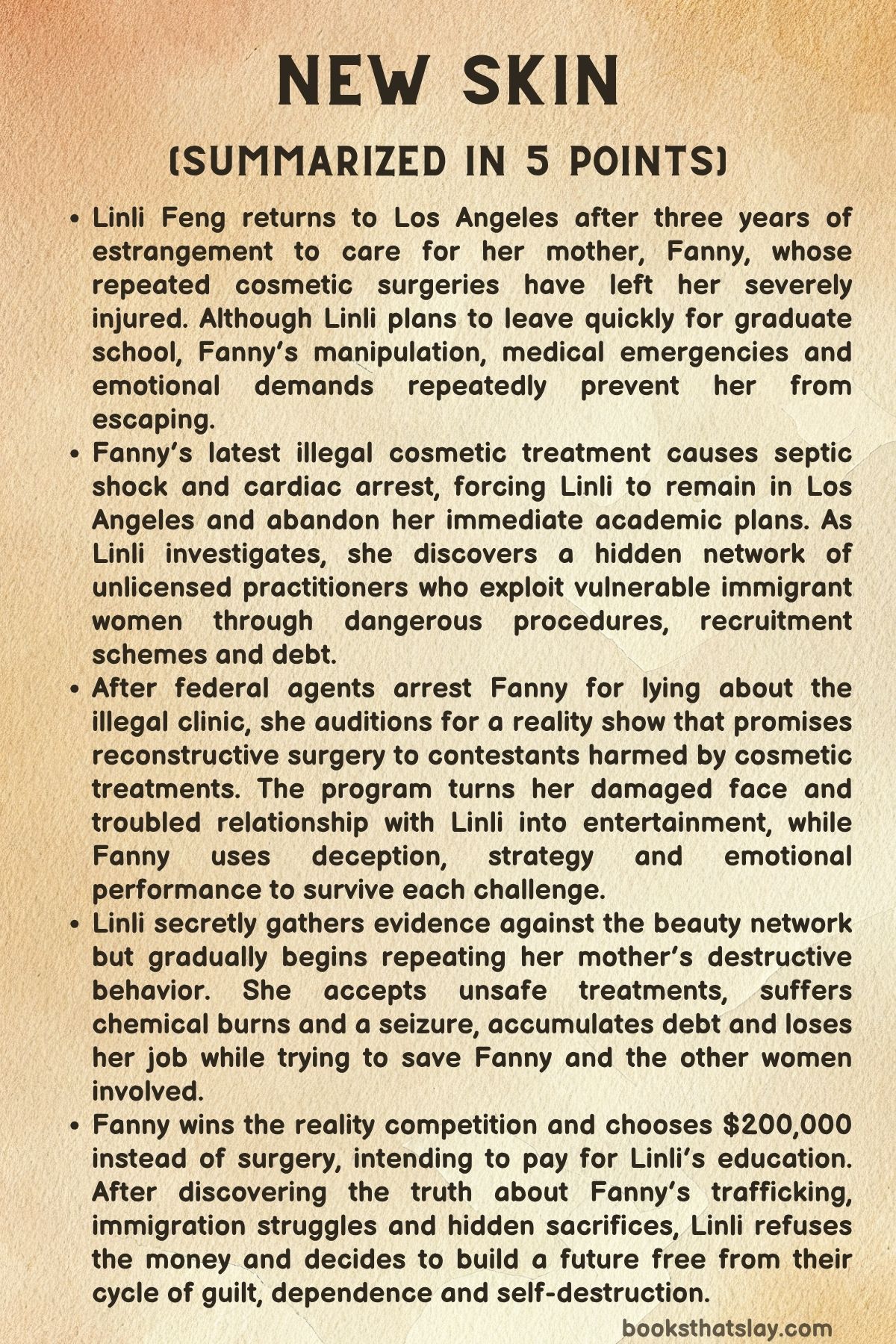
After three years without contact, Linli Feng returns to Los Angeles to care for her mother, Fanny, following another rhinoplasty. When the doctor removes Fanny’s bandages, her nose is swollen, scarred and partly covered in dead tissue, forcing her to undergo leech therapy in an attempt to restore circulation.
Linli intends to stay only a few days before returning to Washington and eventually beginning graduate school in New York. Fanny responds by accusing her daughter of abandonment, claiming that she is dying and reminding Linli that childbirth nearly killed her.
Their arguments reveal a long history of emotional manipulation. Fanny has spent years presenting motherhood as a sacrifice for which Linli can never fully repay her, while Linli believes leaving was the only way to escape a damaging home.
Even while recognizing Fanny’s theatrical behavior, Linli continues cooking, cleaning and monitoring her medication. Memories of being forced to wear eyelid tape as a child show that Fanny’s fixation on appearance was imposed on Linli long before the latest medical disaster.
Fanny’s first major facial surgery took place on Linli’s eighth birthday. The change frightened Linli so deeply that she stopped speaking, struggled at school and became a target for classmates who mocked her mother’s appearance.
Since then, Fanny’s original face has survived only in old photographs and Linli’s uncertain memories. Every procedure has created another version of her, leaving Linli unable to separate the mother she once knew from the person who now stands before her.
While sorting through the house, Linli discovers unpaid bills, credit-card debt and warnings about possible eviction. Fanny cannot afford ordinary expenses, yet she continues finding discounted or illegal cosmetic treatments.
On the night before Linli’s departure, Fanny offers her pills described as magnesium and zinc. They are actually strong sedatives, and Linli awakens the next afternoon to discover that she has missed her flight.
Realizing that her mother drugged her, Linli packs and demands to be taken to the airport. During the drive, Fanny admits that she hired a private investigator after Linli disappeared, although she knew where her daughter was and never attempted a direct reconciliation.
Their argument turns toward Fanny’s past as an undocumented immigrant who endured racism, poverty and exploitation. Linli remembers being told that she was kept only because Fanny needed welfare payments, while Fanny denies making the statement.
When Linli declares that she must escape permanently, Fanny opens the car door and jumps onto the freeway. She survives with a broken femur, but the act causes a traffic accident and once again traps Linli in the role of protector.
Linli tells the police that medication confused her mother rather than admitting what happened. Back at home, the women rely on painkillers, television and bitter silence while Linli misses important commitments to the incarcerated women she has been teaching.
Although Linli secretly books another flight, she claims she will remain in Los Angeles. She begins investigating the procedures Fanny received during their estrangement and suspects that the latest surgery is only part of a larger danger.
Her former coworker Beatriz confirms that the investigator hired by Fanny found Linli in Washington. Beatriz compares Linli’s departure to escaping an abusive relationship and reminds her that physical distance does not immediately remove fear, obligation or guilt.
Soon afterward, Fanny returns from visiting her friend Xiaoqing with her face hidden behind a visor. By the following morning, it is severely swollen, and Fanny screams after seeing herself in a mirror.
At the hospital, doctors suspect that she received construction-grade silicone, counterfeit Botox or another poisonous substance from an illegal practitioner. Her airway begins closing, and she suffers cardiac arrest.
Believing her mother may die, Linli promises that she will abandon graduate school and remain in Los Angeles if Fanny survives. Fanny is revived and treated for septic shock, leaving Linli bound by a promise made during panic and grief.
Six weeks later, Linli has placed her Washington belongings in storage and deferred graduate school. She accepts an office-assistant position at Another Horizon, a community organization supporting people affected by incarceration, poverty, violence and institutional neglect.
The organization is directed by DB Kennedy, who recognizes Linli’s intelligence and experience. Although her position is junior, the work gives her a connection to the restorative-justice projects she left behind.
Linli’s research into illegal cosmetic clinics reveals cases involving blindness, amputation, infection and death. Fanny admits that she attended private beauty parties where unlicensed practitioners offered procedures and rewarded clients for recruiting others.
She still refuses to identify the people involved. Instead, she defends alteration as a kind of freedom, arguing that everything is copied or reshaped and that no completely pure original exists.
For Fanny’s birthday, Linli accompanies her to Xiaoqing’s beauty store and later to karaoke. Xiaoqing criticizes Linli’s monolids, clothing, career and unmarried status before pressuring her into an expensive makeover.
At karaoke, Fanny sings a traditional song about a woman trapped by poverty, marriage and exploitation. She describes immigration, aging and motherhood as forms of slavery, while Linli accuses her of enslaving herself to her face.
Fanny later overdoses on painkillers and speaks vaguely about family abuse before federal agents arrive. They arrest her under her original name, Fan-Ju Feng, for lying during an investigation into the illegal clinic.
Fanny is released on bail, but her public defender, Salvatore, warns that she must cooperate. Surveillance footage places her at the clinic, contradicting her claim that she knows nothing about the people operating it.
Linli’s problems increase when she receives an enormous tuition bill from the graduate program she never attended. She also discovers that Fanny has auditioned for America’s Beauty Extreme, a reality competition offering reconstructive surgery to people harmed by cosmetic procedures.
During the audition, Fanny presents Linli as a doctor and tells producers increasingly dramatic stories about immigration, pregnancy and attempted abortion. Linli cannot determine whether these stories are true, exaggerated or invented for television.
The producers reward Fanny’s performance and secretly identify her as a likely winner. When one of them touches Fanny’s damaged face as though examining an object, Linli immediately defends her despite their private hostility.
Once filming begins, Linli experiences a strange mixture of freedom and loneliness. At Another Horizon, DB teaches her that restorative justice does not always produce immediate agreement and that allowing people to speak honestly can itself be valuable.
On television, Fanny apologizes to Linli and claims that she wants to become a mother her daughter can respect. Linli is moved but remains unsure whether the apology is genuine or designed for the cameras.
The contestants soon turn against Fanny, accusing her of using Linli for sympathy. Racial hostility also shapes the conflict, and Fanny is presented as both a victim and a villain.
Xiaoqing eventually tells Linli that Fanny’s cosmetic obsession worsened after her daughter left. Lonely and desperate for belonging, Fanny became attached to people who offered attention, discounted procedures and rewards for recruiting new clients.
Linli begins wondering whether her escape contributed to her mother’s decline. Her guilt intensifies when a contestant named Hadley dies from a known heart condition shortly after Fanny angrily tells her to drop dead.
Meanwhile, Linli learns that Angel Chang, another victim of illegal injections, is critically ill. Because Angel’s name appears in Fanny’s records, Linli fears that prosecutors may connect her mother to the treatment and pursue more serious charges.
To investigate the network, Linli befriends Ami, a young immigrant who distributes beauty advertisements. Ami brings her to an unmarked salon where Linli agrees to a supposedly mild laser treatment that is actually a dangerous skin-lightening procedure.
Her face burns, peels and bleeds. Rather than obtaining proper treatment, she goes to work, consumes large amounts of caffeine and suffers a seizure while supervising a children’s activity.
Hospitalization forces Linli to recognize that she is beginning to repeat Fanny’s behavior. She has allowed beauty treatments, secrecy and desperation to damage her own body while insisting that she is only trying to save someone else.
On the reality show, violence and humiliation become increasingly severe. Fanny survives by manipulating the rules, stealing a rival’s diary and tricking contestants into repeating a required phrase without understanding its meaning.
Linli begins gathering evidence that might help prosecutors target the network instead of Fanny. She learns that Mama Lu, an illegal practitioner, arranged surgeries for Ami that destroyed part of her nose.
Ami now wears a prosthetic tip over exposed cartilage. Mama Lu has also purchased her smuggling debt, forcing Ami to recruit other immigrant women into a system of cosmetic procedures, complications and growing financial dependence.
Fanny secretly calls Linli from inside the reality-show house and reveals that producers deprive contestants of sleep and food, supply alcohol and manufacture conflicts. She wants to leave, but Linli urges her to remain and defeat the program by understanding its weaknesses.
At a party, Linli uses DMT and experiences a vision of moving backward through every version of Fanny’s surgically altered face. She imagines reaching the face her mother possessed when Linli was an infant and feels the boundary between their identities momentarily disappear.
Linli continues attending illegal beauty gatherings in disguise, recording names, addresses and activities. She also sees how the network creates a false community for immigrant women who are lonely, economically vulnerable and eager for recognition.
During the live reality-show finale, Fanny praises the contestants who attack her and transforms their humiliating secrets into statements about courage. Her unexpected generosity wins public support.
While searching through old papers, Linli discovers proof that Fanny really was homeless and pregnant in Berkeley. Other records reveal that Fanny was trafficked into bonded restaurant labor and stabbed a criminal leader in self-defense.
Her legal status came not simply from giving birth to an American citizen but from cooperating with prosecutors as a victim of crime. Linli realizes that many stories she dismissed as lies contained truths that her mother could not explain directly.
Fanny wins America’s Beauty Extreme and is offered either reconstructive surgery or $200,000. She chooses the money and announces that she will use it to send Linli to graduate school.
Still trying to create good fortune for Fanny’s criminal case, Linli allows Mama Lu to inject filler into her earlobes. The procedure leaves them grotesquely swollen, another sign that Linli has entered the same cycle she condemns.
She collects photographs and information linking Mama Lu, Xiaoqing and the beauty store to the illegal products. However, she loses her job at Another Horizon after repeatedly missing responsibilities and failing to provide the stability required by the people the organization serves.
When Fanny returns home, she explains that the reality show’s edited version concealed friendships, manipulation and staged conflicts. She also admits that she secretly whispered strange phrases to Landon and JJ while they slept, causing them to repeat the speech patterns of another contestant during the finale.
Fanny announces that she and Linli will move to New York and use the prize money for graduate school. Linli assumes the winnings must instead pay for her mother’s legal defense.
She then learns that Ami and Peng have been detained by immigration authorities. Fanny admits introducing Ami to the people who harmed her, but also reveals that her own federal indictment was quietly dismissed after an influential former prosecutor intervened.
Fanny insists that Linli accept the winnings. Linli understands, however, that taking the money would continue their pattern of sacrifice, debt and emotional obligation.
She refuses the prize and chooses to build a future that is not purchased through her mother’s suffering. The decision does not resolve every injury between them, but it allows Linli to imagine loving Fanny without surrendering her independence.
Characters
Linli Feng
Linli is the central consciousness of New Skin, and her greatest conflict is the struggle to separate care from submission. She believes that leaving home proves she is independent, yet her immediate return to caretaking shows that Fanny’s needs still determine her decisions.
Her intelligence and social awareness allow her to recognize manipulation in other situations, but she has difficulty applying the same principles to her own family. She can teach incarcerated women, research trauma and discuss restorative justice while remaining unable to name the injuries that shaped her childhood.
Linli’s anger toward Fanny is justified, but it is accompanied by intense guilt. She resents being treated as the cause of her mother’s suffering while privately fearing that her absence accelerated Fanny’s physical and emotional decline.
Her investigation of the beauty network reveals both bravery and recklessness. She risks her health, employment and legal safety because gathering evidence gives her a sense of control over a situation that has always made her feel powerless.
As the story progresses, Linli begins repeating the behavior she criticizes in Fanny. She accepts dangerous treatments, accumulates debt, conceals information and treats bodily pain as an acceptable price for solving larger problems.
Her final refusal of the reality-show money represents an important shift. Rather than proving her love through sacrifice or accepting Fanny’s sacrifice as a permanent obligation, she chooses a more uncertain form of independence.
Fanny Feng
Fanny, originally named Fan-Ju Feng, is the most disruptive and commanding presence in New Skin. She is manipulative, theatrical, resourceful and deeply wounded, making it impossible to reduce her to either an abusive mother or a helpless victim.
Her cosmetic obsession emerges from several sources. Racism, poverty, aging, cultural displacement and the desire to appear respectable in America all shape her belief that changing her face can change her social position.
Each procedure promises renewal but produces greater damage. Fanny treats the body as something that can be endlessly revised, even when the revisions destroy the very identity she hopes to improve.
As a mother, she uses guilt to maintain closeness with Linli. She reminds her daughter of childbirth, poverty and immigration in ways that make love feel like an unpaid debt.
Yet Fanny’s accusations also come from genuine fear. Linli is her strongest emotional connection, and abandonment threatens the identity she built around surviving for her child.
Her stories constantly shift between truth and performance. She exaggerates for television, denies verifiable events and adapts her identity to each audience, but documents later prove that some of her most unbelievable claims were rooted in real trauma.
Fanny’s victory on the reality show demonstrates her extraordinary ability to understand systems and exploit their contradictions. Choosing money instead of surgery suggests that she may finally value her daughter’s future more than the fantasy of obtaining a perfect face.
DB Kennedy
DB is Linli’s employer, mentor and occasional source of emotional discomfort. His work at Another Horizon gives him a language for discussing trauma, accountability and repair without pretending that every conflict can be neatly resolved.
He challenges Linli’s assumption that successful restorative justice must end in agreement. For DB, remaining present, listening and allowing injury to be named may matter even when forgiveness does not occur.
His questions about Linli’s attraction to troubled women force her to confront the connection between her professional commitments and her relationship with Fanny. Linli resists this interpretation because she wants her work to represent freedom rather than repetition.
DB is compassionate, but he is not endlessly permissive. When Linli repeatedly misses responsibilities and becomes unreliable, he fires her because the organization’s vulnerable clients cannot be asked to absorb the consequences of her crisis.
His decision demonstrates that understanding trauma does not eliminate accountability. He cares about Linli while also refusing to let her private emergency damage the people Another Horizon is meant to support.
Ami
Ami initially appears to be a cheerful promoter within the beauty network, but her apparent confidence hides coercion, physical injury and economic captivity. Her damaged nose and prosthetic tip reveal the cost of procedures she once presented as paths toward improvement.
Mama Lu’s control over Ami is strengthened by debt. Because the practitioner purchased her smuggling obligation, Ami is forced to recruit other women in order to repay a burden that may never truly disappear.
Ami’s sales language shows how victims can become participants in the systems that harmed them. She praises hard work and beauty while concealing the deterioration beneath her prosthesis.
Her friendship with Linli introduces tenderness into the investigation. Ami dreams of New York and a freer life, yet immigration detention shows how easily those hopes can be destroyed by forces beyond individual effort.
Her decision to help Yan obtain an abortion demonstrates moral courage. Although she cannot immediately free herself, she tries to prevent another woman from becoming trapped by an unwanted form of motherhood.
Xiaoqing
Xiaoqing is Fanny’s friend, Vivian’s mother and the owner of Paris Eiffel. At first she appears primarily as an aggressive salesperson who criticizes Linli’s appearance, clothing, career and unmarried status.
Her beauty store promotes the idea that femininity requires constant purchasing and correction. She treats monolids, aging and plain clothing as defects that products can repair.
Xiaoqing also possesses important knowledge about Fanny’s decline. She understands that Fanny’s obsession intensified after Linli left and recognizes that loneliness made her vulnerable to the illegal network.
Later revelations show that Xiaoqing is not merely an observer. Paris Eiffel is connected to counterfeit products, and she flees after police pressure exposes her role in importing and distributing dangerous substances.
Her affectionate relationship with Vivian also complicates Linli’s judgment. Xiaoqing may participate in exploitation while still being capable of tenderness toward her own daughter.
Beatriz
Beatriz represents the life Linli built away from Fanny. As a former coworker and trusted friend, she understands why Linli disappeared and does not romanticize the idea of family reconciliation.
She compares Linli’s escape to leaving an abusive relationship, validating the fear and confusion that continue even after physical separation. Her perspective gives Linli an alternative to Fanny’s claim that departure was simply selfish abandonment.
Beatriz’s move to New York intensifies Linli’s awareness of everything she has postponed or lost. The possible job she offers in Yonkers suggests that another future remains imaginable, although it would require Linli to choose herself again.
Salvatore
Salvatore is Fanny’s public defender and one of the few people who speaks plainly about the criminal danger she faces. He explains that cooperation could transform Fanny from a defendant into a witness, but she refuses to provide information.
His limited resources contrast with the powerful private lawyer Linli hopes to obtain. This difference reflects the unequal legal options available to people without money or social influence.
Salvatore also becomes a source of information for Linli when she impersonates Fanny over the telephone. His request for names, dates and locations gives structure to her investigation, even though she has no formal authority to conduct it.
Mama Lu
Mama Lu is one of the clearest human representatives of the illegal beauty economy. She operates from hidden locations and presents dangerous procedures as affordable opportunities for women excluded from conventional medical care.
Her control extends beyond cosmetic services. By purchasing Ami’s smuggling debt, she gains economic and personal power over a vulnerable immigrant who has few safe options.
Mama Lu’s network depends on trust within marginalized communities. Women recruit friends, share recommendations and socialize at beauty gatherings, allowing exploitation to resemble mutual support.
Her willingness to inject Linli without proper safeguards shows that profit and control matter more to her than health. She turns insecurity into debt and transforms damaged clients into recruiters for the next group of victims.
Yan
Yan is a vulnerable woman considering a procedure when Linli encounters her at a beauty gathering. Although her role is limited, she represents the next potential participant in the cycle that has already harmed Fanny, Ami and Linli.
Linli’s desire to save Yan marks a shift from private investigation toward direct intervention. Yan’s situation also becomes connected to reproductive freedom when Ami helps her obtain money for an abortion.
Her presence broadens the story’s treatment of bodily control. Cosmetic pressure and unwanted pregnancy both involve social forces attempting to determine what a woman’s body should become.
Vivian
Vivian is Xiaoqing’s accomplished daughter and a source of envy for Linli. Her apparently affectionate relationship with her mother offers Linli a painful image of the maternal closeness she has never experienced.
Vivian also represents a socially approved version of daughterhood. Her success, appearance and family connection seem to satisfy the standards by which Linli is frequently judged.
The contrast may be partly misleading, since Linli sees only the polished surface of their relationship. Nevertheless, Vivian’s presence exposes how strongly Linli longs for ordinary approval from Fanny.
Reyna
Reyna is a production worker who comforts Linli after she becomes overwhelmed during Fanny’s audition. By sharing her experience with an abusive father, she establishes a connection based on difficult family histories.
Her kindness briefly interrupts the exploitative atmosphere of reality television. Unlike the producers who treat suffering as usable material, Reyna responds to Linli as a person in distress.
She also demonstrates that individuals working inside harmful institutions are not always identical to the institution itself. Her compassion does not remove the program’s cruelty, but it gives Linli a moment of recognition.
Dr. Wolf
Dr. Wolf is the therapist on America’s Beauty Extreme. Although presented as a mental-health professional, he participates in exercises designed to generate humiliation, conflict and dramatic footage.
His presence gives exploitation the appearance of treatment. Contestants are encouraged to expose trauma, attack rivals and perform forgiveness while the program claims these activities promote healing.
Dr. Wolf represents the misuse of therapeutic language. Concepts such as honesty, vulnerability and growth become tools for entertainment rather than methods of protecting damaged people.
Hadley
Hadley is one of Fanny’s rivals on the reality show and openly describes her as demonic. Her hostility contributes to the racial and emotional divisions within the house.
Her sudden death from a heart condition turns an already abusive competition into a public spectacle of accusation. Because Fanny told her to drop dead shortly beforehand, other contestants blame Fanny despite the known medical explanation.
Hadley’s death reveals the danger of treating real illness as entertainment. Even after she dies, the program continues using conflict surrounding her as material for the season’s narrative.
Landon
Landon is an aggressive contestant who accuses Fanny of exploiting Linli for sympathy. His attacks help establish Fanny as the likely villain of the program.
His private diary reveals a sexual obsession involving Mercedes’s used menstrual products. Fanny exposes the entry publicly, turning his attempt to shame her into a humiliation of his own.
During the finale, Fanny reframes Landon’s secret as evidence of authenticity rather than simply attacking him. This unexpected praise helps her control the public narrative while also showing her ability to transform another person’s weakness into strategic advantage.
JJ
JJ is closely aligned with Landon and participates in the campaign against Fanny. Like several contestants, he responds to her difference and unpredictability with suspicion.
Fanny repeatedly defeats him through language rather than direct force. She first tricks him into saying the phrase required for a secret challenge and later influences his speech while he sleeps.
His breakdown during the finale becomes evidence of how thoroughly the contestants have been manipulated. The show has created an environment in which suggestion, exhaustion and fear can alter behavior.
Clarice
Clarice is unpredictable, physically aggressive and difficult for the other contestants to understand because of her fragmented speech. The program uses these qualities as entertainment rather than addressing her needs with care.
During a challenge, she is permitted to attack members of the opposing team. Dr. Wolf’s acceptance of the violence shows how the program turns cruelty into an official rule.
Clarice’s later disappearance is manufactured into another mystery. Fanny eventually imitates her speech to influence Landon and JJ, making Clarice’s voice part of the strategy that wins the finale.
Mercedes and Jimmy
Mercedes and Jimmy are contestants who eventually quit in protest against the show’s violence and degradation. Their departure distinguishes them from participants who continue adapting to increasingly abusive rules.
Their refusal shows that leaving can be a meaningful form of resistance. They do not defeat the program from within, but they reject the demand that suffering must continue simply because a prize has been promised.
Angel Chang
Angel Chang is a critically ill victim of illegal cosmetic injections. Although she does not appear directly for long, her condition raises the legal and moral stakes of Linli’s investigation.
Her name in Fanny’s records suggests that Fanny’s recruitment may have helped place other women in danger. Angel therefore represents the consequences that extend beyond Fanny’s own injuries.
Linli fears that Angel’s death could lead to severe charges against her mother. More importantly, Angel reminds her that exposing the network is necessary not only to protect Fanny but also to prevent further harm.
Peng
Peng is connected to Ami and is later detained with her by immigration authorities. His detention demonstrates how quickly the people surrounding the beauty network can become vulnerable to state power.
Although little is revealed about his inner life, his fate expands the story beyond cosmetic exploitation. Immigration enforcement remains an active threat even when individuals are already facing debt, bodily injury and criminal coercion.
The Producers
The producers of America’s Beauty Extreme transform private suffering into a competitive narrative. They encourage Fanny to exaggerate her history, identify her as a likely winner and manipulate contestants through hunger, alcohol and sleep deprivation.
They also edit relationships into simplified roles such as victim, villain and hero. Their version of reality depends on concealing ordinary friendship and increasing visible conflict.
The producers represent a broader culture that consumes pain while claiming to offer transformation. They promise medical repair but require contestants to surrender control over their stories and bodies.
Themes
Beauty, Bodily Control and Self-Destruction
In New Skin, the body becomes a site where social pressure, personal longing and economic exploitation meet. Fanny’s surgeries are not driven by vanity alone; they emerge from her desire to escape the judgments attached to race, class, age and immigrant identity.
Her changing face promises access to a more respected life, yet every procedure moves her further from physical safety. The search for improvement therefore becomes a cycle in which injury creates the desire for another correction.
The illegal beauty network expands this pattern beyond one individual. Vulnerable women are offered belonging, affordable transformation and financial opportunity, but the procedures often leave them disfigured, indebted or dependent on the people who harmed them.
Linli initially believes she stands outside this system. Her chemical burns, swollen earlobes and medical collapse show that knowledge alone does not protect a person from repeating familiar behavior.
The body also becomes a form of communication. Fanny’s damaged face expresses experiences she cannot clearly describe, while Linli’s injuries reveal the extent to which she has internalized her mother’s methods of coping.
Neither woman can return to an untouched original. Their challenge is to accept that survival may require living with damage rather than endlessly attempting to erase it.
Mothers, Daughters and the Burden of Sacrifice
Linli and Fanny understand love through competing ideas of sacrifice. Fanny believes that poverty, migration, childbirth and single motherhood created a permanent debt that Linli should repay through loyalty and care.
Linli experiences this demand as emotional imprisonment. Every attempt to establish independence is interpreted as betrayal, making separation feel cruel even when remaining close is destructive.
Their bond is sustained by both resentment and genuine devotion. Linli protects Fanny from police scrutiny, defends her against humiliating producers and abandons major plans when she fears her mother will die.
Fanny’s behavior is similarly contradictory. She drugs, manipulates and publicly exploits Linli, yet chooses money over surgery because she wants to finance her daughter’s education.
The relationship shows how sacrifice can become a weapon when it is repeatedly used to demand obedience. It can also become a substitute for communication, allowing both women to perform love without speaking honestly about fear, rage or dependence.
Linli’s final refusal of the money challenges this family pattern. She does not reject Fanny’s love, but she refuses to let another sacrifice determine the shape of her future.
Storytelling, Performance and Uncertain Truth
Fanny survives by altering stories as readily as she alters her appearance. She changes details, invents identities and reshapes traumatic memories according to what each audience is prepared to reward.
Reality television encourages this behavior by treating emotional truth as less valuable than dramatic effect. Producers help Fanny construct an underdog narrative because pain becomes useful only when it can attract viewers.
Linli responds by dismissing many of her mother’s stories as lies. The discovery of shelter records and immigration documents forces her to reconsider this judgment, since events that sounded impossible often contained hidden facts.
The novel does not suggest that Fanny is secretly truthful in every situation. Instead, it shows that invention and truth can coexist when trauma has disrupted memory, language and self-understanding.
DB offers Linli another way to think about narrative. People create stories to bridge what they cannot know, but those stories can be revised when new evidence or understanding appears.
This possibility is central to Linli’s development. She cannot change the past, but she can stop treating the harshest version of her family history as the only possible interpretation.
Repetition, Inherited Trauma and the Possibility of Change
The characters repeatedly reproduce the injuries they are trying to escape. Fanny responds to exclusion by damaging her face, while Linli responds to Fanny’s self-destruction by accepting dangerous procedures of her own.
Ami recruits women into the same beauty network that destroyed her nose. Her behavior is shaped not by simple cruelty but by debt, coercion and the hope that participation may eventually provide freedom.
DB describes this pattern as repetition compulsion. People may return to familiar forms of harm because repetition creates the illusion that an old wound can finally be controlled or given a different ending.
The pattern also passes between generations. Fanny’s experiences of poverty, labor exploitation and family abuse shape the way she controls Linli, even though she may believe she is protecting her daughter from similar suffering.
Change becomes possible only when characters recognize what their repeated actions are expressing. Linli’s refusal of the prize money is therefore more significant than a simple financial choice.
By rejecting both rescue and obligation, she interrupts the idea that love must always be proven through suffering. The future remains uncertain, but uncertainty offers greater freedom than continuing a cycle whose ending is already known.