Returns and Exchanges Summary, Characters and Themes
Returns and Exchanges by Kayla Rae Whitaker is a family saga about the rise, fracture, and survival of the Taylors, whose identities are closely tied to their Kentucky retail chain, Baker-Taylor’s.
Through Fran and Fred’s marriage, their children’s struggles, and the company’s decline, the novel examines how love can become mixed with control, ambition, resentment, and duty. It also portrays the social consequences of sexism and homophobia within a community that values appearances more than fairness. Its timeline eventually reaches 2015, when an elderly Fran reflects on the business, her family, and the complicated man with whom she began her adult life.
Summary
Two years after earlier family conflicts, Benny Taylor is managing one of the Baker-Taylor’s stores on Nicholasville Road. Although his personal life remains disorganized, he approaches retail work with energy, respect, and genuine affection for the employees and customers.
Unlike his father, Fred, Benny does not see management as an opportunity to dominate others. He cleans, repairs, serves customers, and treats the store as a shared social space rather than merely a source of wealth or status.
His attachment to Baker-Taylor’s becomes more important as the family company faces financial trouble. Large competitors are offering more services, several branches are failing, and Fred continues making decisions based on pride rather than evidence.
At the same time, Benny is secretly involved with Nora, an employee who once had a meaningful relationship with his brother Josiah. Benny knows the relationship could hurt Josiah, but he uses romance, drinking, spending, and humour to avoid dealing with the fear surrounding his family.
The central family crisis begins when Fran’s relationship with Wendy Patterson becomes public knowledge. Fran has already told Fred and hoped they could arrange a private separation, but local businessmen and board members quickly turn the revelation into a moral and corporate scandal.
Fred experiences the discovery as both emotional betrayal and public humiliation. His identity depends on being viewed as a successful husband, father, businessman, and patriarch, so the knowledge that other men are discussing Fran’s sexuality makes him feel that his authority has been destroyed.
Fran refuses to apologize for loving Wendy, though she regrets hiding the relationship. During a painful argument, she explains that she has spent years managing Fred’s emotions while enduring his flirtations, his dependence, and his constant need for admiration from women.
Fred is less concerned with understanding Fran than with how men such as Hal Combs will judge him. When he leaves the family home, the emotional division between the couple becomes a legal, financial, and corporate war.
Fred hires Bart Farmington, an aggressive attorney who encourages him to treat the divorce as a battle over masculinity and control. Fran faces threatening letters, public insults, workplace challenges, and attacks from people who believe her sexuality makes her unfit to lead a company.
Benny supports his mother emotionally, while Luce, Fran’s sister, approaches the situation with greater strategic caution. Luce understands that Fred’s allies can use the courts, the board, religion, public opinion, and the company’s family image to punish Fran.
The divorce also affects Birdie, the youngest Taylor child and a nationally recruited high school basketball star. Basketball has given her a private identity beyond the family, but opponents begin using Fran’s relationship to distract and humiliate her.
During a game, Becky Tumey whispers a homophobic insult about Fran and suggests Birdie must also be gay. Birdie loses her concentration, misses an important shot, and realizes that her mother’s public treatment will follow her even into the space where she once felt free.
Fred makes the situation worse by speaking to reporters and business contacts about the divorce. When Birdie asks him to stop drawing attention to the family, he responds with cruelty and criticizes her weight, damaging the special bond she once believed they shared.
Birdie initially directs some of her anger toward Fran. She argues that Fran spent years protecting Fred from consequences and helping him believe he controlled the family, only to withdraw that support when she chose Wendy.
Fran acknowledges Birdie’s pain but reminds her that a daughter cannot fully understand the compromises of a long marriage. Their relationship becomes strained, though Birdie slowly begins to recognize what her mother endured.
Fred also attempts to control Birdie’s basketball recruitment by giving reporters and universities only his contact information. Birdie responds by naming Fran as the primary contact and insisting that both parents be included in decisions about her career.
The danger surrounding Fran soon becomes physical. A stranger approaches her in a car park, shoves her, and shouts a homophobic insult before escaping in an ordinary family vehicle.
The attack forces Birdie to see that respectable social identities do not prevent cruelty. The men threatening Fran may be parents, ministers, teachers, police officers, or businessmen who believe violence is justified by their moral certainty.
Fran continues managing the company while being questioned about her sexuality during workplace meetings. She refuses to let personal attacks distract her from employee safety, financial problems, and allegations of sexual harassment within the stores.
Benny becomes increasingly angry, but Fran tells him that public rage is a freedom she cannot afford. If she reacts to every insult, others will portray her anger as proof that she is unstable and unqualified.
Meanwhile, Fred begins a relationship with Pammy, an employee who supports his account of the divorce. The community treats his affair as understandable consolation, while Fran’s relationship is used as evidence of moral corruption.
Benny attempts to make Fran’s new life more ordinary by inviting Wendy and her daughter, Holly, to the family home. The first dinner is uncomfortable, but the Taylor and Patterson households gradually begin sharing meals and forming a new domestic unit.
Birdie remains guarded until she sees the way Fran looks at Wendy. She recognizes a kind of love and desire that she cannot remember her mother ever showing Fred, and her judgment begins to soften.
Anonymous callers start threatening the women at the house with sexual violence. Wendy takes Birdie’s fear seriously and teaches her how to use a firearm, believing that practical preparation is necessary when the authorities and community cannot be trusted.
The family business is also approaching disaster. Fred proposes buying Madison’s Sporting Goods, a heavily indebted chain whose locations and liabilities could overwhelm Baker-Taylor’s.
Benny confronts him, but Fred mocks his intelligence and refuses to treat him as a serious participant in the company. Fred’s ambition is no longer connected to sound business judgment; he wants a major acquisition to restore the authority he believes the divorce has taken from him.
Birdie tries one final time to seek protection from her father. She tells Fred that callers have threatened to rape her because she is Fran’s daughter, but he implies that Fran’s choices invited the hostility.
Fred’s refusal destroys Birdie’s remaining trust. Wendy’s move into the family home gives Birdie emotional security, but it also makes the household a clearer target for those determined to punish Fran.
During an interview with Sports Illustrated, Birdie speaks honestly about her father, sexism in athletics, and the history of Baker-Taylor’s. She explains that both parents built the company and that Fred’s competitive hunger often becomes destructive.
The published article emphasizes her most critical remarks. Fred reacts with fury and later refuses to open his condominium door during Birdie’s scheduled visit, leaving her crying outside while Benny waits in the car.
Birdie regains her focus and leads her team to a state championship. After the game, however, Becky Tumey provokes a confrontation in the car park.
Becky’s father, an off-duty police officer, immediately assumes Birdie is the aggressor. He strikes her in the face, breaks her nose, and uses his professional connections to have her arrested.
Universities withdraw Birdie’s scholarship offers despite evidence that she was attacked. The legal charge is eventually removed, but her reputation has already been damaged, and the American basketball future she had worked toward disappears.
Fred treats Birdie as a public embarrassment instead of protecting her. Sam, usually the quietest Taylor sibling, forces Fred out of the hospital room while Fran holds her injured daughter and finally allows herself to cry.
The corporate conflict becomes even more dangerous when Fred continues pursuing the Madison’s acquisition. Fran, Luce, Benny, and board member Philip Keckley warn that another poor quarter could force Baker-Taylor’s into bankruptcy, but Fred and Hal blame the company’s decline on Fran’s scandal.
One night, a group of men attacks the family home, breaking windows and entering the property. Fran fires a warning shot while Wendy and Holly take shelter in the basement.
Birdie sees Hal among the attackers and shoots him deliberately in the leg. The men escape, and the police show little interest in investigating, leaving the family to conceal Birdie’s role and clean Hal’s blood from the ground.
For Birdie’s safety, Luce and Jack send her to Miami. Living with Jack and Vivian gives her privacy and stability, and she later accepts an opportunity to play professionally in Germany.
Years later, a university coach tells Birdie that Fred once drove for hours to ask the school to restore her scholarship. The attempt failed, but the revelation complicates her memory of a father who abandoned her publicly yet sometimes tried to repair the harm after it was too late.
Benny’s relationship with Nora also collapses when he discovers that she has been involved with Josiah at the same time. Josiah is less upset by Nora’s independence than by Benny’s secrecy and refusal to speak honestly with him.
At the divorce hearing, Fred’s attorney presents Fran as immoral, unstable, neglectful, and sexually deviant. He uses her books, her financial help to Wendy, Sam’s past hospitalization, Benny’s school problems, and Birdie’s arrest to attack her fitness as a mother and business leader.
Fran’s attorney reveals that the Taylors’ first son, Billy, died after Fred delayed seeking medical attention because he feared the expense. Although the disclosure exposes a terrible part of the marriage, the judge accepts the public family-values argument and gives Fred control of major assets and the company.
The board then dismisses Fran for supposed moral misconduct. She loses the business she helped build, even though its systems, culture, finances, stores, and public identity carry the results of her labour.
Without Fran’s management, Baker-Taylor’s deteriorates rapidly. Fred continues making reckless decisions, branches close, employees lose their jobs, and Benny is eventually fired from the company he considers his true home.
Fred suffers panic attacks and asks Benny to help him breathe in the way Fran once did. Benny realizes that Fred has removed Fran from his marriage and business while remaining unable to function without the care she provided.
The family then learns that Luce has pancreatic cancer and has little time left. Fran converts the formal living room into a care space and devotes herself to medication, bathing, meals, bedding, and every practical detail that might make her sister comfortable.
Wendy, Sam, Benny, Holly, Jack, and Philip help care for Luce. Philip’s presence reveals that he has long been Luce’s lover, and Benny gives him a key so that their relationship no longer has to remain hidden.
Losing both Luce and Baker-Taylor’s pushes Benny toward despair. He becomes drunk inside the store and tells Sam that he cannot bear seeing the company reduced to a cheap and hollow version of itself.
Sam understands that the business is not simply Benny’s employment. It is the place where Benny found usefulness, belonging, family history, and a future he could imagine inheriting.
Sam quietly gathers old company records, shareholder documents, signatures, and proxies. With support from Josiah, Jack, Philip, Luce, and other shareholders, the siblings create a legal plan to remove control from Fred’s faction.
The divided family gathers as Luce dies in Fran’s home. After her death, they clean the room, wash dishes, move furniture, and complete the ordinary tasks through which they have learned to express care.
The shareholder plan restores Fran’s authority and gives Benny a senior operational role. Benny must inform Fred that the company is no longer under his complete control, approaching him with a combination of firmness and compassion.
Years later, Fran explains that she and Benny returned to a business already badly damaged by Fred, Hal, and the Madison’s executives. They closed stores, reduced costs, and tried to protect the respectful culture that had once made Baker-Taylor’s distinctive.
A larger company eventually purchases the chain while keeping its name and Fran as its manager. Fran remains in leadership for nineteen more years, while Fred stays near the office until his health declines.
Fred dies beside Fran while watching a recording of Birdie playing basketball. The family finds it easier to mourn the younger and kinder version of him than the bitter man he became.
Fran retires at seventy-six, and Wendy proposes marriage on her final day. Birdie, now known as Roberta and working as a respected coach, maintains a guarded relationship with her family but allows Fran to tell their history.
Near the end of her life, Fran remembers escaping her dangerous childhood with Fred. He was once the friend who waited for her, ran beside her, and helped her believe that another life was possible.
Her final memories do not excuse Fred’s actions, but they preserve the contradiction at the centre of their relationship. He was both the person who helped her escape and the person who later tried to confine her, leaving love, injury, gratitude, and anger existing together.
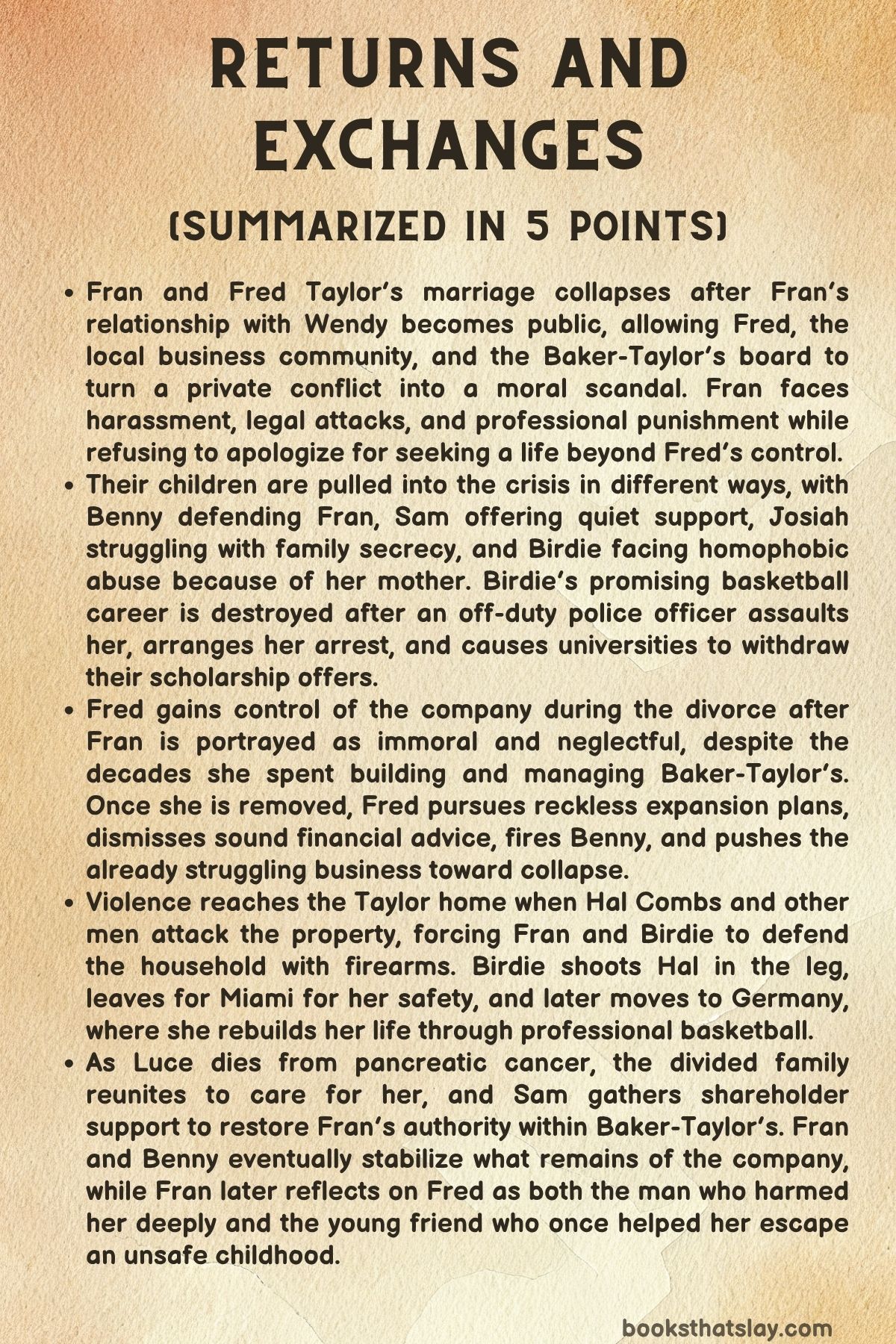
Characters
Fran Taylor
Fran is the central force of Returns and Exchanges, a woman whose intelligence, discipline, and labour hold both the Taylor family and Baker-Taylor’s together for decades. She is a gifted financial and operational leader who understands that a retail company succeeds through daily attention to employees, customers, presentation, safety, and practical systems rather than through public speeches or masculine displays of authority.
Her greatest strength is also the source of much of her suffering: she responds to crisis by taking responsibility for everyone around her. She manages Fred’s emotions, protects the children, solves financial problems, maintains the household, assists employees, and absorbs hostility without allowing herself the public freedom to collapse.
Fran’s relationship with Wendy represents a demand for personal existence beyond service. She does not deny that secrecy hurt Fred and the children, but she refuses to accept the belief that decades of sacrifice have permanently erased her right to love, desire, companionship, and self-determination.
The legal and corporate response to her sexuality reveals how thoroughly her worth has been made conditional. The same community that benefited from her leadership accepts the claim that she is morally unfit, allowing male directors and a judge to reduce a lifetime of work to a judgment about her private relationship.
Fran is not presented as flawless. She can be emotionally guarded, accustomed to making decisions for others, and slow to recognize how her methods of protecting Fred helped preserve his dependence and entitlement.
Her final reflections show a mature ability to hold opposing truths together. She understands the damage Fred caused without denying that he once helped her escape an unsafe home and stood beside her at the beginning of her adult life.
Fred Taylor
Fred is a charismatic but deeply insecure patriarch whose identity depends on recognition from other men. His business ambition, marriage, children, and public image all serve as evidence that he is powerful, successful, masculine, and deserving of admiration.
Fran’s relationship with Wendy injures him emotionally, but his strongest reactions are connected to humiliation. He becomes obsessed with the possibility that Hal, Jim, the board, the church, and the business community will laugh at him or interpret Fran’s choice as proof that he failed to control his wife.
Fred’s dependence on Fran is profound even when he resents her competence. She regulates his panic, organizes the company, manages the household, compensates for his impulsiveness, and gives him the appearance of authority by solving problems before they expose his weakness.
Once Fran stops performing that role, Fred becomes more aggressive and less stable. He hires a hostile attorney, manipulates the press, isolates Birdie from recruitment decisions, supports attacks on Fran’s character, and pursues the Madison’s acquisition as an emotional display of strength.
His treatment of Birdie demonstrates that his love is often conditional. He celebrates her when her athletic success adds value to the Taylor name, but he criticizes, rejects, and abandons her when she challenges his authority or creates negative publicity.
The novel nevertheless refuses to make him entirely simple. His attempt to restore Birdie’s scholarship, his presence at Luce’s death, and his final years near Fran show that regret and attachment survive beneath his pride, though they arrive too late to undo the harm he caused.
Benny Taylor
Benny is often viewed as the irresponsible Taylor child, yet Returns and Exchanges gradually reveals him as the family member who most fully understands the human value of Baker-Taylor’s. He loves retail work not because it gives him status but because it provides movement, cooperation, familiarity, service, and a daily sense of belonging.
His management style is collaborative and practical. He respects experienced workers, assists employees directly, serves customers, and rejects the competitive posturing that dominates Fred’s boardroom.
Benny’s weaknesses emerge through avoidance. He drinks, spends impulsively, jokes during serious situations, becomes involved with Nora despite Josiah’s history with her, and repeatedly seeks emotional escape instead of having difficult conversations.
His anger also makes him dangerous to himself. He wants to confront every man who insults Fran, imagines killing Hal, destroys merchandise after being fired, and often mistakes emotional intensity for effective action.
Fran teaches him that uncontrolled rage is a luxury unavailable to people whose behaviour will be used against them. Over time, Benny learns to combine his instinctive loyalty with greater patience, responsibility, and strategic judgment.
His development becomes clearest during Luce’s illness and the company’s recovery. He shops, cooks, cleans, drives, comforts, assists the dying, helps Fred through a panic attack, and eventually accepts operational responsibility, proving that care rather than authority is the foundation of his leadership.
Birdie Taylor and Roberta
Birdie is a disciplined, intelligent, physically powerful young woman who creates an identity through basketball. On the court, she can temporarily escape being the youngest Taylor child and experience herself as an individual defined by skill, control, concentration, and work.
Her athletic strength also places her outside the narrow femininity Fred understands. He takes pride in her success while attempting to change her appearance, control her recruitment, criticize her body, and use her achievements to improve the family name.
Birdie’s response to Fran is initially severe. She understands that Fran spent years supporting Fred’s illusion of control, but she underestimates the cost of that labour and treats her mother’s endurance as an obligation that should have continued indefinitely.
Her view changes as she witnesses Fran’s love for Wendy, the community’s violence, and Fred’s refusal to protect her. The threats against the household force Birdie to understand that prejudice is not an abstract disagreement but a danger capable of entering homes, car parks, schools, courts, and police systems.
The destruction of Birdie’s scholarship future reveals how institutions punish young women whose bodies are perceived as threatening. Becky’s father uses Birdie’s size and athletic ability to portray her as dangerous, while universities value reputation more than fairness.
As Roberta, she builds an international career and later becomes a respected coach. Her guarded distance from the family suggests that survival required reinvention, yet her willingness to let Fran tell the family history shows that separation has not completely erased attachment.
Josiah Taylor
Josiah is the intellectual and psychologically observant Taylor sibling. His idea of the John Wayne Syndrome explains how men are taught to expect authority while remaining emotionally unprepared for situations they cannot control.
He understands Fred’s behaviour as a product of insecurity rather than genuine confidence. This insight helps the family interpret Fred’s theatrical anger, competition, cruelty, and need to dominate every room.
Josiah’s relationship with Nora once represented the possibility of a life outside the family company. Benny’s secrecy therefore hurts him not because he believes Nora belongs to him, but because his brother chooses concealment over honesty.
His refusal to resolve the conflict immediately shows emotional boundaries that Benny lacks. Josiah will not perform the labour of explaining the entire family crisis in a car park simply because Benny is frightened and wants relief.
He later supports the shareholder effort to remove Fred from control. His admission that he takes satisfaction in the result reveals unresolved anger toward a father who repeatedly failed to understand or defend him.
Sam Taylor
Sam is the gentlest and most inward-looking Taylor sibling. His artistic career gives him a life outside Baker-Taylor’s, allowing him to observe the family with a degree of distance that Benny and Birdie do not possess.
His history of hospitalization has been used by others to question Fran’s motherhood, but his adult life demonstrates growth, independence, and professional accomplishment. He has exhibitions, commissions, friendships, and a modest stability built through patience rather than public approval.
Sam’s quietness should not be confused with weakness. When Fred abandons Birdie at the hospital, Sam physically removes him, acting with a firmness that shocks the rest of the family because he rarely displays anger.
He also responds to Benny’s drunken crisis without judgment. Instead of lecturing him or calling someone else, Sam enters the failing store, listens to his grief, and recognizes that losing Baker-Taylor’s means losing a home and identity.
His search through company records becomes one of the most decisive actions in the book. Sam’s attention to documents, relationships, and shareholder power accomplishes what Benny’s confrontations cannot, restoring Fran’s authority through careful collective action.
Luce
Luce is Fran’s sharp, practical, and fiercely protective sister. She sees danger earlier than most of the Taylor children because she understands how courts, companies, religious communities, and wealthy men convert prejudice into institutional power.
Her advice can seem harsh, especially beside Benny’s unconditional emotional support. However, her realism comes from knowing that affection alone cannot protect Fran from losing her home, employment, assets, or public reputation.
Luce has protected Fran since childhood. By hiding money and a train schedule in Fran’s Bible, she helped her sister escape Vice and begin a new life in Lexington.
Her own relationship with Philip remains concealed for years, suggesting that Luce also understands the sacrifices imposed by secrecy. As she approaches death, the household finally accepts Philip openly, allowing their connection to exist without explanation or shame.
Luce’s illness brings the divided family into one space and transforms the Triple Crown house into a place of service. Her death becomes both an enormous loss and the moment that motivates the family to complete the legal effort to restore Fran’s control.
Wendy Patterson
Wendy is Fran’s partner and a source of independence, desire, and emotional recognition. She does not want to be treated as Fran’s dependent, hidden responsibility, or convenient solution, and her hesitation about moving into the family home reflects her desire for dignity.
She understands prejudice with a realism that Fran is still learning. Wendy knows that openness can create freedom, but it also increases visibility and may expose families to hostility from people who believe themselves morally justified.
Her relationship with Birdie develops through practical trust. When Birdie confides in her about the threatening calls, Wendy does not dismiss her fear or burden Fran immediately; she listens, assesses the danger, and teaches Birdie to defend herself.
That training later allows Birdie to stop the attack on the house, though it also places a terrible responsibility on a teenager. Wendy’s practical response is therefore both protective and evidence of how badly the surrounding institutions have failed the family.
Over time, Wendy becomes part of the household’s daily structure. Her eventual career success and marriage proposal to Fran show that their relationship survives public hostility, corporate loss, illness, and the long process of building an ordinary life together.
Holly Patterson
Holly is Wendy’s thoughtful and observant daughter. Her presence makes the relationship between Fran and Wendy a matter of family formation rather than simply romantic escape.
During early dinners, Holly asks direct questions about divorce, property, and legal delay. Her innocence exposes how complicated adult secrecy appears to children who are expected to live with its consequences.
Holly connects with the Taylor siblings, particularly as the households begin sharing meals and Friday evenings. She becomes part of the new family structure before the adults have fully decided how to describe it.
The attack on the house is especially traumatic because she has less power and understanding than the others. Birdie’s fear for Holly helps explain why Birdie accepts armed responsibility and why the family later conceals what she did.
Nora
Nora is confident, direct, and sexually independent. Her forceful personality attracts Benny, who is both excited and intimidated by her certainty.
She also provides Benny with information about Fred’s legal meetings and company decisions. This makes her both a romantic partner and an informal source within the corporate conflict.
Her involvement with both Benny and Josiah exposes the brothers’ assumptions about intimacy and loyalty. The book does not treat Nora as property belonging to either man, but her secrecy contributes to the breakdown of trust between them.
Nora also reflects Benny’s tendency to seek refuge in relationships rather than confront pain directly. He goes to her when the company, divorce, and threats become overwhelming, using physical intimacy as temporary relief from responsibility.
Hal Combs
Hal is one of the clearest representatives of cruelty protected by social and corporate respectability. He treats Fran’s sexuality as entertainment, enjoys Fred’s humiliation, and uses prejudice as a method of increasing his own influence.
His hostility is not limited to private gossip. He supports reckless business decisions, mocks Fran directly, helps frame the company’s difficulties as consequences of her behaviour, and participates in the attack on her home.
Benny’s memory of Hal crushing a mouse captures the character’s pleasure in domination. Hal does not merely want Fran removed; he enjoys seeing vulnerable people frightened, injured, or publicly degraded.
Birdie’s decision to shoot him in the leg is a controlled response to an immediate threat. His presence among the attackers confirms that the violence is connected to the same business and social circles that condemned Fran in supposedly respectable language.
Jim Field
Jim presents prejudice through the language of Christian concern. Unlike Hal, who openly enjoys scandal, Jim convinces himself that informing Fred is a moral duty intended to correct Fran and restore the proper family order.
His sincerity does not make his actions harmless. By presenting social judgment as religious responsibility, he gives Fred permission to treat control as virtue and punishment as a necessary response to sin.
Jim’s role shows how violence can begin with calm conversations among respectable men. He does not personally attack Fran’s home, but his certainty helps create the moral atmosphere in which others believe harassment and dispossession are justified.
Bart Farmington
Bart Farmington is Fred’s divorce attorney and a professional expression of Fred’s worst impulses. He treats the separation as a contest in which victory requires humiliating Fran and reducing her life to evidence of deviance.
His strategy depends on gendered stereotypes. He presents Fran’s sexuality, books, parenting difficulties, financial decisions, and children’s struggles as proof that she is morally and psychologically unfit.
Farmington’s crude behaviour toward women reinforces the hypocrisy of his argument. A man who shows little respect for women is permitted to define the standards by which Fran’s duties as a wife and mother are judged.
He helps transform private pain into institutional punishment. Through his legal framing, the court overlooks Fran’s labour and treats Fred’s authority as more legitimate than her documented contribution.
Jack and Vivian
Jack is a trusted family ally who understands Fred’s capacity for cruelty and warns Benny that the divorce will expose the most destructive version of his father. His advice encourages Benny to become more responsible rather than assuming Fran can protect herself without support.
Jack and Vivian provide Birdie with safety after the attack on the house. Their Miami home allows her to step away from the Taylor scandal and experience privacy, affection, and a quieter transition into adulthood.
Their childless household becomes an alternative family space. They do not demand that Birdie perform athletic success, public loyalty, or emotional strength in exchange for care.
Jack also participates in Luce’s final days and the effort to restore Fran’s company authority. His presence across multiple crises reflects dependable support that does not seek recognition.
Philip Keckley
Philip Keckley is one of the few businessmen willing to challenge Fred’s financial recklessness. He refuses to treat the Madison’s acquisition as a reasonable risk and distinguishes evidence-based lending from decisions driven by pride.
His relationship with Luce reveals a private emotional life hidden beneath his professional identity. He arrives frightened and vulnerable when she is dying, making clear that their bond has existed for many years.
Benny’s decision to give Philip a key is an act of recognition. It allows Philip to care for Luce openly instead of entering the home as an outsider who must repeatedly request permission.
Philip later supports the shareholder plan that restores Fran’s authority. His loyalty connects personal love with corporate action, showing that relationships concealed from public view can still shape major institutional outcomes.
Coach Fox
Coach Fox is one of the few authority figures who consistently treats Birdie as capable rather than fragile. He recognizes her intelligence, discipline, and potential, which is why he expects her to control her response to provocation.
His criticism after the game may appear unsympathetic, but it is based on his knowledge that opponents will continue targeting Birdie if they discover how easily family insults disrupt her focus. He wants her to protect the future she has built through years of work.
When Birdie asks him to list Fran as the primary recruitment contact, he agrees immediately. His practical support contrasts sharply with Fred’s attempts to control information and access.
Before the state championship, he urges Birdie to separate basketball from the family crisis. His guidance helps her achieve victory, though he cannot protect her from the violence and institutional betrayal that follow outside the gym.
Becky Tumey and Her Father
Becky Tumey is Birdie’s athletic rival and understands that emotional attacks can succeed where physical competition fails. She uses Fran’s sexuality to disturb Birdie because she knows she cannot easily defeat her through skill alone.
Her cruelty is deliberate and strategic. She smiles after Birdie misses a shot because the goal is not merely to win the game but to make Birdie feel ashamed of her family.
Becky’s father expands this hostility through institutional authority. As an off-duty police officer, he strikes Birdie, claims self-defence, and uses professional connections to reverse the roles of attacker and victim.
Their actions show how prejudice becomes especially dangerous when private hostility receives official protection. Birdie’s body, strength, and public reputation are used as evidence against her, while the adult man who injured her is treated as credible.
Pammy
Pammy is an employee who becomes romantically involved with Fred during the separation. Her relationship with him exposes the unequal moral standards applied to male and female desire.
While Fran’s love for Wendy becomes grounds for public condemnation, Fred’s involvement with Pammy is treated as a normal response to marital disappointment. The difference has little to do with fidelity and everything to do with gender, sexuality, and accepted social roles.
Pammy increasingly aligns herself with Fred’s account of the conflict and becomes colder toward Benny. Her position within the company also reflects Fred’s pattern of using female employees for admiration and emotional reassurance.
Billy Taylor
Billy is the Taylor child who died before Birdie was born. Although absent from the main timeline, his death shapes the family’s emotional structure and becomes a hidden source of blame between Fran and Fred.
Fred delayed seeking medical care because he feared the cost, leaving Fran with the belief that Billy might have survived if she had been allowed to call a doctor sooner. This history exposes the danger behind Fred’s need to control decisions even when he lacks the judgment required to make them.
The surviving children grow up within an absence they only partly understand. Billy’s death contributes to Fran’s protectiveness, Fred’s shame, and the family’s habit of concealing painful truths until they become weapons during later conflicts.
Agatha
Agatha is Fran’s granddaughter and the person who arranges the filmed interview in 2015. Her role positions the youngest generation as the receiver and preserver of the Taylor family’s history.
The interview allows Fran to speak after decades in which courts, reporters, board members, advertisers, and relatives repeatedly shaped her public identity. Agatha therefore creates space for Fran to present her own account rather than remain the subject of other people’s stories.
Her presence also suggests that the family continues beyond the company’s decline and the older generation’s deaths. The future is represented not by retail expansion or the Taylor name, but by a descendant willing to listen.
Themes
Love, Control, and Conditional Belonging
In Returns and Exchanges, love frequently becomes inseparable from authority, obligation, and fear of abandonment. Fred loves Fran and the children, but he repeatedly treats love as proof that they should support his identity, protect his reputation, obey his decisions, and conceal his weaknesses.
Birdie experiences this conditional affection most directly when Fred praises her as a champion but rejects her after she criticizes him publicly. His pride in her depends on whether her achievements improve the Taylor name, revealing that admiration can become another method of possession.
Fran’s care is more dependable, though it also creates unhealthy patterns. By regulating Fred’s panic, repairing his mistakes, managing the business, and protecting the children from his instability, she allows him to mistake dependence for authority.
The new household formed by Fran, Wendy, Holly, Benny, and Sam offers a different model of belonging. It develops through meals, shared labour, protection, awkward conversations, illness, and daily presence rather than through claims of ownership.
Luce’s final days reveal the clearest form of this alternative love. The family does not prove devotion through speeches or public image; they bathe her, arrange medication, wash bedding, cook food, welcome Philip, and remain near her until death.
Gender, Sexuality, and Public Morality
Fran’s treatment shows how moral language can be used to remove women from power. Her relationship with Wendy becomes evidence that she is an unfit wife, mother, employer, and business leader, even though her professional ability and maternal labour are well established.
Fred’s relationship with Pammy produces no equivalent judgment. His behaviour is interpreted as ordinary male consolation, while Fran’s desire is treated as a threat to the company, family, church, and community.
Birdie faces another form of gender regulation. Her height, strength, confidence, and athletic authority make her valuable on the basketball court, yet the same qualities are used to describe her as unfeminine, aggressive, physically threatening, and responsible for violence committed against her.
The institutions surrounding the family reinforce these standards. Reporters turn conflict into spectacle, universities withdraw support to protect their reputations, police officers defend one another, board members invoke morality, and the court treats Fred’s patriarchal authority as more legitimate than Fran’s labour.
The novel also distinguishes public respectability from ethical behaviour. Men with families, careers, church affiliations, school bumper stickers, and corporate titles participate in gossip, assault, harassment, financial irresponsibility, and attacks on a home while continuing to view themselves as defenders of morality.
Work, Business, and Personal Identity
Baker-Taylor’s is more than a company because it contains the Taylor family’s history, conflicts, ambitions, and ideas about usefulness. Fran sees the business as a living system requiring careful attention, while Fred sees it increasingly as proof of personal greatness.
Benny’s connection to the stores is especially revealing. He does not love them because he dreams of wealth; he loves the sounds, routines, employees, customers, repairs, deliveries, and small acts of cooperation that make the work socially meaningful.
The company declines when its leaders lose sight of this purpose. Fred and Hal pursue acquisitions, expansion, publicity, and authority while ignoring debt, closures, staff needs, customer experience, and the limits of the market.
Fran’s dismissal demonstrates how organizations often erase the labour that sustains them. The board can remove her name from an office and invoke a morality clause, but it cannot easily replace the knowledge, relationships, systems, and culture she created.
Benny’s firing produces grief because employment and identity have become inseparable. His later return to leadership is meaningful only after he learns that management is not inherited power but responsibility toward workers, customers, family members, and the institution itself.
Memory, Inheritance, and Imperfect Forgiveness
The Taylor children inherit unresolved losses long before they understand them. Billy’s death, Fran’s childhood fear, Fred’s insecurity, Luce’s sacrifices, and the hidden structure of the marriage influence each sibling’s behaviour across adulthood.
Secrecy allows these histories to retain power. The truth about Billy emerges in court as a weapon, Nora’s relationships damage the brothers because they remain concealed, and Fran’s private life becomes more destructive when other people control its public meaning.
Remembering does not produce a simple judgment. Birdie learns that Fred tried to restore her scholarship, while Fran remembers him as both the man who dispossessed her and the boy who helped her escape a dangerous home.
These later discoveries do not erase abandonment, cruelty, financial recklessness, or prejudice. Instead, they prevent the family from reducing Fred to either the loving father he once appeared to be or the bitter patriarch he became.
Fran’s final memories suggest that forgiveness is not the same as declaring someone innocent. It is the ability to recognize that gratitude and anger, tenderness and injury, loyalty and betrayal can remain present together without one cancelling the others.
By telling the story to Agatha, Fran passes down an inheritance different from the retail empire. She gives the next generation a record of flawed people whose choices caused lasting harm, but whose capacity for love, work, change, and regret also remained real.