The Dead Room Summary, Characters and Themes
The Dead Room by Catriona McPherson is a psychological crime novel about bereavement, buried childhood trauma, financial exploitation, and the ease with which vulnerable people can be made to doubt their own perceptions. After losing her husband, audiobook narrator Lindsay Hale returns from Hawaii to the Scottish scrapyard where she grew up, hoping that family familiarity will help her recover.
Instead, she enters an organised campaign of deception involving a missing elderly woman, a suspicious nursing home, a fraudulent property sale, and people who know exactly how to use her grief against her. The novel turns Lindsay’s struggle to trust herself into both a personal recovery and a dangerous investigation.
Summary
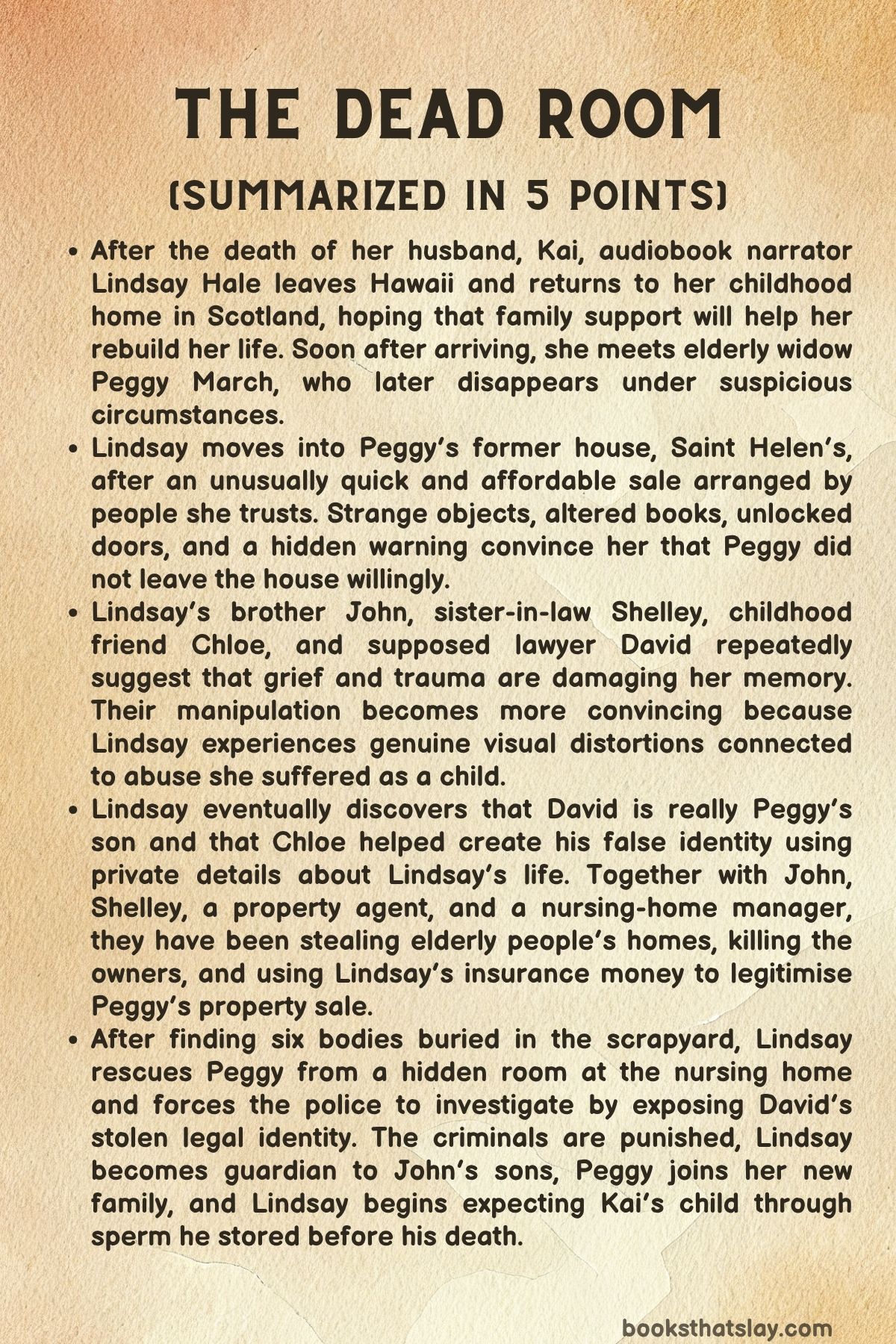
Three months after the death of her husband, Kai, Lindsay Hale remains alone in their Hawaiian home, surrounded by reminders of the life they built together. Both Lindsay and Kai worked as audiobook narrators, and the soundproof recording studio in their house, professionally called a dead room, had been central to their careers and marriage.
While sorting through their recordings, Lindsay discovers a private message Kai made before his death from brain cancer. He tells her to grieve but also encourages her to continue living, find love again, have children, and create the future they had once planned together.
Rather than comforting Lindsay, the recording makes her angry because Kai speaks with deliberate casualness and does not clearly tell her that he loves her. During this emotional crisis, her estranged brother John telephones from Scotland and invites her to return to Lord’s Yard, the scrapyard and family home where they spent their childhood.
Lindsay accepts because she fears remaining alone in Hawaii. She leaves behind her house, career, possessions, and the recording room filled with memories of Kai, hoping that returning to familiar surroundings will provide some form of safety.
After a long journey, Lindsay becomes lost near Dunblane and breaks down while embracing the town’s gold postbox. An elderly widow named Peggy March approaches her, immediately recognises the signs of bereavement, and offers sympathy without forcing Lindsay to explain herself.
Peggy takes Lindsay to Saint Helen’s, her large Edwardian home, where Lindsay rests in a comfortable garden room. Peggy explains that she refuses to leave the house despite pressure to move somewhere smaller, insisting that a home contains memory, identity, and emotional meaning beyond its financial value.
Before Lindsay leaves, Peggy gives her a copy of Agatha Christie’s Sleeping Murder. Lindsay feels an immediate connection with her and leaves her contact information through the letterbox before continuing to Lord’s Yard.
Lindsay arrives a day earlier than expected and sees John sitting with three unfamiliar men: a large man in a checked shirt, a polished man with a cigar, and a thin grey-haired man. John and his wife, Shelley, react awkwardly to Lindsay’s arrival, offering rehearsed apologies about their absence from Kai’s funeral.
That night, Shelley gives Lindsay an herbal drink that causes her to sleep heavily. Lindsay experiences nightmares involving Kai, doctors, John, strange drinks, and concealed violence, then wakes to screams, a struggle, and a heavy impact somewhere outside.
She persuades herself that the sounds came from a fox or from her dreams. The following day, however, she discovers that she has slept for nearly twenty-four hours, and she begins experiencing visual distortions in which people and landscapes appear flat, artificial, and unreal.
While exploring the scrapyard, Lindsay finds an old black biscuit tin identical to one she saw in Peggy’s kitchen. She also notices that John seems unable or unwilling to remember expressions, games, secret entrances, and shared ideas from their childhood.
John encourages Lindsay to remain at Lord’s Yard rather than searching for a home of her own. He offers her a small room for recording but becomes uncomfortable whenever she mentions their past or repeats the family formula about knowing something while pretending not to know it.
When Lindsay returns to Saint Helen’s, she finds the house completely empty. The furniture, curtains, personal belongings, and evidence of Peggy’s life have vanished, while a neighbour explains that Peggy has abruptly moved into residential care.
The neighbour’s hostility confirms that Peggy is real, yet the speed with which her home has been emptied makes no sense. Elsewhere, an unidentified woman wakes beneath a hood in the boot of a moving car, attempts to identify the route, and loses consciousness before she can escape.
Lindsay’s childhood friend Chloe Crozier soon arrives at Lord’s Yard. Chloe had disappeared from Lindsay’s life after she moved abroad, but she returned during Kai’s illness and supported Lindsay throughout his decline.
Chloe now takes control of Lindsay’s search for a new home, dismissing John’s objections. Although she behaves affectionately, she becomes uneasy when Lindsay says she will need a new dead room for audiobook work.
Lindsay begins searching nursing homes for Peggy. At a home called the Elms, manager Eric McAllan reacts aggressively and accuses her of using her family’s clearance business to exploit elderly residents.
Lindsay believes she recognises Eric, just as she previously thought she recognised property agent Robert Walker. Both men deny knowing her while possessing information about her family, increasing her fear that grief, exhaustion, or illness is damaging her memory.
John and Shelley continue treating Lindsay as unstable. Their behaviour becomes especially suspicious when Lindsay mentions a hidden childhood caravan, and John responds with panic despite clearly remembering the place.
As Lindsay’s visual disturbances continue, she finally recognises them as an old psychological response. During frightening moments in childhood, she mentally transformed the world into flat illustrations so that threatening events would feel less real.
Her buried memories had begun returning after she auditioned for an audiobook about complex trauma. The information in the book forced her to reconsider parts of her childhood that she and John had survived by refusing to acknowledge them directly.
At a garden centre, a woman introduces herself as Aileen Murdoch, supposedly a former schoolmate. Aileen’s former husband, David Minto, appears soon afterward, and Chloe encourages Lindsay to accept his invitation to the ballet.
David presents himself as an accomplished Crown lawyer. He is patient about Lindsay’s grief, supports her wish to date again, and seems to understand her desire for companionship without demanding that she abandon her love for Kai.
Meanwhile, Chloe brings Lindsay to a privately listed property that perfectly matches every requirement she gave. The property is Saint Helen’s, now empty and available for exactly the amount Lindsay can afford with Kai’s life-insurance money.
During the viewing, Lindsay notices a message freshly scratched beneath a window in the room that could become her new recording studio. It reads, “Help. They are going to kill m—,” but Chloe dismisses it as an old mark or childish prank.
Despite her unease, Lindsay purchases Saint Helen’s through an unusually rapid and informal legal process. David offers to assist with the paperwork, while John and Shelley abruptly reverse their earlier opposition and encourage her to proceed.
After moving in, Lindsay learns from Peggy’s neighbour, Bunny Boyle, that Peggy has reportedly died. Bunny considers the secrecy surrounding her removal, death, and lack of funeral arrangements inconsistent with the sociable and determined woman he knew.
Strange events begin occurring inside Saint Helen’s. Doors appear unlocked, Sleeping Murder moves between rooms, and Chloe enters the house through entrances Lindsay remembers securing.
When Lindsay finally opens the damaged biscuit tin from the scrapyard, she discovers the same collection of chocolate bars she saw in Peggy’s kitchen. She realises that the tin is not merely similar to Peggy’s possession but is the exact object removed from Saint Helen’s.
Lindsay confronts John, who denies clearing the house. During the argument, more of their shared childhood returns, including the memory of their mother locking them inside the caravan and telling police they had run away.
Their mother threatened that social workers would separate them if they revealed family secrets. Although she sometimes locked the children outside to protect them from their father, she repeatedly returned them to the same dangerous household and forced them to deny what they experienced.
Inside Lord’s Yard, Lindsay discovers piles of possessions taken from an entire household. She also notices a strong smell of decomposition, while John forbids her from contacting environmental authorities and provides implausible explanations about dead animals and slurry.
Shelley claims that the objects were used to furnish Saint Helen’s temporarily for online photographs. The explanation cannot account for the biscuit tin, Peggy’s personal mail, the strange disappearance of her belongings, or John’s fear of official attention.
Lindsay tries to rebuild her career by installing a new dead room at Saint Helen’s. Using recording equipment, she tests disputed phrases she has overheard and confirms that similar sounds can easily be mistaken for one another, raising the possibility that people are exploiting her professional sensitivity to speech.
David encourages Lindsay to believe that her disturbing experiences result from grief and trauma rather than a brain illness. Although he appears supportive, his confident explanations gradually make her dependent upon his interpretation of events.
One night, an intruder in a checked shirt enters Saint Helen’s and escapes through the garden. The police find Lindsay distressed and treat her report as another symptom of bereavement, especially after physical evidence disappears in the rain.
A book in the house alternates between Sleeping Murder and The Amityville Horror, suggesting that someone is deliberately moving or replacing objects. By making Lindsay sound obsessed with haunted houses and imagined intruders, the conspirators prepare others to dismiss any accusation she makes.
David claims that a legal colleague has traced Peggy from the Elms to a hospital. When Lindsay returns to the nursing home, however, Eric claims Peggy has died, and the nearly empty building appears to be concealing heavily medicated or imprisoned residents.
The supposed Aileen Murdoch appears at the Elms and says she knew nothing about Kai’s death. Her statement contradicts David’s claim that his former wife had criticised him for dating a recently widowed woman.
David later introduces Lindsay to his sons, Edwin and Sean. When Sean injures himself and Lindsay takes the boys to hospital, their real mother arrives and reveals herself as Eileen Prentiss, proving that the woman at the garden centre was an impostor.
This discovery changes Lindsay’s understanding of her missing memories. Her inability to recognise certain people is not evidence that her brain is failing, because at least some identities and relationships have been deliberately invented.
At Lord’s Yard, Lindsay recognises Shelley’s brass gong as the top of a table taken from Peggy’s garden room. She confronts John during another supposed poker game and finds him with Robert Walker and Eric McAllan.
The three men are connected through property sales, residential care, and house clearances. Lindsay begins to suspect that elderly homeowners are being placed in the Elms, separated from their properties, and stripped of their possessions.
David offers a complicated confession involving several marriages, persuading Lindsay that his lies may reflect embarrassment rather than criminal intent. She asks him to investigate whether her ownership of Saint Helen’s is legally valid.
His deception collapses when Lindsay overhears him speaking urgently about shared responsibility and hears him refer to details about a hidden book that he should not know. Online research reveals that the real David Minto is an older lawyer whose appearance and duties do not match the man Lindsay has been dating.
Her lover is actually David March, Peggy’s son and the grey-haired man she saw at John’s poker table. He has used another man’s professional identity to gain Lindsay’s confidence and control the property transaction.
Lindsay calls Chloe using an old emergency signal. Chloe arrives and admits that she and David are lovers, then reveals that Lindsay has been selected as the respectable purchaser in an organised scheme involving seven stolen properties.
Chloe has provided David with private information about Lindsay’s tastes, history, grief, career, finances, and hopes for children. This knowledge allowed him to present himself as the ideal partner and explain Lindsay’s suspicions as symptoms of trauma.
A heavily edited recording of the house viewing has been prepared to make Lindsay appear aware of the fraudulent sale. Her fingerprints and belongings have been placed around the property so that she can be portrayed as a willing participant rather than another victim.
Chloe also admits that she returned during Kai’s illness because the group expected Lindsay to become a wealthy widow. Her friendship, care, house search, and emotional support were all part of a plan that began before Kai died.
Lindsay returns to Lord’s Yard during a storm and enters through a secret childhood passage. In the Barrens, she finds six disturbed areas in the ground and realises that they contain the bodies of elderly homeowners whose properties were stolen.
She finds recent paint flakes from Saint Helen’s and the contact card she placed through Peggy’s letterbox. These objects prove that Peggy was imprisoned in the future recording room and taken away shortly after Lindsay first met her.
The screams Lindsay heard on her first night at Lord’s Yard were connected to Peggy, while Shelley’s herbal drink was used to keep her unconscious. John was not simply clearing the victims’ homes; he was disposing of their bodies and controlling the physical evidence.
Hidden inside an old dresser, Lindsay overhears John and David planning to kill her. They intend to present her death as the suicide of a mentally unstable widow whose grief, childhood trauma, and recent behaviour have already been documented.
John also admits that he repeated parts of their parents’ abuse by locking his own sons outside. Lindsay understands that while she tried to escape and recover, John survived by becoming increasingly like the father they once feared.
After escaping the yard, Lindsay finds a female lorry driver and asks for help reaching the Elms. Because she counted only six graves despite learning that there were seven properties, she believes one elderly victim remains alive.
Inside a concealed section of the nursing home, Lindsay discovers Peggy imprisoned, weak, bruised, and deliberately injured. Peggy explains that David cannot legally certify his own mother’s death, while an outside doctor would notice her injuries, so the conspirators have been forced to keep her alive.
Lindsay and the driver take Peggy to Bunny rather than a hospital, where David might be contacted as her next of kin. When police continue to dismiss Lindsay because of earlier reports describing her as delusional, she creates a more dangerous plan.
She returns to Saint Helen’s and locks herself inside the dead room, where she reports the six graves and exposes Peggy’s scratched warning beneath the soundproofing. Chloe locks the room from outside while David watches the property, unaware that Lindsay still has internet access.
When police arrive, Chloe and David calmly describe Lindsay as mentally unwell. The attending sergeant believes them and prepares to send Lindsay for psychiatric assessment without investigating the graves.
Lindsay deliberately punches the officer because arrest will place her in a secure cell where the conspirators cannot kill her. At the station, she requests the real David Minto as her lawyer and uses his stolen identity as the one element the authorities cannot easily dismiss.
Although officers initially cut off her attempt to report the murders, David Minto’s chambers telephone the station and ask specifically for Lindsay. His professional authority forces the police to reconsider her claims and begins the investigation that exposes the entire organisation.
By September, the bodies have been recovered and reburied, while Lord’s Yard has been demolished and replaced by a memorial garden. John, Shelley, Chloe, David March, Eric and Sarah McAllan, and Robert Walker are convicted or otherwise confined for their roles in the crimes.
Lindsay becomes guardian to John’s sons, Zak and Nicky, while Peggy recovers. To prevent David from inheriting Saint Helen’s, Peggy and Lindsay legally marry in an affectionate family arrangement rather than a romantic relationship.
Lindsay also learns that Kai stored sperm after his diagnosis. She becomes pregnant with their daughter and finally listens to the unused ending of Kai’s message, where he admits his fear and expresses the love she believed he had failed to mention.
Surrounded by Peggy, Bunny, and the children, Lindsay no longer treats uncertainty as a reason to deny reality or expect disaster. Her willingness to answer the future with “We’ll see” shows that she has begun living without demanding complete control over what comes next.
Characters
Lindsay Hale
Lindsay Hale is the emotional and investigative centre of The Dead Room, and her development depends on learning to distinguish psychological injury from genuine external danger. At the beginning, she is disoriented by Kai’s death, physically exhausted, professionally inactive, and frightened by the possibility that her mind is failing.
Her career as an audiobook narrator gives her an unusually precise relationship with language, voice, rhythm, and sound. This professional strength becomes a source of anxiety when spoken phrases seem to change, but it later helps her recognise how easily language can be manipulated.
Lindsay’s visual flattening is not a supernatural experience or a sign of neurological disease. It is a childhood survival response through which she turned frightening situations into unreal pictures, allowing her to remain emotionally distant from what was happening.
Her uncertainty makes her an ideal target for the conspirators. They do not need to invent every symptom because they can use genuine trauma, grief, insomnia, and memory gaps to discredit accurate observations.
Even while doubting herself, Lindsay continues collecting physical details. The biscuit tin, scratched warning, moved books, table top, paint flakes, property records, false identities, and hidden graves gradually give her a factual structure strong enough to resist emotional manipulation.
Her courage is practical rather than effortless. She remains frightened, makes mistakes, trusts the wrong people, and repeatedly considers the possibility that others are correct about her mental state.
Lindsay’s most important transformation occurs when she stops treating uncertainty as proof of personal weakness. She learns that not remembering everything does not mean she remembers nothing, and experiencing trauma does not make her incapable of identifying present danger.
Her decision to assault the police officer demonstrates both desperation and strategic intelligence. She understands that being arrested offers more protection than remaining free in a system where respected criminals can describe her as unstable.
By the conclusion, Lindsay has not abandoned her grief for Kai. She has incorporated it into a wider life containing work, parenthood, friendship, responsibility, and a new understanding of family.
Kai Hale
Kai is physically absent from most of the story, yet his influence remains central to Lindsay’s emotions, choices, and understanding of love. His death creates the vulnerability that the conspirators exploit, but his relationship with Lindsay also provides a standard against which their false affection can eventually be measured.
As an audiobook narrator, Kai shared Lindsay’s professional world and understood the importance of sound, voice, and the dead room. Their marriage appears to have been affectionate, creative, intellectually compatible, and built around everyday companionship rather than dramatic declarations.
His final recording initially causes pain because he avoids plainly saying that he loves Lindsay. His humour and encouragement to seek another partner seem to her like emotional distance at a moment when she desperately wants reassurance.
The later discovery of the recording’s unused final minutes changes this interpretation. Kai admits his fear and expresses his enduring love, revealing that the earlier casualness was an effort to make Lindsay’s future feel possible rather than an attempt to diminish their marriage.
His decision to store sperm also gives Lindsay the possibility of having their child. This act does not trap her in the past but allows part of the future they imagined together to survive his death.
Kai’s role contrasts strongly with David March’s imitation of intimacy. Kai knew Lindsay deeply without using that knowledge to control her, while David learns personal details only to construct a convincing performance.
Peggy March
Peggy March is a determined, intelligent, and compassionate elderly woman whose encounter with Lindsay begins the central mystery. She recognises Lindsay’s grief immediately and responds with respect, practical kindness, and emotional honesty.
Her description of widowhood as a calamity validates Lindsay’s suffering without reducing her to it. Unlike those who later treat Lindsay as fragile or irrational, Peggy allows her to rest without demanding explanations or obedience.
Peggy’s attachment to Saint Helen’s represents her right to memory, independence, and control over her own life. The criminal scheme treats the house as a financial asset, but Peggy understands it as an extension of personal history.
Her disappearance demonstrates how older people can be erased through administrative language. Being transferred, medicated, declared incapable, or reported dead allows the conspirators to hide violence beneath procedures that appear respectable.
Even in captivity, Peggy remains resourceful. She deliberately injures herself because she understands that visible marks will prevent an outside doctor from casually certifying her death.
Her decision to marry Lindsay is both affectionate and strategic. By changing the legal line of inheritance, she prevents David from benefiting from her death and turns the institution he tried to exploit into a form of protection.
Peggy ultimately becomes a maternal and familial presence in Lindsay’s reconstructed life. She survives not as a passive person waiting to be rescued, but as someone whose judgment, endurance, and legal decisions help defeat the conspiracy.
John Hale
John is one of the darkest figures in The Dead Room because he is both a survivor of childhood abuse and an adult who repeats its methods. His history explains his emotional damage, but it does not excuse his participation in murder, coercion, and the exploitation of vulnerable people.
As a child, John learned that survival depended on emotional hardness, secrecy, and deliberate forgetting. The family formula about knowing while refusing to know becomes the psychological rule that shapes his adulthood.
His inability to discuss the caravan or their parents initially appears to be repression. Later, it becomes clear that forgetting has also become a moral strategy that allows him to avoid responsibility.
John’s treatment of Lindsay combines resentment, control, and practical calculation. He wants her to remain at Lord’s Yard, doubts her ability to live independently, and repeatedly supports explanations that make her appear unstable.
He also plans to use her insurance money and eventual ownership of Saint Helen’s for the group’s benefit. His role is not secondary because he manages the physical disposal of possessions and bodies, making him essential to the organisation.
The revelation that he locked his own sons outside shows that he has recreated the behaviour he once suffered. Instead of breaking the pattern, he has adopted domination as a way to prevent himself from feeling powerless.
John’s fate in a secure hospital reflects the complexity of his condition. He is criminally responsible, yet his damaged psychological state cannot be separated from the violence that formed him.
Shelley Hale
Shelley presents herself as a worried sister-in-law trying to protect a recently widowed woman. Her exaggerated apologies, rehearsed concern, and constant references to Lindsay’s instability reveal that care has become a performance.
She helps establish the false narrative that Lindsay is unable to manage her own life. By encouraging the children to repeat these concerns, Shelley turns ordinary family interactions into evidence against Lindsay’s independence.
Her herbal tea is one of her most disturbing tools. It allows her to drug Lindsay while maintaining the appearance of domestic kindness, showing how danger can hide inside supposedly nurturing behaviour.
The brass gong made from Peggy’s table reveals Shelley’s casual participation in the theft of another woman’s life. She takes an object from Saint Helen’s, gives it a new function, and displays it openly because she assumes Lindsay will not trust her own recognition.
Shelley is not portrayed as merely obeying John. She knows about the conspiracy, assists in controlling Lindsay, helps conceal the victims, and contributes to the planned explanation of Lindsay’s death.
Her insistence that Lindsay should “go with the flow” summarises her moral position. Shelley protects herself by accepting whatever version of reality benefits the group, regardless of the suffering required to maintain it.
Chloe Crozier
Chloe is the most intimate betrayer in the novel because she converts friendship into surveillance. She knows Lindsay’s history, habits, vulnerabilities, ambitions, and grief, then gives that information to people planning to exploit her.
Her return during Kai’s illness appears to be evidence of loyalty. In reality, she rejoins Lindsay because the conspirators expect Kai’s death to provide insurance money that can be used to legitimise a stolen property.
Chloe’s manipulation succeeds because much of her care is convincing. She travels, comforts Lindsay, assists with practical tasks, finds Saint Helen’s, and behaves like the person most willing to oppose John’s control.
Her resentment has developed over years of comparing her own life with Lindsay’s marriage, career, travel, and happiness. Rather than acknowledging envy, she transforms it into a belief that Lindsay deserves humiliation.
The revelation that Chloe and David are lovers gives her betrayal another personal dimension. She helps create David’s false identity but becomes furious when the performance results in genuine sexual contact between him and Lindsay.
Her edited property video demonstrates her understanding of modern manipulation. She knows that selected images, altered sequences, and controlled context can make an innocent person appear informed and willing.
Chloe’s cruelty toward Kai is especially revealing because it attacks the relationship that gave Lindsay emotional security. By insulting the marriage after using Kai’s illness as part of the plan, she exposes the emptiness beneath her supposed friendship.
David March
David March is an accomplished manipulator who uses social authority, professional appearance, and romantic attentiveness to control Lindsay. His greatest weapon is not physical violence but the ability to construct a believable identity from accurate personal information.
By impersonating Crown lawyer David Minto, he gains prestige and access to legal explanations that Lindsay is unlikely to challenge. His clothing, home, vocabulary, and behaviour are designed to make him appear calm, powerful, and dependable.
David’s romance with Lindsay is carefully tailored. He accepts her grief, avoids pressuring her, discusses children, offers legal help, and presents ordinary domestic companionship as a healthier alternative to dramatic courtship.
Each apparent kindness deepens her dependence upon him. When he attributes her experiences to trauma rather than illness, he seems supportive while still encouraging her to distrust her conclusions.
His relationship with Peggy reveals his moral emptiness most clearly. He is willing to imprison and help kill his own mother in order to obtain her home and protect the wider criminal scheme.
David’s use of several invented marriages gives him flexible explanations for every contradiction. Rather than telling a single lie, he creates enough overlapping stories that Lindsay cannot easily determine which part is false.
His failure comes from overconfidence. Because he knows so much about the conspiracy, he casually reveals details about objects, deaths, and legal procedures that his assumed identity should not possess.
Bunny Boyle
Bunny Boyle initially appears suspicious and hostile when he finds Lindsay at the emptied Saint Helen’s. His reaction is based on a belief that she may be connected to those who removed Peggy rather than on a desire to dismiss her.
Once he understands Lindsay’s position, he becomes one of the few people willing to examine her claims logically. He neither accepts every conclusion automatically nor treats grief as evidence that her observations are meaningless.
Bunny provides important information about Peggy’s personality, family, supposed death, and relationship with her home. Because he knew Peggy before the conspiracy began, he can identify behaviour that does not fit the official account.
His home becomes a place of temporary safety after Peggy is rescued. By keeping her away from institutions that might contact David, Bunny helps prevent the conspirators from regaining control.
His friendship represents a healthier form of support than the protection offered by John, Chloe, or David. Bunny respects Lindsay’s judgment while helping her test it against facts.
Eric McAllan
Eric McAllan manages the Elms and uses the authority of residential care to imprison, medicate, and conceal elderly victims. His position gives him control over records, visitors, staff access, surveillance, and the physical movement of residents.
His aggression toward Lindsay is disguised as concern for vulnerable people. By accusing her of exploiting residents through house clearances, he projects the conspiracy’s own crimes onto her family business.
Eric shifts his behaviour depending on what will most effectively confuse her. During one visit he appears furious and defensive, while during another he acts as though he barely remembers meeting her.
The unnatural silence of the Elms reflects the system he controls. Residents are hidden, sedated, isolated, or falsely reported dead, turning a place intended for care into an instrument of financial violence.
Eric represents institutional corruption at its most dangerous. He does not need to abduct every victim personally because his professional role allows coercion to appear administrative.
Sarah McAllan
Sarah McAllan participates in the conspiracy by impersonating Aileen Murdoch, a former schoolmate supposedly married to David. Her role is to confirm David’s invented personal history and make Lindsay question her own memory.
The impersonation is psychologically precise. Because Lindsay has been away from Scotland for years and is already worried about missing memories, Sarah can present herself as someone Lindsay ought to recognise.
Her appearance at the Elms strengthens the connection between the false marriage and the nursing-home scheme. The encounter also allows her to contradict David’s story in a way that produces confusion without immediately exposing the entire deception.
Sarah demonstrates how the group operates through coordinated roles. Each conspirator supplies a small piece of false reality, making the total construction appear too complex to have been deliberately organised.
Robert Walker
Robert Walker uses his property business to identify valuable homes belonging to isolated or vulnerable elderly owners. His polished manner allows the criminal scheme to enter the legitimate housing market.
When Lindsay first meets him, he denies knowing her while revealing that he already knows where she is staying. This contradiction creates uncertainty without giving her enough evidence to accuse him.
Robert helps ensure that stolen properties can be priced, presented, transferred, and sold through apparently ordinary channels. His role gives the conspiracy the professional surface required to hide its violence.
He also appears at John’s poker table, where social contact is disguised as casual recreation. The recurring gatherings show how the group separates its public identities from its shared criminal work.
Zak and Nicky Hale
Zak and Nicky are John and Shelley’s sons, and their behaviour initially appears to support the claim that Lindsay is unstable. It later becomes clear that they have been coached to repeat adult concerns they do not fully understand.
They are also victims of John’s repetition of family abuse. His admission that he locked them outside shows that the violence experienced by Lindsay and John has entered another generation.
The boys carry shame connected to their parents’ crimes, even though they bear no responsibility for them. Lindsay’s guardianship gives them the possibility of growing up within a family where secrecy is no longer treated as protection.
Their bond with Edwin and Sean is based on shared experience. All four boys must learn that having dangerous fathers does not determine their own moral identities.
Edwin and Sean
Edwin and Sean are introduced as part of David’s manufactured image of respectable family life. Their presence initially makes him appear more trustworthy because he presents himself as an involved divorced father.
Sean’s accident unintentionally breaks the deception. The hospital visit brings the boys’ real mother into contact with Lindsay and proves that the supposed Aileen Murdoch is not David’s former wife.
The boys themselves are innocent of their father’s crimes. They are used as props in his false identity, just as Lindsay’s grief and Peggy’s age are used as opportunities.
Their later friendship with Zak and Nicky creates a small community of children affected by adult wrongdoing. The connection suggests that truth, stability, and responsible guardianship can interrupt inherited shame.
Eileen Prentiss
Eileen Prentiss is the actual mother of Edwin and Sean. Her arrival at the hospital provides the first undeniable confirmation that Lindsay’s confusion has been deliberately created by other people.
Her ordinary concern for her injured son contrasts with the theatrical behaviour of Sarah McAllan. Family photographs and direct recognition provide evidence that cannot easily be explained as Lindsay’s faulty memory.
Although Eileen has limited involvement in the central action, her appearance marks a decisive shift. Lindsay begins moving from self-diagnosis toward the recognition of an organised external threat.
David Minto
The real David Minto never becomes personally involved in Lindsay’s life, yet his identity is essential to both the conspiracy and its collapse. His professional reputation gives David March the authority needed to appear reliable.
Lindsay eventually turns the stolen identity against the impostor. By requesting the real man as her lawyer, she creates a claim that the police cannot dismiss merely as part of her grief.
The response from Minto’s chambers instantly changes the officers’ attitude because impersonating a powerful legal official produces institutional concern. Lindsay therefore uses the criminals’ dependence on social status to force the authorities to listen.
The Lorry Driver
The unnamed lorry driver plays a brief but decisive role after Lindsay escapes from Lord’s Yard. She offers practical assistance without demanding proof that Lindsay is calm, respectable, or emotionally composed.
She helps Lindsay reach the Elms and remove Peggy from captivity. Her immediate action contrasts with the police officers and professionals who repeatedly treat appearances as more important than evidence.
The driver represents ordinary moral courage. She does not need a personal history with Lindsay or a financial interest in Peggy’s survival to recognise that urgent help is required.
Themes
Gaslighting, Perception, and the Struggle to Trust Reality
In The Dead Room, gaslighting works because the false story constructed around Lindsay contains pieces of truth. She is grieving, exhausted, traumatised, forgetful, and experiencing visual distortions, but none of those conditions mean that the intruders, stolen possessions, false identities, or missing victims are imaginary.
The conspirators rarely deny every detail directly. Instead, they offer plausible alternatives, move objects, change explanations, involve children and professionals, and encourage Lindsay to interpret each contradiction as another symptom of illness.
This method turns self-awareness into a weapon against her. Because Lindsay knows that grief and trauma can alter perception, she becomes more willing to distrust herself than to accuse people she loves.
The replacement of Sleeping Murder with The Amityville Horror shows how physical reality can be manipulated to create a psychiatric narrative. An accurate report about a moved book is transformed into evidence that Lindsay is obsessed with haunted houses.
Her recovery does not require perfect memory. It begins when she accepts that incomplete perception can still contain valid information and that uncertainty should lead to investigation rather than automatic self-rejection.
Objects become essential because they preserve continuity when language fails. The biscuit tin, brass gong, scratched warning, paint flakes, graves, false business card, and genuine legal identity allow Lindsay to rebuild reality through evidence.
Grief, Love, and Permission to Continue Living
Lindsay’s grief is not presented as a temporary stage that disappears once the mystery is solved. Her love for Kai remains active throughout the story, shaping her anger, guilt, professional paralysis, desire for children, and response to David.
Kai’s final recording creates conflict because he asks Lindsay to imagine a future she does not yet want. His encouragement feels almost like abandonment because she hears his practical instructions before she hears the fear and love hidden at the recording’s end.
Dating David therefore produces both comfort and shame. Lindsay wants companionship and children, yet every moment of pleasure seems to raise the question of whether continuing to live reduces the importance of her marriage.
The novel rejects the idea that love must be replaced for life to continue. Lindsay can mourn Kai, recognise that David’s affection was false, care for Peggy and the children, return to work, and still build a future connected to the husband she lost.
Kai’s stored sperm makes this connection literal, but the pregnancy does not trap Lindsay in memory. It allows an interrupted possibility to take a new form within a wider and less conventional family.
Her final acceptance of uncertainty marks a healthier relationship with grief. She no longer needs the future to follow the plan she once made with Kai before she can consider it worth living.
Childhood Trauma and the Repetition of Abuse
Lindsay and John survive the same violent household but develop sharply different responses. Both learn to separate knowledge from conscious acknowledgement, using denial as protection against fear, family separation, and punishment.
Their mother contributes to this confusion by sometimes shielding them from their father while also preserving the household that harms them. Locking the children outside or inside the caravan protects them during isolated moments but teaches them that safety itself may involve imprisonment.
Lindsay’s visual flattening continues this childhood strategy. When reality becomes unbearable, her mind turns people and places into unreal images, reducing immediate emotional impact at the cost of later certainty.
John responds by becoming hard, controlling, and emotionally detached. He treats forgetting as proof that the past no longer matters, even while repeating his father’s behaviour toward his sons and using Lindsay’s trauma to plan her murder.
The contrast between the siblings shows that experiencing abuse does not produce one inevitable adult identity. Trauma may explain patterns of fear or control, but adults remain responsible for whether they examine, resist, or reproduce those patterns.
Lindsay interrupts repetition by protecting the next generation. Becoming guardian to Zak and Nicky transforms family responsibility from secrecy and domination into stability, truth, and care.
Homes, Property, and the Erasure of Vulnerable People
Saint Helen’s is valuable to Peggy because it contains the material record of her life. Its rooms, furniture, books, garden, and accumulated possessions express identity in a way that cannot be reduced to market price.
The conspirators see the same house as an asset that can be separated from its owner. Their scheme depends on treating elderly people as legal obstacles between desirable properties and profitable resale.
Residential care, property law, medical authority, and house-clearance work are all legitimate systems. The criminals succeed by connecting these systems so that each stage of dispossession appears ordinary when viewed separately.
The empty house is therefore a form of violence. Removing Peggy’s belongings creates the appearance that she has willingly left, while destroying the physical evidence of her continuing attachment to the home.
Lord’s Yard becomes the hidden underside of this process. The victims’ furniture, clothing, correspondence, household objects, and bodies are all discarded together once their financial usefulness has been extracted.
Lindsay’s restoration of Saint Helen’s reverses this erasure. The property becomes a shared home for Peggy, Lindsay, the children, and the future baby rather than an object obtained through isolation and death.
The demolition of Lord’s Yard and creation of a memorial garden further transform space into testimony. A place built on secrecy and disposal is replaced by one that publicly acknowledges the people the conspiracy attempted to remove from history.