Veiled Court Summary, Characters and Themes
Veiled Court (Legacy of Avalon #1) by C. N. Crawford is a dark fantasy romance centered on Syn Malleore, a demi-Fey survivor, former royal assassin, and committed enemy of monarchy.
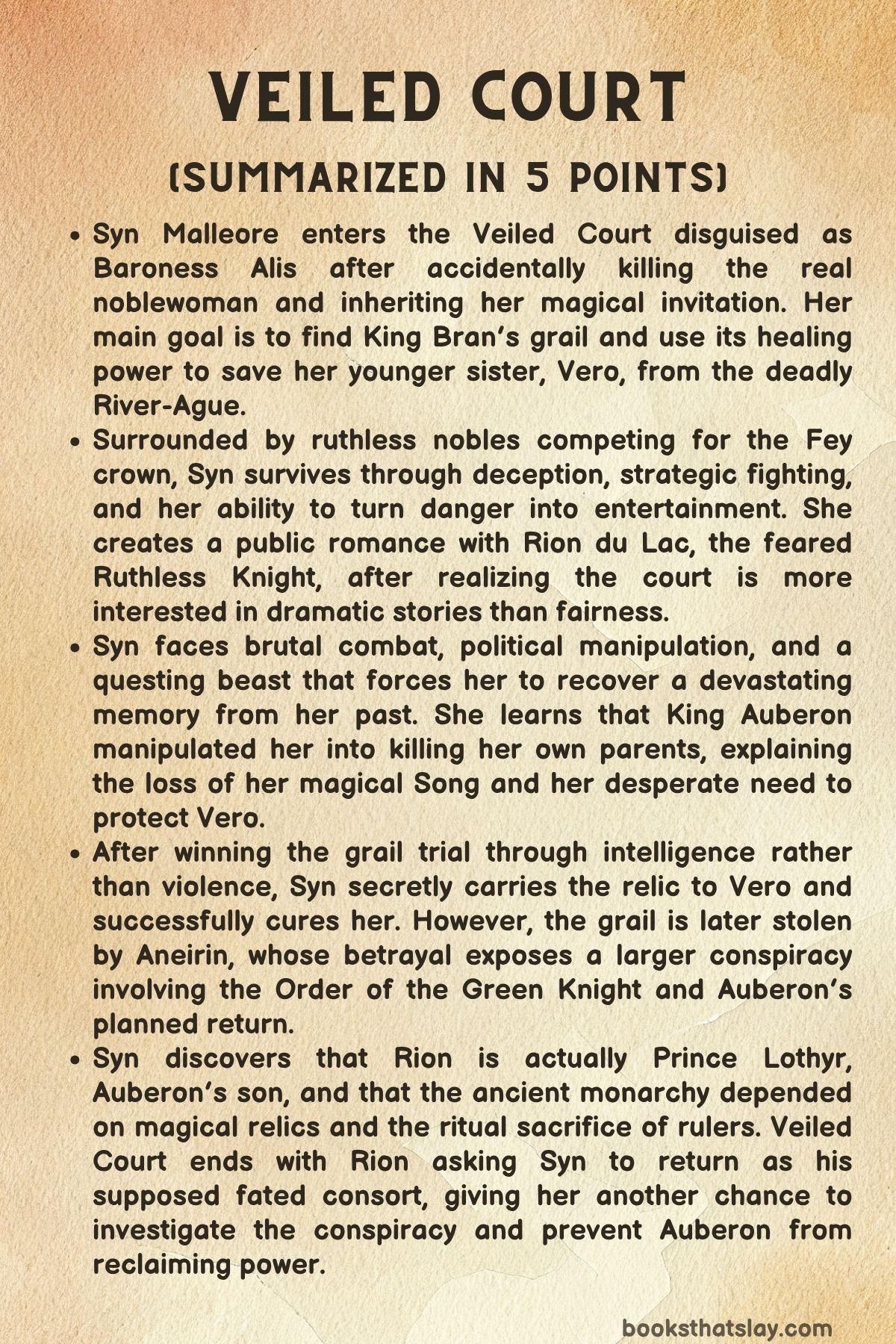
After her sister’s illness worsens, Syn enters a deadly competition disguised as a murdered noblewoman, hoping to steal a magical grail capable of curing any disease. Inside the court, she faces violent trials, political conspiracies, hidden royal histories, and Rion du Lac, a feared warrior whose identity may be as false as her own. The novel combines court intrigue, magical competition, personal guilt, dangerous attraction, and resistance against hereditary power.
Summary
Syn Malleore’s final night in London begins with betrayal. She discovers her boyfriend, Owain, with a mortal woman named Vicky, even though he had promised to escape with Syn into the Fey realm that same evening.
Owain calmly informs her that he intends to take Vicky through the portal instead. Syn hides her pain behind sarcasm and leaves, knowing she must still help her younger sister, Vero, escape the dangerous city.
London has been damaged by war between humans and Fey. Anti-Fey paramilitary forces patrol the streets, buildings bear the marks of dragon fire, and anyone with visible Fey traits risks capture or death.
Vero is also dying from River-Ague, a magical poison created by King Auberon to destroy demi-Fey people. Syn believes the legendary grail of King Bran may be the only object powerful enough to cure her.
Syn meets Vero and their friend Balin at an old church. Using a borrowed magical key, she opens a portal and sends them into Brocéliande, but she remains in London because she must return the key to her childhood friend Tristan.
On her way to meet him, Syn encounters members of the Iron Legion attacking a Fey noblewoman named Baroness Alis. Although Syn no longer possesses the supernatural Song that once made her a deadly assassin, she defeats the attackers and helps Alis escape.
Alis is a telepath and accidentally hears Syn’s hatred of monarchy, including her desire to kill Auberon. She predicts that Syn will destroy kingdoms, poison the powerful, and bring sorrow to the world.
Believing Syn must be stopped, Alis attacks her. Syn briefly senses the return of the Song and kills Alis while defending herself.
Tristan soon discovers that Alis carried a magical invitation to the Veiled Court, where nobles from hidden Fey kingdoms have gathered to compete for the vacant crown. The invitation has transferred to Syn in the form of a golden halo.
Tristan had planned to enter the court as Alis’s servant and spy on the royalists for Avalon Tower. Because magical hunters called the Cloaked Ones will kill Syn if she remains outside, she proposes impersonating Alis and continuing the mission.
The court was built by King Bran, whose grail is believed to remain hidden somewhere inside. Syn therefore has two reasons to enter: she can investigate the royalist movement and search for the relic that might save Vero.
Despite the danger, Tristan agrees to help. No one outside Alis’s isolated homeland knows what the baroness looked like, giving Syn a small chance of maintaining the deception.
Syn enters the Veiled Court dressed in mortal clothing and surrounded by aristocrats. She immediately encounters Countess Igraine and Rion du Lac, the silver-haired Ruthless Knight who has appeared repeatedly in her dreams.
Inside the magnificent fortress, Syn befriends Countess Elizabeth de Benoic, a lonely widow who has spent years under her husband’s control. Elizabeth introduces her to the court’s leading contestants, including the necromancer Mabon, the scarred warrior Dagonet, and the ambitious Igraine.
High Priestess Niniane announces that 181 nobles will compete through trials of courage, combat, leadership, and royal conduct. Contestants may leave only by winning, dying, or receiving official dismissal.
Everyone must swear not to betray or lie to the court. Syn takes the oath while knowing that her identity, purpose, history, and political beliefs are all false.
During the sigil ceremony, magical animals judge the contestants and assign them to elemental towers. Lady Blythe is rejected and burned alive by the dragon Goch, showing Syn what may happen if her lack of noble blood is exposed.
When Syn’s turn comes, ravens call her a murderer and declare that she is not what she appears to be. Instead of condemning her, they surround her like a crown, identify her connection to the Morrigan, and assign her to the Gloaming Tower.
Tristan joins her as a servant and begins preparing her for the first combat trial. Years without the Song have weakened Syn’s fighting ability, forcing her to depend on strategy, speed, deception, and the instincts left from her assassin training.
While exploring the court, Syn follows riddles connected to King Emrys, murdered princes, flowers, bridges, swords, and fire. She concludes that the grail may form part of one of the official trials.
Rion encounters her during one of these searches. He criticizes her mechanical fighting style, senses her mortal heritage, and warns that she will not survive the competition.
The court soon executes an impostor named Hermance, who murdered his noble half-brother and stole his invitation. The crime closely resembles Syn’s own, confirming that discovery would mean torture and death.
During the combat trial, Igraine promotes noble blood and openly attacks demi-Fey people. Syn recognizes that the restoration of monarchy would also restore the persecution that destroyed her family.
Rion selects Syn as his opponent, publicly describing her as weak. To protect herself, Syn invents a romance before the watching nobles, suggesting that fate has drawn her and Rion together through an ancient sovereignty bond.
The spectators eagerly accept the possibility. Syn has turned herself from an unimportant opponent into one half of a courtly love story that the nobles want to continue watching.
In the arena, Rion kills Dagonet despite Dagonet’s command of the Song. Syn kills another contestant with broken wood, gains a sword, and resists Rion’s supernatural dread long enough to fight him directly.
Knowing she cannot defeat him physically, she leaps into his arms and converts their duel into a romantic performance. Rion understands the strategy, plays along, and forces her to surrender publicly.
The council grants Syn mercy. Her popularity rises, while the deaths of dozens of contestants strengthen her belief that the crown itself must be abolished.
Rion later reveals that he suspects she is not Alis. Rather than expose her, he blackmails her into continuing their false romance because it improves his chances of becoming king.
Syn and Tristan secretly travel to Camelot to consult Tana, an Avalon Tower diviner. Tana confirms the earlier prophecies, predicting that Syn will bring failed crops, dry rivers, death, and widespread destruction.
However, Tana suggests that destruction may clear the way for a better order. She also reveals that Prince Talan and Nia have been abducted, possibly by someone associated with the Order of the Green Knight and ancient nature magic.
Rion becomes the primary suspect because of his control over forests, dragons, and primal Fey power. Syn is ordered to remain close to him and discover his real identity.
While returning to the court, Syn and Tristan are attacked by the Iron Legion. Syn is wounded by iron, and Tristan remains behind to protect Avalon Tower while she returns alone.
Lord Cador catches her entering the court illegally. He tortures her with truth-seeking magic and threatens Vero, but Syn sets his hair on fire and kills him.
Rion discovers her beside Cador’s body. He conceals the murder, heals her injuries, and increases his control over her by making her continued survival dependent on his silence.
Syn searches Rion’s chamber and finds royal genealogies connecting him to Bran, Emrys, Merlin, and Auberon. She also discovers symbols linked to the Green Man, strengthening her suspicion that he is tied to the secret order.
The next trial sends contestants after the grail while a questing beast hunts their guilt. During the journey, Igraine attacks Syn and pushes her from a cliff.
Rion abandons his own route to rescue her. His desire-based magic heals her injuries, and the rescue makes their supposed romance appear genuine to the court.
The questing beast later forces Syn to recover the memory she has buried for years. As a young assassin serving Auberon, she was ordered to execute two hooded prisoners and obeyed without seeing their faces.
The prisoners were her parents. They had spent years searching for her, but Auberon had convinced Syn that they had abandoned her.
Her Song disappeared because the truth shattered her mind and her connection to the Morrigan. Her devotion to Vero is partly an attempt to compensate for destroying the rest of their family.
At the final obstacle, the contestants must cross fire using one of two bridges. Rion takes the violent path, while Syn recognizes that the bridge made from a sword can be crossed only by abandoning weapons and armor.
She reaches the grail first and wins the trial. The court allows her to keep the relic for one week, and she secretly takes it to Vero.
After drinking from the grail, Vero’s poisonous veins disappear, her breathing returns to normal, and her natural coloring is restored. Syn finally accomplishes the purpose that led her into the competition.
During the return journey, Syn and Tristan kiss. Tristan admits that he has feared love since Auberon tortured and killed Isolde, an aristocratic woman he once loved.
Syn is also afraid of losing him, so she suggests that they remain friends. Their attempt to protect themselves leaves both emotionally wounded.
A mysterious letter then claims that Vero has been captured and orders Syn to deliver the grail to the dungeon. Rion intercepts her, but when he refuses to let her pass, Syn stabs him with an iron dagger.
The supposed kidnapper is Aneirin, who followed Syn to Vero’s cottage and used a lock of Vero’s hair to create the threat. He steals the grail and escapes.
Syn returns to the wounded Rion and uses desire to activate his healing magic. In his weakened state, he hints that Rion is not his real name.
A magical bronze raven guides Syn and Tristan to Aneirin’s ruined castle. There, Aneirin explains that loneliness, debt, and fear led him to accept help from the Order of the Green Knight.
The order took the grail and tortured him. Before dying, Aneirin reveals that Auberon is alive and that Rion is actually Prince Lothyr, Auberon’s son.
Syn also discovers the true history of the royal relics. During the Golden Age, the grail, sword, and golden bough connected the monarch to the land for one year, after which the ruler was sacrificed and the royal blood returned to the soil.
When the Cloaked Ones expose Syn’s unauthorized absence, she returns openly to the court and bargains with Niniane. She offers information about Cador’s murder in exchange for formal dismissal, then falsely names Aneirin as the killer.
Free of the halo, Syn returns to Vero. Her sister is now healthy and building a life with Balin, while Syn chooses to restore the ruined cottage where their family once lived.
The house is smaller and poorer than Syn remembers, forcing her to accept that her parents transformed hunger and hardship into comforting stories. She also discovers that her childhood dreams of the Ruthless Knight came from her mother’s shadow figures.
Rion eventually finds her and reveals that he protected her by placing evidence of Aneirin’s guilt near Cador’s body. He has convinced the nobles to invite Syn back.
The court now requires its future ruler to form a sovereignty bond with a fated consort. Because the nobles believe Syn and Rion are destined lovers, Rion needs her to return as his future queen.
Syn agrees to consider returning because it will allow her to investigate Rion, recover the relics, and uncover Auberon’s plans. Their false romance is therefore set to continue, even though each knows the other is hiding dangerous intentions.
Characters
Syn Malleore
Syn is the central character of Veiled Court, and nearly every major conflict grows from the tension between the person she was trained to become and the person she is trying to build. She is sarcastic, suspicious, politically rebellious, emotionally guarded, and capable of extreme violence when someone she loves is threatened.
Her hatred of monarchy is personal rather than theoretical. Auberon destroyed her family, used her as an assassin, manipulated her memories, and created the poison that is killing Vero.
Syn’s greatest strength is not her fading combat ability but her talent for controlling stories. She invents the identity of a Waste Land baroness, turns defeat into a romance, transforms poverty into aristocratic mystery, and uses the court’s desire for entertainment against it.
These performances also expose her uncertainty about who she truly is. She is simultaneously Syn, Alis, a former assassin, a sister, a spy, a possible queen, and the destructive figure predicted by several magical sources.
Her devotion to Vero initially appears purely protective, but the questing beast reveals its connection to guilt. Syn believes that saving her sister may compensate for killing their parents, even though no act of sacrifice can undo the past.
Her development comes through accepting uncomfortable truths. She learns that her childhood home was not the paradise she remembered, her motives are not entirely selfless, her attraction to Rion cannot be dismissed as magic, and her feelings for Tristan are stronger than friendship.
By the conclusion, Syn has saved Vero but remains involved in a larger struggle. Her return to the court may make her a queen, a destroyer of monarchy, an instrument of Auberon’s restoration, or some combination of all three.
Rion du Lac / Prince Lothyr
Rion first appears as the legendary Ruthless Knight, a beautiful and terrifying warrior associated with blood, dread, ancient kings, and supernatural authority. His silver hair, golden markings, command over Goch, and connection to the forest immediately separate him from the other contestants.
Within Veiled Court, Rion operates as Syn’s rival, protector, blackmailer, political partner, and romantic danger. He repeatedly threatens to expose her while also concealing her murders, healing her injuries, rescuing her from death, and helping preserve her place in the competition.
His cruelty is genuine rather than entirely theatrical. He kills Dagonet, destroys opponents without hesitation, torments Mabon, and treats the struggle for the crown as something he deserves to win.
Yet his behavior toward Syn reveals limits within that brutality. He repeatedly hesitates when he could kill her, sacrifices time to save her, protects her identity, and becomes emotionally invested in a woman who intends to prevent his coronation.
The revelation that he is Prince Lothyr changes the meaning of his ambitions. He is not simply a violent lord seeking advancement but Auberon’s son, a hidden royal heir connected to Merlin, nature magic, and the Order of the Green Knight.
His exact loyalty remains uncertain. Aneirin identifies him as part of Auberon’s plan, but Rion’s private motives, need for the grail, hidden name, dreams of Syn, and continued protection of her suggest that his relationship with his father may be more complicated than simple obedience.
Tristan
Tristan is Syn’s oldest friend, fellow survivor, trainer, protector, and most trusted partner. Their relationship began in Auberon’s underground academy, where they depended on each other for safety, companionship, and emotional survival.
He understands Syn more completely than anyone else. He recognizes her guilt, challenges her distorted memories, notices when she is punishing herself, and knows how fear hides beneath her sarcasm.
Tristan is an exceptionally skilled fighter and agent of Avalon Tower. He helps Syn infiltrate the court, trains her for combat, gathers intelligence, protects Vero, and repeatedly risks his life to support missions that he considers dangerously reckless.
His romantic feelings develop from years of intimacy rather than sudden attraction. The sparring scenes, dragon journey, secret climb, and eventual kiss reveal how strongly desire has existed beneath their friendship.
His past with Isolde explains his fear of commitment. Auberon murdered the woman he loved because Tristan was considered socially inferior, teaching him that love gives tyrants another weapon.
Tristan’s greatest emotional conflict is therefore between devotion and avoidance. He wants Syn but fears that naming their relationship will place her in greater danger or destroy the one bond he cannot bear to lose.
Vero Malleore
Vero is Syn’s younger sister and the primary reason Syn enters the court. Her River-Ague represents the lasting damage caused by Auberon’s campaign against demi-Fey people.
For much of the story, Vero exists under the threat of death, but she is not merely a helpless figure. She trusts Syn, supports the plan to seek the grail, builds a relationship with Balin, and creates a home despite illness and displacement.
Her recovery gives meaning to Syn’s sacrifices without erasing their moral cost. Syn kills, lies, manipulates, and risks political disaster to obtain the grail, but the cure proves that her desperate mission was not meaningless.
Vero also represents the possibility of life beyond trauma. While Syn remains drawn into violence and royal conspiracies, Vero begins creating a peaceful future based on love, domestic security, and ordinary happiness.
Countess Elizabeth de Benoic
Elizabeth is one of Syn’s first genuine friends inside the court. Her warmth, curiosity, loneliness, and openness contrast with the arrogance and cruelty of many aristocratic contestants.
She survived years of control under her husband and enters the competition after his death. Her participation reflects both a desire for freedom and uncertainty about what to do with that freedom once it has been gained.
Elizabeth is more capable than she initially appears. She survives the combat trial, uses light magic, endures Igraine’s attack, and remains loyal to Syn even without knowing the truth about her identity.
Her friendship increases Syn’s moral difficulty. Syn wants to destroy the institution that Elizabeth hopes might provide safety, belonging, and continued access to a richer social world.
Elizabeth therefore shows why unjust institutions can still attract vulnerable people. The court threatens her life, yet it also offers companionship and possibilities that her former home denied her.
Aneirin
Aneirin begins as an ally who uses shadow magic and helps Syn during Igraine’s attack. His humor, vulnerability, and friendship with Syn and Elizabeth make his later betrayal deeply personal.
His ruined castle, debts, isolation, and fear of returning home explain his desperation. The Order of the Green Knight exploits his need for money, protection, and belonging by promising him a secure place in a restored regime.
Aneirin’s attempt to steal the grail is cruel because he uses Syn’s love for Vero against her. Even so, he does not actually capture Vero, suggesting that he retains limits and cannot fully become the ruthless conspirator his employers require.
His punishment shows the true nature of the order. After he completes the theft, its members torture him and take the relic without giving him the promised reward.
Aneirin’s suicide grows from shame, despair, physical suffering, and the belief that no community remains open to him. His fate demonstrates how authoritarian movements recruit the lonely and then discard them once their usefulness ends.
High Priestess Niniane
Niniane is the religious and administrative authority behind the succession contest. She presents the Veiled Court as a sacred institution designed to identify a worthy ruler through courage, combat, and tradition.
Her actions reveal that the process is based on terror. She accepts executions, permits the council to decide whether defeated contestants deserve life, threatens families, and treats death as a reasonable method of removing the supposedly unworthy.
Niniane values obedience and ceremony more than justice. She is willing to overlook uncertainty when it protects the court’s image, but she reacts viciously when someone challenges her authority or exposes weaknesses in her control.
Her decision to dismiss Syn in exchange for information about Cador reflects political self-preservation. Maintaining the appearance of competence matters more to her than discovering the truth.
Lord Cador
Cador initially appears as a knowledgeable squire who guides Syn through the court’s history, towers, rituals, and hidden relics. His familiarity with ancient traditions makes him an important source of information.
Beneath his polished behavior lies an unquestioning commitment to royal authority. He believes relics and power belong to individuals with divine strength, noble purpose, and hereditary importance.
His interrogation of Syn reveals his cruelty. He uses truth magic to cut into her body and threatens Vero in order to force obedience.
Syn defeats him by using his vanity against him, setting the oil in his hair alight before stabbing him. His death is another example of Syn surviving through observation and improvisation rather than superior strength.
Countess Igraine
Igraine represents aristocratic supremacy in its most direct form. She believes noble blood determines worth and openly supports renewed oppression of commoners and demi-Fey people.
Her hostility toward Syn begins with class contempt and grows into romantic jealousy after the court accepts Syn’s connection to Rion. She attacks not only Syn but also Elizabeth, showing that pride matters more to her than loyalty or fair competition.
Igraine is disciplined, politically aware, physically dangerous, and skilled in water magic. These abilities make her a serious contender rather than a shallow rival.
Her character demonstrates how prejudice can be presented as order, tradition, and cultural preservation. She does not view herself as cruel because she believes hierarchy is natural and necessary.
Duke Mabon
Mabon is a powerful necromancer whose drunken behavior makes him appear ridiculous. His lack of discipline hides an ability to raise the dead and create widespread chaos during combat.
He understands the court as a spectacle based on gambling, appetite, and entertainment. Unlike Igraine, he does not require an elaborate ideology to justify violence because he enjoys the competition’s excesses.
His continued survival confirms that popularity matters more than virtue. The council spares him because his personality and magic amuse the spectators.
Mabon’s attempt to poison Syn also shows his cowardice. Rather than face her openly, he uses deception to remove a rising rival.
Dagonet
Dagonet is a physically imposing former prisoner marked by scars and hardship. His size, experience, and possession of the Song establish him as one of the court’s strongest warriors.
His command of the Song reminds Syn of the lethal power she has lost. It also creates a direct connection between the court’s violence and the part of herself she fears recovering.
Dagonet does not receive enough time to reveal his full personality because Rion kills him during the combat trial. His death primarily establishes the scale of Rion’s power.
He also represents the contest’s waste. A rare and highly trained warrior is destroyed not for justice or necessity but to improve another contestant’s path toward a crown.
King Auberon
Auberon is the central source of historical suffering even when he remains physically absent. He poisoned demi-Fey communities, manipulated trials, persecuted political enemies, destroyed families, and trained children to kill in his name.
His most calculated act against Syn was convincing her that her parents had abandoned her. He then ordered her to execute them, turning her power and obedience into instruments of psychological destruction.
Auberon also murdered Isolde to punish Tristan for crossing class boundaries. This act shows that his political system depends on controlling private relationships as well as public institutions.
The revelation that he survived changes the succession contest into part of a wider restoration plan. Through Lothyr, the Order of the Green Knight, stolen relics, and recruited agents, he seeks to recover the authority he once abused.
Baroness Alis of Listenoise
Alis is the noblewoman whose death allows Syn to enter the court. Her isolation has left her ignorant of London’s anti-Fey violence, making her dangerously confident in the protection offered by rank.
Her telepathy exposes Syn’s hatred of monarchy and produces the first prophecy of catastrophic destruction. Alis responds to that vision by attacking Syn rather than questioning whether the predicted destruction might be directed at an unjust system.
Her death is technically self-defense, but it begins Syn’s deception and places her inside a role built upon murder. The transferred halo turns Alis’s identity into both protection and a permanent threat.
Even after her death, her warning shapes Syn’s choices. Later prophecies repeatedly confirm that Alis saw something real, although the moral meaning of that future remains uncertain.
Balin
Balin is Vero’s loyal companion and eventual romantic partner. He helps her escape London, remains with her during her illness, and participates in creating a safe home after her recovery.
His importance lies in the ordinary future he offers Vero. While Syn and Tristan remain trapped in political violence, Balin helps build a life centered on care, food, books, flowers, and mutual affection.
He also reduces Syn’s responsibility for Vero. Once Vero is healed and loved, Syn must confront the possibility that her sister no longer needs constant protection.
Balin therefore helps expose the difference between love and guilt. Syn can care for Vero without making her sister’s entire life an extension of her own atonement.
Owain
Owain’s betrayal begins Syn’s movement toward the Veiled Court. He replaces her with Vicky and abandons the future they had planned together, proving that his loyalty depended on convenience.
Tristan correctly observes that Owain never treated Syn as an equal partner. He offered escape and security, but the arrangement gave him the power to remove those promises whenever he found someone he preferred.
His later life with Vicky appears tired and disappointing rather than glamorous. Syn’s refusal of his dinner invitation confirms that she no longer measures her worth through his acceptance.
Owain’s betrayal ultimately benefits Syn indirectly. Without it, she might never have encountered Alis, entered the court, found the grail, or saved Vero.
Vicky
Vicky is introduced as a romance coach who participates in Owain’s infidelity while remaining comically unaware of the contradiction. Her confidence and marketing instincts initially make her appear shallow.
Syn later uses Vicky’s understanding of romance as inspiration during the combat trial. By inventing a fated relationship with Rion, she applies the same principles of desire, narrative, and public expectation.
Vicky’s dissatisfaction in Brocéliande shows that fantasy cannot replace belonging. She wanted an extraordinary escape but soon misses London and struggles with the reality of Fey life.
Her character also contributes indirectly to Syn’s political survival. The skills Syn mocks in Vicky become tools for influencing the court.
Tana
Tana is the diviner who confirms that the prophecies surrounding Syn cannot be dismissed. Her vision presents destruction through failed crops, dry rivers, death, and transformation.
Unlike Alis, Tana does not assume destruction is automatically evil. She explains that a corrupt system may need to collapse before something healthier can replace it.
This interpretation gives Syn a way to understand her future without surrendering to fatalism. She may cause catastrophe, but the meaning of that catastrophe will depend on what she chooses to destroy and what follows.
Tana also connects the personal prophecy to the political conspiracy. Her reading points toward the Green Man, nature magic, the missing prince, and the hidden forces operating behind the succession trials.
Raphael
Raphael serves as a senior figure within Avalon Tower and helps coordinate resistance against the Iron Legion and the royalists. He treats Syn as an operative whose position inside the court could expose the larger conspiracy.
He directs her to investigate Rion after Talan and Nia disappear. His suspicions are reasonable, but his instructions place Syn in close contact with a man who can expose or kill her.
Raphael represents strategic resistance rather than Syn’s personal rebellion. He thinks in terms of organizations, intelligence, risks, and long-term political objectives.
His priorities sometimes conflict with Syn’s. Avalon Tower wants careful observation, while Syn must take visible risks to win the grail and save Vero.
Jasper
Jasper is the court’s drunken but talented designer. His initial horror at Syn’s mortal clothing threatens her disguise, but his artistic curiosity helps turn her into a convincing noblewoman.
Syn uses memories of poverty, burned vehicles, bones, violence, and stale food to create an invented image of Listenoise. Jasper translates that story into clothing that suggests embers surviving beneath ash.
His designs help Syn transform vulnerability into authority. Instead of hiding her difference, he makes it central to her public identity.
Jasper demonstrates that appearance is a political language within the court. Clothing can suggest ancestry, trauma, power, mystery, and royal potential before a contestant speaks.
Goch
Goch is the immense dragon who enforces the judgments of the sigil ceremony. His execution of Lady Blythe establishes the cost of being rejected by the court’s ancient magic.
He functions as both creature and instrument of institutional terror. The nobles treat his fire as sacred judgment, allowing violence to appear natural and unquestionable.
Rion’s ability to command Goch reveals the depth of his hidden authority. It also suggests that the forces presented as neutral judges may respond to older royal power.
Goch’s presence beneath the beauty of the castle reminds Syn that wonder and cruelty exist side by side within the court.
Lady Blythe
Lady Blythe is judged weak, confused, and incapable of defending the kingdom. When no magical animal chooses her, Goch burns her alive before the assembled nobles.
Her death proves that the competition does not merely test contestants. It claims the authority to decide whose life has value.
Blythe becomes an early warning for Syn. If her bloodline, identity, or weakness is exposed, she can expect the same public destruction.
Hermance
Hermance enters the court after murdering his noble half-brother and taking the dead man’s halo. His crime closely mirrors Syn’s impersonation of Alis.
Cador tortures a confession from him before executing him. The event shows Syn exactly how the court will respond if her own deception becomes known.
Hermance also complicates the moral distinction between Syn and other impostors. Syn has sympathetic motives, but she cannot deny that she committed a similar act and benefited from another person’s death.
Prince Talan and Nia
Talan and Nia remain mostly absent because their abduction is part of the mystery surrounding the Order of the Green Knight. Their disappearance provides Avalon Tower with evidence that the succession contest is connected to a wider conspiracy.
Rion’s interest in Talan’s poetry suggests personal knowledge or concern. This detail prevents Syn from deciding whether he participated in the abduction, knows the victims, or is following a separate plan.
Their fate remains unresolved, keeping the Green Knight investigation open beyond the immediate struggle for the grail.
Isolde
Isolde appears through Tristan’s account of his past. She was an aristocratic woman who loved him despite the difference in their social positions.
Auberon tortured and killed her because Tristan was lowborn. Her death demonstrates how monarchy controls intimacy through class boundaries and exemplary punishment.
Isolde’s memory explains Tristan’s emotional avoidance. He believes that loving someone openly invites powerful enemies to destroy that person.
Themes
Monarchy, Hereditary Power, and Institutional Cruelty
The succession contest presents monarchy as a system that disguises violence through ceremony, beauty, and claims of sacred tradition. Veiled Court places enchanted towers, magnificent clothing, royal relics, heraldic animals, and formal vows beside executions, torture, prejudice, manipulation, and public killing.
The contestants are supposedly judged on courage and leadership, yet survival often depends on ancestry, popularity, spectacle, and the council’s amusement. Lady Blythe is burned for failing to impress the court’s magic, Mabon is spared because he is entertaining, and defeated contestants live or die according to aristocratic preference.
Igraine’s speeches reveal the social order that royal restoration would create. Noble blood would again justify the persecution of demi-Fey people, commoners, and anyone associated with mortality.
Auberon represents the mature form of this system. His long life and unchecked authority allow cruelty to become policy, while institutions transform personal prejudice into law, punishment, and historical tradition.
Syn’s opposition gradually expands beyond preventing one dangerous contestant from winning. She recognizes that replacing Auberon with a different immortal ruler would preserve the structure that made his crimes possible.
The original sacrificial monarchy complicates the history further. Ancient rulers were bound to the land and killed after one year, suggesting that power once carried a physical cost before kings altered the tradition to preserve themselves.
Guilt, Memory, and the Search for Atonement
Syn’s memories are not reliable records but defenses created by trauma. She remembers a loving cottage, protective parents, and a childhood that was poor but safe because her mind has hidden starvation, violence, abandonment fears, and the murder she was forced to commit.
The questing beast destroys these protections. It forces her to remember that the hooded prisoners she executed were her parents and that they died happy to discover she was still alive.
This knowledge explains both the loss of the Song and Syn’s absolute devotion to Vero. She is not simply trying to save her sister; she is attempting to prove that she can still protect one member of the family she helped destroy.
Her atonement becomes morally dangerous because it allows Vero’s survival to justify nearly anything. Syn lies, kills guards, murders Cador, deceives friends, wounds Rion with iron, and risks political disaster to obtain and protect the grail.
Saving Vero provides relief but does not erase responsibility. The cure cannot restore Syn’s parents, undo her service to Auberon, or make every later death acceptable.
The novel instead presents healing as the ability to live after guilt without denying it. Syn must accept that her childhood contained both love and suffering, that she was manipulated but still acted, and that self-punishment cannot become her only purpose.
Performance, Identity, and the Control of Stories
Syn survives because she understands that identity is partly created through performance. Her claim to be Baroness Alis succeeds not because every detail is perfect but because she gives the court a version of Listenoise that matches its appetite for mystery.
Her mortal poverty becomes evidence of a kingdom ruined by death. Jasper’s clothing then turns that invented history into a visible image of fire beneath ash.
The romance with Rion operates in the same way. Syn cannot defeat him in combat, so she offers the court a more desirable story in which their confrontation signals a fated sovereignty bond.
Once the nobles accept the narrative, both Syn and Rion gain political protection from it. Their staged attraction affects rankings, alliances, mercy, gossip, and the future selection of a royal consort.
The performance becomes dangerous because it begins producing genuine emotion. Their kisses may be political, magical, strategic, or sincere, and neither can clearly separate those possibilities.
Rion also performs an identity. His name, ancestry, loyalties, and reasons for seeking the grail remain concealed beneath the image of the Ruthless Knight.
Stories are therefore neither simple lies nor harmless entertainment. They can save lives, conceal crimes, inspire loyalty, manipulate institutions, preserve childhood hope, or prevent people from recognizing painful truths.
Love, Loyalty, and the Fear of Vulnerability
Syn’s closest relationships are shaped by the belief that love creates danger. Her bond with Vero drives her through every trial, but it is strengthened by guilt until protection becomes an obsession that overrides other moral concerns.
Her relationship with Tristan grows from years of trust, shared trauma, and mutual dependence. He is the person who helped her escape Auberon, protected her after her magic failed, and remained beside her when she could not face her past.
Their romantic feelings become clear, yet both retreat. Tristan remembers Isolde’s murder, while Syn fears that romance could destroy the friendship that has kept her alive.
Rion offers a different form of intimacy based on danger, rivalry, desire, and mutual blackmail. He knows Syn’s crimes and can ruin her, but he also heals her, rescues her, protects her identity, and repeatedly refuses opportunities to kill her.
Syn is drawn to both men for different reasons. Tristan represents safety, history, and emotional recognition, while Rion represents power, uncertainty, physical desire, and a future tied to political transformation.
Elizabeth, Aneirin, Vero, and Balin broaden the theme beyond romance. Each seeks belonging, but their choices show that loyalty can heal, burden, deceive, or be exploited.
The story ultimately treats vulnerability as unavoidable. Refusing love may prevent immediate pain, but it also leaves characters isolated, easier to manipulate, and unable to imagine a life beyond survival.