Between Sea and Sky Summary, Characters and Themes
Between Sea and Sky by Nicola Penfold is a climate-focused dystopian adventure about children growing up in a society that uses environmental collapse to justify permanent control.
Nat belongs to the regulated compound on land, while Pearl and Clover live secretly on a floating shellfish farm with their struggling father. Their lives become connected when Nat rescues caterpillars that may transform into the first butterflies seen in years. What begins as an attempt to protect a few vulnerable creatures exposes government deception, illegal family histories and the damage caused by treating people and nature as property.
Summary
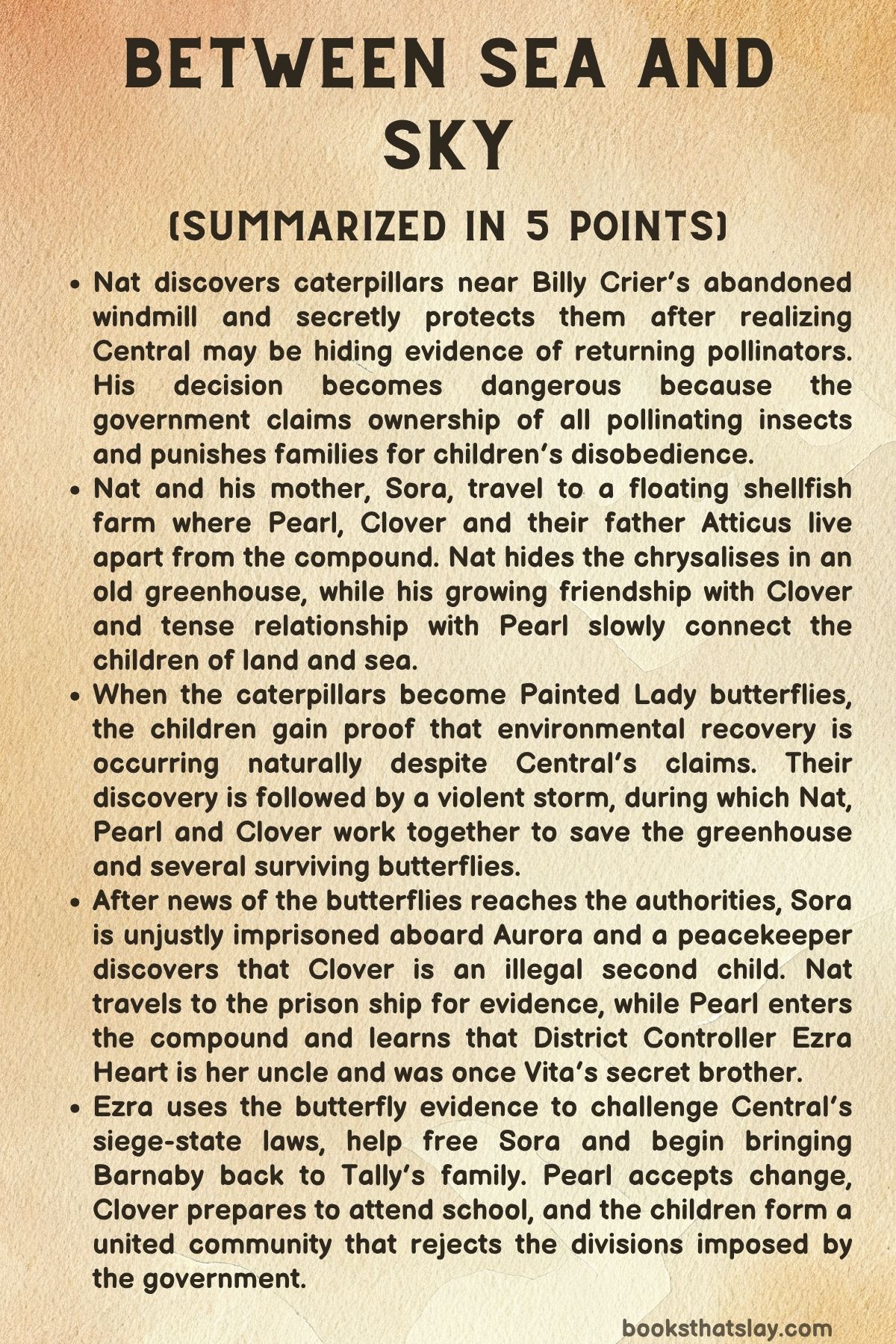
Nat lives with his mother, Sora, inside the Blackwater Bay compound, where Central District regulates employment, food, travel and family size. Every act of disobedience committed by a child adds points to the parent’s record, and families with too many points may be imprisoned aboard Aurora, the decaying ship anchored offshore.
Nat and his friends Tally and Lucas challenge the restrictions by sneaking into forbidden areas and placing coloured flags. Their most dangerous destination is Billy Crier’s abandoned windmill, named after a boy who died there during the Hunger Years while trying to warn his smuggler father about approaching customs officers.
Inside the windmill, Nat finds several names carved into the wood, including Billy and Olive. When workers from Edible Uplands arrive, Nat hides and overhears them discussing creatures that Central wants collected even though the authorities claim they cannot survive in the district.
After the workers leave, Nat discovers black caterpillars feeding on thistles. Instead of reporting them, he gathers them into his unused red flag and secretly takes them home.
Nat, Tally and Lucas research the caterpillars through an old computer in the compound library. They learn that butterfly caterpillars form chrysalises before emerging as pollinating insects, creatures that Central has declared essential to the promised environmental Recovery.
The discovery is politically dangerous because the authorities once promised to relax siege-state restrictions when pollinators returned. Tally believes Central may be removing evidence of butterflies to preserve its control, and her distrust is intensified by the loss of her younger brother, Barnaby, who was taken away under the one-child law.
Meanwhile, Pearl and her younger sister Clover live with their father, Atticus, on a floating shellfish farm built from boats and an old oil platform. Clover’s existence is illegal because families are permitted only one child, so the sisters cannot appear together on land.
Their mother, Vita, died several years earlier after becoming ill, leaving Pearl deeply attached to their isolated home. Atticus has also declined physically and emotionally, forcing the girls to handle much of the farm work while he sleeps, drinks and avoids official messages.
Pearl records the wildlife returning to Blackwater Bay in a carefully maintained ledger. She has documented porpoises, sea birds, shellfish and underwater plants, believing the recovering environment proves that life can return without Central’s supervision.
Clover, however, is tired of isolation. She wants to attend the compound school, meet other children and travel beyond the bay, while Pearl fears that contact with land will expose Clover and destroy what remains of their family.
Sora is selected by District Controller Ezra Heart to conduct research on the sea farm. She hopes to determine whether shellfish and seaweed can provide an alternative food supply, since Blackwater Bay depends dangerously on the growing tower at Edible Uplands.
Nat must accompany Sora, although he worries about leaving Tally, Lucas and the changing caterpillars. By the time he leaves, many of the insects have already formed chrysalises, contradicting official claims that they cannot survive.
At the farm, Clover welcomes the visitors enthusiastically, but Pearl treats them as intruders. She is especially angry that Sora and Nat are placed in Vita’s former office and suspects the research project is the beginning of an official attempt to take control of their home.
Nat is equally uncomfortable. He has never learned to swim, fears the moving platforms and initially dismisses the farm as strange, but Clover introduces him to the porpoises, the shellfish lines and the underwater kelp forests.
Nat eventually reveals the chrysalises to the sisters. Clover is thrilled, while Pearl immediately understands that hiding them could expose Nat, Sora, Atticus and, most dangerously, Clover.
The children decide to keep the chrysalises inside Vita’s neglected greenhouse. Nat and Clover begin restoring it, but Pearl resents their presence there because the greenhouse remains closely connected to her memories of her mother.
As Nat and Clover work together, they become close friends. Clover teaches him about the sea, takes him mudlarking and shows him the skeleton of one of the last whales, while Nat tells her about compound life and the limits Central places on education, travel and employment.
Pearl remains distant, although her curiosity about the butterflies grows. During a delivery to Aurora, she asks her imprisoned friend Olive to help her identify them and learns that they are Painted Ladies, migratory butterflies capable of travelling thousands of miles.
The information proves that the insects may have reached Blackwater Bay naturally. They do not necessarily belong to Central, despite laws declaring all pollinators government property.
While the children care for the chrysalises, Atticus injures his foot on a damaged winch. The wound becomes infected, but Pearl resists outside treatment because the hospital failed to save Vita.
Sora recognizes that Atticus may be developing sepsis and arranges for him to be taken to the compound hospital. Clover supports the decision, but Pearl argues desperately against it and refuses to say goodbye as her father leaves.
Sora remains at the hospital, leaving the children alone on the farm. Pearl discovers the full extent of Atticus’s decline when she cleans his cabin and finds empty bottles, neglected tools and bedding soaked with sweat.
Nat continues learning to swim under Clover’s guidance. The lessons gradually replace the fear he inherited from compound culture with respect for the sea, while Clover gains the companionship she has long wanted.
Pearl starts recording the chrysalises in her ledger but tears out the drawing because she fears it could become evidence. At the same time, she notices signs of an approaching storm even though official reports remain clear.
The porpoises and birds disappear, the atmosphere changes and the ropes connecting the farm begin loosening. Clover and Nat initially trust the official forecast, but Pearl starts securing the platform alone.
The first butterflies emerge before the storm arrives. Their orange, brown and black wings prove that Central’s claim about their inability to survive is false.
George, the boatman who transports supplies between the farm and land, unexpectedly sees the butterflies. Although moved by them, he is frightened because he has unknowingly carried prohibited pollinators and could face punishment.
George later mentions the butterflies at the Tavern, believing his story will be treated as a strange rumour. Instead, the information reaches the authorities, who arrest Sora and register her as a prisoner aboard Aurora because Nat is too young to receive his own civil-disobedience points.
Before the children learn about Sora’s arrest, the storm reaches the bay. The greenhouse breaks away from the farm with the newly emerged butterflies trapped inside.
Nat enters the violent water in an attempt to save them, using the limited swimming skills Clover taught him. He is quickly overwhelmed, but Pearl swims after him and shows him how to move beneath the strongest waves.
With Clover securing ropes from the platform, Nat and Pearl pull the greenhouse back towards the farm. Their survival depends on each child’s knowledge, strength and willingness to trust the others.
The storm damages the farm and kills several butterflies, but seven survive. The children hold a funeral for the dead insects, placing them on dandelions inside a wooden toy boat and releasing it into the water.
The ceremony reminds Pearl of Vita’s funeral and allows her to express grief she has suppressed for years. She finally accepts that the butterflies have become part of the farm’s history rather than merely dangerous objects brought by an outsider.
A peacekeeper then arrives with a warrant to search the platform. She sees Pearl and Clover together, discovers the butterflies and orders the children to catch them so she can confiscate them.
Pearl refuses and challenges the officer to catch the insects herself. Clover sends them flying around the greenhouse, and the officer’s inability to handle them turns the children’s laughter into an open act of resistance.
The peacekeeper finally reveals that Sora has been imprisoned for pollinator theft. Nat is devastated because his mother knew nothing about the caterpillars, while George admits that his careless conversation led the authorities to her.
Pearl explains that the insects are migrating Painted Ladies and offers to retrieve the identification guide from Aurora. George secretly writes a message in her ledger directing them to seek help from Ezra Heart.
Pearl and Clover travel to land, planning to visit Atticus and Ezra. Once ashore, Pearl separates from Clover because two sisters travelling together might attract attention.
Clover goes to the hospital while Pearl walks alone to Ezra’s house. Entering the compound requires her to confront the land she has avoided since Vita’s death.
Nat remains at the farm but soon decides that obedience will not free Sora. He rows to Aurora to retrieve the butterfly guide and confess his responsibility.
Inside the prison ship, Nat meets Sem and Olive. Olive helps him reach the hidden library, where he confirms that Painted Ladies are migratory insects.
Nat also discovers that Olive’s full name is Olive Crier. She was Billy Crier’s sister and was imprisoned as a child simply because she was an illegal second-born child.
The carved names inside the windmill belong to real children whose lives were damaged by Central’s policies. Billy’s famous death and Olive’s imprisonment are parts of the same family tragedy.
Meanwhile, Pearl reaches Ezra’s home and learns that Vita was his sister. Their sibling relationship was illegal, so Vita was raised separately and publicly described as Ezra’s friend.
Ezra is therefore Pearl and Clover’s uncle. He and Vita helped design Edible Uplands, and Vita’s vertical-growing ideas played a major role in preventing another famine.
Atticus blamed Ezra after Vita became ill, believing dangerous materials from the growing tower contributed to her death. Ezra stayed away partly because of the conflict and partly because his position required him to enforce the same law that made Clover illegal.
Ezra explains that sending Sora to the farm was not an attempt to seize it. He wanted to reconnect Vita’s sea research with Edible Uplands and create a safer, more varied food system for the district.
At the hospital, Pearl finds Atticus recovering. Clover has reached him safely, and medical treatment has saved both his foot and his life.
Atticus and Ezra begin repeating their old accusations, but Pearl interrupts them. She argues that the butterflies, porpoises, shellfish, seaweed and returning birds prove that the Recovery is already happening.
She demands that Ezra use his authority to challenge Central’s restrictions. The laws cannot continue when the environmental conditions used to justify them have changed.
Nat returns from Aurora with the identification guide. When Ezra arrives at the farm, Nat attacks him in anger, seeing him as a symbol of every official who allowed Sora, Olive, Barnaby and other innocent people to suffer.
Ezra accepts Nat’s anger and begins documenting the butterflies. He prepares to challenge both Benjamin Price and Central, supported by George and other compound residents who are increasingly willing to resist.
Sora is eventually brought home from Aurora. Ezra submits evidence demanding the repeal of Blackwater Bay’s siege-state laws, while residents begin searching the solar fields for more caterpillars.
Pearl accepts that her wishings did not save Atticus and that her fear of change prevented her from recognizing Clover’s loneliness. She agrees that Clover should attend school and welcomes Nat back to the farm.
Ezra also locates Barnaby, beginning the process of returning him to Tally’s family. Nat brings Tally and Lucas to meet Pearl and Clover, joining the previously separated children of land and sea.
Together, they perform a final wishing for Barnaby. Pearl releases the mermaid figure she created from a broken doll, using the ceremony not to prevent change but to welcome a new beginning.
Characters
Nat
Nat is one of the central figures in Between Sea and Sky, beginning as a curious compound child who tests rules mainly for excitement and recognition. His decision to rescue the caterpillars becomes far more serious than his earlier dares because it requires sustained responsibility rather than a brief display of bravery.
His curiosity is supported by strong moral instincts. He does not fully understand the political importance of the caterpillars when he takes them, but he recognizes that Central intends to destroy or hide something living.
Nat’s courage often operates alongside impulsiveness. Entering the storm to save the greenhouse is reckless, yet the decision also shows how deeply he has come to value the butterflies and the sea farm.
His development is closely connected to learning from others. Clover teaches him to swim and see the sea as a living environment, while Pearl teaches him to respect danger, observe natural signs and accept knowledge that compound society dismisses.
Nat also becomes increasingly conscious of injustice. Tally’s loss of Barnaby, Sora’s imprisonment and Olive’s childhood sentence transform Central’s laws from abstract restrictions into evidence of deliberate cruelty.
By rowing to Aurora alone, Nat stops waiting for adults to correct the situation. He accepts responsibility for his actions while also understanding that individual confession is not enough unless the larger system is challenged.
Pearl
Pearl is the emotional and observational centre of Between Sea and Sky, shaped by grief, fear and an intense desire to protect her remaining family. Her resistance to outsiders initially appears harsh, but it comes from years of carrying responsibilities that should have belonged to Atticus.
She believes safety depends on preserving the farm exactly as Vita left it. The greenhouse, the sea ceremonies and the family’s isolation become defences against further loss.
Pearl’s greatest strength is her attention to the natural world. She notices weather changes before the official instruments, records returning species and understands the sea well enough to save Nat during the storm.
Her knowledge is paired with artistic ability. The detailed ledger, her drawings and the mermaid figure reveal a creative side that she protects because it is connected to vulnerability and memory.
Pearl’s major flaw is her tendency to confuse protection with control. She dismisses Clover’s ambitions, resists medical help for Atticus and initially treats Nat’s presence as a threat rather than considering what her family needs.
Her development requires accepting that change is not always another form of loss. By walking on land, seeking Ezra’s help and supporting Clover’s education, she begins choosing connection without surrendering her identity.
Clover
Clover represents hope, movement and the desire for human connection. Although she enjoys the sea farm, she refuses to accept that isolation should define her entire future.
Her cheerful behaviour often hides serious loneliness. She dreams of school and travel because she has grown up without friends, formal education or the freedom to appear openly beside her sister.
Clover welcomes Nat because his arrival answers a need she has struggled to express. Their friendship allows her to share her knowledge, explore familiar places with new excitement and behave like a child rather than a substitute adult.
She can also be careless. Her attention to Nat distracts her from the radio, and she ignores Pearl’s storm warning because official reports seem more reliable than her sister’s instincts.
Clover nevertheless proves capable during emergencies. She secures ropes, manages equipment and helps save the greenhouse while Nat and Pearl are in the water.
Her acceptance of Ezra is quicker than Pearl’s because she is less invested in preserving old resentments. This openness helps the family imagine a future connected to both land and sea.
Sora
Sora is an intelligent researcher whose professional position does not protect her from Central’s injustice. Her work at Edible Uplands is valuable, yet she remains subject to assignments, movement restrictions and punishment for actions she did not commit.
She approaches the sea farm with genuine scientific interest. Rather than treating Pearl and Clover as curiosities, she recognizes the importance of Vita’s work and the potential of shellfish and seaweed to prevent another famine.
Sora is also a responsible parent. She worries about Nat’s friendships and behaviour, but she gives him enough independence to form his own moral judgments.
Her arrest demonstrates how collective punishment supports Central’s authority. Because Nat is legally too young to hold his own record, the government transfers his supposed offence to his mother.
Sora’s experience reveals that cooperation with the system offers no lasting security. Even a respected researcher can become a prisoner when her family threatens the official version of environmental recovery.
Atticus
Atticus is a loving but damaged father whose grief has developed into withdrawal and neglect. After Vita’s death, he loses much of his ability to manage the farm, leaving Pearl and Clover to perform adult duties.
His exhaustion, drinking and refusal to answer Ezra’s letters show that he has avoided confronting both his physical decline and unresolved anger. Pearl initially protects him because admitting his weakness would threaten her belief that the family can survive without outsiders.
Atticus’s hostility towards Ezra is rooted in grief and suspicion. He believes Vita’s work at Edible Uplands contributed to her illness and resents Ezra for remaining connected to the institution.
His hospitalization becomes a necessary interruption. Medical treatment saves him, disproving Pearl’s belief that the sea alone can heal every wound.
Atticus must eventually accept that isolating his daughters has not protected them. His recovery creates an opportunity for him to resume responsibility and rebuild relationships he allowed grief to damage.
Ezra Heart
Ezra occupies a morally complicated position as District Controller. He works inside Central’s structure, yet he has repeatedly attempted to resist its harshest decisions, including the removal of Barnaby.
His connection to Vita changes the meaning of his interest in the farm. What Pearl interprets as an official takeover is partly an uncle’s attempt to reconnect with the nieces he was forced to avoid.
Ezra’s secrecy has serious consequences. By remaining distant, he allows Atticus’s interpretation of the past to become the only version Pearl and Clover know.
He is not innocent of the district’s suffering. His authority has helped maintain a system that imprisons families, removes second-born children and suppresses evidence of environmental recovery.
Ezra’s response to the butterflies marks a turning point. Instead of protecting his position, he begins using it to challenge Central, confront Benjamin Price and organize public resistance.
His willingness to accept Nat’s anger shows that he understands political responsibility extends beyond personal intention. He cannot undo the past, but he can choose whether to continue serving it.
Tally
Tally is driven by anger over the removal of Barnaby. Her defiance is not childish rebellion but a response to a government that destroyed her family while claiming to protect society.
She immediately understands the political importance of Nat’s caterpillars. Where Nat initially sees living creatures in danger, Tally sees possible evidence that Central has broken its promises.
Her determination is also visible in the cycling race. She refuses to be treated as fragile and converts grief into discipline, defeating Nat through ability rather than sympathy.
Tally’s acceptance of Pearl and Clover at the end shows her instinctive solidarity with other children harmed by the one-child law. She understands that legal status says nothing about whether a child deserves a family.
Lucas
Lucas is the most cautious member of Nat’s original friendship group. He repeatedly offers Nat opportunities to abandon the windmill dare and warns that proof of butterflies may not be enough to defeat Central.
His caution does not make him cowardly. Instead, he understands that authorities can ignore evidence, change explanations or punish the people who expose contradictions.
Lucas provides balance to Nat’s impulsiveness and Tally’s anger. He represents the practical fear experienced by compound residents who recognize injustice but also understand the cost of open resistance.
His participation in the final ceremony shows that caution has not prevented loyalty. He ultimately joins the growing connection between the compound children and the sisters from the sea.
Vita
Vita remains influential even though she died before the main events. Pearl preserves her memory through the greenhouse, mudlarking, wishings and the belief that the sea must remain separate from land.
She was both a scientist and a mother. Her vertical-growing work contributed to Edible Uplands, while her later interest in sea crops anticipated the food system Sora and Ezra hope to develop.
Vita’s history complicates Pearl’s belief that land represents sickness and betrayal. The growing tower is not only connected to her illness; it is also part of her effort to prevent starvation.
Her illegal sibling relationship with Ezra demonstrates how Central forced families to disguise natural bonds. Even before her daughters were born, Vita’s life had been shaped by secrecy.
Vita’s legacy eventually becomes a bridge rather than a wall. Her work connects Ezra, Sora, Atticus and the children to a shared plan for Blackwater Bay’s future.
Olive Crier
Olive is one of the clearest examples of institutional cruelty. She was imprisoned at ten years old for being a surplus child, a status created entirely by Central’s one-child law.
Her connection to Billy gives new meaning to the windmill legend. The compound remembers Billy’s dramatic death but has forgotten the sister whose removal helped create his family’s tragedy.
Olive protects knowledge by caring for Aurora’s library. The books preserve scientific and historical information that Central has removed from compound education.
Her assistance to Pearl and Nat is quiet but courageous. She understands the danger of the butterfly guide, yet she helps the children because knowledge may offer a path towards freedom.
Olive’s continued imprisonment shows that survival is not the same as justice. Her ability to endure does not reduce the wrong committed against her.
George
George connects the farm, compound, hospital and prison ship through his work as a boatman. Because he moves between these places, he sees more of Blackwater Bay than most residents.
He has helped conceal Pearl and Clover for years, proving that he is capable of loyalty and practical resistance. However, his loose conversation about the butterflies leads directly to Sora’s arrest.
George’s mistake does not come from cruelty. He is excited by what he has seen and underestimates how quickly information can reach authorities in a controlled society.
His guilt pushes him towards more active resistance. By directing the children to Ezra and later transporting Ezra to Aurora, he tries to correct the harm he caused.
George demonstrates how ordinary people can support oppression without intending to do so. Silence, rumours and careless speech all carry political consequences when authorities monitor private life.
Benjamin Price
Benjamin Price represents authority without compassion. As governor of Aurora, he controls prisoners, access to information and the conditions under which people are allowed to survive.
He treats the library as his property even though he neither values nor understands its contents. Allowing Olive to work there becomes, in his mind, proof of generosity rather than another form of control.
Price registers Sora as a prisoner without establishing her responsibility. His behaviour shows that the prison system exists to enforce obedience rather than determine truth.
Unlike Ezra, he shows no willingness to question the laws he serves. His power depends on accepting official categories such as migrant, offender and surplus child without considering the human beings behind them.
Billy Crier
Billy exists through memory, legend and the consequences of his death. Compound children know him as the boy who climbed the windmill during a storm and died while trying to protect his father.
Nat initially treats the windmill as a place for proving courage. After meeting Olive, he understands that Billy belonged to a family already being destroyed by the state.
Billy’s attempt to stop the windmill mirrors Nat’s decision to enter the sea during the storm. Both boys act impulsively to save something important, but Nat survives because Pearl and Clover are able to help him.
The white feather used in the final ceremony honours Billy as more than a frightening story. He becomes part of the children’s growing awareness that official histories often hide the deeper causes of suffering.
Barnaby
Barnaby is absent for most of the story, but his removal influences many of the children’s decisions. He was taken from Tally’s family because he was an illegal second child, despite Ezra’s attempt to intervene.
His experience creates an immediate connection between Tally and Clover. Clover understands that discovery could result in the same removal, while Pearl’s protectiveness is partly driven by that fear.
Barnaby also proves that the Communal Families programme is not a distant threat. It has already separated a loved child from people who wanted to raise him.
The effort to bring him home gives the ending a concrete sign of political change. The children’s final wishing does not replace official action but supports it with shared hope.
Sem
Sem works in Aurora’s kitchen and quietly assists the prisoners. His position allows him limited movement, but he remains trapped by responsibility, displacement and the loss of his former home.
He initially discourages Nat from confronting Price because he understands how easily the prison absorbs new victims. His caution comes from experience rather than indifference.
Sem nevertheless helps Nat enter the ship, meet Olive and escape with the guide. He supports resistance when he believes it has a meaningful purpose.
His flooded homeland connects human migration to climate collapse. Central treats migrants as threats, while Sem’s history shows that displacement is often the result of environmental forces beyond individual control.
The Peacekeeper
The peacekeeper serves as an immediate agent of Central’s power. She arrives with official confidence but little understanding of the butterflies, the farm or the people she threatens.
Her attempt to capture the butterflies exposes the emptiness behind her authority. She can cite laws and issue notices, but she lacks the knowledge required to care for the creatures Central claims to protect.
She treats Nat differently because he belongs to the compound, assuming he may cooperate against the sisters. Nat’s refusal reveals how quickly old social divisions are weakening.
Although she is capable of punishment, she appears less powerful when faced with collective defiance. The children’s laughter turns her from an unquestioned representative of government into a frightened adult swinging an oyster cage at insects she cannot control.
Themes
Freedom, Control and Manufactured Emergency
The authorities maintain power by presenting every restriction as a necessary response to environmental disaster. In Between Sea and Sky, limits on movement, family size, education and access to information are defended as temporary measures, yet Central has no intention of ending them when conditions improve.
The promised Recovery becomes a political trap. Central claims that restrictions will be relaxed when pollinators return, but it confiscates caterpillars and declares them unable to survive, preventing citizens from proving that the requirement has been met.
Control extends beyond human behaviour to the natural world. Central declares ownership over butterflies simply because pollinators are valuable, treating migration and survival as events that require government permission.
The same reasoning is applied to children. Clover, Barnaby and Olive are classified as illegal because the state has decided families may contain only one child, reducing human relationships to administrative categories.
Aurora demonstrates the final result of this logic. People are confined not because they are dangerous but because their existence, movement or family connections contradict official rules.
Freedom begins when the children reject the categories imposed on them. Nat refuses to see the butterflies as property, Pearl stops treating land and sea as permanently separate, and Tally accepts Clover without judging her legal status.
The political change at the end is therefore not produced by a single discovery. It comes from people recognizing that an emergency has been deliberately extended to protect those who benefit from permanent obedience.
Grief, Memory and the Fear of Change
Pearl organizes much of her life around preserving Vita’s memory. She protects the greenhouse, repeats the wishings and resists visitors because she believes change will erase what remains of her mother.
Her grief also affects how she treats living people. She dismisses Clover’s need for friends, refuses medical care for Atticus and assumes that Sora’s research must threaten the family.
Atticus responds to the same loss through withdrawal. While Pearl becomes controlling, he becomes passive, leaving his daughters to maintain the farm and protect secrets he no longer has the strength to manage.
The wishings reveal Pearl’s attempt to create order when she feels powerless. By offering objects to the sea, she imagines that sacrifice can prevent separation, illness and death.
The storm forces her to confront the limits of this belief. The butterflies die because of natural danger rather than supernatural payment, and Atticus survives because of antibiotics and medical care rather than a ceremony.
This does not make the rituals meaningless. The butterfly funeral and the final wishing allow the children to honour loss, express hope and connect their private memories to a shared community.
Pearl’s development depends on changing the purpose of remembrance. She stops using Vita’s memory as a reason to reject the future and begins treating her mother’s work as a foundation that land and sea can continue together.
Environmental Recovery and Human Responsibility
The natural world is not presented as permanently destroyed. Porpoises, sea birds, shellfish, kelp and butterflies return whenever they are given space to survive.
Pearl’s ledger becomes an unofficial record of recovery. While Central relies on selected measurements and controlled reports, her observations show that ecological change is occurring outside government institutions.
The Painted Ladies are especially important because migration makes ownership meaningless. Their journey across great distances ignores political borders, travel bans and Central’s claim that every pollinator belongs to the state.
The children’s care allows the butterflies to complete their transformation. Their success suggests that recovery depends less on domination than on patience, habitat and protection.
Sora’s research adds another dimension to environmental responsibility. Blackwater Bay cannot depend permanently on a single growing tower, since disease or contamination could destroy the district’s entire food supply.
Vita’s work offers a model based on cooperation between systems. Vertical agriculture, shellfish farming and seaweed cultivation can support one another instead of competing for official approval.
The story also warns against romanticizing nature. The sea supports life, but it can also produce storms, infection and death, and Pearl’s knowledge is valuable because it respects both possibilities.
Environmental recovery therefore requires honest observation and shared responsibility. It cannot be managed by authorities who suppress evidence whenever nature behaves differently from their official predictions.
Family, Belonging and Solidarity
Central defines family through law rather than affection. Second-born children become surplus, siblings must conceal their relationships and parents are punished for the actions of their children.
These policies create repeated forms of separation. Barnaby is taken from Tally, Olive is imprisoned away from Billy, and Vita and Ezra are forced to grow up publicly pretending not to be siblings.
Pearl initially responds by drawing a tight boundary around her household. She believes belonging must be protected by excluding outsiders, even when Clover and Atticus are suffering inside that isolation.
Nat’s arrival challenges this belief. He becomes Clover’s friend, Pearl’s partner during the storm and part of the farm’s emotional life despite coming from the community Pearl distrusts.
Ezra’s revelation expands the sisters’ understanding of family. He is both an official connected to their suffering and an uncle who has carried his own grief for Vita.
Family reconciliation does not require pretending that past failures did not occur. Pearl continues holding Ezra accountable while allowing him to help Sora, support the farm and rebuild contact with Atticus.
The final ceremony brings together Nat, Pearl, Clover, Tally and Lucas. Their identities as compound children, sea girls, legal children and illegal children become less important than the loyalty they choose to offer one another.
Solidarity becomes the strongest challenge to Central’s authority. The system depends on keeping land residents, sea residents, migrants, prisoners and surplus children separated, while the children create a community based on shared care rather than official permission.