Black River Falls Summary, Characters and Themes
Black River Falls by Jeff Hirsch is a young adult speculative novel about memory, trauma, identity, and the difficult work of surviving after disaster. Hirsch imagines a quarantined town whose residents have lost their personal histories to a contagious virus, leaving them free to rebuild themselves but vulnerable to manipulation and control.
At the centre is Cardinal Cassidy, an uninfected teenager burdened by memories that everyone around him has lost. His relationships with Hannah, Greer, and the other survivors force him to question whether identity comes from the past, present choices, or the people who continue to care for us.
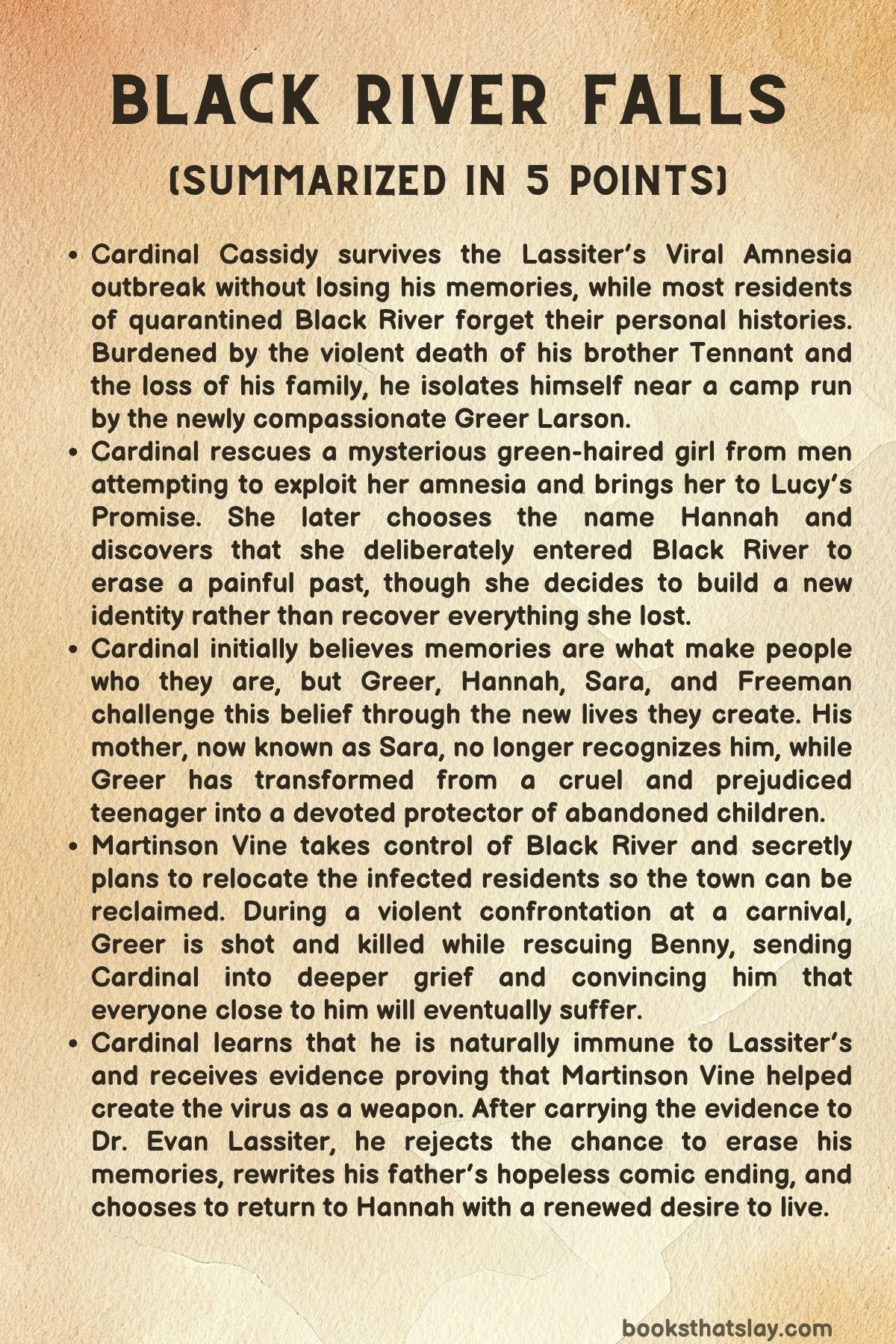
Summary
Eight months after an outbreak of Lassiter’s Viral Amnesia, seventeen-year-old Cardinal Cassidy lives on Lucy’s Promise, a mountain above the quarantined town of Black River. Unlike most of the town’s residents, Cardinal was not infected and remembers his entire life, including the outbreak’s violence and the destruction of his family.
A camp nearby is occupied by Greer Larson and eleven children who lost their memories, parents, and homes. Cardinal remains separate from them, recording his experiences in a notebook addressed to his absent older brother, Tennant, while struggling to eat, sleep, or accept Greer’s attempts to care for him.
Greer learns that two young children are surviving alone in the swamps of Joseph’s Point and wants to rescue them. Cardinal objects because the National Guard permits the camp to remain independent only while it avoids attracting more residents, creating a conflict between Greer’s instinct to help and Cardinal’s fear of losing their sanctuary.
Cardinal eventually agrees to speak to Lieutenant Gonzalez during a supply distribution in Black River. As he approaches the ruined town, abandoned houses, overgrown streets, and signs of past violence bring back memories of October Sixteenth, the day the outbreak transformed everything.
The supply crowd triggers a panic attack, and Cardinal becomes separated from Greer and the children. A woman stops to help him, and Cardinal recognizes her as his mother, but Lassiter’s has erased her knowledge of him and she responds to her own son as though he were a stranger.
Cardinal follows her briefly before wandering to his former family home. The house looks almost unchanged, but dried blood near the front door awakens memories he cannot yet face, and he collapses outside after becoming physically overwhelmed.
On his way back toward Lucy’s Promise, Cardinal sees a green-haired girl being pursued by Dale and Mr. Tommasulo. The men claim that the girl is Dale’s sick wife, but Cardinal realizes that they are exploiting her lost memory and trying to force her into an invented identity.
Cardinal fights the men, and the girl eventually helps him escape by striking Tommasulo with a board. Although she distrusts Cardinal, he persuades her to follow him to Lucy’s Promise, even allowing her to carry his hunting knife as protection.
Greer immediately points out Cardinal’s hypocrisy. Cardinal had opposed rescuing the Joseph’s Point children because of the camp’s rules, yet he has brought a stranger into their home without consulting anyone.
The situation becomes more dangerous when Greer announces that the National Guard is leaving Black River. Control of the quarantine zone will pass to Martinson Vine, a private corporation involved in security, pharmaceuticals, and construction.
Mr. Raney, Martinson Vine’s security chief, visits the camp and presents himself as cooperative. He promises to respect the arrangement that allows Lucy’s Promise to remain independent, but his friendliness carries an unspoken warning that the corporation can remove that freedom whenever it chooses.
Cardinal and Greer rescue the two starving children from Joseph’s Point and bring them into the camp, where they are temporarily named Cash and Shan. Cardinal then begins developing a connection with the green-haired girl, explaining that Lassiter’s destroys episodic memory while leaving language, general knowledge, and procedural skills largely intact.
The camp tries to determine the girl’s former identity by testing her abilities. She is academically knowledgeable, familiar with literature, and probably an experienced guitarist, but she appears in no local school records or missing-person materials.
Her last memories include ringing bells, a fence, a green backpack, and a pink crocodile. Cardinal, Greer, and the girl locate the crocodile sculpture and recover the backpack, which contains a bus ticket showing that she travelled from Indiana to Black River only days earlier.
The identification inside the bag is false, using the literary name Marianne Dashwood and an address connected to Jane Austen. A note prepared by the girl’s former self reveals that she knowingly entered the quarantine zone intending to lose her memory.
The note does not explain her history. Instead, it tells her to stop searching for her old identity and decide who she wants to become, leading her to tear it apart and allow the pieces to fall into the river.
During a camp celebration, she chooses the name Hannah. The decision gives her control over an identity previously defined by fear, uncertainty, and the unknown motives of the person she used to be.
Cardinal and Hannah grow closer, although physical contact remains dangerous because he believes she can infect him. She worries that her former self may have done something terrible, while Cardinal begins sharing stories about Tennant, his mother, and his father Derrick, creator of a comic series called The Brotherhood of Wings.
Cardinal’s mental condition steadily worsens. Nightmares combine his father’s fictional hero with Derrick and Tennant, while running, self-inflicted pain, hunger, and exhaustion become methods of controlling thoughts he cannot silence.
When Hannah and Greer plan to attend a carnival sponsored by Martinson Vine, Cardinal becomes angry and controlling. He accuses Hannah’s former self of selfishly abandoning everyone who loved her and tells Hannah that bringing her to Lucy’s Promise was a mistake.
Greer confronts Cardinal and explains that joy is not ignorance. Caring for the children, celebrating small victories, and creating moments of happiness are what prevent Greer from surrendering to despair, but Cardinal withdraws from the camp rather than accepting what Greer says.
Living alone across the reservoir, Cardinal becomes increasingly reckless. He nearly allows himself to drown, wanders through Black River without protection, and tries to force his mother, now calling herself Sara, to leave her new partner, Fred.
Sara protects Fred and treats Cardinal as a dangerous intruder. Cardinal is forced to recognize that his belief in the superiority of memory has made him possessive, violent, and unable to accept that Sara has freely chosen a new life.
Tommasulo and his companions later attack Cardinal, but Freeman Wayne, Black River’s eccentric librarian, rescues him. Freeman explains that Sara found Fred starving and helped him because she wanted to, not because she was manipulated.
Freeman also describes his own decision not to recreate the person he was before infection. Although records of that identity still exist, he has chosen to become someone shaped by books, reflection, and his current relationships.
Hannah and Greer eventually find Cardinal, and he overhears Greer calling him his best friend. Cardinal remembers that before the outbreak Greer came from a prejudiced family and was feared for his cruelty, but Cardinal concealed that history when the newly infected Greer asked whether they had known each other.
By lying, Cardinal allowed Greer to start again. This memory weakens Cardinal’s insistence that a person is permanently defined by the past, since the compassionate Greer caring for the children bears little resemblance to the boy Cardinal remembers.
Cardinal returns to Lucy’s Promise and begins repairing his relationships. Gonzalez offers to take him out of the quarantine zone and give him a future in New York, but Cardinal refuses because he is not ready to abandon Hannah, Greer, and the children.
Cardinal apologizes to Hannah and accepts that Sara’s new life may be legitimate. He also tells Greer the truth about his previous behaviour while making clear that the person Greer has chosen to become is brave, generous, and essential to the camp.
Before the carnival, Cardinal and Hannah acknowledge their attraction and briefly hold hands through protective gloves. Greer also admits that he has feelings for Hannah, but Cardinal refuses to treat her as someone either boy can claim.
The carnival is revealed as a trap. Martinson Vine disables communication, surrounds the gathering, and announces that the infected population will be forcibly transported to distant facilities so Black River can be restored to its former property owners.
As panic spreads, Cardinal leads Hannah, Greer, and the children toward Lucy’s Promise. Benny becomes separated, and Greer runs back to rescue him, confronting an armed contractor while carrying Cardinal’s knife.
A gunshot is fired, and Greer falls dead on the bridge. His death destroys the emotional centre of the camp and confirms that Martinson Vine is willing to kill anyone who resists its plan.
Cardinal responds by disappearing into his abandoned family house for eighteen days. He convinces himself that everyone would have been safer without him and withdraws into numbness, hunger, and memories of everyone he failed to save.
Hannah finds him and forces him to speak honestly about Tennant. Cardinal finally reveals that on October Sixteenth, Derrick became infected, panicked, and attacked the family with a carving knife.
Tennant tried to protect their mother and was stabbed by Derrick. He died in Cardinal’s arms after declaring that the family was never supposed to have moved to Black River, while their mother fled for help and became infected.
Believing that his memories have made life unbearable, Cardinal removes his mask and kisses Hannah. He deliberately exposes himself to Lassiter’s, expecting to lose his personal history and become free of Tennant, Derrick, Greer, and his own guilt.
Cardinal waits for the virus to erase his mind, but nothing happens. He realizes that he possesses natural immunity, which means he cannot obtain the forgetting he wanted and may be scientifically valuable.
He goes to the bridge intending to kill himself, but Freeman stops him by explaining that his immunity might help researchers develop a treatment or vaccine. Freeman also offers the possibility that the virus could be altered to overcome Cardinal’s immunity.
Freeman then reveals that before losing his memory he was Charles Ellis Dumay, a scientist and businessman involved in creating Lassiter’s Viral Amnesia. Research intended to remove traumatic memories from soldiers was transformed into a contagious weapon funded by Martinson Vine.
When researchers threatened to expose the project, Dumay recommended infecting them. Their escape caused the Black River outbreak, after which Martinson Vine abandoned Dumay and returned only when it needed to conceal its involvement.
Freeman gives Cardinal journals containing formulas, records, and evidence against the corporation. He also provides a sealed letter for Dr. Evan Lassiter explaining how the virus might be modified to infect Cardinal.
Cardinal decides to leave Black River and carry the evidence outside. Hannah objects to the idea that every infected person wants a cure, explaining that her present identity, relationships, and choices are real and might be destroyed if her former memories were restored.
She believes that before entering Black River she rejected someone who loved her and that he later drowned. Although guilt drove her to seek forgetfulness, she no longer believes she needs every detail of her former life in order to understand herself.
Before Cardinal leaves, Hannah gives him the silver key she has worn since they met. Cardinal visits Sara and chooses not to tell her that he is her son, respecting her right to live without the violent history associated with her family.
At his former home, Cardinal finally enters Derrick’s office and discovers the unfinished fifth volume of The Brotherhood of Wings. Derrick’s planned ending leaves the hero alone after everyone around him dies, reflecting the despair that consumed Derrick before the outbreak.
Cardinal takes the unfinished story with him but rejects its hopeless conclusion. In Manhattan, he gives Freeman’s journals to Dr. Lassiter, undergoes testing, and prepares to expose Martinson Vine through the press.
Although Cardinal still carries the letter explaining how to make him vulnerable to the virus, writing his account to Tennant changes his perspective. He realizes that losing his memories now frightens him more than continuing to carry them, so he destroys the letter.
Cardinal revises his father’s comic ending so that Liberty City is restored and the Brotherhood is reunited. He then begins writing to Hannah, promises to return to Black River, and asks her to save him a seat for the camp’s performance of Hamlet, choosing connection and hope over disappearance.
Characters
Cardinal Cassidy
Cardinal is the emotional and moral centre of Black River Falls, a survivor whose immunity leaves him carrying memories that everyone around him has lost. His knowledge gives him practical advantages, but it also traps him inside the violence of October Sixteenth, Tennant’s death, his father’s collapse, and his mother’s transformation.
His first instinct is to control danger by withdrawing from other people. He lives separately from Lucy’s Promise, wears protective equipment, resists accepting food, and treats emotional distance as though it were another barrier against infection.
Cardinal’s protectiveness is sincere, but fear repeatedly turns it into rigidity. He opposes rescuing Cash and Shan, distrusts Hannah, dismisses the carnival, and attempts to force Sara away from Fred because he assumes remembering the past makes him more capable of deciding what is best for everyone.
His habits reveal severe psychological distress. He cuts his palm to steady himself, runs until exhaustion numbs him, neglects food and sleep, wanders without protection, nearly drowns himself, and later prepares to jump from the bridge.
Memory becomes both his identity and his punishment. He believes that forgetting would release him from guilt, so his deliberate exposure to Lassiter’s is not simply an act of intimacy with Hannah but an attempt to erase himself without physically dying.
Cardinal’s growth begins when he recognizes that memory does not automatically produce wisdom or goodness. Greer becomes compassionate after forgetting his prejudiced past, Sara creates a peaceful life without knowing her son, and Cardinal himself becomes violent while trying to defend identities that no longer exist.
His final decision to destroy Freeman’s letter marks an acceptance of pain as part of a complete life. He does not become free of grief, but he chooses to carry it alongside love, responsibility, creativity, and the possibility of returning to Hannah.
Hannah
Hannah enters the story without a name, history, or reliable explanation for why she came to Black River. Her initial fear is reasonable because Dale and Tommasulo immediately attempt to exploit her memory loss, teaching her that other people may use the emptiness in her past to impose identities upon her.
Her decision to call herself Hannah is an act of self-authorship. Instead of allowing false documents, strangers, or an unknown former self to control her, she chooses a name that belongs to the person she is becoming at Lucy’s Promise.
Hannah retains intellectual knowledge, literary awareness, and musical ability, suggesting that education and art were central to her earlier life. Her connection to Hamlet and Ophelia gradually gives her a language for emotions that survived even when the events causing them disappeared.
She is troubled by the possibility that she entered Black River because of guilt. Her later belief that she rejected someone who loved her and that he drowned helps explain why her former self chose amnesia, but Hannah refuses to let incomplete knowledge prevent her from creating a meaningful present.
Her relationship with Cardinal is shaped by both attraction and disagreement. She understands his pain but challenges his assumption that forgetting produces an incomplete existence or that restoring memory would automatically improve the lives of infected people.
Hannah also refuses to act as Cardinal’s cure. She remains beside him when he reveals Tennant’s death, yet she confronts his self-hatred and rejects his belief that the children would be safer without him.
By helping the children stage Hamlet, Hannah creates a purpose not dependent on recovering her biography. Her identity becomes rooted in teaching, art, friendship, courage, and the choices she makes after receiving a second chance.
Greer Larson
Greer embodies the possibility that losing the past can create genuine moral change. Before the outbreak, he came from an isolated, prejudiced family, carried hateful beliefs, frightened other students, and had a reputation that Cardinal initially chooses not to reveal.
After infection, Greer becomes the most compassionate member of the Lucy’s Promise community. He feeds Cardinal without demanding gratitude, rescues abandoned children, protects the camp, organizes celebrations, and gives frightened young people the stable adult presence they no longer possess.
The unexplained “1488” tattoo on his body represents a history that he can no longer remember but cannot physically escape. It raises a difficult question within Black River Falls: whether people should be permanently judged by beliefs and actions that no longer shape their consciousness.
Greer’s strength comes from accepting emotional dependence rather than treating it as weakness. He openly admits that caring for the children and creating moments of happiness keep him alive when despair might otherwise lead him toward suicide.
His conflicts with Cardinal expose the difference between protection and fear. Greer recognizes real dangers, but he refuses to let danger become an excuse for abandoning Cash, Shan, Hannah, or the ordinary pleasures that give survival meaning.
His death while rescuing Benny completes the moral transformation that began with his memory loss. Whatever the former Greer may have believed, the person who dies on the bridge acts with courage, loyalty, and self-sacrifice.
Freeman Wayne
Freeman first appears as Black River’s eccentric librarian and philosopher. He uses literature, metaphor, and reflection to help the infected understand identity, arguing that even when memories disappear, habits and emotional patterns reveal the shape of a former life.
His belief that people need not recreate their previous identities appears compassionate and liberating. Freeman himself discovers records of who he once was but chooses to become a new person defined by books and service to the community.
The revelation that he was Charles Ellis Dumay transforms him into the book’s most morally complicated figure. Before infection, he funded memory research, helped convert it into a weapon, approved the infection of researchers who threatened exposure, and contributed directly to the disaster.
Freeman’s amnesia separates his current consciousness from Dumay’s guilt without erasing the consequences of Dumay’s decisions. He does not remember committing the crimes, yet he accepts that he must reveal the truth and may deserve imprisonment.
His preservation of journals and evidence represents an attempt at accountability rather than personal absolution. Freeman cannot undo the outbreak, restore lost memories, or revive the dead, but he can expose Martinson Vine and give the survivors a chance to resist further abuse.
His offer to help Cardinal lose his memory remains ethically troubling. He understands Cardinal’s desperation and uses the possibility of modified infection to stop him from jumping, but he also offers self-erasure as part of a bargain.
Tennant Cassidy
Tennant is physically absent from most of the narrative but emotionally present in nearly every part of Cardinal’s life. Cardinal addresses his account to him, imagines his advice, remembers his encouragement, and treats him as though he were temporarily away rather than dead.
As an older brother, Tennant was often the hopeful member of the family. He persuaded Cardinal to view the move from Brooklyn as an opportunity and believed that their parents’ ambitions might create a better future.
Cardinal idealizes Tennant after his death, turning him into a source of imagined guidance and moral certainty. This protects Cardinal from fully confronting the violent circumstances in which Tennant died.
The truth reveals Tennant’s courage. He returned home during the outbreak, tried to protect his mother from Derrick, and died in Cardinal’s arms after being stabbed by his infected father.
Tennant’s final words become a source of lasting guilt because Cardinal interprets them as confirmation that the move to Black River destroyed the family. By writing the complete story, Cardinal gradually changes Tennant from a haunting absence into someone whose life can be remembered honestly.
Sara
Sara is both Cardinal’s mother and a new person who does not remember motherhood. Her existence challenges the idea that biological continuity guarantees psychological continuity, since she retains the same body and certain emotional responses while lacking the experiences that formed her former identity.
Cardinal initially refuses to accept her new name. He sees Sara’s relationship with Fred as theft or manipulation because accepting it would mean acknowledging that the mother he loved may no longer exist in the form he remembers.
Sara demonstrates compassion independently of her former memories. She finds Fred starving, helps him receive care, forms a relationship with him, and participates in the rebuilding of the Black River community.
Her terror around knives suggests that emotional and bodily traces of the attack survived infection. She cannot remember Derrick, Tennant, or the blood in her house, but the fear remains embedded within her.
Cardinal’s final choice not to reveal that he is her son respects Sara’s autonomy. He understands that telling her the truth might burden her with violence she cannot properly process and might destroy the peaceful life she has built.
Derrick Cassidy
Derrick is remembered first as a creative father whose comic books gave Cardinal and Tennant a shared world of imagination. His early success allowed the family to leave Brooklyn, but it also drew him into isolation, professional pressure, and emotional withdrawal.
As The Brotherhood of Wings became successful, Derrick spent more time in his office and less time with his family. The hopeful move to Black River gradually became associated with arguments, loneliness, and the collapse of communication within the Cassidy household.
His infection on October Sixteenth turns a troubled father into the direct cause of Tennant’s death. Although the virus influences his panic and confusion, the horror of the act permanently joins Derrick’s face with Cardinal’s memories of violence.
Derrick’s unfinished comics mirror his declining mental state. His later stories kill heroes, destroy communities, and leave Cardinal alone, suggesting that despair had overtaken the optimism of his earlier work.
Cardinal eventually separates Derrick’s final hopeless ending from the totality of his father’s life. By revising the story, he does not excuse Derrick’s failures but refuses to allow the darkest period of Derrick’s existence to control the future.
Lieutenant Gonzalez
Lieutenant Gonzalez represents humane authority within a system that often treats the infected as logistical problems. He permits Lucy’s Promise to operate independently, provides information when possible, and recognizes Cardinal as a traumatised teenager rather than merely an uninfected asset.
His relationship with Cardinal contains a restrained parental quality. He shares Derrick’s artwork with him, protects Hannah’s presence, offers him a home in the Bronx, and imagines a future in which Cardinal can attend college and Comic Con.
Gonzalez lacks the power to prevent Martinson Vine’s takeover, but he does not pretend that the transfer is harmless. His suspicions about the corporation prove correct, and he later helps Cardinal cross the quarantine boundary with Freeman’s evidence.
His offer of escape also tests Cardinal’s priorities. Cardinal refuses because leaving would mean abandoning the camp, but Gonzalez keeps the possibility of an outside life available without forcing him to choose it immediately.
Mr. Raney
Raney is the public face of Martinson Vine’s control over Black River. He speaks politely, offers supplies, and promises cooperation, but every friendly gesture is supported by armed personnel and the knowledge that he can revoke the camp’s independence.
His methods demonstrate how coercion can be disguised as administration. He avoids open hostility until the corporation is ready to relocate the infected, allowing people to believe they are safe while resources and forces are quietly positioned around them.
Raney views Black River primarily as a problem of security, property, and public expense. The residents’ identities, relationships, and newly formed communities matter less to him than restoring economic order and protecting Martinson Vine.
His participation in the forced relocation shows that he is not simply an employee following neutral policy. He knowingly helps construct a trap in which a carnival becomes the setting for confinement, violence, and Greer’s death.
Benny
Benny represents the emotional vulnerability of children whose memories have been erased. After infection, he could no longer recognize the adults claiming to be his parents and repeatedly ran away because their familiarity felt threatening rather than comforting.
Cardinal helps Benny manage fear by reconstructing a peaceful memory in sensory detail. This technique shows that even incomplete or recent experiences can become tools for emotional survival.
Benny’s trust in Cardinal makes Cardinal’s withdrawal especially damaging. When Cardinal breaks promises or disappears, Benny experiences another form of abandonment after already losing his family and personal history.
Greer’s death occurs because he returns to save Benny, but the book does not present Benny as responsible. Instead, the event shows why Greer’s caregiving matters and why vulnerable lives must not be measured according to the risks involved in protecting them.
Cash and Shan
Cash and Shan are discovered starving in a crude shelter at Joseph’s Point. Their rescue begins as the subject of an argument about rules and security, but their condition proves Greer’s belief that refusing to act would have been morally indefensible.
Their temporary names acknowledge both loss and possibility. Since no one knows their original identities, the camp offers them food, safety, companionship, and the freedom to form new connections.
They also expose the limits of Cardinal’s defensive reasoning. His fear that rescuing them will endanger the entire camp is understandable, but their suffering shows that survival without compassion can become another kind of failure.
Tommasulo and Dale
Tommasulo and Dale exploit the confusion created by Lassiter’s. They attempt to convince Hannah that she belongs to them, relying on her inability to verify their claims and using the language of family and medical concern to disguise coercion.
Tommasulo’s desire to force Cardinal into the role of a son reveals the same possessive logic. He treats lost memory as an opportunity to manufacture relationships in which consent has no meaning.
Their actions provide a darker version of Cardinal’s behaviour toward Sara. Although Cardinal’s motives are more sympathetic, his attempt to force Sara back into an old identity resembles the assumption that another person’s history gives someone else ownership over the present.
Dr. Evan Lassiter
Dr. Lassiter enters near the conclusion as the scientist capable of interpreting Freeman’s records and studying Cardinal’s immunity. His work represents the possibility that science used destructively by Martinson Vine can be redirected toward treatment and prevention.
He is also connected symbolically to Cardinal’s final moral choice. Freeman’s sealed letter would allow Lassiter to modify the virus so Cardinal could lose his memories, but Cardinal repeatedly delays handing it over.
By destroying the letter while continuing to cooperate with Lassiter’s research, Cardinal separates helping others from destroying himself. Lassiter may use Cardinal’s immunity to protect future victims, but he will not be given the means to erase Cardinal’s identity.
Themes
Memory and the Construction of Identity
Memory appears neither as the complete foundation of identity nor as something people can lose without consequence. Cardinal remembers everything and initially believes this makes him more authentic than the infected, yet his memories frequently distort his judgement, trap him in guilt, and prevent him from recognizing the reality of other people’s present lives.
Hannah, Greer, Sara, and Freeman demonstrate that identity can be constructed through current choices. Greer becomes compassionate despite an earlier history of hatred, Sara forms a loving relationship without remembering motherhood, and Hannah creates a name, purpose, and community without recovering her biography.
The novel does not argue that the past is meaningless. Emotional responses, physical habits, artistic abilities, fears, and moral injuries survive in altered forms, suggesting that personal history continues to influence people even when conscious recollection disappears.
Black River Falls ultimately presents identity as a relationship between memory and choice. Cardinal’s final decision to preserve his recollections recognizes that pain is part of him, while Hannah’s decision not to pursue a complete restoration recognizes that the present person also deserves protection.
Trauma, Grief, and the Desire to Forget
Cardinal’s suffering is intensified by his inability to escape memories of Tennant’s death. The images of blood, knives, his father’s face, and the ruined family home repeatedly enter his mind, producing panic attacks, nightmares, sleeplessness, self-harm, and suicidal behaviour.
For Cardinal, forgetting becomes a form of imagined peace. He envies the infected because he believes they have been released from guilt, and he exposes himself to Lassiter’s expecting the virus to provide an emotional death without destroying his body.
Hannah’s former self appears to have reached a similar conclusion. Believing herself responsible for another person’s drowning, she entered Black River because she thought a life without memory would be easier than living with remorse.
The story rejects the idea that forgetting automatically heals trauma. Sara retains terror around knives, Hannah carries unexplained guilt and fear of closeness, and Greer’s body still bears the symbols of a hateful history he cannot recall.
Healing begins not when painful memories disappear, but when characters stop facing them alone. Cardinal’s confession to Hannah, his written account to Tennant, and his revised comic ending allow grief to become part of a continuing life rather than proof that life must end.
Community, Care, and Chosen Family
Lucy’s Promise survives because its residents repeatedly choose responsibility for one another. Greer brings children together, distributes food, creates celebrations, and refuses to abandon Cash and Shan even when helping them may threaten the camp’s arrangement with the National Guard.
Cardinal initially views independence as safety. He lives apart, rejects food, hides his feelings, and assumes that emotional attachment creates vulnerabilities that enemies, illness, or death will eventually exploit.
The camp demonstrates the opposite. Shared meals, music, games, gardening, storytelling, and theatrical performance do not remove danger, but they give the residents reasons to survive danger.
Chosen family becomes especially important because biological relationships have been disrupted by amnesia. Benny cannot recognize his parents, Sara cannot recognize Cardinal, and Hannah does not know whether anyone outside Black River is searching for her.
The relationships formed after the outbreak are not inferior replacements. Greer becomes a parent to the children, Hannah becomes their teacher, Gonzalez acts as a protective adult for Cardinal, and Cardinal eventually accepts that participating in these bonds is worth the risk of further loss.
Greer’s death shows the terrible cost of care, but it does not make his devotion meaningless. His influence continues through the children he protected and through Cardinal’s eventual decision to return rather than disappear.
Corporate Power, Moral Responsibility, and Hope
Martinson Vine treats human suffering as a problem of reputation, property, and institutional control. The corporation funds the transformation of therapeutic research into a weapon, abandons the people harmed by the outbreak, and later returns to conceal evidence and remove the infected population.
Its carnival illustrates how power disguises violence. Entertainment, supplies, and polite promises create the appearance of cooperation while helicopters, transports, weapons, and communication restrictions are prepared in secret.
Freeman’s past complicates responsibility because the person confessing the crime no longer remembers committing it. Although Freeman is psychologically different from Charles Ellis Dumay, he accepts that memory loss does not erase the consequences of Dumay’s decisions.
Cardinal faces a different form of responsibility when his immunity offers hope for a vaccine. He resists because he already feels responsible for too many people, yet he eventually agrees to help without accepting the belief that he must sacrifice his identity.
Hope emerges through acts of revision rather than a complete return to the world before the outbreak. Black River’s residents plant gardens, rebuild neighbourhoods, form families, perform plays, preserve evidence, and create new stories.
Cardinal’s rewritten comic ending expresses this possibility most clearly. He cannot bring Tennant or Greer back, but he can reject the conclusion that every community must be destroyed and every survivor must remain alone.