Brighter than Before Summary, Characters and Themes
Brighter than Before by Courtney Walsh is a contemporary romance and personal-reinvention novel about a middle-aged woman rebuilding her identity after divorce.
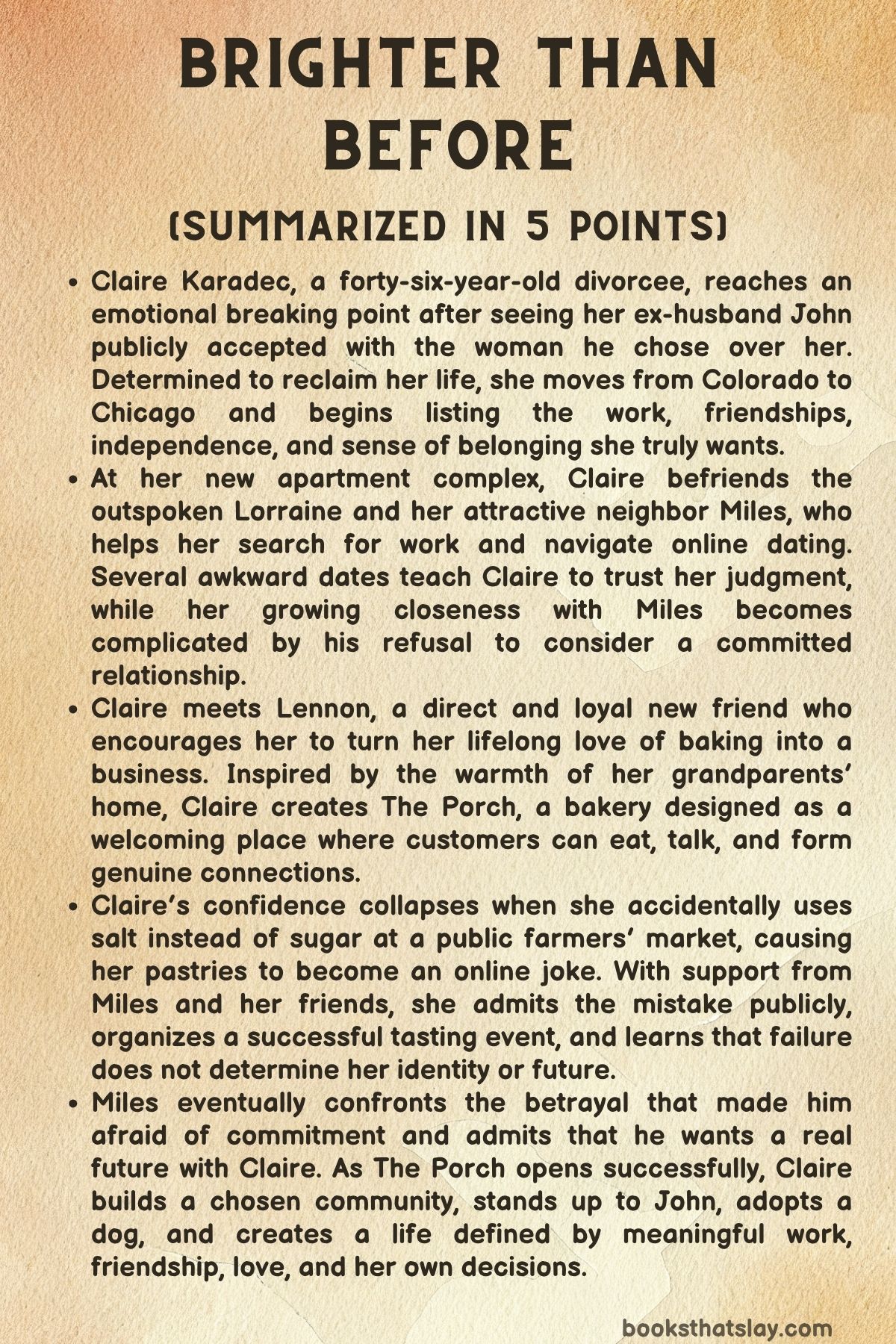
Claire Karadec has spent decades shaping herself around marriage, motherhood, and social expectations, only to discover that the life she carefully maintained could disappear overnight. Her move to Chicago begins as an attempt to escape humiliation, but it gradually becomes a search for meaningful work, honest friendship, independence, and love. Through baking, dating mishaps, public failures, and an unexpected connection with her neighbor Miles, Claire learns that starting again does not require certainty. It requires enough courage to take the next step.
Summary
Forty-six-year-old Claire Karadec has spent the year following her divorce hiding inside the Colorado home she once shared with her husband, John. Her life has become quiet, lonely, and directionless, while John appears to have moved forward without difficulty.
One evening, Claire sees several former friends dressed for the annual One Voice charity gala, an event she once organized. Acting on impulse, she follows them to the country club and watches from outside as John arrives with Misty, the younger woman with whom he had an affair.
Misty is welcomed by Claire’s former social circle as though she has already taken Claire’s place. Claire is especially shaken when she notices what looks like an engagement ring on Misty’s hand.
Trying to get a closer look, Claire sneaks around the grounds in sweatpants, flip-flops, a baseball cap, and sunglasses. Motion-activated lights expose her, and she climbs into a freezing fountain to hide.
The splash draws attention, and John, Misty, and several former friends discover Claire soaked and humiliated. The incident forces Claire to admit that she has reached the lowest point of her life.
Back at home, Claire reflects on the years she spent trying to satisfy John’s wealthy family. His mother, Marilyn, influenced Claire’s clothes, hair, home, social behavior, and understanding of what a respectable wife should be.
Claire had gradually erased parts of herself to fit into a world where she never felt fully accepted. Even after John betrayed her, his family treated Claire as though she were responsible for the failure of the marriage.
Seeking comfort, Claire bakes a Texas sheet cake using a family recipe. Baking reconnects her with Gram, the grandmother who raised her after Claire’s unstable mother proved unable to provide a secure home.
Claire finds the journal recommended by her therapist, Dr. Baskin, and rereads a question she previously avoided: what does she really want? She begins listing her desires, including meaningful work, genuine friends, a new city, a dog, an independent identity, and a place where she belongs.
One month later, Claire moves to Chicago. She sells the Colorado house, reclaims her maiden name, reduces her possessions, and settles into an apartment at the Bexley, a brick complex surrounding a beautiful courtyard.
Her daughter, Minnie, is studying at Oxford and strongly supports the move. John opposes it, warning that Chicago is expensive, dangerous, and unsuitable for a woman without a plan, but Claire reminds him that her decisions no longer belong to him.
At the Bexley, Claire meets Lorraine Ashby, an outgoing older resident with a habit of sharing community news. Lorraine introduces her to the building and mentions Miles, the man living across from Claire who owns the property and redesigned its neglected courtyard.
Claire soon sees Miles with two younger women and assumes he is a careless man who dates women half his age. Because of John’s behavior, she interprets Miles through the distrust created by her marriage.
Minnie secretly creates a profile for Claire on a dating app called Matched. Although Claire is alarmed, she recognizes that dating may be part of the new life she claims to want.
Her first effort to eat alone at a restaurant ends in panic when she sees groups, families, and couples enjoying themselves. She retreats home, but instead of abandoning her list, she promises to attempt the challenge again.
A second embarrassing encounter occurs when Claire locks herself outside while wearing a robe, facial mask, and hair treatment. Miles finds her hiding in the bushes with bags of Chinese food and helps her return to her apartment.
Claire learns that Miles owns the Bexley and knows where the spare keys are hidden. His humor and kindness make her question the negative conclusions she has drawn about him.
Claire begins searching for work, though she has not held a paid position since college. She has a communications degree and regularly contributed ideas to John’s advertising campaigns, but John always received the professional recognition.
Miles accompanies Claire around the neighborhood as she submits applications. His relaxed manner helps her tolerate awkward interviews and speak more confidently with strangers.
The two quickly become friends. When Miles discovers her dating profile, he offers to become her online-dating adviser in exchange for baked goods.
During an evening spent reviewing possible matches, Claire learns that Miles has two grown daughters, Zoey and Ava. He also tells her that he dates casually and has no intention of marrying again.
Claire appreciates his honesty but is troubled by his refusal to imagine a committed future. She still believes that love should involve permanence, even though John’s betrayal has made her suspicious of romantic promises.
Miles recommends Roger as Claire’s first date because he seems harmless and unlikely to create pressure. He describes the meeting as practice rather than an audition for another marriage.
Before the date, Miles takes Claire on a walk through Chicago. They visit the lakefront, where he helps her climb onto the rocks and holds her hand slightly longer than necessary.
Claire recognizes that she is attracted to him. However, she considers Miles emotionally unsafe because he has clearly stated that he does not want commitment.
Her date with Roger becomes a disaster when he arrives late and intoxicated. He spends the evening complaining about his separated wife, Eileen, before admitting that he still wants her back.
Claire arranges a ride home for Roger and advises him to leave the app until he has processed the end of his marriage. Instead of abandoning the pizza tour, she completes it alone and connects with other participants through shared stories of failed relationships.
The night becomes a quiet victory. Claire faces embarrassment, sets a boundary, speaks to strangers, and continues the adventure without depending on a man to rescue it.
Claire briefly finds work at a coffee shop but loses the position after spilling a drink on a French diplomat. Miles and Minnie both encourage her to stop viewing baking as a minor domestic skill and consider it a possible career.
John calls to criticize Claire’s move and ask whether Misty may use the Wellesley family name. He then requests ideas for an advertising campaign, expecting Claire to continue supplying the creative work he once accepted without crediting her.
The request exposes how thoroughly John benefited from Claire’s abilities while discouraging her from building an independent career. Claire begins to recognize that her unpaid contributions were real work, even if they were never acknowledged.
At an upscale food hall, Claire attempts to speak to a stranger and is rudely rejected. Another woman named Lennon witnesses the exchange and invites Claire to sit with her instead.
Lennon is direct, energetic, and openly supportive. By the end of their meal, she simply asks Claire whether she wants to become friends.
Their connection gives Claire one of the things she wrote in her journal: an honest friendship based on choice rather than social obligation. Lennon also challenges Claire’s habit of minimizing John’s manipulation.
Lennon works in real estate and shows Claire an empty commercial property in Lincoln Park. The neglected shop contains a front room, kitchen area, and outdoor space.
Claire begins imagining a bakery inspired by Gram and Pop, family gatherings, church bake sales, and the small-town doughnut shop where regular customers knew one another. She names the business The Porch and adopts the motto “Sit, sip, and stay awhile.”
Her vision is larger than selling pastries. Claire wants to create a place where people can slow down, talk, and feel welcome in a city where loneliness often remains invisible.
Although Claire worries that she lacks professional culinary training or business experience, Lennon reminds her that she has years of experience in budgeting, event planning, hospitality, and baking. These abilities were overlooked because they were performed within marriage and community service rather than paid employment.
Claire continues dating, meeting Scott, who spends an architectural boat tour correcting the guide, and several other men who are self-absorbed, incompatible, or strange. The dates are disappointing, but each one teaches her to trust her instincts instead of making herself agreeable.
When Claire shows Miles the proposed bakery space, he immediately understands her idea. He offers advice about the outdoor area, permits, and design while encouraging her to replace “I don’t know” with “What if?”
Claire adds falling in love to her private list but crosses it out almost immediately. The act reveals that she still wants partnership, even though she fears that admitting the desire will make her vulnerable.
Lennon later invites Claire to what appears to be a pickleball game but is actually a singles event. Claire brings Miles, assuming his social confidence will make the gathering less uncomfortable.
Claire is paired with Greg, while Miles meets Daphne. Watching Daphne flirt with Miles causes Claire to experience jealousy she cannot logically defend, since Miles has never promised her exclusivity.
The four arrange a double date at a sushi-making class. Greg and Daphne soon discover a shared devotion to their cats and become more interested in one another than in Claire or Miles.
Claire and Miles spend much of the class exchanging amused looks. Their natural connection makes the official pairings seem artificial.
Afterward, Claire and Miles continue the evening alone. They take a playful photograph together that could make John believe Claire has moved on, but Claire decides not to send it because provoking John would keep her tied to his opinion.
Claire tells Miles how she discovered John’s affair at the One Voice gala. She had overheard her friends Roxie and Lainey discussing the affair while blaming her for failing as a wife.
She confronted John and Misty, then publicly exposed the betrayal during the charity program. The moment was recorded and spread online, allowing strangers to portray Claire as unstable while paying less attention to John’s actions.
Miles listens without judgment and tells her that John failed her. His compassion creates an intimate moment that neither of them can easily dismiss.
Claire decides to commit to The Porch. She refuses Miles’s offer of financial help because she needs the business to belong to her, though she accepts his professional advice and emotional support.
Their attraction finally leads to a kiss. Miles admits that he likes Claire but repeats that he cannot offer a committed future.
Claire knows that she cannot accept a casual relationship without becoming emotionally attached. They agree not to kiss again and attempt to preserve their friendship, but both understand that their relationship has changed.
Claire begins dating Duffy, Lorraine’s dentist. He is thoughtful, dependable, interested in her business, and openly enthusiastic about his unusual interests.
Duffy takes Claire to a comic convention and explains how he learns about children’s favorite fictional characters to help nervous patients feel comfortable. Claire recognizes his kindness and authenticity.
Yet she does not feel the attraction she experiences with Miles. She realizes that choosing Duffy because he seems safe would be unfair to both of them.
At The Porch, Claire meets Zoey and discovers that the young women she assumed Miles was dating were actually his daughters. The misunderstanding forces Claire to acknowledge how strongly she projected John’s behavior onto another man.
Zoey works in marketing and helps develop The Porch’s visual identity. She also invites Claire to a trivia night with employees from Miles’s landscaping company.
Claire sees that Miles has built a loyal professional community and is respected as a generous leader. She also learns that he has barely dated since she arrived.
When a man named Barry directs insulting remarks toward Claire, Miles punches him. Claire tends to his injured hand afterward, and their emotional closeness returns, but Miles withdraws again.
Lennon tells Claire that she is treating Duffy as emotional protection. Claire admits that she loves the security he represents but cannot deny her feelings for Miles.
John continues warning Claire that she lacks the experience to open a bakery. His messages briefly weaken her confidence, but she recognizes that he has always disguised control as concern.
Claire tells him that if The Porch is a mistake, it is hers to make. She also refuses to provide the advertising ideas he continues requesting.
At a farmers’ market, Claire plans to introduce her products to Chicago. Miles, Zoey, Ava, and other friends help create a beautiful display.
The event becomes disastrous when Claire accidentally switches or mislabels the salt and sugar. Customers react with disgust, and videos of the ruined pastries begin circulating online.
The failure resembles the public humiliation surrounding her divorce. Claire becomes convinced that she has destroyed The Porch before its opening and that John may have been right about her.
She locks herself in the bakery bathroom and repeatedly watches mocking posts. Miles joins her on the floor and gives her three uninterrupted minutes to express every fear she has.
Claire admits that she has invested much of her savings, has no formal training, and feels responsible for disappointing everyone who supported her. She also shows Miles the old fountain video and explains that the new humiliation seems to confirm the internet’s cruel image of her.
Miles reminds her that mistakes are events rather than identities. Being betrayed did not make her a failed wife, and using the wrong ingredient does not make her incapable of owning a bakery.
He takes her to a community playground created by his company and finally explains his own history. Betrayal damaged his marriage and business, nearly causing him to abandon his career.
Instead, Miles reclaimed the company and began creating spaces where people could gather. He tells Claire that pain does not erase talent and that the worst moment does not have to become the final one.
Back at the Bexley, Claire finds that her friends have organized a gathering. Duffy is present, and Claire honestly ends their romantic relationship.
Duffy responds with dignity and acknowledges that her feelings for Miles are obvious. His grace confirms that he deserves someone who can return his affection fully.
Claire then confronts Miles about his conflicting behavior. He is jealous, protective, affectionate, and deeply involved in her life, yet he continues claiming that he wants no commitment.
She asks him what he really wants. When he cannot answer, she leaves him to confront the fear governing his choices.
Lennon, Zoey, and Lorraine develop a plan to repair The Porch’s reputation. Lorraine reveals that her online channel has millions of followers and offers to share a video in which Claire accepts responsibility and invites viewers to a free tasting event.
Claire records the message without pretending to be perfect. By controlling her own story, she replaces shame with honesty and invites the public to watch her try again.
She also closes her dating profile and visits a Degas exhibition alone. Studying unfinished sketches helps her understand that growth can be incomplete and still lead somewhere meaningful.
Miles eventually stops avoiding his feelings. He tells Claire that he is crazy about her, kisses her, and asks her on a real date.
Before the tasting event, Miles and his employees transform the bakery’s neglected outdoor space into the Back Porch. The finished area reflects every element of Claire’s vision.
The sample event attracts a large crowd. This time, customers praise the cakes, muffins, cookies, and pastries, while several people tell Claire that her recovery video encouraged them to face their own failures.
Claire realizes that The Porch is already fulfilling its purpose by creating connection. Her willingness to be honest has become more powerful than an image of perfection.
Miles plans their first official date around experiences Claire missed during her marriage. He takes her to a Chicago flight attraction similar to one John always refused to visit.
Claire learns that Miles kept a list of date ideas while pretending to advise her about other men. He saved his favorite plans because he secretly wanted to share them with her.
Miles describes the future he now imagines: ordinary mornings, neighborhood walks, time with their daughters, new restaurants, coffee, and perhaps a dog. Claire understands that he is no longer offering temporary companionship but a shared life.
Their date is interrupted emotionally when they return to find John waiting outside Claire’s apartment. He claims to have come because he is concerned about the financial risk of The Porch.
Claire recognizes the familiar condescension beneath his concern. Instead of feeling intimidated, she laughs because his judgment no longer defines her.
She tells John that she has friends, meaningful work, independence, and a relationship with someone who values her ideas. The bakery may succeed or fail, but she trusts herself to handle either outcome.
John gives an imperfect apology and asks for forgiveness. Claire admits that she has not forgiven him yet but believes she eventually will, not for his benefit but because she does not want anger controlling her future.
One week later, Claire prepares for The Porch’s grand opening. Minnie returns from England, immediately bonds with Miles, Zoey, and Ava, and joins the community Claire has built.
The bakery opens with a line of customers outside. Claire turns on the lights and flips the sign to “Open,” recognizing that the dream written privately in her journal has become real.
The grand opening is highly successful, and the bakery continues attracting customers. Claire creates honest online content about the realities of running a new business, strengthening the relationship between The Porch and its community.
During an evening video from the Back Porch, Claire reflects on the question that began her transformation. She explains that people do not need every answer before beginning and that courage often feels almost identical to fear.
Miles arrives with another unfamiliar Chicago food and tells Claire that he loves her. Claire returns his declaration, accepting the uncertain but hopeful future they are creating together.
Her journal eventually includes a photograph of Harley, the shelter dog she adopts. Claire can now look at her original list and see meaningful work, real friends, love, a dog, belonging, and a life chosen according to her own desires.
Characters
Claire Karadec
Claire is the emotional and narrative center of the novel, a forty-six-year-old woman whose divorce exposes how completely she built her identity around pleasing other people. At the beginning, she is ashamed, isolated, and deeply influenced by the belief that John’s betrayal proves she was an inadequate wife.
Her humiliation at the charity gala and fountain incident is not merely an embarrassing episode. It represents the collapse of a social identity that depended on marriage, wealth, reputation, and acceptance by people who never truly respected her.
Claire’s background helps explain her determination to create stability. Born while her mother was imprisoned and raised mainly by her grandparents, she learned early that security could disappear without warning.
Gram and Pop gave her love, recipes, routines, and a sense of home, but Claire also learned to conceal her childhood from John’s family. Their judgment reinforced her belief that she needed to appear polished and respectable to deserve belonging.
Her move to Chicago becomes the first major decision she makes without seeking permission. Although she often hears John’s warnings in her thoughts, she gradually replaces his judgment with her own developing instincts.
Claire’s journal is central to her growth because it forces her to name desires she previously treated as selfish. Each item on her list represents a part of herself that was ignored during her marriage.
Her dating experiences reveal both her vulnerability and her increasing strength. Roger, Scott, Duffy, and the other men are less important as romantic possibilities than as opportunities for Claire to practice setting boundaries and trusting her reactions.
Claire’s bakery dream brings together her personal history and emerging independence. The Porch allows her to turn recipes associated with childhood safety into a professional mission centered on hospitality and human connection.
Her response to the farmers’ market failure demonstrates how easily old shame can return. Yet her eventual decision to acknowledge the mistake publicly proves that she is no longer willing to disappear whenever other people laugh at her.
Claire’s romantic development depends on learning the difference between safety created by control and safety created by mutual respect. John expected compliance, while Miles encourages her ambition and treats her ideas as valuable.
In Brighter than Before, Claire’s success is not limited to opening a bakery or finding a new partner. Her greatest achievement is learning that she can survive failure, uncertainty, and rejection without abandoning herself.
Miles
Miles initially appears to Claire as a charming but emotionally unreliable man. Her suspicion is based largely on seeing him with Zoey and Ava, whom she incorrectly assumes are younger women he is dating.
His patience with Claire’s awkward situations immediately establishes his warmth. He helps her after she locks herself out, guides her through the neighborhood, supports her job search, and becomes her dating adviser without making her feel foolish.
Miles uses humor to reduce Claire’s anxiety, but his lightness hides serious emotional damage. His refusal to consider marriage or commitment developed after betrayal damaged both his personal life and professional trust.
Unlike John, Miles never pretends that his emotional limitations are virtues. He openly tells Claire that he does not want commitment, even when honesty risks preventing the relationship he secretly desires.
His landscaping career reflects his deeper character. Miles takes neglected spaces and turns them into places where people can gather, an ability that parallels Claire’s wish to transform an empty shop into The Porch.
He is also a devoted father and respected employer. Zoey and Ava trust him, while his employees see the company as a community rather than a strictly professional environment.
Miles’s support for Claire is practical as well as emotional. He helps with design, permits, promotion, outdoor planning, and crisis recovery, but he generally respects her desire to own the business independently.
His most meaningful act occurs after the farmers’ market disaster. Rather than dismissing Claire’s fear, he sits with her, listens without interruption, and helps separate the mistake from her identity.
Miles’s weakness is his tendency to withdraw whenever emotional intimacy becomes undeniable. He wants Claire, resents her dates, protects her, and imagines a future with her, but continues using his past as a reason to avoid commitment.
Claire’s question about what he truly wants forces him to see that fear has become another form of passivity. He cannot build a life with her until he chooses vulnerability rather than waiting for complete emotional safety.
His eventual declaration is convincing because it is expressed through ordinary hopes rather than grand promises. Miles wants coffee, walks, shared meals, time with their daughters, a dog, and the daily intimacy of partnership.
John
John is Claire’s former husband and the clearest embodiment of the life she must outgrow. His affair with Misty ends the marriage, but his betrayal is only the most visible example of a longer pattern of entitlement and control.
Throughout their marriage, John benefited from Claire’s intelligence and creativity. She supplied ideas for his advertising work, supported his social position, organized important events, and maintained the image his family expected.
He accepted these contributions while discouraging Claire from seeing herself as professionally capable. After the divorce, he continues requesting advertising ideas because he assumes her abilities remain available to him.
John often presents criticism as concern. His objections to Chicago and The Porch sound protective on the surface, but they are rooted in his belief that Claire cannot make good decisions without him.
His behavior also reveals a strong investment in appearances. He allows Claire’s public reaction to the affair to become the defining story while receiving less scrutiny for the betrayal that caused it.
John is not portrayed as completely incapable of reflection. His visit to Chicago and imperfect apology suggest that he eventually recognizes some of the damage he caused.
However, the apology arrives only after Claire no longer needs it to move forward. This timing reinforces the fact that her transformation cannot depend on John’s understanding or regret.
In Brighter than Before, John functions as both an antagonist and a symbol of Claire’s internalized doubt. Even when he is absent, his voice remains in her mind, questioning her choices until she learns to answer it with confidence.
Minnie
Minnie is Claire and John’s twenty-three-year-old daughter, whose support gives Claire permission to imagine a life beyond motherhood and marriage. While studying at Oxford, she remains closely involved in her mother’s emotional progress.
She recognizes that John’s affair damaged more than the marriage. His betrayal also disrupted Minnie’s understanding of her father and the family she believed she belonged to.
Rather than asking Claire to preserve the past, Minnie encourages change. She supports the move to Chicago, creates the dating profile, celebrates Claire’s misadventures, and urges her to create experiences of her own.
Minnie’s humor prevents her support from feeling overly protective. She jokes about Miles, dating, and Claire’s expanding collection of disastrous stories while still taking her mother’s pain seriously.
Her relationship with Claire also reflects a healthy shift in their roles. Claire does not need to remain frozen in the identity of a self-sacrificing mother simply because Minnie is her daughter.
By returning for The Porch’s opening and bonding with Miles, Zoey, and Ava, Minnie becomes part of the blended community emerging around Claire. Her approval is meaningful, but Claire’s happiness no longer depends entirely on receiving it.
Lennon
Lennon becomes the honest friend Claire has been missing for years. Their friendship begins when Lennon witnesses another woman rudely reject Claire and responds by inviting her to share a table.
Her directness immediately contrasts with Claire’s former social circle. Lennon does not conceal difficult truths for the sake of politeness, reputation, or convenience.
She is especially important in helping Claire reinterpret her marriage. Lennon recognizes that John used Claire’s creativity, presented control as concern, and continued expecting access to her abilities after the divorce.
Lennon’s own experience with infertility and motherhood gives depth to her understanding of reinvention. She knows that beginning again does not always mean restoring a lost plan; it may require imagining a different future.
As a real-estate professional, she introduces Claire to the storefront that becomes The Porch. More importantly, she teaches Claire to see possibility where fear initially sees only risk.
Lennon is also willing to challenge Claire about Duffy and Miles. She supports self-protection but refuses to confuse emotional avoidance with wisdom.
During the farmers’ market crisis, Lennon becomes part of the team that helps Claire reclaim the public story. Her loyalty is active, practical, and honest rather than sentimental.
Lorraine Ashby
Lorraine is the energetic social center of the Bexley. She welcomes Claire into the building, introduces her to its residents, and treats community as something that must be deliberately created.
At first, Lorraine appears merely talkative and mildly intrusive. Her habit of livestreaming courtyard activity adds humor and occasionally embarrasses Claire.
The later revelation that Lorraine has millions of online followers changes the significance of her presence. She possesses considerable influence but uses it to strengthen connections rather than elevate herself.
Lorraine helps Claire recover from the farmers’ market failure by sharing the honest response video with a large audience. Her platform gives Claire the opportunity to replace ridicule with accountability and humor.
She also introduces Claire to Duffy and remains enthusiastic about the developing romance with Miles. Her interest may seem nosy, but it comes from genuine affection.
Lorraine represents the value of neighbors who refuse to remain strangers. Through her, the Bexley becomes a home rather than simply an apartment complex.
Duffy
Duffy initially appears as a comic possibility because Lorraine is eager to match Claire with her dentist. He soon proves to be one of the most decent men Claire meets while dating.
He is dependable, prepared, supportive of The Porch, and genuinely interested in Claire’s ideas. His encouragement helps her understand how unusual John’s habitual dismissal actually was.
Duffy’s enthusiasm for comics and conventions demonstrates his authenticity. He refuses to hide what he loves merely to appear sophisticated or conventional.
His work with frightened children reveals that his interests are connected to compassion. By learning about fictional worlds his young patients enjoy, he creates conversations that make dental treatment less frightening.
Claire wants to love Duffy because he appears safe, but she cannot create romantic desire through reason. Her realization prevents her from using him as protection against the risk represented by Miles.
Duffy’s response to rejection confirms his maturity. He accepts Claire’s honesty, recognizes her feelings for Miles, and remains part of the community without resentment.
Zoey
Zoey is one of Miles’s adult daughters and an important contributor to The Porch. Claire initially mistakes her for one of Miles’s romantic partners, making Zoey central to the exposure of Claire’s unfair assumptions.
Zoey responds without hostility when she learns about the misunderstanding. Her humor helps Claire confront the mistake without becoming trapped in embarrassment.
Professionally, Zoey works in marketing and social media for her father’s company. She uses those skills to develop The Porch’s branding, online identity, and recovery strategy.
Her “Porch Palette” preserves the warmth of Claire’s concept while making it recognizable to potential customers. Zoey understands that branding can communicate emotional purpose rather than simply sell products.
She also serves as a bridge between Claire and Miles’s family. Her immediate acceptance signals that Claire is not entering a relationship isolated from the people Miles loves.
Ava
Ava is Miles’s other daughter and, like Zoey, one of the young women Claire misidentifies. Although she has a smaller role, her presence helps reveal Miles as a devoted father rather than the careless dater Claire imagined.
Ava participates in the farmers’ market, the sample event, and The Porch’s opening. Her willingness to help demonstrates that Miles’s family values cooperation and welcomes Claire’s new venture.
Her friendship with Minnie suggests the possibility of a blended family that develops naturally rather than through forced formality. Ava helps make Claire’s future with Miles feel communal and emotionally secure.
Gram
Gram is one of the strongest influences on Claire despite appearing mainly through memory. She rescued Claire from an unstable childhood and provided the routines, affection, and protection her mother could not.
Her recipes become emotional records of Claire’s early life. Cakes, biscuits, muffins, and other foods carry memories of being cared for during periods of uncertainty.
Gram taught Claire that hospitality can alter the atmosphere of an entire day. Food was never merely nourishment; it was a method of comforting people, creating order, and expressing love.
The Porch grows directly from this inheritance. Claire’s professional dream is an extension of the safety Gram created in the kitchen and around the family table.
Gram’s importance also explains why baking survives every attempt by John’s world to reshape Claire. It remains connected to a self that existed before marriage and social expectation.
Pop
Pop helped Gram raise Claire and contributed to her understanding of belonging. His favorite doughnut shop becomes part of Claire’s vision for The Porch.
Claire remembers the regular customers, familiar conversations, and sense that everyone knew one another. These memories teach her that a commercial space can also function as a community.
Pop represents dependable affection and uncomplicated acceptance. Together with Gram, he gives Claire the model of lasting love that allows her to continue believing in commitment even after John’s betrayal.
Misty
Misty is the younger woman with whom John has an affair. Her presence at the One Voice gala makes the betrayal impossible for Claire to ignore.
Claire initially experiences Misty as the woman who replaced her socially and romantically. Seeing former friends welcome Misty intensifies the sense that Claire’s entire position was transferable.
Misty is less developed than Claire or John because the story focuses on the consequences of the affair rather than the details of her motives. She mainly represents the new life John chose while expecting Claire to accept the humiliation quietly.
By the end, Claire can watch John speak with Misty without jealousy. This emotional neutrality proves that Misty no longer controls Claire’s sense of worth.
Marilyn
Marilyn is John’s wealthy and judgmental mother. She contributes significantly to Claire’s belief that acceptance must be earned through performance.
Her influence reaches into Claire’s appearance, clothing, home, social life, and behavior. Claire spends years trying to become the ideal wife Marilyn expects without ever feeling genuinely welcomed.
After the marriage fails, Marilyn’s tendency to blame Claire reinforces the family’s refusal to examine John’s responsibility. She represents a social system that protects status and appearances while treating vulnerability as weakness.
Although Marilyn is not central to the later action, freeing herself from Marilyn’s standards is an essential part of Claire’s transformation. The eclectic warmth of The Porch directly rejects the controlled perfection of the Wellesley world.
Roger
Roger is Claire’s first date after the divorce. He arrives intoxicated and quickly reveals that he remains emotionally attached to his separated wife, Eileen.
His breakdown could have turned the date into another experience in which Claire ignored her own discomfort to manage a man’s emotions. Instead, she recognizes that Roger is not ready to date and arranges his ride home.
Roger’s role is important because he gives Claire an early opportunity to establish boundaries. She can be compassionate without sacrificing the entire evening or accepting responsibility for his unresolved marriage.
Scott
Scott takes Claire on an architectural boat tour but spends most of the outing correcting the guide. His need to display expertise leaves little room for genuine conversation.
He represents the type of date that looks promising in a profile but becomes exhausting in person. Claire’s lack of interest shows her growing ability to distinguish between a socially acceptable match and a meaningful connection.
Greg
Greg meets Claire during the pickleball singles event and later joins her for the sushi-making class. He is polite but competitive, rigid, and intensely focused on performing each task correctly.
His shared enthusiasm for cats creates a stronger connection with Daphne than with Claire. This unexpected pairing allows Claire and Miles to recognize how naturally they understand one another.
Greg is not presented as a bad man. He is simply better suited to someone who shares his interests and style of interaction.
Daphne
Daphne initially becomes a source of jealousy because she is attractive and openly interested in Miles. Claire’s reaction reveals how deeply her feelings for him have developed.
During the sushi class, Daphne becomes far more engaged with Greg after learning that he also owns a cat. Her role demonstrates that romantic compatibility cannot be determined by the pairings people initially expect.
She also forces Claire to confront the contradiction between calling Miles a friend and reacting possessively when another woman receives his attention.
Dr. Baskin
Dr. Baskin is Claire’s therapist and the person who introduces the question that guides the entire story. Her journal exercise asks Claire to identify what she genuinely wants.
Although Dr. Baskin appears only indirectly, the assignment creates the structure for Claire’s transformation. The question moves Claire away from evaluating herself through duty and toward understanding desire as a legitimate source of direction.
Roxie and Lainey
Roxie and Lainey are former friends who knew about John’s affair and chose silence. Their bathroom conversation reveals not only the betrayal but their willingness to blame Claire for John’s behavior.
They represent the false friendships Claire leaves behind. Their loyalty is directed toward social comfort and status rather than truth or compassion.
Their cruelty makes Claire’s later friendships with Lennon, Lorraine, Zoey, and others more meaningful. The contrast shows that real friendship involves honesty, protection, and presence during humiliating moments.
Barry
Barry is an obnoxious acquaintance who insults Claire during trivia night. His comments provoke Miles into physically defending her.
Barry’s main function is to expose the strength of Miles’s protective feelings. He also demonstrates the difference between protection based on ownership and protection arising from respect and chosen loyalty.
Pete
Pete is the contractor who assists Claire with The Porch and helps transport flea-market furniture. His practical contribution supports the gradual transformation of an empty commercial property into a welcoming bakery.
Although he has a limited role, Pete represents the network of people whose labor makes Claire’s vision possible. The business is hers, but its creation depends on cooperation rather than isolated determination.
Eve
Eve is Lennon’s daughter and the child Lennon had after years of infertility. Her existence gives emotional weight to Lennon’s belief that a different future can emerge when an original plan fails.
Eve also becomes part of the community surrounding The Porch. Her presence connects Claire’s new beginning with younger generations and family relationships not defined by blood alone.
Themes
Reclaiming Identity After Divorce
Claire’s divorce destroys the identity she spent decades maintaining, but it also exposes how little of that identity was chosen freely. Marriage to John required her to become acceptable to his family, support his ambitions, contribute ideas without credit, manage social expectations, and treat her own desires as secondary.
The loss of the marriage therefore creates both grief and an unexpected opening. Claire initially experiences freedom as emptiness because she does not yet know who she is outside the roles of wife, mother, hostess, and social organizer.
Her move to Chicago begins the process of separating identity from approval. Reclaiming her maiden name, finding an apartment, eating alone, dating, applying for work, and opening The Porch are all acts through which she becomes the author of her own life.
The journal question about what she really wants is powerful because Claire has spent years asking what other people need from her. Desire initially feels frightening because it requires responsibility; once she names a dream, she must decide whether to pursue it.
Her development does not involve rejecting every part of her former life. She keeps her love of baking, her devotion to Minnie, and the values given to her by Gram and Pop, but she places them inside a life shaped by choice.
By the end, Claire does not need John to regret losing her or Marilyn to approve of her. She understands that identity is not something granted by marriage, status, or social acceptance, but something built through repeated decisions.
Failure, Shame, and the Courage to Try Again
Public humiliation appears repeatedly throughout the story, linking Claire’s greatest fears to moments when strangers watch her lose control. The gala confrontation, fountain incident, lost coffee-shop job, disastrous dates, and farmers’ market failure all threaten to turn individual mistakes into permanent definitions.
Claire’s deepest problem is not simply that she fears failing. She fears that failure will confirm every cruel judgment made by John, his family, her former friends, and anonymous people online.
The salty pastries trigger this fear because the error is undeniably hers. She cannot attribute it to betrayal or manipulation, so she interprets the mistake as proof that she is fundamentally incapable.
Miles helps her separate action from identity. Mixing up ingredients means that one event failed; it does not mean Claire herself is a failure or that The Porch has no value.
The recovery video marks a turning point because Claire voluntarily returns to the public space that shamed her. Instead of hiding, arguing, or pretending perfection, she accepts responsibility and invites people to witness her next attempt.
Her honesty changes the meaning of the event. What could have remained an embarrassing viral moment becomes evidence that recovery is possible without denying the original mistake.
In Brighter than Before, courage is not presented as confidence without fear. Claire acts while frightened, accepts that failure may recur, and discovers that resilience grows through repetition rather than certainty.
Community, Friendship, and Belonging
Claire begins the novel surrounded by people but without genuine community. Her Colorado social circle values reputation and loyalty to John’s family more than honesty, leaving her isolated when the marriage collapses.
Chicago gradually teaches her that belonging can be created through ordinary acts of openness. Lorraine welcomes her into the Bexley, Miles walks through the neighborhood with her, Lennon invites her to share a table, and Zoey offers professional help without questioning her qualifications.
These relationships differ from Claire’s former friendships because they allow imperfection. Her new friends see her embarrassed, frightened, confused, jealous, and unsuccessful, yet they remain present.
The Porch becomes the physical expression of this theme. Claire does not want a bakery designed only for efficient transactions; she wants a place where strangers may sit long enough to become familiar.
The mismatched furniture, Back Porch, lemonade, games, shared tables, and chalkboard question all encourage people to participate rather than simply consume. The business succeeds because its emotional purpose is as important as its food.
Community also changes Claire’s understanding of independence. Becoming independent does not require her to reject help or accomplish everything alone.
She owns the dream and accepts responsibility for it, but Lennon, Miles, Lorraine, Zoey, Ava, Duffy, Minnie, and many others help make it real. Belonging emerges not from performing a perfect role but from allowing others to know her honestly and contribute willingly.
Love, Trust, and Emotional Risk
Claire and Miles both enter their friendship carrying the consequences of betrayal. Claire still wants lasting love but distrusts men, while Miles avoids commitment because he believes anything trusted can disappear without warning.
Their romantic conflict is not created by a lack of feeling. It develops because each person has adopted a different method of protection.
Claire attempts to choose safety through Duffy, a kind and dependable man who does not awaken the same emotional intensity. Miles attempts to preserve safety by limiting relationships before they can become permanent.
Both strategies fail because emotional security cannot be built through avoidance. Claire would be using Duffy as protection rather than loving him fully, while Miles’s refusal to commit causes the very distance he does not want.
Trust develops through consistent actions rather than promises. Miles listens to Claire’s most humiliating memories, respects her ownership of The Porch, supports her ambition, remains beside her during failure, and creates the Back Porch from details she once shared.
Claire also challenges Miles rather than rescuing him from his fear. By asking what he truly wants and walking away when he cannot answer, she refuses to repeat the pattern of waiting for a man to define her future.
Their eventual relationship does not erase uncertainty. It becomes possible because they accept that love always includes risk and choose ordinary partnership despite knowing that guarantees do not exist.