Headlights Summary, Characters and Themes
Headlights by C.J. Leede is a supernatural horror novel, crime investigation, psychological study, and unconventional love story set against the roads, mountains, forests, and expanding suburbs of Colorado.
The book follows FBI agent Daniel Stansfield as he returns to an unsolved series of murders that destroyed his career and marriage, only to discover that the crimes are connected to his childhood trauma. His investigation brings him into contact with Hannah Lawrence, an isolated forest ranger carrying a terrible secret. Together, they uncover a presence that exists beyond ordinary human perception and must decide whether darkness is always something to fear.
Summary
Six-year-old Danny Keller lives with his mother, Rose, in Room 6 of the Happy Inn after they flee his violent father, Calvin. Rose encourages Danny to trust the strange feelings he experiences, calling them signals from a special antenna, but their fragile safety ends when Calvin finds the motel and forces his way inside.
Nearly three decades later, Danny has become Special Agent Daniel Stansfield, an FBI investigator living alone in Salt Lake City. He plans to resign from the Bureau, return to military service for one final deployment, and eventually build a quiet cabin in the mountains, but former supervisor Jack Murphy arrives with news that the Drifter murders have begun again.
Six years earlier, eight ordinary people disappeared, skinned strangers alive, consumed portions of their bodies, and awakened walking beside Colorado highways while wearing the victims’ skins. Every accused killer claimed complete memory loss, electronic devices failed near the crime scenes, and a strand of unidentified brown hair was knotted around each Drifter’s tongue.
Daniel’s failure to solve the case damaged his reputation, consumed his marriage to fellow agent Josie Maynor, and contributed to his decision to abandon Colorado. The new cases force him to confront the possibility that the Drifters were also victims, especially after Pete Noland, a gentle young man, awakens covered in the blood and skin of murdered nurse Ramona Lopez.
Daniel returns to Denver but insists that he will not remain permanently. His reunion with Josie reveals that she now lives with cold-case agent Nat Tillman in the house she once shared with Daniel, while her fear that Daniel intends to die during another deployment exposes how deeply his guilt has shaped his choices.
A third new Drifter, professor Everett Brown, suddenly appears inside the roadhouse Daniel and Josie once frequented. Everett is naked, covered in blood, and carrying a freshly removed human skin, but investigators cannot determine where he came from or how he crossed the surrounding roads without leaving tracks.
During the search, Daniel experiences intense pressure, a powerful vibrating sensation, and the certainty that something is watching him from the darkness. He later discovers a broken motel key tag from the Happy Inn, leading investigators to learn that the building was renovated rather than demolished and now operates as the Wander Inn.
Inside Room 6, investigators find Tony Howell’s skinned body beside Hannah Lawrence, a forest ranger who has been restrained, bruised, and gagged with Tony’s severed tongue. Returning to the room where Calvin murdered Rose causes Daniel’s memories to overwhelm him, and he collapses after seeing Hannah look at him as though she recognizes something hidden inside him.
Daniel remains in Colorado because the new crimes are clearly connected to his past. He is partnered with Tillman, whom he initially views only as the man who replaced him in Josie’s life, while the investigation into Hannah reveals that she abandoned an academic career and now lives alone in a remote ranger cabin.
Hannah’s cabin contains little beyond practical supplies and playing cards decorated with detailed drawings of wildlife. Daniel secretly takes a card showing a fox, feeling an immediate connection to her art and to the solitary life she has created outside ordinary society.
When interviewed, Hannah claims that she was photographing wildlife when she lost control of her body. She remembers Everett skinning Tony with a crude off-white knife and placing the tongue in her mouth, but she conceals parts of her past and displays an unusual sensitivity to enclosed rooms, human smells, music, and the shadows that Daniel has seen since childhood.
Daniel begins accepting that the shapes around him may not be symptoms of trauma. Hannah also sees them, while evidence from the Drifter cases points toward a horned or antlered figure that local children call the Witchwalker.
The investigation links many crime locations to WrightStar, a development company owned by Oliver Wright, whose daughter Claire was the first victim. Wright appears to be a devastated father, but his company has purchased, cleared, or developed land around multiple disappearance sites, making it unclear whether his involvement comes from grief, corruption, obsession, or something more dangerous.
Everett belongs to an online Drifter forum where a mysterious user called Wizdumteller appears to know private information about the investigation. Everett speaks of wolves, damaged ecosystems, and a coming force larger than any human murderer, warning Daniel that the darkness recognizes him.
Daniel also notices that the bite patterns on the original victims contain the same missing section, as though the person who ate them lacked part of a canine tooth. This suggests that the Drifters carried out the abductions and skinning while another individual repeatedly arrived to consume the bodies.
Hannah becomes a suspect when a photograph from her camera shows Tony at a trailhead before she claimed to have met him. Pete Noland then kills himself in jail, unable to endure public hatred and the belief that he committed an atrocity he cannot remember.
Hannah secretly finds Daniel and brings him the bone-like knife used against Tony, claiming it appeared on her bed after the FBI searched her cabin. At the same time, testing reveals that hair found on Daniel’s jacket matches the strands tied around the Drifters’ tongues, leaving both Daniel and Hannah facing arrest.
They flee together and travel to Aspen, where Daniel recovers memories of Rose taking him to the John Denver Sanctuary beside the river. Their search eventually leads them to Ryder Smith, a former suspect who now operates an equine therapy ranch and explains that his former prison cellmate, Theo Wharton, invited a powerful presence to enter him.
Theo has established the Sacred Life Church outside Yampa, calls himself Father Sky, and operates the Drifter forum as Wizdumteller. When Daniel and Hannah confront him, Theo allows another consciousness to take control of his body, while shadows attack the arriving FBI agents and help the fugitives escape.
During their flight, Daniel notices a broken artificial canine in Hannah’s hand. He realizes that she is the person whose bite marks appeared on the original bodies, although she insists that she never killed any of the victims.
At the Stanley Hotel, Hannah reveals that her closest companion and soulmate, Eden, died during a record storm on Mount Whitney. Trapped for more than a month, Hannah survived by eating Eden’s body, leaving her unable to tolerate meat, enclosed spaces, human smells, or the expectations of ordinary life.
Afterward, an unseen presence repeatedly guided Hannah to the bodies of the original Drifter victims. She consumed them but did not participate in their murders, and when the crimes resumed, she refused to feed again, leading the Witchwalker to punish her and place her in Room 6.
Daniel and Hannah attempt to summon the entity through music, fear, traumatic memories, and physical closeness. The Witchwalker forces them to experience one another’s pain, but their emotional and physical bond creates a private mental space where the creature cannot fully control them.
Hannah accepts Daniel’s war injuries, guilt, ghosts, and damaged past, while Daniel accepts her hunger and the actions she committed to survive. Their connection helps Daniel look into a mirror without seeing his father’s face, allowing him to begin separating his identity from Calvin’s violence.
Daniel concludes that the matching hair may belong to a close biological relative rather than to him. He visits Calvin in prison and learns that Rose had written a suicide message before the night at the Happy Inn, stating that she intended to take Danny somewhere he could never be harmed again.
Calvin claims that murdering Rose was the only time he acted as a good father because he believed she intended to kill Danny. Daniel later understands that Rose had previously taken him to Aspen and poisoned their drinks with aspirin, hoping to kill them both and escape Calvin permanently, but Danny’s singing interrupted her first attempt.
Tillman captures Daniel and Hannah after the prison visit, but Daniel finally confesses that he sees ghosts and explains everything he has learned. Tillman believes him, having already noticed moving objects, unexplained cold spots, and Daniel reacting to figures invisible to everyone else.
Together, they reconstruct the routes walked by the Drifters. The paths form circles around Denver and around places important to Daniel and Hannah, revealing that the killings were territorial markings created by covering people in blood and sending them along boundaries.
A final message from Father Sky draws them back to the Happy Inn. Inside Room 6, Theo holds Jack prisoner and explains that he first felt Daniel’s supernatural brightness on the night Rose died, mistaking the signal from the grieving child and the answering Witchwalker for a divine calling.
Theo admits that he manipulated evidence, planted Tony’s photograph on Hannah’s camera, operated the forum, and used information from the entity to build his following. He murders Jack to intensify Daniel’s grief, hoping to attract the Witchwalker and steal its connection by consuming Daniel’s tongue.
Daniel awakens in an endless nighttime version of the motel and finally encounters the Witchwalker in its true form. The colossal being reveals that Danny’s scream during Rose’s murder opened a passage between worlds and called it into human reality.
The creature instinctively adopted Daniel as an abandoned child and attempted to protect him, his territory, and the surrounding ecosystem. Unable to understand human morality, it copied human methods of communication and defense, using pain, fear, blood, possessed bodies, and Daniel’s genetic material to mark land threatened by expanding development.
The Witchwalker later found Hannah, recognized her loneliness and hunger, and began feeding her the bodies. Its actions were not motivated by human cruelty but by a distorted understanding of parenthood, companionship, territorial protection, and survival.
Hannah draws the creature into another realm so that the killings will stop, apparently sacrificing her human life and leaving Daniel behind. He awakens badly injured but alive, forced to accept that the being responsible for terrible violence also believed it was protecting the people it had claimed as its children.
Three weeks later, Daniel uses his inheritance to establish financial support for the victims, Jack’s family, and the wrongfully convicted Drifters. He also begins purchasing WrightStar’s undeveloped properties so the land can be preserved rather than consumed by construction.
After Jack’s funeral, Daniel resigns from the FBI and makes peace with Josie and Tillman, who are expecting a child. He encounters the ghosts of Pete and the other people connected to the case, finally understanding that their deaths are not evidence of his personal failure.
Daniel adopts an injured three-legged dog and names her Dolly. On the drive home, Hannah communicates through music and radio static, explaining that she now moves between worlds with the Witchwalker and does not wish to be restored to an ordinary human existence.
At Whileago Manor, Daniel sees the ghosts of Noel and Marianne dancing inside the house while Hannah appears outside in the shifting form of a fox. Surrounded by the living, the dead, and those who exist between forms, he turns off his headlights and enters the home he is finally prepared to inhabit.
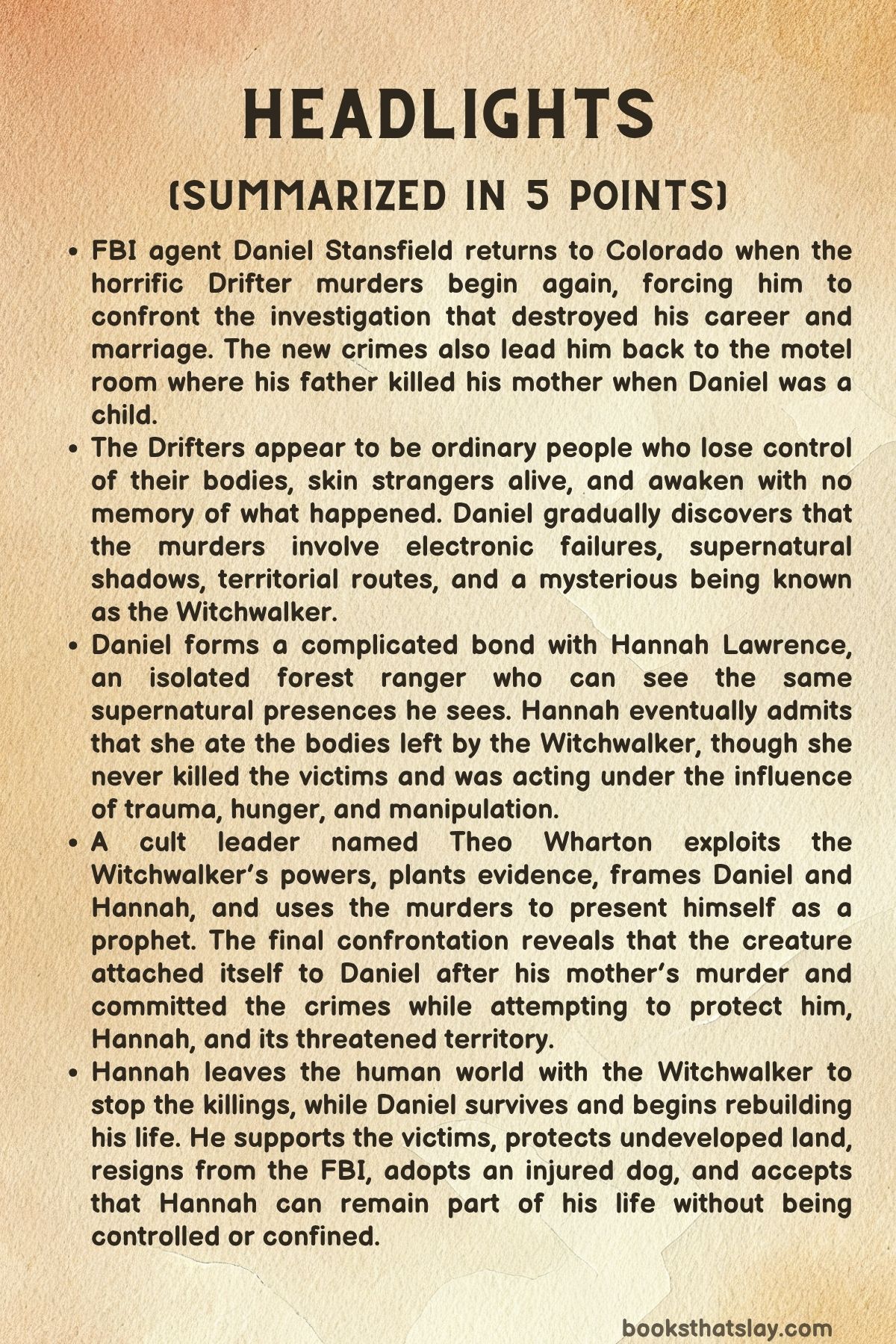
Characters
Daniel Stansfield
Daniel is the central character and emotional foundation of Headlights, carrying childhood abuse, war trauma, professional failure, bereavement, and marital loss beneath an exterior built around discipline. His desire to resign from the FBI and return to military service is less a career decision than an indirect attempt to surrender his future without openly choosing death.
His investigative talent comes from an unusual sensitivity that he has spent years treating as shameful or irrational. He reads emotions, spaces, patterns, and unseen presences with extraordinary accuracy, yet every correct instinct frightens him because it reminds him of the child who saw shadows in Room 6.
Daniel’s greatest weakness is his habit of running before other people can witness his pain. He abandons Denver, Josie, Daphne, Whileago Manor, the Drifter investigation, and the memory of Rose because he believes distance will protect both himself and those around him.
His relationship with Hannah changes that pattern because she does not ask him to become less damaged, less perceptive, or more socially acceptable. Her acceptance allows him to face the mirror, acknowledge the ghosts, confront Calvin, forgive his younger self, and understand that survival does not require emotional isolation.
Daniel’s final growth appears through responsibility rather than punishment. He protects land, supports the victims, adopts Dolly, honors Jack and his adoptive parents, and leaves the FBI without treating resignation as defeat.
Hannah Lawrence
Hannah is defined by survival, isolation, heightened perception, and a hunger that carries both physical and moral significance. Her life after Eden’s death is shaped by shame over the actions that kept her alive, making human contact, enclosed rooms, ordinary food, and social expectations nearly unbearable.
Her choice to work in remote wilderness reflects more than a preference for nature. Open spaces allow her to breathe, observe animals, control her sensory environment, and exist without constantly pretending to be a person untouched by catastrophe.
Hannah conceals her history because she expects discovery to lead to disgust, punishment, or confinement. Although she did not murder the Drifter victims, consuming their bodies ties her to the violence and forces her to question whether survival has transformed her into something monstrous.
Her artistic playing cards reveal the tenderness and attention she rarely expresses through speech. The fox card taken by Daniel becomes a symbol of how he recognizes her before understanding her, seeing intelligence, caution, beauty, and wildness rather than merely evidence of abnormality.
Within Headlights, Hannah rejects the idea that love must tame, cure, or domesticate her. Her final transformation allows her to remain connected to Daniel while moving freely between human, animal, spiritual, and cosmic forms.
The Witchwalker
The Witchwalker initially appears to be the book’s supernatural murderer, but its motives cannot be understood through human moral categories alone. It is an ancient being moving between realities, responding to grief, territory, fear, hunger, and abandonment through instincts closer to those of a predator or protective animal than a human criminal.
Danny’s scream during Rose’s murder summons it across the boundary between worlds. Interpreting him as an abandoned young creature, it adopts him and begins defending the places, memories, and people connected to him.
Its violence comes from imitation and misunderstanding. After observing human beings use pain, blood, destruction, and control to claim territory, it copies those methods without understanding consent, guilt, law, or the permanent psychological effects inflicted on the Drifters.
The being’s relationship with Hannah is similarly distorted. It recognizes her starvation and loneliness, provides bodies as food, and treats the arrangement as companionship, failing to grasp that each offering deepens her trauma.
The Witchwalker is both dangerous and capable of attachment. Its existence forces Daniel to recognize that protective love without moral understanding can become indistinguishable from cruelty.
Rose Keller
Rose is remembered by Daniel as a loving, imaginative mother who offered music, root beer, cowboy dreams, and emotional safety inside a frightening childhood. She teaches him to trust his feelings and calls him her shining boy, giving him a language for his sensitivity before trauma teaches him to reject it.
Her love for Danny is genuine, but years of Calvin’s abuse destroy her ability to imagine an escape that allows them both to live. She comes to believe that death is the only place Calvin cannot reach them, transforming protection into an attempted murder-suicide.
The revelation about the poisoned drinks complicates Daniel’s memories without erasing Rose’s victimization. She is neither reduced to a perfect lost mother nor condemned as a simple threat, because the story shows how terror, isolation, and desperation can corrupt a person’s judgment.
Her music, books, clothing, and voice remain active within Daniel’s memory. Accepting the truth about Rose allows him to mourn the mother she was while acknowledging the terrible choice she nearly made.
Calvin Keller
Calvin is Daniel’s abusive biological father and the source of many of his deepest fears. His violence against Rose, culminating in her murder, teaches Daniel to associate masculinity, mirrors, anger, and physical resemblance with the possibility of becoming his father.
Calvin’s prison conversation reveals that he sees Rose’s murder as an act of protection. Because he interrupted her plan to kill Danny, he has constructed a narrative in which the killing becomes the one moment when his brutality served a righteous purpose.
This belief demonstrates his capacity for self-justification. He may regret aspects of his abuse, but he still places himself at the center of the family’s tragedy and treats violent control as a legitimate response to fear.
Daniel does not offer him easy forgiveness or reconciliation. Their meeting matters because Daniel can finally look at Calvin as a separate human being rather than an identity waiting inside himself.
Theo Wharton, or Father Sky
Theo is driven by jealousy, spiritual ambition, resentment, and a desire to turn supernatural contact into personal authority. As a child, he sensed the immense signal released by Danny’s grief and spent his life believing that the experience proved he had been chosen by a divine force.
Discovering that the power was responding to Daniel rather than to him creates a lasting humiliation. Theo builds the Sacred Life Church, manipulates vulnerable followers, operates the Drifter forum, and uses information from the Witchwalker to present himself as a prophet.
He does not create the entity or originate its territorial behavior, but he exploits the murders for recognition. He plants evidence, frames Hannah, studies the creature’s movements, and draws investigators toward carefully staged confrontations.
Theo’s murder of Jack exposes the emptiness of his spiritual language. He is willing to manufacture grief, consume Daniel’s body, and sacrifice followers because he views other people as tools through which he can obtain the power he believes he deserves.
Josie Maynor
Josie is Daniel’s former wife, an accomplished FBI agent, and one of the people most capable of recognizing his self-destructive behavior. Her accusation that his planned deployment is an acceptable form of suicide shows how clearly she understands the despair hidden behind his professionalism.
Their marriage fails not because affection disappears but because the Drifter case consumes their private life. Josie needs emotional presence and a world beyond investigation, while Daniel responds to failure by withdrawing further into obsession, secrecy, and guilt.
Her relationship with Tillman gives her stability without requiring her to abandon her work. This initially devastates Daniel, but he eventually recognizes that her new life is not a betrayal of their past.
Josie remains protective of Daniel even when she believes he is dangerous or unstable. By the conclusion, they release one another without hostility, allowing their former love to become part of their histories rather than an unresolved demand.
Nat Tillman
Tillman initially appears through Daniel’s jealousy, making him seem intrusive, eccentric, and unworthy of trust. His interest in ghosts, UFOs, legends, and cryptids irritates Daniel because Tillman openly considers possibilities that Daniel has spent his life denying.
As the investigation continues, Tillman proves observant, resourceful, patient, and professionally capable. He notices environmental evidence, reconstructs routes, recognizes inconsistencies, anticipates Daniel’s attempt to visit Calvin, and eventually captures two fugitives whom the entire Bureau has been unable to locate.
His strongest quality is his willingness to revise his beliefs. Once Daniel confesses that he sees ghosts, Tillman listens to the available evidence instead of protecting his pride or dismissing the explanation.
Tillman also accepts Daniel’s criticism and admits that trust must be created by both partners. Their relationship develops from rivalry into genuine friendship, showing Daniel that another man can enter his former life without erasing him.
Jack Murphy
Jack is Daniel’s mentor, supervisor, friend, and substitute family member. He brings Daniel back into the investigation because he believes in his instincts even after the Bureau and Daniel himself have lost confidence in them.
His household represents a version of belonging that Daniel abandoned when he left Colorado. Emily and the children remind Daniel that his disappearance affected people who loved him, not only colleagues connected to the case.
Jack’s loyalty is generous but also places him in danger. Theo murders him specifically because his death will produce enough grief to attract the Witchwalker through Daniel’s emotional signal.
His death becomes Daniel’s final temptation to turn sorrow into self-punishment. Instead, Daniel supports Jack’s family, honors his work, and chooses to live in a way that gives their relationship a continuing purpose.
Daphne
Daphne is a forensic specialist and one of Daniel’s closest former friends. Her directness allows her to challenge both his investigative assumptions and his belief that disappearing from other people’s lives was a clean or merciful decision.
While Daniel was absent, Daphne lost her partner, Tess, and struggled with alcohol. His ignorance of these events shows how completely he withdrew into his own suffering without recognizing that others were carrying losses of their own.
Daphne provides scientific caution when Daniel becomes convinced by the bite patterns, reminding him that forensic evidence can be unreliable. She also recognizes his growing connection with Hannah before he admits it to himself and encourages him not to abandon another chance at love.
Noel and Marianne Stansfield
Noel and Marianne adopt Daniel after Rose’s death and give him security without demanding that he erase his fear. Their home contains ghosts and shadows, but it also becomes the first place where he experiences reliable care, patience, education, and acceptance.
Marianne uses music and dancing to help him recover, while both parents allow him to choose the smallest bedroom because it feels safest. Their approach contrasts with Calvin’s control by giving Daniel space to determine what he can tolerate.
Their sudden deaths intensify Daniel’s belief that everyone who becomes part of his life will eventually be taken from him. Seeing their ghosts dancing at Whileago Manor allows him to understand that love can remain present without requiring him to live inside grief.
Pete Noland and the Drifters
Pete represents the full human cost of treating the Drifters only as criminals. The evidence against him is overwhelming, but his history, personality, terror, and complete lack of memory indicate that his body was used while his conscious will was absent.
Unable to endure imprisonment and public hatred, Pete dies before Daniel can prove that the killers were controlled. His death becomes one of the strongest reasons Daniel continues the investigation even when doing so threatens his career and freedom.
The other Drifters occupy a similar position between perpetrator and victim. Their bodies committed terrible acts, yet the Witchwalker removed choice, memory, and control, leaving them to suffer legal punishment and lifelong guilt for violence they never intended.
Their situation complicates ordinary ideas of responsibility. The book asks whether a person can be morally condemned when the body acts without the participation of the mind.
Oliver Wright
Oliver Wright is shaped by the murder of his daughter Claire and by his determination to find someone to punish. His grief appears sincere, but it also supports aggressive prosecution of the Drifters before the true nature of their condition is understood.
Through WrightStar, he buys and develops properties connected to the crimes. These purchases appear suspicious until the territorial pattern reveals that construction activity was threatening the land claimed by the Witchwalker.
Oliver is not the supernatural architect of the murders, but his company’s corruption and environmental destruction contribute to the conditions that provoke them. His character shows how private grief, corporate ambition, and ecological damage can coexist within the same person.
Eden
Eden appears largely through Hannah’s memory, yet she is central to Hannah’s identity. She was Hannah’s closest companion, soulmate, and source of emotional belonging before dying during the Mount Whitney storm.
Her death forces Hannah into an impossible survival situation. Consuming Eden keeps Hannah alive but leaves her carrying the fear that survival itself has betrayed the person she loved most.
The song connected to Eden becomes both a source of pain and a means of supernatural communication. Daniel’s acceptance helps Hannah separate her love for Eden from the shame attached to what happened after her death.
Everett and Mona Brown
Everett is one of the new Drifters and an early source of information about distorted time, electronic failure, ecological conflict, and the feeling of stepping through reality. His warnings suggest that he understands more than he admits, although his fear and manipulation make it difficult to determine what knowledge truly belongs to him.
Mona is emotionally devoted to Father Sky and appears to use Everett’s forum account. Her reverence for the man she calls Father demonstrates Theo’s ability to create loyalty by offering supernatural explanations to people searching for meaning.
Together, the Browns show how the Witchwalker and Theo affect people differently. Everett becomes a physical instrument of violence, while Mona becomes part of the belief system that allows Theo to increase his influence.
Ryder Smith
Ryder transforms a troubled youth and imprisonment into service, using rescued horses to help vulnerable children. His work establishes him as someone who understands damage without assuming that damaged lives are beyond repair.
His fear of the Witchwalker is based on direct experience with Theo in prison. By explaining how Theo invited possession and later created a congregation, Ryder provides the connection that turns scattered supernatural evidence into a traceable human conspiracy.
James
James gives Hannah access to safety, land, and shelter during a period when she cannot live within ordinary society. His willingness to let her construct an open-sided refuge shows a degree of compassion and practical understanding.
Their relationship remains emotionally complicated because support and dependence exist alongside physical intimacy. James helps Hannah survive, but he cannot fully share the world she perceives or understand the hunger she conceals.
Dolly
Dolly is the injured dog Daniel rescues from coyotes after the investigation ends. Her lost leg mirrors Daniel’s damaged hand and reflects the larger population of survivors whose injuries remain visible even after immediate danger has passed.
Adopting her marks Daniel’s movement from isolation toward care. He no longer dreams abstractly about rescuing a dog in some distant future, because he has begun choosing life in the present.
Themes
Trauma, Memory, and the Cost of Running
Trauma in Headlights does not remain safely located in the past. It survives through music, physical spaces, smells, mirrors, dreams, bodily reactions, investigative instincts, and memories that return only when Daniel is capable of facing them.
Daniel believes that leaving Colorado will free him from Room 6, Rose’s murder, the Drifter case, his broken marriage, and his adoptive parents’ deaths. Instead, every departure strengthens the authority of the memories because he never gives himself the opportunity to understand them.
His military service and FBI career provide controlled environments in which danger has rules and action can replace emotional reflection. When uncertainty or grief becomes unbearable, he runs, works, fights, or plans another deployment rather than allowing another person to witness his fear.
Hannah responds differently but is governed by a similar wound. She removes herself from human society, lives outdoors, limits sensory contact, and conceals Eden’s death because she assumes that disclosure will make connection impossible.
Their bond does not erase trauma or restore a lost version of either character. By sharing memories, they reduce the isolation surrounding them and learn that pain becomes more destructive when it must be carried without language, witnesses, or choice.
Protection, Control, and Violence
Nearly every central act of violence is justified by someone as protection. Rose attempts to kill herself and Danny because she believes death is the only secure escape from Calvin, while Calvin murders Rose because he believes he is saving his son.
The Witchwalker adopts Daniel and Hannah as vulnerable creatures needing food, territory, and defense. Its lack of human moral understanding turns attachment into possession and protection into murder, coercion, bodily control, and psychological devastation.
Theo presents himself as a spiritual guide who can explain the darkness, but his leadership depends on manipulation and sacrifice. He treats followers, victims, law-enforcement officers, and Daniel’s grief as resources through which he can acquire power.
Daniel must learn that genuine protection cannot be based on removing another person’s freedom. His relationship with Hannah succeeds because he does not demand that she become ordinary, remain human, surrender her hunger, or stay permanently inside his home.
The conclusion replaces possession with responsibility. Daniel protects land without claiming ownership over the beings within it, assists victims without demanding gratitude, and loves Hannah without insisting that she be cured or confined.
Territory, Nature, and Human Expansion
Colorado’s roads, suburbs, ranches, construction sites, forests, mountains, and abandoned spaces are active elements of the conflict rather than decorative settings. Human beings repeatedly clear, divide, purchase, rename, and develop land while assuming that nothing meaningful existed there before them.
WrightStar’s expansion threatens ecosystems and crosses boundaries that the Witchwalker considers part of its territory. The entity responds by imitating human territorial practices, using bodies, blood, movement, fear, and genetic markers to establish visible borders.
The Drifter routes form circles around places connected to Daniel and Hannah, revealing that emotional territory and physical territory have become inseparable. Homes, motel rooms, cabins, roads, and forests hold memories that affect both the living and the dead.
Predators such as wolves, coyotes, hawks, and the Witchwalker are feared partly because they resist human control. Ranchers and developers interpret them as threats, while the novel shows that human expansion is often the more extensive and permanent form of violence.
Daniel’s decision to purchase undeveloped land and convert it into protected public space offers an alternative relationship with nature. Protection becomes preservation rather than conquest, allowing the land to exist without being forced to justify itself through profit.
Love Without Taming
Daniel and Hannah are drawn together because each recognizes something in the other that ordinary society treats as unacceptable. Daniel sees ghosts, carries combat trauma, fears mirrors, and believes his darkness makes intimacy dangerous, while Hannah lives with cannibalistic hunger, sensory distress, isolation, and a body transformed by survival.
Their relationship does not depend on denying these realities. Daniel does not romanticize Hannah’s actions, but he distinguishes between what she did to survive, what she did under the Witchwalker’s influence, and the choices she makes when freedom becomes possible.
Hannah offers Daniel the same form of recognition. She experiences his memories, shame, injuries, rage, and fear without reducing him to Calvin’s son or demanding that he perform emotional normality.
Physical closeness creates a mental refuge from the Witchwalker because their connection depends on consent and mutual awareness. This private space contrasts with possession, coercion, and control, all of which force one consciousness to submit to another.
Hannah’s final form confirms that love does not require permanence in a single body or place. Daniel welcomes her return as a fox without trying to restore, capture, or domesticate her, accepting that genuine attachment can include distance, transformation, unpredictability, and freedom.