Queenswood Summary, Characters and Themes
Queenswood by Kathleen Schwab is a fantasy novel about two worlds whose futures depend on people willing to question inherited ideas about power, faith, loyalty, and belonging.
The story follows Rhiannon, a Christian noblewoman carried into Faerie, Angus, a young sidhe king burdened by a failing bloodline, and Cormac, a mortal farmer whose painful mistakes prepare him for an unexpected responsibility. Through enchanted forests, royal courts, village homes, religious communities, and dangerous borderlands, the novel examines how genuine leadership develops through humility, moral courage, freedom of choice, and care for people whom traditional systems have ignored.
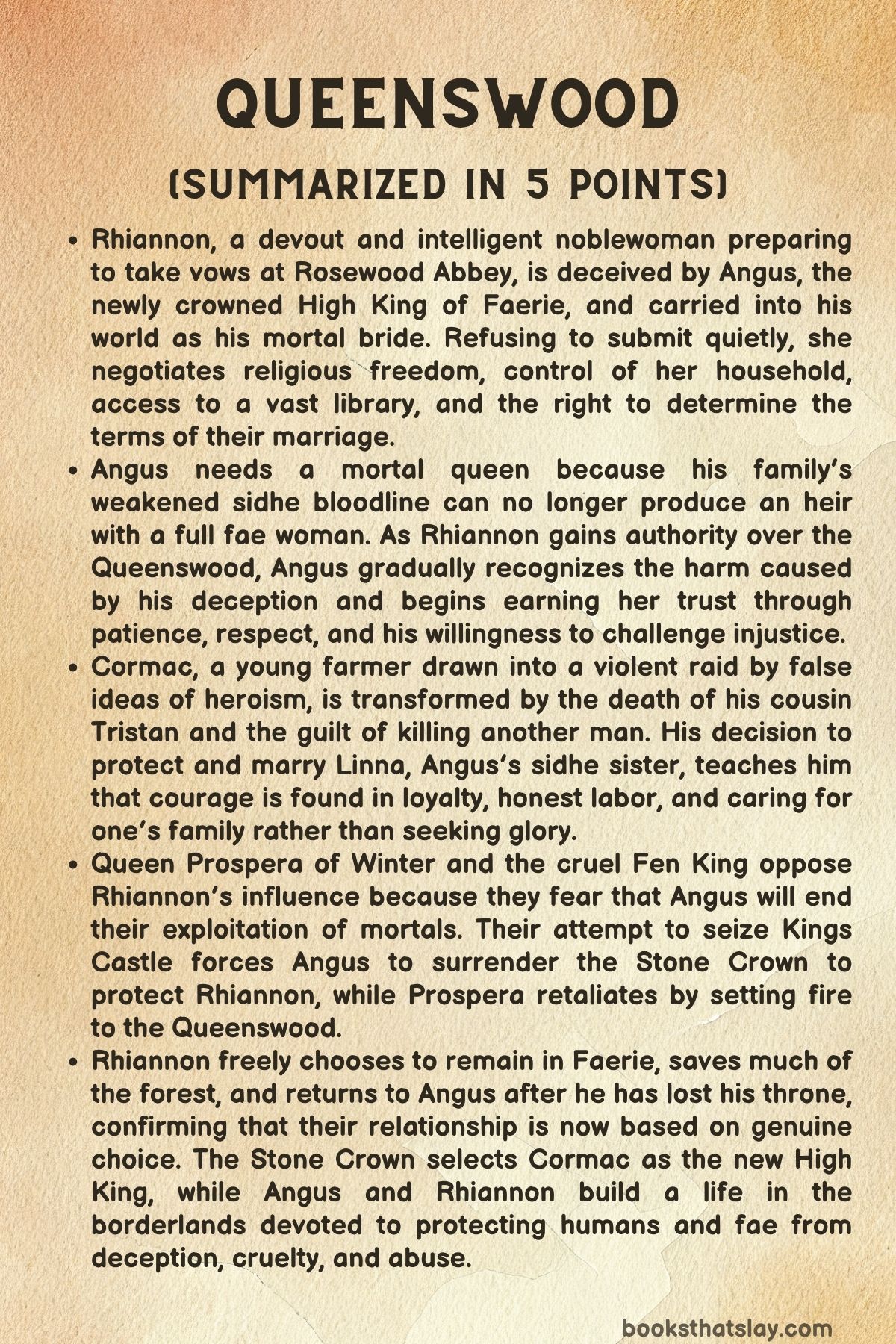
Summary
An ancient magical woman known as the Crone lives in the woods, where she uses sewing, herbs, and knotwork to help those who seek her assistance. When a poor woman unknowingly gives her a kelpie egg sent by the High Court of Faerie, the Crone reluctantly accepts that she must once again involve herself in the affairs of the wider worlds.
Years earlier in the mortal world, a young noblewoman named Rhiannon hears a story about Signe the Fair, a human maiden taken into Faerie by its king. The story troubles her because it raises questions about death, faith, mercy, and whether a woman who lives among the fae can still belong to her human family and religion.
Rhiannon’s mother gives her a hidden religious relic and teaches her that divine compassion is greater than the judgment of harsh individuals. This lesson becomes central to Rhiannon’s character as she grows into a thoughtful young woman who values learning, fairness, and spiritual independence.
In Faerie, Prince Angus leaves the shelter of the Queenswood to prepare for kingship under his father, High King Brennan. Although royal life demands political discipline and an eventual marriage, Angus forms a loving relationship with Peder, the free-spirited son of the Oak King, who gives him companionship without courtly calculation.
Angus soon discovers that the sidhe courts contain both beauty and serious injustice. The Winter Court is controlled by Queen Prospera, while the Fen King openly humiliates mortal servants and treats human suffering as entertainment, teaching Angus that royal custom can protect cruelty when no ruler is willing to challenge it.
Meanwhile, Rhiannon becomes close to Muireann Arundel, whose family expects her to marry for property and inheritance. Muireann instead chooses Red Robert, a poor master-at-arms who supports forest communities threatened by landlords and royal forces, and their escape encourages Rhiannon to question the social order surrounding noble marriage.
Rhiannon eventually enters Rosewood Abbey, where she discovers a community of educated women working as scholars, healers, scribes, administrators, and teachers. She decides to take religious vows, believing that a life devoted to wisdom and service will allow her to use her abilities more meaningfully than an arranged marriage.
The future of Faerie changes when the Crone tells Angus that generations of isolation have weakened his family’s sidhe blood. No full sidhe woman can bear his heir, so he must marry a mortal if his family is to retain the Stone Crown and preserve the Queenswood.
Angus first attempts to build a relationship with a mortal woman named Anett, but differences between human and fae understandings of promises lead to disappointment. His failure leaves him more guarded, yet he still does not fully understand how easily sidhe language, magic, and authority can limit genuine human consent.
After the deaths of his parents, Angus inherits the Stone Crown and becomes High King. The crown connects him to Kings Castle and the foundations of Faerie, but it also places the survival of the realm upon him before he has gained the judgment or emotional maturity required for such power.
Elsewhere, two young villagers, Cormac and Tristan, join Cormac’s uncle Clopas on a violent raid after believing his stories about warfare, honor, and masculine glory. The attack becomes a disaster, Tristan is killed, and Cormac takes a life while defending him, destroying the heroic image of battle that had shaped his childhood.
After death, Tristan meets Angus’s sister Linna, who has left Faerie because a former lover rejected her for being unable to bear a sidhe child. Tristan asks her to find Cormac, believing that his cousin needs loyalty and companionship more than any heroic reward.
Linna reaches Cormac while Clopas and the remaining raiders are threatening her. Cormac defends her despite his exhaustion and grief, and their later marriage gives both of them a place where they are valued for loyalty rather than fertility, status, violence, or usefulness to others.
Angus enters Rosewood Abbey disguised as an elderly priest and speaks to Rhiannon in deliberately misleading language. She believes his questions concern heaven, Christ, and religious devotion, but he treats her answers as binding consent to enter Faerie and marry him.
Rhiannon is carried through a well into Kings Castle, where Angus publicly introduces her as his mortal queen. Though terrified and deprived of her home, clothing, relic, vocation, and family, she refuses to behave as a helpless captive and begins studying the exact customs through which sidhe power operates.
With help from Emilia, an elderly human servant, Rhiannon learns that many mortals in Faerie were abducted, abandoned, or rescued only to become servants. Emilia advises her to act with confidence, since the court is more likely to respect declared authority than emotional appeals for justice.
Rhiannon confronts Angus and refuses to accept the marriage unless he grants her religious freedom, a church, a library, control over her attendants, and the right to raise her children in her faith. Angus agrees, and the negotiation becomes the first moment in which he begins treating her as an independent person rather than the solution to a royal problem.
When Rhiannon enters the Queenswood, fear initially drives her away from its unfamiliar inhabitants. Angus admits that he handled her arrival carelessly, accompanies her on a second attempt, and watches as the forest accepts her kindness and awakens under her authority.
Rhiannon becomes the living queen of the Queenswood, with power equal to Angus’s connection to Kings Castle. She chooses not to expel him from the forest, but her decision is important because it is made from a position of strength rather than dependence.
As Rhiannon studies the courts and the enormous royal library, her relationship with Angus slowly changes. He respects the boundaries of her rooms, listens to criticism, supports the education of her pages Liya and Darragh, and begins trying to become a husband she might freely choose.
During a royal journey, Rhiannon and Angus discover that Queen Nimue has imprisoned Merlin within a wall and built her court from his stolen power. Angus frees him despite the political consequences, and Rhiannon sees that Angus is capable of using royal authority to end injustice rather than merely protect his position.
At SeaForest Court, selkie women tell Rhiannon about mortal men who stole their skins and forced them into domestic lives. Their experiences help her understand that affection and shared history cannot transform captivity into consent, while Angus’s past rescue of a captured selkie shows that he is beginning to recognize the wrongness of his own actions.
Rhiannon chooses to move closer to Angus emotionally, but their growing trust remains fragile. Both carry fear from earlier rejection and deception, yet they gradually decide that whatever the beginning of their relationship, they can treat one another with patience and kindness.
The royal couple then visits Prospera’s Winter Court, where mortal servants suffer in conditions unsuitable for human bodies. Prospera’s hatred of Rhiannon is connected to her own shame about being the daughter of Einar, a halfling man whose human blood caused him to be publicly treated as inferior.
Prospera orders Einar to kill Rhiannon, but he secretly saves her and creates false evidence of her death. Four selkies carry Rhiannon across the northern sea, where she nearly freezes before memories of Angus, her household, her pages, and her future responsibilities strengthen her desire to survive and return.
Believing Rhiannon dead, Angus confronts Prospera and uses her formal promises to remove Einar, Miri, human servants, and several courtiers from Winter. When the Fen King later reveals that Rhiannon survived, he and Prospera unite against Angus because they fear that his growing opposition to sidhe abuses will threaten their power.
They seize Kings Castle and demand the Stone Crown while threatening to hunt and torture Rhiannon. Unable to protect her across both worlds, Angus surrenders the crown after receiving binding promises that neither enemy will physically harm her.
The crown refuses the Fen King and disappears, leaving the throne vacant. Prospera then exploits the wording of her promise by setting fire to the Queenswood, hoping to destroy Rhiannon’s realm without directly injuring her body.
Rhiannon meets the Crone, who offers to return her to Rosewood at the exact moment she disappeared. Given the freedom Angus originally denied her, Rhiannon chooses Faerie, her responsibilities, and her husband, proving that her final commitment is genuinely her own.
When she discovers the forest fires, Rhiannon calls upon water, wind, woodland spirits, animals, and connected forests to stop them. She saves much of the Queenswood, though many young trees and small fae die, making Prospera’s attack a personal and political loss.
Rhiannon enters Kings Castle through a hidden woodland passage and finds Angus sheltering in her library tower. He believes that losing the crown has left him with nothing to offer, but she tells him that he may offer himself, and they finally begin their marriage through mutual desire rather than obligation.
At the same time, Linna gives birth to a son named Fergus, whose mixed human and sidhe nature cannot survive in the mortal world. Cormac chooses to leave his parents and village because Linna and Fergus are now his family, accepting the dangers of Faerie without demanding that Linna remain where their child will die.
Upon reaching Kings Castle, Cormac is called by its foundation stones. They examine his family history, his failures, his defense of Linna, his willingness to remain when others fled, and his new respect for ordinary labor before offering him the Stone Crown.
Cormac accepts freely and becomes High King. With help from the merrows and a former Year King, he defeats the Fen King by forcing him to face the people whose fear and suffering he exploited, but Cormac orders a quick death rather than taking pleasure in revenge.
Cormac then confronts Prospera and uncovers the shame and sorrow beneath her hatred. Instead of destroying her, he allows the merrows to create a peaceful dream of the northern wilderness where she can rest beside the image of the father she loved.
Angus willingly accepts Cormac as the ruler chosen by the stones. No longer High King, he becomes Marcher Lord and takes responsibility for the unstable borders between Faerie and the mortal world, where he can protect people from the kinds of deception and abuse he once committed.
Years later, Angus and Rhiannon have built a household containing humans, fae, children, servants, scholars, companions, and people rejected by both worlds. Rhiannon continues her faith, Angus maintains his bond with Peder, and together they create a life based not on cultural purity or royal possession but on honest choice, shared responsibility, and respect.
Characters
Rhiannon
Rhiannon is the moral and emotional center of Queenswood, beginning as a sheltered noblewoman whose religious beliefs and intellectual ambitions are shaped by love rather than fear. Her childhood concern for Signe the Fair reveals an early sensitivity to exclusion, unfair judgment, and the pain of being separated from one’s family and spiritual home.
Her time at Rosewood Abbey strengthens her discipline, confidence, and desire for useful work. She does not reject marriage simply because she dislikes men; she rejects a social system that treats women’s intelligence, property, bodies, and futures as resources to be transferred between families.
Her abduction forces her to test whether her principles can survive outside the ordered environment in which they developed. Instead of abandoning her faith or surrendering to despair, she studies sidhe language, customs, law, history, and political behavior until knowledge becomes one of her strongest forms of protection.
Rhiannon’s acceptance of Angus is meaningful because it occurs only after she receives a genuine opportunity to leave. Her decision to return to him is therefore not an approval of his original deception but an expression of her ability to separate the man he is becoming from the harmful act he committed.
As queen of the forest, she combines authority with care for individual lives. She values great trees and small creatures equally, mourns those lost in the fires, protects human servants, and uses her position to build a household where education, faith, work, and dignity are available across social boundaries.
Angus
Angus begins Queenswood as a privileged young prince who dislikes courtly restrictions but has not yet examined the power that protects him. His relationship with Peder allows him to experience affection without political duty, yet it also makes him resent responsibilities that he sees mainly as personal burdens.
The prophecy concerning his bloodline encourages Angus to treat marriage as a practical solution to a dynastic problem. His deception of Rhiannon shows a serious moral weakness: he understands the technical power of sidhe promises but initially refuses to consider whether she understands the agreement in the same way.
Angus changes because Rhiannon repeatedly forces him to confront the human effects of his assumptions. Her anger, conditions, fear, intelligence, and eventual authority teach him that agreement gained through unequal knowledge is not the same as free consent.
His best qualities appear when he challenges injustice despite political cost. He frees Merlin, protects abused servants, rejects Prospera’s attempt to replace Rhiannon with Miri, and ultimately gives up the Stone Crown rather than allow his wife to be tortured.
Losing the crown completes his development because it separates his identity from inherited status. As Marcher Lord, he turns his own failures into a reason to protect mortal women from deceptive fae, showing that responsibility requires more than regret; it requires preventing others from repeating the harm one has caused.
Cormac
Cormac begins as an ordinary young man dissatisfied with the quiet labor of village life. Songs and Clopas’s stories persuade him that courage must involve weapons, danger, travel, and public recognition, leaving him unable to see the value in his parents’ patient work.
Tristan’s death and the man Cormac kills destroy his romantic understanding of violence. His guilt is not presented as weakness but as evidence that he has retained a conscience in circumstances designed to silence moral reflection.
His defense of Linna establishes the quality that later makes him worthy of kingship. He acts without certainty of victory or reward, standing against his own companions because protecting a threatened stranger matters more than loyalty to a corrupt group.
Cormac’s marriage teaches him that love is sustained through promises respected in daily life. He does not demand Linna’s history, restrict her movement, or abandon her when her nature and their child’s needs require him to leave the mortal world.
The foundation stones choose him because he has learned to value feeding, building, protecting, listening, and remaining present. His rule rejects both passivity and cruelty, proving that mercy is strongest when joined to the willingness to confront oppression directly.
Linna
Linna initially appears fragile because sadness, rejection, and the expectations surrounding fertility have weakened her sense of purpose. Her former lover treats her inability to bear a sidhe child as proof that she is unsuitable for partnership, causing her to internalize the belief that she has little value.
Her meeting with Tristan gives her a new direction without reducing her to a reward for Cormac. She chooses to seek him, remains beside him during grief, and establishes clear conditions before marriage, ensuring that their relationship begins with boundaries Angus failed to offer Rhiannon.
Linna’s quiet manner conceals considerable strength. She faces armed men without panic, adapts to village life, supports Cormac without controlling his grief, and keeps her promise to speak before leaving even when Fergus’s survival demands an urgent return to Faerie.
Her pregnancy overturns the assumptions that defined her earlier rejection, although the child’s mixed nature creates a different difficulty. Through Linna, fertility is shown not as proof of female worth but as one part of a life whose meaning comes from loyalty, intelligence, courage, and freely chosen family.
Prospera
Prospera is a powerful ruler whose cruelty grows from shame she refuses to understand. As the daughter of a halfling father, she owes much of her strength, knowledge, and emotional security to Einar, yet she has spent her life watching his human ancestry used to humiliate him.
Rather than rejecting the hierarchy that harmed someone she loved, Prospera tries to protect herself by becoming its strongest defender. Her contempt for mortals is therefore connected to her fear that acknowledging their value will expose the part of herself she has been taught to regard as inferior.
She interprets Rhiannon’s elevation as both a political defeat and a threat to the racial order upon which her identity depends. Her effort to place Miri beside Angus also reveals how easily she turns her daughter into an extension of her own ambitions.
Prospera is not excused by her suffering. She endangers servants, orders Rhiannon’s death, supports the seizure of Kings Castle, and burns living communities after promising not to touch the queen.
Cormac’s final treatment of her recognizes both guilt and injury. He stops her without adopting her methods, allowing her to confront the love and sorrow she buried beneath authority before entering a peaceful dream.
Peder
Peder represents freedom, physical joy, natural life, and affection untouched by formal rank. His relationship with Angus begins as an escape from court, but he develops into one of the people most capable of offering the young ruler honest emotional guidance.
He does not treat Rhiannon as a rival whose removal would restore his former place. Instead, he recognizes that Angus has harmed her and advises him to become someone she might willingly love.
Peder’s continued presence in Angus and Rhiannon’s later household challenges the idea that every relationship must fit a narrow political or domestic structure. His acceptance depends on honesty rather than secrecy, making him part of the broader movement toward chosen forms of family.
The Crone
The Crone is a figure of immense knowledge who has grown tired of responsibility. Her initial desire to remain apart from the High Court reflects not cowardice but exhaustion after a lifetime spent carrying the needs of others.
The kelpie’s birth reminds her that wisdom creates obligations even when those obligations are unwelcome. She understands the weakness in Brennan’s bloodline, the uncertainty of the Stone Crown, and the Queenswood’s ability to choose independently of royal tradition.
Her prophecy contributes to Rhiannon’s suffering because she gives Angus a required outcome without ensuring that he understands the ethical limits of pursuing it. Her later offer to restore Rhiannon’s former life acts as an attempt to repair the freedom that her guidance indirectly helped remove.
Einar
Einar is a halfling whose practical wisdom, political intelligence, and emotional patience contrast with Prospera’s rigid pride. Although Winter society treats him as socially inferior, he is the person who taught Prospera how to survive, understand the land, and appreciate the northern world.
His decision to save Rhiannon requires him to deceive the daughter he loves. By pretending to obey the murder order, he prevents Prospera from sending someone who would carry it out without hesitation.
Einar’s greatest weakness is his tendency to protect Prospera from the consequences of her choices. He repeatedly asks Angus for mercy toward her, revealing the painful limits of parental loyalty when love becomes an attempt to contain another person’s destructive actions.
Miri
Miri lives under the control of a mother who views marriage as a political instrument. She recognizes that becoming Angus’s queen would not free her because Prospera would continue using her position to govern through her.
Her early honesty with Angus establishes a relationship based on mutual resistance to an unwanted alliance. Later, she pretends to obey Prospera while secretly helping Angus reach the safety of Rhiannon’s tower.
Miri’s courage is cautious and strategic rather than dramatic. She survives an authoritarian household by understanding appearances, waiting for the right moment, and using the small freedom available to protect others.
Tristan
Tristan begins with the same romantic ideas about warfare that influence Cormac. His death exposes the cost of those fantasies, but his role does not end with the failed raid.
On the road beyond death, Tristan loses the hatred that defined his final moments and recognizes that enemies created by circumstance may share the same fear and need. His request that Linna find Cormac becomes his true act of heroism because it is motivated by care rather than reputation.
Tristan also serves as a witness when the foundation stones judge Cormac. He identifies the loyalty his cousin cannot easily recognize in himself, showing that the dead continue shaping the living through memory, love, and moral testimony.
Clopas
Clopas represents the destructive power of stories that remove suffering from violence. He turns warfare into entertainment, treats peaceful labor as evidence of weakness, and recruits inexperienced young men by promising honor and profit.
His past military service complicates his character because he once sacrificed his own safety so that his brother could remain home and build a family. That earlier generosity does not erase his later actions, but it prevents him from becoming a simple symbol of evil.
Cormac’s dream allows Clopas to face the women and victims he harmed. By helping him leave the warrior hall, Cormac offers mercy without denying responsibility, establishing the moral approach he later brings to kingship.
Emilia
Emilia is Rhiannon’s first reliable guide in Kings Castle. Her knowledge comes not from rank but from long experience as a human woman surviving among people who often regard mortals as possessions, curiosities, or servants.
She teaches Rhiannon to treat clothing, posture, language, and household control as political tools. Her humor and willingness to take human-made objects from sidhe courts also provide a small form of resistance against generations of exploitation.
Emilia becomes part of Rhiannon’s chosen family and helps transform the royal household. Her presence ensures that Rhiannon’s queenship remains connected to the practical needs and accumulated knowledge of ordinary humans.
The Fen King
The Fen King is the clearest embodiment of power without empathy. He humiliates servants, exploits frightened communities, encourages human sacrifice, and treats suffering as proof of his superiority.
Unlike Prospera, whose cruelty is partly connected to buried shame, the Fen King shows little internal conflict. His alliance with her is motivated by fear that Angus and Rhiannon will challenge the privileges allowing him to control mortals.
Cormac defeats him by making him experience the fear and betrayal he created in others. The swift ending Cormac orders denies him both continued power and the prolonged spectacle of pain through which he defined himself.
Brennan
Brennan is a loving husband and father whose private choices carry public consequences. He ignores the Crone’s warning and marries the woman he loves, allowing personal devotion to outweigh the future needs of the royal bloodline.
His decision is understandable, but it leaves Angus and Linna to bear the physical and political consequences. Brennan therefore represents the danger of treating love and responsibility as opposing values rather than obligations that must be considered together.
His inability to remain after his wife’s death also places the crown upon an unprepared Angus. The choice confirms the depth of his attachment while showing how grief can become abandonment when a leader’s dependents still require guidance.
The High Queen
Angus’s mother embodies the living relationship between the queen and the Queenswood. Her health, fertility, grief, and death affect forests across worlds, showing that magical authority carries immense physical and emotional demands.
She accepts the necessity of Angus marrying a mortal and tries to guide him toward wise human women. However, she does not fully prepare him to understand the moral difference between finding a willing partner and securing someone through technical promises.
Her death creates the urgency that drives Angus’s worst decision. Even after she is gone, stories about her lost child help him understand that royal power is inseparable from private sorrow.
Muireann
Muireann serves as an early example of a woman rejecting an arranged future. She chooses Robert and the forest community despite the loss of status, safety, and family approval.
Her decision expands Rhiannon’s understanding of agency because Muireann is not simply carried away by a dangerous man. She knowingly leaves a protected noble life after deciding that loyalty to displaced people and a chosen partner matters more than inherited privilege.
The later revelation that she, Robert, and their child survived confirms that her choice created a viable life beyond the social system that declared her disobedient. Her story helps Rhiannon imagine that leaving an expected path does not necessarily mean abandoning purpose.
Red Robert
Robert is a politically committed outsider who understands the suffering of tenants and forest communities. His argument for marrying Muireann is connected not only to affection but also to keeping local property under the control of someone who knows the people living upon it.
He influences Rhiannon because he appears willing to oppose wealthy landowners and royal violence. Later, however, Angus’s decision to free Merlin shows her the difference between speaking against injustice and possessing the authority to end it.
Robert remains significant as a leader who rejects passive acceptance of exploitation. His survival with Muireann suggests that resistance can preserve communities even when official institutions label such resistance criminal.
Brother Eustace
Brother Eustace is the keeper and guide of the royal library. His role supports Rhiannon’s transformation from an intelligent outsider into an informed political leader.
By introducing her to the library’s vast catalog and hidden levels, he provides access to the histories and records she needs to understand Faerie. He later remains with her household during the occupation of Kings Castle, showing that scholarship and loyalty can be forms of resistance.
Liya
Liya is an educated human child rescued by water spirits and brought into the royal household. Rhiannon refuses to let her remain a decorative servant, instead giving her education, meaningful work, and a recognized place.
Her presence strengthens Rhiannon’s sense of responsibility toward vulnerable children. Liya also helps establish the inclusive household that later becomes a model for cooperation between humans and fae.
Darragh
Darragh is a foster child abandoned by a sidhe court. His history reveals how casually powerful communities can discard children who do not fit their expectations.
Rhiannon’s decision to educate and employ him gives him dignity beyond the identity of an unwanted dependent. Alongside Liya, he represents the practical results of leadership that sees vulnerable people as future participants rather than permanent burdens.
Father Robert
Father Robert is a hermit priest who helps Cormac confront the moral consequences of killing. Because he has also taken a life, his guidance is based on experience rather than distant judgment.
He distinguishes self-defense from murder without pretending that legal innocence removes grief. His approach allows Cormac to accept responsibility without believing that one violent act has permanently destroyed his capacity for goodness.
Nimue
Nimue is a ruler who disguises domination as agreement. She claims that Merlin willingly surrendered his power, using the language of consent to defend an arrangement maintained through imprisonment.
Her court depends upon stolen strength, so its collapse after Merlin’s release reveals that her authority has no independent foundation. Through Nimue, the story shows how powerful people can use a past agreement to justify permanent control while ignoring whether continued consent exists.
Merlin
Merlin appears as a once-powerful man trapped inside the structure created from his own abilities. His confinement demonstrates how surrendering power in one moment can become endless captivity when the recipient refuses to recognize changing will.
His appeal for help gives Angus an opportunity to reject political convenience. Once freed, Merlin causes Nimue’s stolen court to collapse, restoring both himself and the captive land to freedom.
Anett
Anett is Angus’s first attempted mortal bride. Their attraction is genuine, but their relationship exposes the distance between sidhe assumptions and human expectations.
Angus believes that their conversation establishes a lasting promise, while Anett later understands him as a dangerous magical seducer. Her rejection wounds him, but it also provides an early warning that he fails to apply when approaching Rhiannon: mutual words do not guarantee mutual understanding.
Sorcha
Sorcha is a knowledgeable midwife who recognizes Linna’s nature without exposing her. She understands both human expectations and sidhe childbirth, allowing her to protect the family while preserving the secrecy Linna needs.
Her calm handling of the birth contrasts with the fear surrounding mixed identities. She treats Linna’s difference as a practical reality requiring knowledge rather than suspicion or punishment.
Fergus
Fergus is the child through whom the connection between the mortal and fae worlds becomes physically immediate. Cormac sees him as healthy, while ordinary humans perceive a fading infant, revealing that the same person can exist differently across the boundaries of perception and place.
His inability to survive in the mortal world forces Cormac to decide what family means. Fergus therefore changes his father’s migration from an adventure into a permanent act of loyalty and responsibility.
Themes
Consent, Choice, and the Meaning of Freedom
Consent in Queenswood is treated as more than spoken agreement. Angus receives affirmative answers from Rhiannon, but those answers are produced through disguise, unequal knowledge, carefully chosen wording, and her belief that they are discussing Christian salvation rather than marriage in Faerie.
The difference between technical permission and informed choice shapes their entire relationship. Rhiannon does not regain full agency simply because she negotiates favorable conditions after being taken; she regains it gradually by acquiring knowledge, establishing boundaries, gaining independent power, and receiving a real opportunity to return home.
The selkie stories expand this argument by showing that captivity may contain affection, children, comfort, and shared memories. Such experiences may complicate a captive’s feelings, but they do not transform the original theft into a freely chosen relationship.
Rhiannon’s final decision carries moral weight because the Crone offers her a complete restoration of her former life. Only after she can leave without punishment does her choice to return to Angus become evidence of love.
The theme also shapes Cormac and Linna’s marriage. Linna states her conditions clearly, Cormac accepts them without manipulation, and both promise to speak before making decisions that could separate them.
Freedom is therefore presented as an ongoing practice rather than a single declaration. It requires understandable information, the ability to refuse, respect for changing wishes, and relationships strong enough to survive honest choice.
Power, Leadership, and Responsibility
Power exposes the values of those who possess it. The Fen King uses authority to create fear and humiliation, Nimue builds an entire court from another person’s stolen strength, and Prospera treats mortal suffering as acceptable whenever it protects Winter’s status.
Angus initially understands kingship as inheritance, ceremony, succession, and control over the foundations of Faerie. His development begins when he recognizes that possessing authority does not automatically provide the judgment required to use it well.
His strongest royal acts involve limiting power rather than displaying it. He frees Merlin, protects Rhiannon’s conditions, removes endangered servants from Winter, and surrenders the Stone Crown when keeping it would expose his wife to torture.
Cormac offers a different model of leadership because his qualifications come from ordinary work, failure, grief, and loyalty. The foundation stones value the history he once dismissed: farming, building, feeding families, keeping promises, and remaining present when escape would be easier.
As king, Cormac acts decisively against the Fen King and Prospera, but he refuses to reproduce their enjoyment of punishment. He combines force with proportion, ending active threats while recognizing the fear and injury that helped create them.
Angus’s later service as Marcher Lord completes the theme. Leadership becomes most honorable when it protects difficult boundaries, corrects past wrongs, and serves people rather than preserving the leader’s identity.
Belonging Across Divided Worlds
The mortal world and Faerie are separated by religion, custom, biology, history, and unequal power, yet neither world is presented as completely pure or self-sufficient. Human communities can offer faith, labor, family, and learning, but they can also support forced marriage, warfare, poverty, persecution, and the destruction of forests.
Faerie contains beauty, ancient knowledge, living landscapes, and forms of identity unavailable to humans. It also contains courts that exploit mortals, children abandoned between communities, and rulers who mistake age or magical strength for moral superiority.
Rhiannon refuses the idea that belonging to one world requires the destruction of her connection to the other. She keeps her Christianity, becomes queen of a magical forest, raises children between cultures, and transforms her personal story until both parts of her life can remain meaningful.
Cormac follows a similar path from the opposite direction. He does not become worthy by abandoning his human past; the foundation stones choose him because his mortal family taught him the values Faerie’s rulers have neglected.
Characters such as Linna, Einar, Prospera, Fergus, Liya, Darragh, and the selkies show the personal cost of rigid boundaries. Mixed ancestry and divided loyalties become dangerous mainly because societies punish those who cross their categories.
The final household offers an alternative community where difference is not erased. Humans and fae remain distinct, but they share work, protection, education, affection, and responsibility without requiring cultural sameness.
Grief, Mercy, and Moral Transformation
Grief affects nearly every major decision in the story. Rhiannon’s childhood fear after Brianna’s death shapes her concern for Signe, Linna’s rejection leaves her feeling useless, Cormac’s guilt follows Tristan’s death, and Prospera’s buried shame turns love for her father into hatred of human weakness.
The book distinguishes grief that leads to understanding from grief used to justify harm. Cormac suffers deeply after killing a man, but he accepts guidance, returns to constructive labor, protects Linna, and becomes more cautious about stories that glorify violence.
Prospera follows the opposite path. She refuses to confront the humiliation surrounding Einar and instead punishes mortals who remind her of the ancestry she has been taught to despise.
Mercy is never presented as denying guilt. Father Robert acknowledges that Cormac acted in defense while still respecting his sorrow, and Cormac helps Clopas leave the warrior hall without pretending his uncle’s victims did not matter.
The treatment of the Fen King and Prospera further defines this balance. Cormac ends the Fen King’s violence swiftly because allowing it to continue would abandon his victims, but he refuses to turn punishment into entertainment.
Prospera receives peace only after her power is removed and her harm is stopped. Moral transformation therefore depends on truth, responsibility, and protection of the vulnerable, while mercy prevents justice from becoming another form of cruelty.