Retro by Jessica M. Goldstein Summary, Characters and Themes
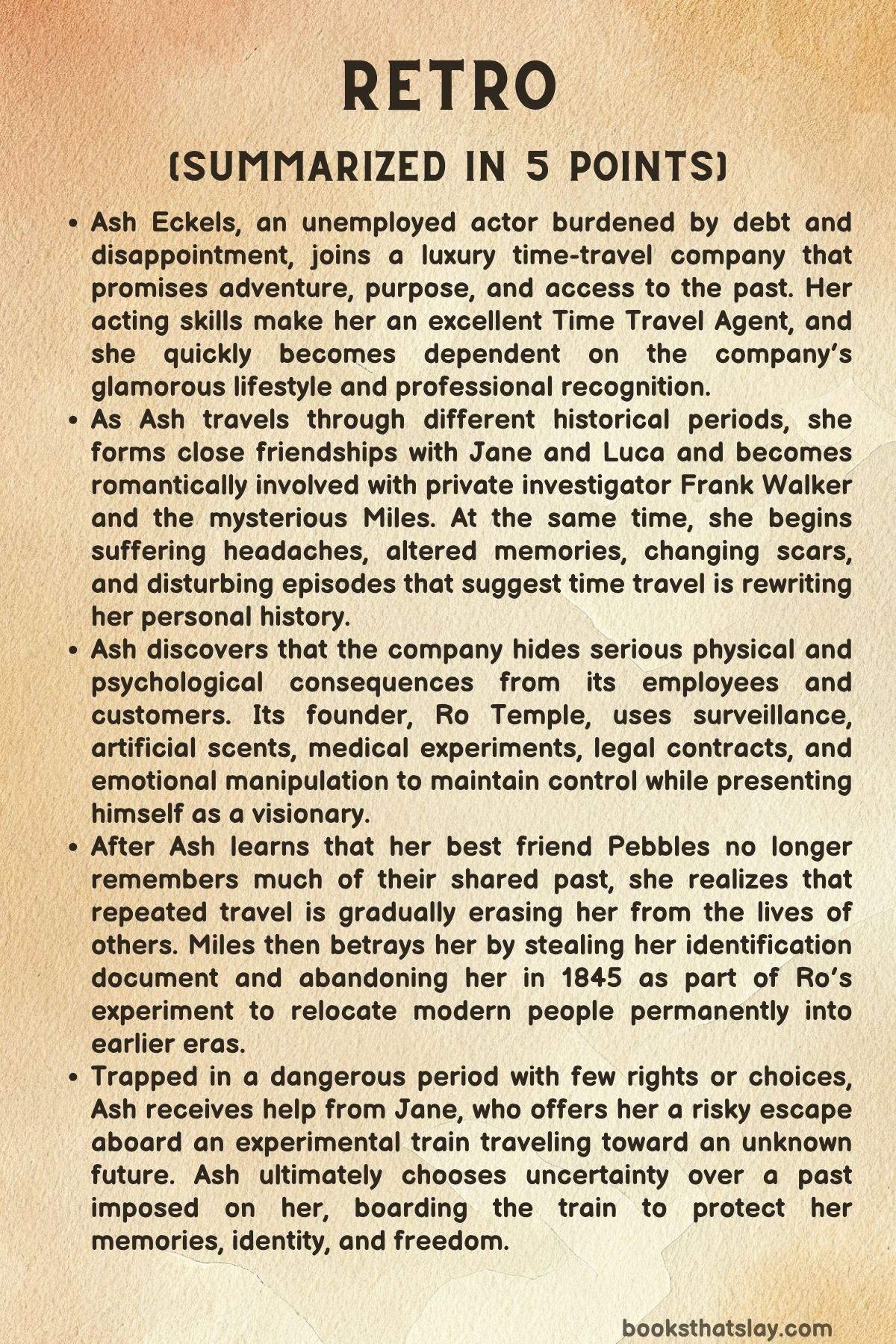
Retro by Jessica M. Goldstein is a speculative novel about Ash Eckels, an unemployed actor who joins a luxury time-travel company after losing faith in her career and future.
What begins as an exciting chance to experience history soon becomes a disturbing examination of nostalgia, corporate control, memory, ambition, and personal identity. As Ash grows dependent on historical travel, her connection to the present begins to weaken in ways she cannot reverse. Through her struggle, the book asks whether escape can ever create a meaningful life and whether people can preserve themselves when their memories, relationships, and choices are controlled by a powerful institution.
Summary
Ash Eckels wakes in a stranger’s apartment after another directionless night in New York. She is unemployed, deeply in debt, disappointed by her failed acting career, and unable to imagine a future that feels desirable.
Her previous employer dismissed her after she refused to pretend that poor compensation, meaningless work, and forced social activities made the workplace feel like a family. With no severance, no financial security, and little hope, she returns to the cramped apartment she shares with strangers.
While scrolling online, Ash sees an advertisement for Retro, an exclusive company that allows wealthy customers to visit carefully prepared destinations in the past. The company is hiring Time Travel Agents, and employees are promised free access to historical travel.
The application asks unusual questions about regret, nostalgia, fear, violence, secrecy, and the desire to escape particular memories. Ash answers honestly, admitting that she wants to leave behind the life she has been living and become someone more adventurous and important.
At her interview, a recruiter named Christopher reveals that the company already knows about her education and acting background. He explains that Agents must perform continuously in real historical settings, maintaining believable identities without the protection of a stage or camera.
Ash succeeds in an immersive test that requires her to disappear into a moving crowd. Christopher recognizes her acting instincts and appeals directly to her belief that she has been waiting for one extraordinary opportunity to justify all her disappointments.
The company relocates Ash to Virginia and gives her a luxurious apartment decorated in the style of the 1920s. The comfort, beauty, and attention she receives make her former life in New York feel distant almost immediately.
Before beginning work, Ash signs an extensive contract that protects the company from responsibility for physical injury, psychological damage, altered relationships, or death. She notices the danger in the agreement but signs because she has no lawyer, no other job, and no realistic alternative.
Ash joins a team with Jane and Luca. Jane is rebellious, spiritually curious, and drawn to cultural experiences, while Luca is sarcastic, historically informed, and suspicious of easy romantic ideas about the past.
The company subjects Ash to medical examinations, memory scans, experimental injections, costume fittings, and safety training. She learns that temporal travel can cause terrifying bodily sensations and that a mechanical error may leave a traveler trapped, injured, or physically merged with a building or object.
Her first journey takes her to Los Angeles in 1937. The trip through spacetime is physically overwhelming, but the experience of entering a living historical city gives Ash the sense of wonder and importance that has been missing from her life.
During a staged initiation exercise at a bar, a real shooting occurs. Ash loses her tracking document and receives help from private investigator Frank Walker, who begins investigating the murder and becomes attracted to her.
Ash later learns that most of the danger was arranged by her colleagues as a test, although the killing was genuine. The company’s willingness to mix controlled performance with actual violence unsettles her, but she remains fascinated by the historical identity she was able to inhabit.
Her first customer assignment involves Brianna’s bachelorette party, which has been organized by Brianna’s childhood friend Celeste. Celeste has spent much of her limited savings on the celebration and desperately wants to prove that her friendship with Brianna still matters.
Ash recognizes Celeste’s insecurity because it resembles her own relationship with Pebbles, the college friend with whom she once shared creative ambitions. Pebbles has become a successful actor, while Ash has spent years believing that the opportunity meant for her arrived for someone else.
The group travels to Dakota Territory in 1866, where historical hardship is packaged as entertainment. Brianna participates in a dangerous railroad rescue, and Miles, the secretive head of Preservation, appears as the cowboy who saves her.
Ash becomes increasingly attracted to Miles. He explains that Preservation secretly repairs historical disruptions caused by travelers, revealing that the company’s claim that history automatically corrects itself is incomplete.
As Ash completes more assignments, her acting abilities make her one of the company’s most effective Agents. She can change accents, invent identities, reassure frightened customers, and conceal emergencies so convincingly that her coworkers finally give her the professional admiration she never received as an actor.
Her new life quickly becomes centered on historical travel, drugs, parties, romantic encounters, and friendships with other employees. The present becomes little more than a waiting area between journeys.
Ash also begins visiting Frank in 1937. His values are shaped by his era, but he listens carefully and treats her as though her thoughts matter, creating an intimacy she rarely experienced in modern relationships.
At the same time, Miles takes Ash on private journeys to vanished landscapes, historic buildings, drive-in theaters, skating rinks, and famous monuments. Although their attraction is clear, he avoids defining their relationship or explaining why he has taken such a strong interest in her.
Small changes begin appearing in Ash’s life. A new scar replaces an old childhood scar, even though she remembers receiving both injuries, and she experiences severe headaches when her memories conflict with her altered body.
Employees describe such changes as continuity errors and assure her that they are harmless. Miles admits that personal events are less resistant to historical alteration than major public events, but he claims that the essential Timeline remains stable.
Ash’s doubts grow after a company meeting in which founder Ro Temple publicly humiliates an employee named Zoe for questioning the psychological effects of travel. Artificial scents, controlled lighting, and Ro’s theatrical presence produce admiration and emotional obedience among the staff.
Ro takes a personal interest in Ash because she has few attachments. She has no spouse, children, property, stable career, or strong relationship with her family, making her unusually free from the obligations that might anchor her to the present.
Ash learns that some customers suffer serious neurological and emotional symptoms after repeated trips. An influencer from Brianna’s party experiences memory loss, sleep paralysis, altered brain activity, and a decline in her public visibility, but the company treats her condition as a legal inconvenience.
The Clinic advises Ash to stop carrying present-day memories into historical destinations. Gabrielle tells her to travel lightly by releasing the personal memories that create painful conflicts between different versions of her life.
Ash realizes that forgetting may not be an accidental consequence of time travel. It may be the behavior the company requires from successful employees.
Her relationship with Pebbles becomes increasingly strained. Pebbles worries about Ash’s safety and asks her to make contact after each trip, but Ash interprets this concern as judgment from someone whose career has succeeded.
A possible opportunity eventually appears when a respected director expresses interest in Ash’s past performance and in a screenplay she and Pebbles once wrote together. Instead of feeling hopeful, Ash becomes afraid that returning to acting would force her to leave the identity and community she has gained through the company.
Meanwhile, public accusations emerge against the powerful industry figure who sexually exploited Ash when she was trying to establish her acting career. Pebbles asks whether she wants to speak publicly, but Ash refuses because acknowledging the abuse would require her to face the event she has spent years minimizing.
Her medical symptoms worsen. Rooms appear to melt, repeated sounds fill her mind, memories overlap, and she sometimes loses control of her body.
Frank investigates Ash and discovers that her historical identity has no verifiable background. Company rules require her to leave the period once a Local becomes suspicious, forcing her to end one of the few relationships in which she has felt fully heard.
Miles then reveals that he once traveled to watch Ash perform Juliet years before she joined the company. His praise makes her believe that he recognized her talent when the rest of the world had forgotten it, strengthening both her trust and her romantic feelings.
After Ash collapses during a severe episode, the Clinic again tells her to release her memories rather than question the system. She obeys because she has seen Zoe fired and knows that her income, apartment, friendships, identity, and access to travel depend on keeping her job.
When Ash finally contacts Pebbles about the screenplay opportunity, she discovers that Pebbles no longer remembers most of their friendship. Ash recalls years of conversations, shared traditions, private jokes, and mutual support, but Pebbles remembers her only as someone she knew long ago.
Ash understands that repeated temporal travel has rewritten her personal history. Her physical absence from the present has gradually removed her from the memories and experiences of the people she left behind.
She seeks comfort from Eugene, the kindly doorman who has always encouraged her. When his body glitches beneath her touch, she discovers that he is a sophisticated hologram programmed to observe, reassure, and emotionally manage the building’s residents.
With Pebbles forgetting her and Eugene exposed as artificial, Ash turns to Miles. He promises that Preservation may be able to repair the damage and convinces her to flee with him to 1845 while they develop a plan.
Ash trusts him with her identification document, sleeps with him, and believes they are beginning a genuine partnership. The next morning, she discovers that his symbolic gift was an ordinary marble and that he has disappeared with the document she needs to return home.
Ro meets her in a local bar and explains that Miles delivered her there intentionally. Ash has been selected as the first major subject of the Good Old Days Project, a plan to place modern people permanently in historical periods.
Ro reveals that major historical events may resist alteration, but individual lives do not. Ash can be removed from the present because the company considers her socially insignificant and believes her disappearance will not affect important events.
Molly, the woman accused of the murder in 1937, was an earlier experimental subject. She remembered Miles’s betrayal and tried to shoot him, but another man was killed and she was dismissed as insane.
Ro tells Ash that the future is environmentally destroyed, violent, and unlivable. He encourages her to remain in 1845, marry, have children, and surrender the memories that are causing her pain.
A company pamphlet confirms that Ash will gradually forget the present while the people she knew forget her. She receives a small amount of money, one week of shelter, and no right to refuse permanent relocation.
Forced to survive, Ash begins working in a dangerous textile mill beside exhausted children. She sees how easily suffering is accepted when workers have never known safer conditions, and she begins thinking about strikes and labor reform.
Remembering modern life causes severe pain, but forgetting would mean losing Pebbles, her family, her identity, and the knowledge that another existence was possible. She understands that even her disappointing life in New York contained freedoms she never valued until they were taken away.
Jane eventually reaches Ash after recognizing the coded butterfly message they created for emergencies. She returns Ash’s identification document and explains that Wyatt has arranged for the damaged Tomorrow Train to reach a secret station.
Traveling into the future may kill Ash because the company cannot predict where or when the vehicle will arrive. Remaining in 1845, however, will gradually turn her into someone who accepts captivity because she can no longer remember being free.
Christopher arrives with Ash’s employment contract and claims that the company legally assigned her to the project. When Jane refuses to cooperate, he attacks her and breaks her arm.
Ash uses the revolver she carried from an earlier assignment and shoots Christopher. Jane takes his identification document to conceal what happened, while Ash begins a long journey toward the secret station on Sheila, the pony taken from company headquarters.
Ash releases Sheila near other horses and approaches the hidden station alone. She considers every terrible future Ro described but also recognizes that his version of what lies ahead may be another method of control.
The Tomorrow Train arrives without revealing its destination. Ash understands that no company, machine, romantic partner, or historical role can identify the place where she belongs.
She boards because uncertainty offers more freedom than a past chosen for her by someone else. As the vehicle enters spacetime, Ash accepts the artificial scent called Daybreak and allows herself to imagine darkness giving way to morning.
Characters
Ash Eckels
Ash Eckels is the central character of the book and the person through whom Retro examines dissatisfaction, ambition, trauma, memory, and the desire to escape. At the beginning, she believes her life has failed because she has lost her job, accumulated debt, abandoned acting, and watched Pebbles achieve the recognition they once expected to share.
Her greatest strength is her ability to perform. She can read a situation quickly, adapt her behavior, create convincing identities, and use pieces of emotional truth to support a lie, making her exceptionally capable as a Time Travel Agent.
That same talent also becomes one of her weaknesses. Because she can inhabit almost any role, she often avoids deciding who she is when no performance is required, and she accepts external validation as evidence that she has finally found a meaningful identity.
Ash repeatedly minimizes her own suffering. She dismisses workplace exploitation, sexual harassment, career trauma, loneliness, and physical danger because she has learned to believe that ordinary or common pain does not deserve serious attention.
Her dependence on the company develops because it supplies everything missing from her life at once: housing, money, friendship, admiration, adventure, attractive partners, and professional recognition. Questioning the organization would therefore require her to risk losing not only a job but the entire structure on which her new identity rests.
Her development reaches its clearest point when she understands that preserving herself matters more than remaining comfortable. Boarding the Tomorrow Train is not merely an escape from 1845; it is her first independent commitment to a future that has not been designed by an employer, romantic partner, or imagined version of the past.
Ro Temple
Ro Temple is the founder of Retro and the main force behind the company’s ideological and scientific abuse. He presents himself as a visionary who has conquered one of humanity’s greatest limitations, but his real interest lies in controlling how people understand time, memory, and personal significance.
Ro is highly skilled at turning criticism into proof of his own greatness. When employees raise concerns about psychological harm, failed machinery, or historical consequences, he reframes those concerns as fear, weakness, or resistance to innovation.
His power depends on more than wealth and technology. Artificial scents, carefully designed spaces, staged entrances, emotional language, surveillance, and detailed personal data allow him to influence people before they consciously evaluate what he is saying.
Ro treats isolation as usefulness. He selects Ash because she has few legal, financial, professional, or familial connections, regarding the absence of social protection as evidence that her life can be removed without consequence.
His philosophy separates public history from private humanity. Major events matter because they shape the world, while individual memories, relationships, bodies, and ambitions can be rewritten or discarded if they do not affect the larger Timeline.
Ro’s claim that the future is unlivable may be true, exaggerated, or entirely false. What matters is that he uses uncertainty about the future to convince Ash that captivity in the past is reasonable, proving that his greatest weapon is his ability to define which choices appear possible.
Miles
Miles is the head of Preservation and one of the most emotionally complicated figures in the novel. He appears practical, mysterious, and more authentic than the company’s polished managers, causing Ash to believe that he represents honesty inside a manipulative institution.
His work involves repairing disruptions caused by historical travel. Because he sees the damage hidden from customers and ordinary employees, Ash assumes that his knowledge makes him capable of protecting her.
Miles studies Ash before she joins the company by traveling back to watch her performance as Juliet. His praise reaches the most vulnerable part of her identity because it confirms that her acting talent existed even when her career failed.
He creates intimacy through private historical journeys, symbolic gifts, secrecy, physical attention, and carefully timed revelations. These gestures appear romantic, but they also function as methods of observation and control.
His betrayal is especially damaging because it does not erase the possibility that he genuinely cares for Ash. He may regret abandoning her, yet he still values his loyalty to Ro and the project more than her freedom, safety, or right to make an informed choice.
Miles therefore represents affection without moral courage. His feelings may be real, but his unwillingness to resist the system turns those feelings into another instrument of harm.
Jane
Jane is Ash’s closest friend within the company and one of the few characters who ultimately acts against its authority. She is impulsive, rebellious, funny, spiritually curious, and openly critical of historical injustice and corporate obedience.
Her interest in the past is connected to her failed ambition to become a poet. Historical travel gives her constant access to inspiration and unusual experiences, but it also allows her to postpone the discipline and vulnerability required to create original work.
Jane searches for moments of complete cultural originality, although she repeatedly discovers that every artistic movement grows from earlier influences. Her impossible search reflects her desire to find something untouched by commerce, imitation, or nostalgia.
Despite her flaws, Jane takes Ash’s danger seriously. She remembers their emergency code, investigates Miles’s actions, enters 1845 without authorization, and offers Ash a possible escape without making the final decision for her.
Her refusal to control Ash distinguishes her from Ro, Christopher, Gabrielle, and Miles. Even when the available choices are terrible, Jane respects Ash’s right to determine which risk she is willing to accept.
Jane’s loyalty becomes physical and costly when she resists Christopher and suffers serious injuries. Her courage proves that friendship can survive historical alteration and institutional pressure when it is expressed through action rather than promises.
Luca
Luca is intelligent, observant, sarcastic, and historically knowledgeable. He often provides Ash with practical explanations that challenge romantic or simplified ideas about the past.
His personal obsession is finding the last good day before a particular invention, disaster, or social change damaged the world. Every attempt fails because he discovers that suffering and compromise were already present before the supposed moment of decline.
Luca is skeptical of marriage and long-term commitment. His refusal of a proposal from a former partner reflects both political questioning and a deeper fear that accepting social progress would require him to make a personal choice he was not prepared to make.
He often recognizes danger before Ash does, particularly in Ro’s interest in her and in Miles’s secrecy. However, his insight does not always lead to resistance, and he sometimes dismisses evidence when accepting it would threaten his position or lifestyle.
His response to the injured influencer demonstrates this limitation. Rather than seriously consider that travel caused her symptoms, he reduces the problem to drugs, dieting, and personal irresponsibility.
Luca is neither blindly loyal nor fully courageous. He understands many of the company’s contradictions but remains comfortable enough within its privileges to avoid confronting them until the consequences become impossible to ignore.
Pebbles
Pebbles is Ash’s former closest friend and the emotional connection most directly affected by alterations to Ash’s personal history. During college, the two women shared ambitions, supported each other through anxiety, and imagined building successful creative lives together.
Her later success in the film Nighthawk creates an imbalance Ash cannot accept. Ash interprets Pebbles’s achievements as evidence that only one of them was allowed to move forward, even though Pebbles continues trying to maintain contact.
Pebbles’s concern about time travel is reasonable and protective. She asks Ash to report her safe returns and later encourages her to speak about the director who exploited her, but Ash experiences these efforts as judgment or interference.
The screenplay True Believers symbolizes the future they once expected to share. When professional interest returns to the project, Ash treats the opportunity as a possible route back into acting, while Pebbles sees Ash’s sudden enthusiasm as opportunistic after years of distance.
The tragedy of Pebbles’s character lies in the fact that she has not simply chosen to forget Ash. History has been reorganized so that many of their shared experiences no longer exist for her.
Pebbles becomes proof that identity is partly preserved inside other people. When she loses the history of their friendship, Ash loses an external witness to the person she once was.
Frank Walker
Frank Walker is a private investigator living in Los Angeles in 1937. He meets Ash after the bar shooting and becomes both a romantic partner and an investigator whose instincts gradually threaten her historical cover.
Frank possesses assumptions about women and relationships that reflect his era. Ash recognizes these faults but finds them easier to identify than the disguised selfishness she encountered in modern dating.
His most important quality is attentiveness. He listens closely, asks direct questions, and gives Ash the feeling that her presence matters, which makes their relationship emotionally grounding even though it is built on a false identity.
Frank’s method of investigation also influences Ash’s understanding of the company. He assumes that everyone lies and searches for the desire or fear protected by each version of events, teaching her to examine motives instead of trusting confidence.
His decision to investigate Ash demonstrates that affection does not prevent him from noticing contradictions. He discovers that she has no traceable employment, family, address, or history, yet he does not immediately treat her as an enemy.
Frank is willing to accept that Ash may have experienced something she cannot yet discuss. His patience creates the possibility of honesty, but company rules and temporal danger prevent her from telling him the truth.
Christopher
Christopher is the recruiter, manager, and enforcer who first introduces Ash to the company. He appears calm, professional, and psychologically perceptive, but his warmth exists primarily to guide vulnerable people toward compliance.
During Ash’s interview, he identifies her deepest desire: the hope that one extraordinary opportunity will make her disappointments appear purposeful. By naming that desire, he makes the job feel less like employment and more like destiny.
Christopher normalizes dangerous contracts, invasive surveillance, experimental duties, and limited employee protections. He rarely offers direct reassurance, instead relying on Ash’s lack of alternatives to secure her agreement.
His corporate language hides personal responsibility. Terms such as Experience Manager and Explorer make exploitation sound adventurous, while broad contractual clauses transform abuse into an assigned duty.
When Ash attempts to escape the permanent relocation project, Christopher abandons his friendly manner. His violent attack on Jane reveals that coercion was always present beneath the polished surface.
Christopher represents the administrative face of institutional cruelty. He does not need Ro’s charisma because his function is to convert one person’s vision into paperwork, policy, intimidation, and physical enforcement.
Wyatt
Wyatt is the young lead engineer responsible for understanding and maintaining the temporal transportation system. Despite his age, he possesses more technical knowledge than nearly anyone else in the organization.
He views machines as systems that can be understood by taking them apart. This mindset gives him a respect for evidence that contrasts with the emotional manipulation used by management.
Wyatt is honest about mechanical dangers. He explains failed landings, unstable coordinates, fatal accidents, and the inability to predict where a future-bound vehicle may arrive.
His position creates a moral conflict between pride and responsibility. He has helped build an extraordinary technology, but he also knows that Ro is pressuring the engineering department to move beyond what can be controlled safely.
Unlike many employees, Wyatt believes Ash’s symptoms deserve serious attention. He recognizes that glamour and stimulation may be used to distract workers from scientific and ethical problems.
His decision to arrange the Tomorrow Train gives Ash a chance to escape, even though he cannot guarantee survival. By doing so, Wyatt places her freedom above the reputation and authority of the system he helped create.
Gabrielle
Gabrielle works in the Clinic and controls many of the medical and psychological procedures imposed on employees. She appears casual and knowledgeable, which initially makes invasive treatment seem routine.
Her technology can retrieve memories with extraordinary emotional clarity. Through her sessions, Ash revisits childhood ambition, friendship with Pebbles, professional disappointment, and sexual exploitation.
Gabrielle’s role becomes increasingly threatening because she refuses to explain what the examinations are designed to measure. When Ash experiences violent hallucinations or memory loss, Gabrielle describes them as progress rather than possible injury.
Her advice to pack light treats memory as unnecessary baggage. Instead of protecting Ash’s identity, she encourages Ash to surrender the parts of herself that conflict with altered history.
Gabrielle may understand the true purpose of the permanent relocation project before Ash does. Her familiarity with severe déjà encore suggests that earlier subjects or employees suffered similar consequences.
She represents scientific authority separated from informed consent. Her calm manner does not reduce the harm she causes; it makes the company’s experimentation easier to accept.
Dominique
Dominique leads the department responsible for clothing and transforming travelers into historically convincing figures. She is elegant, commanding, precise, and deeply knowledgeable about how clothing shapes the body and social identity.
For Ash, Dominique’s work restores the pleasure of costume and character creation. Historical clothing allows Ash to see herself as glamorous, mysterious, and capable rather than unemployed and defeated.
Dominique understands that authenticity is produced through careful construction. Hair, makeup, undergarments, posture, fabric, and accessories all contribute to the identity a traveler performs.
She also enjoys the exclusive privileges available to employees, particularly access to historical spaces that ordinary customers cannot enter. Her preference for parties in the past shows how status continues to operate even inside a workplace built around escape.
Although Dominique supports Ash’s birthday journey and participates in the social life of the group, she does not confront the organization’s abuses directly. She remains an example of someone whose artistic skill and privileged access make complicity comfortable.
Eugene
Eugene initially appears to be the warm and attentive doorman in Ash’s apartment building. He welcomes her, praises her talent, remembers personal details, and treats her as though she has already become the successful actor she once wanted to be.
His encouragement matters because it gives Ash immediate emotional confirmation that her life has changed. He turns employee housing into a place that feels personal, safe, and permanent.
Eugene also helps normalize continuity errors. When Ash asks about her altered scar, he compares life to a story whose superficial details may change while its essential character remains stable.
The discovery that he is a hologram changes the meaning of every interaction. His kindness, stories, admiration, and apparent affection are part of a programmed system designed to reassure and observe residents.
Eugene is disturbing not because artificial kindness has no emotional effect, but because the effect is real for Ash even when the relationship is not mutual. He demonstrates how easily emotional support can become a tool of surveillance and control.
Ash’s Mother
Ash’s mother is anxious, suspicious, and attracted to alarming theories and questionable movements. Her response to danger often takes the form of warnings, articles, and fear rather than calm emotional support.
Her relationship with Ash contains genuine love but limited understanding. She remembers the intensity of Ash’s birth and once maintained a tradition of recalling its exact time, yet she struggles to engage with the emotional reality of Ash’s adult life.
As historical changes accumulate, her memory begins weakening. She becomes confused about Ash’s employment and forgets details that once connected them.
These changes show that Ash’s removal is not limited to her friendship with Pebbles. Her place within her family is also being rewritten.
Ash’s mother therefore represents both the imperfect bonds Ash wanted to escape and the irreplaceable personal history she later fights to preserve.
Ash’s Father
Ash’s father communicates primarily through photographs and factual information about animals. His messages may appear emotionally indirect, but they form a consistent pattern of contact throughout Ash’s life.
He does not respond to Ash’s problems with dramatic advice or judgment. Instead, he offers small observations, suggesting a form of affection that depends on routine rather than emotional discussion.
Ash often overlooks the value of these messages because they do not provide the recognition or understanding she desires. Once she is trapped in the past, however, ordinary contact from her father becomes one of the modern comforts she mourns.
His character demonstrates that meaningful relationships are not always expressed in the language a person expects. The apparent simplicity of his messages becomes important because repetition itself confirms that someone remembers Ash and chooses to reach her.
Celeste
Celeste is Brianna’s childhood friend and the organizer of the bachelorette journey. She spends money she cannot easily afford because she hopes the celebration will confirm that her old relationship with Brianna still holds a special place.
Her efforts repeatedly reveal the distance she is trying to deny. When she mentions Brianna’s childhood love of horses, the other women treat the memory as embarrassing rather than intimate.
Celeste’s insecurity reflects Ash’s relationship with Pebbles. Both women are struggling to preserve equality with friends whose financial and professional success has changed the balance between them.
Unlike the wealthier members of the party, Celeste understands that the trip carries real emotional and physical risks. During the railroad attraction, she is the only person who truly believes Brianna might die.
Her later legal action on behalf of the injured influencer shows that her loyalty is not limited to sentiment. She is willing to challenge the company and document evidence of harm.
Celeste demonstrates that desperation to preserve a relationship can be painful, but it can also produce responsibility, attention, and moral action.
Brianna
Brianna is the bride whose historical bachelorette trip becomes Ash’s first professional assignment. She belongs to a wealthier and more socially confident group than Celeste, and she appears uncomfortable with reminders of the childhood they once shared.
Her desire for the full railroad rescue experience shows her attraction to controlled danger. She wants the excitement to feel real while assuming that the company will prevent any permanent consequence.
Brianna treats history primarily as a luxury product. The past becomes a setting for celebration, photographs, entertainment, and personal status rather than a world inhabited by people facing genuine restrictions and suffering.
Her treatment of Celeste is not openly cruel, but it is dismissive. By allowing the group to laugh at memories that matter to Celeste, she demonstrates how success can make an earlier friendship feel inconvenient.
Brianna’s character helps establish the class divisions within historical tourism. She can purchase danger because she expects other people to manage the consequences.
Molly
Molly is the woman accused of committing the murder that Frank investigates. She is eventually declared insane and unfit to stand trial, allowing the authorities to close the case without understanding her actions.
Ro later reveals that Molly was an earlier Pioneer used in the permanent relocation project. Like Ash, she was delivered into the past by Miles and expected to surrender her original life.
Molly remembers the betrayal and attempts to shoot Miles. Another man is killed instead, leaving her trapped in a period where her claims about time travel can only be interpreted as madness.
Her fate provides Ash with a direct image of what resistance can become when a person lacks evidence, social power, and a believable explanation. Molly is not merely an unsuccessful experiment; she is someone whose justified knowledge has been converted into proof that she is irrational.
Zoe
Zoe is an employee who raises concerns about customers experiencing emotional and psychological difficulties after travel. Ro responds by questioning her publicly and making her uncertainty appear more important than the harm she is reporting.
She is later dismissed after missing or refusing Clinic appointments despite having medical justification. Her firing establishes that participation in company medical procedures is not genuinely voluntary.
Zoe functions as a warning to other employees. Ash remembers what happened to her whenever she considers questioning Gabrielle or refusing treatment.
Although Zoe appears briefly, her treatment reveals how the organization handles internal criticism. It does not answer concerns through evidence; it isolates and removes the person who asks the question.
Grace
Grace is the eleven-year-old worker who trains Ash at the textile mill in 1845. Her competence reflects necessity rather than opportunity, since dangerous labor has already become a normal part of her childhood.
She does not understand the idea of a weekend because she has never experienced a work structure that reserves regular time for rest. Her confusion shows how rights that later appear basic must first be imagined before they can be demanded.
Grace possesses some awareness of women organizing for shorter workdays. Her information gives Ash a possible connection between future knowledge and action within the past.
Her character forces Ash to see history without the protection of tourism. Grace is not part of an attraction; she is a child whose exhaustion and danger continue after the visitor’s experience ends.
Minnie
Minnie is a thirteen-year-old textile worker who continues operating machinery after losing two fingers. Her injury demonstrates how dangerous labor becomes ordinary when workers have no legal protection or economic alternatives.
She receives no special rescue, compensation, or meaningful recovery. Her body is treated as replaceable because the industrial system values production more than individual safety.
Although her role is small, Minnie makes the consequences of Ash’s permanent relocation concrete. The historical period is not simply lacking modern comfort; it contains social conditions that severely limit the survival and independence of vulnerable people.
Sheila
Sheila is the pony kept inside the company’s communication department after an unsuccessful attempt to operate a historical Pony Express service. Employees treat her as a charming mascot and insist that she is living an ideal life.
Ash questions whether comfort is enough when an animal has been removed from its natural environment. Sheila therefore becomes an early reflection of Ash, who enjoys luxury while being increasingly separated from her original life.
Jane later uses Sheila to help Ash travel toward the secret station. The pony becomes essential to an escape from the same institution that confined her.
Ash releases Sheila among other horses before approaching the Tomorrow Train. This act gives the animal the freedom Ash is still seeking for herself.
Maverick, Also Known as Melvin
Maverick is a customer who travels to the Washington UFO sightings of 1952 because he expects proof that governments conceal extraordinary events. His chosen identity and beliefs initially make him appear unreasonable.
His presence becomes significant because Ash is also discovering that a powerful organization is hiding scientific evidence, manipulating information, and discrediting people who question its claims. The difference is that her suspicions are supported by direct experience.
Maverick shows how genuine secrecy can exist beside exaggerated conspiracy thinking. His certainty does not make every belief true, but the organization’s deception makes it dangerous to dismiss all suspicion as irrational.
The Injured Influencer
The unnamed influencer from Brianna’s party provides some of the earliest evidence that temporal travel can seriously damage a person. After returning, she loses followers, sponsorships, public visibility, and aspects of her physical and cognitive stability.
Her symptoms include memory loss, sleep paralysis, altered brain activity, and behavior resembling withdrawal. These effects suggest that history may be changing not only her memories but her position within the social world.
Because Luca regards her as shallow and the company treats her case as a legal problem, her suffering is easy for employees to dismiss. Her character demonstrates how prejudice against a person’s lifestyle can be used to avoid taking credible harm seriously.
Themes
Nostalgia as Escape and Commodity
Nostalgia in Retro is not presented as a simple affection for earlier times. It becomes a product designed, packaged, scented, advertised, and sold to people who are dissatisfied with the present.
The company understands that customers are not necessarily longing for accurate history. They may want childhood security, social privilege, adventure, traditional gender roles, financial stability, cultural excitement, or freedom from modern responsibility.
Historical destinations are therefore arranged to satisfy emotional expectations. Clothing, accommodation, transportation, smells, language, and staged dangers help travelers feel that they have entered a more meaningful world.
The book repeatedly exposes the gap between remembered history and lived history. The American West was already creating myths about itself, holiday traditions were shaped by advertising, malls become precious only after disappearing, and famous cultural moments were influenced by earlier traditions.
Nostalgia also allows people to temporarily abandon their values. Employees criticize capitalism while shopping in an old mall, wealthy customers turn oppression into luxury tourism, and visitors purchase proximity to murders, disasters, plantations, and dangerous medical practices.
Ash’s dependence on the past begins because the present feels empty and humiliating. Historical travel supplies intensity, admiration, beauty, and community, but it does not resolve the causes of her dissatisfaction.
The more she uses nostalgia to avoid her life, the more easily the company removes that life from her. Escape becomes dangerous when it requires a person to stop valuing the memories and relationships that made escape possible.
Identity, Memory, and Continuity
Identity in the novel depends on more than private self-knowledge. It is preserved through bodily marks, repeated habits, shared memories, family traditions, friendships, creative work, and the recognition offered by other people.
Ash initially believes she can leave her disappointing identity behind and become someone new. Historical performance appears to give her control because she can select voices, clothes, names, and behaviors suited to each destination.
The continuity errors reveal that identity cannot be exchanged without cost. When one scar replaces another, Ash’s body begins presenting a history that conflicts with what her mind remembers.
The damage becomes more serious when Pebbles no longer remembers their friendship. Ash still carries their private jokes, traditions, ambitions, and conversations, but the person who helped create those memories no longer confirms that they happened.
This loss demonstrates that relationships are not additions to an isolated self. Other people act as witnesses who preserve versions of us that cannot survive through individual memory alone.
The Clinic’s instruction to release memories is therefore a demand for surrender rather than healing. Forgetting would reduce Ash’s pain because she would no longer recognize the difference between the life she chose and the life imposed on her.
Ash’s decision to risk the future protects continuity even though it cannot guarantee safety. She chooses to remain the person who remembers rather than become comfortable through the destruction of memory.
Corporate Power, Consent, and Manipulation
The company rarely relies on a single form of control. It combines financial dependence, luxury housing, invasive data collection, medical authority, legal contracts, emotional validation, surveillance, social pressure, artificial environments, and physical violence.
Ash technically agrees to many of the conditions imposed on her, but her consent is weakened by unemployment, debt, limited alternatives, incomplete information, and the company’s refusal to explain the risks. A signature cannot represent meaningful choice when one party controls the facts and the other cannot negotiate.
Corporate language helps disguise exploitation. Tourists become Explorers, human resources becomes Experience Management, dangerous vehicles become luxury transportation, and forced permanent relocation becomes an innovative project.
The organization also manages emotion directly. Artificial scents create calm, longing, excitement, safety, and admiration, while carefully designed apartments and holographic employees give workers a programmed sense of belonging.
Criticism is treated as personal failure. Zoe is humiliated and dismissed, injured travelers are blamed for their lifestyles, and Ash is encouraged to interpret memory loss as an inability to commit properly to her work.
Ro’s project extends corporate ownership beyond labor. The company claims power over bodies, memories, relationships, historical placement, and the meaning of an employee’s life.
Christopher’s attack on Jane reveals what polite administration has concealed. Behind contracts, motivational language, and luxury experiences stands the willingness to use force against anyone who refuses the role assigned to them.
Choosing the Future Over the Past
Ash spends much of the story believing that fulfillment exists somewhere behind her. She searches the past for the artistic success, friendship, adventure, recognition, safety, and sense of belonging that she believes she missed.
The other Agents follow similar patterns. Jane looks for complete originality, Luca searches for the last good day, and Miles constructs a life around repairing what has already happened.
Their journeys show that no historical period contains a perfect point before disappointment began. Every age includes inequality, exploitation, loss, performance, commercial influence, and people longing for some earlier condition.
Ro uses fear of the future to justify permanent retreat. By describing what lies ahead as diseased, violent, and environmentally ruined, he presents captivity in 1845 as protection from uncertainty.
Ash eventually understands that a guaranteed past offers no genuine freedom when someone else selects it for her. Remaining would mean accepting dangerous labor, restricted rights, forced dependence, and the gradual disappearance of her memories.
The Tomorrow Train provides no promise of safety. It may carry her only a few minutes forward, leave her centuries away, arrive in a ruined world, or kill her before she reaches any destination.
Boarding it is meaningful precisely because the outcome is unknown. Ash stops demanding proof that the future will reward her and chooses it because an unwritten life still contains the possibility of agency.
Her final decision changes the direction of her desire. Instead of asking where she once belonged, she accepts that belonging may be created through movement, memory, risk, and choices that remain her own.