Regime Change: Inside the Imperial Presidency of Donald Trump Summary and Analysis
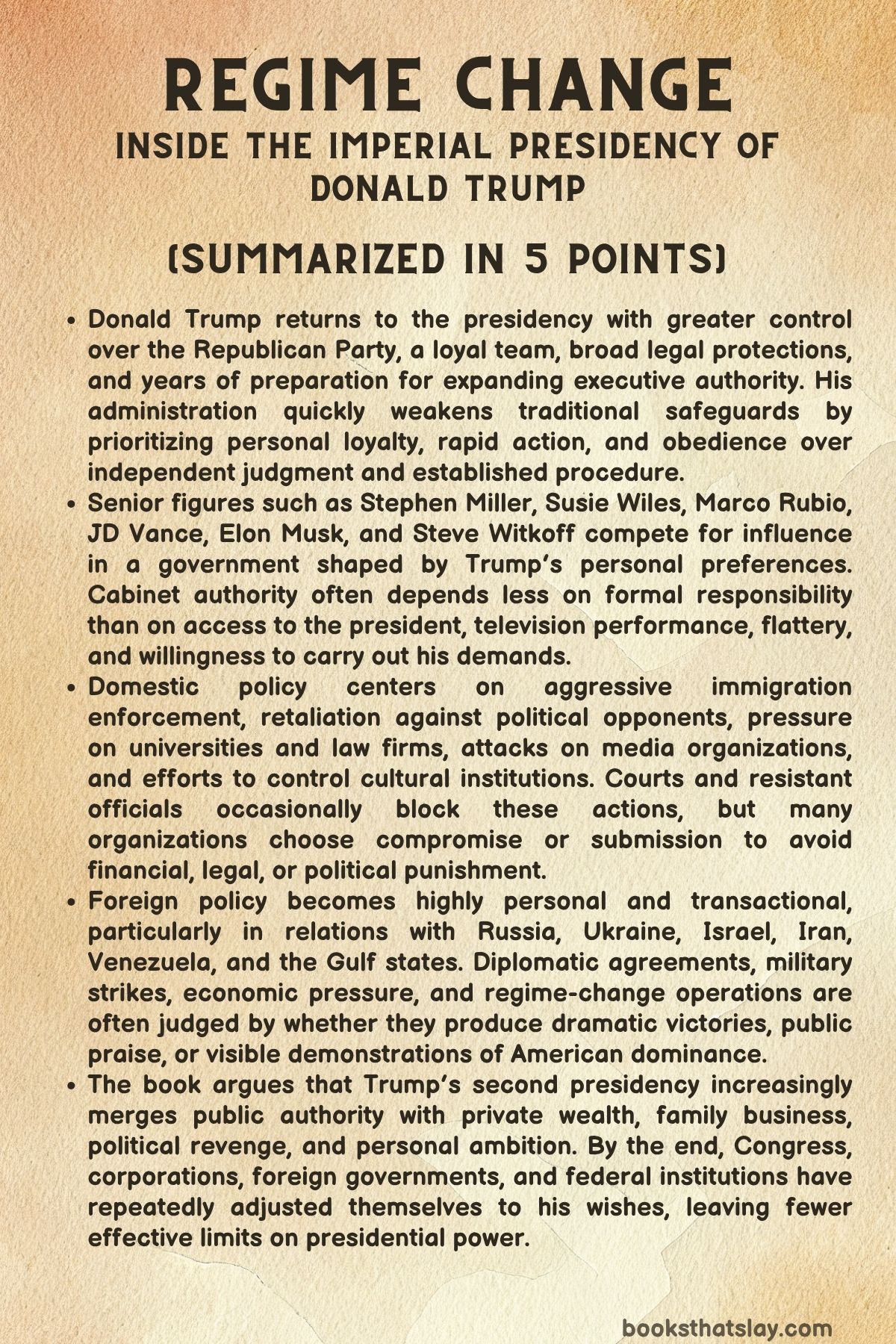
Regime Change: Inside the Imperial Presidency of Donald Trump is a political nonfiction book by Maggie Haberman and Jonathan Swan that examines the first year of Donald Trump’s return to the presidency.
Through scenes from the White House, Mar-a-Lago, diplomatic meetings, cabinet disputes, military operations, and corporate negotiations, the authors show how presidential authority becomes increasingly personal. Loyalty often replaces expertise, public institutions become instruments of pressure, and government decisions are shaped by grievance, spectacle, wealth, and competition. The book presents a detailed account of a presidency testing how much power can be concentrated in one individual when political, legal, and institutional resistance has weakened.
Summary
Donald Trump begins his second presidency from a position far stronger than the one he occupied during his first term. His defeat in 2020, legal troubles, criminal conviction, assassination attempts, and continued refusal to accept the election result have strengthened his connection with supporters rather than destroying his political career.
Four years outside office give Trump and his allies time to study the weaknesses of the federal government and prepare methods for removing internal resistance. When he returns in 2025, he controls the Republican Party, faces a compliant Congress, benefits from broad presidential immunity, and surrounds himself with officials selected primarily for loyalty.
The transition reveals how Trump intends to govern. Cabinet candidates are evaluated through television appearances, personal chemistry, physical presentation, and their past statements about him, while former officials who criticized him or defended Mike Pence are excluded.
Marco Rubio becomes secretary of state after transforming himself from a former rival into a trusted ally. Pete Hegseth, Tulsi Gabbard, Robert F. Kennedy Jr., Kristi Noem, Pam Bondi, Todd Blanche, John Ratcliffe, and others receive powerful positions despite concerns about their experience, judgment, or independence.
Trump begins his term by promising national renewal while portraying the country as ruined by the previous administration. He pardons more than fifteen hundred people connected to the January 6 attack, including violent offenders, after learning that Joe Biden issued pardons to members of his own family and political circle.
The decision establishes a governing pattern in which Trump’s emotional reaction overrides a slower review process. Presidential mercy becomes a declaration that loyalty to him can be rewarded even when it conflicts with conventional ideas of justice or institutional responsibility.
Stephen Miller enters the administration with authority over immigration, domestic policy, executive orders, and major national-security structures. He and Russell Vought have spent years preparing plans to weaken the civil service, expand emergency authority, and allow the president to act without relying on officials who might question legality or practicality.
An early federal funding freeze shows the dangers of rapid action. The poorly prepared order disrupts public programs, causes panic, and is blocked by the courts, but the administration quickly changes the subject by proposing that migrants be detained at Guantánamo Bay.
Susie Wiles provides a different form of influence. As chief of staff, she manages Trump through patience, political skill, controlled access, and quiet removal of rivals, although even she cannot always prevent personal impulses from becoming government policy.
Foreign policy develops through overlapping assignments and uncertain chains of command. Retired General Keith Kellogg believes he is responsible for negotiating an end to the war between Russia and Ukraine, only to discover that Trump has secretly given Steve Witkoff a separate diplomatic channel to Vladimir Putin.
Witkoff, a real-estate investor and longtime Trump friend, gains influence because his informal style matches the president’s preference for personal deals. He accepts Putin’s claims that Russia wants peace, that NATO contributed to the conflict, and that Trump possesses a special connection with the Russian leader.
Trump becomes increasingly hostile toward Volodymyr Zelensky, particularly when Ukraine rejects a demanding minerals agreement without American security guarantees. During a televised Oval Office meeting, Trump and JD Vance accuse Zelensky of ingratitude, disrespect, and risking a wider war, forcing him to leave without signing the agreement.
The confrontation demonstrates that American assistance is being treated as a personal transaction. Respect, protection, and diplomatic cooperation depend not only on strategic interests but also on whether foreign leaders visibly acknowledge Trump’s superiority.
Trump’s relationship with Benjamin Netanyahu is similarly shaped by resentment, admiration, and competition. Although still angry that Netanyahu congratulated Biden after the 2020 election, Trump supports Israel while attempting to present himself as a peacemaker.
He unexpectedly proposes that the United States take possession of Gaza, remove its Palestinian population, and redevelop the territory as valuable waterfront property. The proposal emerges from his real-estate instincts rather than a developed diplomatic plan, forcing advisors to explain and limit its implications after it has already been announced.
Elon Musk becomes another extraordinary source of power. After spending heavily to support Trump’s campaign, Musk receives broad permission to reduce the federal government through the Department of Government Efficiency, an organization with uncertain legal status and limited accountability.
Musk’s employees enter sensitive systems, dismiss workers, target agencies, and dismantle much of the United States Agency for International Development before many cabinet officials understand the scale of their actions. Trump values Musk both as a symbol of technological brilliance and as a shield who can absorb anger over government cuts.
The arrangement eventually breaks down because Musk repeatedly interferes with departments formally controlled by cabinet secretaries. Rubio, Sean Duffy, Scott Bessent, and others challenge him, and Trump finally declares that cabinet officials must control their own agencies.
Musk’s influence declines further after public disputes and his suggestion that unreleased Jeffrey Epstein records may implicate Trump. The Epstein controversy becomes a political crisis because Trump’s movement has encouraged deep suspicion of government secrecy, making it difficult for the administration to dismiss demands for disclosure.
Pam Bondi worsens the situation by distributing binders presented as Epstein material to friendly influencers even though the documents contain little new information. Kash Patel and Dan Bongino blame her for mishandling the issue, while Vance argues that greater transparency is necessary to prevent continued suspicion.
Trump’s economic policy is dominated by his belief in tariffs. He sees them as a source of revenue, a weapon against foreign governments, a punishment for corporations, and a way to force manufacturing back into the United States.
The “Liberation Day” tariff program is created through hurried calculations, online searches, internal rivalry, and Trump’s refusal to accept figures that contradict his expectations. When the announcement causes markets to fall sharply and threatens wider financial instability, Scott Bessent persuades him to pause many of the tariffs while intensifying pressure on China.
Trump also tries to control the Federal Reserve. He attacks Jerome Powell for refusing to reduce interest rates quickly, searches for reasons to remove other governors, and uses disputed renovation costs to portray the central bank as corrupt and badly managed.
The administration’s pressure on independent institutions extends far beyond economic policy. Law firms, universities, media companies, museums, cultural organizations, former government officials, and political opponents face investigations, financial punishment, revoked access, contract cancellations, public threats, or demands for institutional changes.
Some organizations surrender. Law firms agree to provide valuable legal services, media companies settle lawsuits, and corporations adapt their policies to avoid presidential hostility, while Harvard and parts of the Smithsonian system resist through litigation and internal opposition.
Letitia James, James Comey, Adam Schiff, Chris Krebs, Miles Taylor, and others become targets of Trump’s desire for retribution. Bill Pulte, Laura Loomer, Roger Stone, Boris Epshteyn, and other outside loyalists gain influence by presenting accusations that appeal to Trump’s belief that enemies and traitors surround him.
Lindsey Halligan is appointed to pursue cases against Comey and James despite her limited prosecutorial experience. The charges are later dismissed because her appointment is ruled unlawful, showing that even a Justice Department reorganized around loyalty cannot always convert presidential anger into sustainable criminal cases.
Immigration enforcement becomes the clearest demonstration of expanded executive authority. Miller demands higher arrest numbers, aggressive raids, deportation flights, frightening visual imagery, and widespread detention designed not only to remove migrants but also to create fear.
The administration sends alleged Venezuelan gang members to a high-security prison in El Salvador under an agreement with President Nayib Bukele. The mistaken deportation of Kilmar Abrego Garcia becomes a major legal conflict after officials resist judicial efforts to secure his return.
Government lawyers consider whether Trump could suspend habeas corpus by treating illegal immigration as an invasion. Although the administration does not formally take that step, it delays court orders, restricts bond hearings, and keeps thousands of people in detention without criminal convictions.
Military force gradually becomes part of domestic governance. Trump deploys National Guard personnel during protests in Los Angeles and Washington, threatens additional Democratic-controlled cities, and presents himself as the country’s chief law-enforcement officer.
Miller seeks broader authority under the Insurrection Act, while officials including Dan Caine and Susie Wiles worry about legal boundaries and the political use of the armed forces. The presence of troops on American streets begins to appear less exceptional as the administration repeatedly presents civil disorder as a national-security crisis.
The administration also transforms official communication into political entertainment. Steven Cheung, Kaelan Dorr, and other communications officials distribute insults, memes, edited arrest footage, triumphant music, and mocking posts through government accounts.
Cruelty and humiliation are treated as signs of strength, although polling suggests that the approach alienates voters more concerned about healthcare, food, housing, and living costs. Trump’s control of attention remains powerful, but it does not eliminate growing dissatisfaction with economic conditions.
The assassination of conservative activist Charlie Kirk gives Miller and Vance an emotional basis for investigating progressive organizations, foundations, media groups, and nonprofit networks. Trump encourages them to act aggressively, allowing political opposition and constitutionally protected speech to be increasingly described as support for domestic violence.
Abroad, the administration conducts secret military operations against suspected drug-smuggling boats in the Caribbean. These attacks expand into a campaign against Nicolás Maduro, even though the legal basis for treating suspected smugglers as enemy combatants remains disputed.
American forces eventually capture Maduro in a secret operation. Trump presents the mission as a decisive victory and claims authority over Venezuela’s political and economic future, even posting a mock profile that names him as the country’s acting president.
At the same time, Witkoff and Jared Kushner negotiate a Gaza agreement involving hostage releases, Israeli withdrawals, reconstruction, and international administration. The arrangement produces a real diplomatic achievement, although Trump exaggerates its permanence and imagines a development-oriented governing body that could be used in other conflicts.
The Trump family’s business interests expand alongside presidential power. Cryptocurrency ventures, foreign investment, real-estate projects, corporate contributions, valuable gifts, a luxury aircraft from Qatar, and fundraising for a ballroom and presidential library make the boundary between government and private enrichment increasingly difficult to identify.
Trump’s second year begins with renewed pressure from Netanyahu for a larger attack on Iran. Although Vance, Tucker Carlson, and others warn that war would betray Trump’s anti-interventionist campaign, the president becomes attracted to plans promising military destruction, regime collapse, and personal vindication.
Trump authorizes a joint American-Israeli war without congressional approval or NATO support. The decision becomes the largest American military operation since the invasion of Iraq and confirms the book’s central argument: the presidency is being exercised as personal authority, with constitutional restraints, alliances, institutions, and traditional divisions of power treated as obstacles that can be ignored or forced into submission.
By the conclusion, Trump is politically weaker but personally fascinated by the reach of his office. Voters express concern about prices, healthcare, immigration enforcement, and foreign wars, yet the president remains focused on monuments, White House decoration, historical comparisons, military triumphs, and demonstrations of obedience.
Congress, businesses, law firms, universities, cultural institutions, foreign governments, and senior officials have repeatedly adapted themselves to his demands. The result is an unfinished presidency whose direction is already clear: government increasingly reflects the preferences, resentments, ambitions, financial interests, and personal judgments of one man.
Key People
Donald Trump
Donald Trump is the commanding figure in Regime Change, and almost every relationship in the book is defined by its proximity to him. He is presented not simply as a president with strong opinions but as a leader who understands government as an extension of his personality, reputation, interests, and authority.
Trump evaluates people through loyalty, appearance, television performance, wealth, flattery, and their ability to generate victories he can claim. Expertise matters only when it supports his instincts, while officials who question him risk being ignored, humiliated, removed, or publicly treated as enemies.
His governing method depends on uncertainty. He frequently gives similar assignments to different people, encourages rivalries, changes his position, and makes advisors compete for access, ensuring that no one can exercise authority independently of him.
Personal grievance is one of his strongest motivations. His anger toward opponents, prosecutors, media companies, universities, former officials, and foreign leaders repeatedly shapes government decisions, turning federal authority into a means of punishment or forced submission.
Trump also possesses a highly visual imagination. Gold decorations, military videos, monuments, aircraft, ballrooms, trophies, public confrontations, and dramatic announcements appeal to him because they make power visible and turn political life into a performance centered on his dominance.
Despite his confidence, he remains dependent on praise and recognition. His desire for the Nobel Peace Prize, his interest in comparisons with historical conquerors, and his pleasure when powerful individuals seek his approval reveal a persistent need to have his status confirmed by others.
Susie Wiles
Susie Wiles functions as the administration’s stabilizing force. Her influence comes from understanding Trump’s habits, emotional rhythms, resentments, and need for personal control rather than from challenging his worldview directly.
She manages access, protects her authority, removes rivals quietly, and tries to prevent disorder from destroying the administration’s political position. Her calm manner contrasts with the aggression of figures such as Miller, Musk, Cheung, and Loomer, but the gentleness of her presentation should not be confused with weakness.
Wiles is pragmatic rather than ideological. She recognizes that Trump cannot be managed through conventional rules, so she attempts to guide him by controlling information, personnel, timing, and the environment around him.
Her limitations are equally important. She may delay an impulsive action or warn about its consequences, but she cannot consistently stop Trump once he sees an issue as a test of personal authority.
Stephen Miller
Stephen Miller is the administration’s leading ideological strategist and one of the most consequential figures in the book. He converts Trump’s instincts about immigration, political opposition, executive authority, and national identity into policies designed to produce immediate and highly visible results.
Miller has learned from the failures of the first administration. Rather than relying on traditional legal review, he helps construct a network of loyal lawyers, prepared executive orders, and alternative decision-making structures intended to bypass officials who might object.
His approach to immigration depends on numbers, fear, detention, military imagery, and repeated escalation. He treats legal protections, judicial intervention, and procedural delay as barriers that allow dangerous people to remain in the country.
Miller’s definition of threat continues to expand. Migrants, progressive organizations, protesters, nonprofit groups, judges, media institutions, and political opponents can all be incorporated into a larger narrative of invasion or coordinated domestic subversion.
He is disciplined in protecting his own position. He associates himself with successful initiatives while distancing himself from poorly executed decisions, allowing others such as Noem to absorb criticism when his demands create administrative chaos.
Marco Rubio
Marco Rubio undergoes one of the most striking political transformations in the story. Once mocked and defeated by Trump during the Republican primaries, he rebuilds their relationship by defending the president, avoiding public confrontation, and adapting his policy knowledge to Trump’s preferred language of personalities, leverage, loyalty, and deals.
Rubio remains more conventional than many figures around Trump. He understands alliances, regional politics, diplomacy, and the importance of government institutions, yet he survives by presenting these concerns in ways that do not sound like resistance.
His Cuban American background and long-standing opposition to left-wing Latin American governments shape his interest in Venezuela and Cuba. These commitments align him with Trump’s aggressive regional policy, although Rubio is more attentive to the dangers of instability and failed state-building.
Rubio’s constant physical presence increases his influence. As other officials fall from favor, he collects additional responsibilities and becomes one of the few people capable of translating Trump’s impulses into functioning policy.
His relationship with Vance contains cooperation and rivalry. Rubio privately signals that he will support Vance’s future ambitions, but Trump’s comparisons between them keep both men dependent on the president’s approval.
JD Vance
JD Vance is portrayed as intelligent, analytical, ambitious, and deeply aware that his future depends on maintaining Trump’s trust. Unlike Trump, he studies policy details, polling data, ideological arguments, and long-term political consequences.
Vance acts as both loyal defender and cautious restraining influence. He warns against war with Iran, supports transparency over the Epstein controversy, and worries about economic and political damage, but he rarely challenges Trump in a way that might be interpreted as disloyal.
His treatment of Zelensky reveals a harder side. By attacking Ukraine’s reliance on American assistance during the Oval Office confrontation, he helps convert a diplomatic meeting into a public demonstration of dominance.
Charlie Kirk’s death affects Vance personally and politically. His grief contributes to his belief that progressive organizations may form part of a wider network supporting violence, making him more receptive to investigations that threaten civil liberties.
Vance is the probable political heir, but his position remains insecure because Trump refuses to offer certainty. His intelligence may make him useful, yet his future depends on a leader who enjoys keeping possible successors in competition.
Elon Musk
Elon Musk enters the administration as an outsider with unusual financial, technological, and political power. His campaign support, control of X, public popularity among conservatives, and reputation for rapid organizational change make him attractive to Trump.
Musk approaches the federal government as if it were a private company that can be reduced through immediate dismissals, system access, public pressure, and disregard for ordinary procedure. The Department of Government Efficiency gives him authority without clearly defined legal responsibility.
His attacks on USAID and other agencies demonstrate both his effectiveness and recklessness. He can destroy structures quickly, but he often leaves cabinet officials responsible for managing the consequences of actions they did not approve.
Musk’s arrogance creates conflict with Rubio, Bessent, Duffy, and other officials. He expects his private access to Trump to outweigh formal cabinet authority, but this advantage weakens when the president begins to see him as politically disruptive.
The relationship finally collapses because both men demand central attention and personal control. Musk is useful while he serves Trump’s purposes, but he becomes vulnerable once his independence, criticism, and association with the Epstein controversy threaten the president.
Steve Witkoff
Steve Witkoff represents Trump’s preference for informal dealmakers over career diplomats. His real-estate background, personal friendship with Trump, and confidence in face-to-face negotiation allow him to gain responsibilities far beyond his professional experience.
Witkoff tends to interpret personal warmth as strategic sincerity. Putin’s flattery and claims of friendship convince him that Russia genuinely wants an agreement, even when more experienced officials remain skeptical.
His optimism makes him valuable to Trump because he returns from meetings with the possibility of dramatic success. It also creates risks, since foreign leaders can use personal attention to shape his understanding of their intentions.
Witkoff achieves more concrete results in the Middle East, where his direct style contributes to ceasefire and hostage negotiations. Even there, however, his work combines public policy with private relationships, family networks, development plans, and business interests.
Jared Kushner
Jared Kushner returns as an informal but powerful diplomatic figure whose family relationship with Trump gives him authority without requiring a formal government position. His access to Gulf leaders and experience from the first administration make him especially useful in negotiations involving Israel, Qatar, Gaza, and regional investment.
The book treats conflicts of interest surrounding Kushner differently from the way such issues were viewed during Trump’s first term. Relationships once considered ethically dangerous are presented inside the administration as practical assets.
Kushner thinks in terms of development, financing, reconstruction, and personal agreements among powerful leaders. His plans for Gaza therefore combine humanitarian goals with international administration and ambitious commercial redevelopment.
His partnership with Witkoff produces an important agreement involving hostages and reduced violence. At the same time, the arrangement reflects a governing culture in which family connections and unofficial authority can be more important than public accountability.
Benjamin Netanyahu
Benjamin Netanyahu is both an ally and a source of suspicion for Trump. He requires American military and diplomatic support, yet Trump continues to resent his decision to congratulate Biden after the 2020 election.
Netanyahu understands how to flatter Trump and present military action as an opportunity for decisive leadership. He repeatedly encourages the president to support attacks on Iran and frames regime change as both achievable and historically significant.
His influence is limited by Trump’s desire to appear independent. Trump may support Israeli goals, but he also enjoys forcing Netanyahu to make concessions or perform submission, as seen when the Israeli leader is pressured to apologize to Qatar.
Netanyahu’s persistence eventually contributes to American participation in a major war with Iran. He succeeds because he connects his strategic objectives to Trump’s personal fears, ambitions, grievances, and attraction to overwhelming force.
Volodymyr Zelensky
Volodymyr Zelensky is presented as a leader attempting to preserve his country’s survival while dealing with an American president who views assistance as a debt requiring repayment and gratitude. His refusal to accept a minerals agreement without security guarantees reflects his awareness that economic concessions alone cannot protect Ukraine.
Zelensky’s direct manner becomes a disadvantage in Trump’s Oval Office. When he questions Vance’s assumptions and warns that Putin cannot be trusted, his arguments are treated as personal disrespect rather than strategic disagreement.
The televised confrontation leaves him isolated and publicly humiliated. His experience demonstrates how smaller allied nations become vulnerable when American commitments are determined by personal chemistry instead of established policy.
Zelensky also serves as a contrast to leaders who master the language of praise and submission. His unwillingness to perform complete obedience may protect his dignity, but it reduces his influence in Trump’s political system.
Vladimir Putin
Vladimir Putin appears as a skilled manipulator of Trump’s desire for respect, friendship, and historical significance. He presents himself as a leader who admires Trump, understands his grievances, and shares his belief that Biden and NATO caused unnecessary conflict.
Putin uses personal conversation to influence Witkoff and, through him, the American administration’s understanding of the war. His praise encourages Trump to believe that a special relationship can achieve what conventional diplomacy has failed to produce.
The Russian leader’s refusal to end the war eventually frustrates Trump. Even then, Trump’s criticism remains mixed with fascination, suggesting that he continues to value Putin as a powerful figure whose recognition confirms his own importance.
Putin’s success lies in making strategic demands sound like personal truths. By appealing to Trump’s resentment of Zelensky and NATO, he weakens support for Ukraine without offering equivalent concessions.
Scott Bessent
Scott Bessent is one of the administration’s more cautious and institutionally aware economic officials. He understands markets, financial stability, international confidence, and the dangers of sudden decisions, but he must communicate these concerns without directly challenging Trump’s economic beliefs.
Bessent becomes essential during the tariff crisis. When markets fall and bond instability threatens wider damage, he persuades Trump that a temporary retreat can be presented as the preservation of negotiating leverage rather than a defeat.
His conflicts with Musk and Lutnick reveal the administration’s competitive culture. Policy disagreements quickly become personal struggles over toughness, access, and the ability to influence the president.
Bessent also protects Jerome Powell from immediate removal by explaining the market consequences. His role is therefore not to defeat Trump’s instincts but to reduce the damage while allowing the president to preserve his public image.
Howard Lutnick
Howard Lutnick represents the aggressive, deal-centered wing of Trump’s economic team. He supports tariffs, domestic investment demands, and stronger terms in negotiations with foreign governments and corporations.
His conflict with Bessent over Ukraine’s minerals illustrates his preference for maximum extraction. Lutnick interprets compromise as weakness and believes the United States should use its power to demand a larger share of future Ukrainian resources.
Trump encourages Lutnick’s rivalry with other officials because it produces competing displays of loyalty and toughness. Lutnick succeeds when his arguments match the president’s desire for visible victories, even when they make diplomatic agreement more difficult.
His approach to industry also reflects the administration’s interventionist side. Rather than allowing markets to operate independently, he supports threats and state pressure designed to force companies to build factories inside the United States.
Pam Bondi
Pam Bondi becomes attorney general because she is personally loyal and politically dependable. Her role requires her to manage Trump’s demand for prosecutions while preserving enough legal credibility to keep cases alive.
The Epstein controversy exposes weaknesses in her leadership. By distributing binders with little new information, she raises expectations, embarrasses the administration, and creates conflict with Kash Patel and Dan Bongino.
Bondi also faces pressure because Trump believes the Justice Department is moving too slowly against his enemies. Her attempts to protect the department’s procedures are interpreted by loyalists as hesitation or betrayal.
She survives partly because aides create favorable media coverage and redirect Trump’s anger. Her position shows how senior officials must manage not only law and policy but also the president’s emotional response to television, social media, and outside accusations.
Kristi Noem
Kristi Noem is presented as an enthusiastic public supporter of Trump’s immigration program but a less effective administrator. She embraces the symbolism and language of aggressive enforcement while struggling to produce the arrest numbers demanded by Miller.
Her department becomes responsible for translating ideological commands into practical operations. When planning, staffing, legal review, and communication fail, Miller and the West Wing place responsibility on her rather than questioning the feasibility of their targets.
Noem’s position demonstrates the difference between public loyalty and durable influence. A strong television performance may win Trump’s attention, but it cannot protect an official when operational failures become embarrassing.
Her approaching dismissal also reflects the administration’s culture of disposability. Officials are valuable while they produce victories and absorb criticism, but loyalty alone does not guarantee security.
Pete Hegseth
Pete Hegseth is selected because his television presence, public loyalty, and combative image appeal to Trump. Questions about his experience matter less than his willingness to support the president’s concept of military strength.
He often depends on Dan Caine to translate strategic and operational issues into language Trump can use. This dependence suggests that Hegseth’s political usefulness exceeds his command of the military institution he leads.
Hegseth participates in planning operations against Venezuela, drug cartels, and Iran. His role places the armed forces inside an administration that increasingly treats military power as a tool for spectacle, domestic messaging, and personal presidential authority.
He rarely emerges as an independent restraint. Instead, he helps carry out decisions once Trump has chosen a course, even when legal authority or long-term consequences remain uncertain.
Dan Caine
Dan Caine functions as a professional military counterweight inside an administration driven by political and personal considerations. He communicates effectively with Trump and helps convert broad demands into operational choices.
Caine is especially concerned about the risks of using troops for domestic law enforcement and launching major foreign operations without clear political planning. His objections, however, are usually framed through feasibility, legality, or military consequences rather than direct moral opposition.
During the debate over war with Iran, Caine recognizes the danger of regime collapse and uncontrolled escalation. Yet he ultimately defers to civilian authority after presenting his concerns.
His character demonstrates the limits of professionalism under concentrated presidential power. Military expertise may shape how an action occurs, but it does not necessarily determine whether the action should occur.
Russell Vought
Russell Vought is one of the intellectual architects of the administration’s campaign against the federal bureaucracy. His work during Trump’s years outside office helps prepare methods for reducing civil-service independence and expanding presidential control.
Vought believes the executive branch should be responsive to the elected president rather than protected by permanent officials. This principle allows Trump’s allies to describe institutional resistance as undemocratic obstruction.
He also participates in the effort to pressure the Federal Reserve and identify legal or administrative methods for weakening independent bodies. His influence is quieter than Miller’s, but it is equally important to the long-term transformation of government.
Vought’s significance comes from structure rather than spectacle. He provides the administrative reasoning that allows personal presidential authority to be presented as constitutional reform.
Bill Pulte
Bill Pulte gains influence by producing allegations against Trump’s opponents, particularly claims involving mortgages and financial records. He understands that the president responds strongly to visual presentations, accusations of hypocrisy, and evidence that appears to justify revenge.
His claims against Letitia James, Adam Schiff, Lisa Cook, and others are valuable politically even when prosecutors question whether they support criminal charges. The accusation itself can create headlines, institutional pressure, and public suspicion.
Pulte also attacks officials inside the administration by suggesting that they are protecting Trump’s enemies. This tactic makes him dangerous because he can turn legal disagreement into evidence of personal betrayal.
He represents a system in which influence comes from giving the president information he wants to believe. Accuracy becomes less important than emotional usefulness.
Laura Loomer
Laura Loomer operates outside formal government but gains extraordinary influence through her ability to identify supposed disloyalty. She presents lists of officials, associates them with hostile individuals, and encourages Trump to see personnel decisions as matters of personal security.
Her campaign against members of the National Security Council contributes to dismissals and the removal of senior officials. Established review procedures cannot compete with direct access to the Oval Office.
Loomer’s influence depends on Trump’s fear of betrayal. By telling him that people within his administration are secretly working against him, she transforms suspicion into a source of personal authority.
Her criticism of the Qatari aircraft shows that she is not simply obedient. She represents a faction of the movement with its own ideological boundaries and can challenge Trump when she believes foreign influence threatens the nationalist cause.
Tucker Carlson
Tucker Carlson serves as an informal advisor and a voice for the anti-interventionist section of Trump’s movement. He warns that Netanyahu and American hawks are attempting to draw the United States into a destructive war with Iran.
Carlson’s influence comes from his connection with Republican voters rather than formal office. Trump listens because Carlson can frame foreign policy as a question of loyalty to the political movement that returned him to power.
He also acts as an intermediary in discussions involving Venezuela. This unofficial role reflects a presidency in which media personalities and personal acquaintances can participate in diplomacy without clear public responsibility.
Carlson’s warnings do not ultimately prevent war with Iran. His failure reveals that ideological arguments about restraint become less persuasive when Trump sees military action as personally exciting or politically triumphant.
Mike Johnson
Mike Johnson is portrayed as a congressional leader whose authority depends heavily on Trump. Rather than defending Congress as an independent branch, he frequently treats the Oval Office as the true center of legislative power.
Johnson helps pass the administration’s enormous domestic bill by cooperating with direct presidential pressure on Republican members. Threats, praise, campaign money, and promises replace traditional negotiation.
His obedience reflects the transformation of the Republican Party. Legislators who once expected Trump’s influence to fade now understand that opposition can invite a well-funded primary challenge.
Johnson’s role confirms that executive expansion does not occur through presidential action alone. It also requires lawmakers willing to surrender their own institutional responsibility.
Nayib Bukele
Nayib Bukele is presented as a foreign leader whose governing style makes him a natural partner for Trump’s immigration program. His high-security prison offers the administration a frightening symbol of punishment and control.
Bukele proposes accepting deported migrants and even suggests imprisoning American citizens, an idea Rubio’s team immediately recognizes as unconstitutional. His willingness to make extreme offers increases his value in Trump’s transaction-based diplomacy.
During the controversy over Kilmar Abrego Garcia, Bukele participates in a public performance suggesting that returning the mistakenly deported man is impossible. This cooperation helps both governments avoid direct responsibility.
Bukele’s character shows how foreign leaders can strengthen executive power inside the United States. By performing actions that American law would complicate or prohibit, they allow the administration to extend punishment beyond domestic legal protections.
Nicolás Maduro
Nicolás Maduro is initially presented as a regional adversary associated with authoritarianism, oil, criminal networks, and opposition to American influence. Rubio and other officials view his removal as part of a wider struggle against left-wing governments in Latin America.
The administration connects Maduro to drug trafficking and terrorism, even though the relationship between Venezuela and fentanyl entering the United States is weak. This framing provides a justification for military action that goes beyond ordinary law enforcement.
Maduro gradually becomes the target of a covert regime-change operation. The American campaign against suspected boats, the expansion of Caribbean forces, and oil pressure are presented publicly as security measures while preparing for his capture.
His removal gives Trump a dramatic victory but leaves unanswered questions about sovereignty, legality, political succession, and control of Venezuela’s resources. Maduro functions as both an actual adversary and a convenient symbol through which Trump can demonstrate power.
Jerome Powell
Jerome Powell represents institutional independence under direct presidential attack. As Federal Reserve chair, he attempts to base interest-rate policy on inflation, employment, and financial conditions rather than Trump’s political demands.
Powell expects public insults but initially assumes the administration will avoid steps that could destabilize markets. That assumption weakens as Trump considers firing him and allies search for indirect methods of pressure.
The controversy over Federal Reserve renovation costs becomes a means of portraying Powell as incompetent or corrupt. Trump’s public confrontation turns a technical dispute into another loyalty test.
Powell eventually identifies the Justice Department inquiry as an attack on central-bank independence. His resistance makes him one of the few officials willing to describe the administration’s methods publicly rather than adapting in silence.
Letitia James
Letitia James is one of Trump’s most important personal enemies because her civil fraud case threatens both his finances and his identity as a successful businessman. He interprets her legal work not as institutional enforcement but as deliberate personal persecution.
James understands immediately that Trump’s return places her at risk. Accusations concerning her mortgage records are circulated by Pulte, Stone, and other allies before being pushed toward federal prosecutors.
Her case illustrates how investigations can begin with presidential anger and work backward in search of a charge. Even when grand juries or judges reject the government’s approach, the process itself imposes financial, reputational, and psychological costs.
James also represents resistance. Unlike institutions that settle or apologize, she continues to challenge the administration through legal procedures, forcing Trump’s allies to confront limits they would prefer to ignore.
Lindsey Halligan
Lindsey Halligan rises because Trump values loyalty, television presence, and willingness to act more than prosecutorial experience. She is selected after established officials refuse to bring cases they believe lack sufficient evidence.
Halligan secures charges against James Comey and later pursues Letitia James. Her actions satisfy Trump’s demand for visible movement, but confusion over her appointment and grand-jury procedures undermines the cases.
A judge rules that she was not lawfully appointed, leading to dismissal. This outcome reveals the cost of replacing expertise with personal reliability.
Halligan is not merely an incompetent official placed in a difficult position. She represents a broader effort to redefine prosecutors as instruments of presidential purpose rather than independent guardians of legal standards.
Charlie Kirk
Charlie Kirk is an organizer, communicator, and movement leader whose influence extends far beyond his formal position. He mobilizes young conservatives, defends the administration online, and develops a close political relationship with Vance.
His assassination causes real grief among people who know him. It also becomes the basis for claims that left-wing groups, foundations, and media organizations form part of a coordinated structure supporting political violence.
Miller quickly converts the tragedy into a justification for expanded federal investigations. Vance, affected by personal loss, becomes more willing to consider theories of a larger network behind the killing.
Kirk’s role in Regime Change therefore continues after his death. His murder becomes both a personal trauma and a political instrument used to blur the distinction between violent conspiracy, ideological opposition, nonprofit activism, and protected speech.
Steven Cheung
Steven Cheung gives official expression to Trump’s combative personality. His communications style relies on insults, profanity, ridicule, physical imagery, and the language of total victory.
His background in the Ultimate Fighting Championship contributes to a political method built around combat and humiliation. Opponents are not answered through conventional government statements but treated as enemies who must be mocked or dominated.
Trump values Cheung’s loyalty and confrontational image. Cheung succeeds because he does not soften the president’s impulses; he turns them into an organized communications strategy.
His work also shows how government speech changes under Trump. Official accounts no longer attempt to appear neutral, restrained, or broadly representative, instead functioning as extensions of a permanent political campaign.
Rupert Murdoch
Rupert Murdoch occupies an unusual position because Trump admires his influence while distrusting parts of his media empire. Their relationship combines friendship, rivalry, dependence, and the possibility that Murdoch possesses information capable of damaging the president.
Murdoch’s private advice focuses on affordability and domestic economic concerns. He recognizes that Trump’s military and diplomatic claims will not compensate for voter anxiety about healthcare, housing, food, and prices.
Their dinner also becomes a discussion of Republican succession. Murdoch’s views on Vance matter because his media organizations can influence conservative opinion and the future of the party.
Unlike many visitors who simply flatter Trump, Murdoch can deliver unwelcome political information. His wealth and institutional power protect him from the complete submission expected from less influential figures.
The Trump Family
The Trump family benefits directly from the merging of political authority, access, publicity, and private business. Donald Trump Jr., Eric Trump, Barron Trump, and related family ventures participate in cryptocurrency, real estate, investment, fundraising, and development opportunities strengthened by the presidency.
World Liberty Financial becomes a major source of wealth as foreign investors, technology companies, and cryptocurrency businesses seek favorable relationships. Transactions involving Binance, Changpeng Zhao, and Emirati investment networks raise questions about the connection between pardons, regulation, access, and profit.
Eric Trump pursues real-estate ventures and presidential-library planning, while Donald Trump Jr. joins a rapidly expanding investment firm. Barron’s interest in digital assets contributes to the family’s movement into cryptocurrency.
The family’s significance is not limited to personal enrichment. Its activities normalize the idea that presidential power can operate alongside private commercial gain without a meaningful boundary between the two.
Themes
The Personalization of Presidential Power
Government authority is repeatedly redirected away from offices, laws, procedures, and established responsibilities toward the personality of one leader. In Regime Change, access to Trump often matters more than formal rank, and decisions can be changed through a conversation, television segment, social-media post, flattering message, or accusation delivered by a trusted outsider.
Cabinet members, legislators, military officials, foreign leaders, corporate executives, and lawyers learn that policy arguments must be translated into personal terms. A proposal is more likely to succeed when it promises Trump praise, wealth, revenge, visible dominance, or a dramatic victory.
This structure weakens every official around him because their authority remains temporary and dependent. Trump assigns overlapping responsibilities, encourages rivalries, withholds information, and changes direction, preventing any advisor from establishing an independent power base.
The result is not simply a strong presidency. It is a system in which the government’s interests are increasingly defined as identical to the president’s interests, allowing criticism of Trump to be treated as disloyalty to the country.
Personal rule also changes the meaning of success. A policy can be legally questionable, economically damaging, or strategically uncertain and still be considered successful if it creates an image of strength, forces an opponent to submit, or produces praise for the president.
Loyalty, Submission, and Institutional Surrender
Loyalty functions as the central qualification for power. Officials are judged by what they previously said about Trump, whether they defended him during legal crises, how they responded to January 6, and whether they are willing to place his judgment above institutional tradition.
Submission extends far beyond the administration. Technology executives visit Mar-a-Lago, media companies settle lawsuits, law firms offer valuable services, universities face funding threats, and Republican legislators accept the possibility of primary challenges if they oppose the president.
Foreign leaders also learn that ordinary diplomacy is insufficient. Zelensky suffers because he argues openly, while Putin, Netanyahu, Bukele, Gulf monarchs, and other leaders gain influence by using praise, gifts, personal attention, and promises of dramatic deals.
Institutions surrender for different reasons. Some fear financial damage, some want regulatory approval, some hope to preserve limited influence, and others convince themselves that cooperation will prevent more severe consequences.
Each concession creates a precedent for the next demand. Once a corporation, university, law firm, media organization, or branch of government accepts that pressure should be resolved through personal accommodation, the president gains evidence that resistance is unnecessary and obedience is normal.
The theme ultimately concerns collective responsibility. Trump’s authority expands not only because he demands more power but because influential people and institutions repeatedly decide that adaptation is safer than opposition.
Retribution and the Transformation of Justice
Presidential power is frequently used to punish enemies, reward allies, and revise the meaning of justice. Pardons for January 6 defendants declare that actions committed in Trump’s name can receive protection, while investigations of James, Comey, Schiff, Krebs, Taylor, and others turn personal grievance into a government objective.
The administration does not always begin with clear evidence of a crime. Loyal outsiders present accusations, Trump demands action, and officials search for legal theories capable of supporting the desired result.
This process places prosecutors in an impossible position. Refusing a weak case may be treated as evidence of disloyalty, yet pursuing it can lead to judicial rejection, damaged credibility, and accusations that criminal law has become a political weapon.
Retribution also operates through administrative measures that do not require conviction. Security clearances can be removed, contracts cancelled, access denied, funds frozen, investigations announced, and reputations damaged long before a court evaluates the evidence.
The distinction between justice and revenge therefore becomes unstable. Trump and his allies describe their campaign as accountability for previous abuses, while opponents see a federal system reorganized to protect the president and threaten anyone who challenged him.
Even unsuccessful cases matter because the process itself becomes punishment. Legal expenses, public suspicion, institutional disruption, and the fear of future investigation encourage silence and make resistance personally costly.
Spectacle, Wealth, and the Performance of Dominance
Political authority is constantly made visible through decoration, architecture, military imagery, public confrontation, wealth, and staged submission. Gold objects, a giant ballroom, a monumental arch, a luxury aircraft, valuable trophies, dramatic arrest footage, exploding boats, and televised diplomatic conflicts turn government into a continuing display of power.
Trump’s attraction to spectacle shapes both minor and major decisions. He judges historic objects by their appearance, military operations by the force of their images, and policies by whether they can be announced as victories.
The administration’s communications strategy strengthens this pattern. Arrests become entertainment, official accounts distribute memes and insults, and cruelty is edited into content designed to excite supporters and humiliate opponents.
Wealth performs a similar function. Billionaires seeking access, corporations announcing investments, foreign governments offering valuable gifts, and law firms providing free services demonstrate that powerful institutions recognize Trump’s authority.
Spectacle can temporarily conceal weak planning or uncertain results. A military strike may be declared a total success before intelligence is complete, a tariff announcement may be celebrated before markets react, and a diplomatic agreement may be described as permanent before its terms are secure.
The danger is that performance begins to replace governing. As voters become increasingly worried about healthcare, food, housing, and prices, the administration remains drawn toward monuments, wars, ceremonies, viral posts, and displays of personal triumph.