Reasons to Be Loved by You Summary, Characters and Themes
Reasons to Be Loved by You by Hannah Brown is a contemporary romantic novel about identity, family, ambition, and the difficult work of choosing a life that feels genuine. Nikki Bennet returns to her Georgia hometown after years of public scrutiny, romantic disappointment, and carefully maintained success in Los Angeles.
What begins as a temporary family visit becomes a confrontation with her past when her brother announces his engagement to Cara Lancolm, the woman connected to Nikki’s failed televised wedding. Through an unexpected relationship with Cara’s brother Nate, Nikki begins questioning the standards, performances, and fears that have controlled her choices. It’s the 3rd book in the Mistakes We Never Made series.
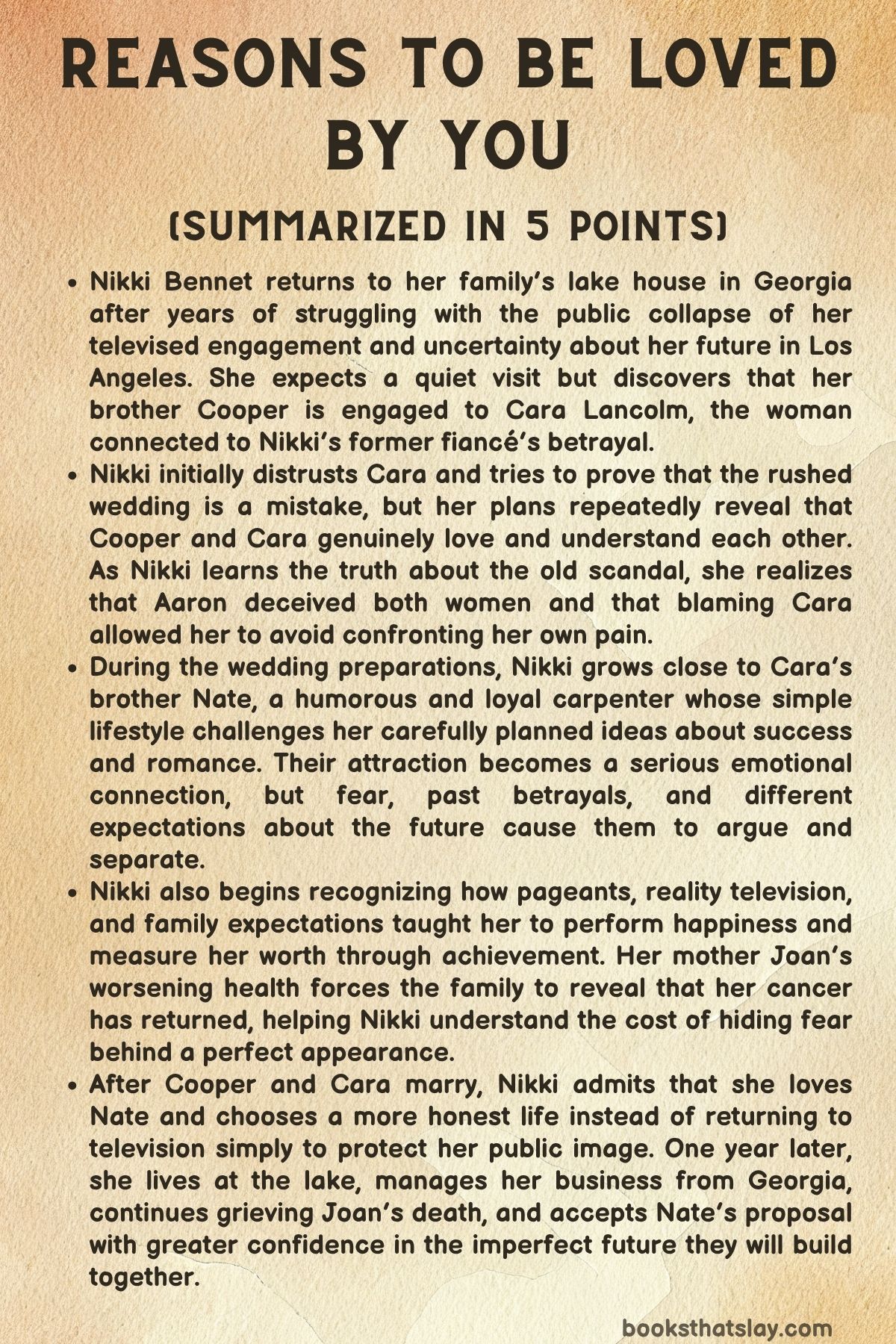
Summary
Nikki Bennet has spent years trying to recover from the televised destruction of her engagement to Aaron Brinkley. Once the celebrated lead of the reality dating program LovedBy, she is now approaching thirty while managing an athleisure business, considering new media opportunities, and attempting to prove that the scandal did not permanently damage her life.
Her romantic life, however, has become a series of empty performances. During a date with Taylor F., a wealthy but condescending private-equity professional, Nikki realizes that she is more concerned with making the evening appear successful than with whether she enjoys the man sitting across from her.
After her best friend Sybil rescues her from the date, Nikki reveals that she is leaving her Los Angeles apartment and temporarily returning to her family’s lake house in Georgia. She claims the trip is only a brief reset, but her reluctance to commit to another home in Los Angeles suggests that she no longer knows where she belongs.
On the drive to Lake Thomas, Nikki stops at a farmstand and meets a scruffy, humorous carpenter carrying an absurd number of tomatoes. When her rented Jeep fails to start, he tries to help despite knowing little about cars, resulting in oil being sprayed across Nikki’s clothes.
The stranger’s honesty and lack of polish make an immediate impression on her. Their playful exchange briefly turns serious when they admit that neither of them places much faith in conventional happy endings, although Nikki leaves without learning how closely their lives are about to become connected.
At the Bennet family home, Nikki discovers that everyone has been keeping a major secret from her. Her brother Cooper is engaged to Cara Lancolm, the jewelry designer who had been dating Aaron during Nikki’s televised engagement.
Nikki has spent years blaming Cara for participating in her public humiliation. Seeing her welcomed warmly by the Bennet family feels like a betrayal, especially when Nikki learns that Cara and Cooper have been together for months and that the entire family deliberately concealed the relationship.
The situation becomes even more unsettling when Cara’s family arrives and Nikki recognizes her brother Nate as the man from the farmstand. Nate had not recognized Nikki during their first meeting, and his natural warmth toward her is complicated by the fact that he is fiercely protective of Cara.
Cooper and Cara announce that they want to marry at the lake almost immediately. Joan, Nikki’s mother, supports the idea with unusual excitement, and the rest of the family quickly begins arranging a wedding that will take place within days.
Nikki believes the couple is acting recklessly, while Nate privately shares many of her doubts. The two form an alliance intended to make their siblings reconsider, although their attempts at subtle interference rarely produce the desired result.
As they spend more time together, Nikki and Nate develop an attraction that neither wants to acknowledge. They insist that they are too different for a serious relationship, yet a chaotic fireworks accident ends with Nate pulling Nikki into the lake and Nikki kissing him beneath the display.
Both dismiss the kiss as a drunken mistake the next morning. Their effort to establish a friendship fails almost immediately because their conversations become increasingly personal, their teasing grows more intimate, and each begins searching for reasons to remain near the other.
Nikki’s return home also forces her to confront the behavior she learned through pageants and reality television. From childhood, she was taught to remain attractive, composed, pleasant, and competitive regardless of what she felt.
Her mother Joan encouraged her pageant career because she believed the preparation gave them meaningful time together. Nikki, however, gradually connected victory with approval and came to believe that losing, struggling, or showing uncertainty made her less worthy of admiration.
This conditioning followed her into adulthood. Whether she is speaking to former pageant rival Mary Moore, interacting with local residents, talking to producers, or answering questions about her career, Nikki instinctively creates a polished version of herself that sounds successful and unaffected.
Nate notices the difference between Nikki’s public manner and the relaxed woman he sees during their private conversations. He is drawn to her ambition and confidence, but he is most affected by the moments when she stops controlling how she appears.
Nikki initially treats the wedding preparations as opportunities for sabotage. She considers unsuitable dresses, unattractive decorations, questionable music, and uncomfortable questions that might expose incompatibilities between Cooper and Cara.
Instead, each effort brings her closer to accepting their relationship. Cooper and Cara disagree openly, listen to each other, negotiate practical matters, and show a level of trust that Nikki’s relationship with Aaron never possessed.
Nikki also begins seeing Cara as a complete person rather than the villain she created in her mind. Learning that Cara lost her mother at a young age, watching her prepare for a wedding without maternal support, and observing her genuine love for Cooper gradually weaken Nikki’s hostility.
During a visit to a bridal shop, Nikki secretly tries on a wedding dress and becomes trapped when the zipper sticks. Nate helps her out of it, and their physical closeness nearly leads to another kiss.
He tells Nikki that she looked like someone who deserved a happy ending. His words reach the part of her that still mourns the future she believed she had earned before Aaron’s betrayal.
Meanwhile, Nikki becomes increasingly concerned about Joan. Her mother appears tired, dizzy, unusually emotional, and determined to make the rushed wedding perfect, but she repeatedly dismisses questions about her health.
Bill, Nikki’s father, avoids explaining why he has discussed property with a real-estate agent or why the family seems to be concealing information. Nikki senses that her siblings understand more than they are willing to reveal.
Nikki receives an offer from Sloane, her former producer, to join A Shore Thing, another program connected to the LovedBy franchise. The opportunity could renew her public career, restore her television relevance, and support the identity she has spent years constructing.
At the same time, Nikki’s connection with Nate begins offering an entirely different possibility. He takes her to the flower farm, shares painful memories of his mother and a former relationship, and listens without judgment as Nikki describes the emotional consequences of public humiliation.
Nate’s former partner made him feel that his life, work, and ambitions were inadequate. Although he appears relaxed and confident, he has protected himself from commitment because he fears once again being treated as someone who is not enough.
At Nikki’s thirtieth-birthday celebration, Joan announces the television offer before Nikki has made a decision. Feeling exposed and overwhelmed, Nikki retreats to the lake, where Nate follows her.
Nikki admits that she no longer knows whether she wants television, Los Angeles, marriage, fame, or the future she has always described. Nate assures her that she does not need to perform around him, and their emotional honesty leads them to sleep together.
The experience is important to Nikki because she does not feel that she must manage her appearance or earn Nate’s approval. For once, intimacy feels like a place where she can be fully present rather than another test she must pass.
The next morning, Nikki realizes that her feelings are serious. She begins imagining Nate as a genuine partner, recognizing his patience, loyalty, skill, kindness, humor, and devotion to his family.
Before she can tell him, she witnesses a tense exchange between Nate and Cara. Nate refuses to explain what is happening, causing Nikki to believe that he is shutting her out and that their night together meant less to him than it meant to her.
Afraid of rejection, Nikki retreats toward the familiar security of achievement. She accepts Sloane’s television offer without discussing it with Nate and tells herself that returning to public life is the sensible choice.
Cara later reveals Nikki’s decision during a karaoke outing, and Nate feels hurt that Nikki concealed it from him. Their disagreement grows into a painful argument about ambition, class, commitment, family loyalty, and the futures they believe they must choose.
Nikki accuses Nate of abandoning her whenever their relationship becomes serious. Nate suggests that Nikki views life as a competition and measures her success against women such as Mary Moore, while Nikki believes he has reduced her to the shallow public image she has spent years trying to escape.
They conclude that their lives are incompatible because Nikki will return to Los Angeles while Nate will remain close to his family and carpentry work. Both speak from fear, but neither feels secure enough to admit how deeply they have fallen in love.
The family crisis becomes public when photographs from the karaoke bar appear in tabloids. Reports accuse Nikki and Cara of staging the wedding for publicity, while an intimate photograph of Nikki and Nate threatens Nikki’s business partnership and television opportunity.
Rather than protect herself by blaming Cara, Nikki publicly defends Cooper and Cara’s relationship. Her response shows that she is no longer committed to treating Cara as an enemy, even though she still cannot admit the truth about Nate.
Nikki then finds an unsent letter from Cara addressed to Aaron. She suspects that it may reveal an ongoing relationship, but the letter is discovered before she decides whether to read it.
Cara explains that she occasionally wrote to Aaron because he was one of the few people who understood the public scandal, although the particular letter was never mailed. Cooper feels betrayed by the secrecy, and the conflict threatens to end the wedding.
Nikki finally speaks privately with Cara rather than making assumptions. Cara explains that Aaron never told her he was entering LovedBy and that she learned of his participation only after friends and viewers recognized him.
Aaron had deceived both women. Cara did not design the scandal to promote her jewelry; she told the truth when reporters contacted her after fans connected Aaron’s tattoo with one of her designs.
Nikki realizes that blaming Cara allowed her to avoid facing Aaron’s dishonesty and the weaknesses that already existed in her engagement. She refuses to read the letter, chooses to trust Cara, and welcomes her as a future sister.
On the wedding morning, Nikki begins repairing other damaged relationships. She gives Cara the Bennet family’s heirloom veil after accidentally tearing the original one and speaks honestly with Joan about the pressure she experienced during her pageant years.
Joan explains that she never intended to make Nikki believe her love depended on winning. Mother and daughter apologize for the ways they misunderstood each other, allowing Nikki to separate Joan’s affection from the expectations she attached to it.
Joan then collapses and is forced to reveal that her cancer has returned. Her prognosis is poor, and the wedding was rushed because she wanted to witness Cooper and Cara marry while she was still well enough to participate.
The diagnosis explains the family’s secrecy, Bill’s housing search, Joan’s exhaustion, and her determination to complete every wedding detail. Nikki is devastated that she did not recognize the signs and feels guilty for living so far away.
Joan reminds her that distance does not make her less devoted and encourages her to repair her relationship with Nate. As they redo their makeup together, Joan rejects perfection as the goal and teaches Nikki to recognize beauty in what remains unfinished, vulnerable, and real.
Cara and Cooper marry before the gazebo Nate has restored. Their vows accept disagreement, imperfection, humor, and continued effort, proving that their relationship is not based on a flawless fantasy but on the choice to keep supporting each other.
Nate later assumes that Nikki has chosen television and Los Angeles. He tells her that he will try to accept seeing her build a future with someone else, although he will continue loving her.
Nikki refuses to let him describe himself as inadequate. She tells him that his loyalty, generosity, skill, humor, honesty, and love for his family are precisely the qualities she wants in a partner.
Nate admits that he has been falling in love with her since their first meeting. Nikki confesses that she feels the same, and they choose a relationship without pretending that their differences, fears, or future decisions will be simple.
One year later, Nikki lives at the lake with Nate. Joan survived until early January and died surrounded by her family after sharing one final Christmas filled with photographs, traditions, and memories.
Nikki continues grieving, but she has begun creating a life that belongs to her. She manages her business from Georgia, paints landscapes in Joan’s former sewing room, and allows herself to enjoy activities without demanding immediate success.
Nate starts his own contracting company and eventually proposes with Joan’s engagement ring. Joan had given him her blessing before her death but asked him to wait until Nikki had time to grieve.
Nikki accepts the proposal surrounded by Nate, her closest friends, and the traditions she inherited from her mother. Her future is not the perfect ending she once tried to manufacture, but it is honest, loving, ambitious, imperfect, and freely chosen.
Characters
Nikki Bennet
At the center of Reasons to Be Loved by You, Nikki Bennet is a woman whose public confidence conceals deep uncertainty about who she is when no one is watching. Her reality-television fame, pageant training, business ambitions, family expectations, and failed engagement have taught her to approach life as a performance in which approval must be earned.
Nikki is highly observant and socially skilled, but she often uses those abilities to control how others perceive her. She can charm dates, reassure fans, impress producers, and create an image of success even when she feels displaced, frightened, or deeply unhappy.
Her hostility toward Cara initially reveals both her unresolved trauma and her need for a clear villain. Blaming Cara allows Nikki to simplify Aaron’s betrayal and avoid considering how much of her engagement was based on public storytelling rather than private trust.
Nikki’s growth depends on replacing assumptions with direct communication. She listens to Cara, speaks honestly with Joan, admits her love for Nate, and eventually rejects professional and romantic decisions made solely to protect her image.
Her ambition is not presented as a defect that must be abandoned. Instead, Nikki learns that achievement becomes destructive when it is used as a substitute for identity, intimacy, or self-worth.
By the conclusion, she remains a businesswoman with significant goals, but she no longer believes every interest must become a competition or every personal choice must impress an audience. Her decision to paint despite being inexperienced shows that she can finally value curiosity, pleasure, and gradual improvement.
Nate Lancolm
Within Reasons to Be Loved by You, Nate Lancolm represents a form of confidence that comes from practical ability, humor, and comfort with ordinary life rather than public recognition. His carpentry, family loyalty, physical ease, and playful manner initially make him appear uncomplicated, but his resistance to commitment is rooted in grief and emotional injury.
Nate uses jokes to create closeness while also preventing conversations from becoming too serious. His humor makes Nikki feel relaxed, but it becomes painful when he jokes about marriage or dismisses their connection at moments when she needs emotional clarity.
His devotion to Cara is one of his strongest qualities. Having lost their mother while Cara was still young, Nate developed a protective role that continues into adulthood, even when he disagrees with his sister’s choices.
Nate is attracted to Nikki’s drive and intelligence, but his previous relationship has made him sensitive to any suggestion that his profession or lifestyle is inadequate. When he believes Nikki may be ashamed of his life, his fear causes him to misinterpret her ambitions as a rejection of him.
The restoration of the gazebo reflects Nate’s approach to love. He understands that valuable things require attention, labor, patience, and repair, even though he initially struggles to apply that understanding to his own emotional life.
His eventual confession demonstrates that he is capable of moving beyond avoidance. Rather than asking Nikki to become less ambitious, he promises to support her successes, disappointments, business goals, and family dreams.
Cara Lancolm
Cara Lancolm is introduced through Nikki’s anger rather than through her own actions, making her an example of how easily a person can be turned into a symbol of someone else’s pain. For years, Nikki imagines Cara as calculating, dishonest, and responsible for the public collapse of her wedding.
The reality is far more complicated. Cara was also deceived by Aaron, who concealed his participation in LovedBy while continuing their relationship and then minimized her importance when his lies were exposed.
Cara’s decision to speak publicly was not a calculated attack on Nikki. She responded to reporters after viewers discovered evidence connecting Aaron with her jewelry designs, and she had been forced into the scandal without having control over its timing or consequences.
Her relationship with Cooper shows a different side of her character. She is playful, emotionally open, willing to negotiate disagreements, and genuinely excited about joining his family.
Cara’s rushed wedding is partly motivated by her love for Cooper and partly by her knowledge of Joan’s illness. Her secrecy creates conflict, but it arises from an attempt to respect Joan’s wishes rather than from selfish manipulation.
Her unsent letter to Aaron shows that recovery does not always follow a clean or socially acceptable path. Writing allows her to process unresolved feelings about the scandal, even though she has no desire to renew a romantic relationship with him.
Cara’s reconciliation with Nikki becomes one of the story’s most important emotional developments. Their embrace replaces manufactured female rivalry with trust, compassion, and the possibility of a sisterly bond.
Cooper Bennet
Cooper Bennet is spontaneous, affectionate, and deeply convinced that his relationship with Cara is right despite its short duration. His willingness to marry quickly reflects confidence in his feelings, but his decision to conceal the engagement from Nikki also shows that he avoids conflict until it becomes unavoidable.
He understands that Nikki may react badly to Cara, yet he chooses to manage her response through secrecy and false reassurance. By telling Cara that Nikki supports the relationship, he creates expectations that make the eventual confrontation more painful for everyone.
Cooper’s defense of Cara is admirable because he refuses to allow his sister’s history to define the woman he loves. At the same time, he can become unfair when he assumes Nikki’s every concern is motivated by jealousy or sabotage.
His relationship with Cara challenges Nikki’s belief that successful couples must agree on everything before committing. Cooper and Cara can differ on religion, children, traditions, and family routines while still listening to each other and searching for practical compromises.
Cooper is not presented as completely mature or cautious, but his love is sincere. His marriage demonstrates that rapid decisions are not automatically shallow when they are supported by honesty, respect, and a willingness to continue learning about one another.
Joan Bennet
Joan Bennet is loving, energetic, image-conscious, and emotionally influential within the Bennet family. Her habit of preparing perfect meals, celebrations, clothing, and appearances reflects both her generosity and her belief that care is demonstrated through effort.
Her relationship with Nikki is affectionate but complicated by years of pageant training and comparison. Joan believed she was giving her daughter special attention and useful confidence, while Nikki often experienced the same activities as pressure to win and remain composed.
Joan’s comments about appearance are rarely intended to wound, yet they reinforce the habits Nikki is trying to overcome. Her influence shows how harmful expectations can be passed through a family even when they originate in love rather than cruelty.
Her secret illness explains the unusual urgency surrounding the wedding. Knowing that her cancer has returned, she becomes determined to give Cooper and Cara a beautiful ceremony before her health declines further.
Joan’s refusal to reveal her condition also mirrors Nikki’s emotional behavior. Both women smile, reassure others, and attempt to manage difficult situations privately because they fear becoming a burden.
Her final lesson to Nikki concerns the difference between perfection and beauty. By accepting ruined makeup, a failed cake, physical weakness, and open grief, Joan helps her daughter understand that love does not require flawless presentation.
Bill Bennet
Bill Bennet is a quieter presence than Joan, but his actions reveal steady devotion to his wife and family. He avoids dramatic displays, preferring practical responses such as researching temporary housing near Joan’s treatment.
His reluctance to explain the real-estate conversations increases Nikki’s anxiety, yet his secrecy comes from respecting Joan’s desire to delay announcing her diagnosis. He is placed in the difficult position of protecting his wife’s wishes while watching his children misinterpret the family’s behavior.
Bill recognizes more about Nikki’s uncertainty than she expects. His questions about her finances, housing, and Los Angeles plans suggest that he sees through her polished description of success.
His support of the rushed wedding reflects his commitment to Joan. Even when the plans seem unreasonable, he understands that helping her witness their son’s marriage has become more important than maintaining an ordinary schedule.
Aaron Brinkley
Aaron Brinkley is the primary source of the mistrust affecting both Nikki and Cara. He is ambitious, publicity-conscious, dishonest, and skilled at presenting self-interest as confidence.
Aaron entered LovedBy while still involved with Cara and accepted Nikki’s public trust without giving either woman the information needed to make an informed decision. His deception was sustained through lies about travel, commitment, and his intentions after the program.
When confronted, he attempts to minimize Cara and persuade Nikki that the wedding can still continue. This response reveals that he values the public opportunity and personal benefit more than the emotional safety of either woman.
Although Aaron appears mainly through memory and indirect communication, his influence remains powerful. Nikki and Cara spend years dealing with the consequences of a rivalry he created, while he escapes much of the gendered criticism directed at them.
His role exposes how public narratives often assign blame to women while excusing the man whose choices caused the conflict. Nikki’s recovery becomes possible only when she recognizes that Aaron, not Cara, was responsible for deceiving them both.
Sybil
Sybil is Nikki’s most direct and protective friend. She is willing to interrupt a terrible date, confront an insulting man, steal his expensive food, and challenge Nikki’s habit of pretending she is fine.
Unlike people who admire Nikki’s public persona, Sybil notices the rehearsed smile Nikki uses to hide discomfort. She refuses to accept Nikki’s carefully constructed explanations when her behavior suggests that she is unhappy or uncertain.
Sybil also questions Nikki’s checklist-based approach to dating. She understands that requirements involving career, height, faith, income, and marriage readiness cannot guarantee emotional compatibility.
Her repeated attempts to show Nikki an apartment listing reveal that she recognizes Nikki’s reluctance to return to Los Angeles before Nikki can admit it herself. Sybil supports Nikki’s ambitions without demanding that she remain loyal to a version of success that no longer satisfies her.
Emma
Emma is both a supportive friend and an important figure in Nikki’s path toward reality television. She originally submitted Nikki’s name to LovedBy because she believed Nikki was capable of a larger and more visible life.
Her decision helped create opportunities for Nikki, but it also unintentionally placed her within an industry that reshaped her identity and exposed her private pain. Emma’s role therefore represents the complicated nature of encouragement: a loving action can still produce consequences no one anticipated.
Emma remains practical when Nikki panics after sleeping with Nate. She reminds her that turning thirty does not require completing a fixed list of romantic, personal, and professional milestones.
Her advice encourages Nikki to judge her life through happiness rather than comparison. She provides the reassurance Nikki needs to recognize that her feelings for Nate are meaningful rather than evidence that she has lost control.
Willow
Willow contributes a calm and questioning voice within Nikki’s closest friendship group. She does not accept Nikki’s decisions merely because they sound ambitious or impressive.
When Nikki considers returning to television, Willow asks whether she genuinely wants the opportunity. The question is simple, but it exposes how rarely Nikki separates her own desires from what appears professionally valuable.
Willow’s presence reinforces the emotional safety of the Core Four. Together, the friends create a relationship in which Nikki can be confused, frightened, contradictory, and imperfect without losing affection or respect.
Linney Bennet
Linney is Nikki’s sister and one of the family members most willing to confront her. Her criticism of Nikki’s long absences forces Nikki to consider how much family life she has missed while concentrating on her career and public recovery.
She can be blunt, and her observations sometimes intensify Nikki’s guilt. However, her frustration comes from wanting Nikki to remain connected to the family rather than from resentment of her success.
Linney also recognizes Nikki’s polished social behavior as a performance. By naming the difference between Nikki’s public character and private self, she confirms that the habit is visible to the people who know her best.
As a nearby sibling, Linney is more aware of Joan’s health than Nikki is. This creates an uncomfortable contrast between physical proximity and emotional knowledge, although the book does not suggest that Nikki loves Joan any less.
Pete Bennet
Pete is another source of sibling honesty. His most important intervention occurs when Nikki criticizes Cooper and Cara for becoming engaged after only a few months.
Pete reminds her that she accepted Aaron’s proposal after an even shorter relationship. The comparison is painful, but it exposes the double standard Nikki is applying to her brother.
His role is less emotionally prominent than those of Cooper or Linney, yet he contributes to the family’s ability to challenge Nikki’s interpretation of events. Pete does not allow her past suffering to make every judgment unquestionable.
Mary Moore Musgrove
Mary Moore Musgrove represents comparison, competition, and the social world Nikki learned to navigate through pageants. As a child, she appears confident and strategically prepared, making Nikki feel both impressed and threatened.
Their relationship contains moments of genuine connection, including Mary Moore’s admission that all contestants feel nervous. However, it is also shaped by the belief that friendship and competition cannot remain separate.
Mary Moore’s possible sabotage of Penelope shows the moral damage produced by environments where victory is treated as proof of worth. Nikki is disturbed by the act but accepts the crown, revealing her own willingness to benefit from a system she distrusts.
As an adult, Mary Moore continues to trigger Nikki’s need to appear successful. Nikki’s exaggerated answers about her career and happiness show that Mary Moore has become less a personal enemy than a symbol of the standard against which Nikki measures herself.
Patsy Musgrove
Patsy Musgrove is Mary Moore’s mother and part of the hometown social environment Nikki associates with comparison and public judgment. Her conversations about the Bennet property help create Nikki’s fear that the lake house may be sold.
Although Patsy does not directly threaten Nikki, her presence activates old anxieties about status, family reputation, and being observed by people who remember her earlier life. She helps show how quickly Nikki returns to performance when confronted with familiar expectations.
Anna Carol
Anna Carol is Nikki’s young niece and a source of humor, innocence, and family continuity. Her presence in the kitchen with Joan shows the traditions of baking, preparation, and domestic care being shared with another generation.
Her misunderstandings, such as calling a veil a “face wig,” interrupt adult tension with uncomplicated curiosity. She is also connected to important plot developments when she plays with Cara’s mail, allowing Nikki to discover the unsent letter.
Anna Carol does not understand the secrets surrounding her, which highlights how unnecessary and damaging many of the adults’ deceptions have become. Her openness contrasts with a family culture in which people frequently hide painful truths in the name of protection.
William
William is another of the Bennet children who reveals Nate’s natural ease with family life. Nate’s ability to play with him, include him in activities, and earn his affection influences Nikki’s growing attraction.
William helps Nikki imagine Nate not merely as an exciting romantic partner but as someone capable of participating in the family life she hopes to build. His interactions with Nate quietly challenge her claim that Nate does not belong in her intended future.
Sloane
Sloane is Nikki’s former television producer and a representative of the professional world that helped construct Nikki’s public identity. She offers Nikki renewed visibility through A Shore Thing at a moment when Nikki feels uncertain about her career and home.
The opportunity is not inherently malicious. It could offer financial and professional benefits, but Sloane’s approach assumes that returning to television is the natural solution to Nikki’s difficulties.
Sloane’s role reminds Nikki that the entertainment industry remains ready to transform personal pain, romance, and controversy into content. Nikki’s decision about the offer therefore becomes a decision about who will control the next version of her life.
Taylor F.
Taylor F. appears briefly, but his date with Nikki establishes the emotional condition in which she begins the story. He is wealthy, confident, dismissive, and far more interested in presenting his qualifications than in learning about Nikki.
His mockery of her television past and his belief that women are not funny expose the limitations of Nikki’s checklist. Taylor appears suitable according to her stated requirements, yet he provides none of the warmth, curiosity, or respect required for connection.
His cruel reference to Aaron also demonstrates how Nikki’s public humiliation continues to affect ordinary interactions. Nikki’s laughter when Sybil responds to him marks one of the first moments when she chooses a genuine reaction over social politeness.
Katie Mae
Katie Mae, the farmstand owner, provides practical competence during Nikki and Nate’s first meeting. While Nate creates chaos beneath the Jeep’s hood, Katie Mae solves the problem by jump-starting the vehicle.
Her brief appearance supports the relaxed, communal atmosphere of Nikki’s hometown. She also allows Nikki and Nate’s introduction to remain humorous rather than becoming a polished romantic encounter.
Penelope
Penelope is a talented pageant contestant whose chances are destroyed when she develops a severe itch after Mary Moore gives her a suspicious spray. Her humiliation exposes the cruelty hidden beneath the polished appearance of pageant competition.
Penelope also functions as a test of Nikki’s moral courage. Although Nikki suspects sabotage and feels uncomfortable accepting the crown, she remains silent because winning still offers recognition and satisfaction.
The later friendship between Mary Moore and Penelope further confuses Nikki’s understanding of loyalty. It encourages her to believe that manipulation can be ignored or absorbed as part of competitive relationships.
Dee Dee
Dee Dee works at the flower farm and mistakenly assumes that Nikki and Nate are preparing for their own wedding. Her assumption gives them permission to pretend that they are a couple without openly admitting what they want.
The imaginary story Nate creates allows Nikki to experience a playful version of domestic possibility. When Dee Dee recognizes Nikki from television, however, the private fantasy collapses beneath the pressure of her public identity.
Aunt Maggie
Aunt Maggie helped care for Nate and Cara after their mother’s death. Her presence represents the extended family support that allowed the siblings to survive a major loss without being emotionally abandoned.
At the wedding, she praises the moments when Nikki appeared genuine on television rather than the scenes in which she seemed most polished. Her observation helps Nikki recognize that vulnerability may have created stronger connections with viewers than controlled perfection ever did.
Sarah
Sarah, Nate’s former long-term partner, never appears directly, but the damage from their relationship shapes his behavior. She made him feel that his work, ambitions, and way of life were insufficient.
Because of that experience, Nate interprets Nikki’s professional goals as possible evidence that she will eventually reject him. Sarah’s influence explains why he retreats when the relationship becomes serious and why he reacts defensively to the idea of Los Angeles or television.
Meema
Meema, Nikki’s grandmother, remains influential through family traditions and inherited objects. The gazebo, heirloom veil, and memories associated with her connect the present wedding to earlier generations of Bennet women.
Nikki once imagined herself as the next person entitled to wear Meema’s veil. Giving it to Cara represents her acceptance of Cara as family and her willingness to release the belief that happiness must arrive according to a fixed order.
Nate and Cara’s Mother
Nate and Cara’s deceased mother shapes both siblings despite appearing only through memory. Her death forced Nate into a protective role and left Cara without maternal guidance during major moments in her adult life.
Nate’s memories of her grilled-cheese sandwiches reveal how grief can attach itself to ordinary sensory experiences. Nikki’s attempt to recreate that memory by taking him to Sadie’s demonstrates her growing understanding of the person beneath his humor.
Themes
Performance, Image, and Authenticity
In Reasons to Be Loved by You, performance is not limited to reality television; it shapes Nikki’s relationships with her family, friends, romantic partners, business contacts, hometown acquaintances, and herself. Pageants taught her to smile through discomfort, provide impressive answers, protect her appearance, and treat emotional control as evidence of strength.
Reality television expanded those habits by transforming love into a production shaped by cameras, producers, editing, audience expectations, and commercial opportunities. Even Aaron’s proposal and their carriage ride created the appearance of a complete romantic ending while hiding how little trust existed once filming stopped.
Nikki continues performing after leaving television because she no longer knows which parts of her public identity are voluntary. She exaggerates her success to Mary Moore, hides her housing uncertainty, treats dates as staged interactions, and accepts professional opportunities because they support the person she believes she is expected to become.
Her relationship with Nate becomes valuable because he responds most strongly when she abandons control. He notices her rehearsed social manner but is drawn to her spontaneous laughter, uncertainty, desire, grief, and unguarded affection.
Authenticity does not require Nikki to reject beauty, success, ambition, or media work. It requires her to stop using those things as protection against judgment and to make choices that remain meaningful when there is no audience to applaud them.
Love as Choice, Labor, and Repair
The restored gazebo offers a practical model for lasting love. Its beauty survives not because it remains untouched but because someone examines the damage, replaces weakened parts, applies skill, and accepts that preservation requires repeated effort.
Nikki once believed romance followed a clear progression: achievement, selection, proposal, wedding, and permanent happiness. LovedBy strengthened this belief by presenting love as a prize awarded at the end of a competition.
Cara and Cooper’s wedding challenges that model. Their relationship develops quickly, yet their conversations show that commitment does not depend on knowing every future answer; it depends on listening, negotiating differences, and continuing to choose one another.
Nikki and Nate initially fail because both want emotional safety without accepting emotional risk. They use jokes, distance, assumptions, ambition, and geography to protect themselves from rejection, causing them to wound each other before either can be abandoned.
Their reconciliation becomes possible when they stop debating whether they fit an ideal plan and begin naming the qualities they actually value. Nikki recognizes that Nate’s work, loyalty, humor, and family devotion are not obstacles to her future, while Nate accepts that supporting her ambition does not require him to surrender his own identity.
Love is therefore presented as neither effortless destiny nor permanent certainty. It is a continuing decision to communicate, repair damage, respect difference, and remain emotionally present.
Competition, Comparison, and the Cost of Winning
Competition teaches Nikki to understand worth through ranking. Pageants offer crowns, applause, scholarships, and maternal attention, but they also train her to observe other women as threats whose beauty or success may reduce her own value.
Mary Moore becomes the clearest symbol of this conditioning. Nikki can experience moments of kindness and connection with her, yet both girls remain trapped in an environment where information, friendship, appearance, and vulnerability can be used to gain an advantage.
The Penelope incident exposes the moral compromise required to preserve victory. Nikki does not cause the sabotage, but she accepts the crown despite suspecting that the competition was unfair, choosing recognition over accountability.
This pattern later shapes her judgment of Cara. Instead of recognizing that Aaron deceived two women, Nikki views Cara as the competitor who defeated her by being chosen.
Nikki also compares her adult progress with her siblings, friends, pageant rivals, and imagined cultural standards. Turning thirty becomes frightening because she believes marriage, children, housing, business growth, and public success should have been completed according to a shared schedule.
Her growth begins when she stops treating another woman’s happiness as evidence of her own failure. Accepting Cara, rejecting Mary Moore as a standard, and painting without demanding immediate excellence allow Nikki to experience life without converting every activity into a contest.
Family, Grief, and Imperfect Happiness
The Bennet family expresses love through closeness, teasing, meals, traditions, practical help, celebrations, and shared spaces. Yet their desire to protect one another repeatedly leads them to hide information, creating the very pain they hope to prevent.
Cooper conceals his relationship because he fears Nikki will stay away. Joan hides her cancer because she does not want to overshadow the wedding, while Bill and the other siblings respect her wishes even as their silence increases Nikki’s confusion.
Cara and Nate also maintain family secrets in the belief that loyalty requires silence. The conflicts surrounding the letter, Joan’s illness, the wedding, and Nikki’s television decision show that secrecy can become harmful even when its motive is love.
Grief affects nearly every central relationship. Nikki grieves her failed engagement and lost public identity, Nate and Cara grieve their mother, Joan and Bill face approaching separation, and the entire family eventually mourns Joan’s death.
The ending does not suggest that romance removes loss. Nikki accepts Nate’s proposal while still grieving, and she understands that healing resembles the repaired gazebo: some parts remain marked by damage and require continued care.
Happiness becomes meaningful precisely because it is not perfect or permanent. The family’s ruined cake, torn veil, uncontrolled tears, spilled champagne, remembered traditions, and unfinished grief create a life that remains beautiful because it is honestly lived.