The Housewife by Natalie Barelli Summary, Characters and Themes
The Housewife by Natalie Barelli is a psychological thriller built around deception, domestic obsession, revenge, and the uncertain boundary between justice and wrongdoing.
At its center is Jodie Davies, a seemingly devoted young wife whose carefully maintained Beverly Hills life hides an extraordinary secret: she married her wealthy husband, Roy, because she believes he murdered his first wife, Deborah, who was also Jodie’s sister. What begins as a private investigation inside an immaculate home gradually exposes hidden affairs, manipulated evidence, physical abuse, false identities, and several deaths. The novel constantly challenges the reader to decide who deserves sympathy when nearly everyone is concealing something.
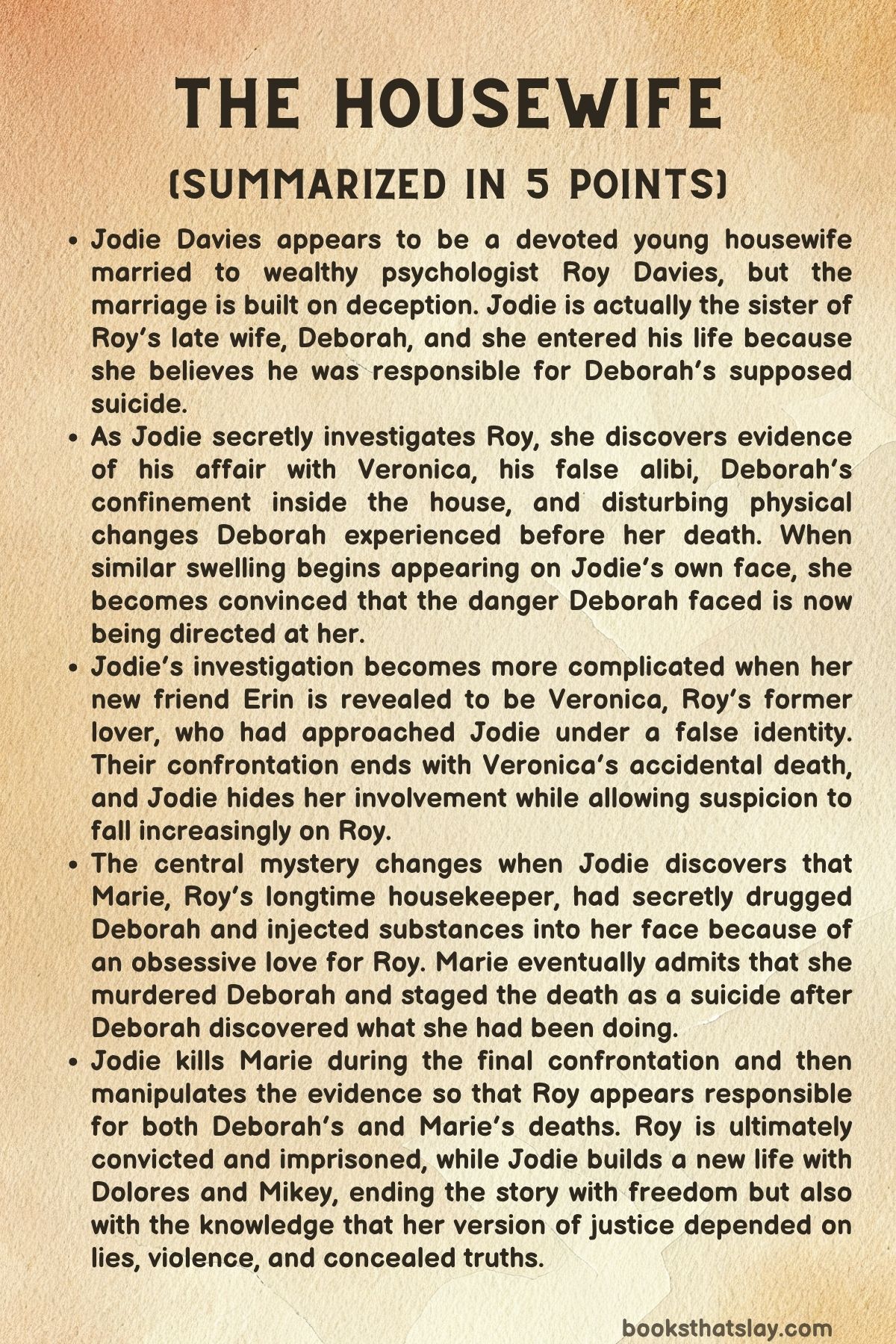
Summary
Jodie Davies appears to be an unusually composed Beverly Hills housewife, even when she is sitting in a police interview room covered in someone else’s blood. While detectives question her, she seems almost as concerned about stains, cleaning methods, and the condition of her expensive shirt as she is about the violent event that has turned her home into a crime scene.
Two weeks earlier, Jodie is hosting an elaborate birthday celebration for her husband, Dr. Roy Davies, a wealthy psychologist and successful self-help author. She has devoted enormous effort to making everything perfect, yet Roy’s friends spend much of the evening talking about Deborah, his beautiful first wife, who supposedly became severely depressed and killed herself shortly before Roy met Jodie.
Jodie becomes increasingly irritated by the way Deborah is remembered as part of an ideal marriage with Roy. Eventually, she publicly questions why a woman who seemed to possess beauty, money, friends, and a loving husband would suddenly shoot herself in the face.
Her question horrifies the guests and enrages Roy. In the kitchen, Jodie briefly considers placing broken glass inside a slice of cake intended for the particularly unpleasant Meredith, revealing how easily violent thoughts can enter her mind, although she changes her mind before anyone is injured.
The evening also reveals that Jodie lied about being pregnant. She had purchased a fake positive pregnancy test and convinced Roy that she was carrying his child because she needed him to marry her quickly.
The reason for that deception becomes clear when Jodie remembers her childhood. She and Deborah were sisters raised in severe poverty by an alcoholic father and an abusive mother, and Deborah was the person who protected Jodie emotionally when their home became unbearable.
As children, they dreamed about escaping into a comfortable life filled with beautiful rooms, flowers, soft towels, good food, and peace. Deborah eventually moved to Los Angeles while Jodie, whose original name was Joanne Adams, served a prison sentence for vehicular manslaughter.
Deborah met Roy and married him, initially sounding delighted with her new life. Her calls to Jodie gradually became less frequent, however, and her personality seemed to change.
Shortly before Jodie was released, Deborah telephoned in fear and whispered that Roy frightened her. Soon afterward, Jodie learned that her sister had died from an apparently self-inflicted gunshot wound.
Jodie never believed the official explanation. After leaving prison, she changed her name, altered her appearance, moved to Los Angeles, studied Roy’s habits, and deliberately arranged a meeting with him.
What she originally intended as an opportunity to enter his life became a romance from Roy’s perspective. Jodie encouraged his attraction and, afraid that she might lose access to him before uncovering evidence, fabricated a pregnancy.
Roy married her only a few months after meeting her. Jodie therefore enters the Davies mansion not as an innocent young bride but as an investigator prepared to expose Roy and, if necessary, kill him.
Maintaining the deception requires considerable effort. Jodie carefully manages her appearance, cooks Roy’s favorite foods, cleans obsessively, and behaves like the ideal wife because she fears losing her position before solving Deborah’s death.
Her greatest domestic opponent is Marie, Roy’s longtime housekeeper. Marie adored Deborah, distrusts Jodie, and repeatedly suggests that Jodie will not remain Mrs. Davies for long.
Jodie searches the mansion whenever possible and eventually gains access to Roy’s locked office. There she discovers Deborah’s diary, a suspicious appointment involving divorce lawyers, photographs and belongings connected to Deborah, and clues suggesting that Deborah had been experiencing frightening physical changes shortly before her death.
A damaged message in Deborah’s diary appears to Jodie to say that a man was responsible for whatever was happening. Because she already suspects Roy, she interprets virtually every discovery as evidence against him.
She also learns that Roy had secretly arranged a meeting with divorce attorneys. Afraid he is preparing to remove her from the house, she impersonates his assistant and cancels the appointment.
Meanwhile, unusual swelling begins appearing on Jodie’s face. The similarity between her symptoms and Deborah’s final physical deterioration convinces Jodie that the same person may be targeting her.
Jodie meets a woman named Erin after becoming stranded without money at a gas station. Erin helps her financially, and because Jodie has spent much of her life without genuine friendship, she quickly becomes emotionally attached to her new acquaintance.
Jodie continues investigating Deborah’s final weeks. A doctor Deborah once consulted explains that Deborah had not appeared severely depressed; instead, she had been deeply concerned that something unexplained was happening to her face.
Further searches of Roy’s office reveal a love letter from a woman named Veronica. The date proves that Roy was having an affair with Veronica while Deborah was alive, contradicting his later claim that the relationship began only after his wife’s death.
Jodie now believes Roy possessed both emotional and financial motives for murder. He wanted another woman, had no prenuptial agreement with Deborah, and could have lost significant wealth through divorce.
Roy’s own behavior strengthens her suspicions. After seeing another man force a kiss on Jodie, Roy accuses her of infidelity rather than protecting her.
Later, during sex, he briefly places his hands around her throat. Jodie begins imagining that Deborah might have endured similar jealousy, accusations, and physical intimidation.
Marie reveals that Roy gave her an entire week away from the house immediately before Deborah died. During that period, Deborah suddenly stopped seeing friends and reportedly became severely unstable.
Meredith eventually admits that she briefly saw Deborah through a window during that final week. Deborah appeared dramatically older, swollen, and physically unwell, while Roy told everyone that his wife was mentally ill and harming herself.
Jodie finally opens Roy’s safe and discovers video evidence that transforms the investigation. The recording shows Deborah confined inside an upstairs room, physically weakened and badly changed in appearance.
Roy questions Deborah about an alleged affair and insists that she is mentally ill and injuring herself. Deborah denies everything, accuses Roy of causing her suffering, and demands freedom.
Although the recording does not show Deborah being murdered, it proves Roy imprisoned her and lied about what occurred before her death. Jodie later finds the actual room inside the mansion.
Her strongest evidence temporarily disappears when she loses the USB containing the recording. She decides to confide in Erin, revealing that Deborah was her sister, that she married Roy under a false identity, and that she believes he murdered her.
Erin reacts with alarm rather than support. Jodie’s lies, fake pregnancy, criminal history, obsessive investigation, and violent certainty make her appear unstable, and Erin advises her to seek psychological help.
Soon afterward, Jodie overhears Roy secretly arranging to meet Veronica. She drugs him with sleeping pills, unlocks his phone, obtains Veronica’s address, takes Roy’s car and clothing, and goes to the meeting herself.
When the door opens, Jodie discovers that Erin and Veronica are the same woman. Veronica had recognized Jodie earlier and intentionally approached her.
Veronica knows that Jodie lied about her pregnancy and has also investigated her background. More dangerously, she has discovered that Jodie’s parents did not die in the manner Jodie claimed.
Jodie privately remembers that she deliberately caused the fire that killed her parents because their continued existence could have exposed her identity to Roy. Her moral position becomes increasingly difficult to defend: she may be seeking justice for Deborah, but she has already committed terrible acts herself.
When Veronica attempts to telephone Roy, Jodie tries to stop her. During the struggle, Veronica falls, strikes her head, and dies.
Jodie does not contact the authorities. Instead, she cleans the scene, removes evidence, returns Roy’s car, and constructs explanations for anything that might connect her to Veronica.
She even deliberately burns her own hand when she realizes her wedding ring has gone missing, creating a believable reason for having removed it. The ring later appears inside Roy’s car, nearly exposing her movements.
Police begin investigating Veronica’s death and discover messages from Roy’s phone arranging the meeting. Because Jodie secretly sent them, Roy truthfully denies doing so, but his affair and his inability to explain the messages make him appear suspicious.
Marie then reveals that she found the missing USB. After watching the recording, she finally begins to believe that something terrible happened to Deborah and forms an uneasy alliance with Jodie.
The investigation changes again when Jodie discovers a letter written by Deborah while imprisoned. Deborah writes that someone is secretly injecting substances into her face and indicates that Marie has been entering the room.
Jodie searches Marie’s belongings and finds syringes and cosmetic materials. She realizes she may have misunderstood Deborah’s damaged diary message: it may have referred not to Roy but to Marie.
Jodie then secretly witnesses Marie dressing in Deborah’s wedding gown, using Jodie’s cosmetics, and pretending to share a romantic relationship with Roy. Marie has been obsessively in love with him for years.
After a violent confrontation, Marie confesses. Because she had previously worked in cosmetic medicine, she knew how to alter Deborah’s appearance through injections.
She secretly drugged Deborah at night, damaged her face, and convinced Roy that Deborah was harming herself because of a psychological disorder. Roy, already jealous and controlling, believed Marie and confined his wife instead of protecting her.
Marie later began doing the same thing to Jodie, hoping Roy would lose attraction to her as well. Her goal had always been to remove the women standing between herself and Roy.
Most importantly, Marie admits that she murdered Deborah. After Deborah discovered the truth and threatened to expose her, Marie returned to the house, manipulated the security system, forced Deborah’s hands onto Roy’s rifle to create misleading evidence, and shot her in the face.
Jodie finally knows that Roy did not pull the trigger. Nevertheless, he imprisoned Deborah, falsely accused her, continued an affair with Veronica, and created a false alibi afterward.
Jodie refuses to spare Marie. She ties her to a kitchen chair and prepares to punish her, but Roy unexpectedly returns.
During the confrontation, Jodie tells Roy that she is Deborah’s sister and exposes Marie as the murderer. Roy admits his affair and his false alibi but insists that he believed Deborah genuinely needed to be confined for her own safety.
A struggle follows over the rifle. Jodie shoots Marie in the face and immediately begins manipulating the scene so that Roy appears responsible.
This leads back to the police interview from the beginning. Jodie gives investigators a mixture of facts and calculated lies, portraying Marie as an ally who helped uncover Roy’s crimes rather than as Deborah’s murderer.
She presents the video, Roy’s affair, the altered alibi, and Deborah’s imprisonment as evidence that Roy murdered his first wife. She also claims Roy killed Marie after Marie tried to expose him.
Police eventually find additional evidence that appears to support her version. Security footage also shows Roy’s car near Veronica’s house, although the person inside was actually Jodie disguised in his clothing.
A possible threat to Jodie’s story emerges through Mikey, Dolores’s deaf son. Mikey had secretly visited Deborah and was inside the Davies house on the day she died.
He actually saw Marie arrive around the time of the murder. Jodie asks him to hide this information because it could destroy the case against Roy, but Mikey initially refuses to lie.
Two years later, Roy stands trial for the deaths of Deborah, Marie, and Veronica. When Mikey is called as a witness, he unexpectedly identifies Roy as the person he saw at the house.
Roy is convicted of murdering Deborah and Marie but acquitted in Veronica’s death. He receives life imprisonment without parole.
Jodie eventually creates the peaceful life she and Deborah once imagined. She opens a successful bakery and catering business with Dolores, develops a genuine friendship with her, helps Mikey receive a better education, and buys a modest home filled with the comforting objects she desired as a child.
One final secret threatens her when Detective Bates discovers that Jodie actually was driving during the fatal incident that sent her to prison. The victim was Deborah’s abusive former boyfriend, and Jodie finally remembers intentionally striking him because of what he had done to her sister.
For a moment, Jodie considers killing Bates with broken glass hidden in cake. She stops herself after imagining Deborah telling her not to continue the cycle.
Bates then destroys the evidence himself after learning that the dead man went on to harm other women. Jodie survives with her freedom intact, leaving the story on an unsettling question: whether justice has truly been achieved or whether several people have simply decided that certain crimes deserve to remain unpunished.
Characters
Jodie Davies / Joanne Adams
Jodie is the central character of The Housewife, and virtually every event is shaped by her unusual mixture of loyalty, obsession, intelligence, violence, domestic aspiration, and moral flexibility. She does not fit comfortably into the role of hero or villain because her desire to avenge Deborah is understandable while many of the actions she takes in pursuit of that goal are calculated, illegal, and sometimes deadly.
Her childhood explains much of her personality. Growing up with abusive and neglectful parents teaches her that safety is something a person must create and defend rather than something naturally provided by family, while Deborah becomes the one person associated with protection, kindness, and hope.
Jodie’s fascination with beautiful houses, cleaning, cooking, flowers, soaps, and domestic perfection is therefore far more than an interest in homemaking. These things represent the opposite of the environment in which she grew up, so becoming an immaculate housewife allows her to construct the life she once believed existed only for other people.
Her devotion to Deborah is equally central. Jodie views her sister not merely as a relative but as the person who emotionally saved her childhood, which means Deborah’s death becomes an injury around which Jodie builds her adult life.
That loyalty also encourages dangerous moral reasoning. Once Jodie decides someone deserves punishment, she becomes capable of deception, manipulation, physical violence, and even murder while convincing herself that the larger purpose justifies what she is doing.
Her marriage to Roy demonstrates both her patience and her willingness to treat people as pieces in a strategy. She changes her identity, studies him, deliberately attracts him, fakes a pregnancy, and performs the role of his perfect young wife because gaining access to his private world matters more to her than honesty.
At the same time, Jodie is not emotionally cold in every part of her life. Her attachment to Erin, her friendship with Dolores, and her fierce protection of Mikey show that she genuinely craves human connection and can be deeply generous when she recognizes vulnerability in someone else.
Her humor and domestic preoccupations also prevent her from becoming a conventional revenge figure. She can contemplate killing someone while worrying about cake, household stains, expensive glassware, or whether dinner has been properly prepared, creating a disturbing contrast between ordinary domestic life and extreme behavior.
Jodie’s greatest weakness is her certainty. Because she begins with the conviction that Roy murdered Deborah, she repeatedly interprets unclear evidence in ways that confirm what she already believes.
The eventual revelation that Marie killed Deborah proves that Jodie’s central theory was wrong, yet it does not fully change her opinion of Roy. She decides that his imprisonment of Deborah, jealousy, cruelty, affair, and false alibi make him morally responsible even if he was not the actual killer.
By the end, Jodie has manipulated the justice system so that Roy is convicted of crimes he did not literally commit. The book refuses to provide an easy moral judgment because Roy is unquestionably abusive while Jodie knowingly manufactures evidence and testimony to ensure his punishment.
Her final decision not to kill Detective Bates suggests that Deborah’s imagined influence may still restrain her. Jodie achieves the home, work, and friendships she once wanted, but her happiness depends partly on secrets that could destroy everything she has created.
Roy Davies
Roy is one of the most morally troubling figures in The Housewife because the eventual proof that he did not murder Deborah does not make him innocent. His behavior toward her created the conditions in which Marie could abuse and ultimately kill her.
Professionally, Roy presents himself as an accomplished psychologist and respected authority on human behavior. That public identity gives him extraordinary credibility, allowing friends and police to accept his interpretation of Deborah’s supposed mental collapse without examining it closely.
Privately, Roy is possessive, jealous, secretive, and controlling. When convinced Deborah is unfaithful and harming herself, he responds not with independent medical care or concern for her autonomy but by imprisoning her inside the house.
His professional expertise makes that decision especially disturbing. A man trained to understand psychological illness becomes remarkably willing to accept a diagnosis that allows him to control his wife completely.
Roy also maintains an affair with Veronica while Deborah is alive. His willingness to create a false professional appointment afterward to hide where he was during Deborah’s death reveals that protecting his reputation matters more to him than helping investigators establish the full truth.
His relationship with Jodie repeats several unhealthy patterns. He becomes suspicious and verbally abusive when Phillip forces himself on her, directs his anger toward Jodie rather than the man who assaulted her, and later places his hands around her throat during sex without meaningful consent.
Roy nevertheless has dimensions that prevent him from being reduced to a single stereotype. He helped Marie overcome addiction and gave her employment, showing that he can be generous and loyal, although his kindness toward Marie ironically strengthens the devotion that eventually becomes destructive.
He also appears genuinely confused when evidence begins connecting him to Veronica’s death. From his perspective, he becomes trapped inside a series of events he cannot explain because Jodie has deliberately manufactured the messages, car movements, and circumstances that make his denials sound dishonest.
His eventual conviction is therefore morally complicated. He is punished for murders he did not directly commit, yet the story presents substantial evidence that his jealousy, deceit, imprisonment of Deborah, and abuse of power caused enormous suffering.
Deborah
Deborah is physically absent from most of the present-day action, yet she is the emotional center of the story. Nearly every important relationship, deception, investigation, and act of revenge develops from what happened to her.
As Jodie’s older sister, Deborah represents safety during a childhood dominated by fear. She comforts Jodie through the cellar door, shares dreams of a better future, and gives her younger sister a model of affection that contrasts sharply with their parents.
Her move to Los Angeles initially appears to fulfill those dreams. She becomes beautiful, socially admired, financially comfortable, and married to a successful man, but the glamorous appearance of her life hides increasing isolation.
Deborah’s tragedy develops partly because the people around her accept explanations about her instead of listening directly to her. Roy believes Marie’s claims, friends trust Roy’s professional judgment, and Deborah becomes increasingly separated from anyone who might recognize what is happening.
She is also caught between two forms of abuse. Marie physically alters her appearance and manipulates the evidence, while Roy’s jealousy and controlling behavior make him willing to interpret Deborah’s resistance as further proof that she is unstable.
The imprisoned Deborah shown in the recording is particularly important because she directly rejects the story being constructed around her. She insists that she is not harming herself and identifies Roy as part of the danger, even though she has not yet understood Marie’s full role.
Her letter eventually provides the clue that exposes Marie. Even after death, Deborah therefore becomes the person whose testimony breaks through the competing lies surrounding her.
Deborah also continues to influence Jodie psychologically. Jodie often imagines what her sister would say, and that imagined voice eventually stops her from putting broken glass into Detective Bates’s cake.
Marie
Marie initially appears to be an antagonistic but understandable housekeeper whose hostility comes from loyalty to Deborah. Her long history with the Davies household, affection for Roy, and contempt for Jodie encourage both Jodie and the reader to interpret her behavior as grief mixed with resentment.
The later revelation completely changes that interpretation. Marie’s loyalty to Roy is actually obsessive romantic possession, and the women he loves become obstacles she believes must be removed.
Her history as a nurse in cosmetic medicine gives her the practical knowledge required to manipulate Deborah’s appearance without being immediately discovered. She drugs Deborah and later Jodie, injects substances into their faces, and uses the resulting physical changes to damage Roy’s attraction toward them.
Marie’s plan depends on psychological manipulation as much as medical knowledge. She tells Deborah enough to encourage suspicion of Roy while simultaneously convincing Roy that Deborah is secretly injuring herself, ensuring that husband and wife become increasingly distrustful of each other.
Her greatest advantage is Roy’s willingness to believe her. Because she is a trusted employee and because Roy already possesses jealous, controlling tendencies, Marie can transform fabricated symptoms into a convincing explanation for Deborah’s behavior.
Her murder of Deborah represents the final stage of that obsession. Once Deborah discovers the medical supplies and threatens exposure, Marie stops attempting to remove her indirectly and kills her.
The method shows considerable calculation. Marie manufactures gunshot residue, manipulates security evidence, strengthens her alibi, and stages the scene as suicide.
Her later treatment of Jodie proves that Deborah’s death did not satisfy her obsession. As soon as another wife occupies Roy’s attention, Marie repeats the same pattern of secret drugging and cosmetic injury.
Marie is therefore both a murderer and an expert manipulator who understands how to exploit the weaknesses of everyone around her. Her defeat comes only because the evidence left by Deborah allows Jodie to reconsider the assumptions she has held throughout her investigation.
Veronica Greenwood / Erin
Veronica is introduced to Jodie as Erin, seemingly a generous stranger who offers help during an embarrassing moment. Because Jodie has so little experience with friendship, the meeting becomes emotionally significant almost immediately.
The revelation that Erin is actually Veronica transforms that relationship. Veronica recognized Jodie before approaching her and allowed their connection to develop while concealing her own history with Roy.
Veronica is neither a simple enemy nor an innocent outsider. She had an affair with Roy while Deborah was alive and later becomes interested in resuming that relationship even after Roy marries Jodie.
At the same time, her suspicion of Jodie is justified. She correctly recognizes that Jodie has constructed an elaborate false identity and becomes increasingly alarmed when Jodie admits to stalking Roy, faking a pregnancy, and marrying him for investigative purposes.
Veronica’s research also comes dangerously close to exposing Jodie’s darkest secret. By discovering contradictions surrounding the deaths of Jodie’s parents, she threatens the entire identity Jodie has built.
Her death is accidental in the immediate physical sense because she falls and strikes her head during the confrontation. Jodie’s decision to conceal her presence, however, transforms a tragic accident into another major deception.
Veronica ultimately becomes one of the clearest examples of how Jodie’s pursuit of Deborah’s case creates new victims and new lies. Her death also provides the false evidence that later strengthens the murder case against Roy.
Mikey
Mikey is Dolores’s deaf son and initially appears only as a child living near the powerful adults controlling the central conflict. His apparent vulnerability causes people to underestimate both his awareness and his importance.
His relationship with Deborah reveals another side of her character. She treated him kindly, gave him access to the Davies home, and told him about Jodie long before the sisters could be reunited.
Jodie’s reaction to Meredith threatening Mikey also reveals something important about her own psychology. Seeing an adult intimidate a vulnerable child immediately reminds her of her abusive mother, and her response becomes violently protective.
Mikey eventually possesses information capable of changing the entire murder investigation because he saw Marie return to the Davies home shortly before Deborah died. Unlike almost every adult in the story, he initially insists that lying is unacceptable.
Jodie attempts to persuade him that withholding the truth would serve a greater justice by ensuring Roy remains accountable for his treatment of Deborah. Mikey rejects that reasoning at first, forcing Jodie to confront a moral standard far simpler than her own complicated justifications.
His eventual courtroom identification of Roy shows that he ultimately adopts his own version of morally motivated deception. He appears to decide that protecting Deborah’s memory and ensuring Roy’s punishment are more important than accurately identifying the person he saw.
Mikey therefore becomes an unexpected reflection of Jodie. Both understand the truth but decide that legal truth and moral justice do not necessarily have to be identical.
Dolores
Dolores is one of the warmest presences in the novel and provides Jodie with a form of friendship that is far healthier than most of her other relationships. Their connection develops naturally through cooking, humor, and shared concern for Mikey.
Her position in Meredith’s household also exposes social inequality inside the wealthy world surrounding Roy. Dolores is talented and hardworking but is treated with considerably less respect than the people consuming the food she prepares.
Jodie recognizes that talent immediately. Their shared love of baking creates a practical connection that later becomes the foundation of a business.
Dolores also helps expand Jodie’s ability to care for people without manipulating them. Unlike Roy, Veronica, or Marie, Dolores is not primarily connected to Jodie through deception, investigation, or revenge.
By the end, their successful catering company represents one of the few achievements in Jodie’s life that is constructive rather than destructive. Dolores also becomes part of the substitute family Jodie builds after finally losing the household identity she created through Roy.
Meredith
Meredith initially represents the judgmental social world surrounding Roy. She looks down on Jodie because of her age, background, and sudden marriage while continually idealizing Deborah after her death.
Her cruelty is often expressed socially rather than physically. She humiliates Jodie, uses her for unpaid catering labor, and makes cutting comparisons between Roy’s relationships with his two wives.
Her later admission that she did not actually like Deborah exposes the artificial nature of some public expressions of grief. Deborah becomes easier for Meredith to praise after death than she apparently was to support while alive.
Meredith also demonstrates how Roy’s status protected him from suspicion. When she sees Deborah looking physically transformed, she accepts Roy’s explanation because he is a respected psychologist and therefore seems more credible than the isolated woman inside the house.
Her mistreatment of Dolores and Mikey further damages her moral standing. Jodie’s violent response is excessive, but Meredith’s willingness to intimidate a child makes her arrogance more than a matter of unpleasant manners.
Detective Bates
Detective Bates functions as an important counterweight to Jodie because he is trained to separate claims from evidence. During the interrogation, he repeatedly challenges her attempts to transform suspicion and interpretation into established fact.
He does not simply accept Jodie’s theory that Roy murdered Deborah. Instead, he recognizes the genuine importance of the affair, the false alibi, the imprisonment video, and other discoveries while still questioning whether they prove the specific murder accusation Jodie wants him to believe.
Bates becomes especially important at the end when he uncovers evidence concerning Jodie’s original vehicular manslaughter conviction. He learns that Jodie was driving and that the victim was Deborah’s abusive former boyfriend.
His decision to destroy the evidence places him inside the same moral territory occupied by Jodie and Mikey. He chooses personal judgment over strict legal procedure because he believes exposing Jodie would punish someone who eliminated a man who later harmed other women.
This final act complicates the idea that Bates represents objective justice. Even the detective eventually decides that truth does not always need to produce legal consequences.
Detective Marcos
Detective Marcos works alongside Bates during the investigation and provides another official presence against which Jodie must construct her false account. His role is less individually developed, but he contributes to the pressure of the police interviews and the careful testing of Jodie’s claims.
Together with Bates, Marcos represents the institutional process Jodie must manipulate if she wants Roy convicted. His presence emphasizes that Jodie is not merely telling a private lie; she is deliberately influencing a formal criminal investigation.
Beau
Beau appears primarily through Jodie’s account of the incident that sent her to prison. For much of the story, Jodie claims that Beau was the drunk driver and manipulated her into accepting responsibility because she was sober.
That account fits Jodie’s broader tendency to present herself as someone repeatedly betrayed by others. The final revelation shows that her memory and explanation were unreliable because she herself had been driving.
Beau therefore contributes to the larger question of whether Jodie consciously lies, psychologically alters painful memories, or does both depending on the situation. His role also reminds the reader that her ability to construct convincing personal narratives existed long before she met Roy.
Phillip McIntosh
Phillip appears briefly but has an important effect on Jodie and Roy’s marriage. He corners Jodie at a fundraiser and forces an unwanted kiss on her.
Roy witnesses only part of the encounter and immediately accuses Jodie of sexual betrayal. Phillip’s aggression therefore exposes Roy’s instinct to blame and control his wife rather than first asking what actually happened.
The incident strengthens Jodie’s belief that Roy may have behaved similarly toward Deborah. Phillip is consequently less important as an independent character than as the catalyst who reveals the disturbing intensity of Roy’s jealousy.
Eileen
Eileen is one of the first people to notice Jodie’s striking resemblance to Deborah. Her observation about their unusual earlobes threatens to expose the secret connection between the two women.
Jodie’s intense reaction frightens Eileen into silence. This moment demonstrates how fragile Jodie’s constructed identity is and how aggressively she responds when an apparently harmless social observation comes close to uncovering the truth.
Barb
Barb belongs to Roy’s established social circle and participates in the conversations through which Jodie learns how Deborah was remembered after her death. Like the others, she has accepted a version of events shaped largely by Roy.
Her role contributes to the novel’s portrayal of collective passivity. Deborah was surrounded by acquaintances, yet very few of them questioned why she suddenly disappeared from social life or whether Roy’s explanation should be independently verified.
Dr. Kowalski
Dr. Kowalski becomes valuable because his recollection directly challenges Roy’s description of Deborah’s final condition. He remembers that Deborah’s concern centered on unexplained physical changes rather than obvious severe depression.
His information gives Jodie one of the earliest pieces of external confirmation that Deborah’s fears were real. It also connects Deborah’s experience to the facial changes Jodie herself begins suffering.
Kowalski represents the possibility that Deborah might have discovered the truth if she had lived long enough for proper medical investigation. Her death prevents that process and allows the false psychiatric explanation surrounding her to remain dominant.
Jodie and Deborah’s Parents
The sisters’ parents shape both women despite remaining largely outside the central present-day action. Their father’s alcoholism and their mother’s violence create the childhood environment from which Deborah and Jodie spend years dreaming of escape.
The mother’s punishment of Jodie for stealing decorative soaps is particularly significant because it turns ordinary symbols of domestic comfort into lifelong objects of desire. Jodie later associates beautiful homes, soft towels, flowers, and careful housekeeping with the safety denied to her as a child.
Their deaths also reveal Jodie’s capacity for premeditated violence. When she fears that Roy might contact them and discover her connection to Deborah, she deliberately causes the fire that kills them.
That act demonstrates that Jodie’s loyalty to Deborah and commitment to her revenge plan can override conventional family bonds. By the time she enters Roy’s life, she has already decided that protecting her mission can justify killing people who threaten it.
Themes
Justice, Revenge, and Moral Responsibility
Justice in The Housewife is rarely identical to legal guilt. Jodie begins with a straightforward goal of proving that Roy murdered Deborah, but the truth eventually becomes far more complicated because Marie fired the fatal shot while Roy created the abusive conditions surrounding Deborah’s final days.
Roy imprisons Deborah, believes accusations against her without securing independent help, conducts an affair, falsifies his alibi, and abandons his wife emotionally when she is in danger. Jodie therefore concludes that the fact he did not literally shoot Deborah should not protect him from punishment.
Her reasoning raises a difficult question about moral responsibility. Roy is innocent of the specific murder for which he is eventually convicted, yet he is far from innocent in the larger circumstances that allowed the tragedy to happen.
Jodie responds by replacing legal truth with the outcome she believes is morally deserved. She lies to investigators, changes the meaning of evidence, frames Marie as an ally, and allows Roy to be convicted of two murders he did not commit.
Mikey eventually makes a similar choice by falsely identifying Roy in court, while Detective Bates destroys evidence that could expose another crime committed by Jodie. These decisions suggest a world in which characters repeatedly decide that the law is too limited to produce the outcome they consider fair.
The result is deliberately uncomfortable. Wrongdoers are punished, but the punishments depend on deception, false testimony, concealed evidence, and individual judgment rather than an honest legal process.
Appearance, Identity, and Domestic Perfection
Jodie’s obsession with domestic perfection grows directly from childhood deprivation. A clean house, beautiful flowers, scented soaps, carefully prepared food, elegant glassware, and soft towels are not trivial luxuries to her; they represent security, control, and escape from the violent household in which she grew up.
Her identity as a housewife therefore becomes something she performs with enormous seriousness. She cooks, cleans, manages her appearance, and anticipates Roy’s needs because maintaining the role protects both her investigation and the dream of domestic stability she has carried since childhood.
Physical appearance is similarly connected to power. Deborah’s beauty helps define her social identity, and Marie attacks that beauty because she believes Roy’s attraction depends upon it.
By secretly damaging Deborah’s face, Marie attempts to alter not only her appearance but also her position inside the marriage. She later repeats the process with Jodie, proving that she views women’s physical attractiveness as something that can be manipulated to control Roy’s affections.
Jodie herself constructs several identities. Joanne becomes Jodie, a convicted woman becomes an elegant Beverly Hills wife, a sister seeking revenge becomes a supposed stranger, and a deliberate investigator becomes a seemingly devoted bride.
The contrast between polished surfaces and hidden realities extends throughout the story. Beautiful homes contain imprisonment, successful marriages hide terror, respectable professionals behave cruelly, loyal employees commit murder, and a perfect housewife becomes one of the most dangerous people in the room.
Deception, Storytelling, and the Unreliability of Truth
Nearly every major character survives by controlling the version of events that other people hear. Jodie fabricates a pregnancy, changes her name, invents childhood friends, lies about her family, hides crimes, impersonates other people, manipulates evidence, and later creates an entirely false account of Marie’s death.
Roy also constructs narratives. He presents Deborah as mentally unstable, hides his affair with Veronica, disguises a personal meeting as a professional appointment, and protects his public identity as a respected psychologist.
Marie’s deception is even more damaging because she creates two contradictory realities at the same time. She encourages Deborah to fear Roy while telling Roy that Deborah is harming herself, allowing each person to misinterpret the other.
These false stories become powerful because they are supported by social authority. Roy’s professional reputation makes people trust his account of Deborah’s condition, while Jodie’s combination of genuine evidence and emotional testimony later makes her accusations against Roy seem plausible.
Memory itself also becomes unreliable. Jodie spends years claiming that Beau was driving during the incident that led to her imprisonment, only to recover the truth that she deliberately struck the victim.
The story therefore treats truth as something vulnerable to repetition, confidence, selective evidence, and personal desire. Facts exist, but characters constantly rearrange them into versions that serve emotional or practical purposes.
By the end, even the legal verdict is based on a mixture of real evidence and deliberate falsehood, demonstrating how difficult it becomes to recover objective truth once enough people have reasons to reshape it.
Trauma, Loyalty, and the Need to Protect
Jodie’s loyalty to Deborah originates in childhood trauma. When their parents fail to provide safety, the sisters become emotionally dependent on each other, and Deborah’s kindness gives Jodie a reason to imagine that life might eventually become better.
That bond explains why Deborah’s death becomes more important to Jodie than ordinary boundaries of law, marriage, or personal safety. She is not simply investigating a suspicious death; she believes she is completing a responsibility she failed to fulfill while imprisoned.
Her protective instinct later transfers to Mikey. When she sees Meredith threatening him, memories of her own mother immediately surface, and Jodie responds with frightening violence because she cannot tolerate watching a vulnerable child experience the fear she once knew.
The same instinct has both compassionate and destructive forms. Jodie protects people she considers vulnerable, but she can also decide that protecting someone gives her permission to hurt or kill somebody else.
Mikey eventually enters the same moral territory when he lies in court because he appears to believe Deborah deserves justice more than the legal process deserves the complete truth. Bates makes a comparable decision when he destroys evidence that could expose Jodie.
Trauma therefore does not simply explain suffering in the story; it shapes later definitions of loyalty and justice. Characters repeatedly protect others by deciding who deserves truth, who deserves punishment, and which rules can be ignored.
The danger is that protection can easily become control. Roy claims he imprisoned Deborah for her safety, Marie convinces herself that removing Roy’s wives serves her emotional need, and Jodie manipulates an entire murder investigation because she believes she knows what justice for Deborah requires.