The Jellyfish Problem Summary, Characters and Themes
The Jellyfish Problem by Tessa Yang is a speculative novel that combines marine science, mystery, grief, friendship, romance, and the supernatural around a marine biologist whose life has stalled after a devastating loss. When Josephine “Jo” Ness travels to a remote Maine island to investigate an enormous glowing jellyfish, the scientific mystery soon becomes deeply personal.
The story asks what happens when people become connected in ways they cannot control, and whether understanding something strange requires destroying it, accepting it, or changing oneself. At its center is Jo’s difficult movement from guilt and isolation toward uncertainty, connection, and a life beyond the past.
Summary
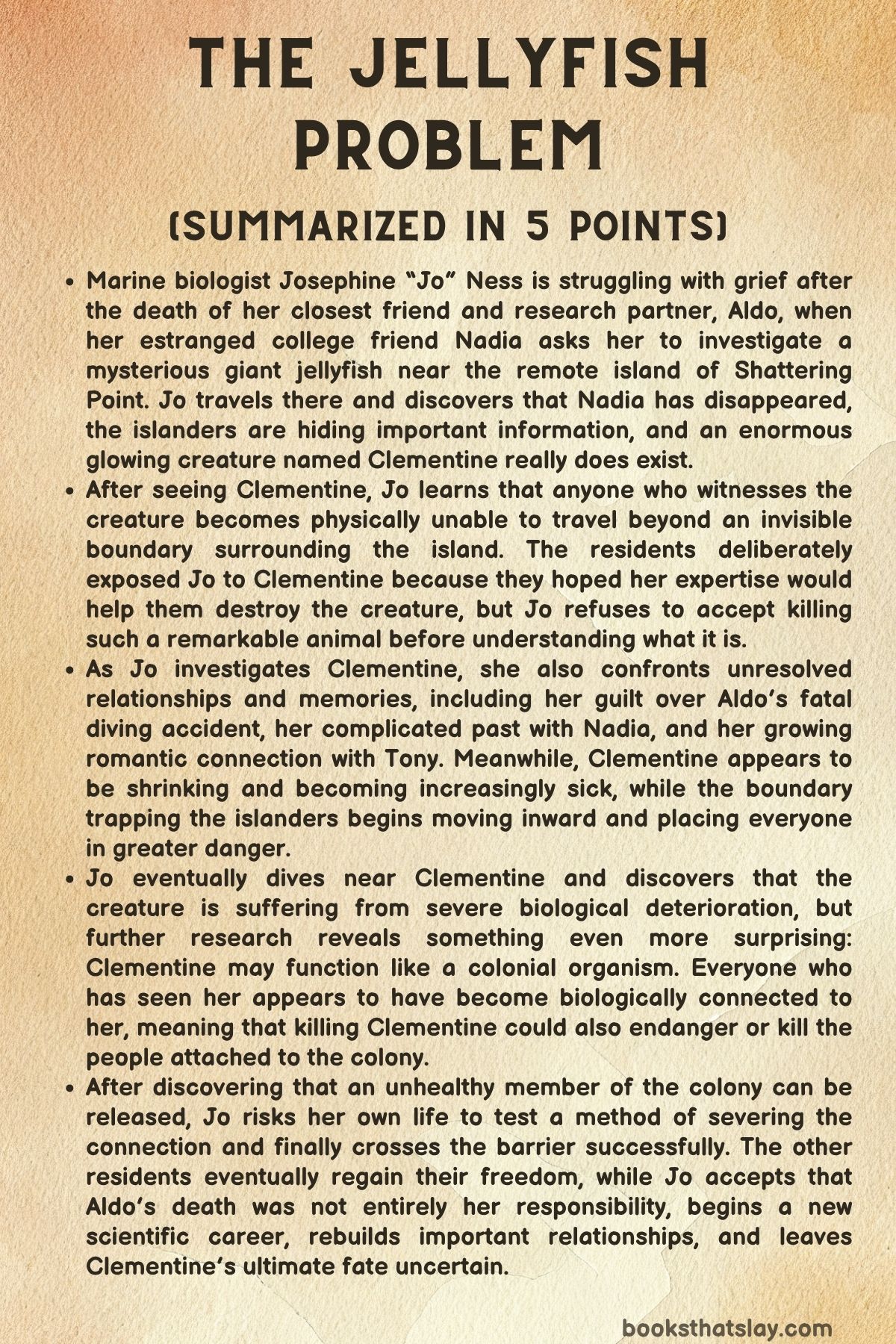
Josephine “Jo” Ness is a marine biologist specializing in jellyfish at Seaheart, an aquarium in California that is struggling to survive. Seven months earlier, Jo’s closest friend and research partner, Aldo Antunes, died during a cave-diving accident, and she has been unable to recover emotionally or complete the jellyfish book they were writing together.
Her stagnant life changes when Nadia Markov contacts her after eleven years of silence. Nadia, once Jo’s closest college friend and the object of feelings Jo never fully resolved, now teaches on Shattering Point, a remote island off Maine, and sends Jo a strange video showing enormous glowing red tendrils moving through the sea.
Jo is skeptical, but the possibility of an unknown species awakens scientific excitement she thought grief had taken from her. She travels to Shattering, despite having developed a severe fear of the ocean after Aldo’s death, and immediately finds the island secretive and unwelcoming.
Nadia is not waiting for her when she arrives. Instead, Jo meets Nadia’s husband, Roger Alvarez, who claims Nadia has suddenly disappeared and seems to think she may simply have left on an impulsive adventure.
Other residents offer conflicting explanations for Nadia’s absence, increasing Jo’s suspicion. At Retreat-by-the-Sea, Jo meets Tony Newell, an EMT temporarily running her aunt’s inn, and the attraction between them is immediate even though Tony also seems to know more about the island than she admits.
Jo eventually meets Sidney Bernet, one of Nadia’s students, who confesses that he recorded the original video. Sidney has named the mysterious jellyfish Clementine, considers her a friend, and tells Jo that she appears near the lighthouse after dark.
Jo goes to the lighthouse and finally sees Clementine herself. The animal is enormous, brilliantly bioluminescent, and unlike anything Jo recognizes, but its light also has an almost hypnotic quality that seems to pull her toward the water.
Then Jo sees something even more disturbing: Aldo, wearing the diving equipment in which he died. She flees, convinced that grief may have caused her to hallucinate, but her attempt to leave Shattering soon reveals that Clementine has created a problem far stranger than an unusual marine organism.
As Jo and Roger travel away from the island by boat, Jo becomes violently ill. Burning pain, suffocation, panic, and visions of Aldo overwhelm her until she collapses, forcing Roger to turn around.
The experience also returns Jo mentally to the cave where Aldo died. During that accident, poor visibility caused the two divers to disagree about the route to safety, and Jo eventually escaped while Aldo never returned, leaving her convinced that her decision contributed to his death.
After Jo recovers, Tony, Roger, and Sylvia Steele, Shattering’s unofficial leader, reveal the island’s secret. Nadia is alive and has been hidden in a secluded cabin because everyone who sees Clementine becomes unable to travel beyond an invisible boundary surrounding Shattering.
Attempts to cross that boundary cause increasing physical distress and can end in collapse. The residents deliberately exposed Jo to Clementine because they needed a jellyfish expert who might discover how to kill the creature and free them, a betrayal that leaves Jo furious.
Jo refuses to accept that Clementine must automatically be destroyed and negotiates time to study her. She begins collecting observations from the islanders, treating them as citizen scientists, and learns that Clementine appears able to interfere with attempts to harm her.
The investigation also brings Jo closer to Tony while forcing her to confront her history with Nadia. Years earlier, after the death of Jo’s father, Jo and Nadia had shared an intimate night shortly before graduation, but Nadia later withdrew because she could not return Jo’s romantic feelings.
Their reunion finally allows them to confront what happened. Jo begins to understand that Nadia’s friendship was real and valuable even though it was not the romantic relationship she once desired, allowing a relationship frozen for eleven years to begin changing.
Meanwhile, Margo Sloan’s paintings of Clementine provide Jo with evidence photographs cannot capture. By arranging the paintings chronologically, Jo and Nadia notice that Clementine’s tentacles have become progressively shorter, suggesting that the animal herself is physically deteriorating.
Jo develops the theory that Clementine may be shrinking because of biological stress. Sylvia, however, reveals old lighthouse records suggesting that a similar creature may have appeared near Shattering many decades earlier, raising the possibility that Clementine belongs to an extraordinarily long-lived species.
Jo’s personal life changes alongside the investigation. Her relationship with Tony becomes sexual and emotionally meaningful, and Jo realizes that she is not trying to replace Nadia; she wants Tony for who Tony actually is.
Tony also carries unresolved family pain. Her mother is seriously ill, and although Tony originally remained on Shattering partly because she wanted distance from that difficult relationship, Clementine’s barrier has transformed voluntary distance into forced separation.
The crisis becomes more urgent when Roger suffers a severe injury apparently caused by one of Clementine’s tentacles and is transported to the mainland. Nadia cannot cross the barrier to reach him, placing her in the unbearable position of knowing her husband may die while she remains physically prevented from going to him.
Jo examines a severed section of Clementine’s tentacle and discovers signs of infection. She proposes treating Clementine rather than killing her, but fear takes control of the island meeting, particularly after Nadia reveals that the boundary has begun moving inward.
Emmett Beckendorf proposes using explosives to destroy Clementine from a distance. Torn between her scientific and moral resistance to killing the creature and her responsibility toward the people trapped by her, Jo agrees to participate in a dive that will place Clementine within range of the attack.
Before the dive, Jo must first return to the water herself. With Tony’s support and a protective prototype suit supplied through engineer Ha-Yun Kim, Jo completes a practice dive and discovers that although Aldo’s death has changed her relationship with the ocean, it has not permanently destroyed her ability to enter it.
The dangerous dive finally allows Jo to observe Clementine at close range. Clementine is not shaped like an ordinary jellyfish but has an immense central body surrounded by hundreds of glowing tentacles, and when Jo sees the creature directly she cannot bring herself to signal for her destruction.
The Aldo-like figure appears again and signals Jo to stop. When Jo approaches it and removes its mask, however, she discovers that it does not truly have Aldo’s face, making her realize that the apparition has been using a familiar form to guide her toward something she needs to understand.
Jo closely examines Clementine and finds that the creature is not merely infected. Her tissues are deteriorating so severely that Jo identifies the process as senescence, meaning Clementine is approaching the end of her biological life.
The failed explosive attack places Tony in direct contact with one of Clementine’s tentacles, yet she survives without the injury Jo expects. Afterwards, Tony describes seeing a network of connections linking the people of Shattering, strangely similar to visions Roger reported after his own encounter.
Working with graduate researcher Shanel Sawyer, Jo finally recognizes what Clementine may actually be. Rather than functioning as a completely separate individual, Clementine behaves like a colonial organism that has incorporated every human who has seen her light into a larger biological system.
The invisible barrier is therefore not simply a wall around the island. It marks the distance that the human members of Clementine’s colony can move away from the central organism, and Clementine does not seriously attack those already incorporated because they have effectively become parts of the same living system.
This discovery makes Clementine’s approaching death terrifying rather than liberating. If the central organism dies, the people connected to her may die with her, and the shrinking boundary suggests that the colony is already becoming unstable.
A possible solution appears through Margo. Although everyone else remains trapped, she suddenly crosses the barrier successfully, and Jo discovers that Norm Sloan has secretly been poisoning his wife after their marriage became increasingly hostile.
Jo realizes that Clementine may have released Margo because a critically unhealthy member threatened the colony’s survival. She concludes that if a person becomes temporarily dangerous to the larger organism, Clementine may sever that individual’s connection.
Jo volunteers to test the theory on herself. During the dangerous experiment, she experiences an intense vision of Aldo in the underwater cave and finally confronts the belief that has controlled her life since his death.
The Aldo she encounters challenges Jo’s need to blame herself, suggesting that guilt gives her an illusion of control because accepting blame is easier than accepting that terrible events sometimes cannot be reduced to a single preventable mistake. Jo finally severs her connection to Clementine, survives, and crosses the barrier.
She could now escape, but she returns to help everyone else obtain the same freedom. The residents eventually reproduce the principle safely enough to cause Clementine to release them, ending their compulsory connection to her and restoring their ability to leave Shattering.
More than two weeks later, Jo’s life has changed significantly. Roger is recovering, Nadia remains part of her life as a genuine friend, Tony may pursue veterinary training near Jo, and Margo has escaped both the island and her destructive marriage.
Jo also accepts a new research position leading Project Clementine with Ha-Yun and Shanel. Instead of remaining emotionally frozen inside the life she shared with Aldo, she is beginning a career that carries his influence forward without requiring her to remain trapped by his death.
Clementine’s fate remains uncertain. Jo considers the possibility that, rather than simply dying, the creature may have reverted to an earlier stage of life in a process similar to that associated with Turritopsis dohrnii, while those once connected to her continue to sense faint traces of their former bond.
Jo no longer needs complete certainty before she can move forward. She accepts that some questions may remain unanswered, reconnects with her mother, allows love and friendship back into her life, and finally becomes capable of remembering Aldo without making his death the permanent center of her identity.
Characters
Josephine “Jo” Ness
Jo is the central consciousness of The Jellyfish Problem, and nearly every major conflict reflects some aspect of her struggle between scientific rationality and emotions she cannot organize as neatly as biological evidence. She is intelligent, skeptical, socially reserved, stubborn, and deeply devoted to creatures that other people regard as strange, threatening, or unworthy of sympathy.
Her interest in jellyfish is not merely professional. From childhood onward, she identifies with misunderstood forms of life, and her scientific career gives her a language for approaching the world without having to expose herself emotionally.
Aldo’s death destroys the separation she has maintained between reason and feeling. Jo can explain complicated biology, yet she cannot accept that an accident involving uncertainty and conflicting decisions may have no single person who can be held responsible.
Her journey on Shattering is therefore both scientific and psychological. Each discovery about Clementine requires Jo to confront something about herself: dependence, fear, attachment, grief, responsibility, and eventually the limits of control.
Jo also changes in the way she understands relationships. She stops treating Nadia as the lost possibility that defined her past, allows herself to love Tony as an individual rather than a substitute, reconnects with her mother, and finally accepts that friendship can be as central to a life as romance.
By the end, Jo has not become carefree or certain. Her growth lies in becoming able to live with uncertainty without allowing uncertainty to become guilt, paralysis, or isolation.
Aldo Antunes
Aldo is physically absent from the present-day story, yet he remains one of its strongest presences because Jo has organized much of her life around both loving him and blaming herself for his death. Their friendship grows from shared scientific curiosity and from the recognition that both are socially isolated in very different ways.
Where Jo withdraws, Aldo performs. His dramatic stories about venom, danger, survival, and near-death experiences create an image of fearlessness, but that image gradually appears less like simple confidence and more like a complicated relationship with his own mortality.
His friendship with Jo has a sibling-like quality. Aldo challenges her, irritates her, shares her fascination with dangerous animals, becomes her regular diving partner, and offers companionship without demanding that she become socially conventional.
The later revelation that Aldo could be moody and deeply unhappy matters because it destroys Jo’s simplified version of him. She has reduced his death to her decision during the accident, but Shanel’s memories demonstrate that Aldo possessed private struggles and dimensions Jo did not completely understand.
The apparition using his appearance turns Aldo into both memory and symbol. Jo must eventually separate the person she loved from the guilt-created version of him she has carried, allowing his memory to become part of her future rather than an accusation that keeps her trapped in the past.
Nadia Markov
Nadia represents one of Jo’s oldest and most complicated forms of attachment. She becomes Jo’s first genuine college friend, helping her feel understood at a period when Jo has largely accepted social isolation as normal.
Their closeness becomes romantically significant for Jo, especially after their sexual encounter near graduation. Nadia experiences the same event differently, however, and her fear of having created expectations she cannot satisfy leads her to withdraw rather than communicate honestly.
Her eleven-year silence is hurtful, but it does not make her uncaring. Nadia is fundamentally warm, optimistic, energetic, and emotionally expressive, yet her avoidance demonstrates that people who value connection can still cause serious harm when they fear difficult conversations.
Her marriage to Roger further forces Jo to acknowledge the difference between memory and reality. Nadia is no longer the unfinished romantic possibility Jo preserved in her imagination, but a person with a life and commitments that continued during their separation.
Nadia also becomes morally complicated when Roger is injured. Her earlier willingness to protect Clementine disappears when waiting threatens the person she loves, showing how ethical principles can change when consequences become immediate and personal.
Her reconciliation with Jo ultimately gives the novel one of its clearest arguments about friendship. Nadia cannot give Jo the romantic relationship she once wanted, but what she can give is neither lesser nor meaningless.
Tony Newell
Tony begins as one of the islanders participating in the deception surrounding Jo, yet she quickly distinguishes herself by refusing to carry the plan through completely. She is supposed to expose Jo to Clementine but cannot deliberately condemn someone she has met to permanent confinement.
That decision establishes Tony’s defining quality: her morality becomes strongest when a theoretical situation turns into an actual human relationship. She can participate in Shattering’s collective secrecy from a distance, but direct emotional contact makes that compromise impossible to maintain.
Tony combines physical competence with emotional avoidance. She is an EMT, cares for injured birds, manages the inn, helps Jo through dangerous situations, and responds effectively during emergencies, yet she has used remaining on Shattering as an excuse to avoid confronting her difficult relationship with her seriously ill mother.
Her romance with Jo works because the two recognize similar habits in each other. Both have built lives around forms of avoidance, although Jo retreats into grief and science while Tony retreats into caretaking, responsibility, and geographical distance.
Tony also refuses to romanticize Jo’s scientific obsession. When Jo becomes absorbed in Clementine while Nadia is terrified about Roger, Tony reminds her that knowledge does not eliminate ordinary obligations to the people one loves.
By the end, Tony represents a relationship based on present choice rather than unresolved history. Her possible move toward veterinary study also reflects her compassionate attraction to vulnerable living creatures and gives her a future chosen actively rather than accepted by default.
Roger Alvarez
Roger initially appears through Jo’s suspicion and jealousy, so his early portrayal is deliberately uncomfortable. His casual explanation for Nadia’s disappearance and his irritation toward Jo make him seem dismissive, while Jo instinctively views him as the man occupying the place beside Nadia that she once imagined for herself.
As the story develops, Roger becomes more sympathetic and more human. His arguments with Nadia arise partly because he wants to leave Shattering while she wants to stay, demonstrating that their marriage contains ordinary disagreement rather than the idealized intimacy Jo initially assumes.
Roger is also threatened by Jo’s emotional history with Nadia. His accusations that Jo still wants his wife are not entirely baseless, but his insecurity makes him defensive and contributes to repeated tension between them.
His severe encounter with Clementine changes the stakes of the conflict. Once he lies critically ill on the mainland while Nadia remains trapped, the island’s problem stops being an abstract debate about freedom and becomes an immediate threat to a marriage.
Roger’s vision of glowing connections later becomes scientifically significant. What sounds at first like confused speech turns out to anticipate Jo’s understanding of Clementine’s colony, making Roger an accidental witness to the biological truth the scientists have not yet recognized.
Clementine
Clementine is simultaneously creature, mystery, threat, victim, biological wonder, and organizing force within The Jellyfish Problem. The human characters repeatedly attempt to force her into a simple category, but she resists being understood as either monster or innocent animal.
Her enormous glowing body inspires wonder, yet seeing her removes a person’s ability to leave the island. Her defensive influence prevents people from harming her, and her connection to humans becomes so profound that their bodies effectively become extensions of her colony.
This creates an ethical difficulty because Clementine does not appear malicious in an ordinary human sense. Her actions can imprison, injure, and terrify people while still functioning as biological survival mechanisms rather than deliberate cruelty.
Her illness also reverses the human characters’ assumptions. At first they believe killing Clementine will free them, but eventually her approaching death becomes another possible source of danger because their lives may now depend on hers.
Clementine therefore challenges the desire to separate self from environment and human life from nonhuman life. She makes connection literal, compulsory, physical, and frightening, forcing everyone to confront the difference between belonging and possession.
Her unresolved disappearance preserves her mystery. Jo’s final theory that Clementine may have reverted to an earlier life stage keeps the creature from becoming a solved scientific specimen and reinforces the idea that knowledge does not always end in certainty.
Sidney Bernet
Sidney is the first island resident to relate to Clementine without beginning from fear, profit, or the desire for control. He names her, considers her his friend, and worries that adults will respond to something unfamiliar by killing it.
His relationship with Clementine reminds Jo of her own childhood identification with jellyfish. Jo recognizes in Sidney the loneliness and fascination that once shaped her, making her promise to protect Clementine especially meaningful.
Sidney also provides essential evidence. Because he recorded the original footage, his honesty pushes Jo past her suspicion that the supposed giant jellyfish might be an elaborate trick.
His intervention during the island meeting places a child’s moral clarity against adult desperation. Sidney cannot solve the practical danger Clementine creates, but he forces the adults to remember that fear does not automatically make destruction morally correct.
Sylvia Steele
Sylvia functions as Shattering’s administrator, historian, authority figure, and practical decision-maker. Her priority is the survival and freedom of the islanders, which makes her willing to manipulate Jo into seeing Clementine even though she understands the consequences.
She is not presented as casually cruel. Sylvia operates under prolonged pressure, and her choices emerge from the belief that conventional morality becomes difficult to maintain when an entire community has been trapped by an organism nobody understands.
Her family history strengthens her fear of Clementine. Records left by her grandfather Augustus suggest that the phenomenon may have occurred decades earlier, giving Sylvia reason to see the creature not as a temporary curiosity but as part of a dangerous historical pattern.
Sylvia often acts as a counterweight to Jo. Jo is drawn toward investigation and preservation, while Sylvia repeatedly asks what those values mean when real people may lose their families, futures, and lives.
Her willingness to adjust when new evidence appears prevents her from becoming a simple antagonist. She represents the hard decisions demanded of someone responsible for a community when every available option carries serious risk.
Emmett Beckendorf
Emmett is one of the most aggressive advocates for killing Clementine, but his position grows from the practical consequences of confinement rather than simple hostility toward nature. As manager of the scallop farm, he has direct evidence that the barrier is moving and therefore understands that the islanders may be running out of space and time.
His impatience with Jo reflects a conflict between scientific caution and emergency decision-making. Jo wants enough evidence to understand what Clementine is, while Emmett believes continued study can become another form of delay when people need immediate freedom.
The explosive plan demonstrates both his ingenuity and his dangerous certainty. He tries to find a technological way around Clementine’s mental defenses, but his willingness to act before Jo fully understands the organism nearly produces disastrous consequences.
Emmett is useful because his arguments are not entirely unreasonable. Jo herself recognizes that sabotaging the attack puts other people at risk, preventing the conflict from becoming a simple choice between an enlightened scientist and an irrational opponent.
Margo Sloan
Margo initially appears eccentric, artistic, intuitive, and unusually receptive to experiences that other people dismiss. Her paintings become scientifically valuable because she can visually represent qualities of Clementine that photography fails to preserve.
She also has a unique sensitivity to the supernatural dimension of Jo’s experience. When she sees the Aldo-like figure standing behind Jo, she validates something Jo had feared was only a symptom of psychological collapse.
Margo’s art therefore operates as another form of observation. Jo’s scientific methods and Margo’s artistic perception appear different, but both become necessary for understanding a creature that cannot be adequately captured through conventional evidence alone.
Her marriage to Norm adds a much darker dimension to her character. By the time Jo recognizes how ill Margo has become, the hostility inside the marriage has escalated into abuse and secret poisoning.
Margo’s eventual escape across the barrier becomes crucial to solving Clementine’s biological mechanism. Her decision to leave Norm afterwards also gives her escape a second meaning: gaining freedom from Clementine coincides with reclaiming freedom from a destructive human relationship.
Norm Sloan
Norm initially seems like a hostile island resident whose priorities are his garden, privacy, and resistance to outsiders. His claim that he does not feel trapped because his garden contains everything he needs presents him as someone who has turned extreme limitation into a form of chosen sufficiency.
That apparent contentment becomes much darker once his relationship with Margo is fully exposed. Their marriage has become volatile, and after a destructive argument involving his prized orchids, Norm secretly begins poisoning her.
His actions make him one of the story’s clearest examples of possessiveness becoming violence. While Clementine’s colony physically restricts people because of biological instinct, Norm consciously harms another person he is supposed to love.
Ironically, his crime produces the clue that saves the islanders. Margo’s weakened condition causes Clementine to release her from the colony, allowing Jo to recognize that the organism will abandon an unhealthy member to protect the larger whole.
Shanel Sawyer
Shanel enters late but becomes intellectually important because she approaches Clementine with the curiosity Jo desperately needs from another scientist. As a graduate researcher studying jellyfish venom and a former intern of Aldo’s, she connects Jo’s current investigation with the professional life Jo shared with him.
Her recollections of Aldo are especially valuable. Shanel remembers qualities Jo did not fully see, including periods of sadness and instability, forcing Jo to accept that loving someone does not mean completely knowing their inner life.
Scientifically, Shanel helps Jo move toward the colony theory. Their discussion of colonial marine organisms provides the conceptual model that allows Jo to reinterpret Clementine’s barrier, the strange visions experienced by Roger and Tony, and the creature’s unusual responses to people who have seen her.
Shanel therefore represents collaborative science rather than solitary expertise. Jo’s breakthrough does not come simply because she is the smartest person present; it emerges when another researcher contributes a different body of knowledge.
Jo’s Mother
Jo’s mother initially exists at an emotional distance because Jo has spent years limiting communication with her family. Her concern becomes intrusive when she enters Jo’s California apartment because she fears something has happened, but the action also reveals how little access Jo has allowed her to have.
Their later conversation about yōkai becomes an important turning point. Instead of dismissing Jo’s description of the Aldo-like apparition, her mother offers a cultural and personal framework in which such figures may guide rather than merely threaten.
She also shares that she experienced something similar after her husband’s death. This creates a bridge between mother and daughter because grief, which Jo has treated as a private burden, becomes something they can finally recognize in each other.
Her memory of accepting Jo’s childhood obsession with jellyfish reminds Jo that she has not always been as alone as she imagines. Their eventual exchange of affection shows Jo reopening a family connection she had allowed grief, distance, and discomfort to weaken.
Jo’s Father
Jo’s father appears primarily through memory, yet his death helps explain Jo’s fear of emotional dependence long before Aldo dies. His sudden death shortly before Jo’s college graduation leaves her numb and contributes directly to the emotional circumstances surrounding her intimate encounter with Nadia.
He is also associated with meditation, which Jo once practiced with him. When Nadia asks Jo to teach her the practice after his death, his influence becomes part of one of Jo and Nadia’s most important shared memories.
His absence establishes a pattern Jo later repeats after Aldo’s death: when confronted by loss, she withdraws rather than allowing other people to participate in her grief. The story therefore connects Jo’s later isolation to an older habit formed through earlier bereavement.
Ha-Yun Kim
Ha-Yun is an engineer connected to Aldo’s professional world and the developer of the Nematoskyn protective suit. Her technology gives Jo a practical means of entering the water near Clementine while reducing the danger from an unknown sting.
Her requirement that Jo accept a consulting arrangement also forces Jo to confront her professional future. Seaheart has become emotionally safe partly because it allows her to remain close to the version of herself that existed before Aldo died.
Ha-Yun’s offer creates a path beyond that stagnation. By eventually making Jo the principal investigator of Project Clementine, she helps transform the island crisis from an isolated disaster into the beginning of a new scientific life.
Augustus Steele
Augustus Steele, Sylvia’s grandfather, appears through historical records rather than through the present-day action. His lighthouse log describes strange scarlet lights and a creature emerging from the sea decades before Jo arrives, suggesting that Clementine or something similar has visited Shattering before.
His later refusal to leave the island and mysterious death give Sylvia’s fear a historical foundation. Augustus therefore expands the mystery beyond the immediate crisis and prevents Jo from assuming that Clementine can be understood solely through the observations made during her own visit.
He also represents the danger of incomplete historical knowledge. His records provide clues but not explanations, leaving the present generation to interpret events whose original witnesses can no longer clarify what they experienced.
Pamela
Pamela is the lobsterman who transports Jo to Shattering when ordinary transportation is unavailable. Her presence is brief, but the journey with her forces Jo into direct contact with the ocean she has avoided since Aldo’s death.
Her nickname for Jo, “Jelly Girl,” also establishes the mixture of teasing familiarity and outsider suspicion that Jo encounters around Shattering. Pamela belongs to the threshold of the story, carrying Jo physically from ordinary life into the isolated environment where the central mystery operates.
Maya
Maya, Tony’s aunt, remains away from Shattering during the central events because she is caring for Tony’s seriously ill mother. Her absence explains why Tony is managing Retreat-by-the-Sea and why Tony had a practical opportunity to remain on the island instead of returning home.
Although Maya has little direct role in the action, her decision places Tony precisely where Clementine’s appearance traps her. She therefore indirectly shapes Tony’s emotional conflict between the family responsibilities she has avoided and the new relationships she develops on Shattering.
Elijah
Elijah is connected to Jo’s professional life at Seaheart and becomes significant when Jo finally resigns. Telling him that she is taking another opportunity marks Jo’s formal separation from the institution that became her refuge after Aldo’s death.
His limited role emphasizes that leaving Seaheart is less about conflict with colleagues than about Jo accepting change. The aquarium protected her during a period of grief, but remaining there indefinitely would also allow grief to continue determining the boundaries of her life.
Theo
Theo, Jo’s cousin, appears in a childhood memory involving a stranded jellyfish. When he deliberately destroys the animal Jo is fascinated by, the experience leaves a lasting impression on her understanding of how humans respond to creatures they consider strange or insignificant.
The memory helps explain Jo’s instinctive resistance whenever people immediately propose killing Clementine. Theo represents an early encounter with casual destruction, while Jo’s reaction establishes the protective impulse that later becomes central to both her career and her moral decisions.
Themes
Grief, Guilt, and the Desire for Control
Grief in The Jellyfish Problem becomes dangerous when Jo converts it into a permanent argument about responsibility. She does not merely miss Aldo; she repeatedly reconstructs the diving accident in search of the moment at which she believes a different decision would have saved him.
Guilt gives Jo something grief cannot provide: a clear cause. If Aldo died because she made the wrong choice, then the tragedy becomes understandable, and a world governed by preventable mistakes can seem less frightening than one in which people may act as carefully as they can and still lose someone.
The Aldo apparition turns that psychological burden into an external presence. Jo initially interprets his repeated appearances as punishment or evidence that she is losing her mind, but eventually the figure guides her back toward the memory she has been refusing to reinterpret.
Her final encounter with Aldo challenges the logic beneath her self-blame. Jo wants responsibility because responsibility creates the illusion that she once possessed enough control to guarantee a different outcome, whereas accepting uncertainty requires admitting that love, skill, and good intentions cannot eliminate every accident.
The resolution does not require Jo to forget Aldo or decide that his death no longer matters. Instead, she learns to remember him without making suffering the proof of her love, allowing grief to remain part of her life without allowing it to define the limits of that life.
Connection, Independence, and the Meaning of Belonging
Clementine turns human connection into biological reality. Everyone who sees her becomes incorporated into a colony, producing an extraordinary situation in which belonging is no longer emotional or symbolic but something physically enforced by the body.
That condition exposes the difference between connection and captivity. The islanders are linked to one another and to Clementine, but because they cannot choose the relationship or determine when to leave it, their biological unity becomes a form of imprisonment rather than community.
Jo’s personal relationships repeatedly explore the same distinction. Her attachment to Nadia survives for years partly because Jo has never willingly released the possibility of what their relationship might have become, while her attachment to Aldo becomes destructive because guilt prevents her from allowing the relationship to change after his death.
Tony offers a different kind of connection because Jo chooses her in the present. Their relationship develops through vulnerability, disagreement, attraction, practical care, and the freedom to remain distinct individuals rather than through the preservation of an idealized past.
The solution to Clementine’s colony reinforces this idea. Freedom does not require Jo to reject every connection; she severs an involuntary biological bond and then voluntarily returns to help the others, demonstrating that meaningful belonging depends not on permanent attachment but on the continuing possibility of choice.
Science, Uncertainty, and Different Ways of Knowing
Jo begins with strong faith in evidence because scientific reasoning gives her stability. She distrusts rumors, questions impossible claims, and repeatedly searches for explanations that can be observed, tested, compared, and reproduced.
Clementine continuously challenges the limits of those methods without making science irrelevant. Photographs fail to capture the creature properly, conventional experts cannot help without seeing the evidence themselves, and experiences that initially appear supernatural later become connected to biological processes that Jo is only beginning to understand.
Margo’s paintings become valuable precisely because scientific instruments are insufficient. Her art records changes in Clementine’s form that allow Jo to identify a pattern of shrinking, showing that disciplined observation can arrive through forms other than conventional laboratory measurement.
The islanders themselves become citizen scientists because months of accumulated experience contain patterns no outside specialist possesses. Shanel’s knowledge later becomes equally essential, demonstrating that expertise works best when it is collaborative rather than treated as a single person’s authority.
The ending preserves uncertainty rather than rewarding Jo with complete explanation. Clementine may have died, transformed, or entered another stage of life, and Jo’s growth is visible in her ability to continue researching without requiring every unanswered question to become an emergency that must immediately be solved.
Fear, Otherness, and the Ethics of Destruction
Jellyfish occupy an unusual moral position throughout the story because people often treat them as frightening, alien, disposable creatures. Jo’s childhood experience with Theo teaches her early that unfamiliar life can be destroyed casually simply because another person sees no reason to value it.
Clementine magnifies that problem because she is genuinely dangerous. The islanders are not irrational for fearing her: she confines them, indirectly separates families, contributes to serious injuries, interferes with their attempts to resist her, and may threaten their lives as her condition worsens.
The moral question therefore cannot be reduced to a simple instruction that humans should protect a harmless animal. Jo must decide how far preservation should go when preserving a unique organism may require other people to remain imprisoned, while the islanders must consider whether fear gives them the right to destroy something they barely understand.
Sidney provides the clearest challenge to fear-based thinking because he continues to see Clementine as a living being rather than merely a problem. Jo occupies the harder middle position, recognizing both Sidney’s compassion and the legitimacy of the adults’ desperation.
The eventual colony theory makes destruction ethically and practically inseparable from relationship. Clementine is no longer simply an external monster threatening the humans because the humans have become parts of her, forcing the story to replace the question of how to defeat an enemy with the more difficult question of how to separate lives that have become dangerously dependent on one another.