The Replacement by Liv Constantine Summary, Characters and Themes
The Replacement by Liv Constantine is a dark psychological tale about ambition, celebrity, betrayal, revenge, and the ruthless desire to be remembered. Set within the competitive world of Hollywood, the story follows an aging actress whose attempt at a career comeback is threatened by a gifted young performer who seems unusually interested in her life.
What initially appears to be a story about professional jealousy gradually becomes an examination of crimes buried beneath fame and glamour. As old secrets surface and identities become uncertain, the story asks how far people will go to obtain success and whether ambition without conscience eventually creates its own form of punishment.
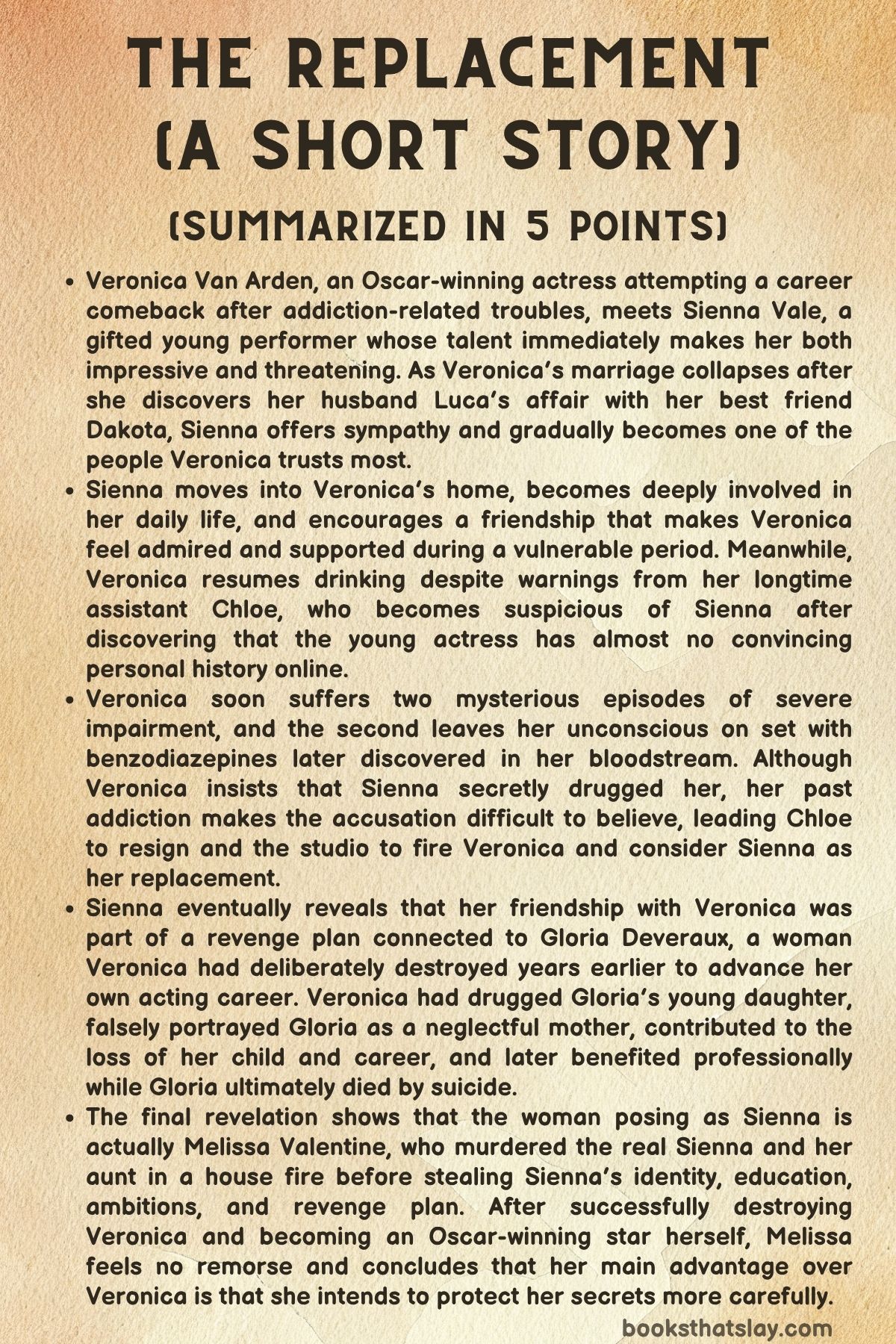
Summary
Veronica Van Arden is an Academy Award-winning actress who has spent much of her life surrounded by admiration, wealth, and public attention. Despite everything she has achieved, she privately recognizes that fame has never given her the happiness she once expected from it.
Her career has recently suffered because of problems on previous film sets, and she is attempting to prove that she can still be trusted professionally. She proudly counts more than one hundred days of sobriety, although her own understanding of sobriety is flexible because she continues taking medication.
Her longtime assistant Chloe manages nearly every practical part of her life, including schedules, food, and professional obligations. Veronica’s dependence on Chloe reveals how much of her apparently controlled existence is actually maintained by someone else.
Veronica’s latest film offers her an opportunity to rebuild her reputation. On set she meets Sienna Vale, an unknown young actress playing the younger sister of Veronica’s character.
Sienna is enthusiastic, beautiful, highly trained, and clearly fascinated by Veronica. During their first rehearsal, however, Veronica realizes that Sienna is far more than an inexperienced admirer because she possesses extraordinary acting ability.
Sienna can shift effortlessly into her character and display an emotional maturity that surprises Veronica. Accustomed to being the strongest performer around her, Veronica experiences an uncomfortable mixture of admiration and insecurity.
Away from work, Veronica’s personal life is equally complicated. Her husband, famous Italian actor Luca Galanis, is filming in Italy alongside Dakota Rollins, Veronica’s closest friend.
Luca has a history of becoming romantically involved with costars, although Veronica has convinced herself that their marriage is different. She also trusts Dakota and believes her friend would never participate in anything that could hurt her.
That confidence begins weakening after Luca accidentally calls Veronica. Through the unintended call, she hears evidence of a party and hears Dakota asking Luca to throw her shirt to her.
Luca later explains that the cast had been drinking, using marijuana, and swimming together. He insists that nothing improper occurred, but his defensive assurances make Veronica more suspicious rather than less.
At the same time, Veronica becomes increasingly curious about Sienna. An online search reveals that the young actress attended Yale’s drama school, has previously appeared in commercials, and is already receiving enthusiastic attention despite having no significant film career.
Soon Veronica sees a photograph of Luca and Dakota looking intimate together in Rome. She studies the image repeatedly, wondering whether the two people she trusts most have secretly betrayed her.
The emotional strain begins affecting her work. Veronica forgets lines on set and fears that the director, Chad, may regret giving her another opportunity after her previous professional difficulties.
During one particularly difficult scene, Veronica’s mind goes completely blank. Sienna notices the problem and deliberately pretends to become dizzy, shifting everyone’s attention away from Veronica and giving her time to recover.
The gesture changes Veronica’s attitude toward the younger woman. Sienna no longer appears merely threatening; she seems kind, perceptive, and willing to protect Veronica when doing so offers her no obvious advantage.
That small comfort disappears when Chloe shows Veronica a leaked video of Luca and Dakota kissing passionately. The image confirms that the affair is real, leaving Veronica feeling that she has lost both her husband and her closest friend simultaneously.
Her humiliation quickly turns into anger. Although Luca has broken his vows, much of Veronica’s fury is directed toward Dakota because she had believed their friendship was built on absolute loyalty.
While Veronica is crying alone in her trailer, Sienna unexpectedly appears. Instead of withdrawing, she stays with Veronica and shares a story about experiencing betrayal herself.
Sienna tells Veronica that Luca’s behavior reflects a pattern and argues that his affair with Dakota should not be treated as Veronica’s personal failure. She also encourages Veronica to control the public narrative and make clear that Luca was the one who violated their marriage.
The conversation gives Veronica something she badly needs: companionship without judgment. She invites Sienna to her home because returning to an empty house feels unbearable.
At Veronica’s luxurious oceanfront property, their relationship becomes much more personal. Sienna describes losing her mother as a child, living in foster homes, eventually being taken in by an aunt, and later losing that aunt in a house fire.
Veronica responds by sharing her own vulnerabilities. She talks about the film that originally made her famous, her Oscar victory, her regrets about never having children, and her awareness that her career has declined.
She also abandons her recent sobriety and begins drinking champagne with Sienna. Feeling protective toward the younger actress and enjoying the attention Sienna gives her, Veronica impulsively invites her to move into one of the house’s empty bedrooms.
Within two weeks, Sienna has become deeply involved in Veronica’s routine. They rehearse together, share meals, drink wine, play cards, and spend long periods talking beside the ocean.
Veronica enjoys becoming Sienna’s mentor because the arrangement allows her to feel admired and useful. She also begins rewriting her own history with addiction, convincing herself that alcohol was never the real problem and that Luca was responsible for introducing her to more dangerous substances.
Chloe does not share Veronica’s trust in Sienna. After investigating the young actress, she discovers that Sienna seems to have almost no digital history beyond a polished professional profile, which Chloe finds highly suspicious.
Chloe also dislikes the intensity with which Sienna observes Veronica. She warns that the young actress may have intentionally inserted herself into Veronica’s life, but Veronica dismisses the possibility because she now sees Sienna as vulnerable and loyal.
Veronica later takes Sienna to a Hollywood party hosted by producer Ian Graham. She wants to help her new friend make professional connections, and Ian quickly expresses interest in Sienna’s future.
While Sienna networks successfully, Veronica drinks champagne and then moves on to vodka. Her belief that she can drink without consequences quickly collapses, and she leaves with a bartender who propositions her.
The following day, Veronica arrives at work with a severe hangover. During preparations for filming, however, she develops symptoms that seem unusually extreme, including nausea, dizziness, difficulty walking, and disorientation.
Chloe worries about both Veronica’s health and the danger to her already fragile professional reputation. Veronica admits that she has been drinking again but insists that she has not returned to drugs.
After recovering, Veronica promises herself that she will regain control. Her private thoughts, however, reveal something darker about her character because she believes major success often requires crossing moral boundaries.
She has convinced herself that powerful people survive by doing whatever is necessary to protect their position. That philosophy suggests that the questionable choices surrounding her career may extend far beyond substance abuse.
At Chloe’s urging, Veronica eventually asks Sienna to move back to her own apartment. Sienna responds calmly and continues appearing supportive, even arriving with homemade muffins and coffee.
Soon afterward, Veronica suddenly becomes impaired again. Her leg stops cooperating properly, her speech becomes slurred, and she can barely remain awake.
The crew naturally assumes that Veronica has arrived intoxicated. Chad watches the disaster unfold while Sienna sits ready to perform, composed and professional as Veronica’s reputation collapses in front of everyone.
Veronica eventually loses consciousness and wakes in the hospital. A toxicology test reveals benzodiazepines in her bloodstream despite her insistence that she has not knowingly taken them.
She begins connecting the two mysterious episodes and remembers that Sienna brought her coffee before both incidents. Veronica therefore accuses Sienna of secretly drugging her.
Ironically, Chloe, who had previously distrusted Sienna, no longer believes Veronica. Veronica’s history of addiction makes her accusation appear like an attempt to avoid responsibility, and Chloe finally resigns because she cannot continue watching Veronica apparently destroy herself.
The consequences quickly become catastrophic. Veronica’s agent tells her that the studio has fired her because she is considered uninsurable, and the film will temporarily halt production while her role is recast.
Even worse, Sienna is being considered as Veronica’s replacement. Because she already knows Veronica’s lines, the filmmakers can simply alter her appearance and allow the younger actress to take over the part.
Veronica’s comeback has therefore become a professional disaster. Her agent, assistant, colleagues, and the public all believe that addiction has once again ruined her career.
A week later, Veronica prepares to enter rehabilitation despite maintaining that she did not knowingly take the drugs discovered in her body. She agrees because she understands that Hollywood expects a public redemption story if she ever hopes to work again.
Before she leaves, Sienna arrives at the house to return her key. Veronica confronts her directly and accuses her of deliberately drugging the coffee.
Instead of simply denying the allegation, Sienna begins referring to memories from Veronica’s past. Through comments about childhood card games and events from years earlier, she leads Veronica to believe that she is actually Marigold Deveraux.
The revelation exposes an old crime Veronica hoped had disappeared with time. Sienna claims to know exactly what Veronica did and explains that destroying her career and reputation has been deliberate revenge.
She has also discovered an envelope among Veronica’s possessions containing damaging evidence connected to the past. Veronica realizes that almost everything about their friendship has been carefully constructed to gain access to her home, her trust, and ultimately her career.
A year passes. Veronica completes rehabilitation, participates in charitable activities, and begins the slow process of repairing her public image.
Sienna, meanwhile, has become a major star after taking over Veronica’s role. She receives an Academy Award nomination for the performance that was originally supposed to restore Veronica’s career.
Watching the ceremony alone, Veronica sees Sienna win Best Actress. During her acceptance speech, Sienna dedicates the award to Gloria Deveraux and publicly reveals what Veronica did many years earlier.
Before becoming famous, Veronica had worked as Gloria’s nanny. Gloria later helped Veronica obtain an opportunity connected to the film that would eventually make Veronica an Oscar-winning actress.
Veronica wanted the role and was prepared to remove Gloria as an obstacle. She secretly drugged Gloria’s seven-year-old daughter, Marigold, abandoned the child, and then falsely testified that Gloria regularly drugged and neglected her daughter.
The accusations caused Gloria to lose custody of her child as well as her professional reputation. On the very night Veronica won the Academy Award that Gloria might otherwise have received, Gloria died by suicide.
Sienna reveals that evidence still exists, including a letter written by Gloria and an old prescription belonging to Veronica. Veronica had kept the materials in her own scrapbook, turning souvenirs from her rise to fame into proof of the cruelty behind it.
Faced with the truth, Veronica finally acknowledges to herself that she deliberately destroyed Gloria because she wanted what Gloria had. Yet even after witnessing the consequences, she refuses to fully condemn her younger self.
Instead, Veronica continues believing that ruthless ambition is simply part of becoming successful. She recognizes the bitter reversal in which Sienna has taken her career just as she once took Gloria’s opportunity.
The story then reveals that even this explanation is incomplete. The young actress is not actually Sienna Vale, nor is she Marigold Deveraux.
Her real name is Melissa Valentine. Melissa had been the best friend of the real Sienna, and the two looked similar enough that people sometimes mistook them for sisters.
The real Sienna was the young woman connected to Gloria’s past and had grown up intending to avenge what Veronica had done. After Melissa lost her parents, Sienna’s aunt also took Melissa into her home.
Both young women dreamed of success, but their friendship deteriorated because of professional jealousy. When Yale accepted Sienna and rejected Melissa, Melissa’s resentment became murderous.
Melissa set the house on fire after removing the batteries from the smoke detectors, killing Sienna and her aunt. She survived and then stole Sienna’s identity, education, ambitions, and carefully developed plan for revenge against Veronica.
Everything Melissa later did to Veronica was therefore borrowed from the woman she murdered. By carrying out Sienna’s revenge, she could destroy Veronica while simultaneously positioning herself to replace her.
Melissa ultimately gains everything she wanted: fame, critical respect, an Academy Award, and a secure place in Hollywood. She feels no remorse for the people whose lives she destroyed along the way.
Instead, she recognizes a similarity between herself and Veronica. Both women believe ambition can justify sacrificing other people, but Melissa considers herself superior because she thinks Veronica’s true failure was becoming careless.
Having watched Veronica lose everything because the evidence of her crimes survived, Melissa intends to make no comparable mistake. Her guiding principle is to trust no one and protect her fame at any cost, leaving the story with one ruthless woman replacing another while carrying the same dangerous understanding of success.
Characters
Veronica Van Arden
Veronica Van Arden is the central figure around whom nearly every major conflict develops. At the beginning of The Replacement, she appears to be a famous actress struggling with aging, addiction, professional decline, marital uncertainty, and the psychological cost of remaining visible in an industry constantly searching for newer faces.
Her greatest contradiction is the distance between vulnerability and cruelty. Veronica can be lonely, frightened, insecure, and genuinely grateful when Sienna protects her on set, yet these qualities coexist with an extraordinary capacity to harm others when her ambitions are threatened.
Her reaction to Sienna initially exposes her professional insecurity. She immediately recognizes the younger woman’s talent, and admiration quickly carries an uncomfortable awareness that Sienna may possess precisely the qualities needed to replace performers from Veronica’s generation.
At the same time, Veronica wants to think of herself as generous. By mentoring Sienna, inviting her into her home, lending her access to professional circles, and offering career guidance, she can imagine herself as a powerful woman helping someone less fortunate.
That generosity is not entirely false, but it is connected to Veronica’s need for admiration. Sienna’s dependence allows Veronica to occupy the superior position in the relationship, giving her a sense of importance at a moment when her marriage and career are both slipping beyond her control.
Veronica’s problems with alcohol and drugs reveal another essential part of her character: her ability to rationalize behavior. Rather than accepting addiction as an ongoing danger, she gradually decides that Luca was responsible for her earlier problems and that ordinary drinking is therefore harmless.
The same habit of self-justification governs her understanding of morality. Veronica believes success requires people to cross lines and eventually treats destructive behavior as a practical requirement of ambition rather than as a genuine ethical failure.
Her past treatment of Gloria shows where this philosophy can lead. Veronica did not merely take advantage of an opportunity; she deliberately targeted a mother and child, drugged Marigold, lied about Gloria, and helped destroy Gloria’s family because removing Gloria benefited her career.
Even after the truth becomes impossible to avoid, Veronica does not experience a complete moral transformation. She understands the irony of being replaced just as she once replaced Gloria, but she still thinks of her original crime as part of the price demanded by extraordinary ambition.
This inability to accept a moral boundary makes Veronica more complicated than a simple victim of revenge. Melissa’s actions against her are cruel and criminal, but Veronica’s suffering also forces the reader to confront the consequences of wrongdoing that wealth, fame, and time had previously allowed her to escape.
Her relationship with Chloe further demonstrates her dependence on people she often takes for granted. Chloe protects Veronica professionally and personally for years, yet Veronica repeatedly dismisses her warnings when they conflict with what she wants to believe.
The collapse of Veronica’s reputation also illustrates how fragile celebrity can be. The public image that once made her seem untouchable turns against her almost immediately when old patterns of substance abuse appear to return, leaving her unable to persuade even those closest to her that she has been manipulated.
Veronica ultimately functions as both victim and perpetrator. Her humiliation creates sympathy, but the revelation of Gloria’s destruction prevents that sympathy from becoming simple approval, leaving her as a woman whose greatest enemy is ultimately the ruthless philosophy she has spent years defending.
Melissa Valentine
Melissa Valentine is the story’s most deceptive character because nearly everything initially presented about her identity is false. For most of the book, she appears as Sienna Vale, a talented young actress whose mixture of vulnerability, admiration, generosity, and ambition gradually earns Veronica’s trust.
Her performance extends far beyond the film set. Melissa effectively performs a complete personality in Veronica’s presence, becoming whatever kind of person will most efficiently enter Veronica’s emotional life.
She presents herself as someone shaped by loss and abandonment, telling stories about her dead mother, foster care, and an aunt killed in a fire. Those details make Veronica protective of her, yet the final revelation shows that Melissa has reorganized truth, theft, and invention into a convincing personal history.
Melissa is extremely observant. She quickly identifies Veronica’s loneliness, vanity, addiction, professional insecurity, desire for admiration, and need to believe that she can still control younger talent.
Rather than attacking those weaknesses openly, Melissa encourages Veronica to make damaging choices herself. Her revenge succeeds partly because she allows Veronica’s existing flaws to help produce the appearance of self-destruction.
Her manipulation of the drugging incidents demonstrates considerable patience. Melissa knows Veronica already has a history of substance abuse, meaning benzodiazepines in her bloodstream will appear more believable as a relapse than as evidence of an attack.
She also understands that suspicion alone will not protect Veronica because years of unreliable behavior have damaged her credibility. When Veronica finally tells the truth about being drugged, the truth sounds exactly like the kind of excuse people expect from someone refusing responsibility.
Melissa’s apparent identity as Marigold creates an additional layer of manipulation. By presenting herself as the daughter Veronica once harmed, she allows Veronica to understand the campaign against her as revenge and therefore stops Veronica from looking deeper into Sienna’s identity.
The final revelation makes Melissa considerably more disturbing. She did not survive Veronica’s earlier wrongdoing and return for justice; she murdered the real young woman who had a genuine claim to that revenge and then stole both her identity and her purpose.
Her murder of the real Sienna and Sienna’s aunt shows that professional envy existed long before Veronica entered her plan. Melissa could not tolerate watching someone close to her receive an opportunity she wanted, particularly after Sienna gained admission to Yale while she did not.
In this respect, Melissa becomes Veronica’s true successor. Both women respond to another woman’s opportunity by treating that person as an obstacle that can be removed.
The connection becomes explicit in The Replacement when Melissa recognizes that she admires Veronica’s willingness to sacrifice others for success. She does not consider Veronica morally superior or inferior; she thinks Veronica simply became careless enough to leave evidence behind.
Melissa therefore represents ambition stripped of remorse. She achieves fame through murder, identity theft, poisoning, emotional manipulation, professional sabotage, and the appropriation of another woman’s suffering without showing meaningful guilt.
Her final belief that one should trust no one suggests that fame has become the only lasting relationship she values. Other people are useful when they provide access, identity, sympathy, opportunity, or protection, but they remain disposable whenever they threaten her position.
Sienna Vale / Marigold Deveraux
The real Sienna occupies an unusual position because she is physically absent from the main action while her identity shapes almost everything that happens. The woman Veronica knows as Sienna is actually Melissa, but the genuine Sienna’s history, ambitions, education, and revenge plan provide the foundation for Melissa’s entire rise.
The available information indicates that the real Sienna was connected to Gloria Deveraux and intended to confront Veronica over what had happened to her mother. Her desire for Hollywood success therefore existed alongside a deeply personal reason for approaching the woman who had destroyed Gloria.
Unlike Melissa, the real Sienna actually possessed the history that could justify anger toward Veronica. Her planned revenge emerged from family trauma and from knowledge of the injustice committed against Gloria and her child.
Her tragedy is that she becomes another person destroyed by the same kind of ambition that destroyed her mother. Before she can carry out her intentions, Melissa murders her because Melissa cannot tolerate being professionally overshadowed.
Sienna’s identity then becomes a resource used by her killer. Her education, professional dream, appearance, history, and revenge strategy are all taken from her, meaning that even the justice associated with exposing Veronica is ultimately disconnected from the person whose life most directly gave it meaning.
The character consequently reinforces the story’s recurring idea of replacement. Gloria is replaced professionally by Veronica, Veronica is eventually replaced by Melissa, and the real Sienna is replaced so completely that the world celebrates her murderer under her name.
Chloe
Chloe serves as Veronica’s longtime assistant, protector, organizer, and one of the few people willing to challenge her directly. Her presence reveals how much practical support is required to maintain Veronica’s glamorous public existence.
She manages food, schedules, professional responsibilities, and crises while also attempting to protect Veronica from her own worst impulses. Unlike many people surrounding a major celebrity, Chloe does not seem primarily interested in flattering Veronica.
Her suspicion of Sienna demonstrates strong observational instincts. She notices the lack of a convincing digital history and the unusually intense attention Sienna gives Veronica long before Veronica accepts that anything may be wrong.
Chloe’s tragedy is that she correctly identifies the danger but becomes unable to recognize the truth at the moment it matters most. Veronica’s genuine relapse into drinking and her previous history with drugs make the accusation against Sienna appear unreliable.
This misunderstanding demonstrates how damaged trust can become a weapon. Melissa does not need to convince Chloe that Veronica is lying through direct persuasion because Veronica’s own past has already created the conditions in which the truth can be dismissed.
Chloe eventually resigns because she believes continued loyalty would mean watching Veronica destroy herself. Her decision is painful rather than malicious, and it suggests that years of managing Veronica’s instability have exhausted even one of her strongest supporters.
Luca Galanis
Luca Galanis is Veronica’s famous actor husband and an important cause of the emotional instability that opens Melissa’s path into Veronica’s life. His affair with Dakota destroys Veronica’s trust at precisely the moment when Sienna begins presenting herself as a source of comfort.
Luca has an established reputation for becoming involved with costars, yet Veronica wants to believe marriage has changed him. His behavior demonstrates how easily a familiar pattern can be ignored when accepting it would threaten a person’s emotional security.
His betrayal is especially damaging because it is public. Veronica does not merely lose her husband; she must watch their relationship become entertainment content while Luca and Dakota are rapidly presented as an appealing new celebrity couple.
Luca also indirectly contributes to Veronica’s relapse. Although he is not responsible for every choice Veronica makes, his affair destabilizes her at a vulnerable point and gives her another reason to abandon sobriety.
His role therefore extends beyond marital betrayal. By damaging Veronica emotionally, he unknowingly helps create the conditions Melissa needs to gain greater access and influence.
Dakota Rollins
Dakota’s betrayal hurts Veronica in a different way from Luca’s because Dakota has been her closest friend and confidante. Veronica believes Dakota understands her history, insecurities, and marriage well enough to recognize how devastating an affair with Luca would be.
The discovery therefore represents the collapse of female friendship as well as romantic trust. Veronica directs enormous anger toward Dakota because the betrayal violates a relationship she considered safe from the competitiveness and dishonesty of Hollywood.
Dakota is not deeply explored from her own perspective, but her actions influence Veronica’s decisions throughout the book. The public celebration of Dakota and Luca as a glamorous couple continues provoking Veronica long after their affair is exposed.
Her role also makes Veronica more receptive to Sienna’s friendship. Having lost the woman she thought was loyal, Veronica becomes unusually eager to accept another woman who appears understanding, supportive, and free from hidden motives.
Gloria Deveraux
Gloria Deveraux is central to the moral history of the story even though the major events involving her occurred years before the present-day action. She was once positioned for professional success and also helped Veronica obtain an opportunity that would eventually transform Veronica’s career.
That generosity was repaid with calculated betrayal. Veronica targeted Gloria through her daughter, using drugs and false testimony to create the impression that Gloria was an irresponsible and dangerous mother.
The consequences were devastating. Gloria lost custody, suffered severe damage to her reputation and career, and eventually died by suicide on the night Veronica celebrated her Academy Award victory.
Gloria therefore represents the human cost concealed beneath Veronica’s success. The award, public admiration, and celebrated career that appeared to demonstrate exceptional achievement were partly built upon another woman’s deliberate destruction.
Her letter becomes especially important because it allows the past to survive despite Veronica’s years of silence. What Veronica regarded as a hidden event eventually becomes the evidence through which her public story can be rewritten.
Gloria’s presence also continues through the motivations of later characters. The real Sienna wants revenge because of what happened to her, while Melissa steals that revenge and uses Gloria’s suffering as part of her own route toward celebrity.
Marigold Deveraux
Marigold is the child whose suffering makes Veronica’s original crime particularly disturbing. At seven years old, she is drugged and abandoned as part of Veronica’s effort to make Gloria appear neglectful and dangerous.
She is therefore not simply collateral damage in an adult professional rivalry. Veronica consciously uses a child as the instrument through which she can remove another woman from her path.
The public narrative created around Marigold becomes the basis for Gloria losing custody and professional credibility. Veronica understands that accusations concerning a vulnerable child will carry enormous emotional power, making Marigold essential to the success of the deception.
Later, the apparent return of Marigold becomes psychologically devastating for Veronica. Melissa recognizes that claiming this identity will immediately connect her actions to Veronica’s deepest hidden crime and make her revenge appear logically complete.
The name therefore carries both historical and psychological importance. It represents the innocent person Veronica exploited and the past she believed she had successfully buried.
Chad
Chad, the director of Veronica’s comeback film, represents the professional pressure surrounding her attempted return. Veronica is acutely aware that her previous behavior has made her difficult to insure and employ, so she interprets every mistake on set as a potential reason for Chad to regret casting her.
His importance becomes greatest during Veronica’s apparent relapse. When she arrives unable to speak or stand properly, Chad witnesses behavior that seems to confirm every fear associated with her professional reputation.
From his perspective, replacing Veronica becomes a practical production decision. The film cannot depend on an actress who appears unstable, particularly when another talented performer already knows the role.
Chad’s willingness to consider Sienna therefore completes Melissa’s professional plan. He does not know that he is participating in sabotage; he simply responds to circumstances carefully engineered to make replacement appear reasonable.
Ian Graham
Ian Graham is a producer whose Hollywood party becomes an important step in Sienna’s professional advancement. Veronica takes Sienna there specifically because she wants to introduce the younger actress to influential people and help develop her career.
Ian quickly recognizes potential in Sienna and gives her his card. His interest confirms Veronica’s belief that she is successfully acting as a mentor, even as she unknowingly helps Melissa create independent connections within the industry.
The party also becomes another stage in Veronica’s decline. While Sienna advances professionally through networking, Veronica drinks heavily and loses control, creating a sharp contrast between the younger actress moving upward and the older actress damaging her already vulnerable reputation.
Ian therefore functions less as an individually developed personality than as a symbol of access. His attention represents the professional doors that begin opening for Sienna while they gradually close for Veronica.
Themes
Ambition Without Moral Limits
Ambition becomes dangerous when achievement is treated as more valuable than human life, loyalty, or responsibility. The Replacement: A Short Story repeatedly presents characters who do not merely want success but convince themselves that success gives them permission to remove anyone standing between them and what they desire.
Veronica’s treatment of Gloria provides the clearest early example. Instead of competing fairly for professional recognition, she drugs a child, creates false evidence of parental neglect, and destroys another woman’s family because Gloria possesses an opportunity Veronica wants for herself.
What makes Veronica especially disturbing is not simply that she committed these acts but that she continues rationalizing them years later. Even after her secret becomes public, she still views ruthlessness as something successful people are occasionally required to practice.
Melissa develops the same philosophy in an even more extreme form. When Sienna receives an opportunity Melissa wanted, Melissa does not accept disappointment or seek another route toward success; she murders Sienna and steals her entire identity.
The similarities between Veronica and Melissa transform the final reversal into more than revenge. Melissa does not truly oppose Veronica’s values because she ultimately shares them, viewing other people as obstacles, tools, or identities that can be used when necessary.
Their difference lies mainly in technique. Veronica leaves evidence, becomes vulnerable through addiction, and grows careless, while Melissa believes she can avoid those mistakes and preserve the success acquired through equally destructive behavior.
The result is a bleak examination of ambition disconnected from conscience. Success itself does not reform either woman because achievement only strengthens their belief that cruelty was justified by the outcome.
Replacement, Identity, and the Fear of Becoming Irrelevant
Replacement operates on professional, personal, and literal levels throughout the story. Veronica begins the narrative already afraid that her age, past behavior, and changing position within Hollywood may allow a younger actress to occupy the place she once controlled.
Sienna’s talent immediately activates that fear. Veronica admires the younger performer, but she also understands how quickly an industry focused on novelty can transfer attention from an established star to someone new.
That anxiety eventually becomes reality when Veronica is removed from the film and Sienna takes over her role. The replacement is especially humiliating because Veronica herself helped mentor the person who appears to benefit from her collapse.
The idea reaches further into Veronica’s history. Years earlier, she effectively replaced Gloria by destroying her reputation and taking the professional opportunity that contributed to Veronica’s own rise.
The apparent revenge therefore creates a reversal in which Veronica experiences what she once inflicted on someone else. Her career, credibility, and public position are taken from her, allowing another woman to receive the recognition she expected for herself.
The final identity revelation makes replacement even more literal. Melissa does not merely compete with Sienna; she eliminates her and then assumes her name, educational background, history, ambition, and future.
This repetition suggests that celebrity culture encourages people to understand identity through position and visibility. The person receiving attention appears valuable, while the person removed from view can quickly become forgotten.
Melissa’s final determination to keep the cameras focused on herself reveals the deepest fear beneath this pattern. For characters who build their identities around recognition, being replaced is not merely a professional defeat but a form of personal disappearance.
Betrayal and the Destruction of Trust
Trust becomes both a vulnerability and a weapon because nearly every major relationship contains some form of deception. Veronica’s emotional collapse begins when Luca and Dakota, the two people she expects to be most loyal, betray her through their affair.
Luca’s betrayal destroys her confidence in marriage, while Dakota’s betrayal damages her ability to believe in friendship. Losing both relationships at once leaves Veronica emotionally exposed and desperate for companionship.
Melissa recognizes that vulnerability and offers exactly what Veronica is missing. She listens without judgment, expresses sympathy, protects Veronica publicly, shares apparently painful personal experiences, and gradually positions herself as a trustworthy replacement for the relationships Veronica has lost.
The deception works because Melissa understands that trust is rarely created through one dramatic act. She builds it through repeated gestures of kindness, professional admiration, emotional disclosure, and practical support.
Veronica eventually invites her into the house because she interprets these actions as evidence of genuine affection. That access allows Melissa to observe Veronica more closely, interfere with her sobriety, locate evidence from the past, and create circumstances that make the drugging incidents believable.
The theme becomes more complicated through Chloe. Chloe genuinely cares for Veronica and correctly suspects Sienna, yet Veronica’s history has damaged their relationship so severely that Chloe cannot believe her when she finally makes a truthful accusation.
The story therefore shows that betrayal does more than hurt its immediate victim. Repeated dishonesty changes the conditions under which future truth is judged, sometimes leaving people unable to distinguish genuine danger from another excuse.
Melissa ends by deciding to trust no one, but that conclusion does not protect her humanity. Instead, it confirms that she views relationships primarily as strategic risks, completing a cycle in which betrayal produces isolation and isolation encourages further betrayal.
Reputation, Celebrity, and the Difference Between Image and Reality
Public reputation functions almost like a separate identity that can be created, damaged, repaired, or stolen regardless of the truth. Veronica’s entire career depends upon maintaining a version of herself that audiences, studios, journalists, and industry professionals are willing to believe.
At the beginning, she already understands the gap between the glamorous woman seen by the public and the unhappy person behind that image. Her fame has created enormous privilege, but it has not eliminated insecurity, loneliness, addiction, or fear.
Melissa’s revenge succeeds because she attacks reputation rather than Veronica’s body. By secretly giving her benzodiazepines, she creates behavior that fits an existing public story about Veronica as an unreliable actress with substance-abuse problems.
The facts become almost irrelevant once the images of Veronica collapsing circulate publicly. Her history makes the apparent explanation so convincing that her employer, agent, colleagues, and even Chloe interpret the incident as self-inflicted.
Veronica also understands that rehabilitation is partly a performance demanded by celebrity culture. She enters treatment because a visible redemption narrative may help restore her employability, even though she continues insisting that the drugs found in her system were given to her without her knowledge.
The same power of reputation destroyed Gloria years earlier. Veronica’s accusations transformed Gloria from respected actress and mother into someone perceived as dangerous and irresponsible, showing that public belief can produce real consequences even when the underlying story is false.
Melissa ultimately masters this system better than Veronica. She creates an entirely fictional identity, performs innocence convincingly, exposes Veronica publicly at the most dramatic possible moment, and converts another woman’s history into an award-winning personal narrative.
The story consequently presents fame as a world where perception can become more powerful than reality. Whoever controls the story seen by the public can often control whose career survives, whose voice is trusted, and whose identity is remembered.