The Troublemaker by Piper Rayne Summary, Characters and Themes
The Troublemaker (The Dugout #4) by Piper Rayne is a contemporary romance centered on two people who have spent years avoiding permanence, only to find themselves unexpectedly tied to marriage, parenthood, and home.
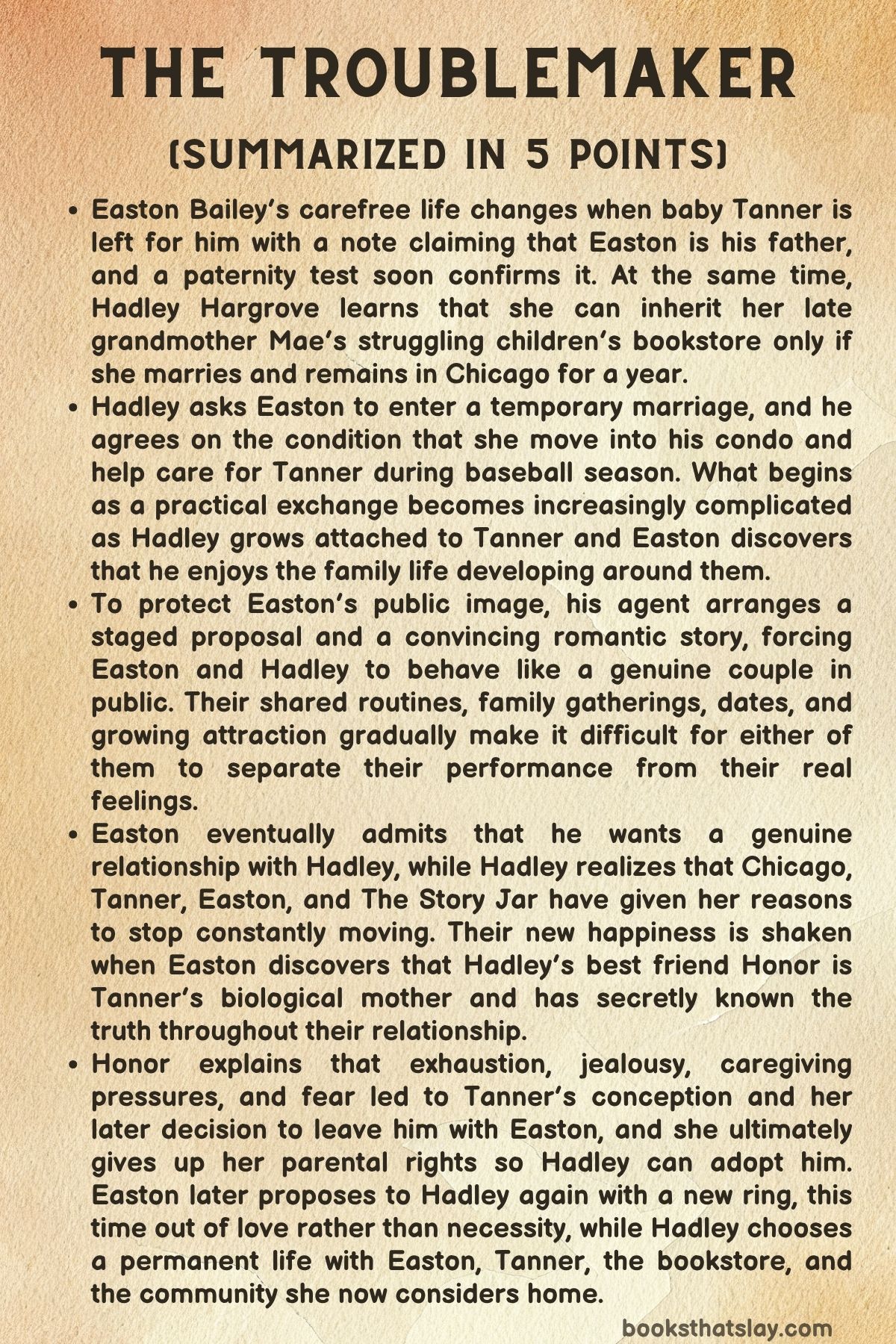
Easton Bailey is a famous Chicago baseball player whose carefree life changes when an infant is left for him with a note claiming he is the father. Hadley Hargrove, meanwhile, must marry and remain in Chicago if she wants to inherit her grandmother’s struggling bookstore. Their practical arrangement begins as an exchange of favors, but living together with baby Tanner gradually forces both to confront what they truly want from love, family, and the future.
Summary
Easton Bailey believes he has built exactly the life he wants. As the successful shortstop for the Chicago Colts, he enjoys professional achievement, loyal friends, a close family, and complete freedom from the marriages and children that increasingly define the lives of people around him.
Everything changes when a baby carrier is delivered to Peeper’s Alley with an envelope addressed specifically to him. Inside is a baby boy named Tanner and a note claiming Easton is his father, and the resemblance between the two makes the possibility difficult to dismiss.
While Easton struggles with the sudden possibility of fatherhood, Hadley Hargrove returns to Chicago for the reading of her grandmother Mae’s will. Hadley has spent years traveling and keeping distance from a family that sees her as irresponsible, particularly her critical mother Margot and sister Sloane.
Mae leaves Hadley The Story Jar, the children’s bookstore that shaped much of her childhood, but the inheritance comes with conditions. Hadley must establish permanent residency in Chicago for a year, and that year will not begin until she is married.
The bookstore is also in serious financial trouble. Mae had been using her own money to keep it operating, and Hadley’s brother Whit warns her that taking responsibility for it could become a burden rather than a gift.
Mae’s final letter changes Hadley’s perspective. Her grandmother explains that she kept the store alive because she believed children still needed places that encouraged imagination, and she tells Hadley that her creativity and adventurous nature may be exactly what the business needs.
Hadley decides she cannot allow The Story Jar to disappear. Saving it requires finding a husband, and the only person she can imagine asking is Easton, the commitment-averse man with whom she has maintained a casual sexual relationship for years.
By the time Hadley reaches him, Easton is already struggling to care for Tanner while waiting for the paternity results. He initially mistakes Hadley’s arrival as evidence that she might be Tanner’s mother, but she quickly corrects him and explains her own unusual situation.
Hadley asks Easton to marry her for one year. He refuses at first because, despite his reputation, he takes marriage seriously and dislikes the idea of reducing it to paperwork.
Then Easton recognizes that Hadley can solve a problem for him too. If Tanner is truly his son, he needs someone trustworthy to help care for the baby during baseball season, so he proposes an exchange: he will marry Hadley if she moves into his condo and helps him raise Tanner.
The paternity test soon confirms with near certainty that Easton is Tanner’s biological father. Their arrangement therefore becomes real in every practical sense: Hadley moves in, Easton becomes a full-time parent, and the pair begin preparing for a marriage designed to benefit them both.
Easton’s agent, Jagger Kale, quickly sees another problem. A famous athlete suddenly appearing with a wife and previously unknown infant son will attract enormous media attention, so Jagger insists that Easton and Hadley create a believable public story before marrying.
The plan leads to a staged proposal at The Story Jar. Easton kneels during children’s story time and proposes while his friends film the event, but the setting, the ring, and the way he looks at Hadley make the supposedly artificial moment unexpectedly emotional.
The proposal spreads online, and soon afterward Easton and Hadley marry legally at the courthouse. Their invented romance is accepted by the public, while their private life begins to look increasingly similar to the story everyone else believes.
Hadley becomes more confident caring for Tanner, while Easton discovers that returning home to Hadley and his son matters more to him than he anticipated. Baseball trips that once represented freedom now make him aware of how much he dislikes being separated from them.
Hadley experiences a similar change. She forms friendships with the partners of Easton’s teammates, settles into life at The Story Jar, and begins enjoying the stability she once avoided.
Their attraction also becomes harder to dismiss. They had successfully kept sex emotionally uncomplicated in the past, but their new domestic life gives every interaction a different meaning.
Easton sees Hadley supporting Tanner, protecting the bookstore, and fitting naturally into his world. Hadley sees Easton not merely as a famous athlete or entertaining lover but as a devoted father, generous friend, supportive husband, and man who takes her ambitions seriously.
Easton also begins searching for Tanner’s biological mother. He believes Tanner deserves the opportunity to know her if possible, although the search creates emotional discomfort for Hadley because she is becoming increasingly attached to both father and son.
The connection between Easton and Hadley becomes especially clear when they visit her family. Margot repeatedly questions Hadley’s choices and treats her as unreliable, while Easton calmly defends her and insists that they will face decisions about Tanner together.
His protection deeply affects Hadley because she is accustomed to being doubted. Around Easton, she does not feel required to become smaller or prove that she deserves respect.
Easton’s parents, Holly and Austin, create an entirely different experience. They arrive unexpectedly from Alaska and welcome Hadley into the family with immediate affection.
Their acceptance forces Hadley and Easton into greater physical and emotional closeness because Holly and Austin assume the newlyweds share a bedroom. Soon Easton and Hadley are sleeping beside one another every night while attempting to resist an attraction that has become much more than physical.
Holly also encourages Hadley to reconsider the meaning of permanence. She suggests that Hadley may not have spent years traveling because she was incapable of creating roots, but because she had not yet found a reason strong enough to stay.
When Easton’s parents give the couple a night at the St. Regis, the distance they have tried to maintain finally collapses. Easton and Hadley spend the evening exploring Chicago together, talking about travel, loneliness, family, baseball, sacrifice, and the lives they have avoided building.
Back at the hotel, Hadley initiates a kiss, and they sleep together. Unlike their earlier casual encounters, neither wants emotional distance afterward.
The next morning forces them to confront the change directly. Easton finally explains the experience with Kenzie that contributed to his fear of serious relationships, while Hadley reveals how her father’s abandonment and her mother’s constant comparisons taught her to associate permanence with disappointment.
Easton admits that his feelings for Hadley are real and asks her to stop pretending with him. Hadley is frightened but agrees to try a genuine relationship rather than continue hiding behind the original arrangement.
Their relationship soon becomes stronger. They date, parent Tanner together, and naturally begin functioning as a family.
When Tanner becomes sick, both immediately care for him as a team. Easton finally says aloud what their lives already demonstrate: they are a family.
Hadley later tells Honor that she believes she is falling in love with both Easton and Tanner. More importantly, she realizes she no longer intends to leave Chicago when Mae’s required year ends.
A frightening car accident confirms Easton’s feelings as well. When he learns that Hadley’s Uber has been struck, he abandons his normal pregame obligations and races across Chicago to reach her.
Seeing Hadley injured but safe forces Easton to recognize how terrifying the possibility of losing her has become. His friends point out that his behavior resembles that of a man already in love, even if he has not yet managed to say the words.
The emotional turning point comes when Tanner calls Hadley “Mama.” Instead of correcting him, she accepts the name.
Easton secretly hears the exchange through the baby monitor and is overwhelmed with happiness, but he gives Hadley space rather than forcing her to explain what the moment means. Later, Tanner repeats the word in front of Easton, allowing them to discuss Hadley’s place in his life openly.
Hadley tells Easton that she wants to remain part of Tanner’s life regardless of what happens romantically. She also makes it clear that she wants Easton and intends to stay.
Their happiness is interrupted by a revelation neither expects. At the funeral of Honor’s grandmother, Easton recognizes Honor’s hummingbird tattoo and suddenly remembers sleeping with her during the period when Tanner must have been conceived.
Honor is Tanner’s biological mother.
For Hadley, the discovery is especially painful because Honor has been her closest friend since childhood. Hadley had spent months discussing Tanner, Easton, the marriage, and her growing feelings with Honor without realizing that Honor already knew far more about the situation than she admitted.
Honor eventually explains that years of caregiving had left her isolated, exhausted, and resentful of the freedom Hadley seemed to possess. During a particularly difficult period, she deliberately sought Easton out because she wanted one night in which she could imitate the carefree existence she associated with Hadley.
She later discovered she was pregnant and attempted to care for Tanner while continuing to look after her grandmother. Eventually she became overwhelmed and left Tanner with Easton because she believed he had the family, money, and resources to give their son a better life.
When Hadley unexpectedly became Easton’s wife and Tanner’s caregiver, Honor remained silent because she believed Tanner had ended up exactly where he should be. She does not want to reclaim motherhood and ultimately makes clear that she believes Hadley is Tanner’s real mother in every way that matters.
Two months later, Honor formally gives up her parental rights so Hadley can adopt Tanner. Easton gives Honor money with no conditions, not as payment for Tanner but as a chance for her to experience the freedom she had been denied for years.
Honor leaves for Ecuador to begin a new life.
Easton, meanwhile, decides that his original legal marriage to Hadley is no longer enough. He buys another engagement ring and plans a second proposal, this time without publicity, inheritance conditions, or contractual motives.
When he returns home, he discovers that Hadley has converted her former bedroom into Tanner’s nursery. By moving permanently into Easton’s room, she has already made her own intentions clear.
Easton replaces the original engagement ring with the new one and asks Hadley to choose him for real. She accepts immediately.
They finally tell each other that they are in love.
By the closing events of The Troublemaker, Hadley no longer sees Chicago as a temporary stop. The Story Jar is profitable, Tanner’s adoption is progressing, she and Easton are buying a house, and the friendships surrounding them remain strong.
The woman who once believed freedom required constant movement has discovered that staying can also be a choice. Easton, meanwhile, has learned that commitment does not destroy independence; it can give his life a meaning that freedom alone never provided.
Characters
Easton Bailey
Easton Bailey begins The Troublemaker as a man who has carefully separated pleasure, career, friendship, and family from romantic commitment. He enjoys being the carefree member of his social group and has convinced himself that avoiding serious relationships protects both his independence and his emotional security.
Tanner immediately challenges that identity. Easton is frightened by fatherhood because it gives him responsibility for another human being before he has prepared for it, yet his attachment develops almost instantly; even before receiving the paternity result, he worries about the possibility that someone could take Tanner away.
His early struggles with diapers, feeding, schedules, and childcare reveal an important difference between confidence and competence. Easton is extremely confident in familiar environments such as baseball, but Tanner places him in a situation where charisma and athletic ability cannot substitute for patience and learning.
That discomfort gradually makes him more mature. Rather than abandoning responsibility or handing everything to somebody else, he asks for help, learns from the people around him, changes his routines, and begins treating fatherhood as one of the central parts of his identity.
His relationship with Hadley exposes a similar contradiction. Easton claims to value emotional freedom, but he also has strong beliefs about loyalty, refusing to sleep with other women even during a marriage he considers technically fake.
His growing love appears through actions long before he can name it. He protects Hadley when her mother criticizes her, worries about the bookstore because it matters to her, races to her after the car accident, misses her while traveling, and begins imagining a permanent family long before he admits that permanence is what he wants.
Easton’s development is therefore less about abandoning his personality than recognizing that commitment does not require him to become someone else. He remains playful, competitive, sexual, confident, and devoted to baseball, but he becomes capable of placing Hadley and Tanner beside those parts of himself rather than treating relationships as threats to them.
Hadley Hargrove
Hadley Hargrove enters The Troublemaker believing movement equals freedom. She has spent years traveling, avoiding long-term relationships and keeping distance from Chicago partly because remaining near her family means confronting their judgment of her choices.
Her grandmother’s will forces her into the exact circumstances she has always resisted: marriage, residence, responsibility, financial pressure, and attachment. Although she initially accepts those conditions only to preserve The Story Jar, they gradually expose the emotional reasons behind her constant movement.
Hadley’s deepest insecurity comes from being treated as the unreliable member of her family. Margot’s criticism has taught her to expect that mistakes will confirm what others already believe about her, which explains why something as ordinary as struggling to calm Tanner can make her fear she is failing completely.
Easton’s response matters because he does not interpret uncertainty as incompetence. By reminding Hadley that learning is part of parenting, supporting her business ambitions, and defending her in front of Margot, he gives her a form of acceptance she rarely receives at home.
Her bond with Tanner becomes the clearest sign of her transformation. Hadley initially views childcare as the price she must pay for the bookstore, but Tanner becomes emotionally important to her until the possibility of leaving him becomes almost unimaginable.
When he calls her Mama, Hadley finally stops reducing their relationship to employment. Accepting the name means accepting that she wants permanence, responsibility, and motherhood even though those ideas once appeared completely incompatible with her self-image.
Her development also avoids presenting travel itself as a mistake. What changes is Hadley’s understanding of why she traveled; she recognizes that some of her movement was genuine curiosity, while some of it allowed her to avoid discovering whether she could create a satisfying life in one place.
By the end, she stays because she has chosen what she wants rather than because Mae’s will requires it. Chicago, Easton, Tanner, The Story Jar, and her community become permanent because Hadley finally feels that staying expands her life instead of limiting it.
Tanner Bailey
Tanner cannot verbally explain his emotions for most of the story, yet he is the character whose arrival produces nearly every major change. His presence forces Easton to confront responsibility and gives Hadley a reason to build attachments stronger than the temporary arrangements she prefers.
His importance extends beyond being a plot device. Tanner responds to consistency, comfort, affection, and familiarity, gradually showing through his behavior that he sees Easton and Hadley as his parents.
His eventual use of “Dada” and “Mama” gives language to a family bond that has already formed. When he calls Hadley Mama and she accepts the title, he becomes the person who unintentionally forces her to acknowledge what she has been trying to define cautiously.
Tanner also complicates every adult decision because choices that might once have affected only Easton or Hadley now have consequences for a child. Their increasing awareness of that responsibility is one of the clearest signs that both are becoming capable of lasting commitment.
Honor
Honor is one of the story’s most complicated supporting characters because she moves from loyal best friend to hidden source of the central mystery. For much of the book, she appears to be the person who understands Hadley best, repeatedly challenging Hadley to consider the emotional consequences of becoming attached to Easton and Tanner.
Those conversations become dramatically different once her identity as Tanner’s biological mother is revealed. Honor has listened to Hadley discuss motherhood, marriage, jealousy, love, and fear while carrying information that could alter every one of those conversations.
Her actions are undeniably deceptive. She deliberately sought out Easton despite knowing about his connection with Hadley, concealed the pregnancy, left Tanner with Easton without identifying herself, and continued hiding the truth after Hadley became Tanner’s caregiver.
At the same time, the book presents the circumstances that contributed to those choices. Honor surrendered much of her young adulthood to caring for her grandmother and became exhausted, isolated, financially strained, jealous of Hadley’s freedom, and desperate to experience a life that felt temporarily unconstrained.
Her final decision confirms that she does not see biological connection as automatic ownership. She acknowledges that she does not want motherhood, gives up her parental rights, and recognizes that Tanner already has the stable family she could not provide.
Honor’s departure for Ecuador reverses the positions she and Hadley held at the beginning. Hadley, once the traveler, finally chooses roots, while Honor, once confined by duty, finally receives the freedom to discover who she is outside caregiving.
Mae Hargrove
Mae is physically absent from the central action because she has died before Hadley receives the inheritance, yet her decisions shape nearly every event that follows. The marriage condition attached to The Story Jar becomes the reason Hadley approaches Easton and therefore the indirect beginning of the family that eventually forms.
Her condition is controlling on the surface, and Hadley understandably sees it as old-fashioned. However, Mae’s letter reveals that she is not simply trying to impose a conventional lifestyle on her granddaughter; she wants Hadley to question whether constant travel is truly the only form of adventure available to her.
Mae also understands Hadley better than much of the Hargrove family does. Rather than treating her travels as evidence of irresponsibility, Mae values the postcards Hadley sends and believes her curiosity, imagination, and independence could become strengths in rebuilding the bookstore.
Her influence continues through The Story Jar itself. Saving the store allows Hadley to preserve Mae’s belief in books, childhood imagination, and community while eventually reshaping the business according to her own abilities.
Margot Hargrove
Margot is one of the primary sources of Hadley’s insecurity. She interprets Hadley’s unconventional choices through a long-established belief that her daughter is impulsive, unreliable, and too similar to the father who abandoned the family.
Her criticism has lasting effects because Hadley does not merely disagree with Margot; she has internalized enough of her mother’s judgment to wonder whether failure would prove Margot correct. This is why inheriting The Story Jar becomes partly a personal test of whether Mae’s faith in her was justified.
Margot also serves as a contrast to Holly Bailey. Where Margot’s presence makes Hadley shrink and defend herself, Holly’s acceptance allows her to relax, emphasizing how strongly family environments influence the way Hadley understands herself.
Whit Hargrove
Whit is Hadley’s most supportive immediate family member, but his support is practical rather than unquestioning. As executor of Mae’s estate, he explains the financial problems surrounding The Story Jar and initially argues that Hadley should seriously consider letting the failing business go.
His skepticism differs from Margot’s because it is based primarily on evidence rather than contempt for Hadley’s personality. When he pushes Hadley to explain why she needs to save the bookstore, he helps her move beyond sentimental answers and admit that Mae’s belief in her has become personally important.
Once he understands that motivation, Whit respects her determination even though he remains aware of the risks. His character provides Hadley with a family relationship in which disagreement does not automatically become rejection.
Sloane Hargrove
Sloane largely reinforces the attitudes Hadley associates with her family. Alongside Margot, she treats Hadley’s history of travel and unconventional choices as evidence that Hadley lacks seriousness and stability.
Although she is not explored as deeply as Hadley or Whit, her presence strengthens the emotional atmosphere of the Hargrove household. Hadley enters family interactions expecting criticism partly because Sloane participates in the pattern rather than challenging it.
Holly Bailey
Holly represents a dramatically different version of motherhood from the one Hadley knows. She welcomes Hadley immediately, treats her as family before demanding proof that she deserves the position, and openly expresses affection for Easton, Tanner, and her new daughter-in-law.
Her acceptance affects Hadley because it gives her a direct experience of family warmth without constant evaluation. Even a casual mistake such as referring to Hadley as Tanner’s Mama becomes significant because Holly recognizes the maternal bond already developing between them.
Holly also understands emotional avoidance. Her conversations with Hadley suggest that both Hadley and Easton have spent years moving away from vulnerability in different ways.
Rather than demanding that Hadley settle down, she encourages her to remain open to what she actually feels. That distinction makes Holly influential without simply becoming another older relative telling Hadley how her life should look.
Austin Bailey
Austin provides Easton with one of his strongest models of commitment. His own history includes sacrificing personal opportunities for family, first by caring for younger relatives after his parents died and later by making decisions that allowed him to remain with Holly.
Easton admires those sacrifices but also finds them intimidating because he is unsure whether he could ever prioritize another person so completely. As his feelings for Hadley deepen, Austin’s example becomes increasingly relevant to Easton’s developing understanding of love.
Austin is also quietly perceptive. He appears suspicious when Easton improvises explanations about separate bedrooms, yet he does not aggressively interrogate the couple.
His private approval of Hadley matters deeply to Easton because Austin’s opinion represents family acceptance rather than public validation.
Decker
Decker functions as one of Easton’s most grounded friends. He supports Easton during the confusion surrounding Tanner but refuses to treat every impulsive decision as harmless.
His strongest role is as a voice of caution regarding Hadley. While some friends see no problem with Easton returning to a sexual relationship with her, Decker recognizes that their circumstances have changed because both Hadley and Tanner could be hurt if Easton treats the situation casually.
Decker’s perspective is shaped by his own experience of family and commitment. He helps Easton understand that biology does not automatically determine parenthood and later challenges Easton to recognize that Hadley already occupies a maternal place in Tanner’s life.
Penelope
Penelope offers practical reassurance when Easton and Hadley are still learning how to care for Tanner. She understands that competent parenting is developed through experience rather than appearing automatically the moment someone becomes responsible for a child.
Her household also gives Easton an early example of stable family life close to his own. By helping with Tanner without taking over permanently, Penelope supports Easton while still leaving him responsible for learning to parent.
Later, she becomes part of the reliable community surrounding Tanner. Her willingness to help demonstrates that Easton and Hadley do not build their family in isolation.
Hayes
Hayes represents the more permissive side of Easton’s friendship group. He often responds to Easton’s problems with humor and is less concerned than Decker about the dangers of Easton and Hadley resuming their physical relationship.
Even so, Hayes remains loyal and deeply involved in Easton’s transition into fatherhood and marriage. His presence helps maintain the playful social environment that allows Easton to remain recognizably himself even while his priorities change.
Foster
Foster repeatedly asks questions that move Easton toward truths he would rather avoid. He is one of the friends who encourages Easton to verify Tanner’s paternity instead of allowing panic to determine his response.
Later, Foster challenges Easton’s assumption that Tanner needs his biological mother to appear in order to have a complete family. His perspective helps Easton recognize that Hadley’s actions have already made her maternal role more meaningful than genetics alone.
Callie
Callie is part of the supportive social network surrounding Easton, Hadley, and Tanner. She participates in the early discovery surrounding Tanner and becomes one of several women through whom Hadley enters the established family community connected to the Colts.
Her presence helps normalize Hadley’s role among partners, parents, and friends. The wider group becomes important because Hadley gradually realizes that ending the arrangement would mean losing not only Easton but also an entire community she has begun to value.
Leighton
Leighton similarly represents the established circle Hadley enters through Easton. Alongside Callie and Penelope, she helps create a social environment in which marriage, children, friendship, and personal identity can coexist.
For Hadley, these women matter because they challenge her assumption that domestic stability necessarily destroys freedom. Their lives demonstrate forms of commitment that do not require surrendering personality or independence.
Jagger Kale
Jagger approaches Easton’s personal crisis primarily through the lens of professional reputation. Once he learns about Tanner and the marriage arrangement, he immediately understands that a famous athlete cannot introduce a wife and infant son without attracting questions.
His solution is deliberately strategic: create a believable romantic narrative before the public can construct a more damaging one. The staged proposal and controlled announcement transform a private bargain into a public love story.
Jagger therefore increases the pressure on Easton and Hadley to perform affection convincingly. Ironically, that performance helps create situations in which genuine emotion becomes harder for them to deny.
Vera
Vera represents continuity between Mae’s ownership of The Story Jar and Hadley’s attempt to save it. As Mae’s longtime friend and employee, she carries institutional knowledge as well as a personal connection to the woman Hadley is grieving.
She reassures Hadley that Mae was proud of her travels, which helps counter the guilt Hadley feels about not being in Chicago before her grandmother’s death. Vera also remains part of the bookstore’s daily operation while Hadley divides her attention between Tanner and the business.
Felix
Felix brings warmth and humor to The Story Jar while becoming genuinely attached to Tanner. His enthusiasm helps turn the bookstore into more than a financial responsibility; it remains a living community where people care about one another.
His affection for Tanner also makes the child part of Hadley’s professional world rather than something separate from it. That overlap helps Hadley gradually stop dividing her life into temporary categories.
Ruby
Ruby is blunt, loyal, and unwilling to let Easton charm his way out of disappointing her. When she learns about his marriage from other people instead of from Easton himself, she openly expresses her anger.
Her reaction reveals that Easton’s carefree habits sometimes cause him to underestimate the emotional expectations of people who care about him. Ruby’s immediate evaluation of Hadley also reinforces the protective nature of Easton’s longtime social circle.
Lila Mercer
Lila represents one of the possible answers to the mystery surrounding Tanner’s mother. Because Easton slept with her during the relevant period and she now has a baby, her appearance initially makes the possibility seem convincing.
The meeting ultimately eliminates her as Tanner’s mother, but it is important for Hadley because seeing Lila triggers jealousy she can no longer dismiss. Lila’s casual assumption that Easton loves Hadley also forces Hadley to confront how much she wishes that assumption were true.
Mike
Mike is Lila’s partner and the father of her child. His presence immediately complicates Easton’s assumption that Lila might be connected to Tanner.
Although his role is brief, his stable relationship with Lila reinforces the contrast between Easton’s earlier casual encounters and the committed life he is beginning to build with Hadley.
Kenzie
Kenzie is important less for what she currently does than for what Easton associates with her. She was Easton’s teenage crush but loved his cousin Lance, and one drunken kiss between Easton and Kenzie created guilt that remained with him for years.
The incident taught Easton to associate romantic emotion with the possibility of damaging important relationships. Combined with his suspicion of women attracted to his fame, that experience helped him justify keeping future relationships casual.
When he finally explains Kenzie to Hadley, he begins replacing avoidance with openness. Speaking honestly about that old guilt allows him to acknowledge that his feelings for Hadley are different from the temporary connections he deliberately pursued afterward.
Lance
Lance is Easton’s cousin and the man Kenzie truly loved. Although he eventually forgave Easton and married Kenzie, Easton continues to interpret their temporary conflict as proof of how easily romantic feelings can damage family relationships.
Lance therefore becomes part of Easton’s emotional history even though the present relationship between them is no longer the central problem. Easton’s inability to release guilt matters more than Lance’s actual judgment.
Hazel
Hazel, Decker and Penelope’s daughter, has a small but meaningful role in Easton’s earliest days with Tanner. Her ability to calm the baby when Easton is struggling intensifies his temporary sense that everyone understands childcare better than he does.
At the same time, the moment shows how naturally children and families already surround Easton. He initially views himself as the exception within that community, only to become a parent himself almost overnight.
Monroe
Monroe appears as one of the children connected to The Story Jar. Her participation in the story-time scene helps place Hadley in the environment where Easton stages his public proposal.
The children’s presence makes the proposal more personally meaningful because Easton chooses the place most connected to Hadley’s childhood, Mae, and her reason for entering the marriage.
Cade Reston
Cade Reston functions as a professional rival who deliberately targets Easton’s emotional vulnerability. His comments suggest that Easton will eventually grow tired of Hadley and discard her, attacking precisely the reputation Easton has spent years creating.
Easton’s decision to answer through his performance on the field rather than physical retaliation reflects growing discipline. More importantly, Cade’s insult bothers him because Easton no longer wants the prediction to be true.
Roberto
Roberto owns the Mexican restaurant Easton chooses during his night out with Hadley. His familiarity with Easton provides Hadley with another glimpse of the man outside celebrity culture.
His playful encouragement of the couple, especially when he moves Hadley toward Easton on the dance floor, creates an atmosphere in which their connection becomes increasingly difficult to describe as performance. The evening allows them to behave like an ordinary couple rather than two people fulfilling a contract.
Brinley
Brinley is Easton’s cousin and Kenzie’s best friend. Her role is primarily part of the history that explains how Kenzie became connected to Easton and Lance.
Although she is not a major participant in the present-day events, she belongs to the close Bailey family network that makes Easton especially sensitive to the possibility of romance creating conflict among relatives.
Bianca Banks
Bianca Banks appears briefly near the end as an executive connected to the Chicago Trojans. Hadley notices suspiciously coordinated phone activity involving Bianca and Mark Ripley.
Her appearance does not significantly affect Easton and Hadley’s completed relationship arc. Instead, she functions as a hint that another relationship may develop elsewhere in the wider social world surrounding the characters.
Mark Ripley
Mark Ripley is likewise introduced near the conclusion through Hadley’s observation of his suspiciously synchronized phone behavior with Bianca Banks. Little psychological information about him is provided in the material.
His main narrative purpose is therefore suggestive rather than central. He helps redirect attention toward future possibilities in the connected world after Easton and Hadley’s romantic conflict has been resolved.
Themes
Chosen Family and the Meaning of Parenthood
Parenthood in The Troublemaker is repeatedly separated from simple biological connection. Tanner is biologically Easton and Honor’s child, yet biology alone does not determine which adults become his parents in the emotional and practical sense.
Easton becomes Tanner’s father because he stays, learns, worries, sacrifices, rearranges his career, and makes the child central to his daily life. Hadley becomes maternal through the same process, beginning as someone who knows almost nothing about babies and gradually becoming one of the people Tanner seeks instinctively for safety and affection.
The contrast with Honor makes the idea more complicated rather than simpler. Honor is not portrayed as lacking all concern for Tanner; she recognizes that she cannot provide the life he needs and ultimately chooses to surrender her parental rights because she believes keeping him for biological reasons would not necessarily serve him.
Tanner calling Hadley Mama becomes the strongest expression of this theme because the word emerges from his lived experience rather than from legal status. He identifies the person who feeds, comforts, protects, reads to, and consistently remains with him.
The broader friend group strengthens the same idea. Easton, Hadley, and Tanner receive practical and emotional support from people who are not all related by blood, showing family as a network created through loyalty, reliability, shared responsibility, and repeated acts of care.
Home, Roots, and the Fear of Staying
Hadley initially treats movement as one of the clearest expressions of independence. Traveling allows her to experience new places, avoid the expectations attached to Chicago, and maintain an identity that cannot easily be controlled by her mother or measured against conventional standards.
Gradually, however, the story distinguishes the desire to travel from the inability to stay. Hadley begins asking whether every departure came from curiosity or whether some departures allowed her to avoid situations in which people could know her deeply enough to hurt, disappoint, or judge her.
Mae’s inheritance forces that question into Hadley’s daily life. She cannot save The Story Jar through brief enthusiasm; she must remain long enough to understand finances, manage employees, attract customers, solve problems, and accept the possibility that her efforts may fail.
Easton and Tanner give permanence an emotional dimension. Hadley finds that routines she once might have described as limiting can become meaningful when they involve people she actively wants beside her.
Her final decision to remain in Chicago therefore matters because the external requirement has effectively become unnecessary. She stays after gaining the emotional freedom to leave because home has stopped meaning confinement.
Honor experiences the opposite movement. Years of caregiving kept her physically rooted while preventing her from exploring her own identity, so her departure for Ecuador shows that staying and leaving cannot automatically be classified as maturity or escape; their meaning depends on what motivates the choice.
Trust, Vulnerability, and Emotional Avoidance
Easton and Hadley are initially compatible because both have created systems for avoiding vulnerability. Their long-running sexual relationship works precisely because neither expects emotional commitment, explanations, permanence, or access to the more painful parts of the other person’s history.
Their fake marriage threatens that structure because living together produces intimacy that cannot be limited to sex. They see each other tired, frightened, insecure, responsible, jealous, nurturing, angry, and hopeful.
Easton’s avoidance develops partly from guilt surrounding Kenzie and partly from his discomfort with women who approach him through his fame. Hadley’s avoidance comes from abandonment and from years of hearing that her restless personality resembles the father who left her family.
Both therefore associate emotional attachment with the possibility of losing control. Easton protects himself by making relationships temporary, while Hadley protects herself by remaining mobile.
Trust develops when each begins allowing the other access to information they previously kept protected. Their conversation about Kenzie, Hadley’s admission about her father, Easton’s willingness to tell her that his feelings have changed, and Hadley’s eventual confession that she wants to stay all mark movement away from carefully controlled relationships.
Honor provides the darker side of the same theme. Her secrecy shows how avoidance can increase damage rather than prevent it, because every month she postpones telling the truth makes the eventual betrayal harder for Hadley to process.
Responsibility, Reinvention, and Second Chances
Nearly every central character is forced to decide whether past behavior permanently defines future identity. Easton begins as a man famous among his friends for casual relationships, yet an unexpected child requires him to become responsible almost immediately.
Fatherhood does not come naturally to him at first. He is overwhelmed by diapers, feeding, schedules, travel, and childcare, but the story treats competence as something that develops through continued participation rather than something a person either possesses or lacks.
Hadley faces the same principle through The Story Jar. Her family history has encouraged her to think of herself as impulsive and unreliable, so saving a failing business becomes a chance to discover whether those descriptions represent truth or merely the expectations she has absorbed.
The bookstore itself undergoes reinvention. Mae preserved it through personal financial support, but Hadley must find new ways to attract customers and eventually uses social media, community involvement, and connections with the Colts to move the business toward profitability.
Honor’s final arc extends the idea further. Her betrayal cannot be erased, but after telling the truth she makes decisions intended to protect Tanner rather than preserve her own image, and she finally receives the chance to build an identity outside years of caregiving.
Second chances here do not depend on pretending previous mistakes never occurred. They depend on accepting consequences, making different choices, and proving through sustained action that a person does not have to remain permanently confined to an earlier version of themselves.