The Unicorn Hunters Summary, Characters and Themes
The Unicorn Hunters by Katherine Arden is a historical fantasy centered on Anne, Duchess of Brittany, a young ruler struggling to preserve her country’s independence from France.
Set against political rivalry, dynastic marriage, and an older world of supernatural forces, the book places personal freedom beside the demands of sovereignty. Anne begins by using stories of unicorns and magic as political distractions, only to discover that the legends surrounding Brittany are real. As the boundaries between ordinary life and the mysterious Lost Lands weaken, Anne must confront dangerous sorcery, unwanted marriages, betrayal, grief, and her own emerging magical abilities while deciding what kind of ruler she wants to become.
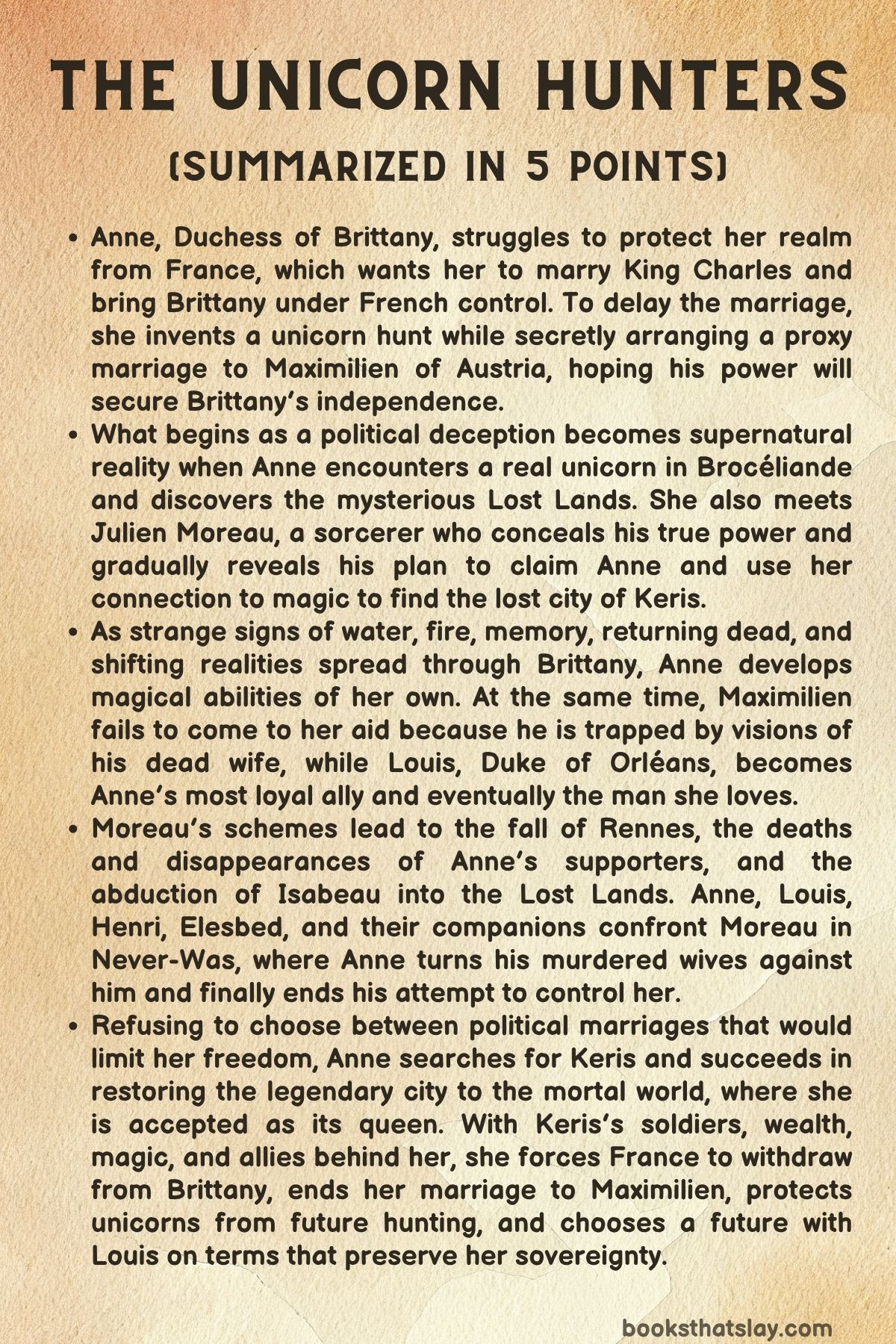
Summary
Anne, Duchess of Brittany, faces a political crisis after war has left her realm vulnerable to France. The French general Guillaume de La Trémoille arrives in Nantes determined to pressure her into marrying King Charles of France, a marriage that would effectively place Brittany under French control.
Anne hides her intelligence behind the appearance of a frivolous young ruler and invents a story about a unicorn being sighted in Brocéliande. Knowing La Trémoille’s enthusiasm for hunting, she persuades him to delay the marriage negotiations while they pursue the creature, giving her time to arrange an alternative future.
Anne has secretly been negotiating marriage with Maximilien of Austria, whose military power could protect Brittany. Since French diviners can detect political schemes, Anne plans to marry Maximilien by proxy inside Brocéliande, where divination becomes unreliable because the forest borders the mysterious Lost Lands.
Wolfgang von Polhaim, Maximilien’s representative, agrees to the plan and returns with permission to act as Maximilien’s proxy. Anne travels toward Paimpont with her court and hunting party, rescuing an orphaned girl named Elesbed along the way.
At the convent, Anne encounters a strange old abbess who seems connected to another reality. The woman questions how much Anne would sacrifice for Brittany and explains that unicorns were once considered guides capable of moving between the mortal world and the Lost Lands.
Anne completes the secret proxy marriage to Maximilien, but the ceremony is interrupted by a terrified woman in old-fashioned clothing. She tells Anne that her husband has murdered several wives and gives her a small mirror before disappearing along with the apparitions of other dead women.
After the ceremony, Anne proceeds with the supposedly false unicorn hunt. The deception suddenly becomes reality when an actual unicorn appears in Brocéliande, seemingly escaping from a hunt taking place in another world.
Anne follows the animal and eventually receives strands of its mane. She also encounters Julien Moreau, a bewildered man who claims to have entered the forest roughly two centuries earlier without aging normally.
The unicorn transforms Anne’s political position because she can publicly present herself as a woman favored by a legendary creature. Meanwhile, Moreau claims that he was once a gifted diviner who entered the Lost Lands while searching for forgotten forms of magic.
Moreau suddenly delivers a disturbing prophecy. A powerful king of the Lost Lands intends to claim Anne as his bride, and three signs will announce his arrival: water, fire, and memory.
Anne returns to Nantes while Marguerite of France arrives determined to secure Brittany for Charles. Marguerite brings Louis, Duke of Orléans, a former ally of the Bretons who has been imprisoned and offered freedom in exchange for helping persuade Anne to accept the French marriage.
Anne and Louis share a complicated history, and their reunion is strained by his agreement with Marguerite. Even so, Louis quickly recognizes that Anne’s extravagant public celebrations and cheerful behavior are strategic performances designed to strengthen her popularity and delay French intervention.
During a public celebration, an impossible flood suddenly overwhelms part of Nantes. The event fulfills the first part of Moreau’s prophecy: water.
The supernatural disturbances continue. Isabeau, Anne’s younger sister, becomes convinced that she might protect Anne by offering herself as the supernatural king’s bride, while Elesbed becomes increasingly suspicious of Moreau.
Isabeau secretly gives Moreau the mysterious mirror Anne received from the dead woman. Moreau claims that it can help restore forgotten magical abilities, but his real intentions are far more dangerous.
At the same time, Maximilien fails to travel to Brittany because he begins seeing what appears to be Mary of Burgundy, his dead wife. Unable to resist the possibility of seeing Mary again, he remains in Ghent while Anne’s political position becomes increasingly desperate.
The second promised sign appears when supernatural fire and the apparition of a burning woman invade the castle. Soon afterward, Anne encounters the third sign when a scene from her childhood becomes physically present, tempting her with the possibility of seeing her dead father again.
Elesbed discovers that Moreau is responsible for much of what is happening. He reveals that he has enormous magical abilities and considers himself king of the korriganed before abandoning her inside the Lost Lands so that she cannot expose him.
Anne’s danger increases when a sea-drake is summoned into Nantes. She confronts the creature, and its silver blood splashes onto her, awakening a new perception that allows her to see different realities occupying the same space.
Using this ability, Anne pulls Elesbed back from the Lost Lands. Elesbed exposes Moreau’s deception, but Anne immediately faces another crisis when her guardian Jean de Rieux decides to surrender her to France, believing this is the only way to protect her from the supernatural threat.
Louis chooses to help Anne escape despite knowing about her secret marriage to Maximilien. Anne, Isabeau, Henri, Elesbed, Louis, and their companions flee Nantes while Moreau attacks them through shifting realities.
Anne uses the power awakened by the sea-drake’s blood to push the supernatural dangers away, but the effort nearly kills her. The mysterious old woman from Paimpont returns and explains that dragon blood can strengthen magical ability while causing terrible damage.
The unicorn appears again and heals Anne. Her connection with the creature now becomes much more than a political symbol, suggesting that Anne has a genuine place within the supernatural forces gathering around Brittany.
Anne travels to Rennes and convinces the Breton estates to continue resisting France. Louis, meanwhile, journeys to Ghent in an attempt to persuade Maximilien to come to Anne’s aid.
He discovers that Maximilien remains trapped by the apparition of Mary. Louis returns to Anne with the devastating news that the husband she risked everything to marry may never provide the protection she expected.
Anne and Louis grow increasingly close as her Austrian strategy collapses. Their relationship gives Anne a different understanding of intimacy because Louis treats her body and choices as belonging to her rather than as political property.
When Moreau abducts Isabeau, Anne enters the Lost Lands deliberately and confronts him. She discovers that the murdered women she has repeatedly seen are Moreau’s former wives.
Anne and Isabeau escape, after which Anne travels magically to Ghent by using grief and memory as a pathway. She finds Maximilien trapped by the memory of Mary’s death and forces him to return his attention to his living responsibilities.
Maximilien finally prepares to sail for Brittany, but France has already surrounded Rennes. Moreau joins Marguerite and designs a tournament outside the city as a distraction, planning to use supernatural forces to bring down Rennes from within.
The tournament quickly becomes catastrophic. Moreau summons unnatural darkness, fire, and supernatural combatants, while a forgotten tunnel reappears beneath Rennes and allows French soldiers into the city.
Polhaim is killed, Henri is cast into the Lost Lands, and Marguerite finally turns against Moreau by stabbing him. Anne is nevertheless captured, and Rennes falls to France.
Marguerite attempts to force Anne toward marriage with Charles, even threatening her with a humiliating examination to prove her virginity. Anne uses Charles’s fascination with the unicorn to protect herself publicly and prevents Marguerite from completely controlling the situation.
Moreau suddenly returns and abducts Isabeau again, while Elesbed follows her into the Lost Lands. Louis attacks the French guards to free Anne, and the two pursue Moreau into the supernatural world.
Inside the castle called Never-Was, Anne and Louis face illusions of everything they secretly desire. They are offered visions of political victory, family happiness, marriage, children, and a peaceful shared life, but Anne learns to identify and reject these false realities.
Elesbed finds Henri and helps free him from his own fantasy. Eventually everyone reaches Moreau, who intends to force Anne to submit by threatening Isabeau.
Anne draws Moreau into the supernatural chapel associated with his murdered wives. The dead women become physically present, attack their murderer, and finally claim him, ending his control over Anne and her family.
After Moreau’s defeat, Anne learns that he was never the rightful king of the korriganed. He had spent centuries searching for the legendary lost city of Keris because a prophecy told him that a woman he sought as a bride would eventually discover it.
Anne realizes that Keris may provide an entirely new solution to her political crisis. Rather than choosing between Charles and Maximilien, she decides to search for the lost city and create an independent source of power capable of protecting Brittany.
Louis accompanies Anne into the Lost Lands. During their journey, they finally act on their love freely, and Anne makes a personal choice about her own body without treating it as a sacrifice demanded by politics.
Anne eventually meets Gralon Meur, the legendary king of Keris. With the help of the unicorn, she reaches the city, which has remained trapped for centuries in the same supernatural night under the rule of Queen Ahèz.
Anne convinces the people of Keris that they must act together if they want freedom. She confronts Ahèz, overcomes the queen’s magical defenses, defeats a sea-drake attack, and uses her own growing sorcery, the unicorn’s aid, and the will of Keris’s people to return the city to the mortal world.
Keris accepts Anne as its new queen. She now possesses soldiers, wealth, magical knowledge, and alliances with the korriganed, giving her the independent strength that she once believed only marriage to a powerful man could provide.
Louis joins her and proposes a future marriage that will preserve rather than absorb Anne’s sovereignty. Anne accepts on the condition that their marriage contract protects her political authority and that Keris becomes the center of their shared future.
Anne then returns to confront France from a position of power. Maximilien agrees to renounce their marriage in exchange for favorable terms, while Anne forces Charles and Marguerite to negotiate the withdrawal of French power from Brittany.
She also permanently forbids the hunting of unicorns. By the end, Anne has transformed the political question that dominated her life: instead of deciding which powerful man must possess her in order to save Brittany, she creates a position from which she can defend her people, choose her own alliances, and determine her own future.
Characters
Anne, Duchess of Brittany
Anne is the central figure of The Unicorn Hunters, and her development is shaped by the conflict between sovereignty and personal freedom. From the beginning, she understands that France sees her marriage as a political mechanism through which Brittany can be absorbed, so she deliberately performs weakness and frivolity while privately conducting far more sophisticated political plans.
Her strongest quality is adaptability. When one strategy collapses, Anne immediately searches for another, moving from the Austrian marriage to public symbolism surrounding the unicorn, military resistance in Rennes, direct confrontation with supernatural forces, and eventually the recovery of Keris.
Anne is also defined by an intense sense of responsibility toward Brittany. She has been taught to regard her body, marriage, children, and happiness as resources belonging to the state, which explains why she initially accepts the idea of marrying Maximilien despite understanding the personal cost.
The supernatural conflict gradually forces her to question that belief. Her growing feelings for Louis, her rejection of Moreau, and her decision to search for Keris represent stages in her recognition that protecting Brittany does not have to require the destruction of her personal autonomy.
Her magical development mirrors her political development. At first she uses legends as convenient tools, but she eventually becomes someone capable of entering the Lost Lands, resisting enchantments, confronting supernatural creatures, and restoring an entire city to ordinary reality.
By becoming Queen of Keris as well as Duchess of Brittany, Anne finally gains authority that comes directly through her own actions rather than through a husband. Her victory is therefore both political and personal, because she creates a form of sovereignty in which duty and individual choice are no longer automatically opposed.
Louis, Duke of Orléans
Louis occupies an unusual position because he begins the story caught between France and Brittany. Marguerite secures his cooperation by promising freedom, placing him in the uncomfortable position of helping the French crown pressure a woman and a country toward which he already feels loyalty.
His return to Anne quickly exposes the weakness of Marguerite’s assumption that he can manipulate her. Louis recognizes Anne’s intelligence almost immediately and understands the political purpose behind performances that other French characters dismiss as frivolous.
His relationship with Anne develops around recognition rather than possession. While Charles, Maximilien, and Moreau each become connected to some version of political or supernatural ownership, Louis increasingly respects Anne’s authority over her country and herself.
That distinction becomes particularly significant in their romantic relationship. Anne has learned to associate marriage and physical intimacy with obligation, but Louis gives her an experience in which desire can exist without immediate surrender of political power.
Louis is not simply a romantic figure, however. He repeatedly makes dangerous choices on Anne’s behalf, helping her escape Nantes, traveling to Ghent, returning to Rennes, fighting during its fall, entering the Lost Lands, and accepting that Anne’s new position as Queen of Keris cannot be subordinated to his ambitions.
His willingness to imagine a marriage governed by contract and preserved sovereignty marks the final stage of his development. He does not rescue Anne from politics but instead learns how to exist beside a woman whose authority must remain her own.
Isabeau
Isabeau initially appears as Anne’s younger and more protected sister, but her development reveals how deeply the political expectations surrounding royal women affect even children. She quickly understands that Anne may be forced to leave Brittany and begins searching for a way to prevent that separation.
Her most dangerous idea is offering herself as a bride to the supposed korrigan king. The decision shows both courage and innocence, because she believes that sacrificing herself might protect Anne and Brittany without fully understanding the nature of the power she is approaching.
Isabeau’s willingness to give Moreau the mysterious mirror also reveals her vulnerability to manipulation. She wants to participate in the defense of her country, but her limited experience prevents her from recognizing how easily Moreau turns that desire into an opportunity for himself.
Her actions parallel Anne’s earlier willingness to sacrifice herself through marriage. Both sisters have absorbed the belief that royal women prove their value through personal surrender, making Isabeau an important reflection of the ideas Anne must eventually reject.
By the later stages of the story, Isabeau becomes far less passive. She survives abduction, wounds Moreau, escapes supernatural danger, and supports Anne’s decision to seek Keris rather than return to the political choices imposed by France and Austria.
Elesbed
Elesbed enters the story as an orphan whose home has been destroyed by war, immediately placing her outside the protected world of aristocratic politics. Her survival skills, knowledge of Breton folklore, and practical intelligence make her increasingly important to Anne’s household.
Unlike many educated adults, Elesbed takes supernatural warnings seriously because stories about Brocéliande, lost objects, dangerous kings, and the returning dead already belong to her understanding of the world. This allows her to recognize patterns that others initially dismiss or misunderstand.
Her courage is especially clear when she decides that protecting Anne is more important than keeping her promise to Isabeau. Moreau intercepts her before she can reveal the truth, yet even after being abandoned in the Lost Lands she continues searching for escape rather than surrendering.
Elesbed also becomes an important protector of Isabeau. During the fall of Rennes, her experience of hardship allows her to make decisions that a sheltered noble child would not know how to make, including hiding, abandoning conspicuous clothing, and judging which powerful adults might still be trustworthy.
Her bond with Butter provides another dimension to her role. The cat can move through supernatural boundaries in ways humans cannot, and Elesbed’s simple desire to recover Butter in Never-Was contrasts with the grand ambitions and fantasies that trap many other characters.
Julien Moreau
Julien Moreau is the principal antagonist of The Unicorn Hunters, though he initially presents himself as a confused survivor of the Lost Lands. His apparent vulnerability allows him to enter Anne’s political world while concealing centuries of accumulated magical knowledge and increasingly destructive ambition.
Moreau’s central obsession is power. He has rediscovered forms of enchantment and sorcery forgotten by the mortal world, and he believes his abilities place him above ordinary political and moral limitations.
His treatment of women exposes the darkest part of his character. He marries and murders several women while searching for the person capable of leading him to Keris, and he eventually views Anne not as an independent human being but as the final instrument required to complete his ambition.
Moreau therefore represents an extreme version of the possessiveness Anne encounters throughout the story. France wants her because she carries Brittany’s sovereignty, Maximilien becomes useful because marriage transfers military power, and Moreau wants her because her relationship with the unicorn may lead him to Keris.
His centuries in the Lost Lands have also damaged his relationship with reality. By the later stages of the book, his desire for control becomes increasingly unstable, particularly in his interactions with Marguerite and his furious attempts to force Anne into submission.
His defeat is especially appropriate because it comes through the women he believed he had permanently silenced. Anne does not simply overpower him herself; she creates the conditions in which his murdered wives can confront him, turning the consequences of his violence back upon him.
Marguerite of France
Marguerite is one of the story’s most capable political minds and serves as Anne’s principal human political opponent for much of the book. Her primary objective is straightforward: Brittany must become securely tied to France, and Anne’s marriage to Charles appears to be the most effective means of accomplishing that goal.
She differs from characters such as La Trémoille because she rarely becomes distracted by spectacle. While others obsess over hunting the unicorn, Marguerite repeatedly recognizes that possession of Brittany matters more than supernatural prestige.
Her conflict with Anne is particularly interesting because both women understand the limitations imposed on powerful women in their society. Marguerite has experienced the loss of political authority after serving as regent, while Anne faces the possibility that marriage will remove much of her independence.
Instead of producing solidarity, however, this shared understanding initially makes them opponents. Marguerite attempts to control Anne through political pressure, humiliation, imprisonment, and finally an alliance with Moreau.
Her relationship with Moreau exposes the danger of pursuing power through someone who cannot be controlled. Marguerite believes his magic can restore her influence and secure Brittany, but she gradually realizes that his ambitions are far more dangerous than the political problem she hoped he would solve.
Her decision to stab Moreau during the fall of Rennes marks an important turning point. It does not erase her actions against Anne, but it shows that Marguerite can recognize when political calculation has created a threat greater than the one it was meant to solve.
Maximilien of Austria
Maximilien first represents Anne’s most practical route toward preserving Breton independence. His status and military resources could counter France, which is why Anne accepts a secret proxy marriage despite knowing that it will eventually require enormous personal sacrifice.
The weakness in this solution becomes clear when Maximilien fails to come to Brittany. His continuing grief for Mary of Burgundy leaves him vulnerable to supernatural manipulation, and Moreau’s forces exploit that emotional wound by allowing him to see what appears to be his dead wife.
His paralysis creates an important contrast with Anne. While she confronts war, political pressure, supernatural attacks, betrayal, and physical danger directly, the powerful husband meant to protect her remains far away because he cannot release the past.
Maximilien is not presented simply as cowardly or malicious. His grief is genuine, which makes the enchantment effective, but his inability to overcome it demonstrates why Anne’s future cannot safely depend upon the strength or decisions of a distant husband.
His eventual renunciation of the marriage allows Anne to close the political arrangement without destroying either side. By then, however, she no longer needs the protection that originally made the marriage desirable.
Henri
Henri serves as Anne’s half-brother, trusted ally, and one of the people most consistently willing to participate in her dangerous plans. He helps arrange the secret communications surrounding the Austrian marriage and remains beside Anne as the political situation deteriorates.
His loyalty becomes especially important because betrayal occurs elsewhere in Anne’s household. While De Rieux decides that surrendering Anne is necessary for her safety, Henri continues acting according to Anne’s own decisions and respects her authority as ruler.
Moreau’s decision to cast Henri into the Lost Lands temporarily removes one of Anne’s strongest personal defenders. Inside Never-Was, Henri becomes trapped in a fantasy built around heroic identity, showing that even courageous characters can be captured by idealized versions of themselves.
Elesbed helps free him from that illusion, after which he resumes his responsibility toward Anne and Isabeau. His survival allows him to become one of the messengers of Anne’s transformed political status when Keris returns.
Wolfgang von Polhaim
Polhaim begins as Maximilien’s messenger but quickly becomes personally invested in Anne’s survival and political plan. His first encounter with Anne, before realizing her identity, gives him a brief view of her as a lively young woman rather than simply a dynastic figure.
As Maximilien’s proxy, he participates in the secret marriage and treats Anne with unusual gentleness during a ceremony that reduces both marriage and physical symbolism to matters of legal necessity. His behavior does not remove the political nature of the event, but it prevents him from becoming another figure who exploits Anne’s vulnerability.
Polhaim remains loyal even after the marriage has placed him at considerable risk. He carries documents, communicates with Maximilien, returns to Rennes, and accepts the danger involved in confronting Moreau.
His death during the fall of Rennes gives serious human cost to Anne’s struggle. Political schemes, magical battles, and dynastic calculations repeatedly involve people who choose loyalty and then pay for it with their lives.
Jean de Rieux
De Rieux is a complicated figure because his betrayal of Anne comes from a belief that surrender will protect her rather than from obvious hostility. As the guardian appointed by her father, he feels responsible for preserving both Anne and Isabeau in circumstances that increasingly appear impossible to control.
Earlier, he warns Anne about the consequences of her plans and reminds her that the political danger extends to Isabeau. His caution therefore has a consistent foundation, even when Anne rejects his conclusions.
When supernatural events escalate, De Rieux decides that French control is safer than continued resistance. From Anne’s perspective, this is an unforgivable betrayal because he removes her ability to decide what risks she is willing to accept for herself and Brittany.
The conflict between them reflects one of the story’s recurring questions about protection. De Rieux believes protecting Anne justifies overriding her judgment, while Anne increasingly insists that safety without agency can become another form of imprisonment.
Calyx
Calyx serves Anne as a court diviner and provides an early explanation of why Brocéliande offers a unique opportunity for secrecy. His knowledge allows Anne to understand that the French system of supernatural surveillance has limits and therefore contributes directly to her plan for the proxy marriage.
As the supernatural situation worsens, his abilities become increasingly dangerous to use. The Lost Lands resist ordinary divination, and attempts to force knowledge through those barriers can physically harm the diviner.
Calyx nevertheless continues serving Anne when she needs him most. During the escape from Nantes, he uses his gift despite the risk and helps identify a path to safety.
His final vision of a city in the sea becomes one of the clues that eventually lead Anne toward Keris. His death therefore marks both personal sacrifice and the transfer from the limited magical knowledge of the ordinary world toward the much larger system of magic Anne is beginning to discover.
King Charles of France
Charles is unusual because he is politically dangerous without possessing the cold strategic focus of Marguerite. As king, his marriage to Anne could determine Brittany’s political future, yet he frequently becomes more interested in chivalric spectacle and the possibility of hunting a unicorn.
His obsession repeatedly delays Marguerite’s plans. What appears childish can therefore accidentally benefit Anne, who becomes skilled at manipulating his fascination with purity, hunting, and legendary creatures.
Charles is not portrayed as personally cruel in the same way as Moreau. He can behave generously, as when he protects Anne’s dignity during the threatened examination, but his good nature does not eliminate the structural danger created by his claim over her.
He embodies the difference between individual personality and political power. Even a relatively pleasant king can become a threat when marriage to him would determine another ruler’s country, body, heirs, and independence.
Guillaume de La Trémoille
La Trémoille represents the aggressive military side of French ambition. He arrives intending to pressure Anne into marriage and initially underestimates her because she deliberately encourages him to believe she is young, shallow, and politically harmless.
His fascination with unicorn hunting becomes one of Anne’s earliest advantages. She correctly judges that his desire for extraordinary prey can distract him from the political purpose of his visit.
Over time, this fascination becomes increasingly obsessive. Even when Marguerite understands that securing Brittany should be the priority, La Trémoille continues treating the unicorn as a prize to be hunted and possessed.
His attitude toward the creature resembles the wider attitude toward Anne. Both are valuable partly because powerful men want to claim something rare, and Anne’s final prohibition against unicorn hunting therefore carries a meaning beyond wildlife protection.
Hawiz
Hawiz occupies a quieter role but represents continuity, care, and trusted experience within Anne’s household. As Anne’s former nurse, she belongs to the small circle of people who interact with Anne as a person as well as a sovereign.
When Anne receives the mysterious mirror, Hawiz responds practically by hiding it and advising caution. Her reaction contrasts with Isabeau’s later decision to give the object to Moreau in the hope of gaining access to greater magical power.
Hawiz helps establish the domestic world that Anne is repeatedly in danger of losing. Characters such as her remind the reader that Anne’s political struggle concerns not only territory and titles but also the network of familiar people whose lives depend upon what happens to Brittany.
The Korrigan Queen
The mysterious older korrigan woman first appears to Anne disguised as an abbess. From their earliest encounter, she tests Anne’s willingness to sacrifice for Brittany and provides information about unicorns and the Lost Lands without fully explaining her own identity.
She later becomes an important guide after Anne nearly dies from using the power awakened by sea-drake blood. Rather than solving Anne’s problems directly, she repeatedly provides knowledge while leaving Anne responsible for choosing what to do with it.
Her explanation of the Lost Lands as a place shaped by the traveler’s own inner nature becomes essential to understanding the supernatural world. The Lost Lands do not merely contain physical dangers; they expose desire, grief, memory, fear, and ambition.
Her eventual revelation that Moreau is not the true korrigan king also dismantles his carefully constructed identity. Through her, Anne gains access to the history that Moreau distorted and to the possibility of finding Keris for purposes entirely different from his own.
The Unicorn
The unicorn begins as a political fiction invented by Anne to delay the French marriage negotiations. Its actual appearance immediately changes the meaning of Anne’s scheme because something she treated as a convenient legend becomes a living presence with its own choices.
The creature repeatedly refuses the role humans try to assign it. La Trémoille wants a trophy, Charles wants a glorious hunt, and political observers turn its favor toward Anne into public symbolism, yet the unicorn ultimately acts according to purposes none of them fully control.
Its relationship with Anne develops because she chooses to protect rather than hunt it. The gift of its mane, its later healing of Anne, and its willingness to carry her toward Keris suggest a bond built on recognition rather than ownership.
The unicorn also becomes closely connected with Anne’s changing understanding of sovereignty. By the conclusion, she permanently forbids its hunting, extending to the creature the same principle she has fought to establish for herself: rarity, beauty, power, or political usefulness do not give others the right to possess a living being.
Themes
Sovereignty, Marriage, and the Ownership of Women
Marriage functions throughout The Unicorn Hunters as an institution in which political authority and control over a woman’s body become almost impossible to separate. Anne is valuable to France not simply because Charles might love or desire her but because marrying her provides a path toward controlling Brittany.
Her proposed marriage to Maximilien initially appears different because Anne actively chooses it as a defensive strategy. Yet even this arrangement requires her to leave her country, produce heirs, accept physical obligations, and depend upon a distant husband for military strength.
The same pattern appears in supernatural form through Moreau. His desire to marry Anne is attached to her ability to locate Keris, meaning that he too sees marriage as a method for possessing the political and magical power associated with a woman.
Anne’s relationship with Louis eventually offers a contrasting possibility. Their intimacy becomes meaningful because it emerges from mutual desire, while Louis’s later marriage proposal accepts conditions intended to preserve Anne’s sovereignty rather than absorb it.
The restoration of Keris finally breaks the structure that had trapped Anne. Once she possesses independent wealth, soldiers, sorcery, and political authority, marriage stops being the price she must pay for national survival and becomes something she can negotiate from a position of genuine choice.
Power, Control, and the Limits of Possession
Different characters repeatedly confuse power with the ability to possess people, countries, creatures, or knowledge. France wants Brittany, La Trémoille and Charles want the unicorn, Moreau wants Anne and Keris, while political marriages are repeatedly designed to transfer claims over territory through control of women.
Moreau represents the most destructive expression of this desire. His magical strength allows him to cross boundaries, manipulate memory, alter reality, abduct people, and silence opposition, yet each new ability increases his conviction that other people should exist according to his wishes.
His murdered wives expose the ultimate violence behind that philosophy. Because they fail to provide what he wants, he treats their lives as disposable and continues searching for another woman who can fulfill the role he has created.
Anne gradually develops enormous power herself, but her relationship with it moves in the opposite direction. After nearly dying from sorcery, she learns that capability does not automatically justify use and that a ruler must consider what exercising power will cost both herself and others.
Her final treatment of Keris reinforces this distinction. She prevents immediate mob vengeance, establishes lawful judgment, negotiates alliances, and forbids unicorn hunting, suggesting that legitimate authority depends on restraint as much as strength.
Grief, Memory, and the Temptation of the Past
Memory becomes dangerous when characters desire the past strongly enough to abandon the present. The Lost Lands repeatedly exploit grief by making what has been lost appear reachable again, turning private sorrow into a pathway through which characters can be manipulated.
Maximilien provides the clearest example. His continuing love for Mary of Burgundy makes him vulnerable to an apparition that appears to return his dead wife to him, and the possibility of recovering that relationship becomes stronger than his obligations to the living.
Anne experiences a similar temptation when the supernatural manifestation of memory recreates a time when her father was alive. She knows the scene cannot truly restore what she has lost, yet the desire to step back into childhood almost overcomes her judgment.
Never-Was develops the same idea through imagined futures rather than recovered pasts. Anne and Louis encounter lives they could have wanted, including political peace, marriage, children, and happiness, but they survive only by recognizing that a perfect illusion is still a form of imprisonment.
The story therefore does not present grief as something that must simply disappear. Anne ultimately uses shared bereavement to reach Maximilien, suggesting that memory can create understanding when it is acknowledged honestly, but it becomes destructive when people allow longing to replace reality.
Freedom, Choice, and Self-Determination
Anne’s conflict begins with a severe limitation of available choices. France offers marriage to Charles, political circumstances push her toward Maximilien, and Moreau eventually offers supernatural power in exchange for submission, making each apparent solution another arrangement in which someone else expects authority over her future.
Her early resistance therefore depends on manipulating the narrow options available to her. She delays, deceives, negotiates, performs innocence, arranges a secret marriage, and uses the unicorn’s public symbolism because straightforward refusal is not politically strong enough.
The discovery of magic gradually expands the field of possibility. Anne’s ability to cross into the Lost Lands allows her to act outside systems controlled by armies, dynastic law, and French divination, but magical power alone does not create freedom because Moreau demonstrates how easily supernatural ability can become another mechanism of domination.
Finding Keris becomes the decisive act because Anne stops choosing among futures designed by other people. Instead, she creates a political alternative that previously did not exist and accepts the immense danger of pursuing it because the decision belongs to her.
Her restoration of the city changes every later negotiation. She can release Maximilien from the marriage, confront France, establish alliances, protect Brittany, forbid unicorn hunting, and consider marriage to Louis without surrendering her crown, turning freedom from an abstract desire into the political power to make meaningful choices.