All We Have Is Time Summary, Characters and Themes
All We Have Is Time by Amy Tordoff is a historical fantasy romance built around two people who experience time in radically different ways.
Beatrix, born in fifteenth-century England, becomes immortal after a desperate wish to survive, while Oliver lives in the twenty-third century and uses commercial time travel after learning the exact date of his approaching death. Their paths cross repeatedly across centuries, turning an accidental encounter into a relationship shaped by waiting, mortality, memory, sacrifice, and choice. At its heart, the novel asks whether a life should be measured by its length or by the people, experiences, and moments that give it meaning.
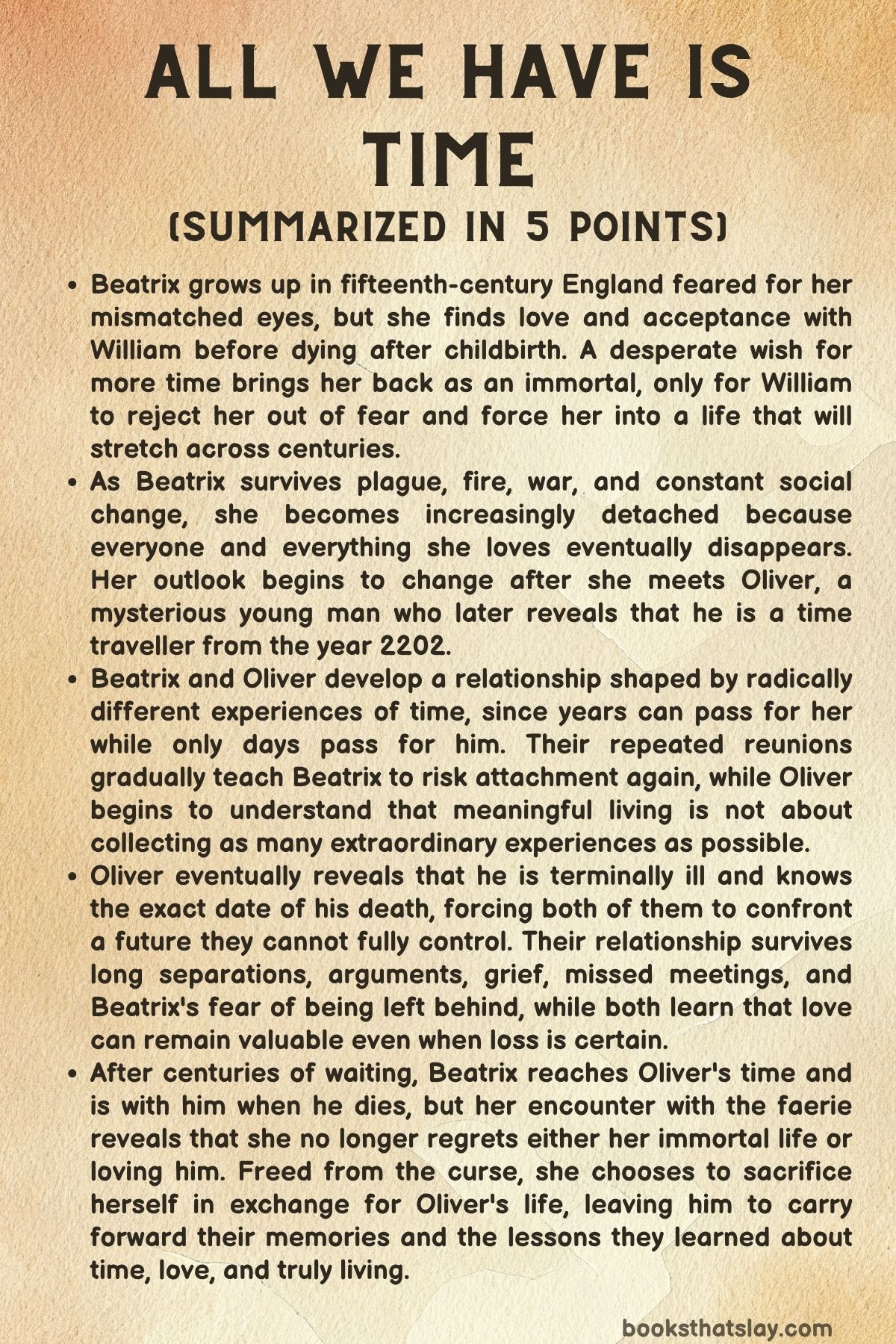
Summary
Beatrix grows up in Lancaut, England, treated with suspicion because her eyes are different colours. Villagers regard her as unnatural, and even her family fears that there may be something strange about her, leaving her with a lasting sense that acceptance can disappear whenever fear takes control.
The forest near the River Wye becomes her refuge. There she develops a friendship with William Woodward, who notices her curiosity, independence, love of nature, and restless desire to escape the judgment of others without treating those qualities as defects. Their connection deepens after William finds her badly injured in the woods and carries her home.
When Beatrix’s family prepares to send her to Tintern Abbey, William urges her not to surrender her future quietly. Their affection becomes love, and they eventually marry, with William giving her a ring engraved with the promise that love conquers all.
Their happiness ends when Beatrix dies following childbirth at the age of twenty-three. In the strange state between life and death, she encounters a faerie who reveals that Beatrix’s parents once brought her into the forest as an infant because they feared she was a changeling.
The faerie had saved the abandoned child. Now she offers Beatrix supernatural existence in exchange for her soul, but Beatrix refuses because she does not want some perfect otherworldly life; she wants William, her newborn daughter, and more of the ordinary human existence that has just been taken from her.
Her desperate wish for more time is granted in a terrible form. Beatrix returns to life unable to age or remain dead, while the faerie warns that she will eventually regret the choice and continue living after that regret begins.
William witnesses Beatrix’s resurrection with horror rather than relief. Convinced that the woman who returned from death might no longer truly be his wife and might threaten their child, he orders her to leave Lancaut.
Beatrix escapes to London with nothing except her clothes, memories, and wedding ring. The promise that love conquers all now seems like a cruel joke, yet St Paul’s Cathedral gives her temporary shelter and an unexpected reminder that beauty still exists.
Decades become centuries. Beatrix remains physically twenty-three while everyone she knows grows old and dies, and she learns to survive through false identities, theft, temporary work, travel, casual relationships, alcohol, and emotional distance.
She survives plague, fire, violence, war, and enormous social change. Even places she once considered permanent disappear, including the medieval St Paul’s Cathedral, forcing her to understand that immortality does not preserve the world around her.
In 1605, Beatrix meets Oliver when she attempts to steal from him at the Globe Theatre. Instead of turning her in, he buys her food and spends the day exploring London with her.
Oliver appears optimistic, curious, and eager to experience everything possible. Their conversations about travel, hope, and the future challenge Beatrix’s belief that expecting anything from life only creates another opportunity for disappointment.
More than a century later, they unexpectedly meet again during Carnevale in Venice. Beatrix is stunned to discover that Oliver has not aged, and the truth finally emerges: he is not immortal but a time traveller from the year 2202.
Beatrix reveals her own secret in return. Oliver becomes the first person in centuries to learn what she is without immediately treating her as dangerous, unnatural, or monstrous, creating a bond neither of them expected.
Their relationship is complicated by the unequal way they experience time. Oliver can leave one historical period and return to another after only a short interval in his own life, while Beatrix must physically live through every year separating their meetings.
Six years for Beatrix may be little more than days for Oliver. Eventually, their meetings become separated by decades or nearly a century, forcing Beatrix to decide repeatedly whether a few hours with someone she cares about are worth years of waiting afterward.
During those years, Beatrix continues forming relationships despite her fear of loss. She helps Lady Jane DeSallowe reunite with Prudence Kendall, becomes involved in the lives of children and families, assists people during periods of war and crisis, and slowly begins questioning her belief that detachment is the safest form of survival.
Oliver also carries hidden pain. In his own century, he uses time travel partly because he feels ordinary life is disappearing before he has experienced enough of it, documenting places and activities in a journal as though existence can be completed through a carefully planned list.
Eventually, Beatrix learns the truth behind his urgency. After collapsing shortly after university, Oliver was diagnosed with a terminal illness, and his brother Theo revealed that Aevum’s research had already discovered Oliver’s exact death date: 19 September 2202.
Oliver feels betrayed because Theo knew the future and concealed it. He believes that, given the choice, he would have spent his life differently, making the remaining months feel both precious and intolerably limited.
When Beatrix discovers that Oliver has only months left, she initially ends their relationship. Having survived centuries of bereavement, she cannot bear knowingly walking toward another loss.
Her attempt at self-protection soon reveals its weakness. Avoiding Oliver cannot remove regret; it simply creates a new form of it, because Beatrix realizes she can lose him through her own fear long before death takes him.
They reunite, though their relationship remains difficult. During the First World War, Oliver witnesses Beatrix’s body repairing itself after a factory explosion, making the physical horror of her immortality impossible for him to romanticize.
They argue because Oliver wants to protect her from future dangers while Beatrix refuses to let his knowledge of history control her choices. Their conflict exposes a painful contradiction: Beatrix sometimes longs for the mortality Oliver desperately wants to escape, while Oliver envies the endless life that she experiences as a burden.
A mistake in Oliver’s travel schedule causes four years to pass for Beatrix when he believes only twelve hours have gone by. His shock at discovering that she has spent those years waiting forces him to understand more fully what their relationship costs her.
He later helps her locate Anna Noble, one of Beatrix’s descendants. Beatrix befriends Anna without revealing their family connection and experiences several years of ordinary companionship, only to lose Anna suddenly.
The loss nearly sends Beatrix back into self-destruction. Oliver helps her understand that grief does not prove loving Anna was a mistake; the pain exists precisely because the relationship mattered.
Their relationship becomes increasingly intimate. Oliver teaches Beatrix to read, shares books with her across different eras, travels with her through Europe, gives her the first real birthday celebration of her life, and spends increasingly large portions of his shrinking future simply being with her.
During a trip to Paris, Beatrix finally tells Oliver about the attack that left the only permanent scar on her body. Years before becoming immortal, villagers who considered her unnatural attempted to murder her in the forest, and the mysterious wolf connected to the faerie saved her.
The confession forces Beatrix to confront not only the violence but the silence that followed it. For centuries she had helped preserve a false story because the truth was too painful for everyone around her to face.
In Paris, Beatrix and Oliver stop trying to treat every hour as something that must be efficiently used. They wander, eat, talk, dance, take photographs, make love, and allow an ordinary shared day to matter as much as any famous historical event.
Oliver gradually recognizes that his original approach to time was mistaken. More life does not necessarily mean accumulating more extraordinary experiences; reading, eating cake, cooking dinner, watching a sunset, or spending an afternoon with someone beloved can carry equal value.
Their future nevertheless becomes increasingly uncertain as Oliver’s condition worsens. Aevum repeatedly warns that his body may no longer tolerate travel, and every meeting carries the possibility that it will be their last.
In 1969, they attend the Apollo 11 launch together. Oliver suddenly disappears when Aevum forcibly recalls him because his health has become unstable, leaving Beatrix without the goodbye they had promised each other.
She follows his journal to Woodstock, hoping he will appear at his next planned destination, but he never arrives. Unknown to Beatrix, Oliver desperately attempts to return, only to discover that a photograph already exists showing her alone at the festival.
The past cannot be changed. Oliver is forced to accept that even time travel cannot restore every missed moment, while Beatrix must confront the possibility that waiting for him may finally be pointless.
Rather than return permanently to isolation, Beatrix makes a new decision. She begins writing her own experiences in Oliver’s journal and travels through the destinations he once planned, gradually transforming his unfinished list into a record of her own life.
More than a century later, she opens a sealed letter Oliver left for her. Instead of a farewell, it contains an address and future dates, asking her to meet him in 2202.
Beatrix reaches Oliver’s century after 233 years apart. She finds him dying but alive, finally tells him directly that she loves him, and meets Theo, Luke, and Zoë, bringing together the separate parts of Oliver’s life.
She also reveals that she once sought out the fatal car crash that killed Oliver’s parents and stayed with his father during his final moments. Her long history has crossed Oliver’s life in ways neither of them fully understood.
On Oliver’s final day, the two exchange stories and memories rather than trying to escape what is coming. Beatrix explains that after following his itinerary for years, she eventually learned to build a life that belonged to her rather than merely waiting for his return.
Oliver dies on 19 September 2202 surrounded by the people who love him. In desperation, Beatrix calls to the faerie and discovers that the creature deliberately arranged their second meeting in Venice, hoping that enough love and eventual grief would finally persuade Beatrix to surrender her soul.
Instead, Beatrix realizes that she does not regret loving Oliver, becoming immortal, or living the centuries that brought her to him. That rejection of regret breaks the original curse and makes her mortal again.
Beatrix could now live a normal human life, but she makes another choice. She willingly gives her soul to the faerie in exchange for Oliver’s life, insisting that the bargain contain no hidden punishment.
One month later, Oliver is alive and his previously certain future has inexplicably changed. He eventually works for Aevum, rebuilding his relationship with Theo and designing historical excursions around ordinary human experiences rather than famous events alone.
A year after Beatrix’s sacrifice, Oliver returns to St Paul’s carrying the journal they created together. He finally understands that he does not need to possess the object forever in order to preserve what they shared.
He leaves it behind for someone else to discover. Beatrix is gone, but the experiences, stories, changes, and love she created continue through Oliver and through the people who may one day encounter the record of their extraordinary lives.
Characters
Beatrix
Beatrix is the emotional centre of All We Have Is Time, and nearly every major question in the book is explored through the contradiction of her existence. She begins as a young woman desperate for more life and becomes someone who eventually understands that unlimited existence can feel far more frightening than mortality.
Her childhood teaches her that difference can make a person vulnerable. The villagers’ obsession with her mismatched eyes reduces her to superstition, while the attempted murder in the forest confirms that ordinary people are capable of terrible violence when fear allows them to stop seeing another person as human.
Immortality intensifies those wounds rather than removing them. Because Beatrix cannot age, she repeatedly watches relationships, homes, cities, customs, and entire generations disappear while she remains physically unchanged.
She therefore develops survival strategies based on distance. Theft, alcohol, travel, temporary employment, physical relationships without emotional commitment, and deliberate forgetfulness allow her to move through centuries without continually exposing herself to attachment.
Those strategies never eliminate her compassion. Her rescue of an abandoned infant during the plague, her protection of Elsie during the Zeppelin attack, her assistance to Jane and Prudence, and her friendship with Anna repeatedly reveal that Beatrix cannot permanently suppress her instinct to care for others.
Oliver changes her not by rescuing her from immortality but by challenging the assumption that loss invalidates love. Through him, Beatrix begins accepting that a relationship does not need permanence in order to have value.
Her final development depends on rejecting regret. For centuries she believes her great mistake was asking for more time, but eventually she sees that her endless life contained people and experiences she would never willingly erase.
Her sacrifice for Oliver therefore differs fundamentally from her original bargain. The young Beatrix desperately asked to avoid death; the older Beatrix willingly accepts disappearance because she has finally learned to choose love without demanding protection from its consequences.
Oliver
Oliver functions as Beatrix’s opposite and her mirror in All We Have Is Time. Beatrix possesses more time than she can bear, while Oliver knows exactly how little time remains to him, yet both initially respond by allowing time to control almost every decision they make.
His journal reveals his fear that life can be wasted unless it contains enough experiences. Historical travel becomes an attempt to expand existence beyond the boundaries of a normal lifespan, transforming centuries into destinations he can visit and record.
The terminal diagnosis explains the emotional pressure behind that behaviour. Once Oliver learns that his obituary contains an exact death date, time stops being an abstract concept and becomes something that can apparently be counted down.
His anger toward Theo comes from the belief that information about his own future was kept from him. Oliver does not merely resent dying; he resents having lost the opportunity to make informed choices about the life that preceded death.
His relationship with Beatrix gradually changes his understanding of experience. At first he wants to witness major historical events, but later some of his most important memories involve reading lessons, meals, walks, conversations, birthdays, jokes, arguments, dancing, and quiet evenings.
Oliver is also capable of controlling behaviour when frightened. His decision to investigate Beatrix’s future and warn her away from danger temporarily turns concern into an attempt to manage her life, repeating in another form the mistake he condemns Theo for making.
He matures when he recognizes this contradiction and apologizes. By the end of the story, he has learned that loving someone does not grant authority over that person’s choices.
His survival after Beatrix’s sacrifice becomes both a gift and an obligation. Oliver must now live the uncertain future he once believed he would never possess, carrying forward what Beatrix taught him about memory, ordinary experience, and the meaning of time.
William Woodward
William represents Beatrix’s first experience of being truly seen. While others focus on her eyes and the rumours surrounding her, William notices specific details about her personality, including her love of the forest, her impatience, her curiosity, and her fear of being forgotten.
His love gives Beatrix a vision of belonging that had seemed impossible. Their marriage proves that she can be chosen openly even within a community that has spent years treating her as something shameful.
William’s greatest failure occurs when Beatrix returns from death. Faced with something that violates everything he understands about life, he becomes terrified that the woman before him may be a supernatural imitation capable of harming their child.
His decision to send Beatrix away devastates her because his love had seemed like the one certainty capable of overcoming the judgment of others. The wedding-ring promise becomes painful precisely because William had sincerely believed it.
The later discovery that he never remarried complicates Beatrix’s resentment. His life after her departure suggests that rejecting the resurrected Beatrix did not mean he stopped loving the woman he had lost.
Beatrix’s eventual return to his grave allows her to judge him with greater maturity. She recognizes that William made an impossible decision while trying to protect their newborn daughter, and she finally admits that under the same circumstances she might have made the same choice.
The Faerie
The faerie begins as an apparently sinister supernatural figure but gradually becomes one of the book’s most psychologically complicated characters. Her dealings with Beatrix are manipulative, yet her behaviour grows out of an existence shaped by abandonment, transformation, isolation, and damage.
She was once human herself. After being abandoned as an infant, she was changed by the faeries, leaving her with a wounded soul and a permanent connection to the human life taken from her.
Her repeated attempts to obtain Beatrix’s soul initially appear to be simple cruelty. Eventually it becomes clear that she believes Beatrix’s intact soul could repair what was damaged inside her.
This does not excuse her actions. She intentionally gives Beatrix immortality in a form likely to cause suffering and later arranges Beatrix’s reunion with Oliver because she expects love and bereavement to weaken her resistance.
At the same time, the faerie resembles the version of Beatrix that Beatrix herself fears becoming. Both are immortal women separated from ordinary human belonging, forced to watch families and generations continue without them.
The difference appears in how they respond to that isolation. The faerie increasingly allows pain to justify manipulation, while Beatrix ultimately decides that suffering does not erase her responsibility to choose how she treats other people.
This parallel makes the faerie more than an external villain. She represents the possible outcome of endless existence without trust, connection, or the willingness to continue participating in life.
Theo
Theo’s relationship with Oliver demonstrates how love can become controlling when fear is allowed to determine another person’s future. After their parents die, nineteen-year-old Theo becomes responsible for his younger brother while carrying his own enormous grief.
His decision to investigate Oliver’s future comes from terror. He wants certainty because uncertainty has already taken both parents from him, but the information he receives becomes an unbearable secret when he learns the date of Oliver’s predicted death.
Theo reorganizes much of his life around trying to save his brother. His medical career and protective behaviour are partly shaped by the belief that sufficient preparation, knowledge, and effort might prevent the future he has seen.
Oliver experiences these actions differently. From his perspective, Theo has withheld the truth necessary for him to make meaningful choices about his own life.
Their conflict therefore contains no simple villain. Theo violates Oliver’s autonomy, but he does so because he is still, emotionally, the frightened older brother trying to keep the last member of his immediate family alive.
Their eventual reconciliation requires Theo to admit that protection cannot replace honesty. It also requires Oliver to recognize the fear and love beneath behaviour he once understood only as control.
Anna Noble
Anna gives Beatrix something she believed she could never regain: a living connection to her human family. Although Beatrix initially intends to observe her descendant from a distance, Anna’s personality makes such detachment impossible.
Independent, politically aware, inventive, and energetic, Anna represents a changing world in which women possess possibilities that would have been unimaginable during Beatrix’s youth. Her clothing designs, cycling, political involvement, and refusal to accept narrow expectations make her especially appealing to Beatrix.
Their friendship becomes powerful because Anna does not know the biological truth connecting them. She values Beatrix simply as the woman she knows, making their bond chosen as well as inherited.
Anna also challenges Beatrix’s habit of living between memory and anticipation. By asking her to attend the wedding, she forces Beatrix to choose whether fear of future disappearance should be allowed to ruin a present relationship.
Her sudden death tests everything Beatrix has begun learning. The grief is severe enough to make Beatrix question whether loving her was a mistake, but remembering their ordinary happiness eventually proves the opposite.
Anna becomes evidence that loss does not erase the value of what preceded it. Through her, Beatrix learns one of the lessons she will later need in order to accept loving Oliver completely.
Lady Jane DeSallowe
Jane initially appears through a story shaped by superstition, because her father claims that faeries were responsible for separating her from someone she loved. Beatrix quickly recognizes the cruelty behind that explanation because supernatural stories are being used to hide ordinary human prejudice.
Jane’s affection for Prudence has been restricted by family expectations and social convention. Her situation reminds Beatrix that people can be imprisoned without chains when society denies them the freedom to name or pursue their own lives.
Beatrix grows genuinely fond of Jane even though attachment threatens the emotional distance she has tried to maintain. Helping Jane escape an unwanted marriage therefore becomes another instance in which Beatrix accepts personal risk for another person’s freedom.
Jane’s relationship with Prudence also challenges Beatrix’s increasingly cynical understanding of love. Their future is uncertain, but they choose one another anyway, suggesting that uncertainty alone is not sufficient reason to refuse happiness.
Lady Prudence Kendall
Prudence represents the persistence of love despite enforced separation. Years pass after she and Jane are torn apart, yet their relationship remains emotionally significant even after the circumstances of their lives change.
Her return creates the possibility that Jane’s story does not have to end according to the expectations of her family. The two women still face danger and social condemnation, but reunion gives them an opportunity to make their own decision.
For Beatrix, Prudence is important because she helps demonstrate that lost time does not automatically make love meaningless. Jane and Prudence cannot recover the years taken from them, but they can decide what to do with the time that remains.
That lesson closely anticipates Beatrix’s later relationship with Oliver. Their lives are also defined by long separations, and the example of Jane and Prudence quietly prepares Beatrix to believe that reunion can matter even when permanence is impossible.
Isabella
Isabella represents both Beatrix’s love for her original family and the exclusions that damaged her long before immortality. As Beatrix’s younger sister, she belongs to the ordinary domestic world Beatrix desperately wants to share.
Beatrix once tells Isabella about the forest while keeping her growing relationship with William private, suggesting genuine sisterly affection alongside the need to protect certain parts of herself. Yet Isabella’s wedding becomes another painful reminder that Beatrix’s presence is considered socially dangerous.
Being excluded from the celebration strengthens Beatrix’s belief that her family can imagine important moments more easily without her. The flower crown associated with the wedding later becomes connected to her time with William and eventually with Anna, allowing an old symbol of rejection to acquire new meanings.
Isabella therefore remains important even after her death. Memories associated with her continue influencing the way Beatrix understands sisters, weddings, flowers, family, and belonging centuries later.
Beatrix’s Parents
Beatrix’s parents embody the destructive power of fear when it enters family relationships. Their decision to carry their infant daughter into the forest after interpreting her mismatched eyes as evidence of supernatural danger becomes the first major rejection of her life.
They do not simply fear public gossip. Their actions reveal that they have internalized the same beliefs held by the village, allowing superstition to overcome parental trust.
Their later attempts to control Beatrix’s future continue the pattern. After she is attacked, they focus on marriage arrangements, increased dowry, obedience, and the possibility of sending her to Tintern rather than confronting what made their daughter unsafe.
Their behaviour helps explain why Beatrix becomes so sensitive to abandonment. The people who should have provided unconditional security repeatedly communicate that her continued presence is a problem requiring management.
At the same time, their actions reflect a society whose prejudices are larger than any single household. They are responsible for the harm they cause, but they are also examples of how communal fear can enter private relationships and reshape parental behaviour.
Elsie Taylor
Elsie is one of the children who reaches Beatrix despite her determination not to become attached. Adventurous, impulsive, and imaginative, she reminds Beatrix of younger people she has loved before and of parts of her own childhood personality.
Their first meeting occurs when Elsie is attempting to run away. Beatrix returns her home and initially intends to continue her own escape from wartime Britain, but the Taylor family’s vulnerability persuades her to stay.
The Zeppelin attack makes Beatrix’s emotional investment undeniable. When Elsie goes searching for faeries, Beatrix risks herself to find the child and protect her from the bombing.
The incident exposes the failure of Beatrix’s usual strategy. She may refuse to name love, but refusing the word does not stop the feeling from forming.
Elsie therefore helps reveal that Beatrix’s emotional life cannot be controlled simply through intention. Connection happens despite rules, and responsibility follows once another person’s wellbeing matters.
Mary Taylor
Mary represents ordinary endurance under wartime pressure. Widowed and responsible for a large family while one son is at the front, she is exhausted rather than heroic in any theatrical sense.
Her home initially appears chaotic to Beatrix, but that disorder reflects the strain of trying to hold a family together with insufficient time, money, and help. Beatrix responds by beginning to assist almost automatically.
Mary gives Beatrix entry into a household that resembles the domestic life immortality denied her. Through routine work, meals, children, worry, and shared responsibility, Beatrix experiences a temporary form of belonging.
Her importance lies partly in what she offers without knowing it. Mary does not see an immortal woman or supernatural mystery; she sees someone capable of helping her family.
Robert Taylor
Robert returns from the First World War physically injured and emotionally changed, allowing him to recognize something similarly haunted in Beatrix. Their connection grows from shared awareness that survival does not leave a person untouched.
He offers Beatrix the possibility of remaining with the Taylor family in a more permanent way. His affection is significant because it arrives at a moment when Beatrix could plausibly build another version of ordinary domestic life.
Beatrix refuses not because she feels nothing but because she feels too much. Loving Robert would mean accepting another mortal relationship whose ending she can already imagine.
His role therefore reveals how strongly Beatrix still allows anticipated grief to govern present choices. The possibility he represents is genuine, but she is not yet prepared to accept its eventual cost.
Lord Sutton
Lord Sutton allows Beatrix to recognize her own behaviour in another suffering person. His experiences have left him withdrawn, dependent on laudanum, and burdened by survivor’s guilt.
Beatrix understands the attraction of numbness because she has spent centuries seeking similar forms of escape. His pain therefore confronts her with an external version of habits she usually treats as private survival mechanisms.
Instead of joining him in avoidance, she asks him to speak. Her invitation to begin at the beginning suggests an emerging belief that pain can sometimes be endured through being witnessed rather than erased.
The scene matters because Beatrix temporarily becomes for Sutton what she herself has rarely possessed: someone willing to hear the entire story without demanding that the suffering disappear first.
Victor Winfield
Victor is one of the Winfield children Beatrix encounters while pretending to be a governess. His curiosity helps draw her into a role she originally intended to use merely as access to Professor Winfield’s research.
Through Victor and his sister, Beatrix becomes more emotionally invested in the household than planned. Their interest in stories allows her to transform her own struggle with faerie rules into fictional narratives.
Her decision to leave books belonging to their late father for the children after being dismissed demonstrates genuine affection. Victor therefore represents another relationship that begins accidentally but becomes meaningful because Beatrix cannot remain merely an observer.
Margaret Winfield
Margaret, like Victor, awakens memories of Beatrix’s sisters and of her younger self. Her presence contributes to the unexpected tenderness Beatrix develops toward the children while working in the Winfield household.
The children also reveal how much Beatrix has changed since Oliver taught her the foundations of reading. Once excluded from written knowledge, she can now use books, research, and storytelling to educate and entertain others.
Margaret’s role is therefore connected to Beatrix’s intellectual development as well as her emotional one. Through caring for the children, Beatrix begins turning abilities she acquired for survival into something she can share.
Luke
Luke belongs to Oliver’s closest circle in 2202 and represents the friendships Oliver risks neglecting while focusing on time travel and his approaching death. His loyalty becomes especially important once Oliver’s illness progresses.
When Luke and Zoë help Oliver sort his possessions, their presence teaches him that what he interprets as pity is actually love. This recognition parallels Beatrix’s own difficulty accepting that attachment can survive fear and grief.
Luke also challenges Oliver’s attempts to intellectualize his feelings for Beatrix. By insisting that love cannot simply be reasoned away, he helps Oliver acknowledge what his behaviour has already revealed.
His friendship demonstrates that Oliver’s life is not valuable only because of extraordinary historical experiences. The people sharing meals, conversations, memories, and ordinary evenings with him are equally central to what he will leave behind.
Zoë
Zoë is direct, perceptive, and emotionally intelligent in the way she responds to Oliver. She quickly recognizes that his conflict with Beatrix involves feelings he is trying to hide beneath rational arguments.
Her role becomes even more important near the end of the story. When Beatrix finally reaches 2202, Zoë becomes the person who meets her first and carries out Oliver’s instructions to bring her to him.
This makes Zoë a bridge between Oliver’s ordinary contemporary friendships and his impossible relationship across history. She does not fully understand Beatrix at first, but her loyalty to Oliver allows her to accept realities that challenge conventional explanation.
Like Luke, she also ensures that Oliver’s death is not treated solely as a private romance. His life belongs emotionally to a network of people, and Beatrix must eventually share grief with others who love him differently.
Lucy
Lucy represents the institutional side of time travel but gradually becomes personally involved in Oliver’s struggle. Her responsibility is to enforce Aevum’s rules, especially when his declining health makes continued travel dangerous.
From Oliver’s perspective, those restrictions can seem cruel because they prevent him from reaching Beatrix. From Lucy’s perspective, allowing further excursions could kill him or create serious consequences.
Her discovery of historical evidence showing Beatrix across different eras forces her to confront something Aevum’s system cannot comfortably explain. Photographs, records, and objects reveal that Beatrix does not fit the categories Lucy understands.
She ultimately refuses Oliver’s desperate request to reach Woodstock because the existing photograph already proves he was not there. In that moment, Lucy becomes the person who forces him to accept that technology cannot provide unlimited control over history.
Her later conversation with Oliver after his unexpected survival leaves room for mystery. Rather than pretending Aevum has explained everything, she acknowledges that some events exceed the ordinary rules through which their world understands time.
Themes
Time, Mortality, and the Meaning of Enough
Beatrix and Oliver begin from opposite positions, yet both are trapped by the same question: how much time would be enough? In All We Have Is Time, one character receives centuries beyond a normal lifespan while the other discovers that only months remain, making each unusually conscious of the limits and possibilities attached to existence.
Beatrix initially believes more time will solve the tragedy of dying young. Immortality proves otherwise because duration without natural endings produces centuries of bereavement, isolation, unstable identity, and the continual disappearance of familiar places.
Oliver responds to limited time through accumulation. His journal turns life into destinations and experiences that can be completed, suggesting that enough activity might compensate for the years he will never have.
Their relationship gradually breaks down both assumptions. Some of their most meaningful experiences are not historically significant at all: reading together, cooking dinner, walking through a city, eating cake, dancing, talking in hotel rooms, or simply remaining beside one another.
The novel therefore separates quantity from value. A century can disappear almost meaninglessly, while a few hours can permanently alter someone’s life.
Oliver eventually understands that the goal is not to defeat time by fitting more into it. Beatrix similarly understands that endless time is not worthless simply because it contains repeated loss.
Both arrive at a more difficult definition of enough. Time becomes meaningful when it is consciously inhabited rather than merely possessed, extended, counted, or survived.
Love, Grief, and the Risk of Attachment
Beatrix spends centuries treating emotional distance as a form of protection. Her reasoning seems logical: everyone she loves will eventually age, die, disappear, or be left behind, while she remains.
The flaw is that avoiding attachment does not remove pain. It replaces the grief of losing others with loneliness, regret, and the knowledge that potentially meaningful relationships were rejected before they could fully exist.
Anna’s death becomes crucial to this development. Beatrix initially tries to call the friendship a mistake because reducing its importance seems easier than accepting the scale of her grief.
Oliver challenges that conclusion by treating grief as evidence that love mattered. Remembering Anna’s bicycles, clothes, tea, conversations, dancing, and friendship shows Beatrix that sorrow does not erase happiness retroactively.
Her relationship with Oliver creates the most extreme version of this conflict because his death is not merely inevitable but precisely dated. Beatrix knows almost from the beginning that she is moving toward another devastating loss.
She repeatedly tries to control that future by ending the relationship, refusing goodbyes, resisting intimacy, or avoiding direct declarations of love. Each act of self-protection produces exactly the regret she hoped to prevent.
The story ultimately presents love as valuable without promising that it will protect anyone from grief. Beatrix’s growth comes from recognizing that pain after loss does not prove attachment was foolish; it proves that another person’s existence became part of her own.
Fear, Otherness, and the Desire to Control What Cannot Be Understood
Beatrix’s mismatched eyes make her a target before she has done anything wrong. Villagers interpret physical difference through superstition, transforming an ordinary child into a supposed changeling, curse, or supernatural threat.
Fear then becomes justification for increasingly severe behaviour. Gossip leads to exclusion, family shame, attempted confinement, and eventually an organised effort by local men to murder her.
The violence is especially significant because Beatrix’s attackers believe their actions are defensive. Once they convince themselves that she is not fully human, cruelty becomes easier to rationalize.
Similar patterns appear in less violent forms throughout the story. Beatrix’s parents attempt to manage her future rather than understand her, William rejects the resurrected Beatrix because he cannot explain what she has become, Theo hides Oliver’s future in an effort to protect him, and Oliver later tries to use historical knowledge to control Beatrix’s decisions.
These actions differ morally, but they share a basic impulse. Uncertainty becomes so frightening that characters try to replace another person’s autonomy with control.
The book repeatedly exposes the cost of this behaviour. Protection without trust can become confinement, and love without respect for another person’s agency can become another form of fear.
Understanding requires something more difficult than certainty. Characters grow when they accept that they may never possess complete knowledge and must still allow other people the freedom to choose.
Memory, Regret, and Choosing to Live
Beatrix’s extraordinary memory initially seems valuable, but immortality turns remembrance into a burden. She accumulates deaths, destroyed places, abandoned identities, lost relationships, wars, disasters, and moments she would rather forget.
Much of her early behaviour is therefore based on suppression. She drinks, moves, steals, avoids attachment, changes names, and refuses to revisit painful truths because forgetting seems necessary for survival.
Yet memories return regardless. William, Lancaut, her daughter, St Paul’s, Anna, Oliver, and countless other people remain present through associations that no physical distance can erase.
The journal becomes an important counterpoint to this fear of memory. Oliver first uses it to organize experiences he hopes to collect, but Beatrix later transforms it into a record of what has actually been lived.
Writing inside its pages after Woodstock marks a major change. Rather than treating memory as something that traps her in the past, she begins shaping it into narrative, allowing loss to become part of a continuing life.
Her eventual return to Lancaut reflects the same transformation. She stops trying to erase William and her daughter and instead tells their stories, accepts the complexity of their choices, and incorporates them into a fuller understanding of herself.
Regret also changes meaning. Beatrix once believes survival itself was her great mistake, but near the end she realizes that rejecting her immortal life would mean rejecting everyone she met because of it.
She finally chooses living over merely surviving when she accepts that memory can carry pain without demanding retreat. The past remains part of her, but it no longer has to prevent her from entering the present or choosing a future.