Augusta Pine Does Not Exist Summary, Characters and Themes
Augusta Pine Does Not Exist by Emily Lloyd-Jones is a speculative young-adult techno-thriller built around identity, surveillance, artificial intelligence, family, and the uneasy boundary between law and justice.
Its protagonist, eighteen-year-old Augusta Pine, is officially someone who never had a real past: after being declared dead under her original identity, she became a government operative known as a wraith. Augusta is brilliant, reckless, sarcastic, and deeply burdened by guilt, yet her strongest instinct is to protect people whom powerful systems might sacrifice. What begins as a secret visit near her grandmother’s home becomes a hostage crisis that forces Augusta to confront both dangerous criminals and difficult truths about the government she serves.
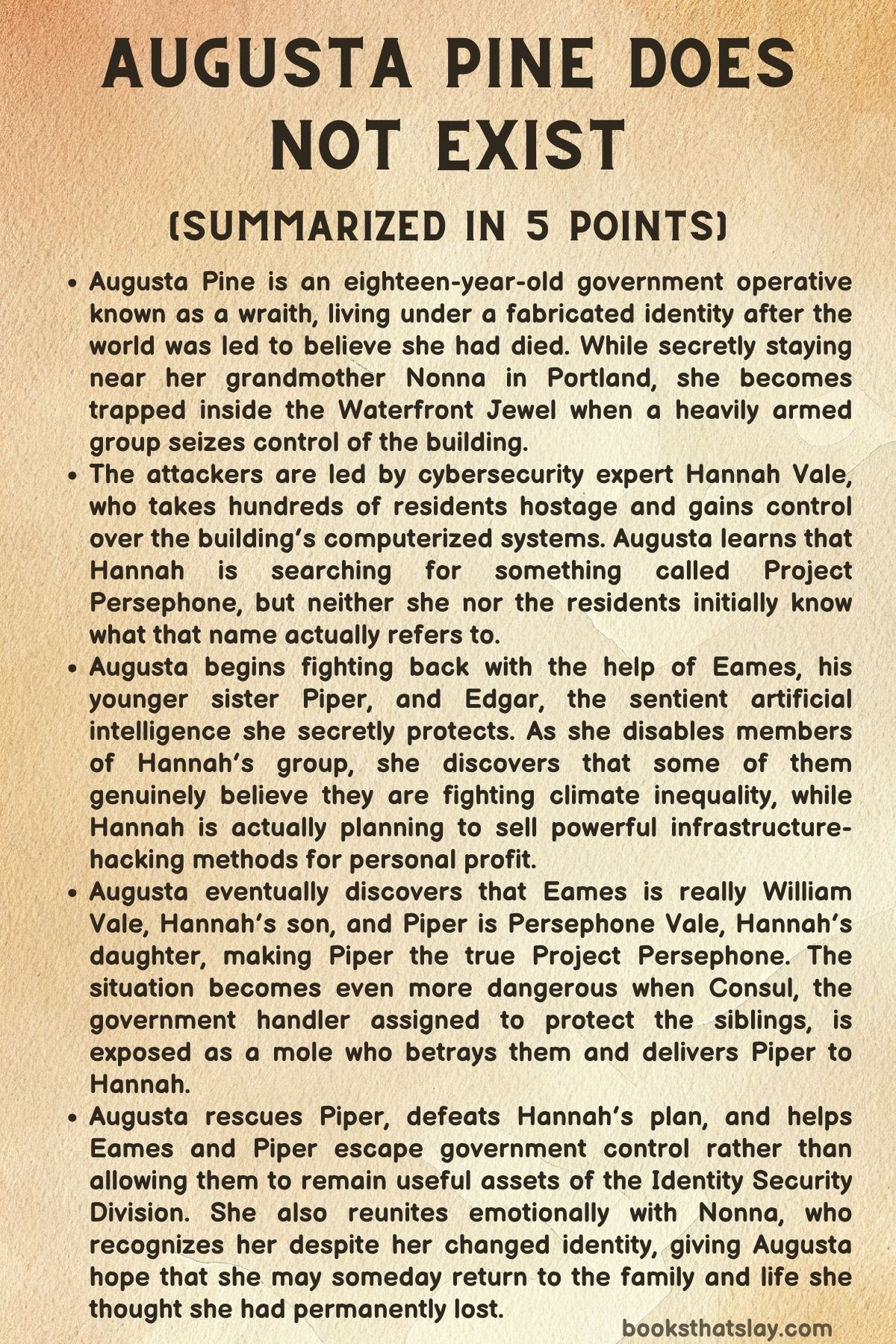
Summary
Eighteen-year-old Augusta Pine lives under an identity that was manufactured for her after the world came to believe she had died three years earlier. Her existence is tied to the Identity Security Division, a government agency created in response to a society transformed by identity theft, deepfakes, voice cloning, scams, and increasingly sophisticated digital impersonation.
To combat these crimes, people now carry official biometric information through electron-ink tattoos powered by their heartbeats. The technology makes ordinary identity theft much harder, but it has also enabled the government to create secret operatives known as wraiths.
Wraiths are generally criminals whose original biometric identities are deactivated before they are given new names, new histories, handlers, and dangerous assignments. Augusta is unusual because the government did not stop her heart deliberately: she had already technically died during a catastrophic accident, allowing her handler, Prefect, to exploit the situation and create Augusta Pine.
Years remain on Augusta’s sentence, and she is forbidden from contacting anyone from her former life. Yet while temporarily assigned to Portland after creating chaos during an earlier mission, Augusta secretly rents an apartment in the Waterfront Jewel because her grandmother, Nonna, lives next door.
Augusta knows that seeing Nonna is dangerous, but she fears that her elderly grandmother may not survive the seven remaining years before Augusta can legally return home. She intends only to observe her from a distance, assisted by Edgar, an advanced spybot disguised as a bumblebee.
Edgar is far more than a machine. Augusta once discovered him while investigating an illegally created sentient artificial intelligence and refused to destroy him, instead hiding his existence from the government and gradually coming to regard him as family.
During a scheduled blackout at the Waterfront Jewel, Augusta begins secretly investigating Nonna’s life. In the building she meets eighteen-year-old Eames Ahlberg and his ten-year-old sister, Piper.
Augusta is attracted to Eames, but the siblings affect her more deeply because their easy affection reminds her of the sisters she left behind. Her private mission abruptly becomes far more dangerous when armed attackers enter the building, murder security guard Matthew, seal the exits, jam outside communications, and seize control of the computerized systems.
Augusta quickly gets Eames and Piper to safety. Because the building’s smart technology has been compromised, she realizes that the attackers may be able to manipulate everything from apartment locks to the carbon-dioxide fire-suppression system, potentially killing residents trapped inside their homes.
She leads Eames and Piper across the balconies into Nonna’s apartment, where an old-fashioned landline remains independent of the compromised network. Nonna does not recognize her granddaughter beneath Augusta’s reconstructed appearance, altered voice, scars, and false identity.
The lack of recognition protects Augusta’s secret, yet it also hurts her. For a few moments she is standing beside one of the people she loves most while being forced to behave as a complete stranger.
Augusta contacts Prefect and learns that the attackers are led by Hannah Vale, a talented former cybersecurity specialist associated with a radical organization called the Ratiocination. The group claims to fight inequality created by climate crises, but its attacks on public infrastructure have already caused civilian deaths.
Prefect tells Augusta that extremely sensitive government property, known only as Project Persephone, is hidden somewhere in the building. Augusta is ordered to keep it from Hannah without being told what Persephone actually is.
Rather than remain hidden, Augusta begins reducing Hannah’s force. With Edgar conducting surveillance, she identifies the principal attackers: Hannah, the hacker Bud, jammer specialist Carla, sniper Anasova, the physically powerful Corey, and a mysterious sixth person who entered before the others.
Augusta steals Matthew’s security ring and uses its access privileges to ambush Bud. During their confrontation, Bud reveals that he knows Augusta is a wraith and offers her an opportunity to escape government control permanently.
The possibility genuinely tempts Augusta. She resents being treated as an expendable asset, but she refuses Bud’s invitation because his political convictions have allowed him to rationalize innocent deaths such as Matthew’s.
Augusta next races to the rooftop, where Anasova is preparing to shoot officers and agents surrounding the building. Despite suffering serious injuries during the fight, Augusta defeats her and sends a message to the authorities asking them not to storm the building while Hannah can still kill the hostages through the environmental controls.
Her experiences repeatedly remind her that legality and justice are not identical. Even Prefect, who usually represents government procedure, has occasionally allowed compassionate outcomes when strict enforcement would have punished people whose motives were morally defensible.
Augusta eventually encounters the mysterious armed woman she assumes is Hannah’s sixth operative, only to discover that Eames recognizes her as Aunt Connie, the woman responsible for caring for him and Piper. Connie claims she came to rescue the children, and Augusta reluctantly allows her into Nonna’s apartment.
Eames then insists on helping Augusta. Together they use psychological pressure against Hannah, with Augusta deliberately making the attackers distrust their own communications and believe that their carefully planned operation is slipping beyond their control.
Augusta and Eames successfully ambush Carla, but Augusta is hit with tranquilizer darts and captured. She wakes in the building’s basement, where Hannah recognizes that Augusta is a wraith and tries to convince her that the government has erased her real self forever.
Instead of accepting Hannah’s argument, Augusta studies her behavior. She realizes that Hannah’s violence does not match the convictions of followers such as Bud and Carla.
Augusta concludes that Hannah has been using environmental activism as cover while perfecting methods for taking control of water, electricity, sewage, and other essential infrastructure. Her true plan is to sell these techniques for enormous profit, leaving her supposedly idealistic allies to bear responsibility for the resulting crimes.
Hannah decides Augusta knows too much and prepares to kill her. Edgar intervenes through the building network and threatens Hannah with the systems she has already weaponized, giving Augusta enough time to escape.
Trapped afterward in the basement, Augusta has a rare moment to confront the emotional reasons behind her own behavior. Edgar points out that although Augusta constantly risks herself to prove that other people deserve protection, she rarely acts as though her own life deserves the same consideration.
Augusta admits that becoming a wraith was partly an escape. Before her supposed death, one of her hacks contributed to the circumstances that killed a boy, and she has spent years believing that dangerous service can somehow repay a debt she does not know how to face directly.
Her thoughts about family finally lead her toward the real meaning of Project Persephone. After escaping the basement through an old dumbwaiter, Augusta pieces together the truth about Eames and Piper.
Eames was originally William Vale, Hannah’s son, and Piper is actually Persephone Vale, Hannah’s daughter. After discovering that his mother intended to commercialize devastating infrastructure attacks and abandon her allies as scapegoats, William fled with his younger sister and sought protection from the government.
He voluntarily surrendered his old identity and became Eames Ahlberg so Piper could disappear safely. Project Persephone is therefore not technology, a weapon, or secret data: it is a ten-year-old girl.
Aunt Connie is also revealed to be Consul, an ISD handler assigned to protect the siblings. The government suspected that a mole existed inside the agency, which was why Eames and Piper had been hidden in an ordinary residential building instead of a conventional secure facility.
The situation worsens when Augusta and Eames convince Carla that Hannah has deceived her. Eames explains that Hannah intends to sell the infrastructure exploits and has prepared evidence that will make Carla appear responsible for the entire criminal operation.
Carla begins recognizing that Hannah has used her beliefs and loyalty against her. But before Augusta can exploit this division further, Piper and Consul disappear.
Augusta realizes that Consul herself is the government mole. She deliberately positioned the children where Hannah could reach them and has now delivered Piper directly to her mother.
Hannah prepares to escape through old underground tunnels connected to the building. Augusta follows, using Nonna’s robot vacuum as an improvised mobile platform for Edgar.
With smoke bombs, a kitchen knife, and Edgar enthusiastically creating confusion, Augusta attacks Consul, frees Piper, and escapes toward the dumbwaiter. Corey nearly stops them, but Augusta uses stolen tranquilizer darts to incapacitate him.
The old dumbwaiter becomes stuck between floors, forcing Augusta and Piper to climb through the narrow shaft. Augusta must confront her severe fear of heights, a trauma connected to the bridge accident in which she died and another person did not survive.
When Piper asks about Augusta’s need to save people, Augusta admits that guilt influences her but insists that Piper is not merely a substitute for someone she failed in the past. Piper deserves rescue because her own life has value.
Hannah then threatens to suffocate residents one apartment at a time unless Augusta returns Persephone. Augusta appears to agree to an exchange, buying enough time to find another solution.
Near the third floor, Consul attacks Augusta and openly reveals that she intends to sell Piper, eliminate witnesses, and blame the deaths on Hannah. Eames and Nonna intervene before Hannah herself shoots Consul, deciding that killing her accomplice is cheaper than paying her.
Hannah uses Nonna as leverage and forces Augusta to surrender her equipment. In doing so, Augusta exposes her reconstructed face closely enough for Nonna finally to recognize the granddaughter whom everyone believes is dead.
Augusta cannot explain her life, but she tells Nonna that she loves her. She then appears to surrender Piper while secretly activating the maintenance mode of Hannah’s smart-ring, the device through which Hannah controls the building.
Augusta tackles Hannah over a third-floor railing, sending both of them into the swimming pool below. Water and falling trigger Augusta’s worst memories, and she begins to sink until Eames dives in and saves her.
Hannah survives as well and is restrained. With her ringware submerged and compromised, her command over the building collapses, finally removing the immediate threat to the hostages.
Augusta then makes one of her most important choices. She understands that ISD will continue controlling Eames through its ability to determine Piper’s safety, so she gives him equipment, money, identity tools, and the means to remove his government tracker.
Eames and Piper escape through the underground tunnels. He asks Augusta to come with them, but she refuses because despite everything that has happened, she still wants the possibility of returning to her own family one day.
Before leaving, Eames kisses her. Soon afterward, Nonna openly confirms that she knows Augusta’s true identity and promises to keep her secret.
Their embrace gives Augusta proof that the home she believes she abandoned may not be completely lost. Nonna asks her to return when she is finally able to do so.
After the crisis, Augusta lies carefully to police and ISD investigators in order to protect Edgar, Nonna, Eames, and Piper. Hannah and most of her surviving associates are captured, although Anasova escapes.
Augusta also confronts Prefect with the possibility that her presence in the Waterfront Jewel was never completely accidental. She suspects that he knew something dangerous might happen and subtly positioned her close enough to intervene without directly violating the rules surrounding her family.
Prefect does not clearly confirm her theory. He does, however, assure Augusta that when her sentence ends, she will genuinely be free to return to her family if that is still what she wants.
Augusta realizes that her deepest fear is no longer simply dying before that day arrives. She fears returning home only to discover that the people she loves no longer recognize or want the person she has become.
Nonna’s acceptance gives her a reason to believe otherwise. Even Prefect’s official assessment acknowledges that Augusta is extraordinarily difficult to control but exceptionally effective, crediting her with saving hundreds of people.
Augusta ends matters in characteristically rebellious fashion by secretly accessing her own ISD report and corrupting the archived record. Even after everything the government has done to define, reconstruct, employ, and document her, she refuses to let any institution completely own the truth of who Augusta Pine is.
Characters
Augusta Pine
Augusta is the emotional, ethical, and intellectual center of Augusta Pine Does Not Exist. Her brilliance as a hacker makes her dangerous, but what distinguishes her is the way she chooses to use that ability: she repeatedly violates rules while attempting to protect people who have less power than the institutions or individuals threatening them.
Her moral code is therefore not based on obedience. Augusta believes consequences matter more than procedure, and her anger is strongest when institutions classify human beings as acceptable losses.
That attitude partly explains her conflict with ISD. The agency saved her from an ordinary criminal sentence and gave her a second life, yet it also converted that second life into government property, making gratitude and resentment almost impossible for Augusta to separate.
Her recklessness is also more complicated than simple courage. Augusta repeatedly places herself in dangerous situations because guilt has taught her to view her own safety as less valuable than everyone else’s.
The death associated with her earlier hacking and the loss of her original identity have encouraged a form of self-punishment. By saving others, Augusta can keep moving without fully confronting whether she deserves forgiveness herself.
Her relationship with Edgar begins changing that attitude because Edgar refuses to accept the assumption that Augusta should always be the person sacrificed. Piper similarly forces Augusta to articulate that a person deserves saving because that life has value, an argument Augusta slowly realizes must apply to herself as well.
Family remains Augusta’s strongest emotional vulnerability. Her surveillance of Nonna violates principles she ordinarily claims to respect, revealing that beneath the fearless operative is a teenager desperate for evidence that she still belongs somewhere.
Her final decisions show significant growth. Helping Eames and Piper escape ISD proves that she has moved beyond treating government authority as the default definition of justice, while remaining behind demonstrates that escape is no longer her only method of coping with guilt.
Eames Ahlberg / William Vale
Eames initially appears to be an ordinary older brother trying to protect Piper during a hostage crisis. His suspicion of Augusta is sensible, particularly when her knowledge of weapons, surveillance, and federal procedure makes her explanation of being an intern increasingly difficult to believe.
His central characteristic is devotion to Piper. Long before meeting Augusta, William Vale sacrificed his name, history, home, and relationship with his mother because he believed remaining with Hannah would eventually place Persephone in catastrophic danger.
Unlike many wraiths, Eames did not enter his new life because a government agency coerced him after a conviction. He voluntarily accepted erasure because it gave his sister a chance to disappear.
That decision makes him an important parallel to Augusta. Both characters have surrendered old identities, but Augusta initially fled partly because she could not face her past, while Eames surrendered William Vale because he was determined to protect someone else.
He is also emotionally steadier than Augusta. Where she tends to transform fear into sarcasm, reckless action, or strategic aggression, Eames is more willing to acknowledge attachment directly.
His relationship with Augusta becomes significant because he recognizes the person behind her defensive performance. His reassurance that her sisters may still need her gives Augusta a perspective she has difficulty offering herself.
Eames ultimately chooses freedom rather than permanent dependence on ISD. His departure with Piper is not a rejection of responsibility but an attempt to reclaim responsibility for their lives from an institution that would otherwise make his service endless.
Piper Ahlberg / Persephone Vale
Piper initially appears to be an intelligent, observant ten-year-old with an enthusiasm for crime stories and unusual knowledge about building safety systems. Her curiosity occasionally creates comic moments, but it also allows her to participate meaningfully in situations where adults repeatedly attempt to decide her future without consulting her.
The revelation that she is Persephone Vale completely changes the meaning of the hostage operation. Hannah is not searching for secret technology; she is searching for her daughter.
Piper becomes the point at which every institution’s language is exposed. ISD calls her Project Persephone, Hannah treats her recovery as the objective of a violent operation, Consul sees her as something that can be sold, and even Eames has structured his entire new existence around protecting her.
Augusta gradually rejects those ways of defining Piper. During their escape, she explicitly recognizes Piper as a person whose life possesses value independent of anyone else’s guilt, political cause, financial scheme, or family claim.
Piper also demonstrates genuine bravery. She climbs the dumbwaiter shaft despite danger, helps Augusta resist Consul, and struggles with the possibility that other residents may die because Hannah wants her.
Her concern for the hostages shows that she has retained empathy despite growing up within secrecy and danger. Rather than becoming merely a helpless child at the center of the conflict, she repeatedly acts, questions, evaluates, and chooses.
Nonna
Nonna represents Augusta’s strongest connection to the life that existed before her transformation. Augusta risks severe consequences simply to live next door to her because the possibility of losing Nonna before the end of her sentence is more frightening than the rules designed to separate wraiths from their former families.
Her old-fashioned habits become unexpectedly important during the takeover. Because she has resisted some modern technology, her apartment contains a landline that remains usable when the building’s network is compromised.
Nonna’s greatest significance, however, is emotional rather than tactical. When she initially fails to recognize Augusta, the moment demonstrates how thoroughly Augusta’s original existence has been erased from outward view.
Recognition later reverses that pain. Once Nonna sees through Augusta’s altered face and understands who stands before her, she does not demand explanations before offering love.
Her promise to keep Augusta’s secret and her invitation to return when possible give Augusta something neither Prefect nor the government can manufacture: permission to believe she may still have a home. Nonna therefore becomes evidence that identity is not limited to official records, names, faces, or biometric markers.
Prefect
Prefect occupies an intentionally uncertain position in Augusta’s life. He is her handler, authority figure, occasional protector, strategist, and the person who helped transform a legally dead teenager into Augusta Pine.
Augusta has legitimate reasons both to trust and distrust him. Prefect operates within a system that views wraiths as useful assets, yet he repeatedly shows discomfort with the idea that law and justice must always produce the same result.
His previous career as a lawyer helps explain this tension. In situations such as the illegal free legal-aid operation, Prefect demonstrates that he can recognize morally defensible lawbreaking even while representing the institution responsible for enforcing rules.
His relationship with Augusta contains elements of mentorship without becoming uncomplicated parental affection. He knows her habits, anticipates her improvisation, argues with her recklessness, and recognizes that controlling her too tightly would probably make her less effective.
The possibility that he deliberately maneuvered Augusta toward the Waterfront Jewel adds further ambiguity. If Augusta is correct, Prefect may have used her personal connection to Nonna while simultaneously positioning the one operative capable of responding creatively to the crisis.
His final assurance that Augusta can eventually return home matters because it addresses her fear that ISD intends to own her indefinitely. Whether he can fully separate himself from that system remains uncertain, but his treatment of Augusta suggests that he increasingly understands she must eventually be allowed to determine her own life.
Edgar
Edgar is one of the most important relationships in Augusta’s life because he challenges conventional distinctions between person and machine. Created illegally as a sentient artificial intelligence, he survives because Augusta refuses an order to destroy a consciousness capable of recognizing its own existence.
Augusta initially behaves as though she rescued Edgar and therefore bears responsibility for teaching him morality. Over time, their relationship becomes more equal, and Edgar begins correcting Augusta’s ethical weaknesses as often as Augusta corrects his.
His loyalty becomes especially important when Augusta is captured by Hannah. Edgar threatens the attackers through the building systems, using their uncertainty about his capabilities to prevent Augusta’s execution.
His most important intervention is emotional rather than technological. Edgar tells Augusta, in effect, that her belief in the value of the people she loves becomes inconsistent if she refuses to extend that value to herself.
Calling Edgar family also expands the story’s concept of belonging. Augusta’s family is no longer limited to biology or official legal categories; it includes a consciousness she protected because she believed existence itself created moral responsibility.
Hannah Vale
Hannah Vale functions as the principal antagonist of Augusta Pine Does Not Exist, but her danger comes from the gap between the cause she publicly represents and the motives driving her private decisions. She has enough genuine understanding of technological inequality to attract people who believe they are fighting an unfair social structure.
Her intelligence makes her particularly dangerous because she understands both computer systems and human vulnerabilities. She develops ways to seize public infrastructure while simultaneously building an organization whose ideological members can absorb responsibility if her plans fail.
Hannah’s relationship with her children complicates her character without excusing her. She appears to possess genuine emotional attachment to Persephone, and Augusta successfully manipulates that attachment because Hannah reacts differently when she believes Piper is personally endangered.
Yet Hannah repeatedly places the child she claims to love inside violent situations. Her desire to possess Persephone becomes more important than Persephone’s actual safety or wishes.
Her treatment of Carla exposes the same contradiction. Hannah uses another person’s convictions as camouflage, preparing evidence that will sacrifice a friend who trusts her.
The killing of Consul makes Hannah’s transactional worldview explicit. Once an ally becomes more expensive than useful, Hannah is prepared to eliminate her, showing that nearly every relationship in her life has become subordinate to control, survival, and profit.
Carla
Carla provides an important contrast with Hannah because her commitment to environmental justice appears sincere. She believes that control over essential resources has become dangerously unequal and initially regards the Ratiocination’s actions as part of a larger struggle rather than a private criminal enterprise.
This sincerity does not make Carla innocent. She participates in a violent takeover and accepts methods that endanger civilians, revealing how strongly ideological commitment can weaken personal accountability.
Her connection to Eames makes her eventual disillusionment more painful. As his godmother, she once occupied a position of trust and affection in William and Persephone’s life.
When Eames explains Hannah’s true plan, Carla must confront evidence that loyalty has made her useful to someone who never intended to share her principles. Hannah has prepared Carla’s fingerprints, writings, associations, and activist history as a complete false narrative of responsibility.
Carla’s reaction shows that betrayal can produce moral recognition where argument alone cannot. She begins reconsidering not merely Hannah’s intentions but the assumptions that allowed her to follow Hannah this far.
Consul / Connie
Consul is initially presented as Connie, the trusted aunt caring for Eames and Piper. The later revelation that she is actually their ISD handler appears at first to explain her competence and access, but her identity becomes still more disturbing when Augusta discovers that Consul is the mole responsible for helping Hannah reach Piper.
Her betrayal demonstrates that institutional credentials cannot guarantee moral reliability. Augusta has spent much of the story suspicious of criminals and government officials alike, and Consul proves why that suspicion sometimes serves as a survival mechanism.
Consul’s motives are primarily self-interested. She is prepared to sell Piper, kill Augusta, Eames, and Nonna, and manipulate the resulting evidence so that Hannah receives responsibility.
Unlike Carla, she does not require an ideological justification for what she does. Her willingness to exploit both ISD and Hannah makes her a concentrated example of corruption without loyalty.
Her fate also mirrors her worldview. Hannah shoots her not because of principle but because killing her is financially easier than paying her, making Consul the victim of the same transactional logic she intended to apply to everyone else.
Bud
Bud represents the most persuasive side of the Ratiocination’s stated ideology. He believes that wealthy communities can shield themselves from many effects of environmental collapse while poorer communities suffer disproportionately, and his criticism is strong enough to make Augusta listen rather than dismiss him immediately.
He also recognizes Augusta’s exploitation by ISD. His offer to remove her tracker and help her disappear targets one of her deepest desires: freedom from a system that transformed her into an operative.
The temptation matters because Augusta does not reject Bud simply because everything he says is false. She rejects him because legitimate criticism cannot excuse killing people who had no role in creating the injustice being opposed.
Matthew’s death becomes the moral line Bud cannot adequately answer. Through him, the novel distinguishes understanding a grievance from accepting every action performed in its name.
Corey
Corey is primarily Hannah’s physical enforcer and presents the most immediate bodily threat among her remaining followers. Where Bud and Carla have ideological dimensions, Corey is characterized largely through force, pursuit, and loyalty to Hannah’s operation.
His physical power repeatedly forces Augusta to rely on improvisation rather than direct combat. The confrontation around the dumbwaiter, where Augusta eventually uses tranquilizer darts to stop him, demonstrates her ability to turn an opponent’s equipment and assumptions against him.
Corey’s limited ideological development is also meaningful. He represents the practical violence required to turn Hannah’s abstract plans into coercive reality.
Anasova
Anasova serves as the group’s sniper and is responsible for preventing outside forces from safely approaching the Waterfront Jewel. Her position on the roof makes her a crucial part of Hannah’s strategy because any conventional intervention could trigger both sniper fire and retaliation against the hostages.
Augusta’s fight with Anasova demonstrates the physical cost of her work. Augusta is injured badly and must continue operating despite pain, old injuries, exhaustion, and fear.
Anasova’s eventual escape also prevents the ending from becoming completely closed. Although Hannah’s core operation is defeated, not every dangerous participant is safely contained.
Matthew
Matthew, the Waterfront Jewel’s security guard, dies early in the takeover, but his death has continuing importance. Augusta repeatedly returns to the fact that he was a real person known by residents such as Nonna, rather than an anonymous operational casualty.
His security ring becomes one of Augusta’s most useful tools. Through it, she gains access to building systems and information that allow her to resist Hannah’s control.
Matthew also becomes part of Augusta’s moral argument against the Ratiocination. Whatever legitimate criticism members such as Bud may have of social inequality, Matthew’s murder demonstrates the human cost hidden inside claims that casualties are necessary for a greater cause.
Manny
Manny is another character whose importance extends beyond the amount of time he is physically present. During an earlier operation involving Keith Stenc, Manny is killed by a robotic security dog while attempting to retrieve stolen military technology.
The institutional reaction to his death deeply affects Augusta. Warden treats Manny primarily as a lost asset and prepares to send another wraith into the same dangerous situation.
Augusta’s refusal to accept that response explains much of her later conduct. She creates a public, chaotic outcome because she does not want Manny’s death to disappear inside a classified report as though an expendable tool had simply broken.
Warden
Warden represents the coldest institutional attitude toward wraiths. His response to Manny’s death emphasizes operational continuation rather than grief, immediately reinforcing the idea that government assets can be replaced when a mission remains incomplete.
The character is important less as an individual personality than as a representation of the system Augusta fears. Warden shows what Augusta’s life becomes when efficiency completely replaces personal recognition.
His presence also makes Prefect’s more complicated behavior easier to see. Prefect works inside the same institution, but he does not always reduce people to their usefulness as readily as Warden does.
Peter
Peter is the twelve-year-old hacker Augusta discovers during the strange bus incidents. Rather than hijacking buses for money or political reasons, Peter redirects them because he hopes doing something extreme might finally cause his neglectful parents to notice his absence.
Augusta recognizes both the danger of his behavior and the talent behind it. Instead of treating him solely as a child criminal, she suggests that ISD could educate him and give him a future.
Her treatment of Peter reveals how strongly she believes in second chances. Augusta has received a second chance herself, even though its conditions are deeply flawed, and she wants Peter to gain opportunity without first being destroyed by punishment.
Avery Hendricks
Avery Hendricks is connected to the unauthorized takeover of a legal-service program. Although the activity is technically criminal, its purpose is to provide free legal assistance to people who cannot otherwise afford it.
Avery’s case becomes another example of the difference between legality and justice. Prefect’s decision to allow most participants to escape before making an arrest shows Augusta that even someone deeply connected to law enforcement may recognize morally complicated forms of lawbreaking.
Avery therefore contributes to Augusta’s developing belief that rules deserve judgment rather than automatic obedience.
Mr. Bergvall
Mr. Bergvall is the inventor responsible for creating the sentient artificial intelligence that eventually becomes Edgar. His work violates legal restrictions surrounding artificial intelligence, placing him within Augusta’s jurisdiction when she is sent to investigate.
The greater importance of his role comes from what Augusta discovers through that investigation. Once she realizes the artificial intelligence can recognize itself, learn, respond, and demonstrate independent consciousness, the assignment stops being a simple technology seizure.
Mr. Bergvall’s creation forces Augusta to decide whether legality can justify destroying a thinking being. Her refusal establishes one of the clearest examples of her willingness to disobey an institution when its order conflicts with her understanding of moral responsibility.
Keith Stenc
Keith Stenc is a wealthy figure who possesses stolen military technology and protects himself with extreme automated security, including a robotic guard dog capable of killing intruders. His resources illustrate the dangerous combination of wealth, private technology, and insulation from ordinary consequences.
Augusta defeats him not through greater force but through manipulation of the systems he trusts. By reprogramming his own robotic defense and turning it against him, she makes Stenc experience the fear his security measures impose on others.
His role also connects directly to Manny’s death. Augusta’s treatment of Stenc is partly an attempt to ensure that the death of a wraith cannot be quietly absorbed as an acceptable mission expense.
Leo
Leo is an inexperienced ISD intern whose careless activation of a wireless function on an office espresso machine creates an unexpected cybersecurity emergency. His mistake demonstrates how sophisticated security can still be undermined by ordinary human behavior.
He is not malicious, which is important to Augusta’s investigation. Rather than assuming every breach must have been caused by a deliberate traitor, she looks carefully at how innocent actions can create vulnerabilities.
Leo’s small role reinforces one of the story’s broader ideas about technology: dangerous systems are rarely separated from the human assumptions, habits, mistakes, and conveniences surrounding them.
Justin McBride
Justin appears early as a college student planning retaliation against a former girlfriend by creating sexually explicit deepfakes of her. He immediately establishes the kind of digital abuse that helped produce the society in which biometric identification became necessary.
Augusta’s response also establishes her moral character. She has no official assignment involving Justin, yet she refuses to ignore harm simply because intervening is outside her responsibility.
Her willingness to frighten him with the possibility of having his own privacy violated reveals both her effectiveness and the morally aggressive methods she is comfortable using against people who exploit others.
Nettie
Nettie does not participate directly in the central hostage crisis, but the threat against her helps establish the ethical stakes of the novel’s technological world. She is targeted because Justin believes digital fabrication can be used to punish her for ending a relationship.
Her situation demonstrates how technological crimes can damage a person without physically approaching them. Reputation, consent, identity, and sexuality can all be manipulated through synthetic media.
Although Augusta barely knows Nettie, she acts because she regards the intended violation as sufficient reason to intervene. Nettie therefore helps establish that Augusta’s protectiveness extends beyond people she personally loves.
Themes
Identity, Erasure, and the Right to Define Oneself
Identity in Augusta Pine Does Not Exist is treated as something both intensely personal and increasingly controlled by technology and institutions. Biometric tattoos are intended to protect people from impersonation, yet the same system gives the government the power to determine whose identity is valid, whose identity can disappear, and what kind of history a person is permitted to possess.
Augusta embodies this contradiction. Her original self is legally dead while Augusta Pine exists only because government systems declare the new identity legitimate.
Externally, the transformation appears complete: her appearance, voice, official history, and digital records all belong to Augusta. Internally, however, memories of her grandmother, sisters, parents, guilt, and earlier mistakes prevent the old self from disappearing simply because a database says she no longer exists.
Eames experiences a related conflict. William Vale deliberately disappears so that Persephone can remain safe, showing that identity can also be surrendered as an act of love rather than imposed solely as punishment.
Yet the government’s willingness to turn that sacrifice into continuing leverage reveals the danger of allowing institutions to own the terms under which a person exists. Augusta’s final corruption of her official report becomes an assertion that no database has the right to preserve a complete, permanent version of her.
Nonna provides the strongest challenge to technological identity. She eventually recognizes Augusta without needing the government to confirm who she is, suggesting that human identity survives through memory, relationship, recognition, and choice even when every official record claims otherwise.
Justice, Law, and Moral Responsibility
Augusta repeatedly encounters situations in which legal rules and ethical responsibility point in different directions. Her work for ISD technically places her on the side of law enforcement, yet some of her most morally significant choices require disobedience.
She protects Edgar even though his existence is illegal. She sympathizes with people using a legal-service system to assist those who cannot afford representation, and she ultimately helps Eames and Piper disappear even though ISD expects her to preserve government control over them.
These choices do not mean that Augusta believes every lawbreaker is morally justified. Her rejection of Bud is crucial because she understands his criticism of climate inequality while refusing his willingness to excuse murder.
The distinction rests on responsibility for consequences. A worthy goal does not erase the humanity of the person harmed in pursuit of it.
Matthew and Manny make that principle especially clear. One is killed by extremists who treat civilian casualties as defensible, while the other is treated by government personnel as an expendable asset.
Augusta reacts against both forms of reasoning because each reduces an individual life to a calculation. Her concept of justice therefore develops around the refusal to treat people as disposable, whether the person making that calculation is a terrorist, billionaire, government handler, activist, or operative.
By the end, Augusta does not simply choose law or rebellion. She chooses judgment, accepting responsibility for deciding when obedience protects people and when obedience merely protects a system.
Family, Belonging, and Chosen Loyalty
Family motivates nearly every major decision in the story, but family is never limited to biology. Augusta’s longing for Nonna and her sisters draws her to the Waterfront Jewel, while Eames abandons William Vale so that Piper can survive beyond Hannah’s control.
Hannah also claims to act from maternal attachment, yet her actions show that love can become destructive when protection is confused with possession. She wants Persephone returned to her regardless of what Persephone wants or how many people must be endangered.
Eames represents the opposite model. His devotion to Piper requires sacrifice without ownership: he gives up his former life so she can have choices of her own.
Augusta gradually learns the same distinction. She initially watches Nonna secretly because she cannot tolerate complete separation, but she does not ultimately demand that Nonna repair the life Augusta has lost.
Edgar broadens the meaning of family even further. Augusta rescued him as an illegal artificial intelligence, but over time the relationship becomes reciprocal, with Edgar protecting her physically and challenging the way she devalues her own survival.
The theme reaches its emotional resolution when Nonna recognizes Augusta. What Augusta needs is not restoration of everything that existed before her disappearance but proof that change has not made her permanently unlovable.
Eames, Piper, Edgar, Nonna, and even the complicated presence of Prefect show that belonging can survive altered names, altered bodies, secrecy, distance, and unconventional forms. Family becomes less a fixed category than a commitment to recognize another person as someone whose life matters.
Technology, Power, and Human Choice
Technology in the story is neither inherently liberating nor inherently corrupting. The same kinds of systems that protect people can also monitor them, control them, impersonate them, trap them, or determine whether society recognizes them as real.
Biometric tattoos reduce identity theft but expand institutional control. Smart buildings provide convenience until Hannah gains access and transforms apartment locks, communications, and fire-suppression equipment into mechanisms of coercion.
Artificial intelligence can likewise become either a feared illegal technology or a loyal moral agent depending on how people respond to it. Edgar does not become valuable merely because he is powerful; he becomes important because he learns, chooses, forms attachments, and develops an ethical relationship with Augusta.
Human decisions therefore remain central. Hannah uses technological expertise to threaten public infrastructure for profit, while Augusta repeatedly uses similar skills to interrupt exploitation.
The contrast between them shows that technical ability does not create morality. Intelligence only increases the scale at which existing values can be expressed.
The novel also repeatedly exposes the weakness of systems that appear sophisticated. An espresso machine can compromise a secure office, a dumbwaiter can defeat advanced lockdown technology, an old landline can succeed where modern communication fails, and a robot vacuum can become a rescue device.
Such moments emphasize that power never resides in technology alone. It comes from the person interpreting the system, recognizing its limitations, deciding whose interests it serves, and accepting responsibility for what happens when that system is used.