Fishbone Cinderella Summary, Characters and Themes
Fishbone Cinderella by Elizabeth Lim is a multigenerational historical fantasy centered on a Chinese family shaped by war, migration, cultural expectations, buried grief, and a strange supernatural inheritance.
Beginning with Yut Ying’s childhood during the Japanese occupation of China and later following her daughter Marigold in America, the novel examines what happens when fear and family secrets are passed from one generation to another. Its Cinderella references are repeatedly questioned rather than simply celebrated, especially when marriage, obedience, beauty, and rescue are measured against a woman’s need for dignity, equality, identity, and freedom.
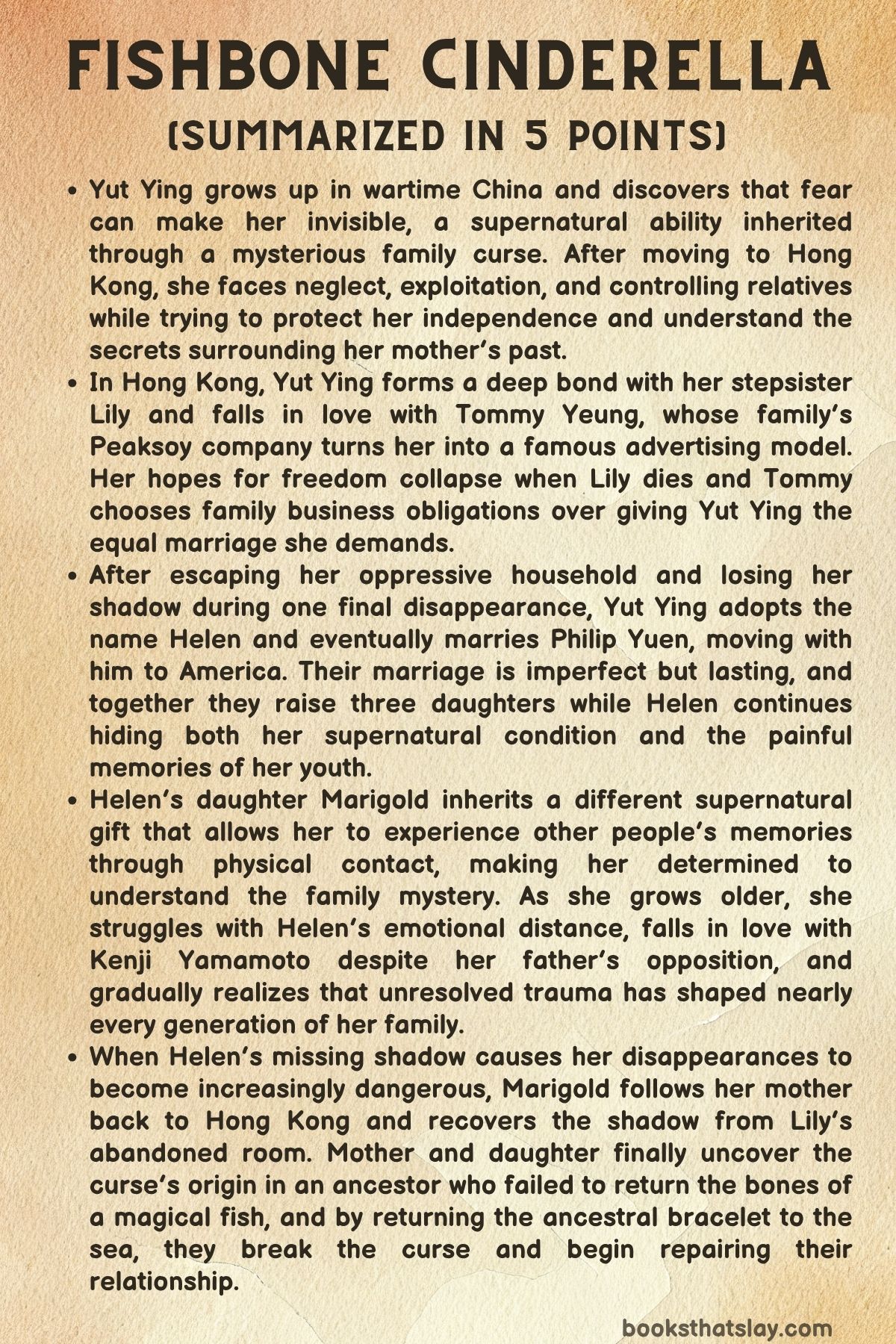
Summary
Seven-year-old Yut Ying lives with her family in Guangdong during the Japanese occupation. When her grandmother secretly sends her back to their abandoned home for medicine needed by her seriously ill brother, Japanese soldiers enter the house, and Yut Ying hides inside a cupboard only to discover that terror has somehow made her invisible.
Her mother, Yuk Fong, is alarmed when Yut Ying explains what happened and orders her never to reveal the incident. Yut Ying slowly realizes that her mother knows something about the strange event, although Yuk Fong refuses to explain the truth immediately.
Yuk Fong has already endured an unhappy marriage to Yut Ying’s father, Pok Mun, an irresponsible and opium-dependent man whose behavior repeatedly humiliated her. After losing stillborn twin daughters and suffering disturbing episodes during pregnancy, she became deeply religious and eventually found herself protecting the family almost alone after Pok Mun moved to Hong Kong.
Years later, when the war ends, Pok Mun invites Yut Ying and her brother Yi Gor to Hong Kong. Before Yut Ying leaves, Yuk Fong deliberately frightens her until she becomes invisible again, proving that the earlier incident was not an accident.
Yuk Fong explains that women in their family inherit a mysterious affliction connected to what was once described as a tiny fish bone. Her own supernatural ability takes the form of prophetic dreams, while Yut Ying’s power allows her to become “nothing,” and she warns her daughter to keep the ability secret.
Hong Kong initially seems exciting, but Yut Ying quickly discovers that the father she remembered has become distant and weakened by opium. She meets his second wife, Sai Ma, an elegant former opera singer whose apparent warmth gradually proves unreliable, and Lily, Sai Ma’s sharp-tongued young daughter.
Although Yut Ying and Lily initially dislike each other, Yut Ying’s secret use of invisibility allows her to witness Lily’s private loneliness. She realizes that Lily’s hostility hides a child desperate for affection, especially from a mother who treats her harshly behind closed doors.
Yut Ying expects to attend school, but her wealthy aunt Gu Ma decides that education is unnecessary and places her in the family shoe factory instead. There Yut Ying works exhausting shifts, suffers public humiliation, and has most of her wages withheld, although she also develops a valuable friendship with a seamstress named Sui Chan.
During this period, she accidentally meets Tommy Yeung, a cheerful boy who helps her search for a lost charm from the gold bracelet Yuk Fong gave her. Tommy later returns the charm and tells her the Chinese Cinderella tale of Yeh Shen, whose magical fish bones help change her fate.
Yut Ying and Lily gradually become true sisters. Lily helps her learn Chinese characters and English, while Yut Ying gives Lily the affection and protection missing from her relationship with Sai Ma.
At the same time, Tommy becomes increasingly important to Yut Ying. He encourages her dream of becoming a singer and eventually asks her to model for an advertisement for Peaksoy, his family’s growing soymilk company.
Using the English name Helen, Yut Ying poses in a yellow dress, and her joyful photograph becomes the public face of Peaksoy. The experience gives her a rare vision of herself as someone who might have beauty, work, music, independence, and love on her own terms.
That hope is interrupted when a dangerous man named Zhou Hin Kong confronts her at home. Yut Ying becomes invisible during the attack, but Zhou discovers enough of her secret to become fascinated by it, assaults her, and leaves her with permanent damage near her ear before Yi Gor shoots him.
Gu Ma uses her influence to hide Zhou’s death and sends Yi Gor away to Malaya. Yut Ying feels abandoned by the brother who saved her because he leaves without allowing them to fully process what happened.
The household’s position becomes increasingly unstable as rumors spread about Gu Ma’s wartime collaboration with the Japanese. Hoping to protect the family through a socially useful alliance, Sai Ma arranges for thirteen-year-old Lily to marry James Tsang despite Lily’s desire for education and independence.
Yut Ying refuses to let Lily surrender quietly. She reveals her invisibility to her sister and promises that they will escape together, turning their bond into a direct rejection of the adults who treat marriage as a transaction.
Before the plan can succeed, Lily is sent away, and Yut Ying’s carefully saved money is confiscated. Lily eventually escapes during a violent typhoon and returns home dangerously ill, prompting Yut Ying to risk her own life crossing flooded streets to find a doctor.
Lily has pneumonia and receives penicillin, but an allergic reaction kills her. Her death destroys Yut Ying emotionally, especially after Sai Ma declares that Lily’s ashes belong to the family she had been contracted to marry.
Unable to tolerate her grief, Yut Ying begins disappearing intentionally. Invisibility becomes less a useful power than an escape from consciousness, allowing her to experience the cold relief of becoming nothing whenever being herself becomes unbearable.
Years later, Yut Ying learns that Tommy had repeatedly tried to find her and that Sai Ma had hidden his letters. Their relationship resumes, and Tommy eventually proposes marriage, seemingly offering Yut Ying the freely chosen future she has always wanted.
The proposal collapses when Tommy’s grandfather demands that he first marry Priscilla-Mae for business reasons and take Yut Ying later as another wife. Tommy sees the arrangement as a temporary compromise, but Yut Ying recognizes the same inequality that damaged her mother’s life and refuses to accept love without equal standing.
After Tommy chooses the family business, Yut Ying prepares to leave the Ha household. During one final use of invisibility inside Lily’s sealed room, however, her shadow separates from her body and remains behind, leaving Yut Ying physically free but spiritually incomplete.
Calling herself Helen, she attempts to become a nightclub singer before her damaged ear and constant harassment force her to leave. She eventually reconnects with Sui Chan and meets Philip Yuen, a kind Chinese-American widower who proposes marriage and offers her a possible new beginning in America.
Helen’s marriage to Philip is neither romantic nor easy. They struggle with poverty, racism, homesickness, his gambling, her emotional withdrawal, and a miscarriage, yet Philip’s care and the kindness of his brother Francis persuade Helen that imperfect relationships can still contain loyalty and genuine devotion.
Helen and Philip eventually move to California, where their daughters Peony, Marigold, and Rosie are born. Helen hopes the family curse has ended, but Marigold eventually develops a supernatural ability of her own: physical contact allows her to experience memories and the emotional wounds attached to them.
Marigold grows into a brilliant, ambitious, socially isolated young woman who wants to become a doctor. Her relationship with Helen is difficult because Helen’s terror that Marigold will inherit her fate causes her to become restrictive, cold, and unwilling to discuss the supernatural events her daughter has witnessed.
At school, Marigold develops a rivalry with Kenji Yamamoto after touching him and seeing a disturbing memory from his childhood. She judges him according to that single moment, while Kenji assumes her rejection comes from anti-Japanese prejudice, and their misunderstanding lasts for years before they finally learn to see each other more fully.
Their rivalry eventually becomes friendship and love. Kenji accepts Marigold’s strange ability without fear, but Philip’s wartime trauma makes him violently opposed to his daughter being involved with a Japanese-American man.
When Philip suffers a stroke, Helen supports his demand that Marigold leave Kenji. Marigold sacrifices the relationship, attends Harvard Medical School, and later returns home when Philip develops lung cancer.
By touching her father, Marigold experiences the memory behind his hatred: Philip and Francis watched their mother die during a Japanese attack. She finally understands that her supernatural ability does not merely reveal events but gives her access to the hidden pain that continues shaping people long afterward.
Meanwhile Helen’s condition becomes life-threatening. Her missing shadow no longer anchors her body, and she begins disappearing involuntarily for longer periods until she returns to Hong Kong with Marigold and finally vanishes completely.
Following Helen’s last clue, Marigold travels to the abandoned Harbourage house and enters Lily’s old room. She discovers Helen’s shadow attached to Yut Ying’s broken childhood doll, but a confrontation with the elderly Sai Ma causes the house to catch fire.
Marigold refuses to leave without the shadow and eventually secures it around Helen’s old wooden comb. She nearly dies in the fire but mysteriously disappears before waking safely outside, suggesting that Helen somehow managed to save her from within the vanished world.
Realizing that Helen may no longer want to return from the peaceful emptiness, Marigold calls for her mother and finally uses the hwamei song that connects Helen to Lily and to the women who came before them. Helen’s shadow spreads across the ground, her body reforms, and mother and daughter are reunited.
Marigold then reveals the true origin of the family curse. Generations earlier, a poor girl befriended a magical golden fish, used its remains to escape an unwanted marriage, and broke her promise to return its bones to the water.
The golden fish spine became the family bracelet, while the mysterious charm was actually a tiny golden slipper. The women inherited supernatural abilities because their ancestor had kept what she had promised to return, making the family’s Cinderella story the result not only of magic but of an unresolved moral debt.
Helen also confesses that Kenji never abandoned Marigold; she had hidden his letters just as Sai Ma once hid Tommy’s. Recognizing with shame that she repeated the very behavior that once hurt her, Helen urges her daughter not to let fear destroy the love she still has a chance to reclaim.
Helen and Marigold finally throw the bracelet into Victoria Harbour, returning the fish’s bones to the water and ending the curse. Helen’s shadow remains attached, Marigold eventually reunites with Kenji, and mother and daughter move forward with a relationship no longer governed by secrecy, inherited fear, or the unfinished promise of their ancestor.
Characters
Yut Ying / Helen Yuen
Yut Ying is the emotional center of Fishbone Cinderella, and much of her character is built around the conflict between disappearing and insisting on the right to exist. Her supernatural ability gives physical form to a problem she experiences from childhood: relatives repeatedly overlook her wishes, deny her education, exploit her labor, control her money, and treat her future as something others may arrange.
Her greatest strength is not invisibility but her refusal to accept inequality once she fully recognizes it. She protects Lily, rejects the possibility of becoming Tommy’s secondary wife, leaves the Ha household, crosses continents, works relentlessly, and eventually creates a family in America.
Helen is also deeply flawed because survival teaches her habits that later hurt Marigold. She hides pain, refuses difficult conversations, uses emotional distance as protection, and eventually repeats Sai Ma’s act of concealing a daughter’s romantic correspondence.
This repetition makes her development especially important because she is neither simply victim nor triumphant survivor. By the end, Helen recognizes that escaping an abusive structure does not automatically prevent a person from reproducing some of its behaviors, and her final honesty with Marigold becomes as necessary as the breaking of the supernatural curse.
Marigold Yuen
Marigold becomes the second central consciousness of Fishbone Cinderella and serves as both Helen’s daughter and her narrative counterpart. Where Helen responds to unbearable experience by disappearing, Marigold is forced into other people’s memories and therefore cannot easily avoid pain at all.
Her intelligence encourages her to approach supernatural experiences analytically. She experiments with objects, studies the conditions under which memories appear, uses gloves as protection, and dreams of medicine because she wants explanations rather than inherited superstition.
Yet Marigold’s development depends on realizing that knowledge without context can be dangerous. Her early judgment of Kenji comes from seeing one terrible moment from his childhood and assuming that the fragment represents the whole person.
By the end, she understands that her gift is most valuable when it produces compassion rather than verdicts. Her willingness to search Helen’s memories, recover her shadow, confront the family curse, and still say “I love you” transforms her from an investigator of pain into someone capable of using understanding to repair relationships.
Lily
Lily initially appears spoiled, abrasive, dishonest, and deliberately difficult, but these qualities quickly become recognizable as defenses created by neglect. Her rejection of Yut Ying’s doll contrasts with the private tenderness with which she later treats it, showing how rarely she feels safe enough to reveal what she actually values.
She becomes one of the strongest positive influences on Yut Ying by teaching her language and refusing to accept the family’s judgment that she lacks intelligence. Lily gives her sister something the adults repeatedly deny her: confidence that learning is possible.
Her own hopes for university and independence make her arranged marriage especially cruel. The adults view marriage as protection for the family, while Lily understands it as the destruction of a future she has barely begun imagining.
Her death remains active long after her physical absence. She becomes the emotional center of Helen’s grief, the reason Helen’s shadow stays behind, the original owner of Marigold’s protective gloves, and finally one of the memories through which mother and daughter are able to find each other again.
Yuk Fong / Mama
Yuk Fong represents both extraordinary endurance and the limitations of endurance as a way of life. She survives a humiliating marriage, reproductive loss, war, displacement, political persecution, imprisonment, and decades of separation from her daughter while continuing to protect those she loves whenever circumstances allow.
She understands the inherited supernatural condition more clearly than Helen does as a child, yet her response is secrecy rather than explanation. Her advice is shaped by practical fear: extraordinary women are safer when nobody knows what they can do.
That strategy protects Helen in some situations but also teaches her that dangerous truths should remain unspoken. Helen later applies the same principle to Marigold, demonstrating how protective behavior can become damaging when fear outlives the original danger.
In old age, Yuk Fong becomes the bridge between generations. Her recognition of Marigold’s power gives the young woman language for experiences she has never understood, while her own prophetic dreams reveal how long the family has accepted suffering as fate.
Tommy Yeung
Tommy represents the most convincing romantic possibility of Helen’s youth because he first treats her as a person rather than an obligation, employee, embarrassment, or marriage prospect. He encourages her singing, restores her lost bracelet charm, includes her in Peaksoy’s ambitions, and helps create the confident public image of “Helen” that she herself has barely begun to imagine.
His affection is genuine, which makes his eventual failure more meaningful. Tommy does not betray Yut Ying because he lacks love; he betrays the equality she requires because he believes love can survive a compromise that benefits his family business.
For him, marrying Priscilla-Mae first appears temporary and practical. For Yut Ying, becoming an additional wife would repeat the structure that destroyed her mother’s marriage and confirm that even the man who loves her expects her to accept less.
Tommy therefore becomes a test of Yut Ying’s self-respect. Walking away from him hurts precisely because the relationship is real, yet her refusal establishes that love cannot be called liberating when one person must surrender equal status to preserve it.
Sai Ma / Seet Ling
Sai Ma is one of the novel’s most complicated antagonists because her cruelty rarely begins with open violence. She prefers social performance, false promises, confiscation, humiliation, jealousy, manipulation, and the control of information, allowing her to appear gracious while quietly limiting the lives of those dependent on her.
Her treatment of Lily is particularly revealing. She wants the social authority associated with motherhood without consistently accepting the emotional responsibility of caring for the daughter who needs her.
Her behavior toward Yut Ying grows from insecurity as much as hostility. Yut Ying is beautiful, connected to Pok Mun’s first marriage, increasingly independent, and capable of attracting public admiration, so Sai Ma treats her presence as a threat that must be reduced.
Age brings remorse but not full moral transformation. When Marigold meets the elderly Seet Ling, her claims of regret coexist with evidence of past poisoning, continuing evasions about Lily, and a final act of locking Marigold in a burning room, showing that guilt alone does not necessarily produce accountability.
Philip Yuen
Philip is deliberately presented as an imperfect husband rather than an ideal rescuer. He offers Helen kindness, marriage, and migration to America, yet he also gambles, becomes possessive, fears abandonment, and at times tries to restrict her independence.
His best quality is his capacity to change imperfectly rather than remain fixed. After fighting with Helen about her English lessons, he responds with a children’s book that helps her study, an awkward but meaningful acknowledgment that he has been wrong.
His relationship with Marigold exposes his most damaging wound. His hatred of Japan originates in wartime trauma and the death of his mother, but he transfers that grief onto Kenji, a young Japanese-American man who had nothing to do with the violence Philip experienced.
Philip demonstrates how trauma can deserve understanding without making every action produced by trauma acceptable. Marigold’s memory-reading power allows her to comprehend him more deeply, but comprehension does not erase the damage caused by his ultimatum or the relationship she sacrifices because of it.
Kenji Yamamoto
Kenji begins as someone Marigold believes she understands after seeing one violent childhood memory. Her mistake makes him central to the novel’s argument that a painful fragment of someone’s past cannot stand in for the entirety of that person.
He grows into a warm, patient, humorous young man whose ambitions match Marigold’s intellectual seriousness. Instead of fearing her supernatural ability, he responds with acceptance and even jokes that the simplest way to reduce the shock of first contact is to keep holding her hand.
Kenji also provides an important contrast to the romantic compromises surrounding Helen. He does not ask Marigold to become smaller, less educated, less ambitious, or less unusual in order to be loved.
His persistence after their forced separation becomes especially significant once Helen admits that she hid his letters. Kenji therefore represents the future Marigold almost loses because one generation’s unresolved trauma is allowed to dictate another generation’s relationships.
Yi Gor
Yi Gor’s relationship with Yut Ying changes repeatedly between irritation, affection, dependence, and resentment. Their sibling bond feels credible because neither treats the other with uninterrupted tenderness, yet moments of genuine loyalty appear when circumstances become dangerous.
His defining action is killing Zhou Hin Kong to save Yut Ying. The act protects his sister but entangles both siblings in a secret that the older generation immediately manages through money, influence, and disappearance.
His departure for Malaya becomes a second wound because Yut Ying experiences it as abandonment rather than sacrifice. She cannot emotionally reconcile the brother who saved her life with the brother who then leaves her alone with the consequences.
Yi Gor consequently represents one of the story’s recurring truths about family: love may be genuine even when the person who loves you is unable to remain, explain himself, or give you the goodbye you need.
Pok Mun / Baba
Pok Mun is less powerful than many of the women around him but causes substantial harm through weakness, selfishness, and avoidance. His opium addiction, extravagance, abandonment of Yuk Fong, second marriage, and emotional distance leave other people carrying responsibilities he repeatedly evades.
Yut Ying’s childhood adoration of him makes the reality of their reunion in Hong Kong particularly painful. She expects a father and finds a man who barely asks about the mother who protected his children during war.
He rarely displays the organized cruelty associated with Sai Ma or Gu Ma. His failure is instead passive: he allows stronger personalities to determine his daughter’s education, labor, money, and future.
That passivity is morally significant because the story refuses to treat doing nothing as harmless. Pok Mun repeatedly has opportunities to protect Yut Ying and repeatedly allows convenience, addiction, or family pressure to matter more.
Gu Ma
Gu Ma represents economic and social power within the Hong Kong household. She controls the shoe factory, dominates Pok Mun financially, determines Yut Ying’s employment, and uses money to manage scandals that might threaten the family.
Her treatment of Yut Ying reveals how exploitation can be disguised as family responsibility. She denies the girl education, puts her to work, publicly canes her, and deducts wages while insisting that these arrangements are appropriate.
Her wartime collaboration adds a political dimension to her moral failures. Protecting wealth and influence becomes more important than ethical loyalty, and the consequences eventually return through investigation and public disgrace.
Her suicide after the factory burns and evidence resurfaces gives her story a bleak conclusion. She spends much of her life controlling outcomes through status and money, only to reach a crisis those tools cannot contain.
Ah Ma
Ah Ma embodies older expectations surrounding family hierarchy, obedience, sons, property, and advantageous marriage. She can be practical during danger, but she also treats Yut Ying as a resource whose appearance may eventually secure a profitable match.
Her decision to send a seven-year-old child into occupied territory for medicine illustrates the severity of her thinking. Yi Gor’s survival matters enough to justify exposing Yut Ying to extraordinary danger, even without Yuk Fong’s permission.
Her obsession with the ruined ancestral home also contrasts with Yuk Fong’s priorities. Where Ah Ma mourns property and status, Yuk Fong emphasizes that the family is still alive.
Ah Ma is therefore not merely an unpleasant grandmother but a representative of a social structure in which lineage, hierarchy, material security, and male survival can outweigh the emotional or physical safety of individual girls.
Sui Chan
Sui Chan gives Yut Ying one of her first relationships in Hong Kong based on reciprocity rather than family obligation. At the shoe factory, she teaches the younger girl how to work efficiently, while Yut Ying shares cooking knowledge in return.
Her friendship demonstrates the importance of communities formed outside blood relationships. Yut Ying’s biological relatives repeatedly exploit or disappoint her, while Sui Chan offers practical support without demanding control in exchange.
Years later, Sui Chan becomes part of Helen’s attempt to build an independent life. Reuniting with her provides Helen with work, connection, and a form of family at a moment when she has deliberately severed herself from the Ha household.
Her continued place in Helen’s life also helps bring Helen back to Hong Kong decades later. She quietly links the young factory worker Yut Ying once was with the older Helen who finally returns to confront what she left behind.
Francis Yuen
Francis begins as Philip’s brother but gradually becomes Helen’s brother in an emotional sense as well. His presence is especially important after Helen’s miscarriage, when he stays with her, plays cards, feeds her Hershey’s Kisses, and gives her companionship without demanding that she recover quickly.
He also reveals that his own decision to avoid an arranged marriage indirectly led Philip to Hong Kong and therefore to Helen. The detail makes Francis an accidental force in the formation of the Yuen family.
His relationship with Eugene quietly broadens the novel’s treatment of love and social expectation. Francis constructs a life that does not conform neatly to the family arrangements expected of him.
His conflicts with Philip over gambling further show that loyalty does not require silence. Francis loves his brother while still confronting the behavior that threatens their financial security and damages the people around him.
Peony Yuen
Peony is the daughter through whom Helen first experiences the overwhelming certainty of maternal love. After years of grief and an earlier miscarriage, holding Peony convinces Helen that she is still capable of creating and sustaining something beautiful.
As an adult, Peony becomes an important contrast to Marigold’s assumptions about female ambition. Marigold initially fears that Peony’s desire to marry Paul and remain connected to the bakery means she is surrendering her identity.
Peony calmly insists that these are choices she has made for herself. Her position establishes the distinction between being forced into domesticity and freely choosing a life centered on family, work, and community.
She therefore broadens the novel’s definition of freedom. Independence does not require every woman to make the same choices; it requires that women possess meaningful authority over the choices they make.
Rosie Yuen
Rosie is more socially adaptable and outgoing than Marigold, which helps emphasize how isolated her sister often feels. She adjusts quickly to new surroundings and is willing to reshape her public identity in ways Marigold finds difficult.
Her energy also makes her a frequent intermediary within the family. She encourages participation in events, shares information, and sometimes reveals things before understanding the consequences, as when Kenji’s name reaches Philip.
Rosie’s mistake is not malicious, and her guilt after Philip’s collapse demonstrates how strongly she cares about the family. Like her sisters, she lives within an emotional system in which information can carry unexpected danger.
She also helps preserve family connection during Marigold’s years away at medical school. Her calls and updates prevent distance from becoming complete estrangement.
Dai Gor
Dai Gor, Yut Ying’s eldest brother, appears much less prominently than Yi Gor but helps establish the larger family structure from which Yut Ying comes. His early complaints and ordinary sibling behavior exist against a background in which all of the children are being shaped by war, scarcity, and the decisions of adults.
Yuk Fong later reveals that her eldest son died while serving with the People’s Liberation Army. His fate extends the family’s losses beyond Lily and shows that political upheaval continues taking members of the family long after the Japanese occupation has ended.
Dai Gor’s limited presence is therefore meaningful in itself. He becomes one of several family members who survive one historical crisis only to be claimed by another.
Zhou Hin Kong
Zhou Hin Kong functions as a direct physical threat at a point when much of Yut Ying’s oppression has previously taken social or domestic forms. He responds to her invisibility not with fear but with fascination, which makes the supernatural ability another reason she can be endangered rather than an automatic source of protection.
The injury he inflicts permanently damages Yut Ying’s ear and eventually limits her dream of becoming a singer. His violence therefore affects not only her body in one moment but the future she had imagined for herself.
His death also exposes the Ha family’s methods. Instead of confronting what happened openly, they hide the body, manipulate consequences, and send Yi Gor away.
Even after death, Zhou continues to influence events because evidence surrounding him later contributes to the collapse of Gu Ma’s position.
Priscilla-Mae
Priscilla-Mae is less a personal antagonist than the human face of the commercial alliance Tommy’s family wants. Her proposed marriage to Tommy demonstrates how elite marriage can operate as an economic agreement regardless of private affection.
The crucial point is that Yut Ying does not blame Priscilla-Mae for Tommy’s choice. The real conflict concerns the system that asks one woman to become the official wife while another is expected to accept secondary status.
Priscilla-Mae therefore helps expose the limits of romantic intention. Tommy can insist that Yut Ying is the person he truly loves, but the formal arrangement still gives another woman the position and legitimacy that he asks Yut Ying to surrender.
James Tsang
James Tsang matters primarily because his engagement to Lily turns marriage into a clear instrument of family strategy. Lily is only thirteen, yet the arrangement is treated as useful because an alliance with the Tsang family may protect the Ha household’s reputation.
Very little emphasis is placed on romance because romance is almost irrelevant to the adults arranging the match. What matters is status, security, and the exchange of family interests.
James consequently represents the life being prepared for Lily without her consent. Whether or not he personally understands the full cruelty of the arrangement, his position within it shows how easily a girl’s future can disappear inside negotiations conducted by other people.
Richard
Richard’s birth strengthens Sai Ma’s position because he is the long-desired male child in a family that attaches importance to sons. His celebration also increases Yut Ying’s exclusion, as she is pushed away from the household’s public presentation of itself.
Later, after Lily’s death, Richard becomes part of the family’s attempt to erase her. He is encouraged to behave as though his sister is simply away rather than dead.
He is not responsible for this erasure, but his presence shows how a family can reorganize its story around the child who remains while suppressing the memory of the child whose death exposes too many uncomfortable truths.
Gary Stein
Gary Stein’s role is brief but important because his camera captures a version of Yut Ying that neither her relatives nor Yut Ying herself fully recognizes. When she begins singing during the Peaksoy session, he photographs genuine joy rather than a stiff commercial pose.
Decades later, his photographs become evidence of Helen’s hidden youth. Marigold sees an image of her mother looking confident, beautiful, and openly happy beside Tommy, forcing her to understand that the severe woman she knows had an entirely different life before motherhood.
Stein therefore becomes an accidental keeper of memory. His photographs preserve what Helen tries to suppress and give Marigold visual proof that pain has not always defined her mother.
Mrs. Kwan
Mrs. Kwan offers Helen a healthier form of authority when she employs her at Far East Bakery. Unlike Gu Ma, who exploits Yut Ying’s sewing ability, Mrs. Kwan recognizes skill and creates an environment associated with generosity rather than humiliation.
Her warmth reminds Helen of Yuk Fong, which is significant because much of Helen’s adult life is shaped by homesickness and the search for maternal connection. Mrs. Kwan cannot replace Mama, but she gives Helen a workplace in which competence receives respect.
Her presence demonstrates how ordinary kindness can alter a migrant’s experience even when it does not solve larger problems of poverty, displacement, or grief.
Eugene
Eugene appears through Francis and is strongly implied to be his life partner rather than merely the roommate Francis publicly describes. His inclusion quietly presents another relationship that exists beyond conventional family expectations.
He is accepted into practical family life through actions rather than formal declarations. When Helen experiences dangerous labor, Francis and Eugene help get her to the hospital.
That practical care matters in a story filled with official relationships that often fail to provide safety. Eugene’s role reinforces the idea that family can be defined by presence, responsibility, and care rather than social labels alone.
Paul Wong
Paul is important primarily through Peony’s choice to build a future with him. Marigold initially worries that marriage will limit her sister, interpreting Peony’s decision through the history of women such as Yuk Fong, Lily, and Helen.
Peony’s confidence about Paul corrects that assumption. The relationship is something she wants rather than something arranged to satisfy another family’s interests.
Paul therefore contributes to the distinction between marriage itself and coercive marriage. The novel does not reject partnership or domestic happiness; it rejects structures in which a woman is denied meaningful choice.
Edison
Edison, Sui Chan’s son, assists Marigold when she returns to Hong Kong searching for 12 Harbourage. He drives her through a city that has changed dramatically and helps locate the decaying house despite the transformation of roads and neighborhoods.
His role is practical rather than psychologically central, but his presence demonstrates the continuing value of the community Helen built outside her biological family. Sui Chan’s friendship survives into the next generation through Edison’s willingness to help Marigold.
Dr. Wong
Dr. Wong becomes important during Lily’s final illness. Yut Ying risks her life during the typhoon to reach him because she believes professional medical treatment offers the best chance of saving her sister.
His use of penicillin reflects the period’s changing medicine and the tragic limits of medical knowledge. The drug appears capable of saving Lily from pneumonia but instead triggers the severe allergic reaction that kills her.
The episode is particularly important later because Marigold wants to become a doctor. Her life develops around the conviction that suffering should be understood and treated even though the earlier generation learned painfully that medicine cannot guarantee rescue.
Susu
Susu is a household servant whose observations contribute to Sai Ma’s control of Yut Ying. By reporting Yut Ying’s interaction with Tommy, she gives Sai Ma another reason to shame and punish the girl.
She later remains with the elderly Seet Ling at the decaying Harbourage house. Her continued presence suggests how old household structures can persist long after the wealth, authority, and family unit that created them have largely disappeared.
Tingting
Tingting appears most significantly during Zhou Hin Kong’s invasion of the household, when Yut Ying finds her unconscious. Her condition immediately signals that ordinary household protection has failed and that Yut Ying has entered a genuinely dangerous situation.
Although her role is small, she helps establish the vulnerability of servants and dependents within the same domestic structure that places Yut Ying at risk. The powerful members of the family possess money and influence, while those with less authority are often the ones exposed directly to danger.
Prince Cannonball
Prince Cannonball, the household cat, is a small but revealing presence in Yut Ying’s life. When Sai Ma accuses Yut Ying after a dead rat is found inside the phonograph, Yut Ying accepts punishment rather than reveal the cat’s involvement because she fears Sai Ma will have him killed.
Her decision illustrates the protective instinct that later defines her relationship with Lily. Even when she possesses little power herself, Yut Ying repeatedly accepts personal consequences to shield someone more vulnerable.
Themes
Inherited Trauma and the Possibility of Breaking a Cycle
The supernatural inheritance in Fishbone Cinderella gives physical form to the way pain travels through families. Yuk Fong sees future losses, Helen disappears from the physical world, and Marigold absorbs the memories and emotional wounds of other people, so each woman experiences suffering differently while remaining connected to the same unresolved origin.
The inheritance is not limited to magic. Yuk Fong teaches Helen secrecy because secrecy once protected women in dangerous circumstances, Helen later hides painful truths from Marigold, and Marigold grows up feeling rejected by a mother whose distance is actually produced by terror of losing her.
The same pattern appears in Philip’s relationship with Kenji. Philip’s mother dies during a Japanese attack, and decades later he attempts to control his daughter’s relationship with a Japanese-American man who bears no responsibility for that history, showing how unprocessed pain can direct anger toward the wrong generation.
Breaking such cycles requires more than surviving them. Marigold must learn the stories behind Helen’s fear, Helen must admit that she repeated Sai Ma’s behavior by hiding Kenji’s letters, and mother and daughter must finally return the fish bones their ancestor kept.
The curse ends only when the family stops treating the past as something that must be hidden, obeyed, or silently endured. Healing therefore depends on understanding inherited pain without accepting the idea that descendants must continue living according to it.
Visibility, Disappearance, and the Right to Exist Fully
Helen’s invisibility initially appears powerful because it allows her to escape soldiers, overhear hidden conversations, enter locked spaces, and protect herself during moments of danger. Yet the ability gradually becomes a disturbing reflection of how often she is already treated as invisible within ordinary family life.
Gu Ma values her labor more than her education, Sai Ma calls her a servant in public, Baba rarely defends her, and the household repeatedly treats her wishes as insignificant. Becoming literally unseen therefore mirrors an emotional reality in which Yut Ying’s needs can disappear even while her body remains present.
After Lily dies, invisibility becomes especially dangerous because Helen begins using it to avoid consciousness itself. The cold vanished space promises relief from grief, but every voluntary disappearance weakens her connection to her own identity.
Losing her shadow makes this conflict permanent. Helen can escape the Ha household physically, yet the missing shadow remains attached to Lily’s room, suggesting that part of her never truly leaves the moment when grief and guilt become unbearable.
Marigold eventually reverses this pattern by insisting on seeing her mother completely, including the parts Helen wants hidden. Recovering the shadow means more than saving Helen’s body; it restores her connection to a self she spent decades trying to suppress.
The final transformation is therefore not learning how to disappear more effectively. It is gaining the ability to remain present without being consumed by what presence requires.
Women, Marriage, Choice, and Equality
Marriage repeatedly becomes a test of whether a woman is permitted to choose the conditions of her own life. Yuk Fong enters an arranged marriage with Pok Mun and endures abandonment, Sai Ma gains social position through marriage but remains deeply insecure, Lily is offered to the Tsang family for political protection, and Yut Ying is pressured to accept a secondary position beside Tommy.
The Cinderella tradition is questioned through these experiences. Yut Ying repeatedly asks what happens after a heroine marries the prince because marriage itself cannot prove that she has gained freedom.
Her refusal of Tommy becomes the clearest statement of this principle. Tommy loves her and wants a future with her, but his proposal requires her to accept another woman as his first wife while waiting for a later arrangement that may never give her equal status.
The novel also avoids suggesting that independence requires rejecting marriage altogether. Helen voluntarily marries Philip despite limited romance, Peony freely chooses Paul and a life connected to the family bakery, and Marigold eventually has the possibility of returning to Kenji.
What distinguishes these relationships is consent and equality rather than whether they fit one ideal model. Peony’s choice is not less independent because it includes marriage, just as Yut Ying’s refusal of Tommy is not a rejection of love.
Freedom exists when women are able to decide what kind of partnership, work, education, family, and future they want without being reduced to instruments of another person’s financial, social, or emotional needs.
Memory, Secrecy, and Understanding Other People
Memory repeatedly determines how characters judge one another, but the story distinguishes between possessing information and truly understanding it. Marigold’s supernatural ability makes this problem literal because touching someone may reveal an intensely private memory without providing the full context surrounding it.
Her conflict with Kenji begins because she sees him violently smashing a car and treats that single memory as proof of his character. Only years later does she learn that the event occurred during the collapse of his parents’ marriage and that he immediately regretted his behavior.
Philip provides a more serious version of the same lesson. Marigold experiences the death of his mother through his memory and finally understands the origin of his hatred of Japan, but the discovery does not automatically make his treatment of Kenji acceptable.
Understanding therefore requires a difficult balance between compassion and judgment. The book suggests that seeing why someone became cruel, frightened, controlling, or prejudiced can make that person comprehensible without requiring others to excuse the harm produced by those feelings.
Secrecy creates the opposite problem because hidden information prevents people from understanding one another at all. Helen hides Tommy, Lily, the curse, her disappearing, and eventually Kenji’s letters, leaving Marigold to interpret emotional distance without access to its causes.
Their relationship changes when buried memories become shareable knowledge. By recovering Helen’s past rather than merely exposing it, Marigold learns that genuine understanding depends on context, empathy, accountability, and the courage to let another person see what fear has kept hidden.