Fossil Feud Summary, Characters and Themes
Fossil Feud by Maggie North is a contemporary romance built around paleontology, academic rivalry, scientific ethics, and two people trying to reclaim lives shaped by other people’s expectations.
Ripley Adams is a gifted fossil hunter whose academic career was destroyed after a former boyfriend claimed credit for her research, while Dr. James Smithson is a celebrated paleontologist carrying private guilt beneath his professional reputation. Their uneasy partnership begins with a suspected fossil fraud and develops into a larger struggle involving career damage, financial pressure, family responsibility, scientific ownership, and love. At its core, the book asks who deserves credit, who controls knowledge, and how people decide what makes a life worth living.
Summary
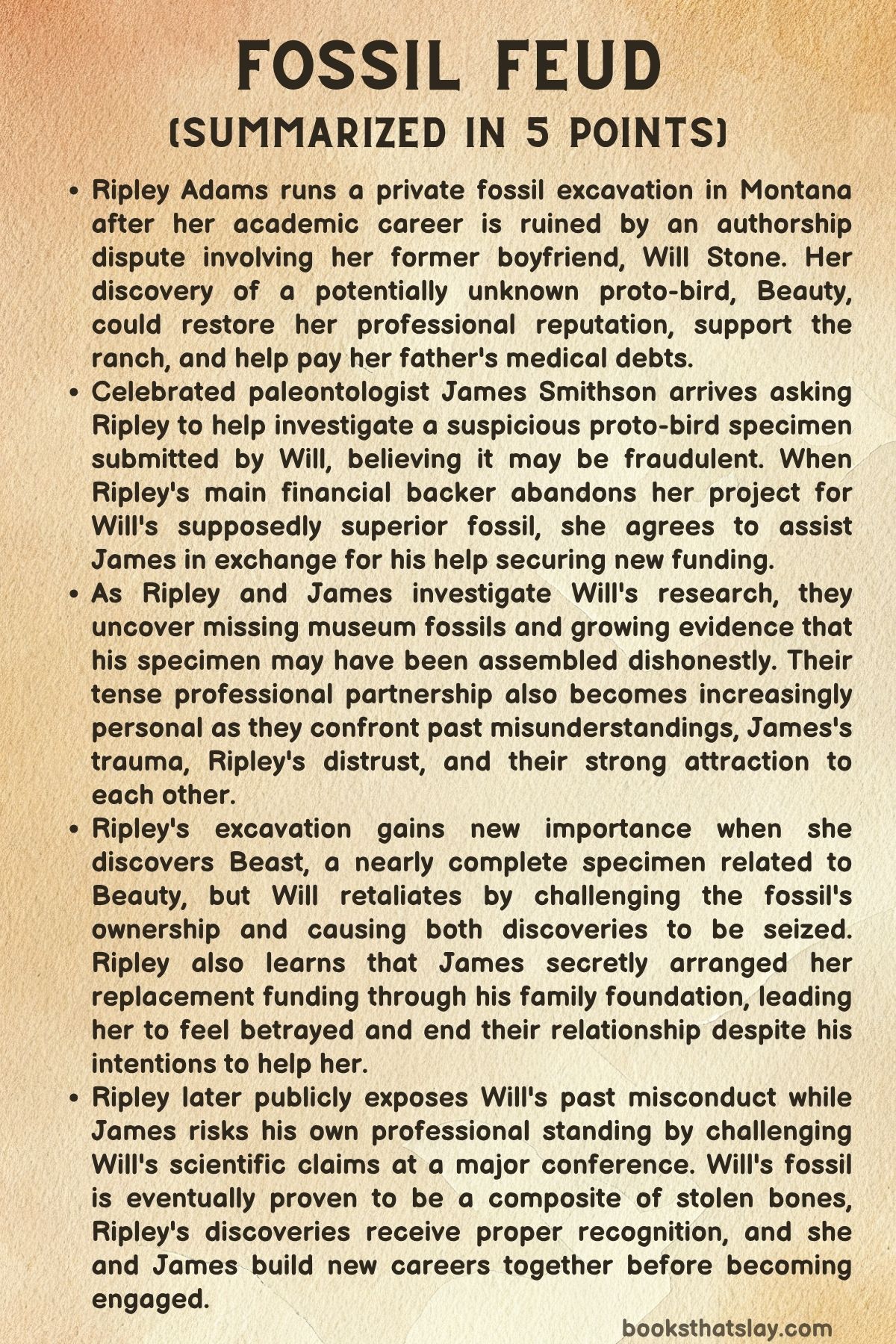
Ripley Adams runs Clever Girl Fossils, a private excavation on Yellowtail Ranch in Montana, after leaving a promising paleobiology PhD under humiliating circumstances. Her most valuable discovery is a delicate proto-bird wing she calls Beauty, which could represent an unknown species and provide enough money to secure the ranch, support her excavation team, and help pay the medical debts of her father, Steve, who has cancer.
Ripley keeps Beauty secret because a discovery of that importance could attract competitors before she finds the rest of the skeleton. Her plans are disrupted when Dr. James Smithson, a famous Oxford paleontologist whom she deeply resents, arrives at the ranch and asks for her help investigating a suspicious scientific paper describing an extraordinarily complete proto-bird from the same region.
James believes the specimen may be fraudulent because its preservation, test results, and supporting evidence appear almost impossibly perfect, while the researchers refuse to allow independent examination. Ripley initially wants nothing to do with him, especially because James once refused to help her when her academic career was collapsing, but the situation changes when she learns that the paper’s lead author is Will Stone, her former boyfriend.
Will is also the person responsible for much of Ripley’s professional downfall. During their relationship, he gained access to her ideas and later claimed that a central breakthrough in her research belonged partly to him, leading their supervisor to demand that Ripley place Will first on a major paper; rather than surrender credit for her own work, Ripley withdrew the paper and lost her path toward completing her doctorate.
The threat becomes immediate when Maury, the billionaire financing Clever Girl, learns about Will’s apparently complete specimen and transfers his support to Will’s project. Ripley is left with only enough money to keep operating briefly, putting Beauty, the Yellowtail family’s investment, her employees, and her hopes of helping Steve in danger.
Ripley therefore proposes a bargain to James. She will help investigate Will’s fossil if James uses his connections to secure replacement financing for Clever Girl, and James agrees, although he insists that he needs to see the excavation and Beauty if he is going to persuade serious donors to invest.
Allowing James into the dig is difficult for Ripley because professional intimacy previously gave Will the opportunity to exploit her work. Yet James repeatedly demonstrates that he understands her ownership of the project, respects her expertise, and is willing to admit when his own views are wrong, including his earlier dismissive attitude toward private fossil collectors.
As James becomes part of camp life, Ripley discovers a version of him that conflicts with the arrogant academic figure she constructed in her memory. He encourages students, respects the excavation crew, reacts to Beauty with genuine scientific wonder, and recognizes immediately that Ripley’s discovery could transform existing ideas about early bird flight.
His presence nevertheless unsettles Ripley because people naturally turn toward his fame and authority, sometimes leaving her feeling invisible beside her own fossil. She makes clear that Beauty belongs professionally to her and Clever Girl, and James accepts the boundary rather than attempting to claim importance merely because he participated in the project.
Their relationship gradually changes during long conversations, fieldwork, meals, and quiet nights at the excavation. Ripley learns that James suffers from severe anxiety surrounding cars because his mother died in an accident when he was young, while James learns the complete truth about the academic injustice that drove Ripley away from university research.
James eventually succeeds in finding an anonymous donor willing to fund the rest of the excavation season. The agreement is unusually favorable to Ripley, guaranteeing scientific study of the fossils and protecting her first authorship, allowing Clever Girl to survive while giving Ripley and James more time to investigate Will.
Their search for evidence leads them to the Royal Tyrrell Museum in Canada, where they learn that Will previously worked inside the research collection. While examining the drawers he accessed, Ripley and James discover multiple missing bones, including material resembling parts of Beauty, and begin to suspect that Will may have assembled his supposedly complete proto-bird using stolen specimens from different institutions.
The trip also forces James to confront his trauma when Ripley narrowly avoids a highway collision. After suffering a panic reaction, James finally admits that he had been attracted to Ripley from the first time he met her years earlier and that fear of becoming professionally involved with someone who might become his student contributed to his cold treatment of her.
Their long-suppressed attraction becomes impossible to deny, and they kiss, but James quickly restores distance between them because he believes a romantic relationship could damage Ripley professionally far more severely than it would damage him. He sees his own reputation, institutional power, wealth, and gender as forms of protection she does not possess and refuses to become another influential man whose choices limit her future.
A visit to Steve further changes Ripley’s understanding of responsibility. She has organized much of her life around protecting her father from illness and financial hardship, but Steve insists on enjoying the life he has rather than treating survival itself as the only goal, reminding Ripley that love does not give her control over another person’s choices.
Ripley and James continue their investigation and eventually become trapped overnight inside the Royal Tyrrell Museum. Away from professional observers, James reveals that paleontology was never entirely his own dream: he loved drawing, fantasy, and dragons as a child, but after his mother’s death he dedicated himself to science partly from guilt and partly because his demanding father taught him that scientific achievement was the only respectable path.
During their night in the museum, Ripley encourages James to consider art as a legitimate part of his identity, while James makes Ripley feel seen in ways she rarely allows herself to experience. They become physically intimate but continue stopping short of fully committing to a relationship, both recognizing that the emotional consequences are already becoming greater than either expected.
Back at Clever Girl, their attempts at distance become increasingly unrealistic. Ripley eventually discovers James’s sketchbook and finds page after page of drawings of herself in ordinary moments, making it clear that his feelings have been present far longer and run far deeper than his cautious language suggests.
James admits that he already loves her but has been afraid Ripley might eventually have to choose between him and the father, career, and Montana life she values. Ripley rejects the idea that avoiding happiness will protect either of them from pain, and they finally decide to accept their relationship even though they have no simple solution for what happens when the excavation season ends.
Their scientific work receives an extraordinary breakthrough when Ripley discovers another proto-bird skeleton beneath storm debris. Unlike Beauty, the new specimen, soon nicknamed Beast, is nearly complete and appears to belong to the same species, giving Ripley the evidence needed to establish the legitimacy and significance of her discovery.
As the team races to remove Beast, Will appears again and reveals how little remorse he feels about taking credit for Ripley’s earlier work. He also discovers the location of her excavation and threatens both her scientific priority and James’s career, particularly because James is involved in investigating Will while romantically involved with Ripley.
James refuses to abandon either the investigation or Ripley simply to protect his own reputation. His decision is important to her because he repeatedly does what Will never did: he acknowledges that Ripley’s ideas belong to her, refuses credit he has not earned, and accepts personal risk rather than transferring that risk onto her.
The team successfully extracts Beast by helicopter and prepares Beauty and Beast for scanning, but their apparent victory collapses when federal authorities seize the fossils after Will claims that Beast was excavated on neighboring property. Ripley realizes that even a temporary legal dispute could prevent her fossil from being recognized before Will publishes his own specimen.
Another revelation is even more personally destructive. Ripley discovers that the anonymous donor who saved Clever Girl was actually the Smithson Foundation and that James secretly arranged the funding through his family, causing her to fear that his name and influence have once again become attached to work she fought to keep professionally independent.
Feeling betrayed, Ripley asks James whether he loves her, but his shocked hesitation confirms every fear she has about placing her trust in powerful people. She sends him away, finishes the season without him, and leaves Yellowtail Ranch separated from both the man she loves and the fossils that were supposed to transform her future.
At Steve’s home, Ripley begins reconsidering the assumptions that have controlled much of her life. Steve explains that she was never responsible for fulfilling his abandoned scientific ambitions or sacrificing her future to make his life perfect; what he wants is for her to choose meaning, joy, purpose, and freedom for herself.
James sends Ripley his original drawings of Beauty along with a letter in which he apologizes for hiding the source of the funding. He removes the arrangements that might compromise her independence, accepts responsibility for violating her trust, and finally says plainly what he could not say when the fossils were seized: he loves her.
Ripley joins her friends in an audacious protest at an American Paleontology Society conference where James is expected to announce Will as the recipient of a prestigious scientific position. Instead, James publicly refuses to endorse him and challenges the irregularities surrounding his fossil, sacrificing his own institutional standing rather than helping legitimize questionable science.
Ripley then presents evidence of Will’s earlier misconduct, including his own statements about taking credit for her research, and publicly connects his behavior toward her with the suspicious fossil and his attack on Clever Girl. Her demand that the scientific community insist on independent verification spreads rapidly online under the slogan Free the Birds, transforming a private professional battle into a wider conversation about scientific accountability, sexism, academic power, and proper attribution.
After the protest, James finds Ripley, and the two finally speak without hiding behind professional rules or imagined future sacrifices. James returns the stone on which he had carved their initials and proposes a life that may involve Montana summers, England, distance, career changes, art, family responsibilities, and uncertainty, but would at least be a future they actively choose.
Ripley accepts that imperfect possibilities are better than refusing love in the hope of avoiding loss. She tells James that she loves him, and they decide to build a shared life without requiring every practical difficulty to be solved in advance.
A year later, both their personal and professional worlds have changed. Will’s proto-bird is exposed as a composite made from bones stolen from six museums, Beauty becomes the holotype of the new species, and Beast becomes the only known complete specimen of Montanopteryx ripleii before being acquired by the Field Museum.
Ripley returns to academia on her own terms and prepares to defend her PhD while maintaining an independent career. She and James establish Life Paleontology beside Clever Girl, James openly develops his career as an illustrator as well as a scientist, Matteo begins his university education, Steve is doing better, and the wider community created through the excavation continues to grow.
At the Clever Girl Museum, James surprises Ripley with reproductions of Beauty and Beast based partly on his artwork. A ring hidden on Beast’s wing leads to his proposal, and Ripley accepts, completing a journey in which both characters stop treating time as something they must either control or fear and instead commit themselves to the future they have chosen together.
Characters
Ripley Adams
At the center of Fossil Feud, Ripley Adams is defined by ability, independence, anger, loyalty, and an intense need to retain ownership of both her work and her life. Her distrust is not simple stubbornness; it is the result of having once allowed someone into her intellectual world only to watch that intimacy become the means by which he damaged her career.
Ripley’s relationship with fossils reflects her broader personality because she values evidence, patience, observation, and the satisfaction of discovering something through her own skill. Beauty and Beast therefore matter to her not only financially or scientifically but psychologically, since recognition of those discoveries would confirm that the academic system’s rejection of her did not erase her intelligence.
Her greatest emotional weakness is her belief that love must be managed through responsibility and controlled distance. She tries to protect Steve through money, protects herself from Cara by refusing complete friendship, and initially protects herself from James by creating professional rules that make emotional attachment seem preventable.
Her growth comes when she begins separating care from control. Steve teaches her that she cannot make his life meaningful by sacrificing her own, Cara shows her that avoiding friendship does not prevent grief, and James forces her to consider whether refusing happiness simply because it might end is actually a form of safety at all.
Professionally, Ripley’s final victory is especially important because she does not merely return to the institution that rejected her. She creates a position in which academia becomes one part of her life rather than the authority that determines her value, allowing her to reclaim scholarship without surrendering independence.
Dr. James Smithson
Within Fossil Feud, James initially appears to represent nearly everything Ripley distrusts: elite education, academic status, inherited wealth, institutional authority, and the confidence of a celebrated male scientist. The book gradually reveals that much of this polished identity has been constructed from fear, guilt, obligation, and years of suppressing the artistic personality he considers insufficiently respectable.
James’s mother’s death becomes central to understanding his devotion to science. Because she died after an argument connected to his desire to pursue art, he converts scientific achievement into a form of penance, while his father’s rigid expectations strengthen his belief that personal happiness must be sacrificed to duty.
His treatment of Ripley is shaped by an unusual mixture of desire and ethical anxiety. James knows that his professional power could protect him from consequences that might destroy Ripley, so his repeated attempts to maintain boundaries come from a legitimate awareness of inequality even when those boundaries also become a method of avoiding emotional risk.
James’s most meaningful quality is his willingness to change when confronted with evidence. He admits when his beliefs about private fossil collecting are unfair, accepts that he misjudged Ripley, publicly protects her ownership of discoveries, challenges Will despite professional consequences, and eventually acknowledges that art is not an embarrassing diversion from his real life.
His romantic growth therefore parallels his artistic growth. Loving Ripley requires him to stop treating desire as something dangerous that must automatically be suppressed, while becoming an illustrator requires him to stop organizing his identity around his father’s definition of duty.
Will Stone
Will serves as Ripley’s clearest example of professional exploitation disguised as entitlement. He believes that proximity to someone else’s thinking gives him a claim over the result, allowing him to reinterpret a casual remark as intellectual contribution and then justify taking credit because he feels he needs or deserves it.
What makes Will especially dangerous is the absence of meaningful remorse. He does not appear to understand Ripley’s career destruction as a moral failure on his part; instead, he rationalizes his behavior and continues using institutions, reputation, secrecy, and procedural delays whenever they benefit him.
His fraudulent proto-bird extends the same character flaw from personal betrayal into scientific misconduct. Whether dealing with Ripley’s paper or stolen museum material, Will treats knowledge as something he can possess if he can successfully control the story surrounding it.
He also functions as James’s moral opposite. Both men have status and ambition, but James repeatedly gives Ripley credit even when association with her discoveries could benefit him, whereas Will converts another person’s achievements into opportunities for himself.
Steve Adams
Steve is the emotional foundation of Ripley’s life and one of the primary reasons she is so desperate for Beauty to succeed. His cancer makes Ripley see time as a resource that can potentially be purchased through money, treatment, comfort, and better circumstances, creating a powerful but unhealthy sense that she must rescue him.
Steve refuses to reduce himself to illness. His relationship with Sally, his appetite for pleasurable food, his humor, and his insistence on making choices Ripley considers medically imperfect demonstrate his determination to experience life rather than merely extend it.
His most important role is helping Ripley understand that children are not responsible for completing their parents’ unfinished ambitions. By telling her that professional paleontology was not actually the life he wanted, he releases her from a burden she has carried without realizing that he never asked her to carry it.
Steve also understands James with surprising clarity. He recognizes the difference between a man who wants to take from Ripley and one who genuinely wants to support her, helping Ripley reconsider whether James’s mistakes belong in the same moral category as Will’s betrayals.
Cara Yellowtail
Cara begins as Ripley’s capable protégée but gradually becomes one of the people most responsible for challenging Ripley’s emotional defenses. She refuses to accept Ripley’s habit of defining close relationships as temporary professional arrangements simply because doing so makes eventual separation seem easier.
Her loyalty is active rather than passive. She supports Ripley during the financial crisis, confronts her jealousy and avoidance, protects the excavation, grows into greater responsibility, and repeatedly tells Ripley uncomfortable truths when reassurance would be easier.
Cara’s relationship with Griff also mirrors Ripley’s relationship with James. Both women discover that loving someone with a different geographical or professional future creates practical complications, but Cara is more willing to acknowledge that difficulty does not automatically make commitment a mistake.
By the end of the story, Cara has become more than an employee or student. Ripley’s willingness to trust her with Beauty and Beast demonstrates that their relationship has matured into professional equality, friendship, and genuine family-like attachment.
Geraldine Yellowtail
Geraldine provides stability, generosity, humor, and local belonging at Yellowtail Ranch. She is invested in Clever Girl financially and emotionally, yet her relationship with Ripley consistently extends beyond business.
Her food, teasing, encouragement, and involvement in camp celebrations create a domestic counterweight to the intense scientific and professional conflicts surrounding the excavation. Geraldine represents the community Ripley has built almost accidentally while insisting that she is merely passing through.
She also sees Ripley’s feelings for James earlier than Ripley is willing to admit them. Rather than forcing decisions, Geraldine creates an environment in which Ripley can experience belonging without having to earn it through achievement.
Matteo
Matteo begins as an inexperienced and careless intern whose mistakes make him appear unreliable. His development is deliberately gradual, allowing the book to show that competence is something people can acquire when they are given instruction, responsibility, and another chance.
By remaining after the excavation season to help without demanding payment, Matteo demonstrates a level of loyalty and maturity that contrasts sharply with his earlier behavior. His connection through his grandfather eventually becomes important to the evidence against Will, making the supposedly least dependable member of the team unexpectedly valuable.
His eventual path toward university study also reflects the alternative mentoring environment Ripley and Clever Girl create. Rather than demanding perfection before granting opportunity, the excavation allows him to become worthy of greater responsibility through experience.
Griff
Griff is most significant through his relationship with Cara and through the alternative model of commitment that relationship provides. His desire to stop living an endlessly mobile excavation life forces both him and Cara to confront the fact that love does not automatically produce matching plans.
Rather than presenting commitment as effortless compatibility, Griff’s relationship requires negotiation between Montana, Australia, work, and personal aspirations. That difficulty quietly prepares Ripley to imagine a future with James that might also require distance, compromise, and repeated adjustment.
Griff additionally belongs to the dependable core of the Clever Girl community. His continued presence reinforces the book’s movement away from temporary field relationships toward chosen bonds that survive beyond a single excavation season.
Dr. Mindy Wong
Mindy is an accomplished paleobotanist whose arrival exposes several of Ripley’s deepest insecurities at once. She represents the academic world Ripley misses, a level of professional confidence Ripley fears she has lost, and a previous romantic connection with James that makes Ripley question her own place in his life.
Her behavior at Clever Girl also demonstrates the difference between expertise and adaptability. Mindy possesses considerable scientific knowledge but does not immediately respect the culture, priorities, and authority of Ripley’s excavation, causing tension with a team that has developed its own professional standards.
Most importantly, Mindy’s presence gives James an opportunity to defend Ripley when Ripley is not supposed to hear him. His insistence that Ripley is the leader of the excavation becomes significant precisely because it occurs privately and therefore cannot be dismissed as romantic performance.
Maury
Maury represents the unstable relationship between private money and scientific work. His initial support allows Clever Girl to operate, but his loyalty depends largely on possessing the most prestigious discovery and potentially having a new species named after him.
When Will appears to possess a better fossil, Maury changes sides quickly, demonstrating the danger of depending on patrons whose priorities are status rather than long-term scientific responsibility. His withdrawal creates the financial crisis that forces Ripley and James into partnership.
Maury is not presented with the personal malice associated with Will. Instead, he represents a system in which valuable research can remain vulnerable to the desires of wealthy individuals when more stable institutional support is unavailable.
Dr. Charlie Bassa
Charlie Bassa brings experience with fossil fraud into the investigation because his own career was damaged by association with Archaeoraptor. That history makes him especially sensitive to accusations involving fraudulent specimens and institutional failures.
Ripley’s suggestion that the museum might somehow be involved in Will’s misconduct therefore strikes at a personal wound, causing Charlie to withdraw from the conversation. His response reminds Ripley that an investigation into wrongdoing can still harm innocent people when accusations are made without sufficient care.
Charlie also represents the lasting human consequences of scientific deception. False specimens do not merely create incorrect data; they damage reputations, trust, careers, and relationships long after the immediate scandal ends.
J. D. Oakes
J.D. is an old excavation friend whose warmth provides Ripley and James with a second route into the Royal Tyrrell Museum’s records. His willingness to help demonstrates the value of relationships Ripley formed before her professional collapse, even when she assumes that much of her former world has disappeared.
His obvious eagerness to impress James also creates a revealing moment of jealousy. Through J.D., Ripley realizes that James wants emotional privileges he has not yet been willing to claim openly, forcing the two of them to confront the contradictions in their attempt to be merely friends.
J.D. ultimately functions as both practical ally and emotional catalyst. His assistance moves the investigation forward while his presence exposes feelings Ripley and James are still trying to hide.
Dr. Ballard
Dr. Ballard represents institutional authority at its most damaging. Faced with the dispute between Ripley and Will, he does not protect the vulnerable researcher whose work is being challenged but instead pressures Ripley to compromise her authorship.
His demand that Will be elevated to first author turns an intellectual dispute into a test of power. Ripley’s refusal costs her enormously, demonstrating how academic structures can make technically voluntary decisions function like coercion when careers depend on senior approval.
Although Ballard appears mainly through Ripley’s past, his influence continues throughout the story because much of her distrust of universities originates in that experience. He becomes a symbol of the institution’s failure to distinguish authority from fairness.
Vivienne
Vivienne, Ripley’s largely absent mother, helps explain Ripley’s discomfort with being shaped according to someone else’s desires. Her attempt to turn young Ripley into a child performer reflects a tendency to see her daughter as a possible extension of her own ambitions rather than as an independent person.
Steve’s defense of Ripley’s right to remain herself becomes one of her defining childhood memories. The contrast between her parents therefore contributes to Ripley’s fierce belief that love should not require someone to become a version of themselves designed for another person’s benefit.
Vivienne’s absence also helps explain why Ripley clings so strongly to Steve. He becomes the parent who stayed, protected her identity, shared paleontology with her, and provided the stable love she could trust.
Sally Gunderson
Sally initially appears through a comic revelation about Steve’s private romantic life, but her importance is greater than the joke surrounding Ripley’s discovery of their relationship. She provides Steve with companionship during a period when Ripley assumes that she alone must be responsible for his comfort and happiness.
Sally helps reveal that Steve possesses a life outside his role as Ripley’s sick father. Her presence forces Ripley to recognize his sexuality, independence, social needs, and right to make choices that have nothing to do with his daughter.
By the end, Sally’s place in the family becomes permanent. Her relationship with Steve reinforces the broader idea that new forms of happiness remain possible even after illness, grief, age, or major disruption.
Daisy Smithson
Daisy is James’s younger sister and one of the people he most strongly wants to protect. His concern for her future partly explains why he remains financially connected to the family structure he otherwise finds restrictive.
She also reveals James’s capacity for loyalty before Ripley fully trusts it. His desire to preserve Daisy’s freedom shows that his resistance to controlling relationships is not merely theoretical but rooted in his awareness of how power operates inside his own family.
Although Daisy remains largely outside the main action, she adds complexity to James’s financial choices. Walking away from inherited money would not affect only him, making his eventual independence more complicated than simple rebellion against his father.
Marie Wellesley
Marie Wellesley’s arrival during the seizure of Beauty and Beast creates one of the story’s most damaging revelations. As James’s sister and a representative of the Smithson Foundation, she unintentionally confirms that the supposedly anonymous rescue funding originated with James’s family.
Her appearance transforms what had seemed like generous financial support into evidence that Ripley interprets as concealed influence. Because Ripley’s central trauma involves men attaching themselves to her work without her informed agreement, Marie’s connection to the funding immediately reactivates those fears.
Marie therefore functions less as an antagonist than as the messenger whose presence exposes James’s serious mistake. The problem is not that the foundation funded Clever Girl, but that Ripley was denied the information necessary to choose whether she accepted that relationship.
James’s Father
James’s father embodies a rigid philosophy in which scientific accomplishment, family reputation, discipline, and obedience are treated as moral virtues. His influence teaches James to distrust his artistic desires and to associate deviation from the expected career path with dishonor.
His control over family money gives these expectations material force. James’s trust fund remains subject to conditions, meaning that paternal approval can affect not only emotional belonging but financial independence and Daisy’s security.
James’s fear of resembling his father also shapes his romantic behavior. He becomes so determined not to redirect a woman’s life according to his own desires that he initially moves toward the opposite mistake, deciding on Ripley’s behalf that loving him would be too costly for her.
James’s Mother
James’s mother remains emotionally powerful despite having died when he was fourteen. A talented chemist, she is associated in James’s mind with science, expectation, love, and the accident around which he builds years of guilt.
Because her death followed conflict concerning his interest in art, James treats scientific achievement almost as repayment for surviving her. He imagines that choosing art would betray both her memory and the family ideals attached to her profession.
Ripley challenges this interpretation by separating love from self-punishment. Through James’s memories of his mother, the story examines how grief can distort obligation until a person begins living according to what they imagine the dead required rather than what the dead might actually have wanted.
Renzo
Renzo is part of the everyday life that makes Clever Girl feel like a community rather than merely an excavation business. As the camp cook, his role places him within the routines that sustain people doing physically exhausting work in an isolated environment.
His presence is quiet compared with the central characters, but that is part of his function. Clever Girl succeeds because scientific discovery depends not only on famous researchers but also on the people who maintain the practical conditions under which research becomes possible.
Finn
Finn belongs to the younger Clever Girl crew and participates in the excavation’s gradual transformation from a temporary workplace into a loyal community. His presence during the discovery of the suspicious drone shows how even less prominent team members become alert to threats against the site.
He later joins Ripley’s group at the APS conference, demonstrating that his loyalty extends beyond the paid excavation season. His participation helps turn Ripley’s confrontation with Will from an individual struggle into collective action.
Fiona
Fiona, like Finn, represents the broader community surrounding Ripley’s scientific work. She contributes to the excavation and later participates in the campaign to challenge Will publicly.
Her return for the conference action demonstrates that Clever Girl’s relationships have survived the collapse of the season. The people Ripley once expected to lose simply because a project ended instead continue choosing involvement in one another’s lives.
Jordin
Jordin is another member of the excavation crew whose presence emphasizes the mixture of backgrounds and future paths within Clever Girl. Returning to Harvard after the field season reinforces the idea that private excavation and academic science do not have to exist as completely separate worlds.
Although Jordin does not drive the central conflict, the character contributes to the community Ripley initially refuses to recognize as permanent. The departure after the fossils are seized also helps communicate how quickly a vibrant field camp can become empty when a season ends.
John Foster
John Foster becomes significant because information from his connection to Matteo contributes to the evidence Ripley later uses against Will. His role demonstrates how seemingly peripheral relationships can become important when formal institutions fail to provide immediate justice.
He also strengthens Matteo’s place in the story. Through John, the intern who once appeared careless becomes connected to evidence capable of helping Ripley challenge a far more powerful opponent.
Themes
Ownership, Credit, and the Ethics of Scientific Recognition
Scientific credit in Fossil Feud is treated as something far more consequential than professional vanity. For Ripley, authorship determines whether years of observation and intellectual labor remain hers, while the loss of credit to Will nearly destroys her ability to continue in the field she loves.
Will’s behavior shows how exploitation can be disguised as collaboration when professional systems allow influential people to redefine another person’s contribution. His insistence that a passing comment entitled him to ownership of Ripley’s breakthrough demonstrates the danger of treating access to someone’s thinking as equivalent to producing that thinking.
The same conflict appears around Beauty and Beast. Ripley becomes highly sensitive to James’s involvement because scientific history often attaches discoveries to the most famous person standing nearby, regardless of who actually recognized, excavated, or interpreted the specimen.
James earns Ripley’s trust largely by rejecting that pattern. When she offers him partial credit for Beast, he refuses because he knows that proximity does not create ownership, establishing a moral distinction between genuine collaboration and appropriation.
The eventual exposure of Will’s composite specimen expands this issue from personal authorship to scientific integrity. Stolen bones, manipulated provenance, restricted testing, and false claims all arise from the same belief that controlling recognition matters more than respecting truth.
The book ultimately argues that proper credit is an ethical necessity because scientific knowledge depends on trustworthy records of who discovered something, where evidence came from, how conclusions were reached, and whether other researchers can independently examine the result.
Love, Control, and the Freedom to Choose
Many of the characters confuse love with responsibility at some point, creating relationships in which protection risks becoming another form of control. Ripley organizes major parts of her life around saving Steve from financial hardship and extending his life, but Steve insists that survival without pleasure would not necessarily represent the life he wants.
James develops the opposite version of the same mistake. Determined not to become like his father, he refuses to pressure Ripley into sacrificing Montana, Steve, or her career, yet his decision to withdraw romantically still assumes that he has the right to decide what sacrifices Ripley should or should not consider.
Their relationship becomes healthier only when each person is allowed to make an informed choice. Ripley does not need James to determine whether loving him is worth the professional or geographical complications, just as James does not need Ripley to decide that abandoning science for art would automatically make him happier.
The secret foundation funding becomes a crucial test because James violates this principle despite acting from generous motives. By withholding the donor’s identity, he prevents Ripley from consenting fully to the arrangement, proving that benevolent intentions cannot replace another person’s right to make decisions about their own life.
Steve, Cara, Griff, and Sally reinforce the same idea in different ways. Love succeeds when people remain free individuals who negotiate shared futures rather than treating devotion as permission to manage one another.
Time, Mortality, and the Decision to Live Fully
Time shapes nearly every major choice in the story. Steve’s cancer makes Ripley acutely aware that life can contract without warning, and she responds by trying to convert scientific success into more time, imagining that Beauty’s financial value might purchase treatment, security, and additional years with her father.
The excavation creates another deadline. Ripley measures her summer against funding, weather, fossil extraction, James’s eventual departure, and the possibility that Will may publish first, causing work and love to become experiences constantly shadowed by an approaching end.
James reacts to mortality differently but with equally severe consequences. His mother’s sudden death leaves him trapped in a past moment he cannot repair, encouraging him to spend years pursuing a scientific life partly as punishment for an argument that occurred before the accident.
Their romance gradually challenges both responses. The possibility of future pain does not make present happiness meaningless, and refusing attachment cannot recover lost time or guarantee protection from grief.
Steve understands this before Ripley does. His willingness to eat what he enjoys, pursue a relationship with Sally, and imagine good experiences ahead is not carelessness but a rejection of the idea that extending life should become more important than actually living it.
The carved stone, the fossils, James’s artwork, and the repeated concern with what remains after people leave all express a desire to preserve moments. By the end, however, Ripley and James no longer need permanence to justify experience; they choose a future because time matters, not because they can control how much of it they will receive.
Identity, Ambition, and Choosing a Life for Yourself
Ripley and James have both allowed professional expectations to define their identities, although they arrive there through very different paths. Ripley genuinely loves paleontology but assumes that losing her academic career means losing the version of herself that could be considered a legitimate scientist.
James possesses the reputation Ripley once wanted but gradually admits that his own scientific career was never entirely chosen freely. His love of drawing, dragons, fantasy, and visual imagination has been treated as secondary because his family taught him that scientific accomplishment carries greater moral and social value.
Their influence on each other is powerful because neither simply tells the other to abandon science. Ripley helps James recognize that illustration can coexist with scientific knowledge, while James helps Ripley understand that returning to scholarship does not require returning to the same institutional structure that once failed her.
The supporting characters strengthen this theme through their own choices. Steve rejects the career Ripley mistakenly believes he sacrificed for her, Cara and Griff reconsider what a future together might require, Matteo grows toward higher education, and Sally helps Steve imagine companionship beyond illness.
By the conclusion, success no longer means fitting into one approved model. Ripley combines academic research with independent fossil work, James combines paleontology with professional art, and their shared company creates another route for people who may not fit comfortably inside conventional institutions.
The resulting idea is not that ambition should be abandoned but that ambition becomes healthier when it belongs to the person pursuing it. A meaningful life can contain science, art, business, love, family, uncertainty, and changing priorities without requiring any single institution or inherited expectation to define the whole person.