Into the Fading Twilight Summary, Characters and Themes
Into the Fading Twilight by Catherine Cowles is a romantic suspense novel centered on survival, recovery, trust, and the difficult process of reclaiming a life after severe trauma. Nova Monroe has survived more than a year of captivity, but freedom brings its own challenges as memories return and the people around her struggle to understand what she needs.
At the center of the story is Kol Archer, the man who finds Nova when she is close to death and later becomes one of the few people who understands that protecting someone is different from controlling them. Their growing relationship develops alongside a dangerous investigation that suggests Nova’s nightmare may not truly be finished. It’s the 2nd book of the Starlight Grove series.
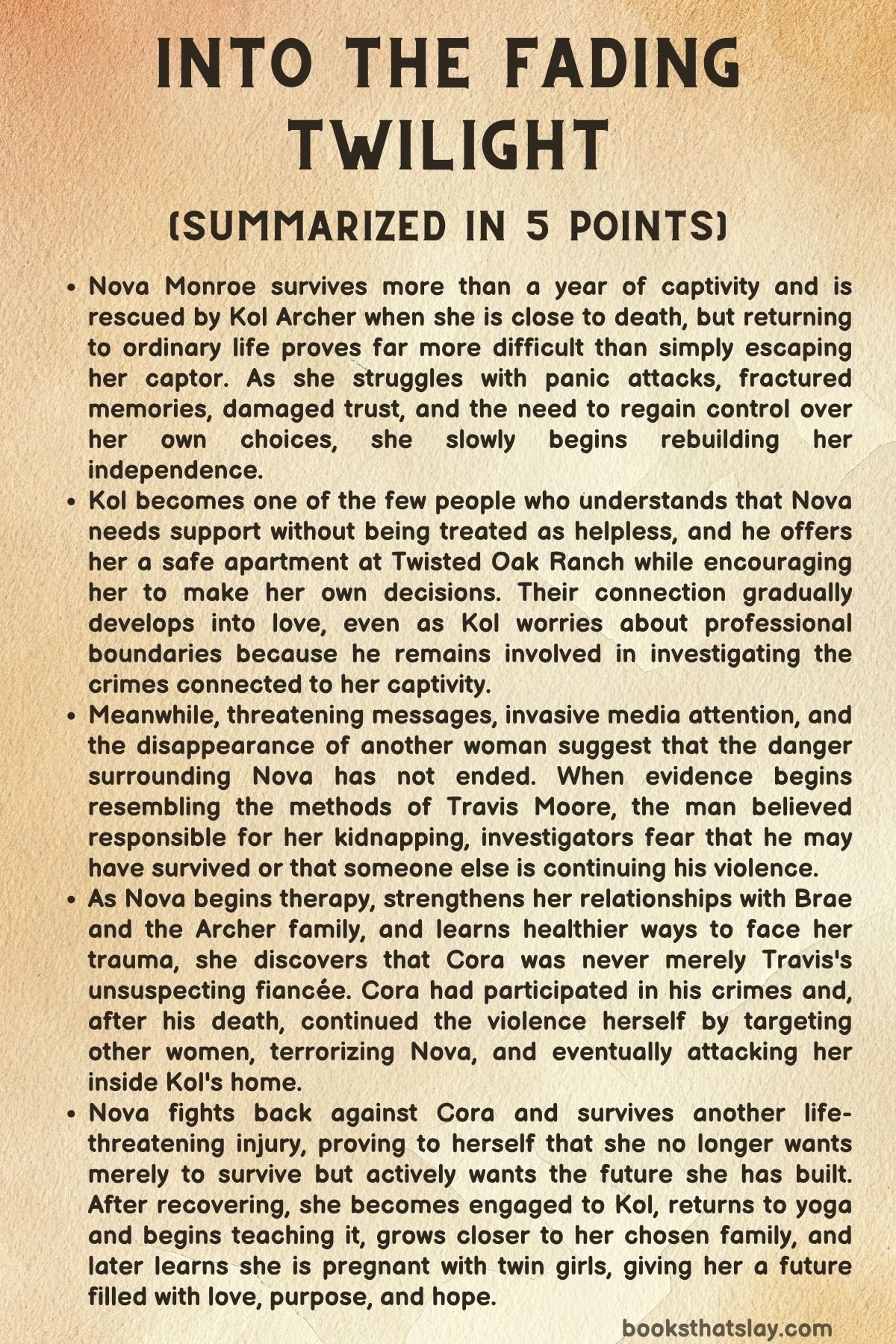
Summary
Nova Monroe has been imprisoned for more than a year when her captor eventually chains her to a tree in the forest and leaves her without food or water. Starved, injured, exhausted, and psychologically broken down, she has reached a point where death seems easier than continuing to fight.
Kol Archer finds her while she is barely conscious and immediately calls for help. When Nova asks him to let her go, Kol understands that she has lost the will to survive, but he refuses to accept her surrender and reminds her that her best friend Brae has never stopped searching for her.
Four months after the rescue, Nova is physically free but finds ordinary life almost impossible to understand. She secretly jumps from a cliff into freezing water because the shock forces her to breathe, giving her unmistakable proof that she is still alive.
She is living with Brae, Brae’s fiancé Dex, and Owen, but the arrangement increasingly makes Nova feel dependent and displaced. Brae loves her deeply, yet constant questions about food, exercise, safety, and health make Nova feel as though someone is still controlling her choices.
Nova begins working at the Boot, hoping employment will restore some independence. There she becomes acquainted with Wylder, Piper, Aidan, Fiona, and Cora, the former fiancée of Travis Moore, the serial killer believed responsible for Nova’s captivity.
Rather than blame Cora for failing to recognize what Travis was, Nova sees another person whose life has been damaged by him. Her ability to recognize suffering in others becomes one of the clearest signs that captivity has not destroyed her capacity for empathy.
Nova’s first shifts are difficult because customers ask invasive questions and unexpected remarks trigger fragments of memory. During one panic episode, Kol finds her and helps her regulate her breathing by focusing on the ground, the trees, and the physical world around her.
Kol calls her Phoenix because he sees someone who has survived destruction and is beginning again. Nova becomes increasingly comfortable around him because he does not demand that she pretend to be fine, nor does he automatically treat vulnerability as weakness.
Kol has his own history with violence. His father, Edmond Archer, was a serial killer, and Kol and his brothers have spent much of their adult lives carrying shame, anger, and responsibility for crimes they did not commit.
Together, the Archer brothers secretly operate the Hourglass Network, investigating disappearances that official systems have overlooked. Kol’s professional investigation into Travis’s victims therefore carries personal meaning, since finding missing people has become part of how the brothers respond to the destruction their father caused.
Nova wants to move out of Brae’s home but cannot afford a suitable apartment and does not yet feel comfortable living completely alone. Kol offers her the apartment above his garage at Twisted Oak Ranch, giving her privacy while keeping trusted people nearby.
The apartment becomes important because it represents the opposite of confinement. It is open, bright, filled with windows, and arranged according to details Kol has quietly learned about Nova, while the locks and security systems remain under her control.
Nova gradually becomes part of the larger Archer family. Skylar, Kol’s eight-year-old daughter, especially reaches her because the child’s open affection feels natural rather than threatening, and Nova begins forming a relationship with her that neither of them expected.
At the same time, someone begins following Nova. Journalist Reese Gatlin repeatedly pressures her to participate in his documentary about Travis, photographs her without permission, investigates her troubled family background, and publishes stories about her despite her refusal to cooperate.
More frightening signs soon appear. Someone leaves newspaper clippings with the warning “NEVER FORGET,” and later a blood-covered necklace belonging to a missing woman named Heidi Ingram appears on Nova’s car with a message declaring that the ordeal is not over.
Heidi disappeared near the same area where Nova was abducted, and evidence suggests methods resembling those used by Travis. Since Travis’s body was never recovered after he was shot and fell into a river, investigators are forced to consider whether he survived or whether another killer is copying him.
As danger increases, Nova’s relationship with Kol becomes more intimate. She tells him that people have been afraid to touch her since her rescue even though she desperately misses physical affection, and when she asks him for a hug, his embrace becomes the first contact that feels completely safe.
Their emotional connection soon turns romantic, but Kol initially resists because he remains officially involved in Nova’s investigation. He worries about professional ethics, his career, Skylar’s stability, and whether Nova’s feelings might be connected to the fact that he rescued her.
Nova refuses to allow him to decide what she feels. Their attraction finally leads to a kiss, although Kol retreats afterward because he remains frightened by the consequences of allowing himself to want a future with her.
Eventually he accepts that his feelings cannot be reduced to responsibility. He loves Nova’s humor, intelligence, defiance, kindness, and determination, while Nova sees beneath his controlled exterior to the guilt and fear that have governed much of his life.
Their first sexual experience is carefully shaped around Nova’s trauma. Because being restrained and physically trapped are major triggers, Kol allows Nova to tie his wrists, giving her control while also surrendering something that is difficult for him because control has always made him feel secure.
The experience allows Nova to reclaim intimacy as something chosen rather than forced. Later, she becomes secure enough to surrender some control herself, demonstrating that her progress is not about erasing fear but about gaining the freedom to decide when trust is deserved.
Nova’s recovering memories remain difficult. After becoming lost while mountain biking, she experiences powerful flashbacks of Travis strangling her and telling her that nobody cared whether she lived.
Kol eventually finds her, and his arrival helps separate the present from the past. The incident also forces both of them to confront unhealthy patterns: Nova sometimes runs from painful emotions, while Kol sometimes tries to control danger because he cannot tolerate the possibility of losing someone he loves.
Nova begins therapy with Marly and works with an abused horse named Twilight. Seeing the animal hesitate before trusting teaches Nova that caution can protect her, but expecting harm from every person and every situation can become another prison.
She also confronts other pieces of her past. She lets Kol cut the long hair she has been afraid to let anyone approach with scissors, speaks openly about returning memories, and finally tells him that she loves him.
Kol says that he loves her as well and decides that continuing as her investigator is no longer appropriate. He informs his superior Sherri Goodwin about their relationship and asks to have the case reassigned, choosing openness rather than hiding behind professional authority.
The danger, however, becomes worse. Heidi is found murdered, and Piper later disappears after leaving the Boot, with blood discovered inside her abandoned vehicle.
Investigators notice that both women resemble Nova, raising the possibility that the killer is selecting victims because of their connection to her appearance. Kol and the Archers become increasingly determined not to leave Nova alone.
Cora then arrives at the ranch claiming Reese attacked her. She appears wounded and tells Kol that Reese escaped into the surrounding area, causing Kol to follow what seems to be a blood trail.
Kol eventually finds Reese seriously injured, but the condition of his wounds reveals that he was attacked much earlier. Kol realizes that Cora lied specifically to lure him away from Nova.
Inside the house, Cora reveals the truth. She was never simply Travis’s unsuspecting fiancée but was his accomplice, and one of Nova’s returning memories confirms that Cora participated in her torture.
Cora explains that she suffered severe abuse during childhood and found comfort in Travis, who eventually helped her murder her abusive mother. Their shared violence grew from there, with Travis becoming fascinated by causing disappearances and then observing the grief of the families searching for the people he had taken.
After Travis’s death, Cora continued the violence herself. She kidnapped and murdered Heidi, abducted Piper, attacked Reese, and deliberately terrorized Nova because she blamed her and the Archer family for destroying the life she shared with Travis.
Cora stabs Nova before Kol can return. When he finally reaches the house, he finds Cora holding a knife to Nova’s throat and cannot safely shoot because Nova’s body is blocking his target.
Nova realizes that waiting for Kol to save her could get them both killed. Remembering the self-defense skills she has learned and everything she now wants to live for, she attacks Cora and creates enough distance for Kol to fire.
Kol shoots Cora, but Nova has already been critically wounded. Her condition deteriorates until she stops breathing, forcing Kol to perform CPR while repeating the words that began their connection: she is alive and she must keep breathing.
Nova survives emergency surgery, although her recovery is difficult. Piper is also found alive after investigators use Cora’s location history to discover where she had been held.
When Nova wakes, Kol blames himself for leaving her, but she refuses to accept his guilt. She explains that he had already given her the strength and knowledge that helped her fight Cora, making her survival something she actively participated in rather than something another person simply handed to her.
Nova eventually returns to Twisted Oak Ranch surrounded by Brae, Skylar, Owen, the Archer brothers, Aster, and the wider family she has gained. What once seemed like temporary shelter has become the first place she genuinely thinks of as home.
Kol proposes with a family ring whose blue-gray stone reminds him of Nova’s eyes and of the twilight in which he first found her. Nova accepts his proposal because the future no longer feels like something she has to fear.
Four months later, therapy has helped Nova regain enough comfort with stillness to return to yoga, and she has begun teaching others. Kol continues helping missing people through the Hourglass Network, Piper is recovering, and the Archer family continues adapting to the consequences of everything that happened.
Nova is also pregnant with twin girls, creating a future that would once have seemed impossible to imagine. Surrounded by love, chosen family, meaningful work, and the man who once refused to let her stop breathing, she reaches a point where survival has grown into a desire for a full life.
Characters
Nova Monroe
Nova is the emotional center of Into the Fading Twilight, and her development depends on the important distinction between being rescued and actually learning how to live after rescue. When the book begins, prolonged starvation, violence, isolation, and psychological manipulation have reduced her world to basic survival, yet the woman who emerges afterward is still intelligent, sarcastic, observant, compassionate, and fiercely resistant to having her choices taken away again.
Her independence sometimes appears self-destructive, particularly through cliff jumping, extreme exercise, and her refusal to admit when she is struggling. These behaviors reveal that control has become psychologically essential to her, since captivity taught her what it meant to have no control over her body, surroundings, or future.
Nova’s strongest development occurs when she learns that accepting help does not automatically mean surrendering independence. Her relationship with Kol, therapy with Marly, friendship with Aster, reconciliation with Brae, and growing bond with Skylar each teach her different forms of trust.
She also refuses to let trauma become her complete identity. By the final part of the story, Nova can acknowledge fear, scars, painful memories, love, sexuality, friendship, and hope without treating any single part of herself as the whole person she has become.
Kol Archer
Kol initially appears to be the stable rescuer, but the novel gradually reveals that his need to protect others is partly rooted in unresolved guilt. Discovering that his father was a serial killer, being absent during the violent crisis that devastated his brothers, and raising Skylar alone have convinced him that constant vigilance is the price of keeping the people he loves safe.
His connection with Nova is powerful because he instinctively understands something the people closest to her sometimes miss. He recognizes that safety cannot be created by taking away her choices, so he offers options, asks permission, adapts when she becomes uncomfortable, and repeatedly reminds her that ultimately she is responsible for making herself safe.
At the same time, Kol does not always live according to his own principles. When fear becomes overwhelming, he becomes controlling, angry, or professionally reckless, showing that his protective instincts can become unhealthy when he confuses love with preventing every possible danger.
His arc in Into the Fading Twilight is therefore about learning that love cannot be guaranteed through control. By stepping away from Nova’s case, admitting his feelings publicly, accepting emotional support, and envisioning marriage and a larger family, he finally allows himself to build a life rather than spending every day atoning for his father’s crimes.
Brae
Brae is Nova’s closest friend and effectively her sister, but their relationship demonstrates how trauma affects the people surrounding a survivor as well as the survivor herself. During Nova’s disappearance, Brae searches relentlessly and develops intense guilt because the hike connected to the kidnapping had been her idea.
After Nova returns, that guilt becomes excessive protectiveness. Brae monitors food, exercise, health, movements, and decisions because she believes constant attention might prevent another disaster, but Nova experiences that attention as another loss of autonomy.
The importance of Brae lies in her ability to recognize the problem once Nova finally confronts her. She admits that fear rather than distrust is driving her behavior, and the two women accept that their friendship cannot simply return to what it was before the kidnapping.
Their bond becomes healthier because they stop trying to recreate the past. Brae learns to stand beside Nova rather than manage her, while Nova becomes able to acknowledge that Brae was also psychologically changed by the year in which she did not know whether her friend was alive.
Skylar
Skylar brings warmth, humor, and emotional clarity into a story filled with adult fear and guilt. Her combination of princess fantasies, tactical interests, glitter, animals, and complete confidence makes her impossible to reduce to anyone else’s expectations.
Her relationship with Nova develops without the hesitation shown by many adults. Sky approaches her naturally, offers affection without defining her by trauma, makes bracelets to help cover her scars until she is ready to expose them, and eventually gives Nova a form of family belonging that feels uncomplicated.
Sky also carries her own wound because her biological mother abandoned her. Her questions about why her mother did not want her reveal insecurity beneath her exuberant personality, allowing Nova to comfort her from personal experience with parental rejection.
The possibility that Nova could become Sky’s mother gives the romantic relationship greater emotional weight. Nova is not simply becoming Kol’s partner; she is becoming part of a child-centered family in which love is defined by presence, acceptance, and consistent choice.
Dex
Dex is both Brae’s fiancé and an important member of the Archer family network. His technical skills make him essential to the secret investigations conducted by the Hourglass Network, particularly when ordinary legal methods cannot uncover the information the brothers need.
He is more comfortable approaching questionable investigative territory than Kol, which creates an interesting contrast between them. Kol normally protects strict professional boundaries, while Dex represents the practical argument that rules sometimes fail people whose cases have already been ignored.
Dex is also a stabilizing presence in Nova and Brae’s relationship. He sees Brae’s fear without dismissing Nova’s frustration and generally avoids forcing himself into conflicts that the two women need to resolve directly.
His loyalty is one of his defining traits. Whether he is helping investigate Reese, searching for missing people, supporting Kol, or protecting the wider family, Dex treats family responsibility as something active rather than sentimental.
Maverick Archer
Maverick hides much of his pain behind jokes, recklessness, teasing, and an appetite for extreme experiences. His attraction to danger initially makes him seem impulsive, but the story gradually shows that adrenaline has become one of the ways he reminds himself that he survived what his father did to him.
That history allows him to understand Nova’s cliff jumping and mountain biking more readily than most people. Instead of immediately condemning her need for an intense physical sensation, he recognizes the emotional logic behind it while still trying to teach her safer ways to seek it.
Maverick’s conflict with Kol also exposes different responses to trauma within the same family. Kol tries to control risk, whereas Maverick deliberately approaches it, and each brother occasionally judges the other’s coping methods without recognizing how similar their underlying fears are.
His unresolved relationship with Aster adds another dimension to him. Their hostility clearly hides old attachment and betrayal, and their eventual engagement suggests that Maverick’s future development will involve confronting emotional vulnerability rather than covering everything with humor.
Orion Archer
Orion is the most withdrawn of the Archer brothers and one of the clearest examples of trauma expressed through isolation. After killing his father while protecting Dex and Maverick, he retreats emotionally and physically, rarely speaks, relies heavily on sign language, and treats the ranch as one of the few places where he can control contact with the outside world.
His initial resistance to Nova living on the property is therefore not simple hostility. Her arrival threatens the carefully protected boundaries he has built around a place that functions as his sanctuary.
Despite that resistance, Orion demonstrates compassion in restrained ways. He gives Nova space when he realizes his presence frightens her, leaves food and chocolate cakes for her, contributes maps and geographical analysis to investigations, and eventually tells Kol that Nova is good for him.
His relationship with Ever reveals how deeply fear governs him. Orion still appears capable of love, but he avoids the person who knows him most intimately because allowing her close would mean risking another devastating loss.
Wylder Archer
Wylder frequently functions as the older, steadier presence within the Archer family. He helps hold the brothers together, supports the Hourglass Network, protects Nova at the Boot, and often notices emotional truths that other characters are trying to hide.
His connection with Cora ultimately gives him one of the cruelest personal blows in the story. He sees her as another person damaged by Travis and begins developing feelings for her, only to discover that she willingly participated in the violence.
That betrayal forces Wylder into a position similar to the one Cora falsely claimed for herself: someone who believed he understood another person and later discovered a hidden capacity for brutality. His withdrawn behavior after her death indicates that factual knowledge of her guilt does not instantly eliminate his grief.
Wylder therefore ends the novel less resolved than several other characters. His reaction suggests that knowing someone committed terrible acts and mourning the person one believed them to be can exist at the same time.
Waylon
Waylon brings eccentricity and comic relief to Twisted Oak Ranch, particularly through his strange animals, Bigfoot enthusiasm, unconventional gifts, and willingness to participate in the family’s chaos. Beneath that humor, however, he is one of the most emotionally perceptive people in Kol’s life.
He recognizes that Kol has spent years behaving as though happiness must be earned through sacrifice. When Kol questions whether Nova’s feelings are genuine, Waylon challenges the assumption that trauma automatically invalidates love.
Waylon also understands the importance of family continuity. Offering Kol his mother’s silver-sapphire ring for Nova turns the proposed marriage into something connected not only to romance but also to acceptance within the larger family history.
His character demonstrates that wisdom in the novel is not always delivered by the most serious person in the room. Some of the clearest truths arrive through someone who can discuss emotional avoidance one moment and Bigfoot the next.
Cora
Cora undergoes the story’s most dramatic reversal. For most of the book, she appears to be a secondary victim of Travis, a woman forced to live with the knowledge that the man she loved was secretly a serial killer.
Nova’s willingness to comfort her makes the later revelation particularly devastating. Cora has been deliberately benefiting from the compassion of people whose suffering she helped create.
Her childhood abuse provides context for the path she followed but never functions as moral absolution. She was imprisoned, starved, and degraded by her mother, then became emotionally dependent on Travis after he provided care and helped her murder that mother.
What follows demonstrates one of the darker ideas in the novel: being harmed does not automatically make a person compassionate toward other victims. Cora converts her suffering into entitlement and violence, eventually convincing herself that her own pain justifies destroying other people’s lives.
After Travis dies, her identity collapses because so much of it had been constructed around their violent partnership. Her attacks on Heidi, Piper, Reese, and Nova become both an attempt to continue Travis’s legacy and an expression of rage toward everyone she believes stole him from her.
Travis Moore
Travis is the primary source of Nova’s trauma even though he is believed dead during much of the present-day action. His power over the story comes from the psychological damage he leaves behind rather than from continued physical presence.
He does not merely imprison and injure Nova; he systematically tries to destroy her belief that anyone cares about her. By repeatedly telling her that nobody is searching and that people are relieved she disappeared, he attacks the emotional vulnerabilities created by her neglectful childhood.
His crimes also demonstrate a desire for control extending far beyond individual victims. Travis enjoys causing disappearances and then observing the grief of the families and communities affected by them, turning other people’s uncertainty into another form of entertainment.
The revelation that Cora shared his violence makes his criminal life even more disturbing. What initially looks like the secret behavior of one isolated predator is eventually revealed as a partnership built on mutual reinforcement, secrecy, and escalating cruelty.
Aster
Aster begins as part of Nova’s developing social circle but becomes increasingly important to her recovery. She understands psychological care professionally enough to recognize that treating a close friend herself would violate appropriate boundaries, which shows a respect for Nova that mirrors Kol’s better instincts.
Instead of presenting therapy as a command, Aster introduces Nova to another possibility. Taking her to Moonridge Meadow Ranch and connecting her with Marly allows Nova to encounter treatment through an environment that feels less clinical and more manageable.
Aster also carries unresolved emotional pain of her own, particularly where Maverick is concerned. Their antagonism clearly comes from an earlier relationship in which she felt disappointed or betrayed by someone she once trusted deeply.
Her eventual engagement to Maverick indicates that the hostility has never represented indifference. Their subplot echoes the larger story’s interest in damaged trust and the possibility that relationships can be rebuilt when people stop hiding from old wounds.
Reese Gatlin
Reese is initially positioned as an obvious external threat because he repeatedly violates Nova’s privacy. He uses investigative journalism less as a search for truth than as a way to gain access to someone whose suffering attracts public attention.
His manipulation is especially clear when he tells Nova that a documentary will exist whether she participates or not. By presenting cooperation as her only way to control the narrative, he attempts to turn another invasion of privacy into something he can describe as empowerment.
Reese therefore represents exploitation rather than the physical violence associated with Travis or Cora. He reminds Nova that survivors can lose ownership of their experiences through public consumption as well as through direct abuse.
The later discovery that Cora attacked him complicates his position without erasing his earlier behavior. He is a victim of Cora’s violence, but becoming a victim does not retroactively make his treatment of Nova ethical.
Piper
Piper initially contributes energy and friendship to life at the Boot. Her excitement over a new romance stands in contrast to Cora’s destroyed ability to trust and briefly symbolizes the ordinary hope that exists outside the central investigation.
Her disappearance changes her role dramatically. Because she resembles Nova, her abduction provides evidence that the new violence may be focused symbolically on Nova even when Nova herself is not physically taken.
Piper’s survival also prevents the ending from becoming completely dominated by death. Although she suffers serious harm, she is rescued and later becomes involved with Compass, suggesting that she chooses to respond to what happened by connecting with other people affected by disappearance and violence.
Her recovery parallels Nova’s without duplicating it. Both survive, but the story leaves room for the idea that survival begins a process rather than completing one.
Ever
Ever is a doctor with a complicated connection to Orion, but her importance extends beyond that relationship. When she treats Nova after the mountain-biking incident, she talks about therapy without pretending that professional help is simple, pleasant, or automatically effective.
Her willingness to admit that she has disliked therapy herself makes her advice credible to Nova. She emphasizes finding the right therapist rather than simply accepting whoever is available, which helps Nova move from outright rejection toward curiosity.
Ever also recognizes the legitimacy of Nova and Kol’s relationship. After speaking privately with Nova, she rejects the idea that Nova is romantically attached to Kol only because he rescued her.
Her continuing love for Orion reveals a more private vulnerability. Ever helps people across the world through medical work, yet part of her constant movement appears connected to fear of building a permanent life that can be lost.
Roger
Roger occupies an important position between friendship, law enforcement, and the complicated history surrounding Travis. He once regarded Travis as a close friend, which means the investigation forces him to confront how completely he misjudged someone he trusted.
Unlike Pete, Roger never treats victims as material for an exciting investigation. His responses repeatedly emphasize the humanity of missing and murdered women, demonstrating the empathy expected from someone with authority.
He also understands Kol well enough to recognize the growing relationship with Nova before Kol formally admits it. Rather than reacting with moral outrage, Roger focuses on the legitimate professional conflict that the relationship creates.
His character reinforces the difference between accountability and condemnation. Kol must address the ethical problem, but Roger does not reduce him to that single mistake.
Sherri Goodwin
Sherri is Kol’s superior and represents professional accountability in the story. She trusts his investigative ability but cannot ignore the conflict created when his relationship with Nova moves from concern into romantic involvement.
Her response is measured rather than punitive. Once Kol admits the truth, Sherri acknowledges that responsibility for Nova’s case must eventually be transferred while also recognizing that an immediate transition may not be practical.
She also refuses to reward Pete simply because he reports Kol. His complaint contains a legitimate underlying concern, but his behavior and lack of judgment make him unsuitable to inherit the investigation.
Sherri therefore illustrates competent authority. She distinguishes between a real ethical issue, personal motives, and actual investigative ability instead of treating them as the same problem.
Pete Simpson
Pete functions as a contrast to Kol’s approach to victims and investigative work. He is arrogant, dismissive, eager for recognition, and at times disturbingly excited by the possibility of another serial killer.
His problem with Kol is not entirely fabricated because Kol genuinely has become too personally involved with Nova’s case. However, Pete’s decision to exploit the situation for professional advantage reveals that his concern is driven at least partly by ambition rather than principle.
His reaction to Heidi’s body is especially revealing. Where others see a murdered young woman and a grieving family, Pete sees the possibility of a larger case.
His eventual demotion and transfer provide consequences for conduct that repeatedly places ego above empathy. The contrast between Pete and Kol suggests that technical participation in justice means little without respect for the people whose lives are being investigated.
Owen
Owen is one of the younger figures who helps reconnect Nova to ordinary affection. His presence reminds her that captivity cost her time with people she loves, strengthening her determination not to allow fear to take more of her life.
Because Owen belongs to the family unit that developed while Nova was missing, he also contributes to her early feeling that she has returned to a world that continued without her. Over time, however, he becomes part of the evidence that she has not been replaced.
His fear after Nova repeatedly disappears reflects the effect her trauma has on the children around her. When he asks whether she is going to leave again, the question expresses attachment rather than control.
Nova’s promise to remain in his life reinforces one of her largest changes. She no longer imagines disappearance as the natural ending of her relationships.
Jack Hooper
Jack is introduced through Compass as a man grieving his murdered wife, Cynthia. His anger toward the people associated with the investigation shows how grief can gradually begin shaping a person’s identity.
He offers to confront Reese for Nova, which comes from protective concern but also exposes how eager he is to direct unresolved rage somewhere. Nova recognizes the danger because she understands what it means for another person’s actions to keep controlling one’s emotional life.
Jack’s participation in equine therapy later suggests that he is attempting to find healthier ways of carrying his loss. His character broadens the novel’s treatment of trauma by showing that families of victims require recovery and support as well.
Marly
Marly represents the professional therapeutic support that Nova initially resists. Her importance comes from the fact that she does not force immediate disclosure or insist that Nova behave according to a predetermined model of recovery.
Working through the horse Twilight, Marly helps Nova recognize a crucial pattern in her thinking. Nova has become accustomed to anticipating attack before another person or animal has actually shown threatening behavior.
Marly does not tell her to become naïve or abandon caution. Instead, she encourages Nova to distinguish between genuine warning signs and expectations created by previous violence.
That distinction makes therapy useful to Nova because it respects the survival instincts that kept her alive while helping her recognize when those instincts are no longer accurately reading the present.
Livie
Livie has a relatively small role but provides an important connection between investigative work and emotional recovery. She is involved professionally with forensic evidence while also participating personally in equine therapy.
That combination quietly challenges the idea that competent professionals are somehow above needing psychological support. Her presence normalizes therapy without turning her into someone defined by it.
She also contributes to the investigation through careful evidence work rather than dramatic action. In a novel where several men compete over authority and investigative control, Livie’s competence functions in a quieter but still necessary register.
Kendra
Kendra is Skylar’s biological mother and appears mainly through Kol’s account of the past. After giving birth, she leaves Sky with Kol and explains that discovering Edmond Archer’s crimes made her fear the family carried some form of inherited psychopathy.
Her actions deeply wound Kol because they reinforce his own fear that his father’s crimes have contaminated him. They also create one of Skylar’s deepest insecurities, since the child naturally interprets abandonment as evidence that something might be wrong with her.
Kendra’s role therefore matters less because of direct presence than because of the emotional consequences she leaves behind. Both Kol and Sky have to learn that another person’s fear or inability to remain does not define their worth.
Heidi Ingram
Heidi is initially presented as a missing young woman whose disappearance transforms the old Travis investigation into an active emergency. The circumstances surrounding her abduction resemble Travis’s methods closely enough to raise the possibility of his survival or a copycat killer.
Her murder proves that the threat is real rather than imagined. Cora’s decision to return Heidi’s body and place a message beneath it shows that the killing is intended not only to end Heidi’s life but also to communicate with the people investigating the case.
Although Heidi receives little direct characterization, her role carries moral importance. Kol’s refusal to treat her as merely another piece of evidence distinguishes his approach from Pete’s fascination with having a new serial-killer investigation.
Fiona
Fiona is part of the supportive environment Nova finds at the Boot. Her maternal presence contributes to making the workplace feel less like a public stage and more like a community where Nova can gradually rebuild confidence.
She is not central to the mystery, but characters such as Fiona matter because recovery does not occur only through dramatic acts. Ordinary kindness, routine interactions, and familiar faces help Nova reconstruct a daily life that is not organized entirely around danger.
Aidan
Aidan contributes flirtation and lighter social energy to the Boot. His presence helps establish the bar as a real social environment rather than simply a setting for the investigation.
For Nova, being around people such as Aidan also provides opportunities to experience ordinary interactions after a year in which every human encounter was controlled by a captor. Even minor social relationships therefore participate in the larger restoration of normal life.
Alma
Alma is the mother of Maya, one of Travis’s victims, and represents the families left behind by violent disappearance. Her participation in Compass shows the continuing consequences of Travis’s actions beyond the people he directly attacked.
Through figures like Alma, the story makes clear that murder creates circles of long-term damage. Families must live with grief, unanswered questions, anger, and the terrible knowledge that someone deliberately chose to destroy a person they loved.
Maya, Cynthia, Amber MacIntosh, and Kimmy Oliver
Maya and Cynthia are identified as victims connected to Travis, while Amber MacIntosh and Kimmy Oliver emerge as possible additional victims examined through the Hourglass Network. None receives enough direct narrative attention for a fully individualized psychological portrait, but their presence expands the scale of the crimes beyond Nova’s personal experience.
They also explain why Kol refuses to treat the investigation as finished simply because Nova survived and Travis is believed dead. Each missing or murdered woman represents a family still entitled to answers, making the search for truth a responsibility that extends beyond the central romance.
Themes
Reclaiming Agency After Trauma
Freedom in Into the Fading Twilight is presented as something far more complicated than escaping physical captivity. Nova can leave a room, drive a car, work at the Boot, or live in her own apartment, yet still feel controlled whenever other people decide what she should eat, where she should go, how she should heal, or what risks she should be allowed to take.
Her struggle for agency explains behaviors that initially appear contradictory. Cliff jumping and extreme exercise are dangerous, yet for Nova they begin as acts in which her body responds to a choice she has made rather than to violence imposed by someone else.
The novel gradually develops a healthier version of the same need. Nova chooses where she lives, chooses whether Kol can touch her, chooses when intimacy can progress, chooses therapy, chooses to cut her hair, and ultimately chooses to fight Cora rather than wait passively for rescue.
This makes recovery an active process rather than a return to a previous self. Nova does not regain freedom by becoming the woman she was before Travis; she gains it by developing the authority to decide who she wants to be after him.
Protection, Control, and the Meaning of Safety
The difference between keeping someone safe and controlling that person’s life appears repeatedly through Brae and Kol. Both love Nova intensely, and both occasionally respond to fear by trying to reduce every possible danger around her.
Brae’s monitoring of food, exercise, and daily decisions initially makes Nova feel trapped inside someone else’s definition of recovery. Kol understands this problem more clearly, yet even he becomes controlling when Nova’s adrenaline-seeking behavior or the active threat against her makes his fear stronger than his judgment.
The healthier moments occur when protection becomes collaborative. Kol gives Nova defensive tools instead of promising that she will never need to protect herself, shares his location when asking her to share hers, and installs security measures that Nova controls.
Safety therefore becomes less about removing danger from the world and more about giving a person resources, trusted relationships, and freedom of choice. Nova cannot guarantee that she will never be harmed again, just as Kol cannot guarantee that everyone he loves will survive, but both can learn to face uncertainty without turning love into confinement.
Chosen Family and the Rejection of Inherited Shame
Many central characters have been failed or damaged by biological family relationships. Nova grows up with neglectful parents, Kol and his brothers are the sons of a serial killer, Skylar is abandoned by her mother, and Cora describes severe abuse during childhood.
The story repeatedly asks what people do with the damage they inherit. Kol spends years trying to compensate for his father’s crimes, as though goodness must be continuously proven, while Nova has internalized the idea that people eventually leave because that lesson was established long before Travis reinforced it.
The Archer family offers an alternative model based on repeated choice rather than blood alone. Brae becomes Nova’s sister in every meaningful sense, Skylar and Owen accept her into their lives, Waylon offers eccentric affection, Orion quietly makes cakes, and the brothers protect one another even when their different coping mechanisms create conflict.
Cora provides the darker contrast because she allows early abuse to become part of the justification for later cruelty. The novel never denies the importance of what happened to her, but it insists that suffering cannot remove responsibility for what a person chooses to do with that pain.
Breathing, Twilight, and Choosing to Live
Breathing begins as the most basic sign that Nova has not died. When Kol finds her, she has nearly surrendered, so his insistence that she is alive and breathing becomes the first challenge to the hopelessness Travis spent months creating.
The phrase later develops into an emotional anchor. Nova repeats it during panic, remembers Kol’s voice when frightening memories return, and uses physical experiences such as cold water to force herself into awareness of her own body.
Its meaning changes most powerfully during the final confrontation. After Cora stabs Nova and Nova stops breathing, Kol performs CPR and repeats the same message, but this time the woman he is fighting to save is no longer someone who wants permission to die.
Twilight carries a similar transformation because it exists between darkness and light. Nova was first found during twilight when she was close to death, but later twilights belong to conversations, intimacy, peace, family, and finally Kol’s proposal, turning the image into a reminder that darkness and light can occupy the same life without darkness having the final word.