The Night Hunter Summary, Characters and Themes
The Night Hunter by Natalie Moss is a survival thriller built around family guilt, wildlife conservation, betrayal, and the consequences of secrets kept for too long. Danielle Johnson returns to a South African game reserve after her mother’s death, expecting an uncomfortable confrontation with her past rather than a fight for survival.
A mysterious final instruction from her mother, a murdered guide, armed pursuers, and old family conflicts gradually transform the journey into something far more dangerous. At its center is Danielle’s troubled bond with her younger sister Grace and the childhood incident that has shaped both women in ways neither fully understands.
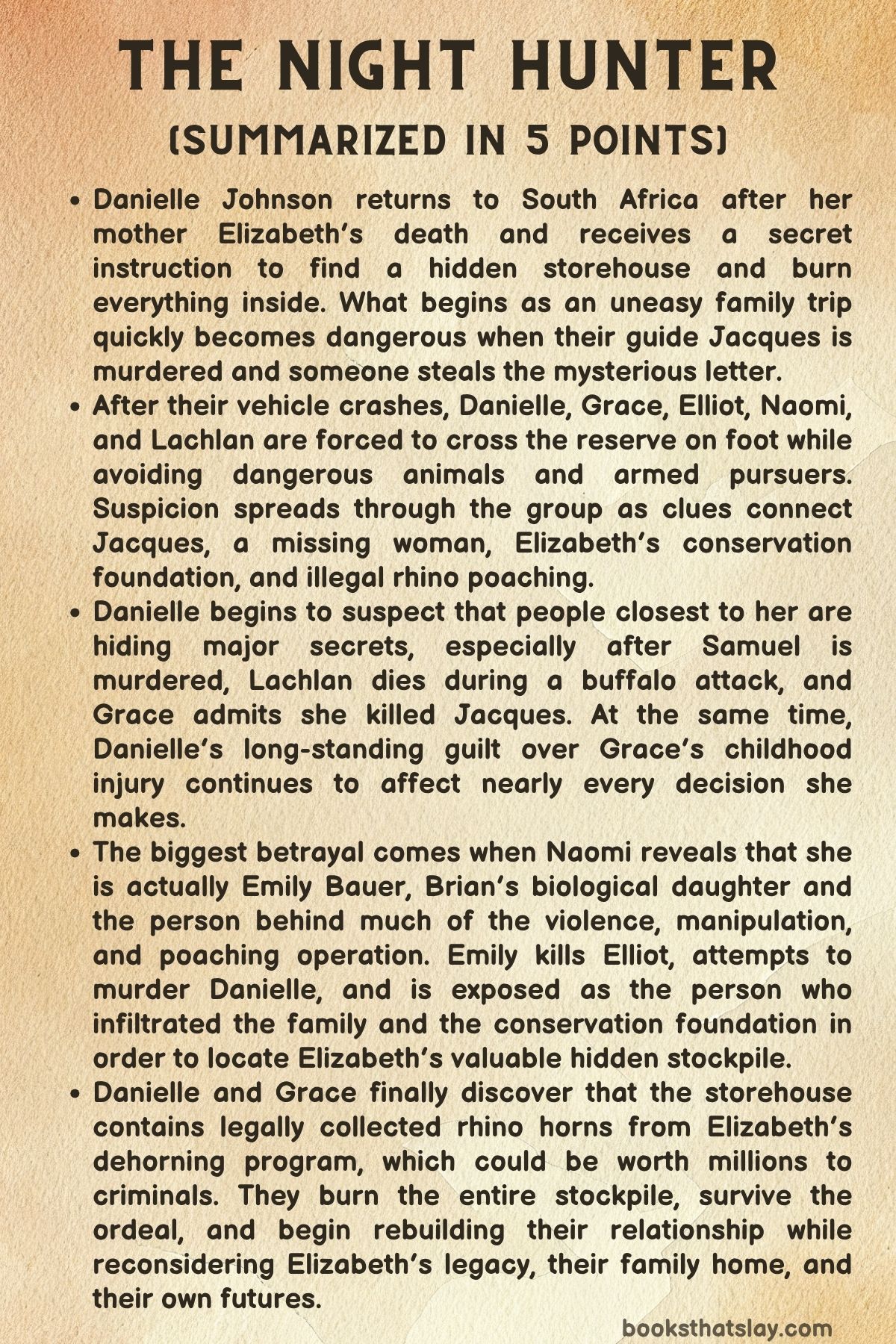
Summary
Fifteen years before the main events, twelve-year-old Danielle Johnson is playing with her younger sister Grace near their home in the South African bush. Grace slips beyond the property boundary, where Danielle eventually finds her cornered by a hyena.
Terrified for both of them, Danielle initially runs instead of confronting the animal. Grace’s screams and the consequences of what happens that day become the defining source of Danielle’s guilt, influencing her relationship with her sister, her mother Elizabeth, and South Africa itself.
As an adult, Danielle has built a controlled and successful life in London as a corporate lawyer. After Elizabeth dies, however, Danielle reluctantly returns to Impala Ridge Private Game Reserve with her boyfriend Elliot and her close friend Naomi because she and Grace have inherited their mother’s house.
Grace has a much warmer connection to the reserve and to Elizabeth’s conservation legacy. She has also invited Lachlan, a former professional rugby player she met several months earlier, without consulting Danielle.
Their safari guide, Jacques Odendaal, immediately makes Danielle uncomfortable. He appears distracted, speaks privately with a suspicious bald man, and gives Danielle two letters Elizabeth left behind.
Grace’s letter is affectionate and straightforward, but Danielle’s contains a secret instruction. Elizabeth orders her to find a hidden storehouse behind the family property, burn everything inside, and tell absolutely no one.
As the group travels deeper into the drought-stricken reserve, Danielle becomes increasingly suspicious of Jacques. She learns that Elizabeth’s Three Rivers Wildlife Foundation has recently experienced financial problems, staff dismissals, and controversy surrounding Elizabeth’s belief that controlled legal trade in ivory and rhino horn might eventually support conservation.
The differences between Danielle and Grace become sharper. Danielle remembers a mother who repeatedly placed conservation before family, while Grace remembers reconnecting with Elizabeth and strongly admires her work.
The following morning, Jacques disappears. Danielle searches for him and finds his body in a tree beneath a leopard, but a knife lodged in his neck proves that an animal did not kill him.
Returning to camp, Danielle discovers that someone has searched their tents. Elizabeth’s secret letter has vanished.
The group attempts to leave immediately, but Grace insists on driving toward the family house rather than the reserve gate. During an argument, she swerves to avoid an impala, crashes the Land Cruiser, and leaves everyone stranded without transportation.
Danielle later finds Elizabeth’s letter among Jacques’s possessions, proving that he stole it. She also discovers newspaper material concerning Elizabeth and Three Rivers, suggesting Jacques had been investigating the family for reasons he deliberately concealed.
With no realistic rescue route, Danielle, Grace, Elliot, Naomi, and Lachlan begin walking through the reserve toward the house. Heat, dehydration, dangerous wildlife, and growing mistrust quickly turn the journey into a survival struggle.
Danielle learns that Jacques had contacted Grace rather than the other way around. She also discovers a photograph of Jacques with a woman named Emily, recognizing the woman as the same supposedly missing person displayed on a poster near the reserve entrance.
This revelation suggests Jacques entered the reserve because he was searching for Emily and believed her disappearance was connected to Elizabeth or Three Rivers.
The group later reaches a river by following coordinates stored in Jacques’s wildlife tracker. Across the water they see the bald man Danielle noticed earlier, accompanied by a woman.
Grace recognizes them as people who had been following the group. Moments later the man opens fire with a rifle, forcing everyone to escape while frightened hippos create chaos in the river.
The tracker becomes another clue. Several of Jacques’s saved locations correspond with places connected to the mysterious armed pair, leading Danielle to suspect the strangers are searching those coordinates as well.
Their already strained relationships begin deteriorating. Grace accuses Danielle of constantly controlling her, while Elliot challenges Danielle’s habit of withholding information and refusing to trust him with painful parts of her life.
They eventually encounter two reserve rangers, Themba Ndlovu and Samuel. Themba once worked with Elizabeth and confirms that the armed man and woman have caused trouble in the area before.
Samuel recognizes Jacques as someone who had previously searched for his missing girlfriend. His reaction to the name Emily also convinces Danielle that the rangers know much more than they are admitting.
Danielle secretly overhears Themba and Samuel discussing Emily and a mysterious “supply.” Before the group can be rescued, Samuel is murdered and the radio is destroyed.
Themba tells Danielle that he believes someone traveling with her is responsible. Suspicion falls heavily on Lachlan because of his aggression, secrecy, earlier argument with Jacques, and constant possession of the group’s rifle.
Danielle and Naomi attempt to take the weapon from him. Searching Lachlan’s belongings reveals numerous prescription painkillers, exposing his struggle with addiction following the injury that ended his rugby career.
Lachlan explains that Jacques discovered the drugs and confiscated some of them, which caused their argument. He denies killing Jacques or Samuel, and his actions soon support his claim when he risks his life to save Danielle from a wounded buffalo.
The buffalo fatally injures Lachlan. His death leaves Grace and Danielle blaming themselves and each other, while Danielle becomes less certain that she has correctly judged anyone around her.
Overwhelmed by guilt, Danielle leaves the others and follows another tracker coordinate. She discovers four slaughtered rhinos whose horns have been removed.
One animal remains barely alive. Danielle desperately tries to help it until Grace arrives and, recognizing that the rhino cannot survive, shoots it to end its suffering.
The sisters finally exchange some of their secrets. Grace says she believed Jacques was helping poachers because she heard part of a suspicious radio conversation, while Danielle reveals Elizabeth’s letter ordering her to burn the hidden storehouse.
Grace also explains that Brian, Elizabeth’s second husband and foundation partner, may have been romantically involved with a woman whose name sounded like Emily. The sisters therefore begin wondering whether Brian, Emily, the missing woman, the poachers, and the foundation are all connected.
After reaching the family house, Danielle searches Brian’s office. She finds evidence of extensive Three Rivers layoffs and discovers that someone named Emily Bauer was listed as Head of Operations.
Then Brian’s decomposing body falls from a cabinet.
The discovery overturns Danielle’s assumption that Brian is directing the poaching operation. Moments later, an even more shocking confession arrives: Grace admits that she killed Jacques.
Grace claims she confronted Jacques because she believed he was helping poachers and became frightened during the encounter. She escapes after Naomi and Elliot arrive, leaving Danielle uncertain whether her sister may also have murdered Samuel.
The armed pursuers then attack the house. Naomi escapes toward the river while Elliot is shot in the arm.
Danielle hides Elliot in dense forest and tries to distract their attackers. When she later reconnects with Naomi, however, Naomi suddenly turns against her and knocks her unconscious.
Danielle awakens restrained and finally learns the truth. Naomi is actually Emily Bauer.
Emily is Brian’s biological daughter and therefore connected to Danielle and Grace through Brian. She deliberately befriended Danielle after learning who she was and secretly became the private buyer attempting to purchase the inherited property.
She infiltrated Three Rivers, manipulated Brian, engineered staff dismissals, supported the poaching operation, tampered with the safari, murdered Samuel, killed Brian, and repeatedly deceived everyone around her. The woman from Jacques’s photograph is not Emily at all but Liyana, Jacques’s real missing girlfriend.
Emily’s ultimate objective is Elizabeth’s hidden storehouse. She believes its contents are valuable enough to justify years of manipulation and multiple deaths.
Danielle escapes and reunites with Elliot, who has discovered both the camouflaged storehouse and Elizabeth’s hidden Land Cruiser. Before they can flee, Emily and her armed accomplices surround them.
Elliot tries to expose Emily’s plan to sacrifice the poachers and place responsibility for the crimes on them. Emily responds by shooting Elliot in the chest.
Danielle tries desperately to save him, but Elliot dies. The man she repeatedly kept at emotional distance proves to have been unwaveringly loyal to her until the end.
Emily then abandons Danielle tied to a tree in the wilderness, expecting animals to kill her. Grace eventually finds her and begins cutting her free.
Grace now tells Danielle the full truth about Jacques. Emily had manipulated her into believing Jacques was assisting poachers, deliberately created a confrontation, and placed Grace in a situation where she believed Emily’s life was threatened.
Grace struck Jacques with the knife during the struggle and killed him, but she had never intended to murder him. Emily then persuaded her to help stage the campsite as though poachers had attacked it.
Danielle responds by confessing the secret she has carried since childhood. During Grace’s encounter with the hyena, Danielle eventually returned with a rifle and attempted to save her.
At twelve years old and terrified, she fired badly and struck Grace instead. Much of the permanent damage to Grace’s arm therefore came from Danielle’s bullet, and Elizabeth concealed the truth to protect both daughters.
Emily returns before the sisters can resolve what Danielle has revealed. Danielle and Emily fight, and Grace comes back to protect Danielle.
When Emily attacks Grace, Danielle obtains the rifle. Facing a situation that echoes the childhood disaster, Danielle steadies herself rather than acting blindly and shoots Emily in the shoulder.
Emily escapes, but Danielle refuses to fire again.
Back at the property, Danielle and Grace finally locate Elizabeth’s hidden storehouse. Inside is an enormous stockpile of legally obtained rhino horns collected through Three Rivers’ dehorning program.
Elizabeth had believed regulated horn sales might someday fund wildlife protection while reducing incentives for poaching. Until such a system existed, she stored the removed horns rather than destroying them.
The collection is worth millions on the illegal market, explaining why Emily and the poachers were desperate to find it. Danielle finally understands Elizabeth’s instruction: now that criminals know of its existence, the stockpile can never be secure.
Danielle and Grace burn the entire collection.
When Themba and other rangers arrive, investigations begin. Danielle protects Grace by claiming that Emily killed Jacques.
The missing woman is finally identified as Liyana, an intern who worked for Elizabeth and dated Jacques. Liyana explains that she secretly copied useful wildlife coordinates to Jacques’s tracker so he could improve his safari guiding.
After Elizabeth became ill, Emily infiltrated the foundation through Brian. Criminals later tried to force Liyana to reveal information about the secret storehouse, causing her to disappear into protective hiding without Jacques knowing the truth.
Jacques had therefore come to Impala Ridge because he was genuinely searching for Liyana. Emily used his investigation, Grace’s loyalty to conservation, and everyone’s suspicions to make him appear guilty.
In the aftermath, Grace considers helping rebuild Three Rivers alongside those trying to connect wildlife protection with employment, education, and local economic development. Danielle stops trying to dictate what her sister should do.
Danielle also decides against selling their mother’s house. Despite everything she has lost, including the future she might have shared with Elliot, she begins accepting that protecting Grace does not mean controlling her.
The sisters finally travel into the reserve and locate a healthy rhino family with three calves. As long-awaited rain begins falling, Danielle recognizes that destroying Elizabeth’s horn stockpile did not mean abandoning her mother’s mission.
What remains is the responsibility to protect life without allowing fear, guilt, inherited expectations, or secrecy to determine every decision. Danielle ends the ordeal with a simpler hope for the animals, herself, and Grace: survival.
Characters
Danielle Johnson
Danielle is the central character of The Night Hunter, and nearly every major conflict is filtered through her complicated relationship with fear, responsibility, and guilt. She has built an orderly professional life in London partly because order allows her to avoid the uncertainty associated with the South African wilderness and the unresolved memories of Grace’s childhood injuries.
Her strongest characteristic is her instinct to assume responsibility for other people. She believes she must protect Grace, manage crises, conceal dangerous information, decide which truths others can handle, and carry emotional burdens without assistance.
This creates a paradox in her personality. Danielle is genuinely loving and courageous, but her protectiveness frequently becomes controlling because she does not distinguish between caring for someone and making decisions on that person’s behalf.
Her relationship with Grace is therefore based partly on affection and partly on guilt. Danielle sees her sister’s damaged arm as physical evidence of her own failure, long before the full truth about the childhood shooting is revealed.
She also struggles with emotional intimacy. Elliot repeatedly asks her to trust him, yet Danielle continues withholding information because secrecy has become her primary method of surviving difficult emotions.
Her development comes through accepting that control cannot eliminate loss. Jacques, Lachlan, Elliot, Elizabeth, Grace, and even the wounded rhino repeatedly force her to confront situations in which she cannot save everyone.
By the end, Danielle is still capable of deception, particularly when she protects Grace from investigators, so her development is not presented as moral perfection. What changes is her understanding of responsibility: she begins separating genuine care from the need to control another person’s choices.
Grace Johnson
Grace initially appears to be Danielle’s vulnerable younger sister, but the novel gradually challenges that interpretation. Her permanently injured arm and Danielle’s memories encourage the assumption that Grace needs protection, yet Grace repeatedly demonstrates greater confidence than Danielle in the wilderness.
She understands animal behavior, finds underground water, recognizes familiar terrain, considers becoming a guide, and remains composed during the elephant encounter. Her willingness to stand between Lachlan’s rifle and the elephant especially shows how differently she responds to danger.
Grace’s conflict with Danielle comes from years of being treated as though childhood trauma permanently reduced her independence. She resents Danielle’s opinions about her education, career, relationships, residence, and the inherited house because she experiences them as extensions of the same assumption: Danielle knows what is best for her.
Her devotion to Elizabeth is another source of tension. Because Grace rebuilt a relationship with their mother, she views Elizabeth’s conservation work with admiration rather than resentment.
Grace nevertheless possesses dangerous impulsiveness. Her killing of Jacques demonstrates how quickly conviction, fear, and manipulated information can lead her into irreversible action.
Her tragedy is that Emily understands precisely how to exploit her. By convincing Grace that Jacques is assisting poachers, Emily transforms Grace’s loyalty to wildlife into a weapon.
Grace’s final actions show both courage and emotional complexity. She rescues Danielle despite learning devastating truths about the past, proving that anger does not erase her love for her sister.
Elizabeth Johnson
Elizabeth dominates the novel despite dying before the central journey begins. Her beliefs, choices, secrets, relationships, and conservation work shape almost every major event.
She is fiercely committed to wildlife and teaches Danielle from childhood that nature cannot be understood through simple categories of heroes and villains. Predators kill because survival demands it, prey animals die so others can live, and responsible conservation sometimes requires decisions that appear cruel when separated from ecological realities.
The same uncompromising worldview damages her family relationships. Elizabeth often expects children to possess emotional resilience far beyond their age, leaves Danielle with responsibilities she should never have carried, and assumes Danielle will eventually inherit a conservation mission she never requested.
Yet Elizabeth is not simply an uncaring mother. Moments from Danielle’s childhood show tenderness, while Danielle’s father explains that Elizabeth continued making difficult trips to Britain because she wanted to maintain contact with her daughters.
Her response after Grace’s childhood injury reveals both her strengths and weaknesses. Elizabeth eventually recognizes that twelve-year-old Danielle should never have been left responsible for Grace, but instead of confronting the trauma openly, she creates a lie intended to protect the family.
That decision influences the next fifteen years. Elizabeth becomes an example of how protection through secrecy can create damage that lasts longer than the truth itself.
Emily Bauer / Naomi
Emily is the central human antagonist of The Night Hunter, but her effectiveness comes from the fact that she spends much of the story occupying the role of Danielle’s closest friend. As Naomi, she offers humor, comfort, loyalty, and emotional support, giving Danielle one of the few relationships in which she believes she can relax.
That friendship is eventually exposed as calculated infiltration. Emily befriends Danielle because she is Brian’s biological daughter and wants access to the Johnson inheritance, the foundation, and ultimately Elizabeth’s hidden horn stockpile.
Her greatest weapon is not physical violence but psychological manipulation. She studies what people fear, need, resent, and believe, then supplies information designed to push them toward choices that benefit her.
Grace becomes convinced Jacques is connected to poachers because Emily interprets his radio conversation for her. Danielle becomes suspicious of numerous innocent or partially innocent people because Emily allows uncertainty to spread.
Emily is also willing to escalate from deception into murder whenever someone threatens her plans. Samuel, Brian, and Elliot die because she regards human relationships as tools rather than moral obligations.
Her false friendship with Danielle makes her betrayal especially destructive. Danielle does not merely discover that Naomi committed crimes; she discovers that years of emotional intimacy were built on invented identity and strategic observation.
Elliot
Elliot represents the possibility of a healthier form of love than Danielle initially knows how to accept. He is patient and supportive, but he does not confuse support with unquestioning acceptance of Danielle’s emotional barriers.
Throughout the journey, Elliot repeatedly asks to be included in Danielle’s life. His frustration is not primarily about curiosity; he recognizes that intimacy cannot survive if Danielle continually decides which truths he is permitted to know.
Unlike Danielle’s relationship with Grace, Elliot’s relationship with her depends on equality. He does not want her to protect him from difficult information, and he refuses to allow her to take responsibility for choices made by Grace, Emily, or the poachers.
His loyalty becomes increasingly clear as danger escalates. Even after being shot, he continues helping Danielle, discovers the storehouse and hidden vehicle, and attempts to expose Emily’s manipulation of her own accomplices.
His death is especially significant because Danielle had feared fully committing to their shared future. The engagement ring she discovered before the trip represents possibilities she delayed confronting.
Elliot therefore becomes connected to one of Danielle’s deepest lessons: refusing vulnerability does not prevent loss. It only reduces the amount of openness available before loss occurs.
Jacques Odendaal
Jacques is deliberately constructed as a suspicious figure. His evasiveness, research into Elizabeth, unexplained interest in Grace, theft of Danielle’s letter, connection with the missing woman, and argument with Lachlan all make him appear capable of serious wrongdoing.
The eventual explanation transforms those clues without erasing his flaws. Jacques had come to the reserve because he was desperately searching for Liyana, his missing girlfriend, and believed answers might be connected to Elizabeth or Three Rivers.
His secretive behavior therefore has an emotional motive rather than a criminal one. He does not trust the people around him enough to explain what he is doing, making him vulnerable to misunderstanding.
Grace kills him because Emily convinces her that he is working with poachers. His death becomes one of the clearest demonstrations of the destructive power of manipulated information.
Jacques is not idealized after his innocence becomes clearer. His earlier professional misconduct, sexist dismissal of Grace’s guiding ambitions, secrecy, and poor judgment remain part of his character.
His tragedy lies in searching for someone he loves while unknowingly walking into a situation designed to make his motives look sinister.
Lachlan
Lachlan is initially presented through Danielle’s suspicion. His size, aggression, possessiveness toward Grace, hostility toward Jacques, and unwillingness to surrender the rifle make him appear increasingly dangerous.
The discovery of his medication changes the interpretation of his behavior. Lachlan has been struggling with chronic pain and addiction following the injury that destroyed his professional rugby career.
His secrecy is driven less by murderous intent than by shame, dependence, and fear of losing control over access to the drugs. His argument with Jacques occurred because Jacques discovered the medication rather than because Lachlan was involved in poaching.
Lachlan remains flawed. His protectiveness toward Grace frequently becomes possessive, and his temper creates genuine danger during the journey.
Yet his decision to save Danielle from the buffalo reveals that he is capable of acting selflessly toward someone with whom he has repeatedly clashed. His death forces Danielle to recognize how quickly suspicion can become certainty when people interpret incomplete evidence according to existing prejudice.
Grace’s comparison between Lachlan’s controlling coach and Danielle is also important. Lachlan’s life illustrates the emotional cost of being forced into identities and expectations chosen by other people.
Brian Johnson
Brian is Elizabeth’s second husband and one of the founders associated with Three Rivers. His relationship with Elizabeth first appears through Danielle’s childhood memories, when his admiration for her conservation work is already visible.
After Elizabeth’s death, Brian becomes an obvious suspect. He resents the terms of her will, controls foundation decisions, authorizes widespread layoffs, and appears to have had a relationship with someone named Emily.
The discovery of his corpse reveals that he is not directing the current violence. Instead, he has become another victim of Emily’s attempt to control the foundation and locate the horn stockpile.
His role nevertheless carries moral ambiguity. Through Brian, Emily gains access to Three Rivers, and his personal connection with her leaves the organization vulnerable.
The revelation that Emily is his biological daughter adds another layer to his history. His abandonment of her helps explain some of her resentment, although it does not justify the choices she later makes.
Brian consequently occupies an uncomfortable position between perpetrator and victim. His decisions contribute to the crisis, but the scale of Emily’s violence goes far beyond anything his personal failures can excuse.
Liyana
Liyana is absent for most of the active journey but remains central to the mystery. Jacques’s photograph and the missing-person poster cause Danielle to believe that Liyana is Emily, an assumption deliberately encouraged by the woman pretending to be Naomi.
The truth reveals Liyana as an intern who genuinely worked with Elizabeth and gathered wildlife information. She also dated Jacques and quietly entered useful animal locations into his tracker so he could improve the quality of his guided safaris.
Her disappearance is an act of survival rather than evidence of criminal activity. After people connected to Emily attempt to abduct her and force information about the storehouse from her, she goes into hiding under ranger protection.
Because Jacques does not know she is safe, he begins his own investigation. Liyana therefore becomes the missing piece required to understand why Jacques behaved so secretively.
Her eventual testimony exposes one of the novel’s central patterns: characters repeatedly construct convincing stories from incomplete evidence, while the truth remains hidden behind assumptions encouraged by someone else.
Themba Ndlovu
Themba initially enters as another uncertain figure because Danielle has already learned that apparently trustworthy people may have hidden motives. His concealed campsite, guarded behavior, and reluctance to explain the poachers create understandable suspicion.
His history with Elizabeth complicates his role further. Danielle recognizes that he once worked alongside her mother when he was younger, connecting him directly to the foundation’s earlier years.
Despite his secrecy, Themba remains committed to protecting the stranded travelers. When Samuel is murdered, he does not know whom within Danielle’s group he can trust and therefore leaves to obtain reinforcements.
His warning that one of them is a killer redirects Danielle’s suspicion toward Lachlan, demonstrating how truthful information can still lead someone toward the wrong conclusion.
Themba ultimately returns with rangers after Danielle and Grace destroy the horn stockpile. His role provides an important contrast with the illegal exploitation of wildlife occurring around him: he represents conservation carried out through professional responsibility rather than personal obsession.
Samuel
Samuel has less time in the story than Themba, but his death significantly changes the direction of the mystery. He recognizes Jacques as a man who had repeatedly searched for information about his missing girlfriend and clearly reacts when Danielle mentions Emily.
His guarded behavior causes Danielle to suspect that the rangers may be hiding dangerous information. In reality, Samuel and Themba are already investigating threats within the reserve and know that someone connected to the name Emily is associated with criminal activity.
Samuel is murdered because he possesses information that could interfere with Emily’s plans. The destruction of his radio shows that his death is strategic rather than accidental.
His murder also demonstrates Emily’s ability to redirect suspicion. Because she remains inside Danielle’s trusted circle, Danielle searches for threats among the more visibly unstable people around her rather than questioning her closest friend.
Bandile
Bandile appears most prominently after the immediate danger has passed, but he is important because he helps replace speculation with verified facts. As a senior figure involved in the investigation, he listens to Danielle’s account and connects her with Liyana.
Through Bandile, the surviving characters learn why Liyana disappeared and how the reserve authorities had been protecting her. His information clarifies the distinction between what the rangers actually knew and what Danielle assumed they knew.
He also represents the institutional future of conservation after Elizabeth. Wildlife protection cannot depend entirely on one forceful personality; it requires coordinated management, trained staff, community participation, and reliable information.
Bandile’s presence helps shift the story from a personal family mystery toward the practical work required after the violence ends.
Amahle Molemi
Amahle is one of the original figures associated with the Three Rivers Wildlife Foundation and represents continuity within Elizabeth’s conservation project. Although she does not dominate the survival narrative, her importance increases when Grace considers what should happen after the crisis.
Grace’s possible future work with Amahle suggests that the foundation may survive without reproducing Elizabeth’s exact methods. The emerging plans emphasize partnerships, community-owned reserves, employment, education, and conservation working together.
Amahle therefore functions partly as a bridge between Elizabeth’s legacy and Grace’s independent future. Grace can participate in wildlife protection without simply inheriting the identity Elizabeth once tried to impose on Danielle.
Danielle and Grace’s Father
The sisters’ father plays a relatively limited direct role but provides an important alternative interpretation of Elizabeth. Danielle has spent years understanding the divorce and custody arrangements as evidence that Elizabeth chose conservation over her daughters.
Her father refuses to support that simple judgment. He explains that Elizabeth struggled deeply in cities yet continued traveling to Britain because maintaining contact with her children mattered to her.
He also notices similarities between Danielle and Elizabeth that Danielle would rather deny. Both women can become consumed by responsibility, make promises they struggle to keep, and convince themselves that their choices are necessary for people they love.
His perspective does not erase Elizabeth’s failures. Instead, it forces Danielle to recognize that someone can cause genuine emotional damage without being completely indifferent or cruel.
The Armed Poachers
The unnamed man and woman pursuing the group provide the immediate physical danger throughout much of the story. Their rifles, hidden vehicle, attacks around the river, and pursuit near the family property make the threat of organized wildlife crime tangible.
They are dangerous, but they are ultimately employees rather than masterminds. Emily directs their actions while planning to leave them responsible for the resulting crimes.
Their decision to abandon Emily once Elliot exposes that possibility shows that their loyalty is transactional. They participate willingly in violence for profit but have no desire to become sacrifices for Emily’s personal ambitions.
Their presence keeps the conservation conflict grounded in material incentives. Rhino horn has enormous criminal value, and that value turns information about animal locations and stored horns into something people are willing to kill for.
Themes
Guilt, Responsibility, and the Need for Control
Danielle has spent fifteen years treating guilt as a permanent obligation. Because she believes she failed Grace during the childhood attack, she responds by trying to manage her sister’s adult life, convinced that vigilance can compensate for what happened when they were children.
That pattern expands beyond Grace. Danielle hides information from Elliot, privately investigates Jacques, decides which dangers others should know about, and repeatedly assumes that every terrible outcome somehow belongs to her.
The Night Hunter gradually distinguishes responsibility from self-punishment. Danielle is responsible for choices she makes, but she is not responsible for Grace’s every decision, Emily’s crimes, Lachlan’s addiction, the buffalo’s attack, or the poachers’ violence.
Elliot understands this distinction more clearly than Danielle. Even after being shot, he refuses to let her blame herself for choices made by the people attacking them.
Grace’s anger also forces Danielle to recognize that excessive protection can deny another person independence. Her constant attempt to prevent Grace from suffering becomes another way of controlling her.
The theme reaches its clearest form when Danielle finally stops trying to choose Grace’s future. Responsibility becomes less about controlling outcomes and more about acting with honesty, courage, and respect when control is impossible.
Secrets, Lies, and the Damage Caused by Protection
Secrets are rarely presented as harmless, even when they begin with protective intentions. Elizabeth hides Danielle’s responsibility for Grace’s childhood injury because she wants to protect both daughters, yet the resulting lie leaves Danielle carrying private guilt for fifteen years.
Danielle repeats her mother’s behavior. She hides Elizabeth’s letter, conceals her suspicions, withholds Samuel’s death, avoids telling Elliot everything, and eventually lies to investigators to protect Grace.
The difference between protective secrecy and manipulative deception becomes increasingly important. Danielle and Elizabeth hide truths because they believe knowledge may hurt someone, while Emily lies because misinformation gives her power over people.
Yet even well-intentioned secrecy produces consequences. Danielle’s silence causes Elliot to question whether she truly trusts him, while Elizabeth’s lie prevents Grace and Danielle from processing their shared childhood trauma honestly.
Emily succeeds largely because she enters a family already accustomed to incomplete truths. Everyone is so practiced at concealing information that another person’s secrecy does not immediately appear extraordinary.
The story therefore treats honesty not as a guarantee against suffering but as a necessary condition for genuine relationships. Truth may cause pain, but concealed truth allows fear and assumption to shape entire lives.
Survival and the Moral Complexity of Nature
Survival operates both literally and morally throughout the novel. Elizabeth teaches Danielle as a child that nature does not organize itself according to human ideas of innocence and cruelty: predators kill, prey dies, and life continues through processes that can appear brutal.
Danielle initially resists this philosophy because she associates it with Elizabeth’s emotional harshness. During the journey, however, she repeatedly encounters situations in which survival requires difficult decisions rather than ideal solutions.
Grace shooting the mortally wounded rhino is one example. Danielle desperately wants to save the animal, but Grace recognizes that ending its suffering is the only meaningful action remaining.
Burning the horn stockpile creates another conflict. Elizabeth accumulated the horns because she imagined a future in which regulated sales could support conservation, but once criminals discover the collection, preserving it creates an unacceptable danger.
Survival also changes Danielle’s understanding of courage. Courage does not mean never feeling fear, nor does survival always mean defeating an enemy.
Danielle ultimately chooses not to shoot the fleeing Emily a second time. After so much death, survival includes deciding when not to kill, even when anger might make violence feel justified.
Family, Inheritance, and Choosing One’s Own Future
Inheritance in the story extends far beyond property. Danielle and Grace inherit a house, a conservation foundation, their mother’s reputation, unresolved family conflicts, and expectations about who they should become.
Elizabeth assumes Danielle will eventually continue her conservation work because she views the foundation as something larger than individual preference. Danielle experiences that expectation as another example of her mother treating duty as more important than personal freedom.
Danielle later repeats the same pattern with Grace. She has strong opinions about where Grace should live, what work she should pursue, whom she should trust, and whether the inherited house should be sold.
Grace’s resistance forces Danielle to confront an uncomfortable resemblance between herself and Elizabeth. Both women can justify controlling behavior as responsibility.
The ending offers a different model of inheritance. Grace may choose to work with Amahle and help rebuild conservation efforts, but the decision belongs to her rather than to Elizabeth or Danielle.
Danielle likewise chooses to help preserve the family house without demanding control over Grace’s future. The sisters do not reject everything Elizabeth left behind, but neither do they accept it unchanged.
Their inheritance becomes something they can evaluate, reshape, preserve, or destroy according to their own judgment, allowing family legacy to influence their lives without dictating them.