Chasing Hope Summary, Characters and Themes
Chasing Hope by Mads Rafferty is a contemporary romance centered on Evie Ellington and Matteo Valenti, two people whose bond has existed since childhood but has been shaped by secrets, fear, trauma, and years of unspoken love.
What begins with Evie losing her job, boyfriend, and closest friendship develops into a much larger story about recovering memories of childhood abuse and learning to reclaim control over her life. Matteo becomes a steady source of support without taking Evie’s choices away from her, while their friendship gradually changes into the relationship both have wanted for years. It’s the 3rd book of the IceHawks series.
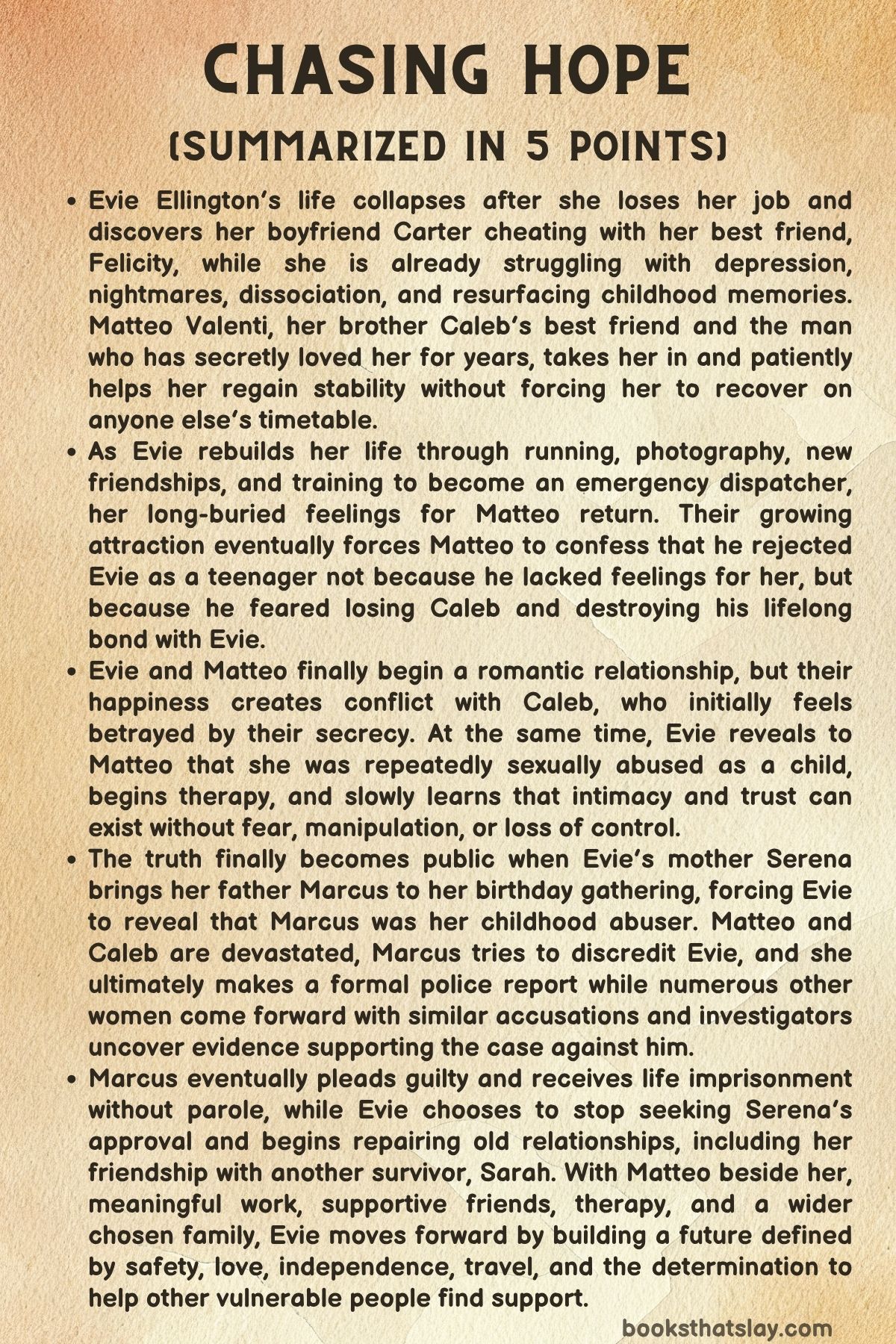
Summary
Evie Ellington’s life begins falling apart when she returns home unexpectedly and discovers her boyfriend, Carter, sleeping with Felicity, the woman Evie considered her best friend. The betrayal comes at the worst possible time because Evie has already lost her job and has been struggling with depression, sleeplessness, dissociation, and disturbing memories from childhood.
Her brother Caleb is traveling to Greece and cannot reach her himself, so he calls his best friend and hockey teammate Matteo Valenti. Matteo has known Evie almost her entire life, and his concern for her is far deeper than Caleb realizes.
Matteo finds Evie in the parking garage destroying Carter’s BMW with a baseball bat. Rather than stopping her, he joins her, allowing her anger to come out before taking control of the practical problems Carter has created.
He confronts Carter and Felicity, forces Carter to take responsibility for their apartment, packs Evie’s immediate belongings, and physically retaliates when Carter speaks about Evie disrespectfully. Matteo then takes Evie to the apartment he shares with Caleb, where he prepares a guest room specifically for her and makes it clear that she can stay as long as she needs.
Evie’s emotional condition soon proves far more serious than ordinary heartbreak. Her relationship with Carter had become controlling and dismissive, but the deepest cause of her deterioration comes from disturbing childhood memories that have begun returning after years of absence.
Matteo recognizes that Evie has changed dramatically. The lively, argumentative girl he has always known now spends long periods withdrawn, struggles to eat, suffers severe nightmares, and sometimes seems mentally absent.
Their connection has existed since childhood. When Evie was very young, she already experienced nightmares involving a mysterious “monster,” and Matteo was one of the few people whose presence helped her feel safe.
As adults, that instinctive sense of safety remains. Matteo encourages Evie to begin moving again through hiking, running, cooking, and ordinary routines, never demanding that she suddenly become the person she once was.
Evie gradually admits that something much worse than Carter’s betrayal is haunting her. She cannot yet identify what happened or name the person involved, but she tells Matteo that if he knew everything, she fears he would want to kill someone.
Her recovery suffers a major setback after a conversation with her mother, Serena. Evie has attempted to tell Serena that memories of childhood sexual abuse have returned, but Serena refuses to believe her and instead defends the person Evie is accusing.
Serena’s rejection pushes Evie into a severe depressive episode lasting more than a week. Matteo repeatedly offers food, coffee, invitations outside, running equipment, and simple companionship, understanding that he cannot force her out of depression but can make sure she never feels abandoned.
Eventually Evie chooses to run with him. Physical movement helps her reconnect with the present, and she promises Matteo that she will keep trying even when she cannot imagine how to repair everything that has been broken.
As Evie begins rebuilding her daily life, her old feelings for Matteo become harder to ignore. She has loved him for years, but she believes he once made it clear that Caleb mattered more to him than any possibility of a relationship with her.
Matteo is hiding the opposite truth. He has loved Evie since they were young and preserved even the handmade bracelet she gave him as a child, repairing it rather than allowing it to disappear when it broke.
Meanwhile, Evie begins creating a future that belongs to her. She applies to the Denver Dispatcher Academy and discovers that emergency dispatch work gives her a sense of purpose because she understands what it means to desperately need someone to listen and believe that danger is real.
She builds friendships with Angel, Tristan, and Kalani and also grows closer to the women connected with the IceHawks. For the first time in months, her emotional world no longer depends entirely on people who have hurt or abandoned her.
The unresolved attraction between Matteo and Evie continues increasing until they finally confront their shared history. Evie accuses Matteo of rejecting her years earlier because preserving his friendship with Caleb mattered more to him.
Matteo admits that the explanation was a lie. When he was eighteen and Evie was sixteen, he had been deeply in love with her but was terrified of the age difference, Caleb’s reaction, and the possibility that a failed romance could permanently cost him the person he valued most.
His attempt to protect their friendship instead caused years of misunderstanding. In the present, Matteo tells Evie he will no longer allow fear of Caleb’s reaction to determine his choices and promises that this time he is choosing her.
They finally kiss, only for the elevator doors to open and reveal Caleb standing there. Furious that his best friend and sister have become romantically involved without telling him, Caleb attacks Matteo and knocks him unconscious.
The fight creates another painful fracture for Evie because Caleb quickly realizes she is keeping a far larger secret from him. He demands honesty, unaware that the truth she cannot say aloud is that their own father sexually abused her throughout childhood.
Soon afterward, Evie finally tells Matteo that she was repeatedly abused as a child. She still cannot name her abuser, but the disclosure allows Matteo to understand her nightmares, dissociation, fear of certain kinds of physical closeness, and conflict with Serena.
Matteo believes her immediately. Although he feels guilty for having been present in the Ellington household without recognizing what was happening, Evie reminds him that he was only a child and could not have understood an abuse she herself could barely name.
Evie begins therapy with Dr. Elizabeth Stutton and starts confronting the memories she has spent years avoiding. She learns that the event that triggered their return occurred during sex with Carter, when restraint caused her body to react as though an earlier assault were happening again.
Therapy does not remove her fear immediately, but it gives her a structured way to process it. Matteo supports her by giving her space when she asks for it and comfort when she wants it, rather than treating her recovery as something he can complete for her.
Their romantic relationship also develops carefully. Eventually they become sexually intimate, and Matteo continually checks Evie’s comfort and gives her control over what happens.
For Evie, the experience creates a radically different understanding of intimacy. Instead of disconnecting from her body or performing for someone else, she remains present and discovers that physical closeness can involve desire, trust, communication, and choice.
The central family crisis finally erupts on Evie’s birthday. Serena arrives unexpectedly with Marcus Ellington, Evie and Caleb’s father, believing she can force some form of reconciliation.
Seeing Marcus destroys any remaining possibility of silence. Evie publicly reveals that Marcus is the man who sexually abused her throughout childhood.
The revelation devastates both Matteo and Caleb. Marcus was not merely Evie’s father but also a respected adult Matteo once viewed as a substitute father, making the truth a destruction of childhood assumptions for all three of them.
Matteo attacks Marcus, and Caleb later does the same after fully understanding what his father has done. Marcus responds by pressing assault charges against Caleb, leading to Caleb’s arrest and forcing Evie to decide how much of her story she is prepared to tell authorities.
At the police station, she decides she no longer wants to give only a limited statement. She formally reports the years of abuse, beginning a criminal investigation.
The decision exposes her private trauma to public attention. Reporters surround Evie and repeat narratives suggesting she is unstable, while Marcus and Serena attempt to undermine her credibility.
Evie and Caleb finally have the conversation she feared. Caleb realizes that the childhood nights when Evie begged to sleep in his room were attempts to escape their father and collapses under guilt for failing to protect her.
Evie cannot remove his guilt, but she understands that Caleb was also a child manipulated by Marcus. Their relationship begins recovering as Caleb also apologizes for his reaction to Evie and Matteo’s romance.
Matteo and Caleb similarly repair their friendship. Caleb finally accepts that Matteo has loved Evie for years and admits that, among all the men he knows, Matteo is the person he trusts most to stand beside his sister.
As the investigation expands, more women come forward accusing Marcus of abuse. Their stories horrify Evie but also prove that his crimes were part of a larger pattern.
Kieran helps Evie transform some of her despair into anger by reminding her that responsibility belongs entirely to Marcus. Evie gradually decides that she wants justice not only for herself but also for the child she once was and the other girls Marcus harmed.
She and Matteo openly declare their love. Matteo returns the childhood bracelet Evie made for him, placing it around her wrist as a symbol of the safety they once tried to give each other when neither fully understood what the other was surviving.
Three months later, Marcus faces sentencing. Thirty-seven additional women have come forward, and investigators have uncovered photographic and digital evidence connected with the exploitation of minors.
Marcus pleads guilty to numerous offenses and receives life imprisonment without the possibility of parole. Serena remains loyal to him even after the evidence becomes overwhelming, confirming that Evie cannot build her healing around receiving the maternal validation she once desperately wanted.
After sentencing, Evie reconnects with Sarah, a childhood friend whose sudden disappearance had confused her for years. Sarah reveals that Marcus assaulted her too and threatened her dog to ensure her silence.
Their reunion helps Evie understand that Sarah never abandoned her because she stopped caring. Both girls were victims of the same man, and they agree to rebuild their friendship slowly.
Evie also chooses to stop pursuing Serena’s approval. Rather than continuing to ask why her mother refused to protect her, she begins protecting her own peace by walking away.
Two months later, Evie and Matteo are openly planning their future. Matteo gives her a North Star necklace and a world map that represents the traveling and experiences they intend to share together.
Their wider community has also grown. Friends from hockey, dispatch, the book club, and the survivor network have become part of the chosen family surrounding them.
Matteo and Kieran launch a child-safety website designed to give children a discreet way to request help when they are unsafe. The project converts part of Matteo’s helplessness over what happened to Evie into something capable of protecting other children.
Evie no longer defines herself only by what Marcus stole from her. She has meaningful work, friendships, renewed relationships, therapy, independence, and a loving partnership based on respect for her choices.
The story ends with Matteo and Evie surrounded by people who have chosen to believe, support, and love them. Their hope does not depend on forgetting the past but on continuing to build a life in which the past no longer decides what they are allowed to become.
Characters
Evie Ellington
Evie is the emotional center of Chasing Hope, and her development is shaped by the gradual movement from isolation and self-doubt toward autonomy, purpose, and the ability to trust her own experiences. At the beginning, she appears to be reacting to a catastrophic breakup, yet it soon becomes clear that Carter and Felicity’s betrayal is only one layer of a much older crisis.
Her resurfacing childhood memories leave her struggling with depression, insomnia, dissociation, fear, and confusion about whether she can trust what her own mind is revealing. The rejection she receives from Serena makes that struggle worse because Evie has spent much of her life learning that the safest response to pain is silence.
Evie’s progress is deliberately uneven. She can run, laugh, flirt with Matteo, or become excited about dispatch work and then later be overwhelmed by a memory that makes her feel as though every step forward has vanished.
What distinguishes her development is that healing never becomes dependent on returning to a supposedly untouched former version of herself. Evie instead creates a different life built around boundaries, meaningful employment, supportive friendships, therapy, and the right to determine who is allowed access to her.
Her decision to become a dispatcher is especially significant because it converts her knowledge of helplessness into empathy. She wants to become the voice that listens when frightened people call for help because she knows how damaging it is to speak and not be believed.
Her eventual decision to report Marcus is therefore connected to the same evolution. She stops allowing fear of other people’s reactions to determine whether she is permitted to tell the truth, even though doing so exposes her to public scrutiny and family destruction.
Her relationship with Matteo also reflects this larger movement toward control. Evie chooses when to disclose her trauma, when to begin therapy, when to resume physical intimacy, when to speak publicly, and when to cut Serena out of her life.
By the ending, Evie has not forgotten what happened to her, nor is she represented as permanently untouched by it. Her victory lies in establishing that trauma can remain part of her history without retaining ownership of her identity or future.
Matteo Valenti
Matteo is both Evie’s romantic partner and one of the principal sources of stability in Chasing Hope. His love for her has existed since childhood, but fear led him to hide it for years because he believed sacrificing romance would preserve his relationships with both Evie and Caleb.
His central strength is his consistency. When Evie becomes severely depressed, Matteo repeatedly appears with food, coffee, invitations, practical help, or simple companionship even when she rejects every attempt.
Importantly, he gradually learns that supporting Evie is different from solving her problems. Matteo has a strong protective instinct and initially wants to confront every person who has hurt her, but the more he understands her trauma, the more carefully he respects her right to control disclosure, treatment, and legal action.
His childhood also explains why the Ellington family matters so much to him. His own parents are wealthy but emotionally unavailable, making Caleb and Evie’s home the place where Matteo once believed he had found the warmth and belonging absent from his own family.
The revelation about Marcus therefore injures Matteo on multiple levels. He is horrified by what happened to Evie, guilty that he never saw it, and forced to recognize that a man he admired was simultaneously terrorizing the person Matteo cared about most.
His relationship with Evie eventually gives him something he has wanted but rarely admitted: open affection, domestic peace, emotional security, and the possibility of creating a family defined by presence rather than neglect. Cutting contact with his parents at the end further demonstrates his decision to stop measuring family purely through biology.
Matteo’s child-safety project also extends his development beyond romance. He cannot change Evie’s childhood, but he can help create a resource that may allow other frightened children to reach assistance sooner.
Caleb Ellington
Caleb undergoes one of the most painful secondary journeys in Chasing Hope because nearly everything he believes about his family is overturned. He begins as a protective older brother who is concerned about Evie but initially attributes most of her problems to Carter and the breakup.
His anger over Evie and Matteo’s relationship comes from feeling excluded by the two people he trusts most. Because he believes the three of them share an unusually transparent bond, discovering that they concealed their romantic feelings makes him interpret secrecy as betrayal.
That anger becomes tragic once he learns what Evie was actually hiding. Caleb realizes that his insistence on complete honesty was directed at a sister who was trying to find a way to tell him their father had sexually abused her.
His guilt deepens when he reinterprets childhood memories, especially Evie’s repeated attempts to sleep in his room. What once seemed like childish clinginess becomes evidence that she was trying to avoid Marcus.
Caleb’s self-blame is understandable but also misplaced, since he was a child manipulated by the same adult who manipulated Evie. Matteo repeatedly tries to help him understand that Marcus deliberately constructed a reality in which nobody saw the abuse.
Caleb eventually repairs his friendship with Matteo and gives his support to Matteo and Evie’s relationship. His willingness to admit that Matteo is the person he trusts most with his sister demonstrates emotional maturity after his initial violent reaction.
The ending suggests that Caleb’s recovery is less complete than Evie’s. His increased drinking and continuing guilt show that learning the truth has created wounds that he will need to address rather than simply suppress.
Serena Ellington
Serena occupies one of the most difficult roles in Chasing Hope because her failure is not that she lacks information but that she repeatedly chooses denial after Evie speaks. Her refusal to believe her daughter becomes a second form of betrayal layered onto the original abuse.
Rather than centering Evie’s fear, Serena worries about Marcus’s feelings and the disruption to the family. Her behavior shows how protecting an idealized family structure can become more important to someone than protecting the person who exposes the truth hidden beneath it.
Serena repeatedly approaches Evie after being told not to make contact, revealing another important problem in their relationship. She does not respect Evie’s boundaries because she continues viewing reconciliation as something she can impose rather than something Evie has the right to refuse.
Her decision to bring Marcus to Evie’s birthday is the clearest expression of that failure. Serena attempts to manufacture a family reunion and instead forces Evie into direct contact with the man she fears.
Even after numerous other women come forward and investigators uncover extensive evidence, Serena continues supporting Marcus. That choice removes any possibility that her disbelief can be explained merely by confusion over recovered memories.
For Evie, the final task involving Serena is therefore not convincing her. It is accepting that continuing to pursue her mother’s validation would allow Serena to keep controlling her emotional peace.
Marcus Ellington
Marcus is the central antagonist of Chasing Hope, though much of his presence is initially hidden behind Evie’s fragmented memories and childhood references to a “monster.” His position as a trusted father allows him repeated access to Evie while also protecting him from suspicion.
His abuse is especially destructive because it corrupts spaces and relationships that should have represented safety. Evie’s bedroom, family gatherings, birthdays, sleepovers, and ordinary childhood routines all become connected with danger.
Marcus also manipulates perception. His public identity as a father, soccer coach, and respected adult allows others to hold an image of him that directly contradicts Evie’s experience.
When exposed, he continues attempting to control events rather than accepting responsibility. Pressing charges against Caleb and allowing narratives questioning Evie’s stability to circulate demonstrate that his concern remains self-protection.
The later discovery of dozens of victims and extensive evidence establishes that Evie was not facing an isolated incident or misunderstood behavior. Marcus repeatedly exploited children and used trust, authority, secrecy, and threats to maintain access to victims.
His life sentence prevents further direct harm, but the novel makes clear that punishment does not retroactively repair what he destroyed. Justice gives Evie safety and recognition, while the emotional consequences still require continued work.
Carter
Carter represents a different kind of harm from Marcus. He is not responsible for Evie’s childhood trauma, but his emotionally manipulative behavior reinforces patterns that make her question herself and minimize her own needs.
His affair with Felicity is particularly cruel because both of them know Evie has been emotionally deteriorating. Carter’s betrayal therefore occurs while Evie is already extremely vulnerable.
His behavior during intimacy also demonstrates how little attention he pays to Evie’s comfort. The incident involving restraint becomes the trigger for her recovered memories because Evie has already learned within their relationship to participate sexually without centering her own desire or sense of safety.
Carter’s importance eventually decreases as Evie becomes stronger. That reduction itself is meaningful because a man who once occupied enormous emotional space in her life becomes increasingly irrelevant once she recognizes that his treatment was not something she deserved.
Felicity
Felicity’s betrayal damages Evie differently because friendship had made her part of Evie’s support system. Evie had trusted her during a period when she had withdrawn from most other people, making the affair feel like the collapse of one of the few relationships she still believed was secure.
Felicity also knew that Evie was struggling. Her decision to become involved with Carter therefore cannot be separated from her awareness that her supposed friend was already emotionally vulnerable.
Her betrayal contributes to Evie’s fear that telling people difficult truths only gives them additional opportunities to hurt her. Later friendships with the IceHawks women and her dispatcher colleagues gradually challenge that belief.
Kieran
Kieran becomes an important source of support because he offers Evie something different from Matteo’s gentleness. He recognizes that Matteo and Caleb are afraid of placing any additional burden on her, but he also believes Evie needs permission to feel anger rather than only exhaustion and sadness.
His conversation with her in the forest becomes a turning point. By explaining that other women have come forward and placing responsibility entirely on Marcus, Kieran helps Evie understand that she is not responsible for either the abuse or the consequences of exposing it.
Kieran’s work with Matteo on the child-safety platform also connects him to the novel’s larger concern with giving vulnerable children methods of asking for help. His role demonstrates how personal pain can motivate constructive action without suggesting that suffering itself was necessary or beneficial.
Sarah
Sarah initially exists in Evie’s memory as a childhood friend who suddenly rejected her without explanation. That disappearance contributes to Evie’s long history of believing that people she loves may abandon her without warning.
The truth is far more painful. Marcus assaulted Sarah during a sleepover and threatened her dog, leaving Sarah frightened into silence.
Their reunion after Marcus’s sentencing allows both women to reinterpret their childhood friendship. Sarah makes clear that she never blamed Evie, which helps remove another burden Evie has been carrying for something Marcus caused.
The possibility of rebuilding their friendship does not depend on pretending nothing happened. They choose to move slowly, acknowledging that both women need space to understand what their shared past now means.
Angel, Tristan, and Kalani
Evie’s dispatcher friends represent the ordinary social life she rebuilds outside her family and romantic relationship. Their importance comes partly from the fact that they know Evie as a colleague and friend rather than primarily as someone connected with the IceHawks or Marcus.
Their humor, teasing, and easy acceptance give Evie relationships that are not constantly organized around trauma. They celebrate her happiness with Matteo, attend games, exchange jokes, and provide support when her private history becomes public.
Their presence broadens Evie’s support system. No single person has to carry the full responsibility for keeping her emotionally connected to the world.
Cindy, Bella, Layla, and the IceHawks Circle
The women around the IceHawks quickly recognize the attraction between Evie and Matteo and encourage Evie to reconsider her assumption that Matteo sees her only as Caleb’s younger sister. More importantly, they welcome her socially when she badly needs new friendships.
Their book club and gatherings give Evie access to community without demanding that she disclose everything about herself first. This acceptance contrasts strongly with the conditional relationships she experienced with Carter, Felicity, and Serena.
The wider IceHawks group also functions as chosen family for Matteo. Teammates such as Grayson and Kieran model affectionate partnerships and domestic lives that help Matteo recognize how strongly he wants similar emotional security.
Dr. Elizabeth Stutton
Dr. Stutton represents professional support rather than rescue. Evie enters therapy frightened that discussing the recovered memories may make everything worse, but the therapist creates room for her to approach the trauma at a pace she can tolerate.
Her role is important because the novel does not make Matteo’s love a replacement for treatment. Matteo can provide safety and companionship, while therapy gives Evie a structured environment for processing memory, dissociation, fear, and bodily responses.
Evie’s willingness to attend therapy marks a major shift from avoidance toward active recovery. She begins identifying goals such as sleeping more safely, reducing automatic fear, and becoming less controlled by unpredictable memories.
Paul
Paul, the private investigator Matteo contacts, contributes to the eventual legal consequences facing Marcus. Matteo initially asks him to investigate adult men who had access to Evie during childhood because Evie has disclosed the abuse without naming the perpetrator.
Once Paul encounters material serious enough to require law-enforcement involvement, the private investigation becomes part of a much larger criminal process. His findings help move the story from personal suspicion toward evidence capable of supporting prosecution.
Paul also illustrates Matteo’s difficulty tolerating helplessness. Matteo respects Evie’s right not to identify her abuser before she is ready, yet he simultaneously searches for ways to determine whether the unknown person remains dangerous to others.
Matteo’s Parents
Matteo’s parents shape his character largely through emotional absence. Their wealth and professional success never compensate for the fact that Matteo grows up feeling secondary to their priorities.
That neglect explains why he becomes so attached to the Ellington household. What he believes is a warm family environment gives him the belonging he lacks at home, making the later truth about Marcus especially destabilizing.
Their eventual demand that Matteo distance himself from Evie and Caleb to protect the Valenti name confirms that appearances still matter more to them than their son’s emotional relationships. Matteo’s decision to cut contact shows that he no longer feels obligated to preserve family ties that consistently deny him the love and loyalty he has found elsewhere.
Themes
Reclaiming Control After Trauma
Control is repeatedly taken from Evie long before the main events of Chasing Hope begin. Marcus violates her bodily autonomy throughout childhood, Carter later encourages a relationship in which Evie minimizes her own needs, and Serena tries to decide how Evie should interpret and respond to her memories.
Recovery therefore requires more than remembering what happened. Evie must repeatedly experience herself as a person who is allowed to choose.
Matteo’s most effective support comes when he understands this distinction. He may desperately want information or immediate action, but he allows Evie to decide when to disclose the abuse, when to tell Caleb, whether to attend therapy, whether to report Marcus, and how far she wants physical intimacy to progress.
The same principle appears when Evie obtains a new phone and gains control over who can contact her. Blocking Serena is not merely a technological convenience; it restores authority over access to her life.
Her career similarly reflects independence. Dispatch work gives Evie a future she selects for herself rather than one organized around Carter, family expectations, or the identity she had before her memories returned.
Even the decision to pursue criminal justice remains hers. Matteo explicitly does not want the fight against Marcus to become another situation where other people decide what Evie must do.
By the ending, control is visible in countless ordinary choices: traveling, loving Matteo, rebuilding a friendship with Sarah, refusing Serena, maintaining friendships, continuing therapy, and deciding what kind of life she wants. Healing becomes the accumulation of decisions that belong to Evie.
Belief, Silence, and the Consequences of Being Heard
Evie’s suffering is intensified by the question of who will believe her. Abuse thrives partly because Marcus is a trusted adult whose public identity makes the truth difficult for others to imagine.
As a child, Evie cannot clearly communicate what is happening. Her language of monsters, floating away, and fear reflects the limited vocabulary of a traumatized child who understands danger without possessing the concepts needed to explain it.
As an adult, she finally has language, yet belief remains uncertain. Serena’s refusal to accept her memories becomes devastating because Evie discovers that speaking does not automatically produce protection.
That experience explains why telling Caleb feels nearly impossible. Losing his belief would mean losing one of the last relationships connecting her to a version of family she still values.
Matteo’s response becomes important because he does not require proof before offering emotional validation. His immediate belief does not settle the legal case, but it tells Evie that disclosure does not always have to result in interrogation or abandonment.
Her choice of dispatch work gives the theme another dimension. She deliberately enters a profession centered on answering frightened voices because she wants callers to encounter someone who listens when they say they are unsafe.
Eventually, other survivors speaking publicly changes the balance of power around Marcus. One voice that opponents attempt to dismiss becomes dozens of independent accounts supported by physical and digital evidence.
The story therefore treats speaking and listening as connected responsibilities. Survivors need the freedom to speak when they choose, but communities also need people willing to hear difficult truths without protecting comfortable illusions.
Family, Loyalty, and Chosen Belonging
Biological family is repeatedly separated from genuine care. Marcus is Evie’s father, yet he is the greatest danger in her childhood, while Serena is her mother but repeatedly chooses Marcus over her daughter.
Matteo experiences a different version of family failure. His parents provide financial privilege but little emotional warmth, leaving him to find belonging with Caleb and Evie.
Those experiences complicate the ideal of unquestioned family loyalty. Serena behaves as though preserving the Ellington family requires Evie to stop accusing Marcus, when in reality that demand protects the person who destroyed the family’s safety.
Evie gradually learns that loyalty cannot mean remaining available to people who refuse to respect her boundaries. Walking away from Serena becomes an act of self-preservation rather than cruelty.
Caleb initially also confuses loyalty with complete access. He becomes angry because Evie and Matteo keep important information from him, but he eventually learns that loving someone does not give him ownership over truths they are not ready to disclose.
Chosen relationships provide an alternative model. Matteo, dispatcher friends, the IceHawks community, Sarah, the book-club women, and other survivors create a network in which care is expressed through respect, presence, humor, patience, and practical help.
Matteo eventually rejects his parents’ demand that he protect the Valenti reputation by distancing himself from Evie and Caleb. His choice makes explicit what the story has repeatedly demonstrated: family can be defined by the people who remain when loyalty becomes difficult rather than by blood alone.
Hope as an Active Choice
Hope in Chasing Hope is not presented as constant optimism. Evie experiences periods when she cannot imagine improvement, remains in bed for days, refuses food, withdraws from friends, and wonders whether fighting Marcus will require more strength than she possesses.
Her eventual progress consists of actions taken while fear is still present. Getting dressed for a run, submitting an academy application, attending therapy, telling Matteo the truth, reporting Marcus, reconnecting with Sarah, and refusing Serena are all small or large decisions that create movement.
Matteo’s behavior reflects the same idea. During Evie’s depressive episode, he repeatedly offers possibilities without assuming any one gesture will transform her condition.
The running equipment left near her bed captures that attitude particularly well. Matteo does not demand that she use it immediately; he simply leaves evidence that a future version of Evie may want it.
The North Star image at the ending continues this idea. Direction matters not because Evie will never become lost again, but because getting lost no longer means she has no way forward.
The child-safety website extends personal hope into collective responsibility. Matteo and Kieran cannot rewrite what happened in the past, but they can build something that may allow another child to reach help.
Evie similarly transforms her own understanding of hope. She does not need to become the untouched child she once was or pretend the damage never happened.
Instead, hope becomes permission to want things again: work, friendship, travel, love, pleasure, justice, safety, and a future large enough to contain far more than the memories Marcus left behind.


