Cross Check Summary, Characters and Themes
Cross Check by Chelsea Curto is a contemporary hockey romance centered on Grant Everett, an NHL player, and Amelia Green, a pioneering coach whose professional ambitions have required years of discipline and sacrifice.
Their relationship begins with Grant admiring Amelia long before she knows him, develops through years of friendship and restrained attraction, and eventually challenges the professional rules Amelia has built around herself for protection. Alongside the romance, the book follows changing attitudes toward women in professional hockey, public scrutiny, career ambition, friendship, family, and the difficult question of whether love and professional independence can exist together without either person giving up part of who they are. It’s the 6th book of the D.C. Stars series.
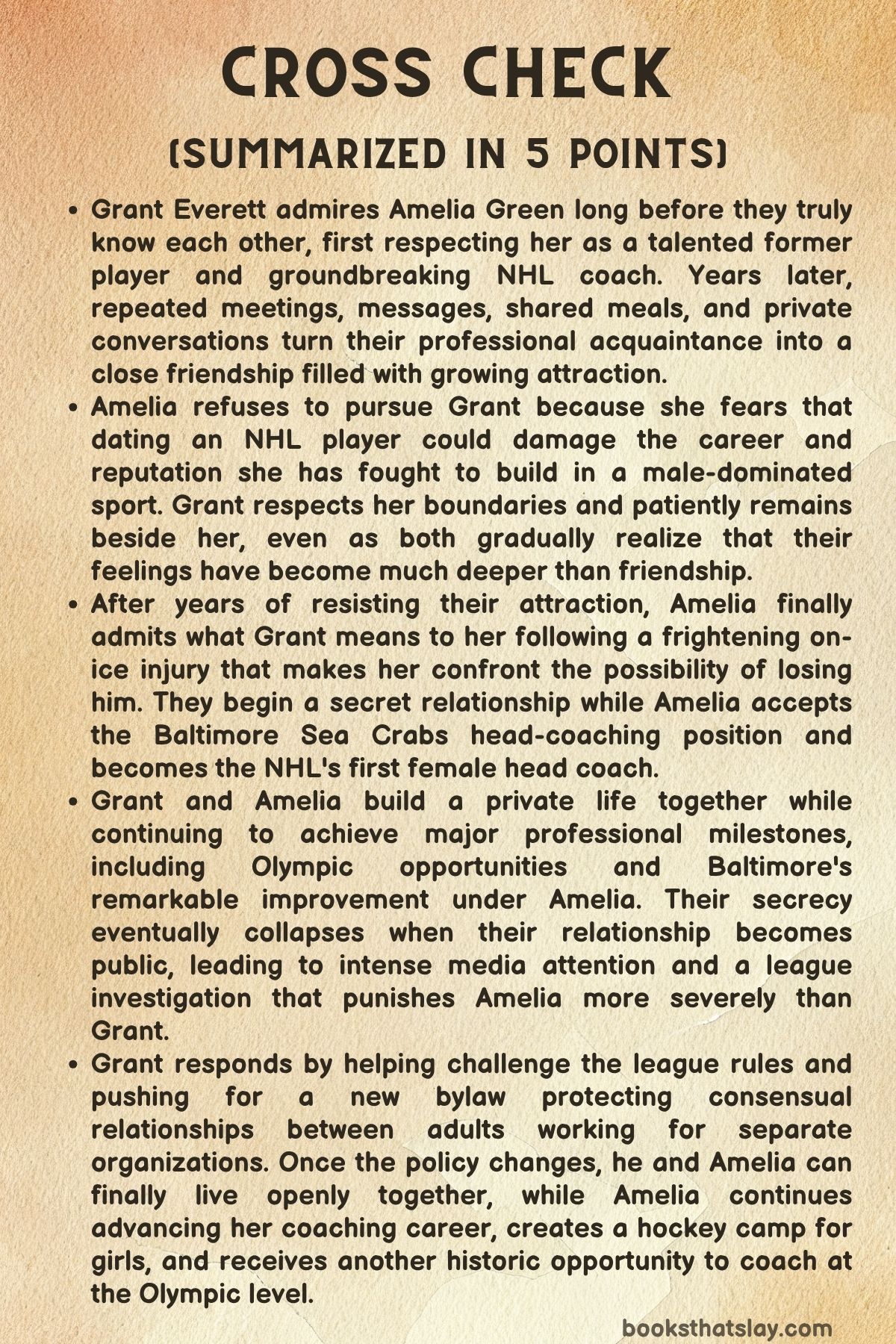
Summary
Grant Everett first becomes aware of Amelia Green while he is still a college freshman dreaming about an unlikely future in professional hockey. Watching her work as an assistant coach, he is fascinated not simply by her appearance but by her intelligence, authority, playing history, and obvious understanding of a sport he loves.
Several years later, their paths finally cross when Amelia is enduring a disastrous date in Denver with a man who casually dismisses women working in professional sports. Grant, by then a young NHL player for the DC Stars, recognizes her and strikes up a conversation after the date ends, surprising Amelia by knowing her history as a player rather than treating her only as a novelty because she is the NHL’s first female coach.
Amelia immediately establishes that she does not become involved with players because her professional position already places her under extraordinary scrutiny. Grant accepts the rule without argument, yet their teams continue meeting, and every encounter strengthens the connection between them as teasing, admiration, and mutual curiosity gradually replace the distance of their first conversation.
A chance meeting during a run in Washington changes the nature of their relationship. Amelia allows Grant into a more personal part of her life, telling him about her dream of creating a hockey camp for girls, while Grant shows her that he sees athletes and coaches as ordinary people who need emotional support, private lives, relationships, and room to struggle.
Their friendship grows largely through messages exchanged across cities and hockey seasons. Grant seeks Amelia out during moments of happiness, disappointment, uncertainty, and grief, while Amelia discovers that she enjoys being the person he trusts and increasingly depends on his uncomplicated support whenever her own career becomes exhausting.
Grant’s attraction steadily becomes something deeper, but he refuses to pressure Amelia into changing the boundaries she has established. He begins keeping notebooks filled with small details about her, preserving favorite foods, jokes, conversations, preferences, memories, and moments because paying attention to Amelia has become one of the central habits of his life.
Amelia meanwhile finds it increasingly difficult to maintain the distinction between friendship and desire. Private meals, training sessions, concerts, messages, celebrations, and quiet evenings begin to resemble dates, while physical moments between them repeatedly force Amelia to confront an attraction she fears could damage the professional reputation she has spent years building.
When Grant becomes too emotionally open during a picnic, Amelia retreats and stops speaking to him. The separation lasts until Grant’s teammate Riley is badly injured in a car accident, leaving Grant frightened and consumed by guilt, and Amelia immediately abandons her attempt at distance by flying to Washington because she cannot tolerate the idea of him suffering alone.
Living temporarily under the same roof exposes how natural they feel together. Amelia helps Grant recover emotionally, Grant admits how badly he missed her, and both promise that they will never again allow fear to erase their friendship, although the increasing physical tension proves that friendship alone is becoming impossible.
Their relationship continues to intensify as Amelia moves closer to her greatest professional goal. After years of proving herself as an assistant and associate coach, she is approached by the Baltimore Sea Crabs about becoming their head coach, and Grant celebrates the opportunity without ever suggesting that Amelia should choose a career path based on what would make their relationship easier.
Before Amelia can fully process the offer, Grant is struck dangerously near the neck by a puck during a game. The terror of possibly losing him destroys the emotional defenses Amelia has maintained for years, and when she sees him afterward, she finally admits that she no longer wants to pretend they are simply friends.
Their first kiss begins a private romantic relationship built upon years of trust. Grant, who has far less sexual experience than Amelia, approaches intimacy with curiosity and communication, while Amelia finds that the emotional foundation between them allows her to be more open, confident, and vulnerable than she has been in previous relationships.
Amelia accepts Baltimore’s head-coaching position and becomes the first woman to lead an NHL team. Although the media repeatedly frames her work through gender, she focuses on coaching, establishes the culture she wants, and guides the struggling Sea Crabs toward remarkable improvement while Grant celebrates every achievement without trying to claim any part of it for himself.
Living near one another allows them to build a more ordinary private life, and their secret romance becomes increasingly serious. Amelia’s friends eventually learn the truth, Maverick discovers Grant’s relationship, and both Amelia and Grant begin imagining a future in which their social circles, careers, home, and relationship can exist together rather than in carefully separated compartments.
Grant’s loyalty becomes particularly visible when another player, Brady Williams, makes degrading sexual comments about Amelia during All-Star festivities. Grant attacks him, later explaining that silence allows misogynistic behavior to continue, while Amelia recognizes that changing hockey culture cannot remain solely the responsibility of the women forced to endure it.
Baltimore’s success strengthens Amelia’s confidence, while her relationship with Grant becomes emotionally undeniable. Grant finally tells her he loves her, Amelia admits that she loves him too, and they begin planning a shared future in a house Grant purchases not as a symbol of control but as a place where they can create a life while maintaining Amelia’s independence.
They furnish the house together and find occasional protected spaces where they can behave openly as a couple. Grant publicly honors Amelia by wearing her jersey during a league event, yet their actual relationship remains hidden because both understand that Amelia could face harsher consequences than Grant if the truth became public.
Their careers continue rising together when Grant is selected for the United States men’s Olympic hockey team and Amelia is chosen to coach the American women’s team. What should be one of the happiest periods of their lives becomes a crisis when photographs exposing their relationship circulate publicly during the Olympics.
Amelia immediately fears that years of achievement will be reduced to gossip about sleeping with an NHL player. She asks Grant for distance and throws herself into coaching, eventually guiding the United States women to an Olympic gold medal, while Grant also helps the men’s team win gold despite privately feeling that one of his greatest achievements means less without Amelia beside him.
Back home, league officials investigate the relationship even though Grant has never played for Amelia and no explicit regulation prohibited two adults from different organizations from dating. Amelia receives an eight-game suspension because the league considers her the higher-ranking person, while Grant receives less severe treatment, confirming Amelia’s fear that the professional consequences will fall disproportionately upon her.
Grant refuses to accept that result as inevitable. With help from teammates, friends, legal contacts, and his old college friend James, he researches league rules and proposes a new bylaw protecting consensual relationships between adults working for separate organizations, transforming his private fight for Amelia into an attempt to change policy for others facing similar situations.
During her suspension, Amelia initially withdraws from almost everyone until Sienna, Lainey, Emmy, Piper, Lexi, Madeline, and other women in her life arrive to support her. Learning what Grant has been doing changes her perspective because he has not asked her to abandon hockey for him; instead, he has tried to remove the institutional obstacle forcing them to choose between their relationship and their careers.
Amelia returns to the home she shared with Grant believing that the proposed change will fail and preparing herself to end their future permanently. While she and Grant confront the possibility that love may not be enough to overcome the league’s response, they receive confirmation that the new bylaw has passed and will protect relationships like theirs going forward.
They reconcile knowing they no longer have to treat their relationship as misconduct. Grant and Amelia revisit the places connected to their beginnings, enjoy ordinary public dates for the first time, and finally allow the personal and professional parts of their lives to exist together without disguises, coded messages, separate arrivals, or constant fear of discovery.
Grant eventually gives Amelia the notebooks he has filled throughout the years, revealing just how carefully he has remembered every stage of knowing her. For Amelia, the notebooks demonstrate that Grant has loved not merely the famous coach or historic figure but also the private woman who likes particular foods, carries insecurities, makes jokes, loses confidence, takes risks, and sometimes needs someone else to carry part of the weight.
Their shared home becomes a gathering place for teammates, partners, family members, coaches, and friends whose lives once occupied separate worlds. Grant and Amelia remain fiercely competitive professionally, but neither considers the other’s success a threat, and their relationship becomes strongest when both are free to pursue separate ambitions while returning to the life they have created together.
Three years later, Amelia finally runs the girls’ hockey camp she once described to Grant during one of their earliest conversations. Grant arrives with many of their friends and reveals that he has declined another Olympic roster opportunity because Amelia has been chosen to coach the United States men’s Olympic team, another historic step he wants the world to recognize as entirely hers rather than interpreting it through their relationship.
The future remains deliberately open because Amelia has several possible directions available to her, including remaining in the NHL, moving into women’s professional hockey, or pursuing executive leadership. What matters is that neither her relationship nor Grant’s devotion requires her to become less ambitious, and the young girls attending her camp now inhabit a hockey world that Amelia’s career has helped make wider than the one she entered.
Characters
Amelia Green
Amelia Green is the emotional and professional center of Cross Check, a woman whose extraordinary career has taught her that every success may be examined more critically because she works in a male-dominated sport. She is disciplined, intelligent, ambitious, strategically gifted, and deeply conscious that mistakes considered ordinary for male coaches could become evidence used against women as a group.
Her resistance to Grant comes from more than simple reluctance to date a player. Amelia has spent years protecting an identity that she built through talent and relentless work, and she fears that romance with an NHL player could cause reporters, executives, and fans to interpret her career through sexuality rather than coaching ability.
That fear causes Amelia to retreat whenever emotional intimacy becomes difficult to control. She can handle tactical pressure, interviews, hostile assumptions, and historic firsts, yet allowing Grant to matter to her requires a different kind of courage because love cannot be managed as neatly as professional preparation.
Her development comes through learning that independence and isolation are not identical. Grant’s support, the loyalty of her female friends, and the respect of players demonstrate that receiving help does not reduce her authority, while her eventual fight against the league shows that protecting her career does not require surrendering the private life she wants.
Amelia’s professional achievements remain hers throughout the story. She rises from assistant coach to associate coach, accepts Baltimore’s head-coaching position, leads a major turnaround, coaches an Olympic championship team, establishes a girls’ hockey camp, and later receives the opportunity to coach the American men’s Olympic team.
Grant Everett
Grant Everett is the romantic lead of Cross Check, but his significance comes largely from the patience with which he approaches Amelia rather than from conventional pursuit. He admires her years before meeting her, and that admiration is rooted in her playing ability and hockey intelligence before romance ever becomes possible.
Grant is openly emotional, affectionate, loyal, and unusually attentive to details. His notebooks become the clearest physical representation of that personality because he records the ordinary pieces of Amelia’s life that most people ignore while focusing on her public importance.
He also respects boundaries even when doing so hurts him. When Amelia insists on friendship, he accepts friendship; when she needs distance, he gives it; and when their relationship becomes private, he accepts secrecy because he understands that Amelia carries risks he does not.
His greatest growth occurs when devotion becomes action beyond the personal. After the league punishes Amelia, Grant does not merely complain that they are being kept apart; he studies regulations, gathers support, seeks legal assistance, and pushes for a policy change capable of helping people beyond their own relationship.
Grant’s love is therefore expressed primarily through attention, encouragement, and protection of Amelia’s autonomy. He wants a future with her, but he never asks her to become less successful to make that future easier.
Emerson “Emmy” Hartwell
Emmy is an important representation of women changing professional hockey from inside the sport, and her presence broadens the world of Cross Check beyond Amelia’s experience alone. As a woman competing at the NHL level, she faces scrutiny that parallels Amelia’s treatment while occupying a different professional position.
Her friendship with both Amelia and Grant allows her to move naturally between their worlds. Amelia understands the pressures Emmy faces, while Grant treats Emmy as a teammate whose talent and ambitions deserve the same respect as anyone else’s.
Emmy is also emotionally perceptive and becomes one of the people who recognizes when Amelia needs support rather than professional advice. During the later crisis, she helps Amelia understand that other people throughout the league may also benefit from Grant’s proposed rule change.
Her own relationship with Maverick provides another example of romance existing alongside elite hockey. Instead of functioning only as a secondary love story, that relationship helps normalize the idea that careers and personal commitments need not automatically compete.
Maverick
Maverick is one of Grant’s closest teammates and becomes a practical source of perspective when Grant’s personal life becomes overwhelming. His relationship with Emmy demonstrates his own ability to love a highly accomplished woman without treating her professional success as competition.
When Maverick discovers Grant and Amelia’s relationship, he immediately understands why secrecy has been necessary. He warns Grant that hidden relationships rarely remain hidden forever, not because he disapproves but because he recognizes the institutional consequences Grant has been hoping to avoid.
After the Olympic exposure, Maverick gives Grant particularly important advice by telling him not to chase Amelia while she is frightened and overwhelmed. His role is therefore both comic and stabilizing, representing the kind of friendship that combines teasing with genuine emotional loyalty.
Hannah Everett
Hannah, Grant’s younger sister, gives the story another perspective on athletic identity and unconventional relationships. Her experience with professional figure skating includes burnout, and stepping away before rediscovering enjoyment through coaching illustrates how achievement can become damaging when it entirely consumes a person’s identity.
Her relationship with Brody also forces Grant to confront his own inconsistencies. Grant initially reacts protectively and critically to their age difference and complicated professional connection, even though his relationship with Amelia contains obvious parallels.
Hannah refuses to let Grant make decisions for her, establishing herself as an adult capable of understanding her relationship and its risks. Grant’s eventual apology strengthens their sibling bond because he learns that love does not grant authority over another person’s choices.
Brody Saunders
Brody Saunders is both Grant’s coach and an important secondary figure in Cross Check, serving as a model of leadership that actively rejects toxic locker-room behavior. Early in Grant’s career, Brody demonstrates that creating a healthy team culture requires coaches to challenge harmful behavior rather than quietly tolerate it.
His relationship with Hannah complicates his role because Grant must suddenly see his intimidating professional authority figure as a vulnerable person capable of love. Brody does not dismiss Grant’s discomfort, but he also refuses to treat Hannah as incapable of deciding what she wants.
Later, Brody becomes particularly important during the scandal surrounding Grant and Amelia. His own experience helps him understand how unconventional relationships intersect with professional structures, allowing him to support Grant through the league investigation rather than reducing the issue to embarrassment or discipline.
Sienna Washburn and Lainey Bodewell
Sienna and Lainey provide Amelia with one of the most important emotional foundations in Cross Check because they understand what it means to be successful women working around professional sports. They give Amelia a place where she does not need to explain why public judgment, sexism, and professional ambition affect her decisions.
They repeatedly identify the fears Amelia tries to rationalize. Long before Amelia openly admits loving Grant, her friends understand that the issue is not simply professional ethics but Amelia’s fear that a relationship could consume the identity she has spent her entire adult life constructing.
Their greatest value is that they support without controlling. They challenge Amelia when fear is making decisions for her, but they never insist that romance matters more than her career.
When the relationship becomes public and Amelia begins withdrawing from everyone, their presence helps restore the community she has forgotten she possesses. They remind her that being strong does not mean facing institutional pressure alone.
Jude Hunter
Jude is Amelia’s head coach in Denver and one of the professional mentors who recognizes her ability without treating her advancement as symbolic. He trusts her tactical judgment, involves her in meaningful decisions, and later encourages her to pursue head-coaching opportunities.
His response when Baltimore approaches Amelia is especially significant because Amelia’s first instinct is to question whether she is truly qualified. Jude reacts as though her readiness is obvious, helping expose the difference between Amelia’s internal uncertainty and how capable colleagues actually view her.
Jude represents constructive mentorship within professional hockey. Rather than protecting his own staff by keeping Amelia beneath him, he understands that successful leadership includes preparing talented people to surpass their current positions.
Elliot Putnam
Elliot Putnam functions primarily within Amelia’s Denver coaching environment, but his career move becomes important because it creates the vacancy that allows Amelia to become associate coach. His departure marks a structural opportunity rather than a personal conflict.
That transition shows Amelia’s steady advancement through professional roles. She is not suddenly handed a head-coaching career because of publicity; she moves through increasingly demanding positions and proves herself at each stage.
James Phillips
James is one of the earliest people in Grant’s life to recognize both Grant’s potential and the significance of Amelia’s career. When Grant doubts that a Florida-raised club player has a realistic route to the NHL, James insists that his talent and work ethic make professional hockey possible.
He also witnesses Grant’s earliest fascination with Amelia. Their joking challenge about whether she will ever look at Grant twice becomes amusing in retrospect because the relationship eventually reshapes both Grant’s private life and league policy.
James later contributes indirectly to the policy fight through family connections that help Grant obtain legal assistance. His reappearance links Grant’s college dreams to the adult life he ultimately builds.
Hudson Hayes
Hudson is one of Grant’s stabilizing teammates and friends. He encourages Grant to remember that hockey should remain something he enjoys rather than allowing pressure to overwhelm the reason he loved the sport in the first place.
That emotional awareness makes Hudson representative of the healthier team culture surrounding Grant. His presence counters stereotypes of professional athletes as incapable of discussing vulnerability or emotional strain.
He also participates in the broader support network that eventually helps Grant process family conflict and fight for his relationship. Hudson’s importance lies less in an individual storyline than in the consistent steadiness he contributes to Grant’s life.
Riley
Riley becomes crucial because his serious car accident exposes how fragile Grant’s sense of security really is. Grant responds to the accident with guilt and irrational responsibility, believing that some different decision might have prevented what happened.
Amelia’s decision to fly to Washington because Riley has been injured becomes a turning point in her relationship with Grant. The crisis destroys the distance she has created and demonstrates that when Grant genuinely needs her, professional rules cannot erase how deeply she cares.
Riley therefore has an indirect but powerful effect on the central relationship. His eventual recovery allows the event to function as a reminder that people cannot indefinitely postpone important emotional choices.
Liam Sullivan
Liam is the Stars’ talented goaltender and another member of Grant’s close professional circle. His achievements contribute to the team’s success, while his blunt personality provides both humor and practical honesty during personal conversations.
When Grant asks teammates for sexual advice before becoming intimate with Amelia, Liam emphasizes that Grant should focus on his partner’s pleasure rather than his own ego. The blunt delivery fits his character, but the underlying message reinforces the book’s repeated focus on communication and mutual respect.
Liam also protects Grant during the public scandal by confronting invasive reporting. His actions show that the Stars’ friendships are strongest when joking gives way to genuine defense of one another.
Ethan Richardson
Ethan is one of the more chaotic figures in Grant’s social circle, frequently adding humor through outrageous remarks, celebrations, and inappropriate jokes. At the same time, he is a highly competitive teammate whose presence helps create the sense that the Stars function as a large, unruly family.
His parties also provide rare environments where Grant and Amelia can relax because privacy measures protect the guests from public exposure. This allows Ethan’s social world to become unexpectedly important to the couple’s attempts to experience something resembling normality.
When Grant is injured by a puck, Ethan’s immediate anger demonstrates the loyalty beneath his comic personality. Like many of Grant’s teammates, he may express affection through chaos, but the attachment itself is serious.
Piper Mitchell, Lexi Armstrong, and Madeline
Piper, Lexi, and Madeline belong to the expanding community of women around the hockey world who help Amelia recognize that she is not navigating professional life alone. Their presence matters because Amelia’s early career has often required her to think of herself as an exception operating in overwhelmingly male environments.
Together with Emmy, Sienna, Lainey, and others, they eventually become part of the group that refuses to let Amelia disappear into isolation during her suspension. Their practical support demonstrates the strength of community when individual resilience has reached its limit.
These women also broaden the social world of the story beyond the central romance. Amelia gradually becomes surrounded by people with whom she can share both professional pressure and ordinary friendship.
Darcy Benderson
Darcy Benderson, the owner of the Baltimore Sea Crabs, plays a crucial role in Amelia’s professional development by approaching her about becoming head coach. Rather than treating Amelia’s gender as a reason for hesitation, Darcy focuses on whether she can change the culture of a struggling organization.
Her willingness to hire Amelia gives her the authority to build something of her own. Darcy’s support is especially important when media questions become disrespectful because she demonstrates that institutional leaders can actively protect their employees rather than leaving marginalized figures to absorb hostility alone.
Darcy therefore represents the possibility of structural change coming from leadership as well as individuals. Amelia succeeds because of her ability, but organizations still require decision-makers willing to recognize that ability.
Thorne
Thorne is one of the Baltimore players whose reaction helps ease Amelia’s anxiety when she begins her historic head-coaching role. Amelia knows that media attention will repeatedly question whether male NHL players can respect a female coach, creating an additional burden before she has even run a full training camp.
His response reassures Amelia that players can judge her by coaching rather than gender. That acceptance does not eliminate every obstacle, but it allows her to move attention away from symbolic expectations and toward the actual work of leading a hockey team.
Brady Williams
Brady Williams serves as one of the clearest representations of the sexist culture Amelia has spent her career confronting. His comments sexualize Amelia, question the legitimacy of her success, and reduce a highly accomplished coach to an object of locker-room speculation.
Grant’s violent reaction is not presented as the only possible response to such behavior, and Amelia herself is concerned about the fight. More important is the conversation afterward, when Grant argues that men within hockey must challenge misogyny instead of leaving women responsible for correcting it every time.
Brady therefore functions as more than a personal antagonist. His behavior exposes the culture that makes Amelia so cautious about public perception in the first place.
Bryson
Bryson is a decent potential romantic partner whom Amelia dates while attempting to convince herself that Grant is not the only man she could want. He is considerate, intelligent, respectful, and interested in Amelia as a person rather than merely as a hockey figure.
His failure as a romantic possibility is important precisely because he does nothing wrong. Amelia cannot blame incompatibility on obvious flaws or bad behavior; she simply discovers that her emotional attachment to Grant already occupies the place another relationship would need.
Their amicable separation helps Amelia become more honest with herself. Deleting the dating app afterward symbolizes the end of her attempt to solve her feelings by replacing Grant.
Connor and the Wider Stars Circle
Connor appears within the large social environment surrounding Grant and notices details such as the notebook Grant guards carefully. Like the other Stars players, he contributes to a team culture where teasing is constant but emotional involvement in one another’s lives is equally strong.
The larger Stars group becomes essential once Grant’s relationship faces institutional pressure. Players who once joked endlessly about romance help research rules, provide advice, defend him publicly, and support his attempt to change league policy.
The group therefore represents found family. Their bond allows professional teammates to become the people who help one another survive injuries, relationships, scandals, family conflicts, championships, and life beyond hockey.
Themes
Ambition Without Self-Erasure
Amelia’s career repeatedly raises the question of whether personal happiness must be purchased by reducing professional ambition. Cross Check rejects the idea that a successful relationship requires Amelia to become less visible, less powerful, or less committed to coaching so that Grant can feel comfortable beside her.
Her anxiety nevertheless makes that possibility feel real for much of the story. Amelia has learned that women in professional sports are often judged not only for performance but also for appearance, relationships, personality, and whether their private lives fit expectations that male colleagues rarely face in the same way.
Grant’s role becomes important because he never treats Amelia’s ambition as competition. He celebrates promotions, encourages her to interview for the Baltimore job, attends games to support her, imagines her entering the Hall of Fame, and eventually steps away from an Olympic opportunity when he believes doing so will allow her own achievement to receive proper recognition.
The relationship therefore works only when Amelia understands that love does not automatically require surrender. Her final possibilities remain open because she can continue coaching in the NHL, enter women’s professional hockey, pursue executive leadership, or accept new international roles while Grant supports rather than directs those decisions.
The girls’ camp provides the clearest conclusion to this theme. Amelia’s ambition ultimately expands opportunities not only for herself but for younger players who now grow up seeing paths that were once almost unimaginable.
Love, Patience, and Respect for Boundaries
Grant’s long attraction to Amelia could easily have become a story about persistence eventually wearing down resistance, but their relationship develops differently. His patience matters because he repeatedly accepts Amelia’s limits even when he privately hopes those limits will someday change.
When she defines them as friends, Grant tries to become a trustworthy friend rather than forcing romantic conversations. When she withdraws, he gives her space; when she requires secrecy, he accepts secrecy; and when she later asks for distance during the public scandal, he suffers but still refuses to violate her request.
This restraint gives Amelia room to distinguish between external pressure and her own desire. She eventually chooses Grant not because he successfully persuades her that her concerns are irrational but because years of experience demonstrate that he consistently respects her decisions.
Their sexual relationship follows the same pattern. Grant’s questions, Amelia’s guidance, their willingness to communicate preferences, and their mutual attention establish intimacy as an extension of trust rather than proof of possession.
The theme becomes broader than romance once Grant begins fighting league policy. Loving Amelia means respecting the career boundary she refuses to sacrifice, so rather than demanding that she choose him, he searches for a way to make the institution accommodate two consenting adults without forcing one of them out.
Gender, Power, and Institutional Double Standards
The professional world of Cross Check continually exposes the unequal scrutiny surrounding women in elite sports. Amelia knows that she is never allowed to function only as a coach because reporters, executives, fans, dates, and opponents repeatedly interpret her decisions through the fact that she is a woman occupying a position historically dominated by men.
That pressure explains much of her caution around Grant. A male coach dating someone connected to the league might create gossip, but Amelia fears her entire career could be reinterpreted as evidence that her professional access came through personal relationships rather than ability.
The scandal confirms that fear when the league punishes Amelia more heavily than Grant. Both participated in the same consensual relationship, Grant never played under Amelia, and no explicit regulation clearly forbade what they were doing, yet Amelia receives the harsher professional consequence because she occupies the higher-ranking position.
The response becomes significant because the characters challenge the structure rather than treating unequal treatment as unavoidable. Grant’s bylaw, the anonymous support it receives, Amelia’s consideration of legal action, her friends’ refusal to let her internalize shame, and the eventual policy change show that institutional rules can be questioned and rewritten.
Amelia’s later achievements deepen that argument. Olympic medals, Baltimore’s success, her girls’ camp, and the opportunity to coach the men’s national team reaffirm that public controversy never changed the coaching ability she possessed before anyone knew about Grant.
Community, Vulnerability, and Chosen Family
Neither Grant nor Amelia succeeds alone, despite both sometimes imagining that strength means handling problems privately. Grant is naturally more comfortable relying on others, while Amelia has spent so many years protecting herself professionally that dependence initially feels dangerous.
Their friends gradually dismantle that isolation. The Stars support Grant through Riley’s accident, family conflict, Amelia’s withdrawal, the Olympic scandal, and the policy fight, while Amelia’s circle of women provides a parallel network that understands the particular burden of being publicly scrutinized within professional sports.
The most important moments of community often occur during crisis rather than celebration. Amelia flies across the country when Grant is emotionally shattered by Riley’s accident, Grant’s teammates arrive when he is devastated after the relationship becomes public, and Amelia’s friends physically enter her apartment when she has withdrawn during her suspension.
Vulnerability becomes a form of connection rather than weakness. Grant’s openness teaches Amelia that fear, grief, doubt, and dependence can be shared, while Amelia gives Grant a space where his emotional nature is respected rather than mocked.
Their shared home ultimately becomes the physical expression of this theme. Friends, partners, relatives, players, and coaches who once belonged to separate areas of their lives gather under one roof, showing that the life Grant and Amelia create is larger than romance alone and is sustained by a community that has gradually become family.