Crown of the Forsaken Heir Summary, Characters and Themes
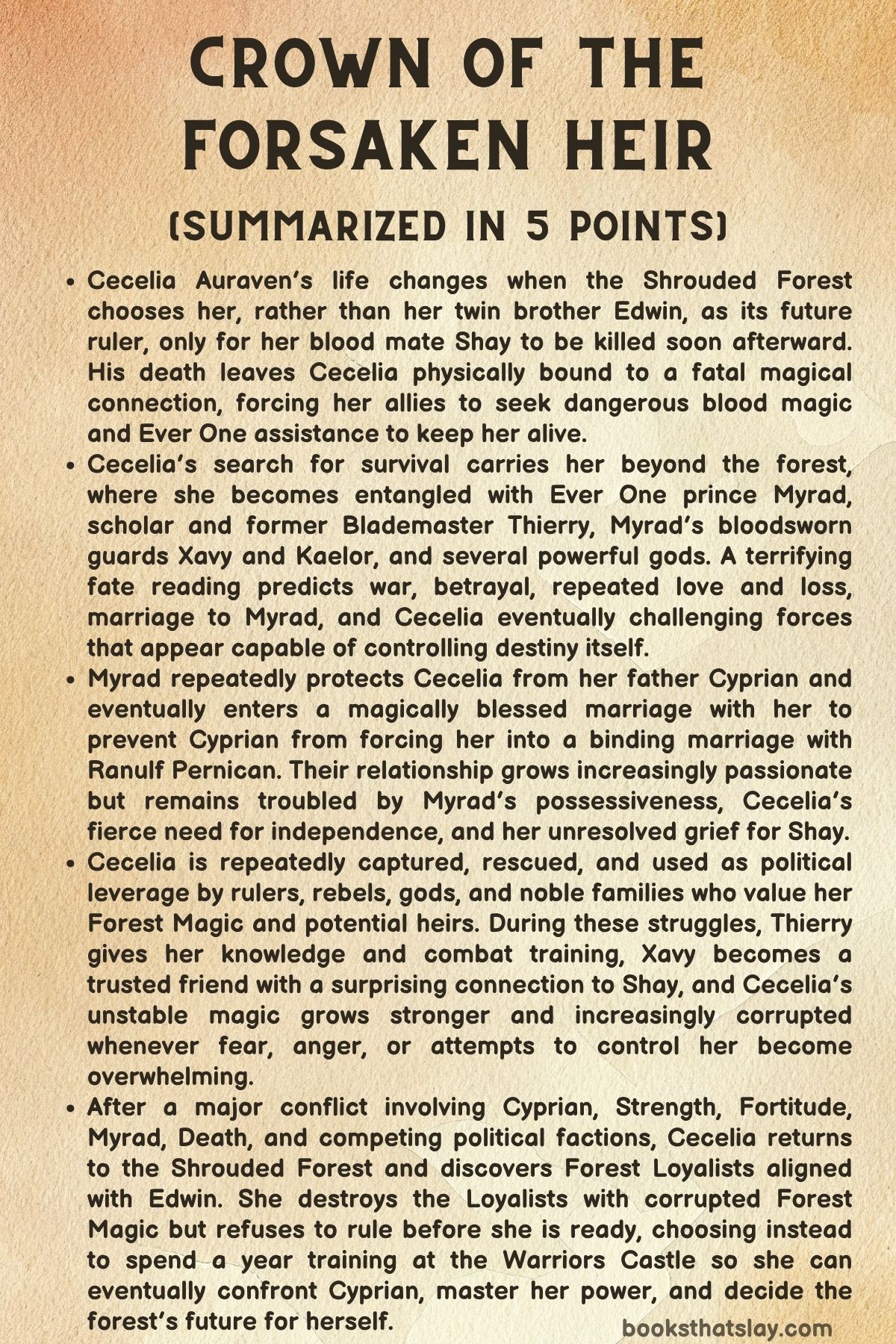
Crown of the Forsaken Heir by Kris Rose is a fantasy novel built around Cecelia Auraven, a young woman whose life changes when the Shrouded Forest chooses her instead of her twin brother as its future ruler.
After the violent death of her blood mate, Shay, Cecelia is drawn into a struggle involving royal families, ancient magic, rebellious factions, gods, forced marriages, and competing claims over her body and power. Her journey becomes both a fight for survival and an attempt to gain authority over a destiny that nearly everyone around her wants to shape for their own purposes. It’s the 1st book of The Shrouded Forest series.
Summary
Cecelia Auraven’s life changes when the Voice of the Shrouded Forest declares her, rather than her twin brother Edwin, the future ruler of their homeland. Before she can understand what this means, dark hounds attack her and her blood mate, Shay, whose death leaves Cecelia bound to a fatal magical consequence because their blood-mate connection continues pulling her toward him in the Other World.
Overcome by grief and physically deteriorating, Cecelia is taken by Edwin, Thom, and Kellan to Vaedra, an exiled Ever One capable of forbidden blood magic. Vaedra determines that Cecelia will die unless the surviving bond to Shay is redirected, while the appearance of a magical crown naming Cecelia Lady of the Forest confirms that the forest truly chose her as its heir.
Death takes a personal interest in Cecelia and refuses to accept that she should die. With the help of the scholar Thierry Maritus, Vaedra and her nephew Myrad learn that part of Cecelia’s bond may be transferred to one of Shay’s living blood relatives, but the necessary person is outside the forest and Cecelia’s rapidly weakening condition leaves little time.
Myrad therefore takes Cecelia into the Ever One Realm so that a more powerful priestess can help her. There, his parents, King Tharion and Queen Aureth, discover her presence, forcing Myrad to pretend that he entered the Shrouded Forest because he had fallen in love with Cecelia rather than because he had secretly contacted his exiled aunt.
Priestess Lireth performs a ritual that stabilizes Cecelia, though it does not permanently solve the problem. Cecelia becomes linked to an unknown relative whose life force now anchors her, meaning that the consequences of Shay’s death will continue affecting her until the mysterious bond is fully resolved.
Life in the Ever One court immediately introduces Cecelia to another form of power and prejudice. Tharion views mortals as inferior and sees Cecelia as a political asset, while a dangerous dose of Ever One Wine leaves her hallucinating before an extraordinary fate reading reveals futures involving war, love, betrayal, divine attention, marriage to Myrad, and Cecelia somehow breaking the authority of the Fate Weavers.
The prophecy terrifies the Ever One court, and Cecelia and Thierry are imprisoned. When Tharion places the threatening Lord Deron in charge of their cell, Thierry kills him to protect Cecelia, after which Myrad secretly helps the prisoners escape into Lillum despite knowing that assisting them places him against his father.
Cecelia and Thierry flee through a world she has barely imagined after spending her life trapped inside the Shrouded Forest. She sees open stars, clean water, distant roads, and ordinary landscapes with wonder, while Thierry offers companionship without demanding control over her and reveals that he was once a Blademaster burdened by the violence of his past.
Their escape ends when Death intervenes and returns Cecelia to her homeland. Cyprian, Cecelia’s father and ruler of the forest, has no intention of allowing his daughter to control her own future and arranges a marriage between her and Ranulf Pernican, intending to use a matrimonial binding spell to make resistance nearly impossible.
Myrad secretly returns before the ceremony can happen and takes Cecelia back into the Ever One Realm. Their relationship remains hostile but increasingly intimate, with Cecelia challenging Myrad’s contempt for mortals while Myrad begins to understand the brutality of the world in which she was raised and the depth of her grief for Shay.
Their situation becomes more dangerous because the Ever One Realm is moving toward civil war. Myrad’s aunt Nocthera has organized a rebellion against Tharion, while the gods Strength and Fortitude become involved in mortal and Ever One politics, and Strength develops a frightening fixation on Cecelia that repeatedly places her in physical danger.
At the same time, Cecelia’s relationship with Myrad changes. Their arguments remain fierce because Myrad’s instinct is to protect her through control, something Cecelia finds intolerable after a lifetime beneath Cyprian, yet attraction develops alongside that conflict and becomes increasingly difficult for either of them to deny.
Death eventually finds Cecelia and places a divine mark on her so he can locate her anywhere. His protective attention gives Cecelia another powerful ally, but it also reinforces the larger reality that gods, kings, rebels, and magical factions now see the Forest Heir as essential to their own political futures.
When Nocthera’s rebellion overtakes Lillum, Cecelia enters the Mother’s Grotto and experiences a revelation concerning her future authority. The priestesses tell her that she is destined to rule through her own power rather than simply standing beside another ruler, and she emerges five days later to find the political balance of the Ever One Realm dramatically altered.
Strength again attacks and humiliates her during the rebel takeover, while Myrad tries to protect her from the matrimonial spell Cyprian intends to use. Myrad performs an ancient blood ritual that the Mother herself appears to bless, creating golden bands around their wrists and unexpectedly transforming the ritual into a genuine magical marriage.
Cecelia is furious that Myrad did not clearly explain what he intended, even though the marriage protects her from being magically bound to Ranulf. Myrad publicly names Cecelia as his wife, complicating the politics surrounding them further and turning their already unstable personal relationship into a union carrying consequences for both realms.
Before Cecelia and Myrad can determine what their marriage means, Cyprian attacks with Fortitude’s help. He exploits the magical suppressant he has long used against Cecelia, weakens her Forest Magic, incapacitates the Ever Ones, and drags her back to the Shrouded Forest so the forced marriage arrangements with the Pernican family can continue.
Cecelia is then transported to the Mountainous Region, where she discovers that the Pernicans consider her reproductive potential and Forest Magic politically useful. Ranulf himself appears reluctant about the arrangement, but his father is willing to use Cecelia as a means of producing powerful heirs, making her captivity another attempt to reduce her life to what others can obtain from her.
The God of Knowledge rescues Cecelia and takes her to Thierry, whose home provides one of the few periods of genuine security she experiences. Thierry gives her space, teaches her swordsmanship, tells her about the wider world, and helps her imagine a life based on learning and choice rather than commands.
Their growing emotional connection is repeatedly interrupted by the expanding magical crisis. Strange fogs, displaced magic, monsters, the Mage Guild, and hidden political groups appear throughout their travels until Davic and divine power separate Cecelia from Thierry and send her once again into the hands of the Pernican family.
Fortitude later removes Cecelia from the Pernicans and takes her into another political conflict involving Strength. The situation escalates until Death, Knowledge, and Healing intervene, leading to a destructive struggle among divine beings in which Cecelia once again becomes the object everyone is fighting over rather than someone permitted to determine where she belongs.
After another rescue, Cecelia reunites with Myrad but remains unsettled by his possessiveness. Her friendship with Xavy becomes increasingly important because he offers companionship, humor, and practical help without reducing her entirely to the role of heir, wife, magical weapon, or political bargaining piece.
Cecelia eventually chooses physical intimacy with Myrad, but conflict quickly returns when she secretly seeks a pregnancy-prevention charm. Myrad reacts angrily upon discovering the deception, causing Cecelia to associate his attempts at control with the many men who have threatened her bodily freedom, and the resulting panic triggers a devastating burst of corrupted Forest Magic.
Xavy calms her by revealing that he once knew Shay. The disclosure creates a powerful new connection between them and helps Cecelia regain control, while also exposing how much of Shay’s past remains unknown to her and how deeply his memory continues influencing every new relationship she forms.
The political crisis reaches another violent peak when Cyprian, Davic, Tharion, Myrad, Strength, Fortitude, Xavy, Kaelor, and others collide during a confrontation. Cecelia fights using increasingly corrupted magic, Strength brutally injures her, Myrad is forced away through a gateway, and Xavy is left so badly wounded that Cecelia cannot tell whether he survives.
Cecelia is eventually brought near the ruined Glass Eternum, where the scale of the conflict becomes impossible to ignore. Cyprian is weakening under the cost of his own excessive magic and begins draining power from others, exposing the destructive foundation beneath the authority he has maintained for so long.
Death tries to move Cecelia somewhere secure, but news that Forest Loyalists have aligned themselves with Edwin convinces her to return home. The revelation is especially threatening because the prophecy warned that her twin would betray the forest, and Cecelia no longer knows whether Edwin remains the brother she once trusted or has chosen the authority he spent his life expecting to inherit.
At the Auraven estate, Cecelia confronts the Loyalists who enabled Cyprian’s cruelty. Grief for Shay, fear for Xavy, anger toward her father, and years of powerlessness feed the corrupted Forest Magic inside her until she publicly identifies herself as the Forest Heir and attacks those who stand against her.
The forest itself joins Cecelia and Death in destroying the Loyalists. Trees, creatures, magical fire, and corrupted ground turn the confrontation into a decisive rejection of the forces that helped maintain Cyprian’s rule, but Cecelia understands that defeating one group does not mean she is prepared to govern everything that remains.
Thom asks her to stay, and the Voice desperately reminds her that the forest needs its chosen ruler. Cecelia nevertheless refuses to take the throne before she is ready, recognizing that inherited power without skill, knowledge, and discipline could simply reproduce another destructive form of rule.
Death directs her toward the Warriors Castle, where Thierry once taught as a Blademaster. He gives Cecelia one year to stop running from her identity, master the strength others fear or desire, and prepare herself for the conflicts still waiting in the forest and beyond it.
Crown of the Forsaken Heir therefore ends with Cecelia neither victorious nor defeated, but finally moving toward a future she has chosen for herself. She rides toward training carrying Shay’s memory, her complicated marriage to Myrad, her bond with Thierry, her concern for Xavy, the threat of Edwin’s possible betrayal, and the knowledge that confronting Cyprian will require her to become far more capable than the frightened daughter he once controlled.
Characters
Cecelia Auraven
Cecelia is the emotional and political center of Crown of the Forsaken Heir, beginning as a grieving young woman who has spent most of her life under the authority of an abusive father and ending as someone consciously preparing to claim power on her own terms. Her selection as Forest Heir gives her enormous importance, but she initially experiences that position less as a privilege than as another demand placed upon a life already shaped by fear, isolation, and loss.
Her most defining struggle is the need to establish ownership over herself. Cyprian, Tharion, Myrad, Strength, the Pernicans, divine figures, rebels, and political leaders repeatedly attempt to decide where she should live, whom she should marry, whether she should have children, and how her magic should be used, making her resistance deeply connected to bodily and personal autonomy.
Grief remains equally central to her character. Shay’s death nearly destroys her desire to live, yet later experiences gradually show that survival does not necessarily mean betraying the love she had for him; instead, her memory of Shay becomes one of the forces that pushes her to see the wider world, keep fighting, and build a future he never had the opportunity to share with her.
Her Forest Magic reflects her psychological condition with unusual directness. When she feels trapped, frightened, violated, or furious, the power can become corrupted and destructive, meaning that mastering it will require more than technical training—it will require Cecelia to understand how trauma, anger, responsibility, and choice coexist within her.
Myrad
Myrad occupies one of the most complicated positions in Crown of the Forsaken Heir because he is simultaneously protector, political actor, husband, source of desire, and frequent cause of Cecelia’s fear. He repeatedly risks conflict with Tharion to save Cecelia, helps her escape imprisonment, removes her from Cyprian before the planned forced marriage, and later uses a magically sanctioned marriage to shield her from another binding ritual.
At the same time, Myrad has been raised within a culture of power and hierarchy, and his instinct is often to solve problems by taking control. He kidnaps Cecelia for what he considers her own safety, silences her magically, displays intense jealousy, reacts threateningly when she seeks contraception without his knowledge, and sometimes speaks about her in ways that reinforce the very inequalities she continually resists.
His developing feelings for Cecelia force him to confront the limits of his worldview. She challenges his assumptions about mortals, privilege, suffering, and authority, while her reaction to his possessiveness reveals that protection becomes dangerous when it removes the protected person’s right to decide.
Thierry Maritus
Thierry represents a markedly different kind of strength in Crown of the Forsaken Heir. Although he is a scholar, historian, former Blademaster, and highly capable fighter, his relationship with Cecelia is primarily defined by patience, emotional attentiveness, knowledge, and his repeated willingness to respect boundaries.
His protection of Cecelia is never passive. He kills Deron when the Ever One threatens her, travels beside her through dangerous territory, comforts her through grief, teaches her practical combat skills, and repeatedly risks himself when powerful factions try to reclaim her.
Thierry is also burdened by his own violent history. He worries that his years as a Blademaster may have permanently damaged his soul, creating a contrast between the man he fears he became and the gentler life he tries to live as a scholar.
His growing emotional connection with Cecelia develops through ordinary acts rather than political obligation. Shared stories, training, stars, books, food, travel, and quiet physical comfort give Cecelia an experience of intimacy that does not depend on ownership, making Thierry an important measure against which she can recognize healthier forms of trust.
Xavy
Xavy becomes one of Cecelia’s most important allies in Crown of the Forsaken Heir because he combines loyalty to Myrad with an unusual willingness to treat Cecelia as an independent person. His humor and relaxed manner offer relief from the severe political environment surrounding her, but beneath that ease lies a strong protective instinct and an increasing emotional attachment.
He repeatedly sides with Cecelia during disagreements, rescues her from drowning, returns money she loses while gambling, helps her obtain a pregnancy-prevention charm, and eventually offers to run away with her. These actions create tension with Myrad because Xavy’s loyalty as a bloodsworn guard conflicts with his personal concern for Myrad’s wife.
The revelation that Xavy knew Shay deepens his importance considerably. Cecelia’s corrupted magic allows him through when others cannot approach, showing how powerfully she responds to the discovery that Xavy possesses a genuine connection to the man whose death shaped everything that followed.
Death
Death is one of the most unusual protectors in Crown of the Forsaken Heir because his fascination with Cecelia begins before she fully understands the forces gathering around her. Rather than behaving as a detached god concerned only with souls, he becomes personally invested in keeping Cecelia alive and reacts with intense anger whenever powerful beings threaten her.
His actions often help her survive. He retrieves Thierry, demands solutions to the blood-mate crisis, returns Cecelia to the forest when he believes she needs to learn her magic, marks her so he can find her, heals catastrophic injuries, and ultimately directs her toward the Warriors Castle.
Yet Death is not a simple source of safety. He too makes decisions for Cecelia, moves her between places without always honoring her wishes, and assumes a level of authority over her future, meaning that even one of her strongest defenders participates in the pattern of powerful figures deciding what is best for her.
By the ending, however, Death also recognizes that Cecelia must become capable of protecting herself. His decision to send her away for a year of training reflects a significant shift from merely rescuing her toward demanding that she become the person who no longer needs to be repeatedly rescued.
Cyprian Auraven
Cyprian is the principal source of oppression in Crown of the Forsaken Heir and the figure whose rule has shaped Cecelia’s understanding of power since childhood. His violence extends beyond political authoritarianism into the intimate life of his family, including the execution of Cecelia’s mother, the suppression of Cecelia’s abilities, and the constant use of fear to maintain obedience.
He treats his daughter primarily as an asset. When Cecelia becomes politically inconvenient or useful, he suppresses her Forest Magic with tinctures, arranges a marriage to Ranulf, negotiates with powerful allies, tracks her across realms, and repeatedly uses force to bring her back under his authority.
Cyprian’s magical strength also reflects the nature of his rule. As his power expenditure increases, he begins draining others to sustain himself, making his magic physically representative of a leadership structure that survives by consuming the people and resources surrounding it.
Edwin Auraven
Edwin begins as Cecelia’s loving twin brother and one of the people most concerned about saving her after Shay’s death. He helps take her to Vaedra despite their father’s prohibition, and his early actions show genuine affection and fear for Cecelia’s survival.
The central complication is that Edwin has spent his entire life believing he will inherit the forest. Cecelia hides the truth of her selection partly because she knows how completely his identity has been built around that expectation, creating an unresolved tension between sibling love and political ambition.
The prophecy that Cecelia’s twin will betray the forest transforms Edwin into one of the story’s greatest uncertainties. His later connection with Forest Loyalists strengthens Cecelia’s suspicions, but the book leaves his ultimate motives unresolved, preserving the possibility that his choices may involve ambition, strategy, fear, divided loyalty, or some combination of them.
Shay
Shay dies at the beginning of the story, but his influence remains present throughout nearly every stage of Cecelia’s journey. As her blood mate, he represents the life Cecelia genuinely chose before politics, divine interest, hereditary power, and forced alliances took control of her future.
His death initially makes survival feel almost meaningless to Cecelia. The magical consequences of their severed bond physically threaten her life, while emotionally she repeatedly compares new experiences and relationships to the future she expected to have with him.
Shay also represents possibility. His dream of traveling through the seven kingdoms and seeing every flower in his book becomes a quiet source of motivation for Cecelia as she finally experiences places beyond the forest, turning his memory from something that only pulls her toward death into something that can accompany her while she continues living.
Thom
Thom serves as one of Cecelia’s strongest connections to the people she leaves behind in the Shrouded Forest. As Edwin’s partner, he exists close to the Auraven family’s internal tensions, yet his concern for Cecelia remains evident when he helps with the desperate attempt to save her after Shay’s death.
He also understands the significance of the forest’s decision before most others fully accept it. By reminding Cecelia that she, not Edwin, was chosen, Thom acknowledges a political truth that threatens the expectations upon which the Auraven household has operated.
His appearance near the end carries symbolic importance because he asks Cecelia to remain and assume responsibility after she destroys the Loyalists. Cecelia’s refusal is not a rejection of Thom or the forest but recognition that affection and legitimacy alone cannot make her ready to govern.
Kaelor
Kaelor is the more restrained and cautious counterpart to Xavy among Myrad’s bloodsworn guards. He participates in protecting Cecelia and helps Myrad navigate the growing crisis, but he remains deeply conscious of political consequences, magical obligations, and the danger created when personal attachments begin interfering with established loyalties.
His relationship with Xavy demonstrates this difference clearly. Where Xavy increasingly acts according to his personal concern for Cecelia, Kaelor repeatedly worries about what Myrad will do if those actions appear disloyal.
Kaelor nevertheless remains an important ally during the larger conflicts. His presence emphasizes the significance of bloodsworn bonds in Ever One society and provides another perspective on the tension between loyalty freely felt and loyalty magically reinforced.
King Tharion
Tharion embodies the arrogance and brutality embedded within Ever One royalty. He immediately evaluates Cecelia according to her political usefulness and repeatedly expresses contempt for mortals, treating supposed racial superiority as justification for humiliation and exploitation.
His treatment of Cecelia reveals both cruelty and insecurity. He gives her dangerous Ever One Wine, imprisons her after the fate reading, considers using her as leverage against Cyprian, and continues viewing her existence according to what advantage it might provide his throne.
His conflict with Nocthera also demonstrates that instability inside the Ever One Realm predates Cecelia’s arrival. The rebellion grows from long-standing resentment toward his leadership, making Cecelia less the cause of the realm’s crisis than a catalyst who exposes divisions already present.
Queen Aureth
Aureth is more restrained than Tharion and occasionally acts as a moderating presence within the royal family. When Myrad lies that he entered the forest because he loves Cecelia, Aureth responds more sympathetically than her husband and argues against immediately converting Cecelia into a political hostage.
Her position, however, remains tied to a court whose structures continually endanger Cecelia. Aureth may show greater empathy, but she does not fundamentally dismantle the assumptions of rank and privilege that allow Tharion to treat outsiders as expendable.
This makes her a character associated with limited compassion inside a harmful system. She recognizes individual wrongs more readily than Tharion does, yet the larger political machinery surrounding her continues functioning.
Vaedra
Vaedra is crucial to Cecelia’s survival because she chooses to help even though doing so risks provoking Cyprian. Her expertise in forbidden blood magic allows her to understand the fatal consequences of the severed bond with Shay and begin searching for a solution when ordinary methods cannot save Cecelia.
Her exile also places her at the edge of Ever One politics. She knows the dangers created by powerful rulers yet remains willing to act against those dangers when someone’s life is at stake.
Vaedra’s relationship with Myrad reveals another side of Ever One family history, especially the rivalry, succession politics, and resentment surrounding Tharion’s rise. Through her, Cecelia begins encountering people who have also been pushed outside accepted systems of authority.
Nocthera
Nocthera initially appears to offer an alternative to Tharion, but her rebellion demonstrates that opposition to a cruel ruler does not automatically produce humane leadership. She has assembled a massive military force and is willing to use political violence and divine alliances to seize control.
Her cooperation with Strength and Fortitude is especially alarming. By accepting help from figures who threaten and abuse Cecelia, she reveals that her revolutionary ambitions can take priority over the safety of individuals caught inside the struggle.
Nocthera therefore complicates any simple division between oppressive rulers and heroic rebels. She represents the possibility that a movement created to remove one dangerous authority can reproduce similar methods when victory becomes more important than restraint.
Strength
Strength represents power stripped of respect, restraint, or consent. His interest in Cecelia is repeatedly expressed through unwanted physical contact, threats, injury, restraint, and an obsession with her blood and magical potential.
His behavior turns divine power into another form of bodily domination. Cecelia cannot meaningfully negotiate with him because the imbalance between them is so extreme, making each encounter a reminder that supernatural status does not imply moral worth.
Strength also increases the political danger surrounding Cecelia because factions are willing to cooperate with him when they believe his power will help their ambitions. His presence exposes how readily leaders can ignore personal brutality when they think an alliance serves a larger strategic purpose.
Fortitude
Fortitude is considerably more ambiguous than Strength. He repeatedly works with forces that endanger Cecelia, opens gateways used to capture and transport her, and participates in political manipulation, yet he sometimes demonstrates hesitation or unexpected restraint.
His treatment of Cecelia occasionally suggests curiosity about her endurance and developing power rather than the simple possessiveness that characterizes Strength. He heals injuries at certain moments, refuses to help Pernican in another, and eventually becomes part of the complicated divine conflict surrounding her.
This inconsistency makes him difficult for Cecelia to classify as either ally or enemy. His character demonstrates why she cannot judge safety merely according to temporary acts of kindness when powerful beings continue reserving the right to decide her fate.
Knowledge
Knowledge is among the more respectful divine figures Cecelia encounters. He approaches her carefully, asks permission before healing or touching her, rescues her from the Pernican estate, and later protects her during the violent confrontation involving Strength and the other gods.
His personality also adds moments of humor through forgetfulness and academic distraction. These qualities make his divinity feel less threatening than the overwhelming presence associated with Strength, Fortitude, or even Death.
Most importantly, Knowledge connects Cecelia with Thierry and with spaces associated with books, learning, and intellectual freedom. For a woman deliberately denied education by her father, that connection gives his role meaning beyond physical rescue.
Healing
The Goddess of Healing appears less frequently than many of the other divine figures, but her interventions are important because they are generally directed toward preserving rather than controlling Cecelia. She warns Knowledge that Cecelia is in danger, participates in her rescue, and treats her injuries after divine violence.
Her presence provides a contrast to gods such as Strength, whose abilities magnify domination. Healing demonstrates that extraordinary power can also be exercised through care and restoration rather than ownership.
She nevertheless exists within the larger divine network that has become intensely involved in Cecelia’s life. Her assistance cannot remove the broader danger created by gods treating mortal political conflicts as arenas for their own rivalries.
Davic
Davic is one of Cyprian’s most reliable agents and therefore an important extension of his authority. He repeatedly appears when Cecelia attempts to escape the structures built around her and uses political claims, magical force, and divine assistance to return her to captivity.
His loyalty places him directly within the system responsible for maintaining Cyprian’s rule. Unlike characters who occasionally question the orders of powerful relatives or rulers, Davic consistently works to preserve existing control.
Later, when Cyprian begins draining power from others, tension emerges even between them. That development suggests that service to an authoritarian ruler offers little permanent security once the ruler’s need for power becomes greater than his loyalty to those who helped sustain him.
Ranulf Pernican
Ranulf occupies an unusual position because he is introduced as the brutal man Cecelia is being forced to marry but proves less personally invested in possessing her than the arrangement initially suggests. He openly dislikes the marriage and appears uncomfortable with the expectations placed upon both of them.
His unwillingness does not make him a true protector. Cecelia remains endangered inside his family home, and Ranulf is unable or unwilling to challenge the larger system strongly enough to secure her freedom.
His character nevertheless distinguishes personal desire from political arrangement. The marriage is primarily valuable to Cyprian and Lord Pernican because of Cecelia’s bloodline, magic, and reproductive potential, showing how dynastic systems can trap both parties while placing far greater danger upon the person with less power.
Lord Pernican
Lord Pernican views Cecelia almost entirely through dynastic usefulness. Her desires are irrelevant beside the possibility that she could produce descendants possessing Forest Magic or create a politically valuable connection between regions.
His willingness to force pregnancy makes him one of the clearest examples of the threats Cecelia faces to her bodily autonomy. He does not need affection, attraction, or even his son’s enthusiasm for the marriage because his interest is focused on what Cecelia’s body might contribute to future power.
The hostile atmosphere of the Pernican manor reflects his worldview. Violence, secrecy, hidden creatures, alliances with stronger forces, and political calculation transform the household into another place where Cecelia is treated as property rather than a person.
Themes
Autonomy Against Ownership
Much of Crown of the Forsaken Heir is driven by the conflict between Cecelia’s right to determine her own life and the repeated attempts of others to claim authority over her. The struggle begins with Cyprian, whose control over Cecelia includes isolation, magical suppression, surveillance, arranged marriage, physical coercion, and a broader refusal to recognize her as someone entitled to make independent choices.
The same pattern appears in new forms after Cecelia leaves the forest. Tharion sees her as diplomatic leverage, the Pernicans see her as a means of producing heirs, Strength treats her body as something he can touch or injure at will, and political factions evaluate her according to the value of Forest Magic.
Even genuine protectors sometimes reproduce the problem. Myrad repeatedly saves Cecelia, but his belief that protection justifies taking control creates fear and resentment because Cecelia has learned that benevolent intentions do not erase the danger of having decisions made for her.
Her attempt to obtain a pregnancy-prevention charm becomes particularly important because it shows her trying to exercise authority over the most intimate consequences of marriage. When Myrad responds with anger, the incident triggers corrupted magic precisely because Cecelia experiences his reaction as another threat to ownership of her own body.
The ending therefore gives special significance to her decision not to remain and rule immediately. Instead of obeying the forest simply because it needs her, Cecelia chooses training, accepting responsibility without surrendering the right to determine how and when she will assume it.
Grief, Survival, and the Permission to Continue Living
Shay’s death establishes grief not as a temporary emotional obstacle but as a force that reshapes Cecelia’s identity. The magical blood-mate bond makes the connection literal because her body begins following Shay toward death, turning mourning into a physical process that threatens to end her life.
At first, Cecelia has little motivation to resist. Even after others begin searching for ways to save her, she questions whether survival matters when the future she wanted died with Shay.
Her later drowning becomes an important turning point because she initially considers surrendering to death and then realizes that she genuinely wants to live. This decision does not remove grief; instead, it changes Cecelia’s relationship with it.
Thierry, Myrad, Xavy, and the wider world introduce experiences that exist alongside her love for Shay rather than replacing it. Cecelia can feel attraction, companionship, curiosity, anger, desire, and ambition while still carrying the memory of the person she lost.
Shay’s dream of traveling through the kingdoms and seeing flowers becomes especially meaningful because Cecelia gradually begins experiencing the places he hoped they would visit together. Memory therefore changes from a force calling her backward toward death into something she can carry forward.
The story treats survival as an active choice repeatedly renewed rather than a single moment of recovery. Cecelia continues grieving even while discovering that wanting a future does not invalidate what Shay meant to her.
Power, Corruption, and the Right to Rule
Political authority throughout the story is repeatedly separated from moral legitimacy. Cyprian possesses enormous magical and governmental power, yet his rule depends upon fear, suppression, loyal enforcers, arranged alliances, and eventually the draining of power from others simply to maintain his own strength.
Tharion presents a different version of the same problem. His confidence in Ever One superiority encourages him to humiliate mortals and treat Cecelia as political property, while resentment against his rule becomes strong enough to support Nocthera’s large rebellion.
Nocthera complicates the question further because removing an oppressive ruler does not automatically make the replacement just. Her willingness to cooperate with Strength and use violent methods suggests that revolutionary movements can adopt the same disregard for individuals that they condemn in existing regimes.
Cecelia’s position as Forest Heir therefore carries a warning as well as a promise. The forest has selected her, but magical selection alone cannot guarantee that she will govern wisely.
Her refusal to take immediate control after destroying the Loyalists becomes one of her most responsible decisions. She recognizes that possession of Forest Magic and hereditary connection cannot substitute for knowledge, discipline, or preparation.
By choosing training rather than immediate coronation, Cecelia begins distinguishing herself from rulers who assume that power itself proves their right to exercise it. Leadership becomes something she believes she must become capable of carrying rather than something she should simply seize.
Love, Loyalty, and Control
Relationships throughout Crown of the Forsaken Heir repeatedly test the difference between loving someone and possessing them. Cecelia’s bond with Shay represents the relationship she freely chose, which is why losing him becomes so devastating and why later relationships are measured against the sense of mutual belonging she associates with him.
Myrad presents the most difficult version of this theme. His willingness to endanger himself for Cecelia is genuine, and their attraction becomes powerful, but his protective instincts frequently transform into control, leaving Cecelia uncertain whether safety with him might simply become another form of confinement.
Thierry offers a strong contrast because he protects without consistently trying to direct Cecelia’s choices. His patience, teaching, emotional restraint, and willingness to remain beside her without demanding possession show how intimacy can be created through trust rather than dominance.
Xavy provides another variation through friendship and loyalty. His bloodsworn bond ties him to Myrad, yet his concern for Cecelia sometimes leads him to act against what Myrad would prefer, forcing him to decide whether loyalty means unquestioning obedience or protecting people even when doing so creates conflict.
Edwin adds a familial dimension. Cecelia loves her twin, but his lifelong expectation of becoming ruler may eventually place ambition against their bond, especially once the possibility of betrayal becomes part of the prophecy surrounding her.
Across these relationships, love is repeatedly tested by freedom. The story suggests that affection becomes ethically meaningful only when the beloved person is still allowed to choose, refuse, leave, disagree, and exist outside the desires of those who claim to care for them.