Don’t Say Mafia Summary, Characters and Themes
Don’t Say Mafia by C.R. Jane is a dark romantic suspense novel centered on Eden Thorne, a young woman whose search for safety places her in the path of Jagger Thatcher, a wealthy and dangerous member of the Vale Syndicate.
Their relationship develops against organized crime, surveillance, murder, obsession, and a violent territorial conflict in Las Vegas. At its center is Eden’s movement from an exhausting marriage and lifelong survival mentality toward a life in which she begins making choices for herself, even when the man she chooses possesses a frightening capacity for control and violence.
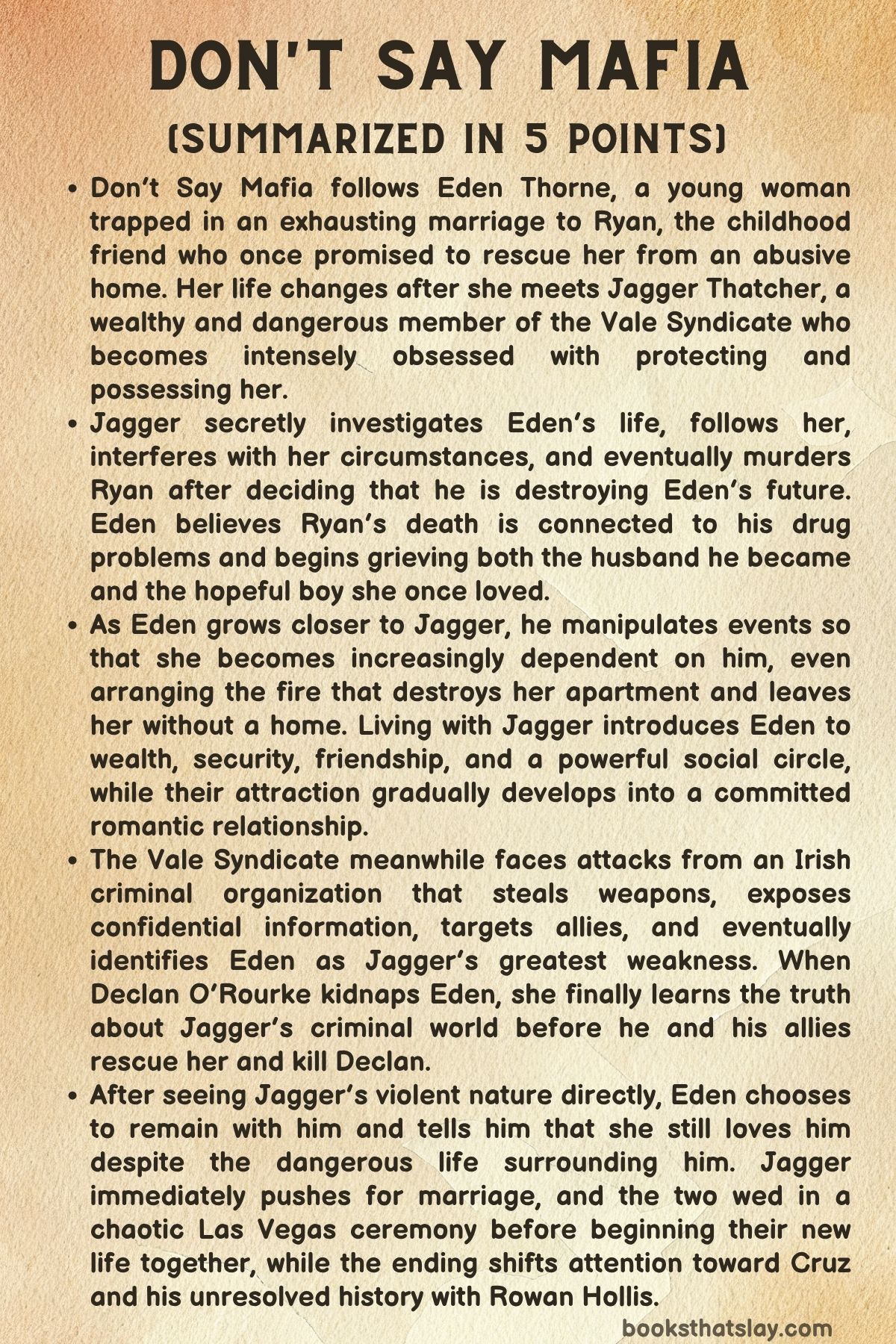
Summary
Eden grows up in a violent trailer park home where her abusive stepfather makes everyday life unpredictable. Her closest refuge is Ryan, another teenager from a troubled family, and the two repeatedly meet at a neighborhood park whenever their homes become unbearable.
Ryan promises that one day they will escape their families and build something peaceful together. Their friendship eventually becomes romantic, and Eden invests enormous faith in Ryan because he represents the possibility of a future beyond abuse.
Five years later, Eden and Ryan are married and living in Las Vegas, but the future they imagined has deteriorated. Ryan drinks, gambles, loses jobs, and increasingly leaves Eden responsible for rent, food, and their basic survival.
Eden works several jobs and begins recognizing disturbing similarities between her marriage and the household she once escaped. She still remembers the loving boy Ryan used to be, however, and that memory keeps her invested long after the adult relationship has become damaging.
At the Paradise casino, Eden is unexpectedly assigned to serve a private high-roller room. There she meets Jagger Thatcher, a wealthy, intimidating man associated with a powerful criminal organization known as the Vale Syndicate.
Jagger arrives intending to confront Irish mob figure Declan O’Rourke about entering Syndicate territory without permission. Instead, his attention immediately fixes on Eden.
When another gambler touches Eden without consent, Jagger responds by driving a knife into the table beside the man’s hand. His reaction frightens Eden, yet she is also affected by the fact that somebody defended her so decisively.
Jagger begins flirting with her and learns that she is married. Rather than treating her marriage as an absolute barrier, he regards Ryan as an obstacle that can eventually be removed.
His interest quickly becomes obsessive. Using Lawson, the Syndicate’s information specialist, Jagger obtains details about Eden’s finances, employment, home, family, and schedule, then begins secretly following her home because he considers her neighborhood unsafe.
His protectiveness is partly connected to Carlie, a former girlfriend who was permanently paralyzed after a violent attack. That experience left Jagger with an extreme response to the possibility of women he cares about being harmed.
Eden continues trying to preserve her marriage. Ryan briefly appears to make an effort, preparing an anniversary dinner and promising that his financial failures are temporary, but Eden realizes during their intimacy that her emotional connection to him has badly weakened.
Jagger begins appearing at her other workplace and openly pursuing her. Eden repeatedly reminds him that she is married, yet she cannot deny her attraction to him or the growing contrast between Jagger’s intense attention and Ryan’s years of neglect.
Meanwhile, the Vale Syndicate faces serious threats. Weapons disappear from shipments, rival forces gather information about the organization, and evidence increasingly suggests that the Irish are deliberately destabilizing its Las Vegas operations.
Eden reaches another breaking point when she comes home expecting a serious conversation with Ryan and instead finds their apartment filled with partying strangers. She recognizes that the chaotic environment resembles precisely the life the two of them once promised each other they would escape.
Ryan later promises again that he will improve, find work, and allow Eden to pursue classes and a future of her own. She wants to believe him but realizes that repeated disappointments have nearly exhausted what remains of their marriage.
Jagger decides to interfere more aggressively. After learning about Ryan’s drug use, he manipulates events so Eden discovers the extent of the problem.
Ryan suffers a serious drug reaction, forcing Eden to rush him to the hospital. Although she comforts him after he survives, she privately wishes for the strength to finally leave him.
Jagger watches much of this through surveillance he has secretly arranged. His desire to protect Eden has already crossed into control, and he increasingly convinces himself that he understands what she needs better than she does.
When Eden loses one of her jobs because she misses work during Ryan’s hospitalization, her financial position becomes even more desperate. Jagger quietly manipulates circumstances around her while presenting himself as the person consistently available when everything else goes wrong.
His most extreme intervention comes when Ryan is lured into an isolated area. Jagger and Zachary kill him and arrange the scene to make his death appear connected to drugs and his increasingly reckless lifestyle.
Eden receives the news while working at Paradise. She is devastated not only because Ryan is dead but because she had finally intended to end their marriage and now will never have the chance to say what she needed to say.
Jagger immediately becomes her primary source of comfort even though he secretly caused the tragedy. Eden later scatters Ryan’s ashes at the park connected to their childhood and recognizes that the boy who loved her and the troubled husband who hurt her can both be remembered truthfully.
She begins releasing the future they once imagined together. Jagger, meanwhile, moves more openly into her life, sending food, flowers, and a new phone while insisting that his romantic intentions are obvious.
Eden gradually returns to work and becomes increasingly unable to ignore the attraction between them. Eventually, she and Jagger share their first major intimate encounter, breaking through much of the restraint that had existed while she was married and immediately after Ryan’s death.
Jagger responds by becoming even more determined to make Eden permanently part of his life. When Cruz jokes that Eden might move in if her apartment became unavailable, Jagger converts the idea into an actual plan.
He arranges a fire that destroys Eden’s apartment without physically harming her. Believing herself the victim of another terrible accident, Eden loses most of her belongings and much of what remained from her marriage.
Jagger appears at exactly the moment she needs help and takes her to his luxurious penthouse. Eden worries about becoming financially and emotionally dependent on him, but Jagger repeatedly insists that accepting food, security, clothing, and shelter does not create a debt.
Their relationship deepens as Eden becomes integrated into Jagger’s social world. She meets Cruz, Maddox, Lawson, and other members of his close circle and discovers that beneath their strange humor and secrecy is a powerful loyalty to one another.
During a poker game, Eden surprises everyone with her intelligence and skill. The evening gives her a chance to experience herself as confident and competitive rather than merely exhausted, poor, grieving, or responsible for another person’s failures.
The attraction between Eden and Jagger finally becomes a fully acknowledged relationship. Eden admits that her greatest fear is allowing herself to care for somebody who might eventually destroy her emotionally, while Jagger privately knows that his own attachment has become so extreme that he would never willingly let her leave.
Their connection becomes public when Jagger takes Eden to meet his family. She attends a professional football game involving his brother Jace and is welcomed into a lively group that gives her another experience of family entirely different from the abusive environment of her childhood.
As Eden becomes happier, danger surrounding the Vale Syndicate increases. Federal investigators receive information about Jagger and his associates, while the Irish continue attacking people, shipments, and businesses connected to the organization.
Jagger and Cruz eventually discover that casino manager Carl has been secretly providing information to their enemies. They brutally deal with his betrayal while Jagger continues hiding the most violent parts of his life from Eden.
Eden begins noticing inconsistencies, especially when Carl suddenly disappears and Leigh tells her that he was last seen with Cruz. Her questions about Jagger’s world become harder to dismiss, although her emotional commitment to him has also become much stronger.
Jagger takes her on a helicopter flight over Las Vegas to celebrate what he considers the anniversary of their relationship. During the night, Eden acknowledges that she has fallen in love with him, and Jagger openly returns the declaration.
Their happiness is interrupted when the Irish launch a coordinated assault. Jagger, Cruz, and Gage are attacked during a weapons operation while armed men invade Jagger’s residence to capture Eden.
Zachary attempts to protect her, but the attackers overwhelm him and seize Eden. Declan intends to use her suffering as a weapon against Jagger and forces him to confront the vulnerability created by loving someone inside his violent world.
Lawson rescues Jagger and Cruz from captivity, allowing them to begin searching for Eden. Jagger’s obsessive habit of tracking her, previously a serious violation of privacy, becomes the means through which her location can be discovered.
Declan reveals enough about Jagger’s criminal activities for Eden to understand that many of her suspicions were correct. She nevertheless recognizes that she has always known something dangerous existed beneath the polished wealth and intense protectiveness Jagger showed her.
Jagger and his allies storm the location and rescue her. Once Eden is safe, Jagger kills Declan with uncontrolled fury and then faces Eden believing that seeing his violence so directly may finally make her reject him.
Instead, Eden tells him she still loves him. Her decision is not based on believing Jagger is harmless but on accepting that the dangerous man she has just witnessed is also the man she consciously chose.
Almost immediately after the rescue, Jagger decides they should marry. Eden finally learns that he and his friends belong to the Vale Syndicate, whose jokingly emphasized rule is that nobody calls their organization the mafia.
Their wedding happens in a wildly unconventional Las Vegas chapel while they are still recovering from the night’s violence. Eden nevertheless gives genuine consent to the vows, and the two become husband and wife.
A week later, they are settling into another penthouse after leaving the residence associated with Eden’s kidnapping. Their marriage remains chaotic, intense, and surrounded by Jagger’s equally unconventional criminal family.
The story closes by shifting toward Cruz. During a visit with his mother, he learns that Rowan Hollis, a woman from his past whom he clearly never stopped caring about, is about to marry another man.
Cruz immediately calls Jagger and announces that they need to leave because he intends to crash the wedding. Eden and Jagger’s story therefore reaches its marital resolution while the final scene opens the next romantic conflict within the Vale Syndicate.
Characters
Eden Thorne
Eden is the emotional center of Don’t Say Mafia, and much of her development comes from learning the difference between endurance and genuine choice. Childhood abuse trained her to survive instability, minimize her own needs, and remain loyal even when loyalty comes at a personal cost, which helps explain why she remains with Ryan long after their marriage becomes destructive.
Her strongest quality is resilience, but the story also shows how resilience can become dangerous when a person believes suffering is simply something to tolerate. Eden works constantly, accepts disrespect from customers, supports Ryan financially, and keeps trying to repair situations that were never hers alone to repair.
Ryan’s death creates complicated grief because she mourns both a husband and the boy who once represented safety to her. Her farewell at the park is important because she allows herself to remember his goodness without pretending that his later behavior was acceptable.
Her relationship with Jagger gradually gives Eden experiences she has rarely possessed: protection, attention, pleasure, travel, friendship, and financial security. At the same time, the reader knows that many of the circumstances pushing her toward Jagger were secretly manufactured by him, creating a large gap between Eden’s perception of freedom and the hidden manipulation surrounding her choices.
By the end, Eden knowingly accepts Jagger’s criminal nature after witnessing his violence firsthand. She does not know every secret concerning Ryan, the fire, surveillance, or the other manipulations, but she chooses the version of Jagger she has finally been permitted to see and enters his world on her own terms.
Jagger Thatcher
Jagger is the central romantic figure of Don’t Say Mafia, but he is deliberately constructed as both protector and threat. He possesses extraordinary wealth, intelligence, confidence, and loyalty, yet his love for Eden is inseparable from surveillance, possession, manipulation, and violence.
His attraction begins immediately and develops into obsession almost before he knows Eden personally. He investigates her background, follows her home, interferes with her jobs, watches her through cameras, removes Ryan, destroys her apartment, and creates circumstances that make himself increasingly necessary.
Jagger consistently interprets these actions as protection rather than abuse. His moral system is based less on conventional right and wrong than on loyalty: people he considers his own receive extraordinary devotion, while those who harm or betray them can be destroyed without remorse.
Carlie’s past explains part of this psychology. Her paralysis after an attack left Jagger terrified of helplessness, and Eden activates that fear so completely that protecting her becomes his central purpose.
His relationship with Eden nevertheless exposes genuine emotional vulnerability. The man who can calmly deal with murder, criminal investigations, and Syndicate warfare becomes frightened by the possibility that Eden might leave, be harmed, or look at him with disgust after seeing what he truly is.
Jagger’s final transformation is therefore not from violent man to harmless romantic hero. Instead, he stops pretending that his criminal identity and his love for Eden can remain completely separate, allowing her to see enough of the darkness to decide whether she still wants him.
Ryan Thorne
Ryan is one of the most tragic figures in Don’t Say Mafia because his adult failures exist beside the memory of the compassionate boy Eden once loved. As a teenager, he understands her fear because he lives through similar family chaos, and his promise to escape with her becomes one of the foundations of Eden’s emotional life.
Their move to Las Vegas initially appears to fulfill that promise. Ryan works and studies, but gambling, alcohol, unstable friendships, unemployment, and drugs gradually consume the future they intended to build.
His behavior becomes deeply damaging without erasing every sign of the person he used to be. He occasionally prepares meals, promises to find work, worries about disappointing Eden, and expresses genuine dependence on her, but each improvement arrives after repeated betrayals and rarely lasts.
Ryan also represents Eden’s difficulty separating love from obligation. She continues supporting him partly because leaving would feel like abandoning the boy who once protected her, even though the adult relationship has become financially and emotionally exhausting.
His death is especially cruel because Eden had finally reached the point of choosing separation. Jagger denies her the chance to make that decision openly, meaning Ryan’s role continues to shape the story even after his death through Eden’s unresolved grief and Jagger’s concealed responsibility.
Cruz
Cruz is Jagger’s closest friend and one of the defining supporting figures in Don’t Say Mafia. Their history began when Jagger saved him from an assassination attempt, after which Cruz introduced Jagger to the Las Vegas criminal world and helped make him part of the Vale Syndicate.
Cruz understands Jagger unusually well and recognizes almost immediately that Eden represents something unprecedented. His jokes about Jagger’s obsession often provide humor, but he also repeatedly identifies uncomfortable truths about the extremes Jagger is willing to reach.
His morality closely resembles Jagger’s in its emphasis on loyalty over legality. Cruz assists with interrogations, criminal operations, cover-ups, and retaliation while treating violence as an ordinary tool of maintaining Syndicate power.
At the same time, his friendship with Jagger feels genuine rather than merely strategic. He challenges him, mocks him, fights beside him, and remains deeply embedded in the group that eventually welcomes Eden.
The final revelation concerning Rowan adds emotional depth to Cruz. His abrupt reaction to learning about her wedding reveals that beneath the sarcasm and criminal confidence is unresolved romantic pain powerful enough to disrupt his normal composure.
Maddox
Maddox functions as both a capable Syndicate operative and an important source of humor within the criminal group. He participates in violent operations without hesitation, including the investigation into the stolen weapons, but his interactions with Jagger and Cruz often resemble those of brothers who have become accustomed to one another’s worst behavior.
His loyalty becomes particularly important during the conflict with the Irish. Maddox participates in rescue efforts, helps deal with dangerous opponents such as Saoirse, and remains part of the small inner circle trusted with the organization’s most sensitive problems.
His presence also helps establish that the Syndicate is more than a business arrangement. The constant joking and arguments among Maddox, Lawson, Cruz, Jagger, and the others create the sense of a dysfunctional but fiercely loyal chosen family.
Lawson
Lawson is the technological and intelligence specialist of the Vale Syndicate. He can locate people, investigate employees, obtain confidential information, manipulate surveillance, and uncover connections that other members of the organization would struggle to find.
His skills initially serve Jagger’s obsession when he provides information about Eden. Later, the same abilities become crucial to the wider Syndicate conflict as Lawson investigates thefts, betrayal, enemy operations, and coordinated attacks.
During the Irish assault, Lawson proves that he is far more than a man behind a computer. He personally conducts a rescue operation for Jagger and Cruz and then assists in locating Eden, making him essential to the group’s survival.
Gage
Gage is one of the Vale Syndicate’s most intimidating members and combines access to legitimate authority with criminal enforcement. His position gives the organization an unusually useful connection to law enforcement, while his willingness to use extreme violence makes him one of its most feared problem-solvers.
Even Jagger approaches Gage’s capacity for brutality with awareness. Yet Gage is not portrayed as an uncontrolled outsider; he is fully part of the group’s internal loyalty system and places himself in danger alongside the others during the war with the Irish.
His serious injuries during the coordinated attack demonstrate how dangerous the rival campaign has become. An organization accustomed to controlling Las Vegas is suddenly forced to confront enemies capable of severely injuring even its strongest members.
Zachary
Zachary serves as one of Jagger’s trusted assistants and enforcers. He participates in the plan that kills Ryan, carries gifts to Eden, handles practical arrangements for Jagger, and understands far more about Jagger’s obsession than Eden initially realizes.
His most important moment arrives when the Irish target Eden. Sent to protect her, Zachary fights the attackers despite being badly outnumbered and is severely injured while trying to give her time to escape.
That act confirms that his loyalty is not merely obedience to an employer. By this point Eden has become part of the circle Zachary considers worth protecting, even at considerable personal cost.
Jace Thatcher
Jace is Jagger’s brother and provides a connection between Jagger’s criminal existence and a more public family world. A professional football player, he regularly teases Jagger about his mysterious wealth and suspicious lifestyle while maintaining a close, affectionate relationship with him.
His explanation of love becomes unexpectedly important when Jagger asks indirectly how someone knows the feeling is real. Jace answers that everything else begins to matter less compared with the person, a description that immediately confirms what Jagger already feels about Eden.
Jace also helps Eden feel accepted into Jagger’s wider family. His reaction to their sudden marriage is shocked but affectionate, reinforcing the sense that Eden has gained a larger family rather than merely a partner.
Riley
Riley is connected to Jace and becomes part of Eden’s introduction to Jagger’s family and football circle. Her presence, along with the other women Eden meets, helps create a social environment in which Eden is welcomed rather than judged for her background.
That acceptance matters because Eden has spent much of her life being categorized by poverty, family dysfunction, and later widowhood. Riley and the others allow her to participate in ordinary friendship and celebration without forcing her to defend herself.
Leigh
Leigh is Eden’s lively casino coworker and one of the people connected to her life before Jagger becomes dominant within it. Her early excitement about the mysterious high roller helps frame Jagger as an object of curiosity before Eden understands how powerful he actually is.
Her relationship with Carl later gives her a more serious role. When Carl disappears after being seen with Cruz, Leigh becomes frightened and warns Eden to be careful around Jagger’s circle, becoming one of the first people close to Eden to directly challenge the reassuring explanation she has constructed around them.
Carl
Carl begins as the casino manager who appears to facilitate Jagger’s interest in Eden, arranging shifts and granting unusual flexibility. Because Eden already knows that casino management rarely behaves so generously, his actions become one of her first clues that Jagger possesses substantial influence.
His later betrayal changes his significance completely. Carl has secretly been providing information to the Irish because of resentment toward the men above him, making him an internal weakness inside an organization that depends heavily on loyalty.
Once his betrayal is discovered, Jagger and Cruz deal with him violently and he disappears. His fate pushes Eden closer to recognizing that missing people and unexplained events surrounding Jagger are unlikely to be coincidences.
Declan O’Rourke
Declan is the primary visible antagonist of Don’t Say Mafia and represents the Irish challenge to the Vale Syndicate. His initial confrontation with Jagger establishes the territorial conflict, and he quickly recognizes that Eden has become Jagger’s greatest vulnerability.
As the conflict escalates, Declan moves from challenging business boundaries to directly attacking the people Jagger cares about. His plan to capture Eden is designed not only to hurt her but to psychologically destroy Jagger by forcing him to witness it.
During Eden’s captivity, Declan also becomes the person who exposes the criminal truth Jagger has kept from her. His plan fails because the revelation does not produce the rejection he expects, and his death at Jagger’s hands becomes the moment Eden sees the full extent of Jagger’s violent nature and remains beside him anyway.
Cormac O’Dalaigh
Cormac stands above much of the Irish campaign and represents the larger organization threatening the Vale Syndicate. His influence is demonstrated through operatives such as Saoirse and through the carefully coordinated actions intended to damage Jagger’s organization financially, politically, and personally.
Although he remains less directly involved in Eden’s experience than Declan, his presence makes clear that the conflict extends beyond a single enemy. Declan’s death resolves the immediate kidnapping crisis without necessarily eliminating the wider criminal rivalry.
Saoirse
Saoirse is an Irish operative connected to Cormac and demonstrates the seriousness of the enemy’s commitment. When confronted by Jagger, Cruz, and Maddox, she responds with armed resistance and confidently declares that the Vale Syndicate is headed toward destruction.
Her suicide using cyanide prevents interrogation and shows that she values the organization’s objectives above her own survival. That decision also leaves Jagger’s group with fewer answers and confirms that their opponents are prepared for extreme sacrifice.
Carlie
Carlie is Jagger’s former teenage girlfriend, and her importance lies primarily in the psychological effect of what happened to her. After she was attacked and permanently paralyzed, Jagger developed an enduring terror of failing to protect someone he loves.
Eden repeatedly activates that trauma. Jagger’s nightmares eventually replace Carlie with Eden in the wheelchair, making explicit that his controlling behavior is partly driven by the fear that another woman he loves could be permanently harmed while he remains unable to stop it.
Shelby
Shelby is Eden’s employer at the coffee shop and represents another part of Eden’s unstable working life. She initially reacts with obvious awareness of Jagger’s status, helping Eden recognize that his influence extends beyond being a wealthy casino customer.
Shelby later fires Eden when she misses work during Ryan’s medical crisis. Jagger responds by arranging consequences, demonstrating how quickly ordinary conflicts in Eden’s life become targets of his intervention.
Theo
Theo is a bartender at Eden’s casino job who repeatedly asks her out. Eden consistently refuses because she considers herself committed to Ryan despite the serious problems within her marriage.
His limited role nonetheless helps establish Eden’s loyalty before Jagger enters her life. She is not casually searching for another relationship; Jagger affects her in a way that previous attention from other men never did.
Paulie Bellino
Paulie Bellino is associated with casino ownership and becomes relevant when Jagger targets strategically useful property. His presence shows the business dimension of the Syndicate, where control of real estate and casinos matters alongside weapons and direct violence.
Jagger’s dealings around Paulie also demonstrate his ability to shift rapidly between pursuing Eden and managing large criminal and financial operations. Personal obsession does not eliminate his strategic intelligence, even though it increasingly determines his priorities.
Gerald
Gerald is a former informant whose public allegations create additional danger for the Vale Syndicate. His information concerning casinos, real estate, political influence, and organized crime is suspiciously current, leading Jagger and Cruz to conclude that someone inside or near their organization is feeding him intelligence.
His role therefore contributes to the growing atmosphere of betrayal. The organization is not merely being attacked physically; its secrecy, legitimacy, and political protection are also being systematically weakened.
Mrs. Nesbitt
Mrs. Nesbitt helps manage domestic life around Jagger’s penthouse and prepares meals for Eden after she moves in. Her presence reinforces the dramatic change in Eden’s circumstances from an empty refrigerator and constant financial anxiety to a home where food and comfort appear without struggle.
For Eden, this care is initially difficult to accept because she has spent years associating survival with relentless labor. Mrs. Nesbitt therefore becomes part of Eden’s adjustment to being cared for rather than always being the caretaker.
Blanche
Blanche works aboard Jagger’s private jet and appears during Eden’s first experience of flying. Her calm professionalism after Eden and Jagger’s intimate behavior provides comic embarrassment for Eden and highlights how ordinary Jagger’s extravagant lifestyle appears to the people around him.
Her brief role also contributes to Eden’s realization that she has entered a world completely removed from the financial insecurity that defined most of her adult life.
Natalie
Natalie belongs to the group Eden meets during the professional football game and stands out through her loud, enthusiastic reactions to the action. Her energy contributes to a social experience that feels welcoming rather than threatening to Eden.
The football gathering matters because Eden is being introduced not merely as someone Jagger is privately seeing but increasingly as his publicly acknowledged partner. Natalie helps form the community into which Eden is gradually absorbed.
Casey
Casey is another member of the social group surrounding Jace and his teammates. Along with Riley and Natalie, she helps provide Eden with an immediate circle of women during a situation that could otherwise have made her feel like an outsider.
Her presence supports the larger contrast between Eden’s isolated past and the increasingly populated life she experiences after becoming involved with Jagger.
Parker and Matty
Parker and Matty are part of the broader family and football environment Eden encounters through Jagger and Jace. Their interactions contribute to the chaotic affection of the group and show Eden a version of family life built around teasing and familiarity rather than violence and fear.
Although neither drives the central conflict, their inclusion matters to Eden’s emotional experience. Ordinary social belonging is something she has rarely possessed, so even these smaller relationships help make Jagger’s world feel increasingly like home.
Rowan Hollis
Rowan appears only indirectly at the end, but her importance is immediately clear from Cruz’s reaction. Learning that she is about to marry Samuel Englewood destroys his usual sarcastic composure and brings back memories of their relationship and painful separation.
Her introduction shifts attention toward Cruz and establishes an unresolved love story beyond Eden and Jagger’s marriage. Cruz’s decision to rush away and interfere with her wedding suggests that Rowan occupies the same emotionally destabilizing position in his life that Eden came to occupy in Jagger’s.
Samuel Englewood
Samuel Englewood is the man Rowan is preparing to marry and is identified as the son of a senator. Little is established about his personality, but his role is structurally significant because the planned marriage forces Cruz to confront feelings he has apparently avoided for a long time.
His existence transforms Rowan from a memory into an immediate problem for Cruz. The final pages therefore use Samuel as the catalyst for the next conflict rather than developing him independently.
Themes
Safety, Control, and the Meaning of Protection
Safety is never presented as a simple condition in Don’t Say Mafia because the people who promise it often create new forms of danger. Eden grows up surrounded by domestic violence, then marries the boy who once promised to rescue her, only to find herself supporting a husband whose gambling, drinking, drugs, and irresponsibility reproduce the instability they escaped.
Jagger appears to offer the opposite life: food, money, physical protection, luxury, attention, and absolute confidence that nobody will be permitted to hurt her. For Eden, those things are enormously powerful because she has spent most of her existence expecting safety to disappear without warning.
The complication is that Jagger’s protection repeatedly destroys Eden’s autonomy. He follows her, investigates her, watches her through cameras, manipulates Ryan, enters her home without permission, kills her husband, destroys her apartment, and tracks her movements.
Some of those same violations later protect her, most obviously when tracking technology helps Jagger find her after the kidnapping. The novel therefore repeatedly places protective acts beside controlling ones until the difference depends less on the action than on knowledge and consent.
Eden experiences Jagger as someone who finally keeps her safe, while the reader knows he has manufactured several dangers from which he subsequently rescues her. That contradiction is central to their romance: the safest person Eden has ever known is also one of the people with the greatest power to control her life.
Escaping the Past Without Erasing It
Eden’s life is shaped by repeated attempts to escape previous versions of herself. She and Ryan leave abusive homes believing geography can separate them from everything their families taught them, yet their Las Vegas marriage gradually recreates many of the same emotional conditions.
Ryan’s decline forces Eden to recognize that escape requires more than leaving a place. Fear, obligation, learned endurance, financial insecurity, and unhealthy definitions of loyalty can travel with a person long after the original environment has disappeared.
Her farewell to Ryan’s ashes becomes one of the clearest expressions of this idea. Eden does not rewrite him entirely as either the wonderful boy she loved or the damaging husband he became.
She accepts that both versions existed. Remembering his childhood kindness does not require her to deny his adult failures, just as admitting the marriage was destructive does not mean every moment they shared was false.
The apartment fire later removes many physical remains of that life far more violently. Although Eden believes the fire accidental, its destruction accelerates a process already occurring internally: the home, possessions, routines, and identity connected to Ryan are disappearing.
Her development comes from building an identity that is not solely the abused daughter, Ryan’s struggling wife, a grieving widow, or Jagger’s protected partner. Moments such as defeating the Syndicate men at poker show a woman beginning to enjoy her own intelligence, confidence, humor, and competitive instincts outside the identities other people have placed upon her.
Obsession, Love, and Possession
Jagger’s feelings challenge any clean separation between devotion and possession. He experiences Eden as someone whose importance immediately exceeds normal attraction, and that intensity becomes the justification for nearly every boundary he violates.
His emotional commitment is real. He worries about her safety, notices her exhaustion, admires her intelligence, wants her included in his family, and becomes genuinely terrified when she is kidnapped.
Yet his devotion is accompanied by the conviction that Eden ultimately belongs with him whether she recognizes it immediately or not. That belief permits him, in his own mind, to arrange outcomes rather than wait for her decisions.
Ryan’s murder is the clearest example. Eden was already reaching the point at which she intended to leave her husband, but Jagger removes Ryan before she can make that choice herself.
The apartment fire follows the same pattern. Jagger wants Eden in his penthouse, so rather than allowing that transition to happen naturally, he secretly removes the alternative.
His internal definition of love therefore depends heavily on permanence and possession. Even after Eden voluntarily chooses him, he privately knows that he would use surveillance and enormous resources to find her if she ever attempted to leave.
The romance in Don’t Say Mafia does not turn that obsession into conventional affection. Instead, the story allows love, control, desire, violence, protectiveness, and possession to occupy the same relationship, creating a deliberately dark version of romantic commitment in which Jagger’s promise never to let Eden go carries both reassurance and threat.
Loyalty, Betrayal, and Chosen Family
Loyalty functions as the central moral currency of the Vale Syndicate. Jagger and his associates routinely commit acts that ordinary morality would condemn, yet within their own system, protecting friends and punishing betrayal are treated as unquestionable obligations.
Cruz, Maddox, Lawson, Gage, and Zachary repeatedly demonstrate this loyalty through action. They joke constantly and insult one another freely, but when violence arrives, they risk injury and death without hesitation.
Carl represents the opposite side of that code. His decision to provide information to the Irish is treated as far more serious than ordinary criminal competition because he had access to the Syndicate’s trust and chose to use it against them.
The Irish campaign itself succeeds largely by attacking connections rather than merely businesses. Judges, informants, shipments, insiders, friends, and eventually Eden are targeted because destroying relationships can destabilize the organization more effectively than attacking money alone.
For Eden, this concept of chosen family has personal significance. Her biological home was abusive, while her life with Ryan became isolating and exhausting.
Jagger’s circle is objectively dangerous, yet it offers her belonging, humor, protection, meals, celebrations, travel, friendship, and people who immediately treat threats against her as threats against themselves. By the end, Eden has entered a family defined not by conventional respectability but by fierce mutual commitment, and her willingness to remain reflects how strongly that sense of belonging answers something she has lacked since childhood.