Etna by Paul Yoon Summary, Characters and Themes
Etna by Paul Yoon is a novel about war, memory, survival, companionship, and the difficult search for a place that can still be called home. Told largely through the perspective of a military dog who has survived years of violence, the story follows Etna as he leaves the army after the war and travels across a ruined country toward the coastal farm where his life began.
His journey becomes both physical and emotional as he meets survivors, forms new bonds, loses companions, and confronts the reality that returning home does not necessarily mean recovering the past. The novel ultimately asks what remains after destruction and whether belonging can be created again.
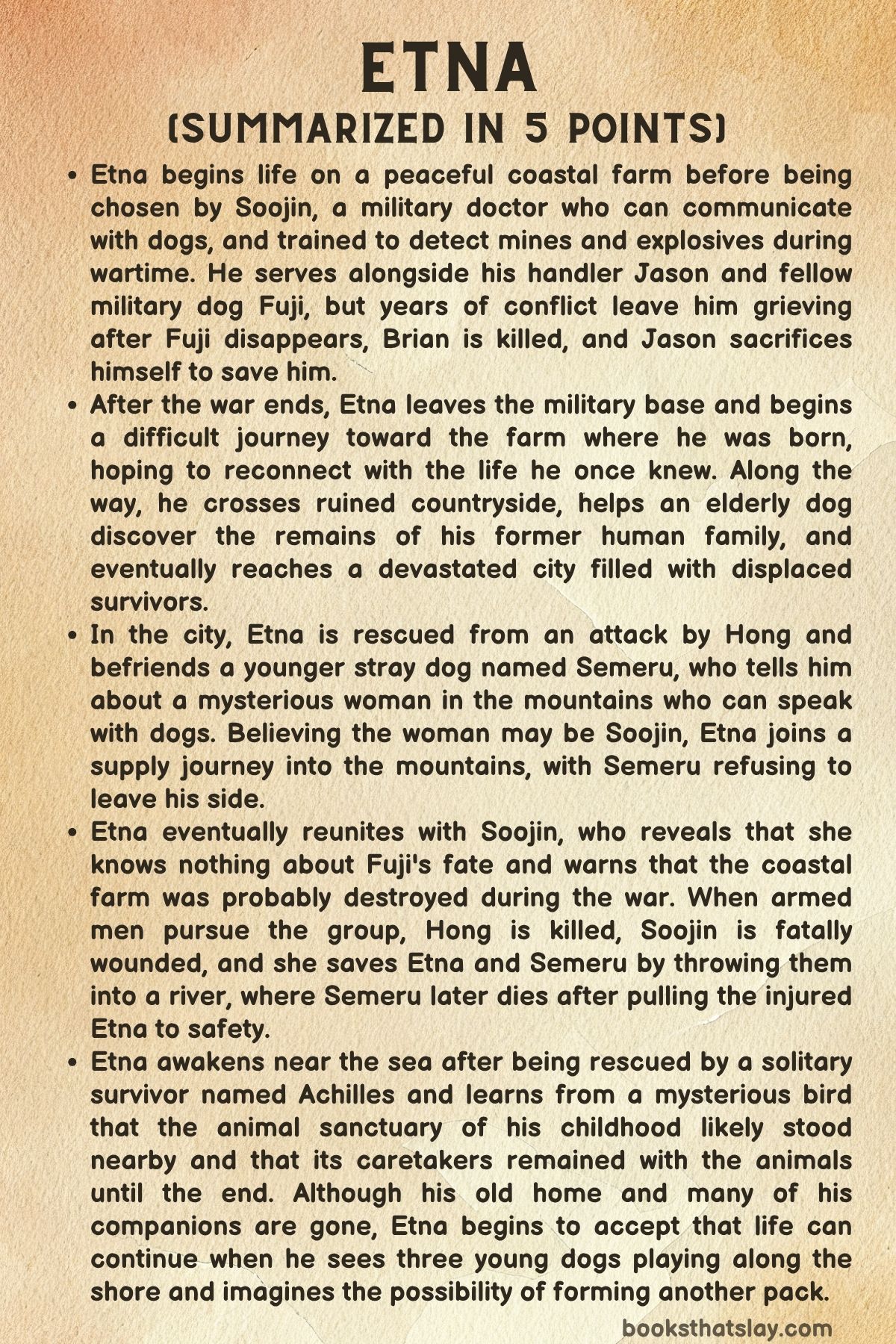
Summary
Etna’s earliest memories belong to a quiet coastal farm where he lives among his mother, siblings, other animals, and the people who care for them. His life changes when war approaches and a military doctor named Soojin arrives searching for dogs capable of serving alongside soldiers.
Soojin has an unusual ability to communicate directly with certain dogs, allowing her to explain what is happening in a way Etna can understand. She chooses Etna and another young dog, renames the second dog Fuji, and asks both of them to survive and protect one another.
Etna and Fuji are taken to an American military base where months of demanding training transform them into military working dogs. Etna is paired with Jason, while Fuji works beside Brian, and both dogs learn how to locate explosives, detect mines, search dangerous buildings, and protect soldiers moving through contested areas.
Etna forms a deep attachment to Jason. Their bond is based on trust developed under constant pressure, and Jason gradually becomes Etna’s closest human companion during the war.
The conflict continues for years, and Etna repeatedly witnesses ruined towns, injured soldiers, dead civilians, frightened animals, and landscapes emptied by violence. The idea of the farm remains inside him as a memory of an existence that seems increasingly distant from the world around him.
During the third year of the war, Fuji disappears without explanation. Etna never learns whether she was killed, captured, separated from her unit, or somehow survived elsewhere, and her absence becomes one of the unresolved losses he carries.
Brian later dies after encountering a mine. Jason survives longer, but his own death comes when an explosion threatens Etna and he throws the dog away from the blast, sacrificing himself in the process.
When the war finally ends, Etna finds himself among soldiers preparing to leave without any clear plan for what will happen to him. Realizing that the military life that shaped him is disappearing, he chooses to leave the base and search for the coastal farm where he was born.
His journey takes him through a country scarred by years of fighting. Water is difficult to find, food is uncertain, transportation systems have collapsed, and abandoned machinery and animal remains appear throughout the countryside.
Etna eventually discovers an abandoned railway station occupied by an old, nearly blind dog. The elderly animal once protected the family who operated the station, but he remained after the surrounding area was destroyed because he believes the people he loved died somewhere in the nearby field.
Etna uses the tracking abilities he learned during military service to search for them. He eventually finds human remains belonging to two members of the family, though a third person remains missing.
The discovery cannot undo the old dog’s grief, but it gives him something definite after years of uncertainty. Before Etna leaves, the dog tells him that he can return to the station if his search for home ends in disappointment.
Continuing along the abandoned railway, Etna encounters soldiers traveling with another working dog. The military dog notices him hiding nearby but does not expose him, silently allowing Etna to continue his journey.
Elsewhere, Etna discovers a crashed fighter aircraft containing the dead pilot. Nearby signs of vanished animal life reinforce the sense that destruction has affected not only human communities but the entire living environment.
Etna eventually encounters a moving cargo train carrying religious aid workers. They pull him aboard, provide food and water, and temporarily offer him safety, but when he realizes that the train will move farther inland rather than toward the coast, he jumps off.
He enters a badly damaged city where displaced people live in improvised settlements beside a river. Food, medicine, shelter, and security remain uncertain, while violence continues even though the larger war has officially ended.
Three territorial dogs attack Etna near the river. His military experience allows him to defend himself despite being injured, and a man named Hong intervenes before the confrontation becomes worse.
Hong treats Etna’s wounded shoulder and becomes one of the first humans since Jason to offer him protection without demanding anything in return. Soon afterward, Etna meets Semeru, a younger stray dog whose energy and curiosity contrast with Etna’s caution and accumulated exhaustion.
Semeru leads Etna to a medical clinic connected with Hong and a woman named Emi. Both humans survived the war as medical workers and now devote themselves to treating people in the ruined city despite limited supplies.
Semeru explains that he received his name from a mysterious woman living in the mountains who can speak with dogs. Etna immediately suspects that the woman may be Soojin, giving him a reason to delay his coastal journey.
While recovering, Etna gradually forms a close friendship with Semeru. The younger dog tells him about surviving the destruction of the city, children who repair abandoned drones, and the unstable communities struggling to rebuild among shortages and recurring violence.
A working donkey warns Etna that the mountains remain dangerous because armed groups continue fighting over medicine and other valuable supplies. Etna also hears Hong and Emi discussing the psychological burden of wartime medical work and Hong’s intention to join a supply journey into the mountains.
When a supply truck arrives without Soojin, Etna secretly jumps into it. Semeru refuses to be left behind and follows him, transforming Etna’s solitary search into another shared journey.
As they travel through the mountains, memories of Jason, Fuji, and the war return repeatedly. Etna remembers a ruined town where Jason once found a piano and sat quietly before it, surrounded by destruction connected to the place where Jason’s mother had been born.
The truck is ambushed by armed men on a mountain road. The driver flees, Hong fights back, and Etna kills one of the attackers using instincts and techniques developed during military service.
Although the group escapes, one bag of medical supplies is stolen. Hong, Etna, and Semeru move into the forest, where the two dogs discover a stone well resembling one that has appeared repeatedly in their dreams.
Soojin soon arrives after recovering the stolen medicine herself. She immediately recognizes Etna, and their reunion brings him face-to-face with one of the few surviving figures from the beginning of his military life.
Etna asks about Fuji, but Soojin has no answers. She has not seen the missing dog since leaving Etna and Fuji with the military years earlier.
When Etna explains his determination to return to the farm, Soojin warns that the coastal region suffered extensive destruction. She believes that the home he remembers probably no longer exists.
Etna nevertheless insists that he must see the place for himself. His goal is no longer simply to recover his former life but to stand again where that life began and understand what remains.
Soojin agrees to help once the medical supplies have been delivered. At the mountain settlement, Etna learns more about her past and recognizes through his senses that she is seriously ill.
Soojin confirms that she knows her condition is worsening. She asks Etna to promise that he will take responsibility for Semeru when they reach the coast, and Etna agrees.
Etna, Semeru, Soojin, and Hong eventually begin traveling toward the sea. Armed men pursue them, forcing the group onto an abandoned mountain route contaminated with unexploded weapons.
Etna teaches Semeru how to identify the presence of explosives. The younger dog learns quickly, and together they guide the humans through dangerous ground that might otherwise have killed them.
Their route eventually becomes blocked near a violent waterfall. The attackers catch up, and the confrontation ends disastrously.
Hong is shot and falls into the river. Semeru is wounded, while Soojin receives a fatal gunshot during the struggle.
Realizing that the attackers want the dogs alive, Soojin chooses to save them even though she cannot save herself. She throws Semeru into the river and then sends Etna after him, removing them from the reach of the armed men.
Both dogs are swept over the waterfall. Semeru manages to pull the injured Etna from the water, but the effort costs him what little strength remains.
Semeru’s heart stops shortly afterward. Etna, badly injured and unable to continue, lies beside his friend’s body until an unknown man discovers him and carries him away.
Etna awakens beneath a tree near a cottage overlooking the sea. The sound and smell of the coast tell him that, after years of war and months of wandering, he has finally reached the region he has been trying to find.
His rescuer is Achilles, a Greek survivor living in relative isolation. Achilles fishes, gathers supplies, and keeps his distance from the conflicts still affecting other settlements.
Etna recognizes the name from a story Hong once told Emi. Achilles had arrived at a wartime field hospital after surviving an event that killed everyone around him, and his solitary coastal existence has become another form of survival.
Near the cottage, Etna encounters an enormous mysterious bird capable of speaking with him. Through their conversations, he tries to determine whether the farm of his childhood once stood nearby.
The bird remembers an animal sanctuary beyond a coastal point where people cared for goats, birds, turtles, dogs, and other animals. Her description convinces Etna that she is speaking about the place where he was born.
She tells him that the humans responsible for the sanctuary did not abandon the animals when danger approached. They remained until the end, giving Etna some comfort even though he still does not know every detail of what happened.
His thoughts turn toward all the companions he has lost: Jason, Fuji, Brian, Soojin, Hong, Semeru, and the many others whose lives crossed his own. What began as a search for one physical home has become an attempt to understand all the different forms of belonging he has experienced.
Etna asks the bird to search near the waterfall for Semeru and Hong and to investigate the remains of the sanctuary. He still needs knowledge of what happened, but he is beginning to understand that answers alone cannot restore the world he remembers.
The bird tells him that companionship remains necessary even when attachment creates the possibility of grief. She also explains that the name Etna, connected with the Sicilian volcano, carries associations with burning, destruction, and enduring force.
Yet the future she imagines for him is not defined solely by fire or loss. Listening to his heart, she tells him that he still has a considerable amount of life ahead.
Before leaving, the bird directs his attention toward three young dogs playing along the shore. Their presence suggests that Etna may eventually form another pack rather than spending the remainder of his life defined by those he has lost.
The original farm may be gone, and the people and animals who shaped his past cannot return. Still, Etna has reached the coast, recovered the place at least in memory, and discovered that survival can lead toward new relationships rather than endless isolation.
He settles into the shade near Achilles’s home and waits. For the first time in a long while, waiting does not mean preparing for danger; it means allowing the possibility that another life might begin.
Characters
Etna
At the center of Etna is a dog whose understanding of loyalty has been shaped by several completely different lives. He begins as an animal raised in security, becomes a disciplined military worker, turns into a solitary survivor, and eventually reaches a point where he must decide whether living means continuing to search backward or allowing himself to form new attachments.
His strongest quality is loyalty, but that loyalty repeatedly exposes him to grief. He remains emotionally connected to Fuji after her disappearance, carries Jason’s sacrifice with him, remembers Soojin as the person who first gave purpose to his military life, and later accepts responsibility for Semeru.
Military service gives him skills that repeatedly save his life, yet those same skills reveal the lasting influence of war on his instincts. He knows how to detect explosives, evaluate threats, fight other animals, kill attackers, and move through dangerous environments, meaning that survival has become inseparable from the training imposed on him.
His journey toward the coast is therefore not merely geographical. He believes that returning to his birthplace will reconnect him with the self he was before war, but the journey gradually teaches him that the past cannot be physically restored.
What changes most is his understanding of home. By the end, he begins to recognize that home may consist not only of the farm where he was born but also of the relationships he creates after reaching the sea.
Soojin
Soojin occupies a distinctive position in Etna because she stands between the human and animal worlds. Her ability to communicate directly with certain dogs allows her to recognize them as thinking beings with memories, loyalties, fears, and choices rather than simply military resources.
Her decision to recruit Etna and Fuji begins the chain of events that defines their lives. She gives them names connected with volcanoes, asks them to protect one another, and sends them into a system where their intelligence will be used for warfare.
Soojin is nevertheless not presented as indifferent to the consequences. When she reunites with Etna years later, she understands that he has experienced losses she cannot repair, particularly the disappearance of Fuji and the deaths of the soldiers connected with the dogs.
Her terminal illness introduces another form of mortality into the story. Unlike sudden wartime deaths, her condition is something she has already accepted, which gives her final decisions a deliberate quality.
Her request that Etna care for Semeru shows that she is thinking beyond her own survival. Her final act, throwing the two dogs into the river before her attackers can capture them, completes the protective responsibility she accepted when she first brought dogs into the war.
Fuji
Fuji is one of the most important absent characters in the novel because her disappearance remains unresolved. She begins beside Etna as another young dog removed from the farm environment and prepared for military work.
Her partnership with Brian parallels Etna’s relationship with Jason, creating the sense that the two dogs are entering the conflict together. Soojin’s request that they protect one another strengthens that connection before circumstances separate them.
Fuji’s disappearance during the war denies Etna the certainty usually provided by death. He cannot mourn her completely because he never discovers what happened, leaving open the possibility that she survived somewhere beyond his knowledge.
This uncertainty makes Fuji representative of the countless disappearances produced by war. Her absence remains emotionally active long after she has vanished from the physical narrative.
Jason
Jason is the human figure most closely associated with Etna’s military years. Through their work together, the relationship grows beyond handler and service animal into a partnership built on repeated acts of trust.
Jason depends on Etna to identify dangers that human senses cannot detect. Etna, in turn, depends on Jason for direction, protection, food, companionship, and emotional stability inside an environment dominated by threat.
The image of Jason sitting at a piano in a destroyed town reveals a quieter side of him. His connection to the place through his mother’s history suggests that soldiers themselves can be caught between personal memory and the destruction they are participating in or witnessing.
His final sacrifice establishes the depth of his attachment to Etna. By throwing the dog away from an explosion, Jason chooses Etna’s survival over his own, leaving the animal alive but burdened with another memory of someone dying to protect him.
Brian
Brian serves as Fuji’s handler and forms the other half of the parallel military partnership established early in the story. His presence helps show that relationships between handlers and military dogs develop through daily dependence rather than simple ownership.
His death by a mine also demonstrates the limits of training and caution. Even among individuals whose work centers on detecting explosives, war contains dangers that cannot always be anticipated.
For Etna, Brian’s death becomes especially painful because it removes another connection to Fuji. Once Brian is gone and Fuji remains missing, an entire part of Etna’s wartime family disappears.
Semeru
Within Etna, Semeru becomes the clearest contrast to the older protagonist’s guarded personality. He is younger, more energetic, more trusting, and still capable of approaching the damaged world with curiosity rather than constant suspicion.
His friendship with Etna develops quickly because Semeru refuses to treat companionship as something that must be approached cautiously. When Etna leaves the city for the mountains, Semeru follows because remaining with his friend matters more than staying in familiar territory.
The younger dog also becomes Etna’s student. When the group must cross an area contaminated with explosives, Etna teaches him how to detect danger, passing on knowledge originally created for warfare and converting it into a means of protecting others.
Semeru’s death is particularly painful because Soojin had asked Etna to care for him. After surviving the waterfall, Semeru uses his remaining strength to pull Etna from the water before dying, reversing the expected relationship between protector and protected.
His final action confirms that the bond between them has become mutual. Etna intended to guide Semeru toward a future, yet Semeru becomes the one who ensures that Etna reaches his.
Hong
Etna presents Hong as a man who continues caring for others even after war has exhausted the institutions that once supported such work. He first appears when Etna is attacked by territorial dogs, intervening and treating the injured animal rather than ignoring him.
His work with Emi at the clinic reveals the burden carried by medical workers who survived years of emergency conditions. The war may have formally ended, but Hong continues facing shortages, injuries, armed violence, and communities dependent on limited medicine.
Hong also functions as an important bridge between Etna’s military past and his later journey. His supply mission gives Etna the opportunity to travel toward Soojin, and his stories introduce Achilles before the two ever meet.
His death beside the waterfall demonstrates how quickly fragile efforts at reconstruction can collapse under continuing violence. Hong survives the official war only to be killed while trying to move medicine through a country still dominated by armed groups.
Emi
Emi represents the quieter endurance of people attempting to rebuild civilian life. Working beside Hong, she continues treating the wounded despite limited resources and the emotional effects of everything she experienced during the conflict.
Her conversations with Hong reveal how medical work has affected both of them psychologically. They have seen suffering at close range for years, and survival does not erase those memories simply because the larger battles have stopped.
Emi also gives the ruined city a sense of continuing human responsibility. While armed groups fight over supplies and displaced families struggle for shelter, people such as Emi remain committed to maintaining some form of organized care.
The Old Station Dog
The elderly dog living at the abandoned railway station offers Etna a possible vision of what happens when loyalty becomes permanent waiting. Nearly blind and physically weakened, he remains in the place once occupied by the family he protected.
His refusal to leave is based on uncertainty. He believes that the humans died nearby, yet without finding them he has been unable to complete his mourning or abandon his post.
Etna’s discovery of two sets of remains gives the old dog partial closure rather than complete resolution. One family member remains missing, preserving some uncertainty even after the search.
The station dog’s offer of refuge also matters because he understands Etna’s own search for home. He recognizes that the destination Etna remembers may no longer exist and provides an alternative place where the younger dog could someday belong.
Achilles
Achilles appears late in the story but becomes crucial because he saves Etna after the waterfall. He is a survivor who has chosen isolation, living beside the sea through fishing and scavenging rather than participating in the unstable communities farther inland.
His history links him with Hong and Emi even before Etna meets him. During the war, Achilles had once arrived at a field hospital after losing everyone around him, meaning his solitary existence is rooted in trauma rather than simple preference.
He represents one possible response to survival: reducing life to a small, manageable space after experiencing overwhelming loss. Yet his decision to rescue Etna shows that he has not entirely withdrawn from responsibility toward other living beings.
The Mysterious Bird
Near the end of Etna, the enormous bird becomes both guide and witness. She possesses knowledge Etna cannot obtain himself because she can travel freely across areas that remain inaccessible to him.
Her information about the former animal sanctuary helps Etna connect the coastal landscape with his childhood memories. More importantly, she tells him that the humans who cared for the animals stayed rather than abandoning them, giving him a form of emotional resolution.
The bird also challenges his assumption that avoiding attachment might protect him from further pain. She recognizes that companionship inevitably creates vulnerability, but she treats that vulnerability as part of living rather than evidence that relationships should be avoided.
Her observation that Etna still has considerable life ahead shifts the story’s focus from survival alone toward possibility. By directing his attention to the three young dogs on the shore, she encourages him to see the future as something that may still contain community.
The Working Donkey
The donkey Etna encounters in the city offers practical knowledge about the world beyond the settlement. His warnings about armed groups in the mountains demonstrate how animals, like humans, have learned to understand the political geography created by war.
The donkey also broadens the novel’s portrayal of working animals. Etna is not the only creature whose body and labor have been shaped by human systems, and the donkey’s presence suggests that animals throughout the country have been forced to adapt to instability.
The Military Dog on the Railway
The unnamed military dog who notices Etna near the railway but does not reveal him appears only briefly, yet the encounter carries considerable meaning. The dog recognizes another animal shaped by military life and silently chooses not to interfere with his escape.
That decision suggests an understanding that exists outside human commands. For a moment, one trained dog allows another to choose freedom rather than returning him to institutional control.
The Three Young Dogs
The three dogs playing beside the sea function less as developed individuals than as signs of a possible future. Their ordinary play contrasts sharply with Etna’s memories of military training, violence, hunger, and constant danger.
They represent companionship that has not yet been defined by loss. When Etna watches them, he is confronted with the possibility that another pack might someday exist without replacing the people and animals he still remembers.
Themes
Home, Memory, and the Impossibility of Returning
Home exists first as a physical place in the protagonist’s memory: a coastal farm filled with animals, familiar humans, family, routine, and safety. As the journey continues, however, the idea becomes increasingly separated from geography because war has altered the landscape so completely that returning to a location cannot restore the life once lived there.
The protagonist continues toward the sea even after Soojin tells him that the sanctuary was probably destroyed. His insistence reveals that the journey is no longer based on the belief that everything will still be waiting for him; instead, he needs to confront the distance between memory and reality.
Etna treats memory as both refuge and burden. Memories of the farm sustain the protagonist through years of military service, but they also create an image of belonging that reality cannot reproduce.
Reaching the coast therefore forces him to reconsider what home can mean. The sanctuary may be gone, yet Achilles’s cottage, the mysterious bird, and the young dogs create the possibility that belonging can exist without recreating the past.
The old station dog reinforces the same idea from another direction. His life has become fixed around the place where his human family disappeared, showing what can happen when loyalty prevents movement beyond what has been lost.
Home ultimately becomes something carried through memory while being rebuilt through present relationships. The past remains important, but survival requires allowing new places and companions to acquire meaning.
The Cost of Attachment
Nearly every important relationship in the story eventually exposes the protagonist to grief. Fuji disappears, Brian dies, Jason sacrifices himself, Soojin is fatally wounded, Hong is killed, and Semeru dies after saving the dog who had promised to protect him.
Repeated loss creates an understandable temptation toward emotional withdrawal. Each new companion becomes another possible source of suffering, particularly for someone who has already outlived multiple versions of his family.
Yet the novel refuses to treat attachment as a mistake. Jason’s sacrifice saves Etna, Soojin’s final decision allows the dogs to escape capture, and Semeru’s last effort gives Etna another chance at life.
Relationships therefore create pain precisely because they create value. The grief Etna carries is evidence of the importance those lives had rather than proof that he should never have loved or trusted them.
The bird expresses this idea most directly by encouraging him to consider companionship even after everything he has experienced. Avoiding another pack might reduce one kind of vulnerability, but it would also deny him the possibility of affection, purpose, protection, and shared existence.
The three dogs on the shore become significant because Etna can see them without immediately turning away. His willingness to imagine joining others marks a shift from treating survival as continued separation toward understanding that a future worth inhabiting may require risking loss again.
War, Survival, and What Violence Leaves Behind
The formal end of war does not end its consequences. Destroyed transportation systems, unexploded weapons, displaced populations, shortages, armed groups, traumatized medical workers, abandoned animals, and ruined cities continue shaping everyday life long after organized military operations have stopped.
The protagonist embodies that persistence physically and psychologically. His senses, movements, reactions, and understanding of danger have all been trained for combat, making war something carried inside him even when he is no longer serving soldiers.
Skills created for violence can nevertheless be redirected. When Etna teaches Semeru how to detect explosives, knowledge once used to support military operations becomes a means of guiding vulnerable people safely through contaminated ground.
The novel also refuses to reduce survival to victory. Characters survive by fleeing, hiding, treating wounds, scavenging, remembering, protecting one another, or creating small spaces of stability inside a damaged country.
Etna repeatedly shows that survival carries its own responsibilities. Remaining alive means remembering those who did not, deciding what to do with inherited skills, and determining whether trauma will produce permanent isolation or some attempt at rebuilding.
The coastal ending does not suggest that the damage has disappeared. Instead, it presents survival as an unfinished condition in which grief remains present while ordinary life slowly becomes imaginable again.
Loyalty, Pack, and Chosen Family
The protagonist belongs to several different packs during his life, and none of them is defined only by biological family. His earliest pack includes his mother, siblings, animals, and caretakers, while military service later creates another family through Fuji, Jason, Brian, and Soojin.
After those relationships are broken, new bonds develop with Semeru, Hong, and others encountered during the journey. These connections show that belonging can be created repeatedly even when previous communities have been destroyed.
Loyalty often appears through action rather than declaration. Jason gives his life to save Etna, Soojin protects the dogs while dying, Semeru follows Etna into danger, and Etna repeatedly places himself at risk for companions he has accepted as his own.
The old station dog represents loyalty that has become fixed completely in the past. His years of waiting demonstrate both the nobility and danger of devotion when it leaves no room for another life.
Semeru represents a different form of loyalty because his attachment develops in the present. He chooses Etna freely, learns from him, travels with him, and ultimately saves him, proving that a newly formed bond can become as meaningful as an older one.
The final appearance of the young dogs suggests that chosen family remains possible after repeated devastation. Etna does not need to forget Jason, Fuji, Semeru, Soojin, or the farm in order to accept another pack; memory and new belonging can exist together, allowing loyalty to become a bridge toward life rather than only a connection to what has been lost.