Kitten by Stacey Yu Summary, Characters and Themes
Kitten by Stacey Yu is a contemporary literary novel about dependency, adulthood, family attachment, grief, and the difficult work of becoming responsible for one’s own life. At its center is Katie, a twenty-two-year-old recent graduate whose emotional and financial uncertainty makes her increasingly dependent on her boyfriend James and, later, on his family’s elderly cat, Silver.
What begins as a seaside holiday gradually becomes a confrontation with Katie’s fear of independence. Through her relationships with James, Silver, her estranged mother, Lou, and Isabelle, the novel examines the difference between being cared for and being capable of caring for others.
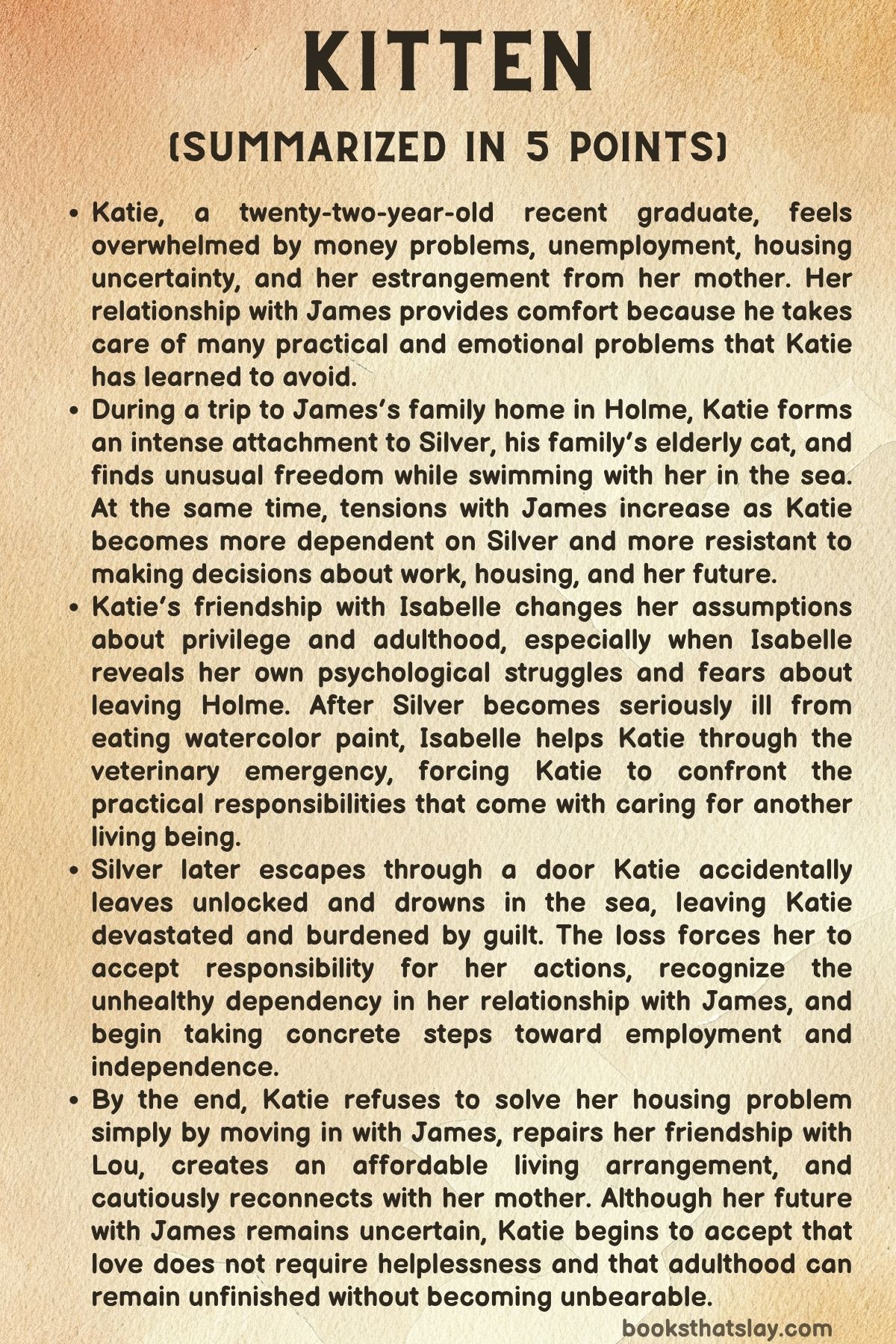
Summary
Katie has recently turned twenty-two and has been dating James for six months. Her birthday is emotionally complicated because her mother was the same age when she gave birth to Katie, and the two women have now been estranged for a year.
James’s elderly family cat, Silver, quickly captures Katie’s attention. Watching James care for the animal with uncomplicated tenderness makes Katie feel both fascinated and comforted, especially because much of her attraction to James comes from the safety she experiences when someone else manages difficult situations for her.
Their relationship originally began after Katie became extremely drunk at a bar, vomited on James, and allowed him to take care of her. He washed her hair, stayed with her, and helped her through the night, establishing a pattern in which Katie receives care while James finds satisfaction in providing it.
Katie’s circumstances have become increasingly unstable since graduating from university. Her temporary job has ended, a paycheck has been delayed, she has almost no money, and she has made little effort to secure permanent employment.
Lou, her roommate and longtime friend, repeatedly urges her to deal with unpaid bills and begin planning for the future. Katie rejects Lou’s practical assistance, partly because employment, ambition, and ordinary adult expectations leave her feeling overwhelmed.
James invites Katie to spend two weeks at his family’s seaside house in Holme. Because Katie has never seen the ocean, she imagines the journey as both an adventure and evidence that her relationship with James is becoming serious.
During the drive, however, several warning signs appear. Katie gives Silver sweetened coffee without understanding how dangerous caffeine might be for a cat, James learns that work will require him to return temporarily to New York, and Katie humiliates herself by urinating in the rental car after refusing to tell James how urgently she needs a bathroom.
Once in Holme, Katie becomes acutely conscious of the differences between herself and James. His family home represents wealth, stability, and continuity, while her own future feels uncertain and poorly organized.
Lou soon announces that she is moving out, leaving Katie with an approaching housing crisis. Katie knows James would probably give her money or allow her to live with him, but accepting such help would make her already considerable dependence on him even greater.
At the beach, Katie develops a remarkable connection with Silver. Following the cat into the water allows her to discover that she can swim better than she believed, and the ocean becomes one of the rare spaces where she feels free from ordinary expectations.
Katie also meets Isabelle Hartley, who grew up with James. Isabelle initially represents everything Katie thinks she lacks: beauty, financial security, social confidence, family connections, and a long personal history with James.
Mrs. Hartley’s questions about Katie’s career deepen Katie’s insecurity. James tries to defend her by emphasizing her artistic ability, but Katie resents the suggestion that a talent must be converted into professional ambition.
Her difficulties become harder to ignore when she admits to James that she has less than fifty dollars. At the same time, her emotional investment in Silver grows stronger, because the cat exists outside the world of careers, rent, achievement, and adult responsibility.
An argument erupts while Katie and James watch Mamma Mia!. Katie reacts angrily when James becomes distracted during a scene involving a mother and daughter, revealing how deeply the film touches the unresolved pain surrounding her own mother.
Katie later tries to perform an act of kindness by buying James his favorite pastries, but even this becomes tangled with embarrassment about money. During another argument, Silver chokes and eventually coughs up a penny, creating an absurd interruption that briefly displaces the couple’s conflict.
Katie impulsively calls her mother after a year of silence. Her attempt at reconciliation is rejected, leaving her devastated and pushing her even closer to Silver.
Lou proves more dependable than Katie has allowed herself to recognize. She has already covered Katie’s unpaid utility expenses and tells her directly that constantly assuming other people dislike her allows Katie to avoid recognizing their actual care.
As the holiday continues, Katie gives more attention to Silver and less to James. Her memories reveal that her bond with her mother was built on an unstable cycle of closeness, emotional dependence, withdrawal, and attempts to regain affection.
Even Katie’s childhood relationship with swimming was connected to this dynamic. She once jumped into a pool partly because she wanted to make her mother rescue her, suggesting that helplessness has long functioned as a way for Katie to secure love.
The same pattern now appears in Katie’s relationship with James. James enjoys helping people, while Katie often feels safest when another person makes decisions, solves problems, or takes responsibility on her behalf.
Their sexual relationship begins reflecting this imbalance. Katie becomes interested in games involving pursuit, surrender, and dependence, while James increasingly senses that something about the dynamic makes him uncomfortable.
At an art museum, Katie finally explains the rupture with her mother. During her final year of university, she returned home miserable and considered abandoning school, only to discover her mother increasingly withdrawn, underweight, and obsessed with Katie’s childhood.
Her mother experienced Katie’s growing independence as abandonment. Eventually Katie told her that she was no longer part of her life and returned to New York, but the separation never freed Katie from guilt or responsibility.
The novel later reveals more of the family history. Katie’s Chinese immigrant grandparents settled in Little Rock, and her maternal grandmother, an artist, eventually left the family.
Katie’s grandfather Bill became central to his daughter’s life, and when illness struck, Katie’s mother gave up art school to care for him and work in his laboratory. The pattern of one generation sacrificing its independence for another therefore predates Katie.
Katie’s mother later built a similarly enclosed emotional world around her daughter. Katie worshipped her as a child, learned to paint by copying her work, and came to associate art itself with their relationship.
As Katie grew older, her mother seemed unable to accept the change. Her fixation on Katie’s childhood clothing and youth exposed the extent to which she wanted time, identity, and their relationship to remain fixed.
Meanwhile, Katie’s own adult circumstances deteriorate. Lou informs her that new tenants are taking their apartment, leaving Katie only two weeks to move, while Katie retreats further into fantasies of remaining permanently in Holme with Silver.
James eventually announces that he must take Silver back to New York because his parents are returning. Katie reacts with panic, insisting that she needs the cat.
James offers what seems to him like a practical solution: Katie can return early, move into his apartment, and meet his parents. Instead of feeling reassured, Katie feels trapped by the prospect of allowing James to solve every aspect of her life.
She grabs Silver, locks herself in a bedroom, and refuses to communicate with him. After pleading with her for a long time, James leaves Holme alone.
Katie later meets Isabelle for coffee and discovers that the woman she envied has serious struggles of her own. Isabelle once lived in New York but returned home after severe psychological difficulties and now fears leaving Holme again.
Their growing friendship becomes important because Isabelle does not function as either Katie’s rescuer or opponent. She is another young woman struggling with adulthood, memory, family expectations, and the distance between imagined potential and actual life.
A crisis begins when Katie returns home and finds that Silver has bitten through the expensive watercolor paints James purchased for her. The cat has vomited violet liquid and collapsed.
Katie and Isabelle rush Silver to an emergency veterinary clinic. Silver survives the poisoning, but the treatment costs $1,299, far beyond Katie’s immediate means.
Isabelle pays the bill without humiliating Katie. When Katie finally receives her delayed university paycheck, she repays Isabelle and Lou, temporarily resolving her debts while realizing that money alone cannot solve the habits that created many of her problems.
Katie and Isabelle become closer and eventually take psychedelic mushrooms together. Isabelle admits that she feels ashamed of failing to fulfill the promise of her privileged childhood, and Katie realizes that both of them have allowed other people’s expectations of their younger selves to shape their adult identities.
Silver remains ill after returning from the veterinary hospital. James tells Katie not to allow her outside, but their conversation turns into another confrontation when he discovers that Katie has neglected even basic duties such as cleaning the litter box.
Katie begins to recognize how much she has relied on James. She tells him that their relationship is fundamentally unequal because he has money, stability, experience, and practical competence, while she has allowed herself to possess almost none of these things.
Then Katie misunderstands the front-door lock and accidentally leaves it open. Silver escapes.
Katie runs barefoot to the ocean and enters dangerous water while searching for her. She is nearly drowned by the rough sea but survives, experiencing during the struggle a sudden recognition that her feelings for James have developed into genuine love.
Isabelle and Bruno help search the shoreline. Katie speaks honestly about her relationship and admits that she has enjoyed helplessness because it allowed James to manage life for her, while James has gained emotional purpose from being needed.
Their search ends tragically when Bruno emerges from the water carrying Silver’s drowned body. The cat has died near the same place where James once discovered her abandoned many years earlier.
Katie carries Silver home, cleans her body, brushes her teeth, tends to her paws, and sleeps beside her. She delays telling James because speaking the truth would make the loss fully real.
During this period, Katie’s mother unexpectedly calls. Their conversation remains difficult, but it begins breaking the silence between them, and Katie confronts the ways money, pride, responsibility, and dependence have shaped their bond.
Katie then does something she has repeatedly avoided: she begins seriously applying for jobs. She also tries painting with the damaged watercolor set and finally admits that she may no longer want to be an artist.
The realization is painful because painting has always linked Katie to her mother. Abandoning the imagined artistic future means allowing herself to become someone her childhood did not predict.
When James returns, Katie has to tell him that Silver is dead. He is horrified by the loss, by Katie’s decision to keep Silver’s body in the bed, and by the fact that Katie waited an entire day before telling him.
Their argument forces both of them to face truths they have avoided. James accuses Katie of resisting change and remaining attached to misery even when her choices harm herself and the people around her.
Katie accepts responsibility for accidentally opening the door. Rather than demanding that James rescue, forgive, or punish her, she allows herself to recognize the consequences of her action.
Together they bury Silver on the beach near the place where she was originally found. The burial marks the end of the strange protected world Katie created around Holme, Silver, and her desire to remain outside ordinary adulthood.
On the drive back to New York, James suffers a panic attack and becomes unable to continue driving. Katie takes the wheel, reversing the usual structure of their relationship and proving that she can care for him when he is vulnerable.
Back in Manhattan, Katie sees the furniture James purchased for her planned move into his apartment. Instead of representing security, it now represents a future they created without fully understanding whether she wanted it.
They share a quiet moment of physical closeness in which neither person performs a role. Katie realizes she now loves James more genuinely than she did when their relationship began.
James’s mother later visits and comforts him without blaming Katie for Silver’s death. Her instinctive knowledge of her son’s emotional needs highlights the contrast between James’s secure family attachments and Katie’s complicated understanding of maternal love.
Katie also apologizes to Lou. Lou explains that unpaid bills were never the central problem; what hurt was Katie’s disappearance from their friendship after becoming absorbed in James.
Lou challenges Katie’s habit of assuming nobody cares about her. By believing herself unwanted, Katie has often given herself permission to ignore other people’s needs while concentrating entirely on her own insecurity.
Katie eventually admits to James that she does not want to move into his apartment. James already understands this, having noticed that she never settled into the space or even touched the stuffed shark he bought for her.
Katie tells him that when she first said she loved him, she primarily loved what being with him did for her. Now she believes she truly loves him, and that love makes independence more necessary rather than less.
They separate and take a broader break from their relationship. Katie stays temporarily with Lou, continues searching for work, and faces rejection without collapsing into complete hopelessness.
She begins noticing possible solutions rather than waiting for rescue. Lou’s difficult roommate Nicolo suggests partitioning part of the large living room so Katie can become a paying roommate.
Katie also meets Isabelle in Manhattan and learns that Isabelle has chosen to leave Holme and attempt a new life. Their friendship now rests on mutual recognition rather than Katie’s earlier jealousy.
Isabelle raises the possibility that Silver may have been seriously ill and might have instinctively sought isolation near death. Katie cannot know whether this is true and finally chooses not to make Silver’s final actions into a simple moral explanation for her own guilt.
Lou ultimately agrees to the living-room arrangement. Katie will pay a proportional amount of rent and take responsibility for the shared space, giving her an imperfect but genuinely independent housing solution.
Finally, Katie calls her mother again. She apologizes for their silence, discusses James, Isabelle, Holme, and Silver, and admits that she has never stopped thinking about her.
Her mother acknowledges the same feeling. As they compare their memories, Katie begins understanding that her mother has an identity, memory, and interpretation of the past that exist separately from Katie’s own.
The conversation does not magically repair their relationship, but it gives them a possible future. Katie’s mother invites her to visit and paint her old bedroom, suggesting reconnection without demanding a complete return to childhood.
Afterward, Katie senses Silver’s presence in the small movement of a bowl of milk. She photographs the deep blue night and sends the image to James with the word “Blue.”
Katie still does not know whether she and James will reunite, exactly what work she will do, or what relationship she will ultimately have with her mother. For the first time, however, uncertainty no longer feels identical to disaster, and she can imagine an unfinished future belonging to herself.
Characters
Katie
Katie is the emotional center of Kitten, and nearly every major conflict grows from her fear that adulthood requires losing the forms of love that once made her feel safe. At twenty-two, she is intelligent and highly self-aware in some respects, yet she repeatedly avoids employment, financial planning, housing decisions, uncomfortable conversations, and ordinary responsibilities.
Her passivity is not simple laziness. Katie has learned to connect love with dependency, beginning with the intense relationship she shared with her mother and later reproducing that structure with James.
She often makes herself small, helpless, or difficult because helplessness has historically encouraged other people to care for her. Even her childhood decision to jump into a swimming pool partly to make her mother rescue her demonstrates that the desire to be saved predates James.
Katie’s attachment to Silver gives this impulse a different direction. With the cat, she is sometimes the dependent figure seeking comfort, but she is also responsible for another vulnerable creature, which exposes the limitations of her own ability to provide consistent care.
Silver’s poisoning and eventual death force Katie to recognize that loving someone does not excuse negligence. Her transformation becomes visible when she accepts responsibility, searches seriously for work, repays debts, takes over driving during James’s panic attack, rejects the easy option of moving into his apartment, and creates a housing arrangement she can actually support.
Her final development is therefore less about becoming completely confident than about learning to tolerate uncertainty. Katie begins the story wanting another person to guarantee that she will be safe and ends it understanding that a life can be unstable, imperfect, and still genuinely hers.
James
James initially appears to be the ideal caretaker in Kitten. He is attentive, financially secure, emotionally expressive, patient, and quick to solve practical problems, qualities that make him enormously attractive to Katie when she feels incapable of managing her own life.
His relationship with Katie, however, reveals that care can become complicated when one person builds identity around providing it. James enjoys helping others, encourages Katie’s art, offers financial security, prepares space for her in his apartment, and tries repeatedly to move her toward what he considers a better future.
These actions are usually generous, but Katie gradually recognizes that James is also most comfortable when he understands how to help. His relationship with her therefore risks becoming a partnership in which he is permanently competent and she is permanently dependent.
James is not presented as deliberately controlling. In fact, he becomes uncomfortable when Katie describes their relationship in terms of power, and he repeatedly tries to respect her limits.
Silver’s death exposes the vulnerability beneath James’s caretaker identity. His grief, panic attack, and need for Katie’s support reveal that he is not simply the stable figure standing above her problems; he also has fears, childhood wounds, and emotional needs of his own.
The relationship becomes healthier only once Katie can see James as a person rather than a rescue system. Their separation therefore carries pain but also creates the possibility that any future relationship between them could involve two adults capable of alternately giving and receiving care.
Silver
Silver functions as far more than an animal companion in Kitten. She becomes the creature onto whom Katie projects fantasies about freedom, dependency, innocence, responsibility, and escape from human expectations.
Katie envies Silver because the cat does not need employment, ambition, money, social status, or a carefully planned future. Silver can eat, sleep, swim, demand attention, and depend entirely on other people without being judged for failing adulthood.
At the same time, Silver gives Katie the experience of being needed. Feeding, bathing, carrying, brushing, and swimming with the cat temporarily allow Katie to occupy the caretaker position she usually assigns to James or her mother.
The relationship also exposes Katie’s immaturity. Giving Silver coffee, neglecting practical aspects of her care, leaving dangerous materials accessible, and accidentally allowing her outside while sick all show that affection without sustained responsibility can have serious consequences.
Silver’s death becomes the central rupture in Katie’s development because it cannot be undone through apology or reassurance. Katie has to live with the possibility that her mistake contributed to the loss while resisting the temptation to turn herself permanently into either an innocent victim or an unforgivable villain.
By the end, Silver survives primarily through memory. Katie’s decision to remember her as curious and freedom-seeking rather than as a symbol of guilt allows the cat to remain an individual creature rather than becoming merely a lesson in Katie’s personal development.
Katie’s Mother
Katie’s mother is one of the most psychologically important figures in Kitten, even when she is absent from the immediate action. Katie’s understanding of love, abandonment, art, adulthood, money, and dependence has been shaped by the intense private world the two created together.
Her history explains part of this pattern. She sacrificed her own artistic ambitions to care for her sick father, Bill, after having already experienced abandonment by her own mother.
She subsequently invests heavily in Katie, and her daughter becomes both the center of her emotional life and a connection to the possibilities she herself lost. As Katie grows older and becomes independent, her mother experiences the change almost as a personal rejection.
Her fixation on Katie’s childhood clothing and earlier identity reveals an inability to accept the passage of time. Rather than supporting separation as a natural part of parenting, she often appears to experience Katie’s adulthood as the destruction of their former closeness.
Yet the novel does not reduce her to an oppressive mother. She has experienced abandonment, sacrifice, financial pressure, isolation, and disappointment, and her later attempts to send Katie money show that care remains present even when communication has broken down.
The final conversation between mother and daughter becomes important because Katie begins seeing her mother as an individual rather than only as the source of her own guilt. Their differing memories suggest that reconciliation will require both women to accept that love cannot depend on possessing the same version of the past.
Lou
Lou provides one of Kitten’s clearest models of love expressed through boundaries rather than rescue. She repeatedly asks Katie to pay bills, seek employment, plan for housing, and acknowledge practical realities, which Katie initially interprets as criticism.
In reality, Lou has been supporting Katie for years. She covers unpaid utilities, offers professional introductions, gives her somewhere to stay, and continues maintaining the friendship even after Katie becomes absorbed in James.
Lou’s most important contribution is her refusal to flatter Katie’s self-image. She tells Katie that constantly assuming everyone dislikes her allows her to avoid responsibility for how she treats other people.
This forces Katie to recognize that insecurity can become self-centered. Feeling unloved does not mean she is incapable of neglecting people who actually do love her.
Their reconciliation therefore expands Katie’s understanding of intimacy. Friendship is not merely background support compared with romantic or maternal relationships; Lou has been one of the most stable people in Katie’s adult life.
Isabelle Hartley
Isabelle initially appears through Katie’s insecurity rather than through her own reality. Beautiful, wealthy, socially connected, and familiar with James’s family, she seems to represent an effortless adult life against which Katie feels inadequate.
That perception collapses once Isabelle speaks openly about her psychological difficulties. She once attempted life in New York but returned to Holme after a breakdown and now feels trapped by fear, family expectations, and memories of who she was supposed to become.
Her friendship with Katie develops because neither woman can maintain the fantasy that the other possesses a perfect life. Isabelle’s privilege has not protected her from anxiety, disappointment, isolation, or paralysis.
She also becomes practically important during Silver’s medical emergency. Isabelle drives Katie to the veterinary hospital, remains with her, pays the bill without humiliation, helps search for Silver later, and continues the friendship after Katie returns to Manhattan.
Her eventual decision to leave Holme mirrors Katie’s movement toward independence. Both women begin accepting that refusing to choose is still a choice and that adulthood requires acting without certainty about the outcome.
James’s Mother
James’s mother appears only briefly but provides an important contrast to Katie’s maternal relationship. Her response to Silver’s death demonstrates a form of care based on reassurance without emotional possession.
She immediately understands that James needs to hear that he is good and that Silver’s death was not his fault. Her ability to comfort him reflects a long-standing knowledge of her son without requiring him to remain emotionally dependent on her.
Her kindness toward Katie is equally significant. She could easily direct her grief into accusation, yet she refuses to simplify the tragedy into an act requiring a single person to condemn.
Through her, Katie witnesses the possibility that maternal love can include closeness without making separation feel like betrayal. This contrast helps her reconsider what she might eventually want from her own mother.
Mrs. Hartley
Mrs. Hartley embodies the social and economic world that makes Katie feel judged. Her questions about employment and her reaction to Katie’s lack of a defined career intensify Katie’s belief that successful adulthood requires a clear professional identity.
Because Mrs. Hartley has also played a maternal role in James’s life, Katie experiences her judgment as particularly threatening. She fears that the woman is measuring whether she is appropriate for James.
Yet Mrs. Hartley is also important because her family’s apparent stability proves less complete once Isabelle’s struggles are revealed. The polished exterior of the Hartley household cannot prevent their daughter from feeling uncertain, trapped, and ashamed of her own stalled development.
Bill
Bill, Katie’s maternal grandfather, appears primarily through family history but has enormous influence on later generations. His illness leads Katie’s mother to abandon art school and reorganize her life around caregiving.
That sacrifice becomes part of the emotional inheritance passed to Katie. Her mother learns that love means giving up part of oneself for another person, while Katie grows up believing that relationships naturally involve obligation and dependency.
Bill is therefore significant even without direct participation in Katie’s adult life. His illness helps establish the family pattern in which care and personal sacrifice become difficult to separate.
Katie’s Maternal Grandmother
Katie’s grandmother is an artist whose eventual abandonment of her family leaves a major absence behind. Her departure shapes Katie’s mother, who later seems determined to build a relationship with her own daughter that cannot be abandoned in the same way.
Art also passes symbolically through the women of the family. Because Katie associates painting with both her mother and earlier generations, abandoning the expectation that she must become an artist means questioning a family identity rather than merely changing careers.
Her grandmother therefore influences Katie indirectly through absence. The fear of leaving and being left travels through the family long after the original departure.
Katie’s Father
Katie’s father is largely absent from her life and exists mostly as part of the story she has inherited about her birth. He was another Chinese American art student, already involved with someone else, and never became an active parent.
His absence helps intensify the closed relationship between Katie and her mother. Without another parent sharing emotional or practical responsibility, mother and daughter become almost entirely focused on one another.
The lack of a paternal relationship also means that Katie grows up without witnessing a model of partnership between independent adults. Her later dependence on James emerges from many influences, but the structure of her childhood gives her few examples of balanced romantic intimacy.
Nicolo
Nicolo initially occupies a minor and somewhat irritating place in Lou’s apartment, but he becomes important because he identifies a practical solution Katie fails to see. His suggestion that Katie partition part of the living room transforms an apparently impossible housing crisis into a manageable compromise.
This moment captures Katie’s changing relationship with problems. Earlier she tends to view every obstacle as overwhelming until another person rescues her, whereas the arrangement with Lou and Nicolo requires negotiation, payment, responsibility, and acceptance of imperfection.
Nicolo also bonds with Katie over insomnia and warm milk, showing again that meaningful human connection can appear in forms Katie does not initially value. Not every supportive relationship needs to become emotionally consuming.
Bruno
Bruno plays a small but emotionally powerful role during the search for Silver. He joins Isabelle and Katie along the coast and ultimately retrieves Silver’s body from the water.
His gentle return of the cat gives physical reality to the loss Katie has desperately hoped to avoid. Through Bruno, the search ends not with uncertainty but with an irreversible fact that Katie must face directly.
Tom
Tom, James’s manager, represents the professional world that repeatedly interrupts the couple’s attempt to create a private refuge. Work demands force James to return to New York during the Holme trip and remind Katie that James’s life contains obligations beyond caring for her.
Tom’s presence also indirectly emphasizes the difference between James and Katie. James possesses a demanding career and is needed professionally, while Katie begins the story without employment, direction, or a stable sense of what she wants to contribute.
Themes
Dependency, Care, and the Desire to Be Needed
Relationships throughout Kitten repeatedly blur the boundary between healthy care and dependency. Katie is drawn to James because he makes life easier, beginning from the night they meet when he cleans her, comforts her, and assumes responsibility while she is incapable of caring for herself.
That dynamic gradually becomes the structure of their relationship. James handles money, transportation, planning, housing possibilities, emotional reassurance, and practical crises, while Katie becomes increasingly comfortable allowing him to occupy the competent role.
The problem is not that receiving care is inherently unhealthy. The difficulty arises when Katie begins using helplessness as evidence that she is loved and James begins gaining part of his identity from constantly being needed.
Silver complicates this structure because Katie becomes responsible for a creature even more dependent than herself. She enjoys feeding, bathing, carrying, and protecting the cat because these acts allow her to experience the emotional power usually held by James.
Yet Silver’s poisoning and death reveal the difference between enjoying the feeling of being needed and consistently meeting another being’s needs. Responsibility requires attention even when it is boring, unpleasant, inconvenient, or emotionally unrewarding.
Katie’s growth becomes visible when she stops imagining relationships as fixed roles. She can drive when James cannot, accept Lou’s boundaries, repay Isabelle, reject James’s housing solution, and still admit that she loves and needs other people.
Care therefore becomes healthiest when it can move in both directions. Dependence is no longer proof of love, and independence does not require emotional isolation.
Adulthood, Responsibility, and Uncertainty
Katie experiences adulthood less as freedom than as the disappearance of protection. Employment, rent, housing, money, relationships, career choices, and family separation all require decisions she fears making because every decision appears to close off other possibilities.
Her strategy is therefore avoidance. She postpones job applications, ignores financial problems, resists housing decisions, and imagines that remaining with James or Silver might allow her to continue without choosing a direction.
The novel repeatedly shows that refusing to decide does not prevent consequences. Lou moves out, housing disappears, debts accumulate, James makes plans on Katie’s behalf, and Silver suffers partly because Katie has not developed consistent habits of responsibility.
Isabelle experiences a related paralysis from a different social position. She has wealth and family support, yet she is similarly frightened by the distance between the person she expected to become and the person she currently is.
Their friendship demonstrates that adulthood cannot be reduced to financial success or conventional achievement. What matters is the willingness to act without possessing complete certainty about whether an action will succeed.
By the ending of Kitten, Katie still lacks a guaranteed career, permanent romantic resolution, or perfectly repaired family relationship. What changes is her belief that uncertainty itself is unbearable.
The imperfect living arrangement with Lou becomes symbolic of this shift. Katie does not receive an ideal apartment or a romantic rescue; she accepts a partitioned living room she can afford, contribute to, and call her own.
Adulthood emerges as participation rather than mastery. Katie does not become someone who knows exactly what will happen next; she becomes someone increasingly willing to take responsibility for whatever comes.
Mothers, Daughters, and the Difficulty of Separation
Katie’s relationship with her mother shapes nearly every important emotional pattern in the story. Their early closeness is so intense that Katie learns to understand love as a state in which the boundaries between two people almost disappear.
For her mother, Katie becomes especially important because earlier relationships have already connected love with abandonment and sacrifice. Her own mother left the family, while caring for Bill required her to surrender art school and reorganize her future around someone else’s needs.
When Katie begins developing an independent adult identity, her mother struggles to accept the change. Katie’s departure is experienced not simply as maturation but as the loss of the relationship that has structured her mother’s life.
Katie responds with both anger and guilt. She wants independence while continuing to feel responsible for the loneliness her independence creates.
Their conflict shows why physical separation alone cannot create emotional freedom. Even after a year without contact, Katie organizes much of her thinking around her mother, repeatedly remembers childhood, reacts strongly to fictional mother-daughter relationships, and remains uncertain about pursuing art because painting is inseparable from maternal memory.
The eventual reconciliation works because neither woman simply returns to the old relationship. Katie apologizes, but she also recognizes that her mother has memories, experiences, and interpretations that differ from her own.
Her mother’s repainted house becomes especially meaningful. The childhood home has changed without disappearing, suggesting that relationships can survive alteration if both people stop demanding that the past remain permanently intact.
Their future remains uncertain, but the story presents separation and love as potentially compatible. Katie can care about her mother without surrendering adulthood, and her mother can remain part of Katie’s life without possessing the entire emotional world they once shared.
Grief, Guilt, and Accepting Irreversible Loss
Silver’s death gives the novel its harshest lesson about consequences. Katie has spent much of her life treating difficult situations as things that can be avoided, postponed, explained away, or handed to someone else, but death cannot be negotiated with.
Her guilt is complicated because responsibility is real without being absolute. Katie accidentally opens the door, has previously made careless decisions regarding Silver’s health, and knows that her actions contributed to the circumstances surrounding the cat’s disappearance.
At the same time, she cannot know with certainty why Silver went to the ocean or whether the sick animal might have escaped under different circumstances. Isabelle’s later theory that Silver may have instinctively isolated herself near death offers one possible explanation but not a definitive answer.
Katie must therefore learn to live without either complete innocence or complete condemnation. She cannot erase her mistake, but endlessly punishing herself would become another form of self-absorption rather than meaningful responsibility.
Her decision to wash Silver’s body, sleep beside her, tell James the truth, assist in the burial, and eventually remember Silver as a curious animal rather than merely the object of her guilt reflects this process. Grief requires acknowledging the finality of what happened while allowing memory to contain more than the final tragedy.
James must undergo a similar process. His first response is anger and devastation, yet he too eventually needs reassurance that caring deeply for Silver did not give him the power to prevent every possible loss.
The theme extends beyond death to other endings. Katie grieves childhood, her idealized relationship with her mother, her imagined identity as an artist, the early version of her romance with James, and the belief that someone else can always protect her from consequences.
Acceptance does not mean these losses stop hurting. It means Katie stops demanding that life remain unchanged in order to feel safe, allowing memory, responsibility, and uncertainty to exist alongside the possibility of continuing forward.