Let’s Kiss and Tell Summary, Characters and Themes
Let’s Kiss and Tell by Joss Richard is a contemporary romance centered on Lucy Reid, an outspoken sex-and-relationships writer whose career suddenly depends on convincing readers that she has entered a committed relationship.
Her solution is Marshall “Marsh” Oakley, a journalist who needs a date for his ex-girlfriend’s wedding and has little interest in complicating his already work-dominated life. What begins as a mutually convenient fake relationship gradually exposes the fears both have hidden behind independence, ambition, and emotional caution. The book combines romantic comedy with questions about intimacy, career identity, trust, family history, and the difficult difference between understanding relationships intellectually and actually risking oneself inside one.
Summary
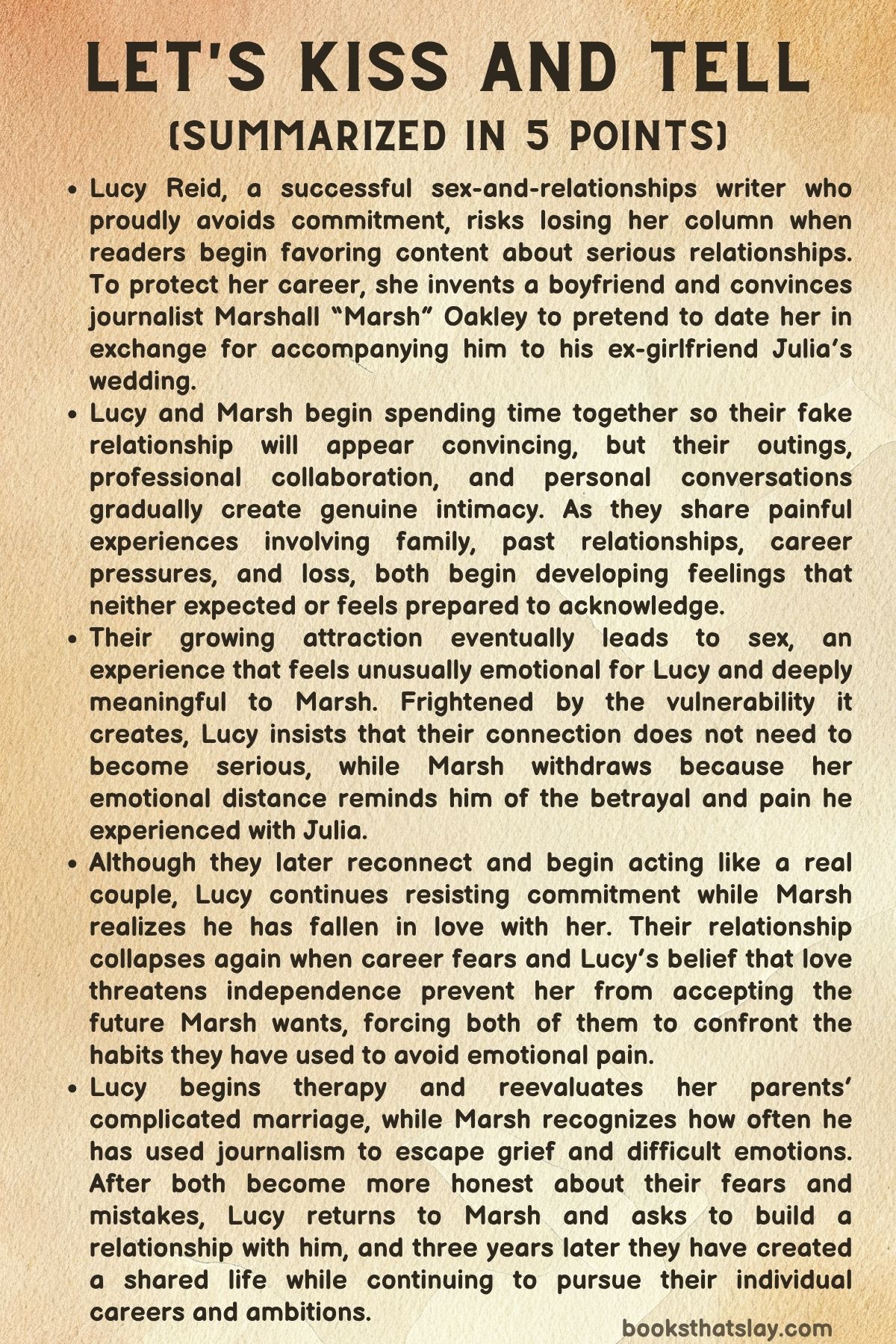
Lucy Reid is twenty-nine and has created a professional identity around being proudly single. As a sex-and-relationships writer for The Rue, she has spent years telling readers that pleasure, independence, and a fulfilling life do not require romantic commitment, an outlook partly formed by discovering her father’s affair when she was young and watching her mother remain married to him.
Her confidence is shaken when her editor, Eman, tells her that readership of her column has fallen sharply. The magazine’s audience has changed, with more readers wanting material about established relationships, and Lucy panics when she realizes that the career she built could disappear if she cannot adapt.
Without thinking through the consequences, Lucy claims she has recently entered a relationship. Eman immediately asks her to write about the experience, leaving Lucy with the problem of inventing a boyfriend convincing enough to support a continuing series of personal articles.
Around the same time, Marshall “Marsh” Oakley attends the farewell party of his friend Jay, whose position at the LA Journal Marsh is taking over. Marsh is an ambitious investigative journalist who has spent years freelancing and finally has the permanent position he has wanted, but his devotion to work has left little room for anything else.
Lucy and Marsh meet at the party and quickly establish an easy rapport through conversations about journalism, music, sex, and relationships. Marsh reveals that he needs a date to the Palm Springs wedding of Julia, the woman he dated for nearly a decade, because their families remain connected and attending alone would make an uncomfortable situation even worse.
Lucy soon recognizes that their problems can solve each other. She proposes pretending to be Marsh’s girlfriend until Julia’s wedding, allowing Marsh to arrive with a convincing partner while giving Lucy enough authentic experiences to turn into relationship articles.
Although Marsh initially worries that the arrangement could become inappropriate, he eventually agrees. They establish personal details that will help them perform convincingly, but their conversations about family, children, careers, marriage, and past relationships create a level of intimacy Lucy does not usually experience with casual partners.
The relationship pieces quickly revive Lucy’s career. At the same time, Marsh becomes fascinated by her intelligence, humor, confidence, and unusual perspective on people, while Lucy discovers that Marsh is much more emotionally interesting than the useful fake boyfriend she originally imagined.
Their professional worlds begin overlapping as well. Marsh is investigating wealthy businessman Alf Olson and an escort-service scandal, and he invites Lucy to observe interviews because her expertise in sex, gender, and relationships gives her a perspective his more traditional reporting does not always capture.
Lucy observes that Marsh approaches journalism through facts and observable evidence while she pays close attention to emotional atmosphere. Their contrasting methods begin to complement each other, establishing respect between them that extends beyond attraction.
Their fake dates gradually become more personal. A flea-market trip, boxing session, expensive open-house visits, tacos, coffee, and a ride on the Santa Monica Pier Ferris wheel give them experiences that Lucy initially intends to transform into content but that increasingly resemble ordinary moments between two people genuinely enjoying each other.
The house tours become especially revealing because they begin casually imagining a life together. They discuss offices, kitchens, guests, and how they might use the space, allowing both to picture a shared future they supposedly have no intention of pursuing.
At Santa Monica, Lucy finally explains how her father’s affair damaged her faith in romantic love. Rather than trying to correct her feelings, Marsh listens, and Lucy admits that she feels safe with him, a confession far more intimate than the sexual openness on which she has built her public identity.
Their attraction also becomes increasingly difficult to deny. Lucy sits on Marsh’s lap while performing for Julia’s suspicious friend Dani, the two dance closely at a club, and Marsh eventually pulls away because he fears that sleeping together could threaten both their careers.
His rejection embarrasses Lucy, who falls briefly into an old habit by going to Chris, one of her casual partners. Nothing happens between them, yet the episode makes Lucy recognize that what she wants from Marsh is not interchangeable with the easy physical relationships she has maintained in the past.
Lucy later spends an evening at Marsh’s house, where she gains access to an even more vulnerable part of his life. Marsh tells her about Julia’s miscarriage, the daughter he privately thought of as Clementine, and his eventual decision to have a vasectomy, revealing grief he rarely discusses.
Meanwhile, Marsh realizes his own feelings are becoming serious. His brother Oliver and his friend Jay both recognize that he speaks about Lucy as someone emotionally important rather than merely a participant in a fake arrangement, yet Marsh remains convinced that Lucy would never truly want the kind of relationship he is beginning to imagine.
When Lucy meets Marsh’s family at Sadie’s birthday celebration, the performance becomes still more difficult to separate from reality. Lucy cares whether Oliver, Quinn, Sadie, and Marsh’s mother like her, while casual touches and kisses between her and Marsh feel increasingly natural.
Julia’s unexpected appearance creates tension, but it also makes Lucy confront her jealousy. Soon afterward, travel problems leave Lucy and Marsh sharing a luxurious hotel suite with one king-size bed, finally destroying the physical boundaries they have been trying to preserve.
They have sex, and the experience changes the emotional terms of their connection. Lucy, despite having far more sexual experience than Marsh, is shaken because intimacy with him feels different: she does not simply feel desired but understood, safe, and emotionally exposed.
Marsh interprets the night as the beginning of something meaningful. Lucy becomes frightened by exactly that possibility and insists that sex does not need to change their arrangement, unintentionally touching Marsh’s deepest insecurity because Julia once used similarly dismissive language about her affair.
Unable to explain the emotional association, Marsh withdraws. The fake relationship ends, Lucy stops helping with his article, and both pretend they are simply terminating an arrangement even though their pain makes clear that they have lost something real.
Lucy soon realizes that separation does not solve the problem. She ends her casual relationship with Chris and writes publicly about experiencing genuine emotional connection during sex for the first time, indirectly acknowledging that Marsh reached a part of her she had always protected.
Eventually Lucy returns and proposes continuing a sexual relationship without defining it as serious. Marsh understands the danger but agrees because he would rather have some part of her life than none, and their connection begins looking even more like a partnership.
They spend evenings cooking, attend boxing classes, socialize with friends, watch films, share showers, discuss childhood memories, and become incorporated into each other’s ordinary routines. Lucy also resumes contributing professionally to Marsh’s investigation, explaining the economic and gendered power structures surrounding sex work.
Marsh’s resulting feature is published with Lucy identified as an expert. The recognition matters deeply to her because it validates her intelligence beyond the provocative reputation of her column, while Marsh becomes proud of the role she has played in strengthening his journalism.
Their original bargain reaches its official purpose when they travel to Palm Springs for Julia’s wedding. Lucy speaks privately with Julia and learns that Marsh’s former relationship was more complicated than a simple story of betrayal, because Julia had spent years feeling abandoned while Marsh increasingly retreated into work.
Lucy understands Julia’s pain but refuses to let Marsh carry all the blame. Meanwhile, Marsh finally accepts that his old relationship was already dying long before Julia’s affair and forgives her, recognizing that he no longer wants his past to determine how he lives.
Just when Marsh seems emotionally free of Julia, Lucy receives news about layoffs at the Journal. Fear that their workplace relationship could threaten her career intensifies all her existing anxieties, and a disagreement with Marsh turns into a confrontation about love itself.
Marsh argues that loving someone does not mean surrendering independence, while Lucy feels he is trying to tell her what she should want. Marsh has fallen in love with her and wants a future together, but Lucy refuses to accept a commitment she still associates with vulnerability and eventual pain.
They separate again, this time with no fake-dating rules to hide behind. Jonah challenges Lucy afterward, forcing her to admit that she has used sexual confidence as emotional armor because casual intimacy allows people to approach her body without gaining enough access to truly hurt her.
Lucy returns to her parents and confronts her mother about why she stayed after her husband’s affair. To Lucy’s surprise, her mother explains that the marriage had been deeply troubled, that she and Lucy’s father had separated in the past, and that remaining together was ultimately an active choice rather than helpless acceptance.
The conversation dismantles the simple lesson Lucy drew from childhood. Love can contain betrayal, anger, forgiveness, failure, choice, and repair without automatically turning the person who stays into someone weak.
Lucy then begins therapy, where she recognizes that the fake relationship gave her a psychologically safe loophole. Because she believed nothing was real, she allowed herself to experience companionship and vulnerability without admitting that she was risking her heart.
Marsh is changing as well. Oliver confronts him about repeatedly responding to emotional pain by disappearing into journalism, and Marsh begins questioning whether career achievement should continue to define his entire identity.
He experiments with living differently, even trying to date another woman named Kathy. When he realizes he remains emotionally attached to Lucy, however, he communicates openly rather than using the encounter as an escape.
Both begin expressing themselves more honestly through writing. Lucy publishes an article acknowledging that she destroyed something valuable because of fear, while Marsh writes a deeply personal piece about love, vulnerability, pride, and the woman he lost.
Marsh’s article becomes enormously popular and reveals publicly how profoundly the relationship changed him. Lucy understands how difficult such openness is for him and rushes to see him before he leaves on a trip to Thailand.
When they meet again, Lucy does not claim that therapy has suddenly solved all her fears. Instead, she tells Marsh that she still does not know exactly how to have a healthy relationship but wants to learn with him rather than continue protecting herself by keeping him outside her life.
Marsh admits that he does not have all the answers either and tells her that he loves her. Lucy finally accepts that what began as a professional bargain became real long before either of them was willing to name it.
Three years later, they have built the domestic life they once pretended to imagine while touring houses. They share their home with a dog named Pepper, maintain their careers without allowing work to consume everything, and continue choosing a relationship based on communication rather than certainty.
Lucy has also turned her experiences as a sex writer, daughter, dater, and partner into a memoir, giving herself greater control over the story she tells about her life. Their ending does not suggest that love erased their flaws; instead, it shows two people who learned that independence and intimacy can exist together when both are willing to remain present, communicate honestly, and accept emotional risk.
Characters
Lucy Reid
Lucy Reid is the emotional center of Let’s Kiss and Tell, and much of her development comes from the gap between what she understands professionally and what she can tolerate personally. She knows how to discuss sex, boundaries, desire, gender, dating, and pleasure with unusual confidence, yet she has spent much of her adult life ensuring that sexual openness never requires emotional dependence.
Her independence is genuine, but it is also partly defensive. Discovering her father’s affair taught her to associate romantic commitment with humiliation and loss of control, so she chooses situations in which she can leave before anyone gains enough emotional importance to hurt her.
Her fake relationship with Marsh initially appears perfect because it gives her the appearance of commitment while protecting her from the consequences of actually making one. That illusion slowly fails as she discovers that what she enjoys most is not simply attraction but companionship, security, ordinary routines, intellectual respect, and being understood.
Lucy’s treatment of Chris also exposes one of her flaws. Because she has trained herself to separate sex from attachment, she sometimes underestimates how her emotional distance affects other people and must eventually acknowledge that independence does not excuse carelessness.
Her professional growth parallels her romantic development. At first she changes her column largely because she fears losing her career, but her experiences with Marsh lead her toward more emotionally complex writing and eventually help her understand that honesty requires far more than publicly discussing sex.
Therapy becomes essential because Lucy does not simply switch from opposing relationships to embracing them. She starts examining why she reacts to vulnerability with fear, allowing the ending of Let’s Kiss and Tell to present her decision to love Marsh as an informed risk rather than a total rejection of her earlier values.
Marshall “Marsh” Oakley
Marsh initially appears more conventional than Lucy, but he has developed his own sophisticated form of emotional avoidance. Where Lucy uses casual relationships and sexual independence, Marsh uses work, turning journalism into a structure through which he can avoid uncertainty, grief, and difficult personal decisions.
His relationship with Julia demonstrates the consequences of that pattern. They remained together for nearly ten years, but Marsh increasingly disappeared into his career, allowing familiarity and inertia to replace active emotional participation.
Julia’s affair wounds him deeply because it confirms his fear of being replaceable, a fear already reflected in his obsessive commitment to proving himself professionally. The miscarriage they experienced adds another layer of grief that Marsh has never adequately processed and helps explain both his vasectomy and his tendency to treat emotional pain as something to survive privately.
Lucy challenges his habits because she awakens curiosity rather than comfort. Around her, Marsh experiments with new experiences, discusses subjects that embarrass him, imagines domestic possibilities, and eventually begins valuing time with another person as much as professional achievement.
His development in Let’s Kiss and Tell is therefore not simply about falling in love. He has to forgive Julia, recognize his own role in the collapse of that relationship, stop defining himself entirely through journalism, and learn to communicate before silence allows fear to make decisions for him.
His personal essay near the end is especially important because a man who has spent his career reporting other people’s stories finally makes himself the subject. Publicly acknowledging vulnerability represents a profound change from the Marsh who initially tried to preserve control by keeping work and emotion carefully separated.
Julia
Julia functions as much more than the stereotypical former girlfriend standing between the central couple. Although Marsh initially remembers their breakup primarily through the pain of her infidelity, later conversations reveal a relationship in which both people had been unhappy and emotionally disconnected long before the affair occurred.
Her frustration with Marsh is understandable because she spent years watching work consume more of him while their relationship gradually lost intimacy. This does not excuse her betrayal, but the book allows her actions to exist inside a larger history rather than using them as proof that she is simply cruel.
Julia also retains complicated feelings about Marsh even while marrying Chad. Her interest in Lucy and repeated concern that Marsh may be hurt again suggest that their long shared history cannot instantly become emotionally neutral.
Her eventual conversations with both Lucy and Marsh allow the past to become something they can interpret rather than merely suffer from. In Let’s Kiss and Tell, Julia ultimately represents the possibility that a failed relationship can contain real affection, serious harm, mutual mistakes, and valuable lessons at the same time.
Jonah
Jonah is Lucy’s close friend and one of the few people capable of challenging the stories she tells herself. His humor allows him to discuss Lucy’s chaotic romantic situation without becoming moralizing, but he is also willing to confront her when avoidance begins masquerading as principle.
He understands that Lucy’s belief in independence contains both conviction and fear. After the breakup with Marsh, Jonah refuses to accept her rehearsed claims that she never wanted love in the first place and instead forces her to consider why this particular loss has affected her so deeply.
Jonah also serves as an important professional sounding board. He recognizes how much Lucy’s public writing depends on the private experiences she is having with Marsh and warns her when gaps in that story could make the fictional relationship less convincing to readers.
His friendship gives Lucy a stable emotional connection outside romance. That matters because the story never suggests that Marsh should become her entire support system; Jonah remains evidence that Lucy was always capable of loyalty and intimacy, even before she learned to accept those qualities in a romantic relationship.
Chris
Chris represents the comfortable emotional limits Lucy has established before meeting Marsh. Their casual sexual arrangement works for Lucy because it demands little vulnerability and allows her to maintain control, but Chris eventually reveals that he had hoped their connection might become something more substantial.
His disappointment exposes Lucy to the consequences of assuming that emotional detachment is equally simple for everyone involved. She has treated their arrangement as uncomplicated partly because she never allowed herself to ask whether Chris experienced it differently.
His later confrontation with Marsh is unpleasant and deliberately humiliating, yet some of his criticism forces Lucy to acknowledge genuine weaknesses in her behavior. She has avoided commitment, sometimes kept multiple people emotionally distant, and occasionally failed to consider what her actions mean to others.
Chris therefore operates as an uncomfortable mirror. His hostility makes him unsympathetic during the confrontation, but his presence contributes to Lucy’s growing recognition that personal freedom still requires responsibility toward people who become emotionally invested.
Oliver Oakley
Oliver is Marsh’s brother and one of the strongest voices challenging Marsh’s dependence on work. Because he has known Marsh throughout every major emotional crisis, Oliver can identify a pattern that Marsh himself has normalized.
He sees that Marsh threw himself into journalism after the miscarriage, after the end of his relationship with Julia, and again after separating from Lucy. Oliver therefore understands that professional ambition is not merely one of Marsh’s admirable qualities but also his preferred hiding place.
His conversations with Marsh expand the emotional concerns of Let’s Kiss and Tell beyond romance. Oliver asks who Marsh would be without journalism, forcing him to confront how dangerously narrow his sense of identity has become.
Oliver’s family life with Quinn and Sadie also gives Marsh another model of adulthood. It shows him that close relationships need not erase ambition and that making room for family can create meaning rather than diminish professional seriousness.
Quinn
Quinn contributes to the warmth of Marsh’s family environment and helps make Lucy’s introduction to that world emotionally significant. Although she is not given the same extensive personal development as Lucy, Marsh, or Oliver, her presence helps establish the family life that Lucy initially observes as an outsider.
Through Quinn and Oliver’s household, Lucy experiences a form of stable affection that challenges her assumption that long-term partnership necessarily requires sacrificing individuality. Their family does not function as an idealized argument that commitment is easy; instead, it quietly provides evidence that domestic closeness can coexist with distinct personalities and independent lives.
Quinn also matters because Lucy becomes attached not only to Marsh but to the community surrounding him. This makes the Palm Springs separation more painful, since rejecting Marsh also means stepping away from relationships she has begun to value.
Sadie
Sadie, Marsh’s niece, brings out a relaxed and affectionate side of Marsh that differs sharply from the intense journalist Lucy first encounters. His obvious devotion to her gives Lucy evidence that Marsh’s emotional reserve is selective rather than an inability to love.
Sadie also becomes part of Marsh’s attempts to rebuild his identity after the breakup. His decision to get a tattoo chosen by her reflects his effort to make choices based on enjoyment, affection, and spontaneity instead of professional usefulness.
Her presence reinforces one of the book’s quieter ideas: people are often more complicated than the identities they construct around work or romance. Marsh may think of himself primarily as a journalist, but his relationship with Sadie shows that family, playfulness, and tenderness are equally genuine parts of him.
Eman
Eman serves as the professional catalyst for Lucy’s entire fake-relationship scheme. By warning her that her readership is falling and that audiences increasingly want content about committed relationships, Eman unintentionally pushes Lucy into the lie that creates the central conflict.
Eman is not simply an antagonist threatening Lucy’s job. The changing editorial expectations reflect the instability of digital media, where writers are often forced to adapt their voices to audience data, sponsorship opportunities, and shifting commercial demands.
Later praise from Eman demonstrates that Lucy’s new writing is successful because it reveals emotional dimensions that her earlier work often avoided. Yet that success also creates an ethical problem, since the greater professional rewards become, the harder it is for Lucy to separate genuine personal development from a public narrative built on deception.
Nadia Lewis
Nadia Lewis is Marsh’s respected managing editor and represents the level of journalistic seriousness both Marsh and Lucy value. Marsh worries about disappointing her because his permanent position at the Journal represents years of professional effort and a rare sense of security.
For Lucy, Nadia’s praise is particularly meaningful because she recognizes greater depth in Lucy’s newer relationship writing. Lucy has received attention for provocative work before, but validation from a respected editor gives her confidence that she can be recognized for emotional insight and intellectual range rather than sexuality alone.
Nadia therefore contributes indirectly to the career anxiety affecting both central characters. Their fear of workplace consequences is credible because each has something professionally important to protect, making the conflict between personal risk and career security more than a convenient romantic obstacle.
Jay Dunn
Jay is Marsh’s longtime friend and provides an outside perspective on the absurdity of the fake-dating arrangement. Once Marsh admits what is happening, Jay quickly recognizes what Marsh refuses to state: if two people enjoy being together, are attracted to each other, and keep choosing one another’s company, the distinction between pretending to date and actually dating has become increasingly artificial.
His questions push Marsh toward admitting that a genuine relationship with Lucy appeals to him. Marsh’s immediate retreat into assumptions about why Lucy would never choose him also reveals how insecurity, rather than simple incompatibility, is preventing him from acting honestly.
Jay’s role is relatively small, but he is important because he identifies the emotional truth before either central character can accept it. He represents the perspective of someone outside the arrangement who can see how transparent their supposedly controlled situation has become.
Lucy’s Mother
Lucy’s mother becomes crucial late in the novel because Lucy has constructed much of her adult philosophy around a misunderstanding of her parents’ marriage. For years, Lucy assumes her mother stayed after infidelity because she was too dependent, frightened, or socially conditioned to leave.
The truth is more complicated. Her mother explains that the marriage had already experienced serious problems, including a period of separation, and that reconciliation after the affair was a conscious choice rather than passive acceptance.
This conversation does not erase what Lucy’s father did. Instead, it teaches Lucy that relationships cannot always be understood from the outside through simple categories of victim and betrayer.
Her mother’s willingness to remain and rebuild forces Lucy to reconsider her belief that protecting oneself from pain is the highest form of strength. Choosing forgiveness can also require courage, especially when it comes after anger, reflection, separation, and a realistic understanding of what has gone wrong.
Lucy’s Father
Lucy’s father has comparatively little direct narrative presence, yet his affair shapes much of Lucy’s personality. The teenage Lucy interprets his betrayal as proof that love eventually creates dependence and that dependence leaves people vulnerable to humiliation.
Because she does not know the full history of her parents’ marriage, she turns one painful event into a universal rule. That rule influences her adult relationships long after the original family crisis has passed.
His role therefore demonstrates how children can carry simplified interpretations of adult events into later life. Lucy’s eventual growth depends not on pretending that his betrayal was harmless, but on recognizing that the meaning she assigned to it was incomplete.
Ana
Ana, Lucy’s therapist, helps Lucy convert emotional pain into self-understanding rather than another round of avoidance. Instead of telling Lucy that she secretly wanted conventional romance all along, Ana helps her examine why the fake arrangement felt safe enough to let her experience genuine closeness.
Her insight that the arrangement created a loophole is central. Lucy could enjoy companionship, intimacy, and vulnerability because she believed there was no real commitment and therefore no genuine emotional danger.
Ana’s role in Let’s Kiss and Tell prevents Lucy’s transformation from appearing instantaneous. Lucy does not simply suffer heartbreak and suddenly become emotionally healthy; she actively begins examining the patterns, beliefs, and defensive habits that contributed to the breakup.
Kathy
Kathy appears during Marsh’s attempt to move forward after losing Lucy. Their interaction initially seems as though it might become a new romantic or sexual connection, but Marsh realizes that he remains emotionally attached to Lucy.
What matters is how he handles the realization. Instead of using Kathy to distract himself, avoiding the subject, or disappearing afterward, he communicates openly that he has recently left a serious relationship and is not ready for another.
Kathy’s understanding response allows the scene to demonstrate Marsh’s growth rather than merely Lucy’s continuing importance. His emotional development includes learning to treat other people honestly even when honesty creates an awkward or disappointing moment.
Themes
Emotional Vulnerability and the Fear of Love
Lucy and Marsh both desire closeness while developing different systems for protecting themselves from it. Lucy keeps emotional stakes low through casual sex and a philosophy of radical independence, whereas Marsh protects himself through work, emotional silence, and relationships that can continue through habit without demanding difficult conversations.
Their fake relationship becomes powerful because it temporarily removes the fear attached to vulnerability. Lucy believes she cannot truly be hurt because the relationship is supposedly artificial, while Marsh initially believes clear rules will prevent emotional confusion.
That safety allows both to behave more honestly than they do in supposedly real relationships. They talk about childhood experiences, grief, family, sex, professional ambition, insecurity, miscarriage, infidelity, and imagined futures before they are willing to admit that those conversations have already created intimacy.
Sex becomes frightening precisely because it destroys the fiction that emotional and physical closeness can remain separate. Lucy realizes she feels exposed in a way that casual encounters never created, while Marsh interprets the same experience through his fear of betrayal.
Let’s Kiss and Tell ultimately treats vulnerability not as the absence of fear but as the decision to remain emotionally available despite uncertainty. Lucy’s final choice matters because she does not return to Marsh claiming certainty; she returns admitting that she still lacks answers but wants to learn with him.
Marsh reaches a similar point by publishing personal writing that exposes the feelings he once kept private. Their relationship becomes possible only when both stop requiring emotional safety as a prerequisite for love.
Independence, Partnership, and Personal Identity
Lucy initially treats independence and romantic partnership as opposing conditions. To her, commitment carries the danger of becoming dependent on someone else, compromising her ambitions, and reproducing the kind of marriage she believed she witnessed between her parents.
The story repeatedly challenges that binary without suggesting that Lucy’s independence is misguided. Marsh is attracted to her precisely because she is assertive, professionally ambitious, sexually confident, and unwilling to organize her life around conventional expectations.
The problem arises when independence becomes defined as never needing anyone. Lucy gradually learns that choosing companionship does not automatically mean surrendering control over her identity, while Marsh learns an equally important lesson from the opposite direction: dedicating oneself almost entirely to work is not necessarily independence either.
Marsh’s professional obsession has narrowed his identity until journalism becomes both his purpose and his emotional hiding place. Oliver’s question about who he would be without his career exposes the danger of allowing any single role to consume the self.
Their relationship therefore requires both characters to broaden rather than abandon their identities. Let’s Kiss and Tell presents partnership as healthiest when neither person becomes the other’s entire life and neither treats intimacy as a threat to autonomy.
By the ending, Lucy and Marsh retain careers, ambitions, friendships, family relationships, and individual uncertainties. Their shared domestic life works because commitment has become an addition to their identities rather than a replacement for them.
Work, Ambition, and the Stories People Tell About Themselves
Journalism is not simply a backdrop to the romance; it shapes how Lucy and Marsh understand reality. Lucy’s career is based on turning personal experiences into public narratives, while Marsh initially believes strongly in observational distance and factual reporting.
Their approaches begin influencing each other almost immediately. Lucy encourages Marsh to notice emotional and gendered dimensions within his investigation, while Marsh’s respect for evidence and professional seriousness helps Lucy recognize that her expertise deserves more ambitious recognition.
The ethical tension is especially strong for Lucy because her renewed professional success depends on writing about a relationship that initially does not exist. As genuine feelings develop, the deception becomes even more complicated because experiences belonging to both Lucy and Marsh are being converted into content for thousands of readers.
The novel also examines how professional identities can become defensive structures. Marsh tells himself that relentless work proves seriousness and protects him from being expendable, yet the same dedication helped destroy his relationship with Julia and later becomes his automatic response to heartbreak.
Lucy likewise bases much of her identity on being the outspoken single sex writer who does not need romance. Changing emotionally therefore threatens not only her private worldview but the public persona through which she has earned a living.
Their later writing marks significant growth because both begin using journalism differently. Instead of controlling public perception through carefully constructed personas, they write material that acknowledges uncertainty, mistakes, vulnerability, and personal responsibility.
Family History, Forgiveness, and Breaking Old Patterns
Both Lucy and Marsh enter their relationship carrying interpretations of past events that continue shaping present behavior. Lucy believes her parents’ marriage proves that commitment traps people in relationships where betrayal must be tolerated, while Marsh sees Julia’s affair as evidence that emotional investment can leave him exposed and replaceable.
These beliefs contain genuine pain, but they are incomplete. Lucy eventually discovers that her parents’ marriage had difficulties she never understood as a child and that her mother consciously chose reconciliation after separation, reflection, and mutual effort.
That revelation does not transform infidelity into something acceptable. It changes Lucy’s understanding of agency by showing her that staying, leaving, forgiving, and rebuilding cannot always be judged from outside a relationship through simple rules.
Marsh undergoes a parallel change when he reconsiders Julia. He comes to recognize that their relationship had become emotionally empty long before her betrayal and that his obsessive devotion to work contributed to the distance between them.
Forgiving Julia therefore becomes a way of releasing himself from an identity built around being the injured party. He can acknowledge that she hurt him without allowing that hurt to determine every future relationship.
The family histories surrounding Lucy and Marsh ultimately demonstrate how easily unresolved experiences become scripts that people repeat. Growth begins when they stop treating the past as destiny and instead examine which lessons remain useful and which were created from fear, grief, or incomplete information.