Mac Meyers Needs Me Summary, Characters and Themes
Mac Meyers Needs Me by Helena Hunting is a contemporary college sports romance centered on Ophelia “Fee” Forrest-Hammer and Mac Meyers, two close friends whose attraction has remained hidden behind caution and misunderstanding.
A fake-dating arrangement gives them permission to act on feelings they have both tried to suppress, but the story reaches beyond romance into grief, artistic identity, athletic pressure, friendship, and emotional honesty. Fee must learn that loving someone does not guarantee another devastating loss, while Mac must discover that kindness without firm boundaries can become avoidance. Their relationship develops through friendship, patience, communication, and mutual support. It’s the 2nd book of the Tilton University series.
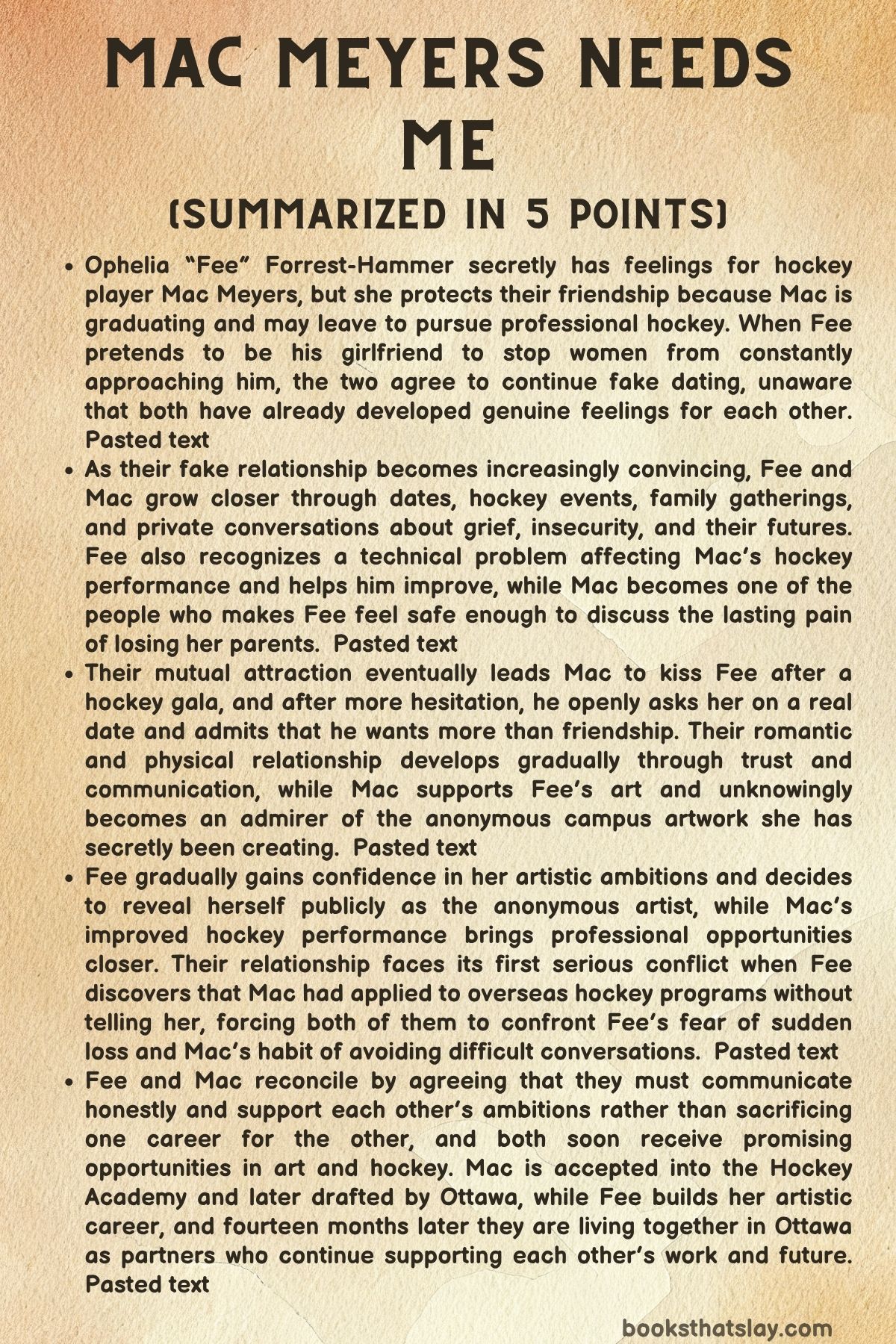
Summary
Ophelia “Fee” Forrest-Hammer has been quietly attracted to Mac Meyers for a long time, but she has convinced herself that friendship is safer. Mac is affectionate, friendly, and naturally charming, which means women constantly approach him, and Fee assumes she is simply another person who receives his easy warmth rather than someone special.
Fee carries another private identity as an anonymous campus artist whose posters and other unofficial pieces express emotions she does not always reveal openly. Her art has become a place where she can process the grief of losing her parents, while her public life remains closely connected to hockey because of her sister Lexi and their extended professional hockey family.
Mac’s romantic reputation is far less accurate than it appears. He dislikes hurting people and has difficulty telling interested women that he does not want to date them, so his vague politeness unintentionally gives them hope, while Fee recognizes that his lack of boundaries is creating the very confusion he wants to avoid.
During a study session, Fee casually claims that Mac is her boyfriend to stop another interruption. Mac secretly loves hearing her say it because his attraction to her has existed for a long time, although he has avoided pursuing her partly because he never wants her to think he values her family’s professional hockey connections more than her.
Mac suggests turning the invented relationship into an actual fake-dating arrangement. Having Fee as his supposed girlfriend would make it easier to discourage unwanted romantic attention, while Fee can help him learn how to set clear boundaries without believing he is being cruel.
Their first public attempts at pretending are immediately complicated by real attraction. Mac holds Fee’s hand, remembers her preferences, keeps her close, introduces her as his girlfriend, and carefully checks whether she is comfortable with his physical affection, while Fee struggles to convince herself that his attentiveness is only part of the performance.
The arrangement also gives Fee access to Mac’s private fears about hockey. His performance has declined during an important final university season, and he worries that his dream of playing professionally is slipping away just as graduation approaches.
Fee does not dismiss those concerns with easy encouragement. Because she has spent years around elite hockey players, she understands how technical adjustments, confidence, and comparison can affect performance, and she becomes one of the few people Mac feels comfortable talking to honestly about the pressure he is carrying.
Their emotional intimacy grows alongside the romantic tension. Mac reveals that he does not enjoy casual physical relationships and needs trust and attachment before sexual attraction becomes meaningful to him, while Fee gradually allows him to see the grief that still accompanies memories of her parents.
Mac repeatedly proves that he can offer comfort without demanding anything in return. When Fee is upset, he holds her, listens to her, and avoids using her vulnerable moments as opportunities to push the relationship forward, even when he desperately wants to tell her that his feelings are real.
Fee also becomes directly involved in helping Mac repair his game. After discovering him practicing alone, she notices that changes in his body have altered the mechanics of his shot, and the two experiment until he begins adjusting his technique successfully.
Their growing closeness nearly results in a kiss during a movie night, but Fee panics and awkwardly high-fives Mac instead. She immediately fears that she has ruined her chance, while Mac interprets the moment as another sign that she may only want friendship.
The uncertainty finally breaks at a hockey gala. Mac sees Fee as far more than a convenient date, and after spending the evening dancing and talking with her, he decides he would rather risk rejection than continue pretending.
Outside her apartment, he kisses her, and Fee responds with equal enthusiasm. The kiss confirms that their attraction is mutual, although neither immediately becomes skilled at discussing what this means, and Fee even begins introducing him awkwardly as her friend when he later meets more of her family.
Mac increasingly becomes part of Fee’s family life while Fee becomes more invested in his hockey future. She watches him interact with Callie, Lexi, Roman, and other important people in her life, and she recognizes that he fits comfortably into a world tied both to her childhood and to the family structure created after her parents’ deaths.
Fee eventually arranges an extraordinary training session involving members of her professional hockey circle, but she remains determined that Mac’s career must be based on his own ability. Her goal is not to secure advancement for him through connections but to give him access to knowledge that can help him make the most of his own work.
Their friends can see the romance developing long before Fee and Mac learn to speak plainly about it. An away tournament even leaves them sharing a room and a bed, yet fear and uncertainty prevent either from making a confession, demonstrating that physical opportunity alone cannot solve an emotional communication problem.
Mac eventually decides to stop relying on accidental intimate moments. He directly asks Fee on a real date, admits that he likes her as more than a friend, and receives the answer he has been hoping for when Fee happily accepts.
Their official relationship begins with a pottery-painting date chosen because Mac wants to enter Fee’s artistic world rather than make everything about hockey. They finally compare how long they have liked each other and realize that both spent months misreading the other’s behavior.
Mac also tells Fee that he has never had intercourse because he never previously reached the level of emotional security he needed. Fee treats the disclosure respectfully, shares her own history without shame, and allows their physical relationship to develop gradually according to mutual comfort rather than outside expectations.
As romance makes Fee feel safer, her art changes as well. She creates imagery about a damaged heart being repaired and begins considering whether anonymity still serves her, especially when Mac unknowingly collects and admires work created by her secret artistic persona.
His admiration has unusual importance because he loves the work before knowing it is hers. Fee realizes that Mac responds to her creativity on its own merits, and his support contributes to her growing willingness to present herself publicly as an artist rather than keeping her most personal work hidden.
Mac’s hockey performance steadily improves as he incorporates Fee’s observations and works with experienced players. At the same time, he continues encouraging Fee to think seriously about exhibitions, artistic opportunities, and a future in which her talent becomes more than something shared anonymously around campus.
Their relationship therefore becomes reciprocal rather than one-sided. Fee helps Mac regain confidence as an athlete, while Mac encourages Fee to stop separating her public self from the creative voice that most honestly represents her.
Fee eventually enters the spring art show and reveals to Mac that she is the mysterious campus artist he has admired for months. Mac reacts with excitement and pride, giving her confidence as she prepares to connect her identity publicly with work that has previously existed without her name.
Their emotional commitment deepens further after Fee gives him an artwork depicting the different parts of his life. Mac finally feels ready to have intercourse, and because the decision is discussed openly rather than treated as an expected milestone, their first time becomes another expression of trust; afterward, they openly tell each other that they are in love.
Love, however, does not remove their old fears. Mac remains anxious about professional hockey, while Fee becomes increasingly aware that his success may take him away from Toronto, forcing her to confront the possibility of separation after finally allowing herself to become deeply attached.
The first major conflict arrives when Fee discovers that Mac had applied to prestigious hockey programs in other countries before their relationship became serious. The applications themselves are not a betrayal, but his failure to tell her feels like hidden preparation to disappear from her life.
Fee’s reaction is inseparable from her history. Losing her parents suddenly taught her that someone essential can vanish without warning, so discovering plans Mac kept private activates a fear much larger than the actual applications.
Mac recognizes his own contribution to the conflict. His parents taught him to associate disagreement with unhealthy confrontation, so he has developed a habit of avoiding difficult conversations in the hope of preserving peace, only to discover that secrecy creates deeper hurt.
They temporarily give each other space while Fee concentrates on her art show. The separation clarifies rather than weakens their feelings, and Fee’s public artistic reveal becomes a major success, attracting followers, other artists, and a possible apprenticeship with Ellie Stryker at Inked Armor.
Mac attends despite the unresolved disagreement and supports Fee without trying to force a reconciliation. His response shows that loving her means respecting her independent ambitions even when their relationship is going through a difficult period.
When Fee and Mac finally discuss the argument, both identify the deeper patterns behind it. Fee explains that unexpected separation frightens her because of grief, while Mac admits that his tendency to avoid conflict led him to hide information instead of trusting their relationship with the truth.
They agree that neither should automatically surrender career opportunities for the other and that future decisions must be discussed openly. Their reconciliation becomes less about solving one disagreement than about establishing healthier rules for the life they hope to build together.
Fee begins researching artistic opportunities in places connected to Mac’s possible hockey future, not because she intends to abandon her own ambitions, but because they have started thinking as partners. Her career also expands rapidly through commissions, merchandise possibilities, tattoo work, and the growing public recognition of her former anonymous identity.
Mac similarly becomes more secure on the ice. Instead of treating every game as a test of whether he deserves a professional career, he begins trusting the work he has done and allowing performance to come from preparation rather than panic.
The immediate uncertainty ends when Mac is accepted into the Hockey Academy summer program in Toronto along with his friends. Roman deliberately removes himself from Mac’s admissions decision, ensuring that Mac is evaluated without any advantage created by his relationship with Fee, and the remaining evaluators choose him independently.
Mac eventually enters the professional draft and is selected by Ottawa, while his friends also receive opportunities with different teams. Ottawa is close enough to Toronto for Mac and Fee to maintain their relationship while Fee finishes university, allowing both of their ambitions to continue without one being erased for the other.
Fourteen months later, Fee and Mac are living together in Ottawa after surviving a difficult period of long-distance dating during Mac’s rookie season and Fee’s final year of school. Fee now has a growing artistic career and tattoo work, while Mac has established himself in professional hockey.
Their life together retains the friendship that made their romance possible in the first place. They care for each other in practical ways, support each other’s work, maintain their playful attraction, and face uncertainty as partners rather than hiding from it, turning what began as a convenient fake relationship into a shared life built on trust.
Characters
Ophelia “Fee” Forrest-Hammer
Fee is the emotional center of Mac Meyers Needs Me, balancing an outwardly capable personality with grief, romantic caution, and a creative identity she initially keeps hidden. Her fear of loving Mac is not simple indecision; she has already experienced the sudden death of her parents, so attachment carries the possibility of once again losing someone who has become essential to her.
Her anonymous artwork gives her a language for feelings she cannot always express directly. The art becomes darker during painful periods and more hopeful as she begins healing, making her creative development a visible measure of her emotional progress.
Fee is also far more knowledgeable about hockey than she initially gives herself credit for. Years spent around professional athletes allow her to notice the technical problem affecting Mac’s shot, and she later uses her family network carefully, arranging help without trying to manufacture his success.
Her growth becomes especially clear when she publicly claims her anonymous artistic identity. She moves from creating powerful work without attaching her name to it toward accepting attention, professional opportunities, commissions, merchandise, and tattoo work.
The conflict over Mac’s overseas applications exposes her deepest weakness: she sometimes treats uncertainty as a warning that love may end in abandonment. By confronting that fear instead of ending the relationship, Fee learns that protecting herself from every possible loss would also prevent her from building a meaningful future.
Mac Meyers
Mac is the romantic counterpart and co-lead of Mac Meyers Needs Me, initially defined by a contradiction between public confidence and private insecurity. He appears socially effortless because women constantly approach him and he treats nearly everyone warmly, yet he is uncomfortable rejecting people and often mistakes avoidance for kindness.
His inability to establish boundaries reflects a broader fear of conflict. Experiences within his parents’ relationship taught him to associate difficult conversations with instability, causing him to postpone uncomfortable truths rather than risk upsetting people.
Mac’s hockey struggles intensify this pattern of insecurity. He watches talented teammates succeed while his own performance declines, and his fear that he will miss his professional opportunity leads him to train privately and judge himself harshly.
His relationship with Fee gives him emotional security without removing the need for personal growth. She helps him recognize technical problems, but Mac must still practice, perform, apply to programs, face scouts, and earn his opportunities through his own effort.
His approach to intimacy is equally important. Mac needs emotional trust before taking major physical steps, and his willingness to tell Fee about his inexperience demonstrates how much safer he feels with her than he has with previous partners.
By the end, Mac has not become someone who never feels anxious. He has instead become someone more willing to communicate, accept uncertainty, set boundaries, and believe that difficult conversations do not automatically destroy relationships.
Lexi Forrest-Hammer
Lexi occupies an important family role in Mac Meyers Needs Me because she became a source of stability after the death of Fee’s parents. Her position as Fee’s older sister carries both affection and responsibility, and Fee recognizes that Lexi had to shoulder burdens that changed their family dynamics permanently.
She also gives Fee perspective during the conflict with Mac. Rather than treating Fee’s fear as irrational, Lexi helps her see that the terror of unexpected separation belongs partly to the past and that refusing attachment cannot protect someone from every possible loss.
Lexi’s professional hockey connections could easily have turned her into a convenient career tool for Mac, yet the story avoids that route. Instead, she becomes part of the support network that welcomes Mac while still allowing him to establish his own identity and merit.
Cammie
Cammie functions as Fee’s outspoken confidante in Mac Meyers Needs Me, often identifying romantic truths that Fee would rather avoid. She recognizes that the fake relationship has become genuine and repeatedly encourages Fee to stop treating obvious mutual attraction as something that can be indefinitely ignored.
Her friendship is useful because she knows when to press and when to stop. When Fee becomes frightened by what a real relationship with Mac might mean, Cammie ultimately respects her decision rather than forcing her into a confession.
Cammie’s relationship with Chase also gives Fee a nearby example of open romantic affection. Her explicit fanfiction provides comic relief, but her larger narrative role is to challenge Fee’s habit of overthinking emotional opportunities until they disappear.
Gage Steele
Gage is one of the most distinctive supporting characters in Mac Meyers Needs Me because his comic behavior is paired with moments of unusual emotional perception. He jokes constantly, interferes in his friends’ romantic situations, communicates with his sister Jade through sign language, and often brings energy to group scenes.
His academic insecurities reveal a more vulnerable side. Gage sometimes compares himself unfavorably with his friends because of learning difficulties, but those around him remind him that his mathematical ability, social perception, and other strengths cannot be reduced to conventional academic measures.
He is also remarkably perceptive about Fee and Mac’s conflict. Gage understands why hidden plans involving separation could affect Fee so strongly after losing her parents, showing that beneath his humor is a careful observer of other people’s emotions.
His later decision to let Andie stay in his room introduces another potential emotional complication. The immediate attention he gives her suggests that he may be entering the same territory of unrecognized attachment that his friends have already experienced.
Brody Stiles
Brody is presented as an exceptionally talented hockey player whose professional prospects appear stronger and more obvious than Mac’s. His ability sometimes intensifies Mac’s insecurity, but Mac’s reaction is generally a mixture of envy and genuine admiration rather than resentment.
Brody is also part of the male friendship network that supports Mac through both hockey and romance. He participates in teasing and advice, but he also helps with practical acts such as secretly arranging Mac’s equipment for the professional training session Fee organizes.
His unresolved attraction to Enid suggests that athletic confidence does not necessarily translate into romantic confidence. Brody repeatedly watches her or reacts defensively when his feelings are noticed, creating a parallel to the long period during which Fee and Mac were unable to acknowledge their own attraction.
His eventual selection by Chicago in the professional draft confirms the level of talent that has been apparent throughout the story. Even so, his importance is not limited to being the gifted player against whom Mac compares himself; he is also a loyal friend navigating uncertainties of his own.
Chase Lovett
Chase is another member of Mac’s close hockey circle and is most visibly characterized through his affectionate relationship with Cammie. Their willingness to seek private time together becomes a recurring source of humor during tournaments and group gatherings.
He also participates in the shared culture of teasing, encouragement, and competitive support among the hockey players. When the friends eventually receive professional opportunities, Chase’s selection by Philadelphia becomes part of the wider transition from their university years into adult athletic careers.
Through Chase and Cammie, the story presents a relationship that is already openly established, creating a contrast with Fee and Mac’s extended period of uncertainty. Their ease with affection often makes Fee and Mac’s refusal to admit their feelings look even more obvious to the rest of the group.
Enid
Enid is one of Fee’s close friends and participates in the supportive group surrounding her romantic and artistic development. She is present during social gatherings and becomes part of the community that treats Fee’s eventual relationship with Mac as something natural rather than disruptive.
Her unresolved connection with Brody gives her a quieter romantic subplot. The attraction appears to exist on both sides, yet discomfort or past complications prevent either of them from addressing it clearly.
That situation reinforces one of the story’s recurring ideas about unspoken emotion. Fee and Mac eventually escape the cycle of guessing and avoidance, while Enid and Brody remain an example of what happens when attraction continues without direct communication.
Callie
Callie is Fee’s younger sister and helps reveal Fee’s protective, caregiving instincts. When Callie becomes ill, Fee immediately responds to the family need, and Mac’s willingness to assist gives him another opportunity to understand responsibilities that existed long before he entered her romantic life.
Callie also connects Fee to hockey in a more personal way than the professional players surrounding the family. Her games bring Mac into family spaces where his behavior matters not as an aspiring professional athlete but as someone increasingly important to Fee.
Mac’s interactions with Callie influence Fee because they show that he can fit into the ordinary structure of her family. His presence feels less like a temporary romance and more like the beginning of a lasting place within her wider support network.
Roman Forrest-Hammer
Roman is both part of Fee’s extended family structure and an influential figure in the professional hockey world. His status makes Mac understandably nervous, particularly because Mac wants professional success without anyone believing that dating Fee gave him an unfair advantage.
Roman nevertheless treats Mac’s ambitions seriously. He offers advice, participates in the special training session, watches Mac play, and identifies opportunities that could help him continue developing.
The most important confirmation of Roman’s integrity comes when Mac is considered for the Hockey Academy. Roman deliberately removes himself from the admissions process, allowing other evaluators to judge Mac without the appearance of favoritism, and their unanimous decision validates Mac’s progress independently.
Jade Steele
Jade is Gage’s sister and provides further insight into his character and family relationships. Their use of sign language shows a close connection and also emphasizes Gage’s abilities outside the academic areas where he sometimes doubts himself.
Her presence at social events strengthens the sense that the central friend group extends beyond hockey teammates. These relationships operate more like a broad community than a collection of isolated couples.
Jade also becomes indirectly important when her best friend Andie needs somewhere to stay. That situation introduces Andie into Gage’s immediate world and creates the possibility of another complicated relationship within the group.
Andie
Andie enters relatively late but immediately disrupts the established household dynamic. She arrives needing accommodation, and Gage offers her part of his space, including his large closet, with an eagerness that draws attention from everyone else.
Her role primarily establishes a new emotional possibility rather than completing a major storyline within this book. Gage’s unusual attentiveness toward her suggests that their living arrangement may become personally significant.
The humor around Andie’s arrival also serves as a release after Fee and Mac’s first serious relationship conflict. Just as the central couple learns to communicate more maturely, another pair appears positioned to begin its own confusing process of attraction.
Tally
Tally is part of Fee’s supportive social circle and provides an example of a relationship that survived an unconventional or complicated beginning. Her romantic history gives Fee evidence that uncertainty at the start does not necessarily prevent a relationship from becoming genuine.
She also proves practically supportive during Fee’s art show. When Fee’s anxiety causes an embarrassing clothing problem, Tally helps without turning the moment into something dramatic, demonstrating the ordinary care that characterizes Fee’s friendships.
Her contribution may be quieter than that of Cammie or Lexi, but she reinforces the importance of having people who support Fee through both major emotional decisions and immediate everyday problems.
Ellie Stryker
Ellie appears at a crucial point in Fee’s artistic development. At the spring art show, she recognizes Fee’s talent and discusses the possibility of a summer apprenticeship connected to Inked Armor.
The opportunity matters because it proves that Fee’s career can develop alongside Mac’s rather than existing as a secondary concern. Mac’s excitement about the possibility also demonstrates that he does not view Fee’s ambitions as competition with his hockey future.
Ellie therefore represents the professional world opening to Fee once she stops hiding behind anonymity. By the epilogue, Fee’s work in a tattoo studio shows that this direction becomes part of her growing artistic career.
Dred
Dred belongs to the larger network of people who make Fee’s family life unusually connected to professional hockey. His presence during important gatherings reinforces the sense that Fee grew up surrounded by athletes who are famous publicly but function as ordinary friends and relatives in private.
For Mac, people such as Dred initially intensify the intimidation of entering Fee’s world. Over time, however, those figures become part of the environment in which he learns to separate admiration from insecurity.
Connor Grace
Connor is another established hockey figure within Fee’s extended circle. His involvement in family gatherings and later in the training opportunities surrounding Mac illustrates how deeply hockey is embedded in Fee’s life.
Characters like Connor also create an important test for Mac’s motives. Mac respects the access Fee’s family connections provide but remains uncomfortable with receiving anything that would allow others to dismiss his achievements as favoritism.
Quinn Romero
Quinn participates in the special training session Fee organizes for Mac. His presence helps transform the session into a genuine developmental opportunity rather than a casual practice with friends.
For Mac, receiving direct instruction from experienced players he respects is both technically valuable and psychologically restorative. The training helps him see that his difficulties can be addressed through adjustment and work rather than interpreted as proof that he lacks the ability to progress.
Alex Waters
Alex is a highly respected professional whose appearance at a Tilton practice immediately intensifies Mac’s tendency to overanalyze his future. Even positive attention becomes material for anxiety because Mac interprets every comment in relation to whether he is good enough for the next level.
His presence therefore functions less as a personal relationship and more as a test of Mac’s mindset. Mac must learn that being noticed, improving, and continuing to work are meaningful developments even when no single interaction can guarantee a professional career.
Kristoff
Kristoff, Lexi’s father, makes a smaller but meaningful contribution by sending Fee coveted art markers. The gift arrives while she is considering whether to enter the spring art show and becomes another sign that the people around her believe her art deserves serious attention.
His gesture supports Fee’s artistic identity without demanding anything from her. It contributes to the gradual accumulation of encouragement that helps her decide hiding forever is no longer compatible with the career she wants.
Kelsey
Kelsey appears early as one of the women drawn to Mac and unintentionally intensifies Fee’s jealousy by sitting in his lap. Her role is brief, but she demonstrates the social problem that makes the fake-dating arrangement possible in the first place.
Fee sees women like Kelsey as proof that Mac has endless romantic options. Mac, meanwhile, initially fails to understand how his friendliness and weak boundaries can be interpreted as romantic encouragement, making these early interactions important to his later growth.
Themes
Love, Loss, and the Fear of Separation
Fee’s romantic hesitation is shaped by an experience far more serious than ordinary fear of rejection. The sudden deaths of her parents taught her that loving someone creates a vulnerability that cannot be controlled, and that lesson follows her into Mac Meyers Needs Me even when the circumstances surrounding Mac are completely different.
Her anxiety becomes clearest when she discovers Mac’s overseas hockey applications. The applications existed before their relationship became serious, yet the idea that someone she loves has quietly planned for a future elsewhere feels emotionally connected to the earlier experience of people disappearing from her life without warning.
Lexi helps Fee recognize that refusing love cannot prevent loss. Avoidance may reduce immediate vulnerability, but it also removes the possibility of trust, companionship, and the future Fee genuinely wants.
The epilogue completes this development without pretending that love eliminates difficulty. Fee and Mac endure long distance during his rookie season and her final year of school, proving that separation can be painful without automatically becoming abandonment.
Fee’s growth therefore lies in accepting uncertainty rather than defeating it. She learns that security does not come from guaranteeing another person will never leave; it comes from building a relationship in which change, distance, fear, and future choices can be discussed honestly.
Communication, Boundaries, and Emotional Honesty
Mac begins with a distorted understanding of kindness. He hates disappointing people, so he avoids directly rejecting women who approach him and gives vague answers that feel gentle to him but actually create false expectations.
Fee’s criticism forces him to recognize that a boundary is not an act of cruelty. Clear communication can respect another person’s feelings more than indefinite ambiguity, and that lesson eventually applies to far more than romantic attention.
His failure to mention the overseas applications shows that the underlying problem has not disappeared simply because he learns to tell strangers he has a girlfriend. Mac still associates uncomfortable conversations with the conflict he witnessed in his parents’ relationship, so he hides information that he fears might upset Fee.
The resulting argument demonstrates how avoidance turns manageable discomfort into a larger breach of trust. Fee does not need Mac to abandon opportunities for her; she needs him to allow her to participate honestly in conversations about decisions that could affect their shared future.
Their reconciliation establishes a healthier model. Both identify the fears behind their reactions and agree that protecting a relationship cannot mean concealing difficult truths.
Communication also shapes their physical relationship. Mac and Fee discuss experience, boundaries, comfort, contraception, and readiness, showing that honesty is not merely a solution to conflict but the foundation for intimacy throughout the story.
Identity, Art, and Being Seen
Fee’s anonymous art allows her to express parts of herself that feel too vulnerable for public ownership. In Mac Meyers Needs Me, artistic anonymity initially gives her freedom because she can communicate grief, humor, anger, and hope without attaching those emotions to the identity people already associate with her family and hockey connections.
That freedom eventually becomes a limitation. When another student begins imitating her work, Fee sees how remaining hidden allows someone else to occupy space that she is afraid to claim.
Mac’s response to her artwork is especially important because he admires the anonymous artist long before learning the truth. His room contains pieces he has collected because they genuinely affect him, giving Fee rare proof that her work succeeds independently of her name, family, or romantic relationship.
The spring exhibition marks her decision to unite the identities she previously kept separate. By presenting polished academic work beside pieces from her secret artistic persona, she allows viewers to understand that both belong to the same artist.
Professional opportunities follow that act of self-recognition, including possible tattoo work, commissions, merchandise, and an expanding online business. Fee’s career therefore begins advancing most clearly when she stops treating visibility as something inherently dangerous and starts accepting that being known can also create opportunity.
Ambition, Success, and Self-Worth
Mac’s hockey storyline repeatedly separates achievement from personal worth. Early in the story, declining statistics cause him to interpret every mistake as evidence that his dream may be ending, while the success of teammates such as Brody gives him another standard against which to judge himself.
His improvement begins when he moves away from panic and toward specific work. Fee identifies a technical issue, Mac adjusts his mechanics, professional players offer further instruction, and repeated practice gradually restores both his performance and confidence.
The story is careful to preserve his ownership of that success. Fee opens doors to expertise, but she cannot perform for him, and Roman later removes himself from the Hockey Academy admissions process so that Mac’s acceptance cannot reasonably be attributed to favoritism.
Fee experiences a parallel version of the same conflict through art. She possesses talent long before she is willing to display it under her own name, meaning ability alone is not enough; she must also accept the risk of being judged publicly.
Neither character is ultimately required to surrender ambition in order to prove love. Mac pursues professional hockey while Fee develops an artistic career, and their strongest decisions come when they search for ways to support both paths.
Success therefore becomes less about receiving external approval than developing enough confidence to pursue meaningful work without allowing fear, comparison, or romance to erase individual purpose.