Pink Ink Summary, Characters and Themes | Avina St. Graves
Pink Ink by Avina St. Graves is a dark romance that combines psychological suspense, artistic obsession, murder, and forbidden attraction.
Set primarily at Cresswell University, the novel follows Reyna Sinaga, an aspiring filmmaker whose fascination with an unidentified serial killer brings her into the orbit of Maddox Shaw, a celebrated artist with dangerous secrets. Their relationship develops against the backdrop of a powerful clandestine organization, complicated family histories, and an escalating struggle for personal freedom. Through its unconventional protagonists, the book explores the relationship between creativity and violence, the consequences of inherited power, and the difficulty of maintaining personal independence within an obsessive romantic relationship.
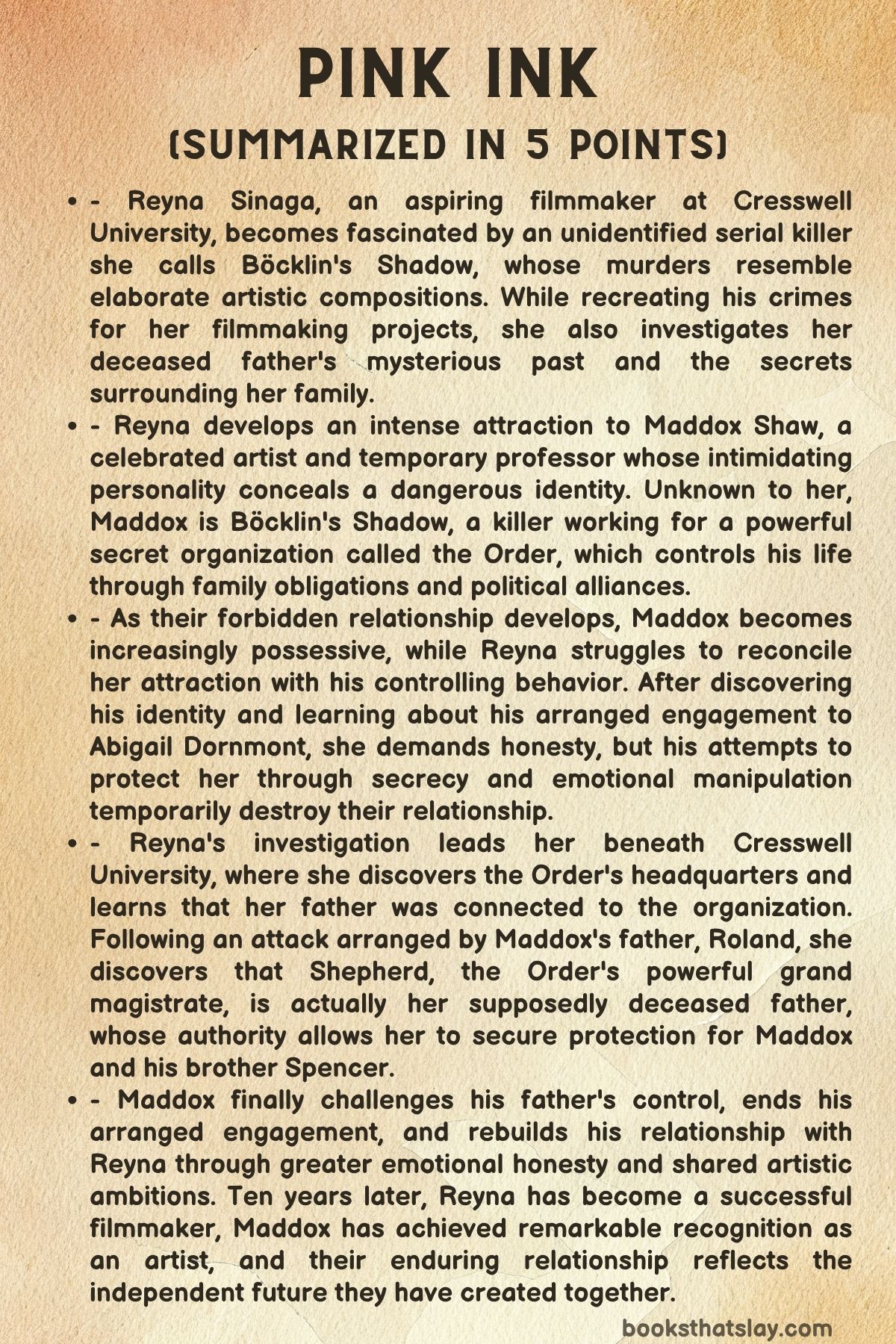
Summary
Reyna Sinaga is a film student at Cresswell University whose artistic ambitions are closely connected to her fascination with death. Her latest project recreates a murder scene using pink artificial blood, a distinctive technique inspired by her childhood experiences with horror films.
The project draws upon the crimes of an unidentified serial killer whom Reyna has named Böcklin’s Shadow. With the assistance of Lawrence, a police officer who provides confidential crime-scene photographs, she has discovered artistic connections between murders that initially appear unrelated.
The killer arranges his victims in elaborate compositions inspired by classical paintings, religious imagery, and symbolic objects. Reyna believes his work demonstrates an extraordinary understanding of visual storytelling, although she remains unaware of his identity.
Her interest in the murders develops alongside another investigation concerning her deceased parents. Her mother, Mora, was a celebrated Indonesian surrealist painter who encouraged Reyna’s creativity, while her father’s mysterious past remains almost entirely unknown.
Before dying, Mora instructed Reyna to find a shepherd. Reyna has never understood the significance of those words, but she suspects they are connected to the secrets surrounding her family.
During a visit to an art exhibition, Reyna encounters a handsome British stranger while examining a painting of a shattered angel. Their discussion becomes heated when she criticizes the artist’s inability to communicate genuine emotional understanding.
The stranger reacts angrily to her assessment and leaves. Reyna subsequently discovers that he is Maddox Shaw, the celebrated painter responsible for the work she criticized.
Her embarrassment intensifies when Maddox appears at Cresswell as the temporary instructor of her filmmaking course. Their initial classroom encounters are antagonistic, with Maddox questioning her abilities and Reyna refusing to surrender her artistic convictions.
Unknown to Reyna, Maddox leads a second life as Böcklin’s Shadow.
Beyond his public identity as a successful artist, he serves the Order, a secret society whose wealthy and influential members manipulate political institutions and exercise considerable control over their families.
Maddox’s father, Roland Shaw, is an important figure within the organization. Maddox has been raised to fulfill its demands, including carrying out violent assignments that he transforms into elaborate artistic productions.
Although he possesses a genuine appetite for violence, he resents the obligations imposed upon him. His greatest vulnerability is his younger brother, Spencer, whose safety Roland repeatedly uses to secure Maddox’s obedience.
Maddox is also trapped in an arranged engagement to Abigail Dornmont, a woman he does not love. Their proposed marriage is intended to strengthen an alliance between two powerful families.
Meanwhile, his artistic career has reached a crisis. Despite his international reputation, Maddox struggles to produce work for an important upcoming exhibition.
His encounters with Reyna gradually change that situation.
When he examines her filmmaking projects, he discovers that she understands the symbolism behind his murders with astonishing precision. One film, titled The Rule of Three, interprets a killing in almost exactly the manner he originally intended.
Maddox becomes fascinated by the possibility that Reyna possesses an artistic imagination comparable to his own. He begins following her investigations, collecting photographs of her, and secretly observing her private life.
His fascination develops into an increasingly possessive attraction.
Reyna initially sees Maddox as an arrogant and intimidating instructor, but his serious attention to her work changes her opinion. Unlike previous professors, he examines her artistic decisions carefully and offers criticism that helps her develop.
Their conversations gradually become personal. Maddox learns about her childhood, her mother’s influence, and the origins of her unusual filmmaking style.
Reyna, meanwhile, discovers an unexpectedly vulnerable side to the famous artist. His unfinished paintings reveal his creative uncertainty, while his occasional tenderness contradicts his intimidating public behavior.
Their attraction eventually crosses the boundaries of their academic relationship. What begins as provocative conversation becomes an intense physical relationship conducted largely in secrecy.
Maddox’s protective behavior also becomes increasingly controlling. He follows Reyna, interferes with men who express interest in her, and insists upon accompanying her during dangerous investigations.
Reyna resists his attempts to direct her choices, but her feelings continue deepening.
Maddox eventually takes her to a location associated with one of Böcklin’s Shadow’s murders. As Reyna analyzes the scene, she identifies symbolic meanings that investigators have overlooked.
Her observations convince Maddox that she understands him more completely than anyone else.
He begins treating his murders as messages intended for her, creating another elaborate scene with the anticipation that she will recognize its significance.
When Reyna investigates the subsequent killing, she begins sensing that the murderer is communicating directly with her.
A dangerous confrontation involving another man ultimately exposes Maddox’s identity. Reyna witnesses his capacity for violence and realizes that the professor she has fallen for is the serial killer she has spent months studying.
The revelation forces her to reconsider their entire relationship.
Although frightened, Reyna does not immediately reject him. Her fascination with his artistic vision and her emotional attachment survive the discovery, even as she recognizes the danger of his actions.
Maddox admits his identity but continues withholding information about the organization controlling his life.
Their relationship encounters another crisis when Reyna discovers that Maddox is engaged to Abigail.
She feels betrayed by his failure to disclose the arrangement. Maddox explains that the engagement is a political obligation rather than a romantic commitment, but refuses to reveal the full consequences of ending it.
Reyna becomes increasingly frustrated by his secrecy.
The Order’s grand magistrate, known as Shepherd, subsequently warns Maddox that his attachment to Reyna threatens his position. He also reminds Maddox that Spencer can be harmed if the Shaw family fails to cooperate.
Fearing for Reyna’s safety, Maddox decides to end their relationship.
Instead of explaining the threat, he deliberately attacks her artistic confidence and suggests that their connection was meaningless. Reyna leaves devastated, refusing to accept his cruelty.
Maddox soon discovers that separation has not weakened his obsession. When he sees Reyna meeting Lawrence, his jealousy leads him to interrupt their dinner.
Reyna confronts him about his contradictory behavior. She refuses to accept his possessiveness when he has denied her the honesty and commitment she needs.
Their conflict remains unresolved until Reyna makes an important discovery beneath Cresswell University.
Her investigation into missing historical records leads her to a concealed staircase and an underground network of passages. There, she encounters evidence of an organization operating beyond the university’s ordinary institutions.
She overhears discussions concerning political influence and discovers artwork resembling Maddox’s creations.
Most importantly, she enters a chamber with a distinctive honeycomb ceiling.
Reyna recognizes the architecture from an old photograph of her father. The discovery establishes that he once visited the secret headquarters beneath Cresswell.
Before she can escape, Maddox finds her.
He reveals the existence of the Order and explains its influence over powerful families. Reyna learns that his engagement, violent assignments, and fear for Spencer are all connected to the organization’s demands.
The revelation helps her understand Maddox’s choices without erasing the damage caused by his deception.
Their confrontation becomes an opportunity for reconciliation. Reyna insists that Maddox cannot continue making every decision for Spencer or controlling her own future in the name of protection.
They acknowledge their feelings and resume their relationship.
However, their reunion attracts dangerous attention.
During a commercial filming assignment, Reyna is attacked by Alex, a fellow student who attempts to kill her with a knife.
She fights back and survives, but the incident reveals that her relationship with Maddox has made her a target.
Maddox discovers that Roland ordered the attack.
His anger nearly drives him to kill his father, but he recognizes that open retaliation could endanger both Reyna and Spencer.
The situation appears impossible until Reyna encounters Shepherd.
To Maddox’s astonishment, she recognizes the grand magistrate as her supposedly deceased father.
Shepherd’s true identity transforms the balance of power surrounding their relationship.
Reyna confronts him about his disappearance and the suffering his absence caused Mora. He explains that his position within the Order made separation necessary for their protection.
Reyna refuses to accept that explanation as sufficient justification for abandoning his family.
Nevertheless, she recognizes the authority he possesses.
She demands protection for Maddox and Spencer, along with permission for Maddox to terminate his engagement without retaliation.
Shepherd eventually agrees to a tentative arrangement.
The revelation also gives Maddox the opportunity to challenge Roland.
During a tense family confrontation, Maddox announces that he will no longer support his father’s political ambitions. He rejects the engagement to Abigail and refuses to continue sacrificing his personal freedom for the family’s interests.
He also acknowledges that Spencer must decide independently how to approach his relationship with the Order.
With the immediate threats reduced, Maddox and Reyna begin building a more stable relationship.
Their emotional intimacy develops alongside their artistic collaboration. Reyna discovers the extent of Maddox’s childhood injuries, and he gradually allows her to understand the vulnerability hidden beneath his violent personality.
His creative confidence returns as he prepares his exhibition.
When the collection finally opens, Reyna discovers that Maddox has dedicated it to her.
The paintings incorporate her appearance, tattoos, artistic interests, and personal history. They also communicate the emotional transformation he has experienced since meeting her.
Reyna recognizes that Maddox has used his art to express feelings he previously struggled to articulate.
They openly declare their love and commit themselves to a shared future.
Ten years later, Reyna has become a successful filmmaker preparing for the premiere of Death Touched, an ambitious project that has occupied several years of her life.
Maddox has also achieved extraordinary professional recognition. Their relationship has endured, and they continue supporting one another’s creative ambitions.
At the premiere, Reyna reunites with Kimi and her father. Although she wishes Mora could witness her achievements, she recognizes how profoundly her mother’s encouragement shaped her life.
The novel concludes with Reyna and Maddox established as accomplished artists and devoted partners, having created a future beyond the expectations that once threatened to separate them.
Characters
Reyna Sinaga
Reyna Sinaga is the central protagonist of Pink Ink, an ambitious filmmaker whose artistic imagination, intellectual curiosity, and determination shape the novel’s central conflicts. Her unusual fascination with murder initially appears to be an unconventional creative interest, but it eventually becomes the means through which she discovers both her romantic partner and the truth about her family.
Reyna’s relationship with art originates in her childhood. Encouraged by her mother, Mora, she develops an appreciation for visual storytelling that emphasizes emotional significance rather than technical accomplishment alone.
Her decision to use pink artificial blood demonstrates her ability to transform childhood experiences into an original artistic identity. Rather than simply reproducing violence, she attempts to interpret its symbolic possibilities through cinema.
Her fascination with Böcklin’s Shadow reveals both her intelligence and her willingness to challenge conventional perspectives. She recognizes artistic patterns connecting seemingly unrelated crimes and identifies meanings that experienced investigators overlook.
Nevertheless, her admiration exposes a significant moral contradiction. She initially approaches the murders as artistic objects, paying greater attention to their symbolism than to the suffering involved in their creation.
Her relationship with Maddox forces this contradiction into the open. Once she discovers his identity, she must reconcile her admiration for his creativity with the reality of his violent actions.
Reyna’s emotional vulnerabilities originate partly in her family history. The deaths of her parents leave her with unresolved questions, financial difficulties, and a persistent fear of abandonment.
Her investigation into her father’s past demonstrates that she refuses to accept uncertainty when answers might still exist. This determination also explains her resistance to Maddox’s attempts to conceal important information.
Although she accepts his dangerous nature, she does not willingly surrender her right to make decisions. Her insistence upon honesty distinguishes emotional commitment from unconditional submission.
Her confrontation with Shepherd represents another important stage in her development. Rather than accepting his authority simply because he is her father, she demands accountability for his abandonment.
By the conclusion, Reyna has achieved the artistic independence she desired. Her success as a filmmaker demonstrates that her identity extends beyond her relationship with Maddox, even though their creative partnership remains an important part of her life.
Maddox Shaw
Maddox Shaw is the male protagonist of Pink Ink, a celebrated painter whose public accomplishments conceal his identity as Böcklin’s Shadow. His characterization depends upon the tension between extraordinary artistic sensitivity, an appetite for violence, and a desperate desire to escape the expectations imposed upon him.
Maddox approaches murder as a form of artistic production. He constructs elaborate scenes using religious symbolism, classical references, and carefully arranged objects, transforming his victims into components of his compositions.
His behavior reveals a disturbing separation between aesthetic appreciation and moral responsibility. Although some victims have histories of abuse or exploitation, their wrongdoing does not eliminate the cruelty of his methods.
His artistic crisis reflects the restrictions imposed upon his personal life. Years of compulsory service to the Order have reduced his freedom, while his arranged engagement reinforces his position as an instrument of family ambition.
Reyna’s arrival restores his creative excitement. Her ability to interpret his work gives him a sense of recognition that professional acclaim has never fully provided.
His attraction, however, quickly develops into obsession. Secret surveillance, jealousy, and interference in her personal decisions demonstrate that his desire for intimacy is inseparable from his need for control.
Maddox’s childhood provides important context for these tendencies. His physical scars and family circumstances reveal that violence has shaped his understanding of power, vulnerability, and affection.
His devotion to Spencer exposes another dimension of his personality. Although capable of extraordinary brutality, he repeatedly sacrifices his independence to protect his younger brother.
This protective instinct becomes destructive when he attempts to manage every danger without allowing others to participate in the decisions affecting them.
His decision to reject Reyna illustrates the problem. Believing that separation will protect her, he deliberately inflicts emotional pain rather than trusting her with the truth.
Maddox’s development requires him to recognize that love cannot exist solely through possession and protection. His eventual confrontation with Roland represents a rejection of the authority that has defined his adult life.
His exhibition provides the clearest expression of his emotional transformation. Through painting, he begins communicating vulnerability and affection rather than relying exclusively upon violence and dominance.
The novel does not present his artistic recovery as proof that his past actions have been morally resolved. Instead, his development centers upon gaining personal freedom and accepting emotional intimacy without abandoning every aspect of his dangerous identity.
Shepherd / Reyna’s Father
Shepherd is one of the most consequential figures in Pink Ink, serving as both the grand magistrate of the Order and Reyna’s supposedly deceased father. His concealed identity connects the novel’s family mystery with its central struggle over political power.
For much of the story, Shepherd appears as an intimidating authority figure who controls Maddox’s assignments and monitors his personal decisions. His position allows him to influence the powerful families operating within the organization.
He understands the importance of maintaining political alliances and initially treats Maddox’s relationship with Reyna as a threat to institutional stability.
His behavior demonstrates how thoroughly the Order places collective interests above individual freedom. Even when he recognizes Maddox’s emotional attachment, he initially prioritizes the organization’s established arrangements.
The revelation that Shepherd is Reyna’s father fundamentally changes his characterization.
His disappearance, once understood as a death, becomes a deliberate decision that deprived Reyna of paternal affection and left Mora to raise their daughter without him.
Shepherd claims that separation protected his family from the dangers associated with his position. The explanation establishes his awareness of those dangers but does not erase the emotional consequences of his choice.
Reyna’s confrontation forces him to acknowledge the personal cost of his secrecy. His institutional authority cannot compel her forgiveness or restore the years they lost.
His eventual willingness to protect Maddox and Spencer suggests that his attachment to Reyna can influence his political decisions.
Nevertheless, their reconciliation remains cautious. Shepherd must begin earning the trust that his prolonged absence destroyed.
Roland Shaw
Roland Shaw represents the authoritarian family structure that governs Maddox’s life. As a powerful member of the Order, he treats his sons primarily as instruments through which the family can preserve its influence.
His relationship with Maddox depends upon intimidation, obligation, and emotional manipulation. He repeatedly exploits Maddox’s devotion to Spencer to ensure obedience.
Roland’s insistence upon the engagement to Abigail demonstrates his belief that marriage should serve political advancement rather than individual happiness.
His willingness to arrange an attack upon Reyna reveals the extent of his ruthlessness. When his son’s romantic attachment threatens the family’s ambitions, Roland responds by attempting to eliminate the perceived obstacle.
His actions establish a central distinction between himself and Maddox. Although both men use violence, Roland’s primary motivation is maintaining institutional control, whereas Maddox’s relationship with violence also involves personal compulsion and artistic obsession.
Roland’s authority weakens when Shepherd’s relationship to Reyna becomes known. Maddox finally possesses enough protection to challenge his father openly.
His characterization illustrates how inherited privilege can become a mechanism of coercion within families that prioritize status over affection.
Spencer Shaw
Spencer is Maddox’s younger brother and one of the principal reasons Maddox remains obedient to the Order. His relative vulnerability gives Roland a powerful means of controlling his elder son.
Spencer initially appears through his playful personality and willingness to flirt with Reyna. His behavior introduces moments of humor into the otherwise threatening atmosphere surrounding the Shaw family.
He also possesses greater personal freedom than Maddox, largely because his brother has absorbed many of the responsibilities intended to protect him.
This arrangement creates an important contradiction. Maddox’s sacrifices originate in genuine affection, but his determination to shield Spencer also prevents his brother from exercising complete independence.
As Maddox’s relationship with Reyna develops, he begins recognizing that protection cannot justify controlling another person’s future indefinitely.
Spencer consequently represents both Maddox’s remaining family attachments and the possibility of breaking the pattern of inherited obedience.
Abigail Dornmont
Abigail Dornmont is Maddox’s arranged fiancée, whose proposed marriage forms an important part of the Order’s political strategy. Although her engagement initially appears to make her a romantic rival to Reyna, her circumstances reveal that she is also constrained by family expectations.
Abigail does not possess a genuine romantic connection with Maddox. Their relationship exists because their parents believe the marriage will strengthen an influential alliance.
Her discomfort around Maddox suggests that the engagement offers little personal satisfaction.
When she encounters Reyna, Abigail warns her about Maddox’s dangerous nature. The interaction establishes that she understands more about his circumstances than Reyna initially realizes.
Her position exposes the limited freedom available to individuals whose families treat personal relationships as political transactions.
Abigail’s importance therefore extends beyond the romantic conflict. She demonstrates that the Order’s restrictions affect women as well as men, even when they belong to privileged families.
Mora Sinaga
Mora Sinaga, Reyna’s deceased mother, remains an influential presence throughout the novel despite appearing primarily through memories. A celebrated Indonesian surrealist painter, she provides the foundation for Reyna’s artistic identity.
Her encouragement allows Reyna to approach creativity without surrendering to conventional expectations. The childhood idea of replacing red blood with pink illustrates how Mora transforms her daughter’s unusual imagination into something worth developing.
Mora also represents Reyna’s strongest connection to her cultural and artistic inheritance.
Her mysterious instruction to find a shepherd becomes especially significant once Shepherd’s identity is revealed.
The words establish that Mora possessed knowledge about the family circumstances Reyna spends years attempting to uncover.
Although the novel does not resolve every detail of Mora’s understanding of the Order, her influence connects Reyna’s personal history with the larger mystery.
Her absence also gives Reyna’s eventual professional success additional emotional significance. At the premiere of Death Touched, Reyna recognizes that her achievements remain connected to the encouragement she received from her mother.
Lawrence
Lawrence is Reyna’s police-officer friend and an important contributor to her investigation of Böcklin’s Shadow. By providing confidential crime-scene photographs, he gives her access to evidence that would otherwise remain unavailable.
His assistance demonstrates that he recognizes her unusual analytical abilities. However, the arrangement also creates professional and personal risks because Reyna is examining sensitive investigative material.
Lawrence becomes more complicated when Reyna begins investigating her father’s past.
His fearful reaction to an old photograph indicates that he possesses information he is unwilling to share.
His repeated warnings suggest that he understands the danger surrounding her investigation, although he does not provide the explanations she needs.
His possessive behavior during their dinner also complicates their friendship. His confrontation with Maddox exposes tensions that extend beyond their shared interest in the murder investigation.
Lawrence ultimately functions as a connection between Reyna’s artistic curiosity and the official world of criminal investigation.
Kimi
Kimi is Reyna’s roommate and close friend, providing an important connection to ordinary university life. Her friendship offers Reyna emotional stability amid the increasingly dangerous circumstances surrounding her investigations.
The contrast between their financial situations highlights Reyna’s economic vulnerability. Kimi possesses substantial family wealth, while Reyna must carefully manage her expenses and protect her scholarship.
Despite their different circumstances, their friendship remains genuine.
Kimi’s presence also establishes that Reyna possesses meaningful relationships outside her attraction to Maddox.
Her return in the epilogue, accompanied by Owen and expecting a child, provides a glimpse of the life that has continued alongside Reyna’s artistic achievements.
The friendship illustrates the continuity of personal attachments beyond the novel’s central romantic conflict.
Alex
Alex initially appears as an ordinary university student whose interactions with Reyna attract little suspicion. His eventual transformation into a violent attacker demonstrates how thoroughly the Order can infiltrate apparently ordinary environments.
His attack during Reyna’s commercial filming assignment reveals that the threat against her is not confined to unfamiliar criminals or secret underground gatherings.
By exploiting circumstances connected to her professional ambitions, Alex turns an ordinary work opportunity into a life-threatening situation.
His connection to Roland exposes the practical consequences of the Shaw family’s political power.
Alex’s role also demonstrates Reyna’s resourcefulness under pressure. Her ability to resist him and survive prevents her from becoming merely a passive victim of the conflict between Maddox and his father.
Annabel Shaw
Annabel Shaw is Maddox’s mother and an important representative of the family’s controlling social environment. Her conversations with Maddox reveal how parental expectations reinforce the Order’s influence over individual lives.
She emphasizes the political importance of his engagement to Abigail and expects him to fulfill obligations regardless of his personal preferences.
Her behavior contributes to the atmosphere of emotional restriction surrounding the Shaw household.
Unlike Roland, whose authority frequently operates through direct intimidation, Annabel reinforces family expectations through social pressure and appeals to duty.
Her characterization helps explain why Maddox experiences his family as an institution rather than a source of unconditional security.
Paddy
Paddy is one of Maddox’s murder victims, selected for a killing that Maddox intends Reyna to investigate. His role demonstrates how the killer’s relationship with violence changes after becoming romantically attached.
Maddox carefully plans the crime, incorporating electrical equipment and symbolic elements into the scene.
His primary interest is no longer limited to satisfying his artistic imagination. He increasingly considers how Reyna will interpret the finished composition.
Paddy’s death therefore becomes a disturbing expression of Maddox’s attachment.
The character’s significance lies in exposing the moral danger of transforming a human being into an object through which another person communicates romantic feelings.
Matthew
Matthew is another victim selected for one of Maddox’s elaborate killings. His history of abuse gives the assignment particular significance because it recalls aspects of Maddox’s traumatic upbringing.
Maddox initially intends to create a carefully controlled artistic composition filled with religious and numerical symbolism.
However, his emotional instability undermines the execution of his plan.
The resulting destruction reveals that his artistic violence is not always governed by the precision he attempts to maintain.
Matthew’s role consequently exposes the connection between Maddox’s unresolved trauma and his increasingly unstable creative identity.
Professor Bradford
Professor Bradford represents the conventional academic environment against which Reyna struggles to establish herself. His repeated criticism creates anxiety about her artistic competence and the security of her scholarship.
Although his role is relatively limited, his influence helps establish the professional pressure surrounding Reyna.
Her experience with Bradford also creates an important contrast with Maddox’s teaching.
Where Bradford’s assessments leave her uncertain about her abilities, Maddox’s detailed observations provide practical opportunities for improvement.
The distinction explains why Reyna begins valuing Maddox’s artistic judgment despite their initially hostile relationship.
Daniel
Daniel is Roland Shaw’s political opponent within the Order. Although his individual personality receives comparatively little attention, his position becomes important during Maddox’s confrontation with his father.
The possibility of supporting Daniel gives Maddox a means of challenging Roland’s ambitions.
His role establishes that the Order contains competing political interests rather than functioning as an entirely unified institution.
Daniel therefore represents an alternative center of influence that Maddox can use while rejecting his father’s authority.
Owen
Owen appears in the epilogue alongside Kimi, providing a brief indication of how the supporting characters’ lives have progressed during the intervening decade.
His presence helps establish that Kimi has developed a family life while maintaining her friendship with Reyna.
Although he does not play a substantial role in the central conflicts, his appearance contributes to the novel’s closing atmosphere of personal continuity and achievement.
Themes
Art, Violence, and the Ethics of Creative Expression
In Pink Ink, artistic expression becomes inseparable from questions about suffering, interpretation, and moral responsibility. Reyna’s fascination with Böcklin’s Shadow begins because she recognizes sophisticated visual symbolism in murders that investigators approach primarily as criminal acts.
Her filmmaking attempts to reconstruct these scenes through carefully chosen compositions and pink artificial blood. The unusual color allows her to establish a distinctive artistic identity while creating a degree of separation from the violence she depicts.
Maddox approaches the relationship between art and death differently. For him, murder is not merely material that can inspire an artwork; the killing itself becomes part of the creative process.
He arranges victims according to classical paintings, religious references, and personal symbolism. His elaborate productions demonstrate technical imagination while exposing his willingness to reduce human beings to objects.
The contrast between the protagonists raises questions about the boundaries of artistic freedom.
Reyna can interpret disturbing material without personally committing violence, whereas Maddox treats actual suffering as a necessary component of his work.
Their relationship complicates this distinction because Reyna initially admires his artistic accomplishments without knowing the true circumstances of their creation.
When she discovers his identity, her continued attraction reveals how aesthetic appreciation can coexist with troubling moral contradictions.
Maddox’s later exhibition introduces another possibility. His paintings communicate affection, vulnerability, and personal liberation without requiring the creation of another murder scene.
His artistic recovery suggests that emotional intimacy can provide creative inspiration independently of destructive behavior.
The novel consequently explores art as both a means of expressing human experience and a potential justification through which individuals distance themselves from the consequences of their actions.
Obsessive Love, Possession, and Personal Autonomy
The romantic relationship between Reyna and Maddox develops through a constant struggle between emotional attachment and personal independence. Their attraction is powerful partly because each recognizes an unusual form of understanding in the other.
For Maddox, Reyna possesses the rare ability to interpret his artistic intentions without requiring extensive explanations. Her recognition becomes especially valuable because his family and professional environment have long treated his abilities as resources to be exploited.
However, his attachment quickly becomes possessive.
He follows Reyna, observes her without permission, interferes with other men, and repeatedly attempts to control the circumstances of her investigations.
These behaviors reflect his fear of losing someone who has become central to his emotional and artistic identity.
Reyna’s response establishes the central tension of their romance. Although she is attracted to Maddox’s commanding personality, she refuses to accept that his feelings automatically grant him authority over her decisions.
Their separation makes this conflict particularly visible.
Maddox believes that deliberately hurting Reyna will protect her from the Order, but his unilateral decision deprives her of the information necessary to make an informed choice.
His subsequent jealousy exposes the contradiction between rejecting a relationship and continuing to demand influence over another person’s life.
Reconciliation becomes possible only when Reyna learns the truth and challenges his assumptions about protection.
The relationship remains unconventional, and Maddox’s possessiveness does not simply disappear.
Nevertheless, the novel presents emotional honesty and independent choice as necessary foundations for their continuing commitment.
Their eventual partnership suggests that intense attachment becomes more sustainable when both individuals can acknowledge their vulnerabilities without completely surrendering their autonomy.
Family Secrets, Inherited Power, and the Struggle for Freedom
Family loyalty operates as both a source of emotional connection and an instrument of control throughout Pink Ink. Reyna and Maddox inherit complicated relationships with powerful individuals whose decisions shape their lives long before either fully understands the consequences.
The Order provides the institutional foundation for these conflicts.
Its influential families maintain authority through political alliances, arranged marriages, secrecy, and intimidation.
Maddox’s relationship with Roland illustrates the personal cost of this system. His father treats him as an extension of the family’s political ambitions rather than as an independent individual.
The engagement to Abigail reinforces this arrangement by transforming marriage into a mechanism for consolidating influence.
Spencer’s vulnerability gives Roland an additional means of manipulation.
Because Maddox fears for his brother’s safety, he accepts responsibilities that preserve the same oppressive structure he resents.
Reyna experiences a different form of inherited secrecy.
Her father’s disappearance leaves her with unanswered questions about her identity and the circumstances surrounding her parents’ relationship.
The discovery that Shepherd is both her father and the Order’s grand magistrate reveals that her family history is directly connected to the organization controlling Maddox.
Their confrontation exposes the limits of protection as a justification for deception.
Shepherd’s claim that he abandoned his family to keep them safe does not eliminate the emotional consequences of his absence.
Both protagonists eventually challenge the authority of their fathers.
Reyna demands accountability from Shepherd, while Maddox refuses to continue supporting Roland’s ambitions.
Their decisions establish that inherited power does not necessarily determine an individual’s future.
The possibility of freedom emerges when they reject the assumption that loyalty requires unquestioning obedience.
Trauma, Emotional Vulnerability, and the Possibility of Transformation
Maddox’s violent personality is closely connected to the traumatic experiences that shaped his childhood. His physical scars reveal a history of suffering that he has attempted to conceal beneath professional success, intimidation, and emotional distance.
His artistic crisis reflects the limitations of these defensive strategies.
Although he possesses extraordinary talent, his creative abilities have become increasingly constrained by obligations and unresolved emotional conflict.
Reyna’s arrival introduces a relationship in which he feels recognized beyond his reputation and usefulness to the Order.
Her interest in his unfinished paintings encourages him to acknowledge uncertainty rather than maintain the appearance of complete artistic control.
The revelation of his scars provides an important moment of emotional vulnerability.
By allowing Reyna to witness evidence of his childhood suffering, Maddox exposes a part of himself that he has previously protected through aggression and secrecy.
Reyna’s acceptance helps establish the possibility of intimacy without requiring him to conceal every source of pain.
Her own experiences also shape the relationship.
The loss of her mother, her father’s disappearance, and her financial insecurity have created vulnerabilities that make abandonment particularly frightening.
Her insistence upon honesty reflects a desire to avoid repeating the uncertainty that defined her childhood.
Their relationship becomes a means through which both characters confront aspects of their histories.
However, the novel distinguishes emotional understanding from the complete elimination of destructive tendencies.
Maddox’s traumatic experiences help explain his relationship with violence, but they do not erase responsibility for his choices.
His eventual transformation is expressed primarily through his rejection of family control, renewed artistic confidence, and willingness to communicate affection openly.
The concluding exhibition and Reyna’s later professional success establish that their histories continue influencing them without entirely determining the lives they create together.