Promise Me Never Summary, Characters and Themes
Promise Me Never by Liv Constantine is a psychological thriller that explores romantic obsession, deception, professional ambition, and the dangerous consequences of possessive love.
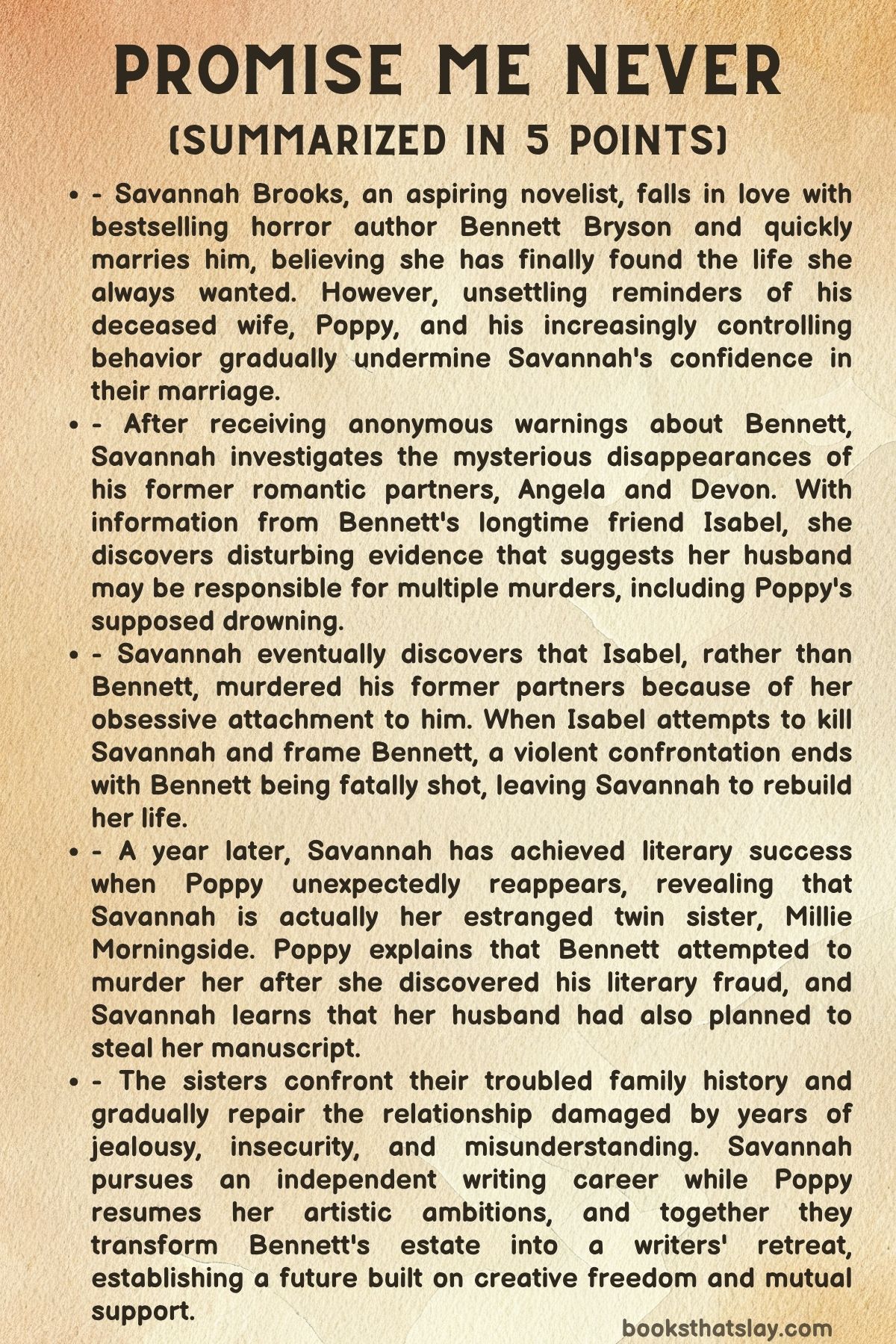
The story follows Savannah Brooks, an aspiring novelist who marries Bennett Bryson, a successful horror author whose previous wife died under mysterious circumstances. What initially appears to be Savannah’s ideal marriage gradually becomes a frightening experience as she discovers troubling details about her husband’s past. Through alternating perspectives and revelations about earlier relationships, the novel examines the difference between genuine affection and destructive attachment. Its unexpected developments expose hidden connections between characters and challenge assumptions about innocence, guilt, and personal identity.
Summary
Savannah Brooks has always believed that determination and careful planning can help her achieve the life she wants. Having grown up feeling undervalued by her parents, she dreams of becoming a successful novelist and finding a husband who will offer the love and security she has long desired.
Her position at the prestigious literary agency Margolis, Sutton & Klein brings her closer to both ambitions. When she learns that bestselling horror author Bennett Bryson will attend a writers’ conference, she recognizes an opportunity to meet the man she has admired for years.
Bennett is wealthy, attractive, and professionally accomplished, although his career has suffered from declining sales. His wife, Poppy, supposedly died after falling from their yacht, leaving him a widower.
At the conference, Savannah catches Bennett’s attention by challenging another author’s inaccurate literary reference. Their conversations reveal an immediate attraction, and Bennett invites her to dinner.
Despite Savannah’s attempts to follow conventional dating advice, their relationship becomes intimate almost immediately. Bennett admits that she is the first woman he has pursued since Poppy’s death.
Rather than returning directly to his Bedford estate, Bennett extends his New York hotel reservation for an entire month. Their romance develops rapidly, and they discover shared interests in literature, creative work, marriage, and family.
Savannah becomes convinced that Bennett represents the future she has always wanted. However, occasional references to her previous life suggest that she is concealing information that could threaten their relationship.
When Bennett proposes marriage, Savannah is delighted but dissatisfied with his suggested three-month engagement. She fears that postponing their wedding might give him an opportunity to reconsider.
Using a calculated argument about her religious convictions, Savannah persuades him to marry sooner. Bennett eventually agrees, and she resigns from her position at the literary agency.
Her employer, Marion Sutton, expresses concern about the speed of their relationship. She also reveals that Bennett was engaged twice before marrying Poppy, although both engagements ended unexpectedly.
Savannah proceeds with the wedding and moves into Bennett’s magnificent Bedford estate. There, she encounters Felicia, his protective housekeeper, and Finn, the affectionate family dog.
The house contains constant reminders of Poppy, including a preserved art studio filled with her belongings. Savannah feels uncomfortable competing with the memory of a woman Bennett appears unable to forget.
Her uneasiness increases when Bennett gives her an extravagant wedding ring resembling one Poppy wore. Savannah wonders whether her husband has given her his deceased wife’s jewelry.
Married life initially offers comfort and luxury, but Bennett’s demanding writing schedule soon leaves Savannah isolated. He spends long hours behind the locked door of his study and refuses to permit anyone inside.
Savannah attempts to occupy herself by writing her own novel. Although Bennett initially encourages her ambition, his editorial comments become increasingly discouraging and contradictory.
Their relationship takes a frightening turn when Bennett chokes Savannah during an intimate encounter without obtaining her consent. He apologizes afterward, but the experience leaves her afraid of his capacity for violence.
Meanwhile, the narrative reveals disturbing details about Bennett’s marriage to Poppy. Their relationship began with intense attraction and shared artistic ambitions, but his possessiveness gradually created serious disagreements.
Poppy resented his attempts to control her friendships and professional success. She also became suspicious of his insistence that his writing office remain completely private.
Her suspicions eventually led her to obtain the office key and investigate its contents. What she discovered fundamentally altered her understanding of her husband.
Savannah’s own suspicions begin when she finds an anonymous warning attached to her vehicle. The message claims that Bennett is dangerous.
Although Bennett dismisses it as the work of an unstable admirer, Savannah preserves the note.
A subsequent encounter with a mysterious woman intensifies her fears. The stranger claims that Bennett murdered three women, including her best friend.
Savannah eventually meets the woman, who introduces herself as Isabel Pierce, a longtime friend of Bennett and Poppy.
Isabel identifies Angela and Devon, Bennett’s former fiancées, as women whose disappearances deserve investigation. She also questions the circumstances surrounding Poppy’s supposed drowning.
Savannah begins researching their lives and discovers troubling similarities between their experiences and her own. Devon, for example, admired Bennett’s writing and became romantically involved with him after receiving his professional encouragement.
When Savannah visits Devon’s father, Harrison, she encounters a grieving parent who has never received satisfactory answers about his daughter’s disappearance.
She also notices a distinctive necklace in a photograph of Devon and her mother.
Meanwhile, Bennett is traveling through Europe on a promotional tour. Unknown to Savannah, he has been monitoring her activities through surveillance cameras installed throughout their home.
His growing suspicion that she is investigating him threatens his carefully controlled existence.
Savannah eventually discovers Angela’s distinctive silk scarf among Bennett’s possessions. The discovery strengthens her belief that her husband may have retained belongings from women he murdered.
When she obtains a key to his study, she enters with Isabel’s assistance. Inside, they discover a collection of personal possessions, including jewelry, a hairbrush, and a telephone belonging to Devon.
The evidence appears devastating. Savannah becomes convinced that Bennett is a serial murderer who has concealed his crimes behind his public reputation.
However, an apparently insignificant detail changes everything.
While discussing the evidence, Savannah notices Isabel touching a necklace with distinctive decorative beads. She remembers seeing an identical design in the photograph at Harrison’s house.
The realization makes Savannah reconsider the entire investigation.
Before she can escape, Isabel recognizes that her deception has been discovered. She reveals that she has been obsessed with Bennett since adolescence and has regarded his romantic partners as obstacles.
Isabel is responsible for the murders previously attributed to Bennett.
She has deliberately manipulated Savannah into suspecting her husband, constructing an elaborate explanation for the disappearances while concealing her own involvement.
Producing a gun, Isabel forces Savannah to write a letter accusing Bennett of murder. She then sedates her and transports her to an isolated farm.
Savannah awakens imprisoned and discovers that Isabel intends to kill her and frame Bennett.
During a confrontation, Savannah manages to seize Isabel’s gun. However, the situation becomes more dangerous when Bennett unexpectedly arrives after returning from Europe.
He discovers that his longtime friend has been responsible for a series of crimes committed because of her possessive attachment to him.
Isabel refuses to surrender. During the ensuing struggle, a gunshot strikes Bennett.
He dies from his injuries, leaving Savannah devastated and Isabel facing the consequences of her actions.
A year later, Savannah has transformed her experiences into a bestselling thriller titled Killer Twist. Marion represents her again, and Savannah finally achieves the literary recognition she once believed was beyond her reach.
During a book signing, however, a woman approaches and calls her Millie.
The woman is Poppy, Bennett’s supposedly deceased first wife.
The encounter reveals that Savannah Brooks was originally Millie Morningside, Poppy’s fraternal twin sister.
Savannah changed her name after college because she wanted to escape a childhood dominated by comparisons with her sister. She had always believed that Poppy received greater admiration, affection, and opportunity.
When Poppy married Bennett, Savannah felt that her sister had once again obtained something she desperately wanted.
Following Poppy’s supposed death, Savannah deliberately pursued Bennett while concealing their family connection.
Poppy’s return forces Savannah to confront both her deception and her unresolved resentment.
During their reunion, Poppy reveals the truth about her disappearance.
She had discovered that Bennett was using artificial intelligence to imitate successful novels, reproducing recognizable elements of other authors’ work while attempting to conceal the borrowing.
When she confronted him aboard their boat and threatened to expose his practices, Bennett pushed her overboard.
Poppy struck her head and lost consciousness but was eventually rescued.
Discovering that the authorities believed she had drowned, she decided to remain hidden because she feared Bennett would attempt to kill her again.
She escaped to New Mexico, where she established a quiet life in an artists’ community.
Poppy also reveals that she was pregnant when Bennett attacked her. Her daughter, whom she named Millie, became another reason to remain concealed.
The revelation that Poppy named her child after her sister profoundly affects Savannah. It demonstrates that Poppy’s affection survived their estrangement.
The sisters gradually rebuild their relationship.
Together, they investigate Bennett’s professional deception and discover that his unfinished novel closely resembles Savannah’s manuscript.
Savannah realizes that Bennett intended to appropriate her work after repeatedly encouraging her to abandon it.
His apparent professional guidance was another form of exploitation.
Poppy proposes converting Bennett’s estate into a writers’ retreat, transforming a place associated with secrecy and control into one that encourages creative independence.
Savannah begins therapy to confront her insecurities, while Poppy resumes her artistic career.
Savannah also secures a three-book publishing contract for the series Bennett dismissed as unoriginal.
The criminal investigation establishes Isabel’s responsibility for the murders, while Poppy’s survival exposes Bennett’s attempted murder and literary fraud.
Although neither sister can erase the damage caused by their past, they finally begin recognizing each other as individuals rather than rivals.
Their reconciliation offers the possibility of a future defined by mutual support, personal achievement, and freedom from the relationships that nearly destroyed them.
Characters
Savannah Brooks / Millie Morningside
Savannah Brooks is the central protagonist of Promise Me Never, and her character combines determination, ambition, insecurity, and a powerful need for emotional validation. Originally named Millie Morningside, she reinvents herself as Savannah Brooks to escape the identity she associates with childhood disappointment.
Her ambitions extend beyond financial comfort or romantic security. She genuinely wants to become a successful novelist and believes that professional recognition will establish her value independently of her family’s judgments.
However, Savannah’s determination is complicated by her unresolved resentment toward her twin sister, Poppy. She has spent much of her life believing that Poppy received the admiration and opportunities denied to her.
This insecurity influences her relationships with men. Her earlier obsession with Derek, which eventually resulted in a restraining order, demonstrates how rejection can provoke unhealthy behavior when she interprets romantic acceptance as proof of personal worth.
Her pursuit of Bennett reveals a similarly calculating side. She deliberately enters his professional environment and conceals her relationship with Poppy, believing that marrying him will allow her to obtain the life she once associated with her sister.
Nevertheless, her affection for Bennett becomes genuine. She experiences real happiness during their courtship and suffers deeply when their marriage begins revealing disturbing qualities.
Savannah’s transformation becomes apparent when she investigates the warnings about Bennett. Rather than surrendering completely to fear, she gradually learns to question appearances, examine evidence, and act independently.
Her confrontation with Isabel demonstrates considerable courage. Although frightened and physically vulnerable, she manages to regain control of the situation and survive.
The revelation that Poppy is alive forces Savannah to confront a different kind of danger: the possibility that her entire adult identity has been shaped by resentment.
By acknowledging her insecurities and pursuing therapy, she begins separating her self-worth from competition with her sister. Her eventual publishing success also demonstrates that she possesses genuine creative ability.
Savannah’s development ultimately concerns the movement from external validation toward personal independence. She learns that marriage, wealth, and public recognition cannot compensate for unresolved emotional conflicts.
Bennett Bryson
Bennett Bryson is one of the most deceptive figures in Promise Me Never, initially appearing as a successful, intelligent, and emotionally wounded novelist. His public reputation and apparent devotion make him attractive to women who admire his achievements.
Beneath this image, however, Bennett possesses a powerful need to control his surroundings and preserve his professional standing. His relationships reveal how easily affection becomes entangled with possessiveness.
His marriage to Poppy demonstrates the contradiction in his personality. He initially admires her independence and artistic ambition, but her growing professional success eventually threatens his sense of authority.
Bennett interprets disagreements and independent decisions as potential abandonment. His financial generosity also creates situations in which he can influence his partners’ choices while presenting himself as supportive.
His relationship with Savannah follows a similar pattern. Although he encourages her writing at first, his criticism gradually becomes destructive.
The discovery that he intended to appropriate her manuscript transforms his professional advice into evidence of calculated exploitation.
Bennett’s dependence on artificial intelligence to imitate successful novels exposes another dimension of his insecurity. He fears professional decline so intensely that he compromises the originality on which his reputation supposedly rests.
His greatest moral failure occurs when Poppy discovers the deception. Rather than accepting responsibility, he attempts to murder her to prevent exposure.
His interactions with Isabel also reveal emotional irresponsibility. By repeatedly returning to her without offering the commitment she desires, he sustains a relationship founded on unequal expectations.
Although Bennett is not responsible for the murders of Angela and Devon, his innocence in those crimes does not make him harmless. His attempted murder of Poppy establishes that he is capable of extreme violence when his reputation is threatened.
His death prevents him from facing legal consequences, but the exposure of his actions destroys the public identity he worked so carefully to maintain.
Poppy Morningside
Poppy is a central figure in Promise Me Never, initially presented as Bennett’s beautiful, supposedly deceased first wife. Her gradual emergence as an independent character challenges the idealized image surrounding her absence.
An ambitious visual artist, Poppy values originality, creative freedom, and professional achievement. She wants her artwork to receive recognition because of its quality rather than her husband’s wealth.
Her decision to move into Bennett’s home initially reflects a genuine desire to build a shared life. She believes their similar artistic interests will allow them to understand each other’s professional needs.
However, financial dependence gradually exposes differences in their expectations. Bennett assumes that his generosity entitles him to influence her career, while Poppy insists on maintaining artistic independence.
Her resistance to his possessiveness demonstrates her determination to preserve an identity outside marriage. She refuses to abandon friendships or accept restrictions simply because Bennett becomes jealous.
Poppy’s investigation of his office develops from these conflicts. She increasingly recognizes that his secrecy prevents the mutual trust she expected from marriage.
When she discovers his literary fraud, her commitment to artistic integrity becomes decisive. She refuses to overlook the deception despite her love for him.
Her survival after Bennett pushes her overboard demonstrates resourcefulness and determination. Remaining hidden allows her to protect herself and her unborn child, although it also requires sacrificing contact with her former life.
Poppy’s relationship with Savannah provides another important dimension to her personality. Although Savannah interprets their childhood as constant competition, Poppy remembers moments of affection and mutual dependence.
Naming her daughter Millie demonstrates the emotional connection she continues to feel toward her estranged sister.
Her eventual return allows both women to reconsider their shared history. Poppy becomes an important influence in Savannah’s recovery without demanding that their previous difficulties disappear immediately.
Her character represents creative independence, survival, and the possibility of rebuilding relationships after betrayal.
Isabel Pierce
Isabel Pierce is the principal murderer in Promise Me Never, although she initially appears to be a concerned friend attempting to protect Savannah.
Her deception succeeds because she possesses genuine knowledge of Bennett’s history. Having known him since childhood, she understands his relationships, insecurities, and personal habits.
Isabel’s attachment to Bennett began during adolescence and developed into a consuming romantic obsession. Their later sexual relationship encouraged her belief that they shared a special connection.
However, Bennett never offered the permanent commitment she desired. He repeatedly pursued other women, returning to Isabel when those relationships ended.
Rather than accepting his choices, Isabel interpreted his partners as rivals who prevented her from obtaining the relationship she believed she deserved.
Her murders demonstrate how completely this belief has distorted her understanding of love. She treats other women’s lives as obstacles that can be eliminated.
Isabel also possesses considerable intelligence and manipulative ability. She constructs a convincing narrative in which Bennett appears responsible for several disappearances.
Her warnings to Savannah exploit genuine inconsistencies in Bennett’s behavior, making the accusations particularly credible.
By collecting incriminating evidence and arranging circumstances to support her story, Isabel attempts to control not only the murders but also how others understand them.
Her relationship with Poppy demonstrates the depth of her deception. She establishes a seemingly affectionate friendship while secretly resenting Poppy’s marriage to Bennett.
Her final confrontation with Savannah exposes the possessiveness beneath her carefully maintained appearance. When her plans begin collapsing, she abandons persuasion and resorts to direct violence.
Bennett’s death becomes the ultimate contradiction of her obsession. Her determination to possess him produces the circumstances that destroy the very relationship she hoped to secure.
Isabel represents the danger of treating romantic desire as entitlement rather than recognizing another person’s autonomy.
Felicia
Felicia is Bennett’s longtime housekeeper and former nanny. Having cared for him since childhood, she maintains a protective attachment that extends beyond her professional responsibilities.
Her familiarity with the Bryson family makes her an important source of information about Bennett’s upbringing. She remembers encouraging his literary ambitions when his parents expected him to enter the family business.
This history explains why Bennett trusts her and why Felicia regards him with such personal loyalty.
Initially, she receives Savannah coldly. She fears that Bennett’s new wife may be attracted to his wealth and suspects that their rapid marriage reflects questionable intentions.
Her attitude gradually softens as Savannah makes an effort to establish a friendly relationship. Their shared conversations reveal that Felicia is capable of warmth despite her guarded nature.
However, her loyalty limits her objectivity. She consistently dismisses allegations about Bennett’s previous relationships and interprets criticism of him as unfair.
Her inability or unwillingness to recognize his destructive behavior demonstrates how affection can influence judgment.
Felicia’s eventual support for converting the estate into a writers’ retreat provides a constructive resolution to her character.
She can continue living in the home while helping transform it into an environment that supports the creative ambitions of others.
Marion Sutton
Marion Sutton is Bennett’s literary agent and Savannah’s former employer. She represents the professional publishing world and understands the demands accompanying literary success.
Her relationship with Bennett is primarily professional, although their long association gives her considerable knowledge of his temperament.
Marion recognizes both his talent and the commercial pressures affecting his career. She encourages promotional appearances because she understands that his declining sales require renewed public attention.
Her attitude toward Savannah is generally supportive. She appreciates Savannah’s professional abilities and recognizes her ambitions as an aspiring novelist.
When Savannah announces her engagement, Marion expresses concern about the speed of the relationship. She also warns that Bennett’s demanding schedule could make marriage to him emotionally difficult.
These warnings demonstrate practical judgment rather than hostility toward the couple.
Marion’s later representation of Savannah establishes an important connection between the protagonist’s earlier ambitions and her eventual success.
Through Marion, Savannah returns to the professional world she abandoned and gains recognition on the strength of her own writing.
Henri
Henri is Poppy’s close friend and one of the individuals who remains suspicious about the circumstances of her disappearance.
He understands Poppy’s independent personality and recognizes that her marriage to Bennett had become increasingly difficult.
His conversations with Poppy before her disappearance reveal concerns about Bennett’s controlling behavior. However, Henri cannot establish precisely what happened to her.
When Savannah encounters him at the café, his reaction suggests that her marriage has reopened troubling memories.
His reluctance to become involved reflects genuine fear of Bennett. Although he believes that Bennett killed Poppy, he does not possess evidence sufficient to establish the accusation.
Henri eventually confirms that Poppy intended to leave her husband, strengthening Savannah’s suspicions.
His character demonstrates the importance of outside perspectives in relationships where one partner exercises excessive control.
He also illustrates the limitations of suspicion: recognizing troubling behavior does not automatically provide the evidence necessary to establish a crime.
Angela
Angela is one of Bennett’s former fiancées whose disappearance becomes central to Savannah’s investigation.
Although she does not receive extensive direct characterization, the details surrounding her life establish her importance to the mystery.
Savannah discovers photographs connecting Angela to Bennett, including an image showing her wearing a distinctive Hermès scarf.
When Savannah later finds an apparently identical scarf among Bennett’s possessions, she interprets it as evidence of his involvement in Angela’s disappearance.
Angela’s story initially supports the impression that Bennett has a pattern of murdering women who reject him.
The eventual revelation of Isabel’s crimes changes the meaning of that evidence.
Angela becomes one of the victims of Isabel’s possessive obsession, demonstrating how the killer deliberately targets women who occupy the romantic position she desires.
Devon
Devon is another of Bennett’s former romantic partners whose disappearance provides important clues about the murders.
Like Savannah, she possesses literary ambitions and admires Bennett’s professional achievements.
Their relationship begins after Devon encounters him at a book appearance. His promise to help her develop her manuscript establishes a connection that resembles Savannah’s experience.
This similarity frightens Savannah because it suggests that her own marriage may be following a dangerous pattern.
Devon’s disappearance also reveals the lasting consequences of unresolved crimes for surviving relatives.
Her father, Harrison, continues searching for answers and remains deeply affected by the absence of reliable information.
The photograph showing Devon and her mother wearing distinctive necklaces becomes especially significant.
When Savannah recognizes the same design on Isabel’s necklace, Devon’s story provides the clue that exposes the actual murderer.
Although Devon is absent from the principal action, her life and disappearance remain essential to the novel’s central revelation.
Harrison
Harrison is Devon’s father, whose continuing grief demonstrates the human consequences of the disappearances.
His willingness to speak with Savannah reflects his desire to preserve his daughter’s memory and understand what happened to her.
Through his recollections, Devon becomes more than a missing woman associated with Bennett’s romantic history.
Harrison describes her interests, ambitions, and relationship with her family, restoring an individuality that the investigation might otherwise overlook.
His home also contains the photograph that eventually becomes crucial to identifying Isabel.
Harrison’s character emphasizes the emotional uncertainty experienced by families who cannot establish whether a missing relative is alive or dead.
Bridgette
Bridgette is Poppy’s friend in London and an important figure in the investigation of her supposed drowning.
She receives a delayed letter revealing that Poppy intended to leave Bennett before disappearing.
The letter contradicts Bennett’s portrayal of their marriage as happy and stable.
Bridgette confronts him directly, questioning whether Poppy’s death was accidental.
Her determination demonstrates loyalty to her friend and an unwillingness to accept an explanation that conflicts with newly discovered evidence.
Although Bridgette cannot establish the truth herself, her confrontation reveals that Bennett’s account of his marriage contains important omissions.
Her character shows how preserving personal correspondence can eventually challenge a carefully constructed narrative.
Jessica
Jessica is Savannah’s friend and provides an early perspective on her romantic expectations.
During Savannah’s thirtieth birthday celebration, Jessica encourages her to reconsider the way she approaches relationships.
She believes that Savannah becomes emotionally invested too quickly and recommends a dating advice book that emphasizes restraint.
Although her suggestions initially appear harmless, Savannah uses them to construct calculated interactions with Bennett.
Jessica’s role reveals the extent to which Savannah regards romance as something that can be managed through strategy.
She also establishes Savannah’s dissatisfaction with her previous relationships and her desire to find a permanent partner.
Derek
Derek is Savannah’s former romantic partner, whose relationship with her reveals troubling aspects of her behavior before meeting Bennett.
After Derek ends their relationship, Savannah struggles to accept his decision.
She repeatedly contacts him and begins driving past his residence, eventually prompting him to obtain a restraining order.
Her actions demonstrate how rejection can intensify her obsession when she believes a relationship is necessary to establish her worth.
Derek also possesses literary ambitions, making professional success another source of comparison between them.
Savannah later takes satisfaction in believing that she has surpassed him through her marriage to Bennett.
His character provides important context for her eventual realization that romantic disappointment should not determine her identity.
Molly
Molly is an aspiring writer whose professional success provokes Savannah’s jealousy.
When Molly receives a substantial publishing contract, Savannah outwardly congratulates her while privately believing that her own writing is superior.
This reaction demonstrates how strongly Savannah associates achievement with personal validation.
Molly also introduces rumors surrounding Poppy’s death, suggesting that Bennett’s wife may not have fallen from the yacht accidentally.
Savannah initially rejects the possibility because it threatens her idealized perception of Bennett.
Molly therefore serves two important purposes: exposing Savannah’s competitive insecurity and introducing early doubts about the man she intends to marry.
Lucy Love
Lucy Love is a rising horror novelist whose appearance at Bennett’s conference becomes the occasion for his first meaningful encounter with Savannah.
Marion arranges for Lucy to interview Bennett, but he dislikes her approach and redirects the event toward audience questions.
Savannah challenges an inaccurate literary reference made during the discussion.
Bennett appreciates her intelligence and becomes curious about her identity.
Although Lucy’s involvement in the larger story is limited, her appearance establishes the professional circumstances through which Savannah attracts Bennett’s attention.
Bennett’s Younger Sister
Bennett’s younger sister is an important figure in his childhood history, particularly because her death initially appears connected to the pattern of suspicious incidents surrounding him.
According to Isabel’s recollection, Bennett became angry when his sister kissed another boy during a party.
An argument followed, and the girl was subsequently found dead after apparently drowning in a stream.
Investigators classified the death as accidental, but Isabel later encourages Savannah to question that conclusion.
The incident becomes part of the misleading narrative suggesting that Bennett has been responsible for deaths since adolescence.
Her character illustrates how unresolved childhood events can be reinterpreted when later accusations create suspicion.
Themes
Romantic Obsession and Possessive Love
Love becomes destructive when affection is replaced by the belief that another person must remain permanently available, regardless of personal choice. The relationships in Promise Me Never demonstrate how obsession can disguise itself as devotion while gradually undermining autonomy.
Isabel provides the clearest example of this transformation. Her attachment to Bennett begins during adolescence and develops into a conviction that their eventual union is inevitable.
Because Bennett repeatedly becomes involved with other women, Isabel interprets his relationships as obstacles rather than expressions of his independent desires. She refuses to accept that loving someone does not create an entitlement to that person’s affection.
Her murders represent the extreme consequences of this belief. She attempts to eliminate romantic rivals while constructing explanations that preserve her own apparent innocence.
Bennett demonstrates a different form of possessiveness. He wants his partners to admire him and remain emotionally available, but he becomes threatened when their ambitions or independent decisions challenge his authority.
Poppy’s professional achievements provoke jealousy, while Savannah’s growing independence creates tension within their marriage.
Savannah’s earlier pursuit of Derek also reveals how romantic rejection can become an obsession when personal worth depends on another person’s acceptance.
These parallel relationships establish an important distinction between emotional intensity and genuine love.
Strong affection does not necessarily indicate trust, mutual respect, or emotional security.
The novel ultimately demonstrates that relationships become dangerous when individuals interpret another person’s freedom as betrayal and attempt to replace mutual commitment with control.
Identity, Jealousy, and the Need for Validation
Savannah’s decision to abandon the name Millie Morningside demonstrates how profoundly childhood experiences can influence adult identity. Her reinvention represents an attempt to escape a family history in which she believes her sister consistently received greater admiration.
Although Savannah and Poppy are twins, Savannah interprets their differences as evidence that she is inherently less desirable. Their parents’ comparisons intensify this belief, encouraging her to measure her accomplishments against Poppy’s achievements.
Her attraction to Bennett cannot be separated from this emotional history.
When Poppy marries the celebrated novelist, Savannah regards the relationship as another example of her sister obtaining something she wants. Bennett’s subsequent widowhood appears to offer an opportunity to reverse that pattern.
Savannah’s professional ambitions are similarly affected by comparison. She envies Molly’s publishing success and takes satisfaction in believing that she has surpassed Derek.
These reactions suggest that achievement alone cannot resolve her insecurity because her standards of success remain dependent on other people’s circumstances.
The revelation that Poppy is alive forces Savannah to recognize how much of her adult life has been organized around competition.
Poppy’s perspective challenges Savannah’s understanding of their childhood. She remembers genuine affection and companionship rather than the uninterrupted rivalry Savannah describes.
Their reconciliation becomes possible when Savannah begins questioning the assumptions that shaped her resentment.
Her eventual publishing success also acquires a different meaning.
Rather than proving her superiority over Poppy or Bennett, it establishes that her creative abilities have value independently of comparison.
The novel suggests that personal identity becomes more stable when individuals recognize their achievements without treating another person’s happiness as evidence of their own failure.
Secrecy, Deception, and the Manipulation of Truth
Secrecy shapes nearly every important relationship in Promise Me Never, creating a world in which appearances frequently conceal contradictory realities. Characters hide information to protect themselves, preserve reputations, or control how others interpret their actions.
Savannah conceals her identity as Poppy’s twin sister because revealing the connection would threaten the romantic future she has constructed.
Her deception is rooted in insecurity, but it also prevents Bennett from understanding the actual circumstances surrounding their relationship.
Bennett’s secrecy serves a different purpose.
His locked study conceals evidence of his literary fraud, while his surveillance system allows him to observe Savannah without her knowledge.
He presents these restrictions as professional necessities, transforming ordinary expectations of privacy into mechanisms of control.
Isabel manipulates information even more deliberately. She provides Savannah with genuine details about disappearances while arranging those details to support a false conclusion.
Her accusations succeed partly because Bennett has genuinely behaved suspiciously.
The discovery of possessions belonging to missing women appears to establish his guilt, but their significance changes when Savannah recognizes Isabel’s necklace.
This development demonstrates how evidence can mislead when its context has been deliberately constructed.
Poppy’s disappearance introduces another form of concealment.
Unlike Bennett or Isabel, she hides her survival to protect herself and her daughter from a credible threat.
Her secrecy therefore complicates any simple distinction between honesty and deception.
The narrative distinguishes between concealment intended to preserve life and deception intended to exploit others.
Ultimately, the truth emerges through the comparison of different accounts, physical evidence, and personal memories.
The novel demonstrates that understanding events requires questioning not only whether information is accurate but also who presents it, what has been omitted, and why a particular interpretation benefits the person offering it.
Creative Ambition, Professional Integrity, and Exploitation
Writing and visual art provide the principal characters with opportunities for personal fulfillment, but creative ambition also becomes a source of rivalry and exploitation.
Bennett’s early literary success establishes his wealth and public reputation. However, declining sales gradually transform his professional ambition into anxiety about losing the status he has acquired.
Rather than confronting that insecurity through his own creative efforts, he begins using artificial intelligence to imitate commercially successful novels.
His actions compromise the originality on which his identity as a respected author depends.
Poppy’s reaction demonstrates a contrasting understanding of artistic achievement. She believes that professional recognition should reflect genuine creative ability rather than purchased opportunities or concealed appropriation.
This conviction also explains her discomfort when Bennett invests in a gallery to secure an exhibition for her work.
Although his financial assistance may appear generous, Poppy fears that it will undermine the independence she has worked to establish.
Savannah’s writing career reveals another form of artistic exploitation.
She initially regards Bennett as a mentor whose professional experience can help her improve her manuscript.
However, his contradictory criticism gradually undermines her confidence. The eventual discovery that he intended to appropriate her story exposes the manipulation underlying his advice.
His behavior demonstrates how professional authority can be used to discourage emerging talent while benefiting from another person’s ideas.
Savannah’s later success reverses this imbalance.
Her bestselling novel and subsequent publishing contract establish that her creativity possesses value independently of Bennett’s approval.
Poppy’s renewed artistic career provides a parallel example of reclaiming professional independence.
Their decision to transform Bennett’s estate into a writers’ retreat gives this development a broader significance.
A property previously associated with secrecy, artistic rivalry, and professional exploitation becomes a place dedicated to supporting creative work.
The novel ultimately presents genuine artistic achievement as something that requires independence, integrity, and respect for the creative contributions of others.