Ransom by Leslie Wolfe Summary, Characters and Themes
Ransom by Leslie Wolfe is a psychological thriller that combines murder, deception, romantic obsession, and the lasting consequences of childhood trauma.
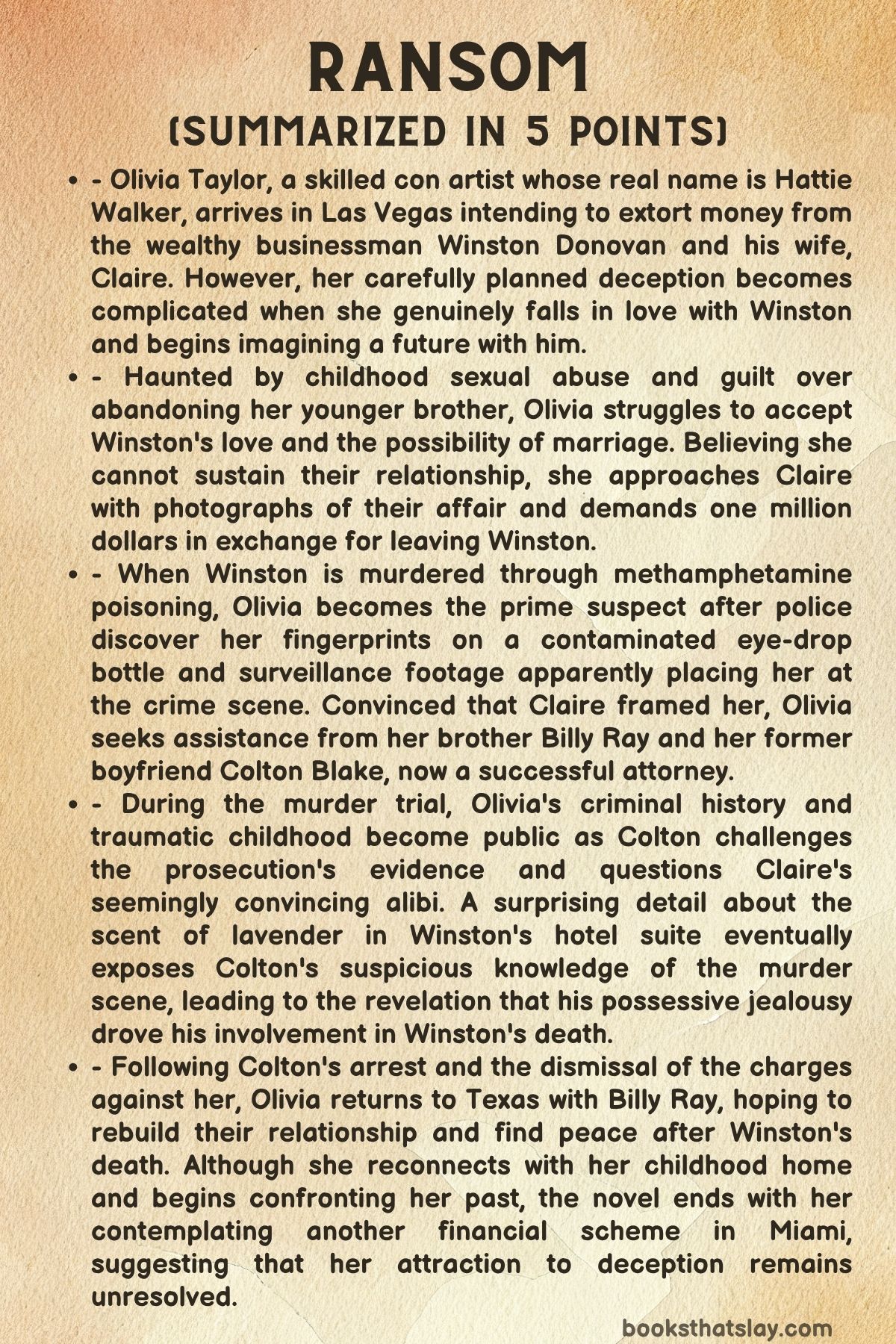
The story follows Olivia Taylor, a resourceful con artist who arrives in Las Vegas intending to exploit a wealthy married man. Her carefully constructed scheme takes an unexpected turn when she genuinely falls in love with her intended victim. When he is murdered, Olivia becomes the prime suspect, forcing her to confront the secrets she has spent years concealing. Through a complicated investigation and courtroom battle, the novel explores the dangerous consequences of possessive love, the limits of reinvention, and the struggle to escape one’s past.
Summary
A man lies dying on the marble floor of a luxurious Las Vegas hotel suite. His eyes burn, blood trickles down his face, and severe chest pain leaves him unable to breathe properly.
As he struggles toward the door, he hears someone leaving the room. Whoever witnessed his suffering abandons him without offering assistance, leaving the circumstances of his death a mystery.
Two months earlier, a twenty-seven-year-old woman prepares to escape Seattle. At the airport, Avery Sinclair, the teenage son of a wealthy airline owner, recognizes her and angrily confronts her over the damage she has caused his family.
She denies knowing him and narrowly avoids further questioning before boarding a flight to Las Vegas. Although she intends to abandon her dangerous lifestyle, she has already decided to undertake one final financial scheme.
Upon arriving, she destroys her old telephone and establishes a new identity as Olivia R. Taylor. Her real name is Hattie Walker, and she has spent years attempting to escape the poverty and abuse of her childhood in Texas.
Olivia checks into the luxurious ARIA hotel and begins constructing the appearance of a wealthy socialite. She hires photographer Tony Vega to stage a paparazzi encounter, creating publicity that falsely connects her to the influential Taylor casino family.
Her objective is Winston James Donovan, a forty-seven-year-old businessman who made his fortune in oil before entering the renewable-energy industry. Winston is married to Claire Donovan, and Olivia believes their marriage offers a profitable opportunity.
Olivia carefully studies Claire’s appearance, adopting similar clothing and styling her blond hair to match Winston’s apparent preferences. She also researches his professional interests, hoping to establish a convincing connection.
However, her preparations are interrupted by nightmares about her childhood. She remembers her abusive father, her younger brother Billy Ray, and Colton Blake, the boyfriend she abandoned when she fled Texas.
Meanwhile, an intimidating stranger begins following her. Olivia nicknames him Jack and suspects he is connected to the people whose wealth and reputations she intends to exploit.
Despite Jack’s repeated warnings that she should leave Las Vegas, Olivia continues her operation.
At an exclusive charity gala, she befriends Evelyn, an influential older woman whose social connections provide access to Winston. Olivia attracts Winston’s attention through carefully timed encounters, allowing him to believe their meeting is accidental.
Their first substantial conversation occurs at a renewable-energy conference. Olivia disguises herself as a volunteer and deliberately gives Winston another attendee’s identification badge, creating an opportunity to discuss solar technology.
Winston recognizes her immediately but plays along with the deception.
Their conversation develops into a genuine exchange about renewable energy, revealing that Olivia’s knowledge extends beyond her calculated performance. Winston invites her to meet again, beginning a relationship that quickly exceeds her original intentions.
He takes her into the desert to visit a solar-energy installation, and she later arranges an excursion along the Colorado River. They ride horses, go dancing, and discover shared interests that bring them increasingly close.
Olivia begins recognizing Winston’s kindness and sincerity. Rather than viewing him as another wealthy man to manipulate, she falls in love with him.
Her feelings create a serious dilemma.
For years, Olivia has relied on emotional distance to protect herself. She has survived by exploiting wealthy married men, persuading their wives to pay substantial sums in exchange for ending her relationships with their husbands.
Winston was supposed to become another profitable target. Instead, he offers Olivia the possibility of genuine companionship and emotional security.
Nevertheless, her childhood trauma makes physical intimacy frightening. She cannot explain her reactions without revealing the sexual abuse she experienced at her father’s hands.
Winston eventually proposes marriage beside the Bellagio fountains. Olivia accepts, overwhelmed by happiness, but the engagement intensifies her fear that she cannot sustain their relationship.
She also discovers that Winston has not fully informed Claire about his divorce plans.
Believing that their future is impossible, Olivia decides to complete her original scheme.
She hires private investigator Brad Pendergraft, who supplies photographs documenting her relationship with Winston. Brad also investigates Jack and discovers that the mysterious stranger has a disturbing criminal history.
Armed with the photographs, Olivia visits Claire at the Donovan residence.
She offers to surrender Winston in exchange for one million dollars in cryptocurrency and a signed nondisclosure agreement. Claire appears surprisingly willing to negotiate, leaving Olivia uneasy about how easily the arrangement proceeds.
During their conversation, Claire asks Olivia to administer her eye drops. Olivia obliges, unknowingly creating evidence that will later be used against her.
After securing the financial arrangement, Olivia becomes devastated by the prospect of abandoning Winston.
She drives to the Cosmopolitan, where he has invited her to his suite, intending to return her engagement ring. However, she cannot bring herself to enter the hotel and eventually drives away.
The following morning, police arrive at her residence.
Detective Aaron Stanek arrests her for Winston’s murder.
Investigators explain that Winston died after a massive dose of methamphetamine caused a fatal cardiac event. The drug was apparently administered through contaminated eye drops.
Police discover an eye-drop bottle bearing Olivia’s fingerprints in her vehicle.
Surveillance footage also shows a blond woman resembling Olivia entering Winston’s suite shortly before his death.
Olivia insists that she never entered the room. She believes Claire impersonated her, murdered Winston, and planted the bottle to frame her.
Stanek remains unconvinced.
Facing a potentially devastating prosecution, Olivia contacts Billy Ray, her younger brother, whom she has not seen for more than a decade.
Their reunion reveals how much their lives have changed. Billy Ray explains that their abusive father died from a rattlesnake bite, bringing Olivia unexpected relief.
Billy Ray also arranges legal assistance from Colton Blake, Olivia’s former teenage boyfriend.
Colton has become a successful attorney and agrees to defend her. He obtains her release on substantial bail and begins preparing for trial.
However, Olivia refuses to reveal everything about her past.
She conceals her extortion arrangement with Claire, her fraudulent identity, and her previous operations involving wealthy married men.
Colton recognizes that her secrecy threatens the defense, but Olivia fears losing his respect.
As the investigation continues, the prosecution gathers damaging evidence.
Computer records show that Olivia extensively researched Winston before meeting him. Her fingerprints are found on the poisoned bottle, and surveillance footage appears to place her at the murder scene.
Avery Sinclair is also called to testify.
He reveals that Olivia previously lived in Seattle under the name Melanie Gates and became involved with his father, Alan Sinclair. His testimony exposes her history of deception and the damage her activities caused his family.
Olivia finally admits to Colton that she deliberately targeted wealthy married men for financial gain.
Although furious about her dishonesty, he continues defending her.
The trial exposes further details about Olivia’s childhood.
Billy Ray describes their father’s violence and explains how Olivia repeatedly protected him. Psychological expert Dr. Kristen Leishman subsequently testifies about the lasting effects of childhood sexual abuse.
Her testimony helps explain Olivia’s fear of intimacy, secrecy, and tendency to abandon relationships when she feels threatened.
Meanwhile, Colton challenges the forensic evidence.
He establishes that skin cells found beneath Winston’s fingernails could have resulted from ordinary affectionate contact. He also demonstrates that unidentified fingerprints were recovered from the eye-drop bottle.
Additional evidence suggests that someone had been tracking Olivia’s movements.
Nevertheless, Claire’s alibi remains a significant obstacle.
According to investigators, Claire was shopping at the Miracle Mile mall when Winston died. Surveillance footage and purchase records appear to confirm her presence.
Olivia independently examines the shopping center, searching for a possible route Claire could have used to reach the Cosmopolitan.
Eventually, she notices an overlooked detail in the surveillance footage.
The recording suggests that Claire could have entered a clothing store, changed into an outfit resembling Olivia’s, and left without being recognized.
Colton confronts Claire with this possibility during her testimony.
He presents evidence suggesting that she traveled to the hotel disguised as Olivia before returning to the mall and changing into her original clothing.
The revelation undermines her alibi and introduces reasonable doubt about Olivia’s guilt.
For the first time, Olivia believes she might escape conviction.
That evening, she and Colton celebrate with dinner. Their shared history draws them closer, and Colton kisses her, briefly reviving the affection they once shared.
However, a disturbing discovery soon changes everything.
Detective Stanek reveals that an anonymous tip originally directed investigators toward Olivia. He also suggests that Colton’s professional history deserves closer scrutiny.
Olivia learns that Colton previously represented Benny DiMarco, a man connected to organized crime.
During the trial’s closing arguments, Colton describes Winston’s final preparations for Olivia’s arrival at the hotel suite.
He mentions the scent of lavender.
Olivia immediately recognizes the significance of this detail.
Winston had told her that he used lavender because he believed it discouraged scorpions. Yet Colton had never been authorized to inspect the crime scene.
His apparent knowledge of the room’s atmosphere raises an alarming question.
Olivia interrupts his closing argument and demands to know how he knew about the lavender.
The courtroom descends into confusion.
Judge Thomas Antunez suspends proceedings and recognizes that Colton may have a conflict of interest requiring independent investigation.
The truth subsequently emerges.
Colton had recognized Olivia after her arrival in Las Vegas and arranged for Frankie, the man she called Jack, to follow her.
His surveillance revealed her developing relationship with Winston.
Colton’s longstanding love had become possessive, and his jealousy intensified when he discovered that Winston intended to marry her.
His connection to the surveillance operation and knowledge of Winston’s suite expose his involvement in the murder and the attempt to frame Olivia.
The man who appeared to be rescuing her had helped create the danger from which she needed rescuing.
Stanek arrests Colton, and the charges against Olivia are dismissed.
Although she escapes conviction, Olivia remains devastated by Winston’s death and Colton’s betrayal.
She also discovers troubling circumstances surrounding her father’s fatal rattlesnake bite, raising the possibility that Colton had been involved in another death connected to her past.
Olivia eventually returns to Texas with Billy Ray.
Several months later, she is living on the family farm, rebuilding their relationship and enjoying the familiar countryside.
Her old horse, Lone Star, provides a comforting connection to her childhood.
However, the ending reveals that Olivia’s transformation is incomplete.
As she considers her financial future, she begins imagining another elaborate scheme involving wealthy men in Miami.
Despite everything she has experienced, the temptation to resume her old lifestyle remains.
The novel concludes with Olivia apparently safe from her immediate enemies but still drawn toward the dangerous methods that have defined her adult life.
Characters
Olivia Taylor / Hattie Walker
Olivia Taylor, whose real name is Hattie Walker, is the protagonist of Ransom and the character through whom the novel examines survival, deception, trauma, and moral responsibility. Her transformation from an abused teenager into a sophisticated con artist forms the foundation of the story.
Growing up on an impoverished Texas farm, Hattie experiences prolonged abuse at the hands of her father. Her childhood teaches her that vulnerability can invite suffering and that survival sometimes requires secrecy, manipulation, and escape.
Her decision to flee Texas represents both liberation and emotional devastation. Although she saves herself from immediate danger, leaving Billy Ray behind creates guilt that continues to influence her adult relationships.
As Olivia Taylor, she constructs an identity designed to conceal everything about Hattie Walker. Her expensive clothing, glamorous lifestyle, invented social connections, and calculated confidence are instruments of reinvention rather than expressions of genuine security.
Olivia possesses considerable intelligence and adaptability despite lacking a conventional education. She independently studies unfamiliar subjects, understands social behavior, and recognizes how wealth influences the assumptions people make about others.
Her ability to manipulate appearances allows her to move among affluent individuals who would otherwise dismiss her. However, her success also encourages her to regard relationships as transactions in which emotional attachment becomes a potential weakness.
Her involvement with Winston challenges this philosophy. She initially approaches him as another financial target but discovers that she genuinely admires his intelligence, kindness, and professional ideals.
Falling in love exposes the limitations of her manufactured identity. Although she desires intimacy, her traumatic experiences make physical closeness frightening, and she believes that revealing her past would make her unworthy of lasting affection.
Olivia’s decision to extort Claire despite loving Winston demonstrates her emotional contradictions. She sacrifices the relationship she values because she cannot imagine maintaining it without surrendering the defenses that have protected her for years.
Her arrest forces her to confront the consequences of her deception. The false identities and financial schemes that once guaranteed her independence become evidence that threatens her freedom.
During the trial, Olivia gradually reveals the painful history she has concealed. Her willingness to acknowledge her abuse represents an important movement toward accepting that her past does not determine her value.
Nevertheless, the ending resists presenting her as completely transformed. Even after returning to Texas, she considers pursuing another wealthy target, showing that her attachment to manipulation remains deeply established.
Olivia’s characterization is therefore defined by contradiction: she is resourceful but self-destructive, capable of sincere love but afraid of intimacy, and determined to achieve freedom while repeatedly choosing circumstances that endanger it.
Winston James Donovan
Winston James Donovan is the wealthy businessman whose relationship with Olivia initiates the central tragedy of Ransom. His position as a successful entrepreneur makes him attractive to Olivia, but his personal qualities gradually transform him from an intended victim into someone she genuinely loves.
Having accumulated considerable wealth through the oil industry, Winston redirects his professional ambitions toward renewable energy. His interest in solar technology demonstrates a desire to use his resources for purposes extending beyond personal enrichment.
He is intellectually curious and enjoys discussing his work with someone who shares his enthusiasm. Olivia’s genuine interest in renewable energy becomes an important reason their relationship develops beyond superficial attraction.
Winston also possesses an adventurous personality. His excursions into the desert, visits to solar installations, horseback riding, and willingness to participate in Olivia’s preferred activities reveal a man who values companionship and new experiences.
His affection for Olivia develops rapidly. Rather than treating her as a temporary diversion, he begins imagining a future in which they share their lives.
However, Winston is not without moral complications. He begins pursuing Olivia while still married to Claire, and his failure to communicate his divorce plans clearly contributes to the conflict surrounding their relationship.
He also uses his resources to track Olivia’s telephone when he fears for her safety. Although motivated by concern, this action shows that his affection can lead him to disregard boundaries.
Nevertheless, Winston is generally characterized by patience and emotional generosity. He attempts to accommodate Olivia’s reluctance toward physical intimacy without fully understanding its origins.
His proposal represents his belief that their relationship offers the possibility of a lasting partnership. For Olivia, the gesture becomes both the fulfillment of her desires and the beginning of an emotional crisis.
Winston’s murder transforms him from an active participant into the central absence around which the investigation develops. His death destroys the future Olivia had briefly imagined and exposes the dangerous consequences of Colton’s possessiveness.
His character ultimately represents the genuine emotional connection Olivia discovers but cannot preserve.
Colton Blake
Colton Blake is one of the most consequential characters in Ransom, initially appearing as Olivia’s former teenage sweetheart and eventual legal defender. His development demonstrates how affection can become destructive when it is transformed into possessiveness and control.
During their adolescence in Texas, Colton offers Hattie companionship and the possibility of escaping her abusive home. His marriage proposal reflects his sincere desire to build a future with her, although he does not understand the full extent of her suffering.
Hattie’s rejection and subsequent disappearance leave him emotionally affected for years. When he reappears as a successful attorney, his return initially suggests that an important relationship from her past might finally be repaired.
Colton’s professional confidence provides Olivia with much-needed reassurance after her arrest. He challenges the prosecution’s evidence, secures her release on bail, and develops arguments intended to establish reasonable doubt.
His legal abilities are considerable. He recognizes weaknesses in forensic testimony, challenges questionable interpretations, and uses expert witnesses to explain Olivia’s psychological history.
However, his apparent dedication conceals a disturbing personal investment in the case.
Colton has maintained an emotional attachment to Olivia that does not adequately recognize her independence. Learning that she has fallen in love with Winston provokes jealousy rather than acceptance.
His decision to employ Frankie to monitor her reveals the controlling nature of his feelings. Although he presents the surveillance as protection, it also allows him to maintain knowledge of Olivia’s private life without her consent.
His involvement in Winston’s murder demonstrates the ultimate corruption of his affection. He is willing to destroy another man’s life and place Olivia in danger rather than accept that she has chosen someone else.
His subsequent role as her defense attorney adds another disturbing dimension. The person responsible for her predicament positions himself as the individual capable of rescuing her.
Colton’s connection to organized crime further complicates his character. His professional history suggests familiarity with people and methods that make his criminal involvement more plausible.
The revelation concerning lavender exposes the difference between his carefully maintained public identity and his concealed actions.
His characterization challenges the assumption that longstanding affection necessarily produces trustworthiness. Although he once appeared to offer Hattie safety, his adult behavior demonstrates that love without respect for another person’s autonomy can become a form of domination.
Claire Donovan
Claire Donovan is Winston’s wife and one of the novel’s principal sources of uncertainty. Her position as a wealthy married woman facing the possible collapse of her relationship makes her an obvious potential adversary to Olivia.
Initially, Claire appears through Olivia’s research. Her photographs, clothing, hairstyle, and public appearances become material that Olivia uses to construct an identity designed to appeal to Winston.
This process reduces Claire to a collection of observable characteristics before she becomes an active participant in the narrative.
When Olivia approaches her with evidence of Winston’s affair, Claire displays remarkable composure. Her apparent willingness to negotiate creates suspicion because her response differs from the anger or desperation Olivia expects.
The eye-drop incident becomes especially significant because it places Olivia’s fingerprints on an object later connected to Winston’s death. Claire’s involvement in this encounter makes her a plausible suspect once investigators discover the contaminated bottle.
Her shopping-mall alibi further complicates the investigation. Surveillance recordings initially appear to establish that she could not have committed the murder.
However, Olivia’s examination of the footage reveals that Claire might have changed clothing and impersonated her. The possibility seriously undermines the prosecution’s interpretation of the evidence.
Claire’s characterization depends partly on the uncertainty surrounding her actions. She possesses a potential financial motive, access to Winston, and circumstances that allow the defense to challenge her account.
Yet the eventual revelation concerning Colton changes the significance of these suspicions.
Claire also represents a woman whose marriage and financial security are threatened by the decisions of others. Her role prevents Olivia’s conduct from being understood solely as a harmless reversal of power between wealthy men and financially vulnerable women.
Billy Ray Walker
Billy Ray Walker is Olivia’s younger brother and one of the most important emotional connections in Ransom. His relationship with his sister provides an opportunity to examine the enduring consequences of family violence and prolonged separation.
As a child, Billy Ray witnesses aspects of their father’s cruelty without fully understanding the sexual abuse Hattie experiences. He nevertheless recognizes that his sister frequently protects him from danger.
Her departure leaves him behind in the household she desperately needs to escape. Although Olivia believes that leaving him is necessary, her decision becomes a source of guilt that follows her for years.
Billy Ray’s return during her murder investigation begins repairing their damaged relationship. Despite the long separation, he responds to her request for help rather than allowing resentment to determine his actions.
His loyalty becomes essential when he contacts Colton and travels to Las Vegas.
Billy Ray provides practical assistance and emotional support during Olivia’s most frightening experiences. His willingness to remain beside her contrasts with her longstanding belief that survival requires complete independence.
His courtroom testimony also becomes central to the defense. By describing their father’s violence and Olivia’s attempts to protect him, he reveals a side of his sister that the prosecution’s portrait of a calculating criminal largely ignores.
The circumstances of their father’s death introduce additional complexity. Billy Ray’s account of the rattlesnake bite raises questions about whether the death occurred accidentally or involved deliberate intervention.
Nevertheless, the story does not establish that Billy Ray was responsible.
His eventual reunion with Olivia represents the possibility of recovering a family connection that abuse and secrecy nearly destroyed.
By returning to Texas together, the siblings begin constructing a relationship based on their shared history rather than the silence imposed by their father.
Detective Aaron Stanek
Detective Aaron Stanek is the investigator responsible for examining Winston’s murder. His characterization reflects both the authority of law enforcement and the dangers of concentrating too heavily on an apparently convincing interpretation of evidence.
When Olivia is arrested, Stanek believes that the circumstances strongly implicate her. Her false identity, relationship with Winston, fingerprints on the poisoned bottle, and apparent presence at the hotel create a persuasive initial case.
His questioning demonstrates professional confidence, but it also reveals a reluctance to accept Olivia’s alternative explanation.
Stanek initially dismisses her suspicions concerning Claire because the available evidence appears to support the prosecution’s theory.
Nevertheless, he is not portrayed as entirely inflexible. As the case develops, additional information forces him to reconsider assumptions that previously seemed secure.
His recognition of the anonymous tip becomes particularly important. The fact that investigators were directed toward Olivia suggests that someone deliberately influenced the investigation.
Stanek’s later comments about Colton’s professional history reveal that he possesses information Olivia has overlooked.
His role changes as the truth approaches exposure. Rather than remaining committed to the original prosecution theory, he eventually participates in Colton’s arrest.
Stanek represents an investigative process that can both endanger an innocent person through premature conclusions and contribute to justice when new evidence receives proper attention.
Frankie / Jack
Frankie, whom Olivia nicknames Jack, initially appears as an intimidating stranger who repeatedly follows her around Las Vegas.
His physical presence, disciplined behavior, and refusal to explain himself create considerable anxiety. Olivia interprets his surveillance as evidence that someone connected to organized crime or her previous operations may be pursuing her.
His warnings that she should leave Las Vegas complicate this interpretation. Although his actions appear threatening, his words suggest that he may possess genuine knowledge of an approaching danger.
Brad Pendergraft’s investigation reveals Frankie’s criminal background, making Olivia’s suspicions more serious.
The eventual discovery that he works for Colton redefines his earlier appearances.
Frankie is not simply an unrelated stalker. He is part of the surveillance operation through which Colton maintains knowledge of Olivia’s movements and her developing relationship with Winston.
His role demonstrates how protection and surveillance can become difficult to distinguish when the person arranging them conceals their motives.
Although Frankie repeatedly warns Olivia, his involvement in Colton’s activities also makes him part of the machinery through which her independence is compromised.
Avery Sinclair
Avery Sinclair is the teenage son of Alan Sinclair, a wealthy airline owner whom Olivia previously targeted in Seattle. His role connects Olivia’s present predicament to the consequences of her earlier financial schemes.
When Avery confronts Olivia at the airport, his anger reveals the personal damage caused by her involvement with his father.
Unlike Olivia, who regards the operation as a transaction involving wealthy adults, Avery experiences its consequences through the disruption of his family.
His courtroom testimony exposes her former identity as Melanie Gates and establishes that she previously became involved with another married man.
Avery’s testimony is damaging because it supports the prosecution’s portrayal of Olivia as manipulative.
However, Colton demonstrates that Avery’s emotional interpretation cannot establish responsibility for Winston’s murder. The Sinclair marriage had already experienced difficulties, and Avery cannot prove that Olivia caused every aspect of its collapse.
Avery therefore represents an important distinction between moral responsibility and criminal guilt.
His resentment toward Olivia has understandable origins, but his testimony also illustrates how anger over previous wrongdoing can influence assumptions about an unrelated crime.
Evelyn
Evelyn is an influential member of Las Vegas society who initially helps Olivia gain access to Winston’s social circle.
At the charity gala, Olivia deliberately befriends her because Evelyn possesses the connections and credibility that can make her invented identity appear legitimate.
Evelyn’s willingness to accept Olivia reflects the importance of appearances within affluent social environments. The publicity manufactured by Tony Vega helps Olivia appear worthy of recognition before anyone verifies her background.
Nevertheless, Evelyn’s character develops beyond her initial usefulness to Olivia.
During the trial, she offers Olivia encouragement rather than condemning her for having misrepresented her social position.
Her response suggests an understanding that wealth does not automatically establish moral worth and that outward respectability can conceal wrongdoing.
Evelyn’s compassion provides an important contrast to the public judgment Olivia experiences throughout the prosecution.
She represents the possibility of evaluating another person through conduct and circumstances rather than reputation alone.
Brad Pendergraft
Brad Pendergraft is the private investigator Olivia hires to identify the stranger following her.
His professional role gives Olivia access to information she cannot obtain through ordinary channels. His investigation reveals Frankie’s disturbing criminal history and reinforces her belief that she may be facing a dangerous adversary.
Brad also supplies photographs documenting her relationship with Winston.
These images serve two purposes. They preserve evidence of Olivia’s genuine romantic experiences while also becoming instruments in her extortion arrangement with Claire.
His involvement therefore illustrates the morally ambiguous uses of investigative expertise.
Brad’s services help Olivia protect herself from an unknown threat, but they also enable her to pursue a scheme intended to extract money from another person.
Although he remains a supporting character, his work contributes directly to the chain of events leading toward Winston’s death and Olivia’s arrest.
Tony Vega
Tony Vega is the photographer Olivia hires to manufacture publicity surrounding her arrival in Las Vegas.
He helps create the impression that she is a wealthy, elusive socialite with connections to the Taylor casino family.
Through staged photographs and carefully placed information, Tony transforms an invented identity into something that appears credible to strangers.
His role emphasizes the power of publicity and the ease with which social recognition can be manufactured.
Later, Tony’s involvement becomes damaging when the prosecution discovers that Olivia paid for the publicity.
His testimony helps expose the deliberate construction of her identity, reinforcing the argument that she is accustomed to manipulating other people’s perceptions.
Tony also appears among the reporters following the dismissal of the charges.
His continuing presence shows how Olivia’s private suffering has become public entertainment, attracting the same attention she initially sought for strategic reasons.
Dr. Kristen Leishman
Dr. Kristen Leishman is the psychological expert who evaluates Olivia and testifies about the consequences of childhood abuse.
Her role is essential because she provides a professional explanation for behavior that other characters interpret as suspicious or irrational.
She explains that survivors of prolonged abuse may experience difficulties with trust, emotional attachment, and physical intimacy.
Her testimony helps the jury understand why Olivia might genuinely love Winston while simultaneously withdrawing from him.
Dr. Leishman also addresses Olivia’s repeated changes of identity and efforts to escape her past.
Rather than interpreting these behaviors as automatic evidence of violent intent, she places them within the broader psychological consequences of trauma.
Her testimony does not excuse Olivia’s criminal behavior or establish her innocence by itself.
Instead, it challenges simplistic assumptions that deception, fear, or emotional inconsistency necessarily indicate responsibility for murder.
Through her professional perspective, the novel distinguishes between understanding the origins of behavior and removing responsibility for its consequences.
Samantha Grimshaw
Samantha Grimshaw is an experienced homicide detective called by the defense as an expert witness.
Her testimony examines the importance of considering alternative explanations during criminal investigations.
She challenges the assumption that suspicious conduct must necessarily indicate guilt, explaining that investigators should examine evidence without becoming excessively committed to an initial theory.
Her observations are particularly relevant because the prosecution relies heavily on circumstances that appear incriminating when considered together.
However, Grimshaw’s cross-examination also creates difficulties for Olivia.
When asked whether a guilty person might deliberately manufacture evidence suggesting that someone else committed a crime, she acknowledges that such a strategy is possible.
Her answer allows the prosecution to reinterpret Olivia’s claims of being framed as another potential deception.
Grimshaw’s role illustrates the limitations of expert testimony. Professional knowledge can identify weaknesses in an investigation without conclusively determining which explanation is correct.
Dr. Julian Burgess
Dr. Julian Burgess is the coroner who examines Winston’s body and explains the medical cause of death.
His testimony establishes that Winston suffered a fatal cardiac event associated with a massive methamphetamine overdose.
The prosecution relies on his findings to connect the poisoned eye drops to the death.
Burgess also discusses the discovery of Olivia’s skin cells beneath Winston’s fingernails.
Although the prosecution suggests that these cells may indicate a physical confrontation, Colton establishes that they could have been transferred through ordinary affectionate contact.
Burgess acknowledges this alternative explanation.
His role demonstrates how forensic findings require interpretation and how apparently incriminating physical evidence may possess innocent explanations.
Lydia Vargas
Lydia Vargas is the forensic specialist who examines evidence collected during the investigation.
Her testimony introduces Olivia’s fingerprints on the eye-drop bottle and information recovered from her electronic devices.
The prosecution uses these findings to argue that Olivia planned her involvement with Winston and possessed a connection to the object responsible for his death.
However, Vargas also acknowledges limitations in the evidence.
Several partial fingerprints cannot be conclusively identified, and a tracking device associated with Olivia’s belongings suggests that another person may have monitored her movements.
Her testimony therefore supports more than one interpretation.
Vargas represents the distinction between forensic observation and the conclusions investigators construct from those observations.
Dylan Mitchell
Dylan Mitchell is the prosecutor responsible for presenting the murder case against Olivia.
He constructs his argument around her history of deception, her financial circumstances, and the physical evidence connecting her to Winston.
His opening statement portrays Olivia as a calculating woman who deliberately selected a wealthy target and ultimately murdered him.
Mitchell also recognizes the value of her previous misconduct in influencing the jury’s assessment of her credibility.
By calling Avery Sinclair, he introduces evidence that Olivia has previously manipulated another wealthy married man.
His cross-examinations are strategically aggressive. He challenges defense witnesses and attempts to turn their concessions into arguments supporting the prosecution.
Mitchell’s treatment of Billy Ray’s testimony is especially revealing. By questioning the circumstances of their father’s death, he introduces suspicion into an account intended to explain Olivia’s childhood trauma.
He also offers Olivia a plea agreement, demonstrating the strategic calculations involved in prosecuting a case carrying severe potential punishment.
Mitchell’s character illustrates the adversarial nature of criminal proceedings, in which each side attempts to establish the interpretation of evidence most favorable to its position.
Judge Thomas Antunez
Judge Thomas Antunez presides over Olivia’s murder proceedings and represents the institutional authority of the courtroom.
He grants Olivia bail after considering Colton’s arguments, allowing her to prepare her defense outside custody.
However, he also imposes procedural restrictions that frustrate Olivia’s attempts to investigate independently.
His refusal to grant certain defense requests demonstrates the importance of legal procedure, even when those restrictions appear disadvantageous to the accused.
The judge’s most significant intervention occurs after Olivia questions Colton’s knowledge of Winston’s suite.
Recognizing that her attorney may be implicated in the murder, Antunez suspends proceedings and acknowledges the need for independent legal representation.
His response emphasizes that a defendant’s right to a fair trial cannot be separated from the integrity of the attorney representing them.
Alan Sinclair
Alan Sinclair is the wealthy airline owner whose involvement with Olivia precedes her arrival in Las Vegas.
Although he does not occupy a substantial role in the present-day action, his relationship with Olivia establishes the pattern she intends to repeat with Winston.
Alan’s wealth and marital vulnerability make him an attractive target for her financial scheme.
His affair contributes to the deterioration of his family relationships, particularly his relationship with Avery.
Through Alan, the novel demonstrates that Olivia’s operations have consequences extending beyond the wealthy men she directly manipulates.
His previous involvement with her also creates evidence that later threatens her defense.
Olivia’s Father
Olivia’s unnamed father is the principal source of the childhood trauma that shapes her adult personality.
He is portrayed as an abusive and controlling man whose violence makes the family home dangerous for both Hattie and Billy Ray.
His sexual abuse of Hattie creates psychological injuries that continue affecting her long after she escapes.
Her fear of intimacy, difficulty trusting others, and determination to control her environment are closely connected to her experiences under his authority.
He also interferes with communication between the siblings, contributing to their prolonged separation.
His death from a rattlesnake bite initially appears to end his direct influence over their lives.
However, the suspicious circumstances surrounding the incident introduce the possibility that another person deliberately caused his death.
Even after he is gone, the consequences of his behavior remain central to Olivia’s life.
His character demonstrates how an abusive person’s influence can continue through fear, shame, secrecy, and damaged relationships.
Mr. Barney
Mr. Barney is an older man who provides Olivia with kindness and temporary stability during her early years of homelessness.
His presence contrasts with the cruelty she experienced in her family home.
At a time when Olivia struggles to secure food and shelter, his friendship offers an example of assistance that is not necessarily founded on exploitation.
His death from a stroke leaves Olivia alone again.
The loss reinforces her awareness that security can disappear without warning, contributing to her determination to become financially independent.
Although his role is relatively brief, Mr. Barney helps establish that Olivia’s experiences after escaping Texas are not defined exclusively by cruelty.
He represents the possibility of genuine human kindness, even in circumstances dominated by uncertainty and hardship.
Camilla Reyes
Camilla Reyes is the housekeeper who discovers Winston’s body in the Cosmopolitan suite.
Her testimony connects the mysterious death at the beginning of the novel to the subsequent murder investigation.
As an ordinary employee carrying out her duties, she encounters the consequences of a crime involving people whose wealth and influence place them far outside her own circumstances.
Her observations establish important details about the scene, including the disturbing condition of Winston’s body.
Later, Olivia returns to the suite and questions the housekeeper in an attempt to identify evidence overlooked by investigators.
Camilla cannot provide the decisive information Olivia seeks, but her position makes her an important witness to the immediate aftermath of the murder.
Benny DiMarco
Benny DiMarco is a figure connected to organized crime whom Colton previously defended against a murder charge.
Although he remains outside the main action, his association with Colton becomes important when Detective Stanek encourages Olivia to investigate her attorney’s professional history.
Colton’s successful defense of DiMarco establishes that he possesses experience with dangerous individuals and serious criminal proceedings.
The connection also changes Olivia’s understanding of Colton’s reputation.
What initially appears to be an unexplained aspect of his legal career becomes part of the broader revelation concerning his concealed activities.
DiMarco therefore functions as an indirect clue that Colton’s life contains relationships and experiences Olivia knows little about.
Themes
The Lasting Consequences of Childhood Trauma
Olivia’s childhood experiences continue shaping her choices long after she escapes her father’s control. Her physical departure from Texas provides freedom from immediate violence, but it does not eliminate the fear and shame she carries into adulthood.
Her father’s abuse teaches her to associate vulnerability with danger. As an adult, she attempts to protect herself by controlling her surroundings, concealing personal information, and avoiding situations in which another person might possess emotional power over her.
These defensive habits become especially visible in her romantic relationships. Olivia can attract men and manipulate their feelings, but genuine intimacy threatens the emotional distance she has carefully maintained.
Her relationship with Winston exposes this contradiction. She loves him sincerely, yet the possibility of marriage frightens her because physical closeness can revive memories of her abuse.
Rather than explain her suffering, she concludes that she cannot provide the relationship Winston deserves.
This belief demonstrates how trauma can distort a person’s understanding of their own worth. Olivia interprets the consequences of abuse as evidence that something is fundamentally wrong with her, even though the responsibility belongs to the person who harmed her.
Ransom also explores the effects of childhood trauma through Billy Ray. Although he experiences their father’s cruelty differently, the violence shapes his relationship with Olivia and contributes to their prolonged separation.
Their reunion creates an opportunity to acknowledge experiences that were previously concealed.
Dr. Leishman’s testimony provides an important distinction between understanding trauma and excusing harmful behavior. Olivia’s experiences help explain her fears and defensive strategies, but they do not remove responsibility for her financial schemes.
The novel ultimately presents recovery as an unfinished process. Olivia begins confronting her past, but her continuing attraction to deception suggests that recognizing psychological wounds does not automatically eliminate the behaviors developed around them.
Deception, Identity, and the Illusion of Reinvention
Olivia’s repeated changes of identity demonstrate her belief that personal history can be escaped through deliberate reinvention. By becoming Olivia Taylor, she attempts to separate herself from Hattie Walker, the abused teenager who fled an impoverished Texas farm.
Her transformation depends on controlling what other people see.
Clothing, expensive hotels, carefully arranged photographs, and fabricated social connections allow her to appear wealthy and respectable despite possessing none of the background she claims.
The ease with which influential people accept her identity exposes their dependence on superficial indicators of status. A convincing public image often proves more persuasive than verified personal history.
Tony Vega’s staged publicity illustrates this process particularly clearly. Once Olivia appears in newspapers as an elusive socialite, strangers begin treating her invented reputation as established fact.
However, her deception extends beyond appearances.
She also constructs emotional identities suited to the men she targets, studying their interests and preferences before presenting herself as an ideal romantic companion.
Her relationship with Winston complicates this strategy because their shared interest in renewable energy develops into something authentic.
Olivia gradually discovers that she cannot completely separate her fabricated personality from her genuine desires.
The murder investigation then reverses the advantages of her deception. The false identities and manufactured circumstances that once protected her become evidence supporting the prosecution’s accusations.
Colton’s characterization develops the theme further.
He appears to be a devoted former boyfriend and courageous defense attorney, yet his public identity conceals possessiveness and criminal involvement.
His betrayal demonstrates that apparent respectability can disguise wrongdoing just as effectively as Olivia’s invented social position.
The novel ultimately questions whether reinvention can produce genuine freedom when the person constructing a new identity remains unwilling to confront the past.
Olivia’s return to Texas suggests a partial reconciliation with her original self, but her thoughts about another scheme reveal that the desire to escape through deception has not disappeared.
Love, Possession, and Personal Autonomy
The contrasting relationships between Olivia, Winston, and Colton examine the difference between affection that respects another person’s independence and attachment that seeks to control it.
Winston’s relationship with Olivia begins under deceptive circumstances, yet their growing affection creates opportunities for genuine understanding.
He recognizes her intelligence and enthusiasm, encourages her interests, and attempts to accommodate her reluctance toward physical intimacy.
His behavior is not entirely free from boundary violations. Tracking Olivia’s telephone without her consent demonstrates that even concern can become intrusive when one person assumes authority over another’s decisions.
Nevertheless, Winston generally attempts to construct a future based on companionship.
Colton’s relationship with Olivia follows a different trajectory.
His affection originates during their adolescence, when he witnesses her distress without fully understanding the abuse occurring at home.
Years later, he remains attached to the idea that they belong together.
Rather than accepting Olivia’s independent romantic choices, Colton interprets her relationship with Winston as a threat to something he believes should be his.
His surveillance operation reveals how possessiveness can disguise itself as protection.
By employing Frankie to follow Olivia, Colton obtains information about her life while denying her the opportunity to decide whether she wants his involvement.
His subsequent criminal actions demonstrate the extreme consequences of treating another person’s affection as an entitlement.
Colton’s willingness to endanger Olivia while presenting himself as her rescuer exposes the contradiction within his understanding of love.
The relationship becomes especially disturbing because he uses knowledge of her traumatic past to maintain emotional influence.
Ransom therefore distinguishes emotional intensity from genuine care.
Colton’s feelings may be powerful, but their destructive expression undermines any claim that they serve Olivia’s interests.
Olivia’s eventual recognition of his betrayal marks an important movement toward understanding that love cannot justify surveillance, coercion, or the destruction of another person’s freedom.
Wealth, Power, and Moral Compromise
Olivia’s pursuit of financial security originates in experiences of extreme deprivation. After escaping Texas, she struggles to obtain food, shelter, and the basic necessities of survival.
These experiences convince her that money is essential to independence.
As she becomes more sophisticated, financial security develops into an obsession with luxury and social standing. She no longer seeks merely to survive; she wants enough wealth to ensure that she never again experiences the helplessness of her youth.
Her criminal operations exploit the privileges of wealthy men.
By targeting married businessmen, she identifies individuals whose desire for discretion makes them vulnerable to financial demands.
Olivia justifies her conduct by arguing that powerful men frequently exploit younger women. She regards her schemes as a reversal of the unequal relationships she has observed.
However, her reasoning overlooks the suffering inflicted on people who are not responsible for those inequalities.
Avery Sinclair provides an important example. His anger reveals that Olivia’s actions affect children and families whose emotional losses cannot be reduced to financial transactions.
Claire’s situation also complicates Olivia’s justification.
Although Claire possesses substantial wealth, she faces the possible collapse of her marriage and the financial consequences of divorce.
Olivia attempts to transform that vulnerability into profit.
The novel also examines how wealth shapes access to institutions and social credibility.
Olivia’s expensive appearance allows her to gain entry into exclusive environments, while her supposed connection to an influential family changes how strangers treat her.
Conversely, once she is accused of murder, her financial history becomes a source of suspicion.
The prosecution uses her lack of conventional employment and unexplained wealth to construct a portrait of calculated criminality.
The final pages reveal that Olivia’s attachment to financial manipulation remains unresolved.
Although she has experienced devastating consequences, she continues imagining another profitable operation.
Her return to Texas provides emotional connection and physical security, but neither completely replaces her belief that wealth offers the most reliable protection against vulnerability.
The ending therefore leaves a significant moral question unanswered: whether Olivia can ever achieve the freedom she desires without relying on the same exploitative practices that repeatedly threaten to destroy her life.