Stay Buried Summary, Characters and Themes
Stay Buried by Jennifer McMahon is a supernatural horror novel that combines a century-old mystery with a modern investigation into a family’s concealed history.
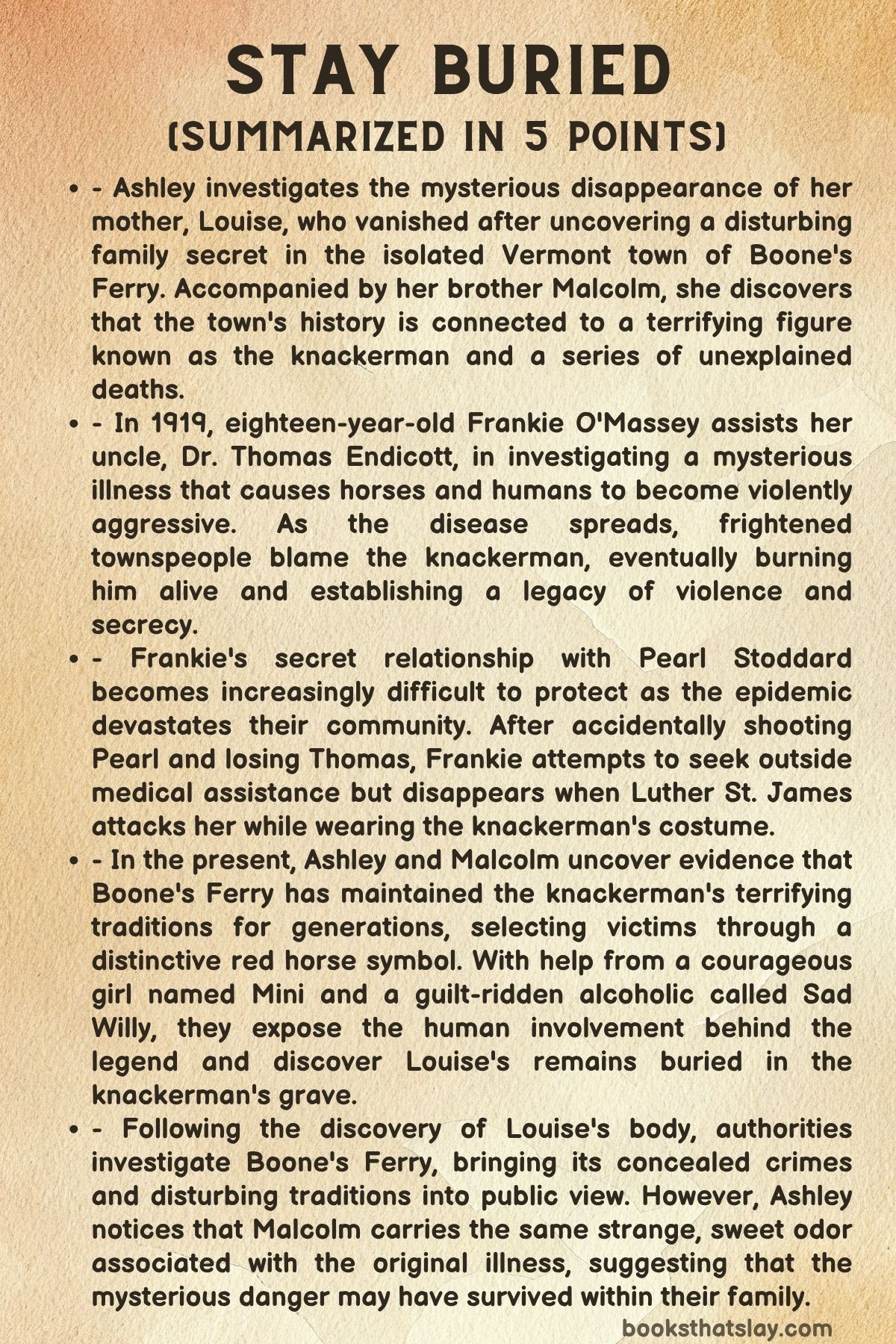
Set in the isolated Vermont town of Boone’s Ferry, the story follows two timelines connected by a mysterious illness, violent deaths, and the legend of a figure known as the knackerman. When Ashley investigates her mother’s disappearance, she discovers that the town’s traditions conceal generations of cruelty and unexplained events. Through Ashley’s search and the experiences of a young medical apprentice named Frankie, the novel examines inherited trauma, forbidden love, collective guilt, and the terrifying consequences of allowing fear to determine who deserves to live.
Summary
In October 2014, a mysterious figure wearing a coat made from animal hides and a horse-skull mask approaches a room at the Deer Run Motel in Boone’s Ferry, Vermont. He paints a red horse symbol on the door, takes out an ancient knife, and knocks, waiting for the woman inside to answer.
Nearly two years later, Ashley is still struggling with the disappearance of her mother, Louise. Police discovered Louise’s abandoned car near a flooded river and one of her shoes downstream, leading investigators to suspect suicide.
Ashley has never accepted that explanation. Her grief contributed to a psychological breakdown that interrupted her medical career, and she continues experiencing disturbing visions of her mother’s mutilated body.
While searching through her grandmother’s belongings, Ashley discovers a letter Louise wrote from Boone’s Ferry shortly before disappearing. In it, Louise claims to have uncovered a family secret that her mother deliberately concealed.
Ashley’s grandmother reacts with terror when confronted with the letter. She insists that Ashley must never visit Boone’s Ferry, but refuses to explain why.
Soon afterward, the elderly woman dies, leaving Ashley and her younger brother, Malcolm, an inheritance that includes a previously undisclosed house in Boone’s Ferry. They also discover old journals belonging to Frankie O’Massey, a young woman who lived there in 1919.
The journals reveal a disturbing history.
In March 1919, eighteen-year-old Frankie works as a medical apprentice to her uncle, Dr. Thomas Endicott. Their lives change when they are summoned to investigate five horses that have inexplicably become violent and attacked one another.
The surviving mare displays unnatural aggression, bloody froth, yellowed eyes, and a sickeningly sweet odor. Although Thomas initially suspects rabies, the disease progresses too rapidly to fit his diagnosis.
Within a day, every horse in Boone’s Ferry becomes infected and must be destroyed. The illness soon appears among humans, whose behavior becomes similarly violent and unpredictable.
Among the afflicted is the town’s knackerman, a man responsible for collecting and disposing of dead animals. He attacks Thomas inside the doctor’s surgery before collapsing and apparently dying.
The following morning, however, his body has disappeared.
The event intensifies the community’s belief that supernatural forces are responsible for the outbreak. Thomas continues searching for a medical explanation, while the townspeople increasingly favor religious interpretations and violent solutions.
Frankie is also struggling with a private conflict.
She is secretly in love with Pearl Stoddard, a young woman she has known since childhood. Because their relationship would be condemned by the community, they meet in an abandoned house and imagine eventually escaping together.
Pearl wants them to leave Boone’s Ferry immediately, but Frankie feels obligated to remain with Thomas and continue her medical training.
Their plans become increasingly uncertain as the disease spreads.
Pearl’s mother, Clarice, becomes violently ill and attacks her husband, Benjamin. Thomas and Frankie investigate, but Clarice disappears into the surrounding wilderness.
When her body is discovered, the doctor determines that she died from a gunshot wound rather than the illness. Someone has begun killing the infected.
Benjamin subsequently develops symptoms and attacks Thomas, biting him during the struggle. Luther St. James shoots Benjamin, apparently ending the immediate danger.
Thomas realizes that he may now be infected.
Meanwhile, the town’s fear of the knackerman becomes uncontrollable. Residents capture him, chain him inside Luther’s barn, and prepare to burn him alive.
Thomas opposes the execution, arguing that the man’s condition must be investigated rather than condemned as demonic possession. His objections fail, and the townspeople burn the prisoner.
When they recover his remains, they discover that the charred skeleton appears to possess a horse’s skull instead of a human head.
The discovery leaves Frankie unable to explain what she has witnessed.
Before these events reach their conclusion, Frankie accidentally shoots Pearl while attempting to defend herself against someone she believes is pursuing her. Pearl survives emergency surgery, but the incident leaves Frankie devastated.
Thomas, recognizing that his own condition is worsening, prepares his medical notes and specimens for preservation. He instructs Frankie to hide them somewhere the townspeople will never search.
She buries the evidence in the knackerman’s newly prepared grave.
When Frankie returns home, she discovers that Thomas has died by suicide. He has left instructions for her to travel to Boston, seek assistance from another physician, and bring medical experts to investigate the outbreak.
Frankie prepares to leave, promising Pearl that she will return and that they will eventually build a life together.
Her journey ends before she can escape the valley.
A figure wearing the knackerman’s costume attacks her in the woods. When the mask shifts, Frankie recognizes a scar belonging to Luther St. James.
She realizes that the supposedly supernatural figure is being impersonated by someone she knows.
Frankie’s disappearance leaves Pearl waiting for a reunion that never occurs. Decades later, Pearl remains unmarried, continuing to imagine the ordinary domestic happiness they might have shared.
In the modern timeline, Ashley and Malcolm arrive in Boone’s Ferry to investigate their mother’s disappearance.
The settlement appears strangely detached from contemporary life. Its residents are suspicious of outsiders, its buildings preserve an old-fashioned atmosphere, and information about its history is difficult to obtain.
They discover that the town hall burned down on October 15, 2014, one day after Louise wrote her mysterious letter.
Ashley suspects that the destruction of the archives and her mother’s disappearance may be connected.
The siblings meet Josephine Banks, the elderly tenant of their grandmother’s house. Josephine welcomes them and shows them her collection of handmade dolls representing people from the town’s history.
Among the figures is one depicting the knackerman.
Josephine describes him as a legendary figure associated with the town’s misfortunes, but her explanations do little to satisfy Ashley.
Elsewhere, a young girl named Mini Fitzpatrick becomes involved in the mystery.
After witnessing a frightening figure riding a white horse, Mini discovers that her family’s front door has been marked with the red horse symbol.
Her parents immediately understand that they have been selected by the knackerman.
The town responds by shunning the family, leaving them isolated and terrified.
Mini subsequently finds a gold pocket watch engraved with the initials TEC. She learns that it originally belonged to Thomas Endicott and was later given to Frankie.
When she shows the watch to Jack St. James, a local man associated with the Deer Run Motel, he reacts furiously and orders her to remain silent.
Mini begins suspecting that the knackerman is not an immortal creature but someone living among them.
Meanwhile, Ashley and Malcolm discover the same red horse symbol painted on their motel door.
Their investigation becomes increasingly dangerous when they learn that Louise received an identical mark before disappearing.
A local woman named Cheryl admits that she warned Louise to leave Boone’s Ferry. Louise refused, apparently believing that her genealogical discoveries were too important to abandon.
Ashley also meets Will O’Brien, known as Sad Willy, an alcoholic haunted by his wife’s death.
Willy knows the truth about the town’s traditions. He believes that the knackerman’s power has survived because residents repeatedly participate in violence while concealing their collective responsibility.
When Ashley asks who the knackerman really is, Willy tells her that everyone is the knackerman.
His words echo those spoken by Benjamin Stoddard in 1919.
Ashley’s discoveries become more alarming when she and Malcolm visit Josephine again.
Josephine locks them in her basement, where Ashley discovers Louise’s leather bag and research materials.
The documents reveal that Louise had questioned the family history surrounding Thomas Endicott. A DNA test apparently challenged the accepted account of her ancestry.
Louise had subsequently investigated the events of 1919, discovering that the outbreak involved extraordinary symptoms and that frightened residents had killed suspected victims.
Ashley also finds unfinished dolls resembling herself and Malcolm.
The siblings escape through a basement window and reach the town church, where they discover a hidden shrine devoted to the knackerman.
Inside a glass case lies a skeleton with a horse’s skull.
A historical portrait of the original knackerman bears an extraordinary resemblance to Malcolm, suggesting that their family connection to the town extends beyond the history they believed they knew.
Ashley also finds Louise’s cameo ring among the offerings surrounding the remains.
The discovery confirms that her mother became involved in the town’s secret rituals.
Josephine and other residents confront the siblings, accusing them of desecrating the shrine. Their hostility reveals that the knackerman’s legend has developed into a system of collective obedience and sacrifice.
Meanwhile, Mini independently discovers the knackerman’s costume in an abandoned cellar.
There she encounters Willy, who has come to challenge the town’s traditions.
He explains that identifying the person wearing the mask will not be sufficient. The role has survived generations because the community continues giving it authority.
Together, Willy and Mini devise a plan.
Willy puts on the costume and paints the red horse symbol on numerous doors throughout town. By marking many houses, he disrupts the practice of selecting isolated victims.
He intends to reveal himself and demonstrate that the feared figure is an ordinary human being.
He also begins digging in the knackerman’s grave, hoping to bury the tradition permanently.
Before he can complete his plan, townspeople learn that the knackerman has appeared in the cemetery with Mini.
Ashley, Malcolm, and the assembled residents rush toward the graveyard.
Cheryl arrives carrying a shotgun and shoots the masked figure.
Mini immediately reveals that the man inside the costume is Willy.
Ashley recognizes that his injuries are fatal. Willy dies while attempting to destroy the tradition that has consumed his life.
His death demonstrates the terrible consequences of a community conditioned to respond to its fears with violence.
The open grave, however, contains another devastating revelation.
Ashley discovers the remains of a woman with dark curly hair, a severely damaged skull, and a familiar camel-colored coat.
She recognizes her mother.
After two years of searching, Ashley has finally discovered what happened to Louise.
The authorities subsequently investigate Boone’s Ferry, exposing the crimes associated with its secret traditions. The town attracts national attention, and the disappearance that once appeared to be a suicide becomes part of a much larger criminal investigation.
Ashley and Malcolm return home carrying a clearer understanding of their family’s past.
Yet the mystery is not entirely resolved.
As Malcolm prepares to leave for a short trip, Ashley notices a strange smell coming from him.
It is sweet and rotten, resembling decaying apples.
Ashley remembers that Frankie described the same odor in the animals and people afflicted by the mysterious illness in 1919.
She calls after Malcolm, suddenly fearing that something associated with the original outbreak may have survived within their family.
He has already left.
The novel closes with the disturbing possibility that uncovering the town’s human crimes has not eliminated the older, unexplained danger.
Characters
Ashley
Ashley is the central protagonist of the contemporary storyline, a woman whose search for her missing mother becomes an investigation into the violent history of her ancestors. Her determination is inseparable from grief, guilt, and a powerful need to understand what happened to Louise.
In Stay Buried, Ashley’s greatest difficulty is knowing whether she can trust her own perceptions. Following her mother’s disappearance, she experienced horrifying apparitions that contributed to a psychiatric hospitalization and disrupted her medical career.
Her history makes her unusually vulnerable when she encounters disturbing events in Boone’s Ferry. She cannot immediately determine whether the apparitions, strange coincidences, and apparent supernatural occurrences are genuine or symptoms of another psychological crisis.
Nevertheless, Ashley refuses to dismiss every extraordinary experience simply because she has previously been unwell. Her investigation demonstrates her growing ability to distinguish between uncertainty and evidence.
Her relationship with Malcolm reveals another dimension of her character. Although she occasionally conceals information from him, she values his companionship and gradually learns to accept his assistance rather than carrying her grief entirely alone.
Ashley’s discovery of Louise’s remains provides an answer to the question that has dominated her life. Yet the final suggestion that Malcolm may be affected by the historical illness prevents her journey from becoming a straightforward movement from uncertainty to peace.
She emerges as a character defined by persistence, intellectual curiosity, and the painful recognition that understanding the past does not guarantee safety in the present.
Frankie O’Massey
Frankie is the central figure of the historical storyline, an eighteen-year-old medical apprentice whose intelligence and professional ambitions distinguish her from the expectations imposed upon women in her community.
Her relationship with Dr. Thomas Endicott gives her access to medical training that would otherwise be difficult to obtain. She approaches illness with curiosity and discipline, carefully recording symptoms even when the events around her become terrifying.
In Stay Buried, Frankie’s development is shaped by the conflict between scientific inquiry, personal loyalty, and her desire for an independent future. She wants to become a physician, protect the people she loves, and preserve the life she has built in Boone’s Ferry.
Her relationship with Pearl exposes the limitations of these ambitions. Frankie loves Pearl deeply but initially struggles to imagine abandoning her apprenticeship and family to establish a life elsewhere.
The epidemic forces her to confront the impossibility of protecting everyone through personal sacrifice.
Her accidental shooting of Pearl becomes the clearest expression of this conflict. In attempting to defend herself from a perceived threat, Frankie wounds the person whose safety matters most to her.
Yet she continues acting courageously, assisting with Pearl’s operation, preserving Thomas’s medical evidence, and preparing to seek outside help.
Her disappearance at Luther’s hands gives her story its tragic conclusion. The future she imagines remains unrealized, while the evidence she attempts to protect becomes part of the mystery inherited by later generations.
Frankie represents the struggle to maintain compassion and intellectual independence within a community increasingly governed by fear.
Malcolm
Malcolm is Ashley’s younger brother and her closest companion during the investigation into Louise’s disappearance. His initial skepticism provides an important counterbalance to Ashley’s determination.
He remembers the psychological crisis that followed their mother’s disappearance and worries that returning to the mystery could destabilize his sister. His concern sometimes makes him appear dismissive, but his actions consistently reveal his affection for her.
Malcolm prefers practical solutions and attempts to imagine a constructive future for their inherited property. His interest in converting Josephine’s house into a bed-and-breakfast contrasts with Ashley’s exclusive focus on uncovering the past.
However, Malcolm is not immune to the town’s inexplicable influence.
He recognizes the inherited house from recurring dreams and experiences an unsettling resemblance to the historical knackerman’s portrait. These details undermine his confidence that everything can be explained through ordinary reasoning.
His willingness to defend Ashley during their confrontation with the townspeople demonstrates his courage and loyalty.
The novel’s ending transforms his character into a source of renewed uncertainty. The strange odor Ashley notices suggests that Malcolm may be connected to the original illness in a way neither sibling understands.
His role therefore extends beyond that of a protective brother. He becomes a living reminder that family history may contain dangers that cannot be eliminated simply by exposing concealed crimes.
Dr. Thomas Endicott
Thomas is Frankie’s uncle, medical mentor, and one of the principal representatives of scientific reasoning in the historical narrative. His commitment to treating patients remains strong even when the community begins abandoning ordinary standards of compassion.
In Stay Buried, Thomas’s professional identity places him in direct conflict with residents who interpret the outbreak as divine punishment or demonic possession.
He initially suspects rabies but refuses to preserve that diagnosis once the evidence contradicts it. His willingness to reconsider his assumptions establishes him as a physician guided by observation rather than professional pride.
Thomas also demonstrates a strong sense of moral responsibility. He treats the knackerman despite the man’s social position and attempts to prevent his execution.
His relationship with Frankie is particularly important. He encourages her medical ambitions, values her observations, and trusts her with responsibilities that others might deny a young woman.
His affection for Margaret and concern for their unborn child reveal the personal cost of his professional obligations.
When Benjamin bites him, Thomas confronts the possibility that he may become dangerous to the people he loves. His decision to take his own life reflects his fear of losing control and harming others.
Before dying, he preserves his medical evidence and entrusts Frankie with completing his work.
Thomas’s legacy is therefore both personal and intellectual. He leaves behind a model of compassionate medical practice, even though the town’s secrecy prevents his discoveries from immediately helping future generations.
Pearl Stoddard
Pearl is Frankie’s childhood friend and secret lover, a young woman whose desire for an openly shared life contrasts with Frankie’s attachment to her responsibilities in Boone’s Ferry.
She recognizes the limitations imposed upon their relationship and refuses to treat secrecy as a permanent solution.
Pearl proposes leaving town and establishing a life somewhere their relationship can exist without constant fear of exposure. Her suggestion that Frankie present herself as a man reflects the extreme adjustments required to escape social condemnation.
Her determination is not simply romantic idealism. She understands that remaining in Boone’s Ferry means surrendering control over their future to people who would reject their relationship.
Pearl’s loyalty becomes especially apparent during the epidemic.
Despite the violence surrounding her family, she continues trusting Frankie and planning their reunion.
When Frankie accidentally shoots her, Pearl survives a life-threatening injury. The incident places their future in even greater uncertainty, but it does not erase their emotional attachment.
The later account of Pearl’s life reveals the enduring consequences of Frankie’s disappearance.
She never marries, although another man repeatedly proposes to her. Instead, she continues imagining the domestic life she and Frankie hoped to share.
Her character demonstrates how a disappearance can shape the emotional existence of someone left behind, even when the immediate violence has ended.
Margaret Endicott
Margaret is Thomas’s wife, Frankie’s aunt, and an important source of emotional stability within the Endicott household.
Her practical care for the family is accompanied by beliefs in divination, protective customs, and forms of knowledge that Thomas tends to dismiss.
This difference does not make Margaret irrational. Rather, it reflects a broader division between scientific explanations and traditional understandings of danger within the community.
In Stay Buried, Margaret occupies a particularly vulnerable position because she is pregnant during the outbreak. Thomas’s determination to send her away arises from his fear that the disease could destroy both her life and their unborn child’s.
Her reluctance to leave demonstrates her devotion to her family and to the patients who depend upon their household.
Margaret also appears connected to mysteries that Thomas has not fully explained. The knackerman’s apparent familiarity with her suggests that her past contains information the family has concealed.
Her eventual return to Boone’s Ferry with her daughter, Charlotte, confirms that she survives the outbreak but never receives the answers she expects about Frankie.
Margaret’s role illustrates how survival can coexist with enduring uncertainty. She escapes the immediate catastrophe while carrying forward a family history marked by loss and unanswered questions.
Louise
Louise is Ashley and Malcolm’s mother, whose disappearance initiates the contemporary mystery.
Although she is largely absent from the immediate action, her investigation and the consequences of her decisions influence nearly every major development.
Louise becomes interested in her ancestry after discovering inconsistencies in the accepted family history. A DNA test challenges what she believes about Thomas Endicott and leads her to investigate Boone’s Ferry.
Her determination resembles Ashley’s. Both women are unwilling to accept incomplete explanations when evidence suggests that important information has been deliberately concealed.
Louise’s decision to remain in Boone’s Ferry despite Cheryl’s warning demonstrates the strength of her commitment to discovering the truth.
Her belongings eventually reveal that she uncovered evidence of the 1919 outbreak, the persecution of infected residents, and the town’s suppressed history.
The discovery of her remains establishes the terrible consequences of that investigation.
Louise also remains psychologically present through Ashley’s disturbing apparitions. Whether these experiences are supernatural communications or manifestations of grief is not fully resolved by the supplied account.
Her character embodies the persistence of family secrets and the costs endured by those who attempt to expose them.
Josephine Banks
Josephine is the elderly tenant of the house Ashley and Malcolm inherit from their grandmother. Her initial hospitality conceals a deep commitment to Boone’s Ferry’s disturbing traditions.
She welcomes the siblings, encourages Malcolm’s interest in the property, and offers information about the town’s history.
Yet her apparent kindness becomes increasingly unsettling as Ashley discovers the handmade dolls representing historical and contemporary residents.
The dolls reveal Josephine’s unusual relationship with memory and identity. She preserves the community through miniature representations, assigning individual people places within a carefully maintained historical world.
Her decision to imprison Ashley and Malcolm exposes the authoritarian nature beneath her domestic appearance.
Josephine believes that the knackerman’s rituals protect Boone’s Ferry from a greater catastrophe. This belief allows her to justify the suffering of selected individuals as a necessary sacrifice.
Her devotion to the preserved skeleton further demonstrates how completely she has accepted the town’s mythology.
Josephine is frightening precisely because she does not regard herself as cruel. She believes that protecting the community requires obedience to a system that outsiders recognize as profoundly unjust.
Mini Fitzpatrick
Mini is a young resident of Boone’s Ferry whose curiosity becomes an essential force in exposing the knackerman’s secret.
Unlike many adults, she has not completely accepted the town’s explanations for its rituals.
When her family is marked, Mini witnesses firsthand how quickly familiar neighbors withdraw their support. Her parents respond with helpless fear, while she continues searching for information.
The gold pocket watch provides her with a connection to the town’s history.
Her investigation of Jack St. James and the abandoned knackerman property demonstrates remarkable initiative, although her curiosity frequently places her in danger.
Mini’s discovery of the costume undermines the distinction between supernatural legend and human participation.
Her partnership with Willy is particularly significant. Their different ages and experiences allow them to challenge the same tradition from contrasting perspectives.
Mini possesses the courage to question what she has been taught, while Willy understands the historical consequences of unquestioning obedience.
Her distress when Cheryl shoots Willy reveals the emotional cost of their attempt to expose the truth.
Mini represents the possibility that younger generations can challenge inherited customs rather than automatically perpetuating them.
Will O’Brien, or Sad Willy
Willy is one of the novel’s most morally complicated characters. His alcoholism, grief, and reputation as a local failure conceal his intimate knowledge of Boone’s Ferry’s destructive traditions.
The death of his wife, Anna, has left him consumed by guilt.
He recognizes that the town’s rituals have caused immense suffering, yet his dependence on alcohol repeatedly prevents him from acting decisively.
His conversations with Ashley establish that he understands the knackerman as something larger than an individual murderer.
When he declares that everyone is the knackerman, he identifies collective participation as the source of the legend’s enduring power.
Willy’s relationship with Mini finally gives him an opportunity to transform remorse into action.
By wearing the costume and marking numerous houses, he attempts to demonstrate that the figure is human and that the community’s system of selection can be disrupted.
His decision is courageous but dangerous.
Cheryl’s fatal shooting shows that the terror surrounding the costume cannot be dissolved simply by revealing the person inside it.
Willy’s death becomes the ultimate expression of his struggle to correct the past. He succeeds in exposing the destructive nature of the town’s beliefs, but he does not survive to witness their collapse.
Luther St. James
Luther is a local farmer whose responses to the epidemic reveal how fear can become a justification for cruelty.
His first appearance involves the destruction of his infected horses, an action that initially appears necessary to prevent further suffering.
As the illness spreads, however, Luther increasingly favors violence over medical investigation.
He challenges Thomas’s authority, supports the persecution of the knackerman, and shoots Benjamin after the infected man attacks the doctor.
His willingness to kill reflects a growing conviction that extraordinary danger permits extraordinary brutality.
The revelation that Luther wears the knackerman’s costume when attacking Frankie exposes the difference between his professed desire to protect the community and his willingness to perpetuate its terror.
His distinctive scar allows Frankie to recognize him beneath the mask.
Luther consequently represents the transformation of collective panic into deliberate human violence. His actions also establish a connection between the original catastrophe and the rituals maintained by later generations.
Benjamin Stoddard
Benjamin is Pearl’s father and an influential member of Boone’s Ferry whose personal tragedy becomes closely connected to the outbreak.
After Clarice attacks him, Benjamin recognizes that he may have contracted the illness.
Rather than wait for symptoms to develop, he asks Thomas to observe him and restrain him if necessary.
His request demonstrates an unusual willingness to place the safety of others above his own freedom.
Benjamin also appears aware of Frankie’s relationship with Pearl. His acknowledgment of their connection introduces another source of uncertainty into Frankie’s already dangerous circumstances.
When his illness develops, Benjamin loses control and attacks Thomas.
His declaration that everyone is the knackerman becomes one of the novel’s central mysteries, connecting the historical outbreak to the contemporary rituals.
His death demonstrates the disease’s capacity to destroy individual identity and turn a person who hopes to protect others into a threat.
Clarice Stoddard
Clarice is Benjamin’s wife and Pearl’s mother, one of the first townspeople whose illness exposes the disease’s capacity to produce violence within ordinary households.
Her attack on Benjamin transforms the outbreak from a public emergency into an intimate family catastrophe.
Her subsequent disappearance prompts a search that reveals the community’s increasing willingness to kill suspected victims.
When Thomas examines her body, he discovers that she died from a gunshot wound.
Clarice’s fate is particularly disturbing because the immediate cause of her death is human violence rather than the mysterious infection.
She represents the vulnerability of people whose suffering makes them objects of communal fear.
Her death also places Pearl in a position of devastating uncertainty, showing how the outbreak destroys families even before its full nature becomes known.
Jack St. James
Jack is a contemporary resident whose involvement with the knackerman’s costume connects the modern rituals to the historical events.
His association with the Deer Run Motel places him near Ashley and Malcolm’s investigation.
His significance becomes clearer when Mini shows him Thomas Endicott’s pocket watch.
Jack’s furious reaction and demand for silence suggest that he knows how the object came into the knackerman’s possession.
His participation in the confrontation at the church further establishes his commitment to the town’s established practices.
Jack demonstrates how ordinary residents can preserve a tradition of violence while appearing to lead unremarkable lives.
His character also illustrates the continuity between generations. The surname St. James connects him to a family already associated with the historical catastrophe, reinforcing the persistence of Boone’s Ferry’s concealed past.
Cheryl
Cheryl is a local woman whose willingness to speak with Ashley distinguishes her from residents who refuse to discuss the knackerman.
She admits that she encountered Louise and warned her to leave Boone’s Ferry.
Her disclosure provides Ashley with important confirmation that her mother understood she was in danger.
Cheryl’s fear of being overheard demonstrates the social pressure imposed upon residents who question the town’s practices.
Nevertheless, she eventually attempts to confront the system directly.
When she sees the masked figure in the cemetery, she shoots him, believing that eliminating the knackerman will end the terror.
Her action instead kills Willy.
Cheryl’s tragedy lies in reproducing the same violent response she hopes to oppose. Although she rejects the town’s continuing submission to the legend, she remains influenced by its habit of treating perceived threats as enemies to be destroyed.
Ashley and Malcolm’s Grandmother
The siblings’ grandmother serves as a crucial link between their immediate family and the concealed history of Boone’s Ferry.
Her refusal to discuss the town initially appears to arise from fear, but her possession of Frankie’s journals and the inherited house suggests a much deeper connection.
She deliberately conceals information about Louise’s investigation and attempts to destroy historical documents.
These actions make her an ambiguous figure.
Her secrecy may reflect a desire to protect her descendants, but it also prevents them from understanding the danger surrounding their family.
Her death leaves Ashley and Malcolm with an inheritance that is both material and psychological.
The house, journals, and surviving letters become the means through which the siblings uncover the past.
Her character demonstrates how attempts to protect descendants through silence can leave them vulnerable to dangers they have not been taught to recognize.
The Knackerman
The knackerman is both a historical individual and a symbolic identity that survives across generations.
Originally associated with the disposal of dead animals, he occupies a marginal position in Boone’s Ferry’s social hierarchy.
During the 1919 outbreak, his unusual behavior and apparent resurrection make him a convenient target for frightened residents.
His execution establishes the foundation of the town’s continuing guilt.
The discovery of a horse skull among his remains introduces a supernatural uncertainty that the narrative never completely eliminates.
Over time, the knackerman becomes an identity that different individuals can assume through the costume.
The figure therefore exists simultaneously as a possible supernatural presence, a human impersonation, and a mechanism through which the community enforces obedience.
His greatest power comes from the town’s willingness to believe that his authority justifies the suffering of selected individuals.
Themes
Collective Fear and the Normalization of Violence
Fear transforms Boone’s Ferry from a community facing an unexplained medical emergency into a society willing to sacrifice its own residents. The initial outbreak creates legitimate danger, but the townspeople’s responses gradually become as destructive as the illness itself.
When horses begin attacking one another, destroying the infected animals appears to be a practical response. Once similar symptoms emerge among humans, however, the community begins abandoning the distinction between treating illness and punishing those who suffer from it.
Clarice Stoddard’s death provides an early example of this transformation. Her gunshot wound reveals that someone has decided killing a suspected victim is preferable to confronting the uncertainty surrounding the disease.
The execution of the knackerman establishes the consequences of this mentality on a larger scale.
Thomas argues for medical investigation, but his appeals cannot overcome the crowd’s conviction that violence will restore safety. Their willingness to burn the prisoner demonstrates how collective agreement can make an act of cruelty appear necessary.
In Stay Buried, the consequences extend across generations.
The contemporary community continues selecting and isolating individuals through the red horse symbol, treating their suffering as an acceptable price for collective protection.
Willy’s death exposes the persistence of this response. Cheryl attempts to end the tradition by shooting the masked figure, only to kill the man who is trying to challenge it.
The novel ultimately presents collective fear as a force capable of making violence seem ordinary, particularly when responsibility is distributed among an entire community.
Inherited Secrets and the Burden of Family History
Ashley inherits more than property and family documents when her grandmother dies. She also inherits the consequences of decisions made by people whose lives ended long before she was born.
Her mother’s disappearance initially appears to be an isolated tragedy. The discovery of Louise’s letter, however, reveals that the circumstances surrounding her death cannot be understood without examining the family’s earlier history.
The old journals connect Ashley to Frankie O’Massey and the outbreak of 1919.
Their survival demonstrates that the past has never entirely disappeared, even though successive generations attempted to suppress it.
Ashley’s grandmother preserves the documents while simultaneously concealing their contents. Her contradictory actions suggest that knowledge of the past can become both a responsibility and a source of terror.
Louise attempts to resolve the contradictions within the family history through genealogical research.
Her investigation exposes disturbing connections between ancestry, the knackerman, and the violence committed in Boone’s Ferry. Her disappearance then creates another secret that Ashley must confront.
The discovery of Louise’s remains brings a measure of certainty, but it does not eliminate the consequences of the family’s history.
Malcolm’s resemblance to the historical knackerman suggests that ancestry carries significance beyond recorded names and relationships.
The final appearance of the strange odor associated with the 1919 illness makes this possibility even more disturbing.
Family history emerges as something that cannot be escaped through silence. Concealing painful information may postpone confrontation, but it also deprives later generations of the knowledge needed to understand their circumstances.
Love, Loyalty, and the Cost of Sacrifice
Frankie and Pearl’s relationship reveals the emotional consequences of living in a community where personal identity must be concealed to preserve social acceptance.
Their love develops in private spaces, away from the scrutiny of Boone’s Ferry’s residents. The abandoned Ayers house becomes a place where they can imagine an ordinary future together.
Yet their hopes remain constrained by expectations that neither woman can easily escape.
Pearl recognizes that their relationship cannot remain secret indefinitely. Her proposal that they leave town reflects her desire for a life defined by mutual commitment rather than constant concealment.
Frankie shares that desire but remains attached to Thomas, Margaret, and her medical ambitions.
Her obligations become more demanding as the epidemic spreads.
She cannot abandon her uncle while he struggles to understand the illness, but remaining in Boone’s Ferry exposes Pearl to increasing danger.
The accidental shooting makes this conflict especially painful. Frankie’s attempt to protect herself injures the person she most wants to protect, demonstrating how violence can destroy the security that love promises.
Her subsequent departure represents another sacrifice.
She leaves Pearl behind because she believes seeking medical assistance is necessary to save the community. Her intention is to return, but Luther’s attack prevents their reunion.
Pearl’s later reflections reveal the enduring consequences of this separation.
Her imagined domestic life with Frankie consists of ordinary companionship rather than extraordinary achievements. The simplicity of these hopes emphasizes how much was taken from them.
Their relationship illustrates the difference between sacrifices freely chosen for love and losses imposed by a society unwilling to accept that love.
Science, Superstition, and the Uncertainty of Death
The mysterious illness challenges the boundaries of medical knowledge throughout the novel. Its symptoms resemble recognizable diseases, but its progression and consequences repeatedly resist conventional explanation.
Thomas initially approaches the outbreak through diagnosis and observation.
He compares symptoms, examines patients, and documents abnormalities, demonstrating his conviction that even frightening phenomena deserve careful investigation.
Frankie shares his commitment but remains more willing to acknowledge the possibility that some events cannot be explained by their existing knowledge.
The disappearance of the knackerman’s apparently dead body creates an especially difficult problem.
Thomas has pronounced him dead, yet he vanishes from the surgery. Benjamin’s apparent ability to remain conscious without a detectable heartbeat introduces another contradiction.
These experiences challenge the distinction between life and death without establishing a complete supernatural explanation.
The townspeople respond differently.
Rather than investigating uncertainty, they interpret it as evidence of demonic possession and use that interpretation to justify violence.
In Stay Buried, this conflict is not resolved through a simple rejection of either science or the supernatural.
The discovery that human beings wear the knackerman’s costume explains many of the supposedly supernatural events. It demonstrates how deception, collective belief, and ritual can create the appearance of an unstoppable creature.
Yet the original illness remains unexplained.
The horse-headed skeleton and the strange odor surrounding Malcolm preserve the possibility that something genuinely extraordinary exists beneath the town’s manufactured mythology.
The novel consequently distinguishes between acknowledging the limits of knowledge and surrendering judgment to superstition.
Thomas and Frankie continue searching for evidence because uncertainty demands investigation. The townspeople, by contrast, transform uncertainty into certainty about whom they should fear and punish.
The unresolved ending preserves this tension, suggesting that uncovering human deception does not necessarily explain every mystery associated with the natural world, death, or the family’s disturbing inheritance.