The Iron Hex Summary, Characters and Themes
The Iron Hex by Victoria S. Walsh is a fantasy novel centered on memory, political revolution, outlawed magic, personal guilt, and the danger of blind loyalty.
Its story follows Eira, a potion-maker who discovers that the quiet identity she has lived with for three years was created after the loss of nearly her entire past. Her search for those missing memories links her to a fugitive commander, a hidden princess, and the ruler responsible for Astra’s oppressive new order. Alongside her journey, an ambitious knight begins questioning the empire she once served without reservation, exposing a much larger conflict involving forbidden magic, human experimentation, and approaching war. It’s the 1st book of the Iron Hex Trilogy.
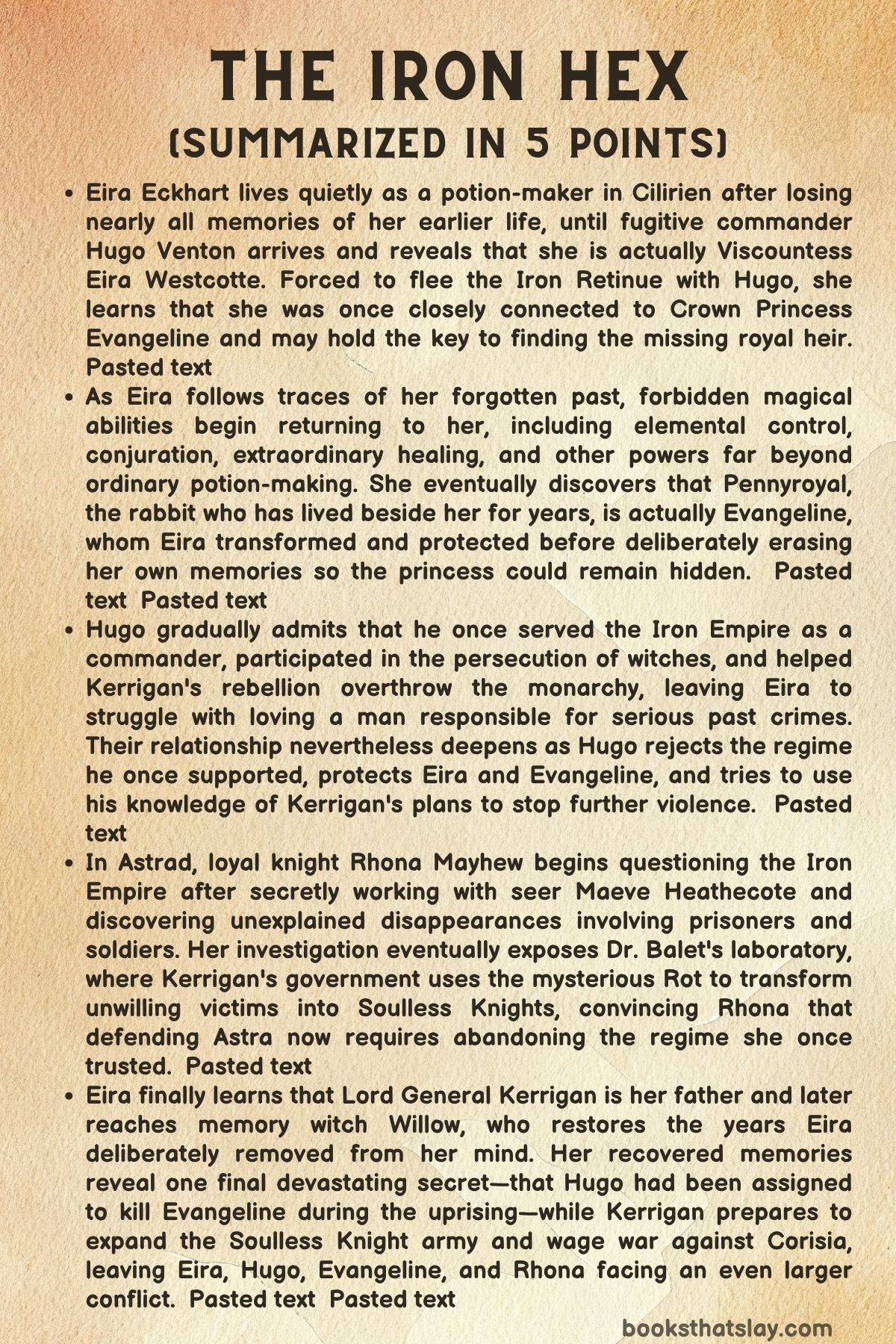
Summary
The Iron Hex begins with Lord General Kerrigan ordering a group of trusted Iron Retinue knights to hunt down Commander Hugo Venton, who has deserted his post and stolen information of great importance. Kerrigan considers Hugo a traitor and demands not only his death but the deaths of anyone who shelters him, establishing the brutal authority of the Iron Empire.
Far from the capital, Eira Eckhart runs the Potions Patisserie in Cilirien. Three years earlier, she supposedly suffered a fall that destroyed nearly all memories of her previous life, leaving her with no clear knowledge of who she had been before becoming a potion-maker.
Eira lives carefully because the Iron Empire has outlawed most forms of magic. Although potions and some alchemy remain permitted, witches with other abilities have been hunted and executed, forcing anyone with illegal powers to hide.
Eira herself secretly possesses abilities beyond potion-making. She can summon Beatrice, a magical hand that assists her around the house, although she refuses to think too deeply about what this means for her true magical nature.
Her quiet routine changes when Hugo enters her shop. He claims to need the services of a powerful witch, but his questions suggest that he knows Eira is capable of more than she admits.
Their interaction becomes stranger because Hugo appears to know something about her while Eira genuinely considers him a stranger. Before he can explain himself, the Iron Retinue arrives in Cilirien, forcing Hugo and Eira to escape together.
Hugo warns that because soldiers saw Eira with him, she will now be considered an accomplice. Eira reluctantly flees with him, bringing her rabbit Pennyroyal along without realizing how important the animal truly is.
As they travel, Hugo becomes increasingly confused by Eira’s inability to recognize him. Eventually, after Eira admits that her memories stop more than three years earlier, Hugo reveals that her identity is false.
She is really Eira Westcotte, a viscountess from one of Astra’s important noble families. Hugo once served her household, and Eira had been one of Crown Princess Evangeline De Clare’s closest friends.
The revelation becomes even more serious because Evangeline disappeared after the uprising that placed Kerrigan and the Iron Empire in power. Hugo believes Eira escaped with the princess and may be the only person who knows where the surviving heir went.
Their journey is interrupted by Saoirse, a former Iron Retinue knight who has been transformed into something unnatural. Her extreme strength, resistance to injury, and barely human physical condition reveal that secret experiments are taking place inside the empire.
Eira kills Saoirse to save Hugo and then treats Hugo’s injuries. His wounds heal at an impossible rate, suggesting that Eira unconsciously used powerful healing magic rather than ordinary medicine.
Meanwhile, Sir Rhona Mayhew serves Kerrigan with complete devotion. Rhona believes the Iron Empire gave her opportunities that the old social order denied her, particularly the chance to become a respected knight despite the barriers she previously faced.
Her certainty begins changing after she meets Lady Maeve Heathecote. Maeve appears to predict the near death of Lord Wilmer, leading Rhona to suspect that she is secretly a seer.
Instead of reporting Maeve, Rhona investigates privately. Maeve eventually confirms that she possesses forbidden prophetic magic and explains that her visions repeatedly involve Rhona and a danger threatening Astra.
Rhona convinces herself that working with Maeve is justified because the visions may protect the empire. Yet the decision represents her first deliberate rejection of the laws she once enforced unquestioningly.
Eira and Hugo continue tracing the path Eira apparently followed after the rebellion. In Fallstead, an innkeeper recognizes Eira from three years earlier and remembers that she traveled with another young woman whose description matches Evangeline.
This independent confirmation makes Eira accept that Hugo has been telling the truth. Her vanished aristocratic identity, her connection to the royal family, and the mystery of her missing memories can no longer be dismissed.
As Eira grows closer to Hugo, their former emotional bond begins reappearing in a new form. Hugo admits only fragments of their previous relationship because Eira asks him not to overwhelm her with stories about who she used to be.
She wants her current personality to remain meaningful rather than being treated as an incomplete replacement for Viscountess Eira Westcotte. Hugo gradually accepts that recovering her past must not erase the three years she lived as Eira Eckhart.
Danger exposes more of her hidden abilities. During an ambush, Eira instinctively commands vines to restrain Iron Retinue soldiers, proving that she possesses elemental magic far beyond anything she believed possible.
Hugo then kills their trapped enemies to prevent them from reporting her powers. His willingness to use lethal force disturbs Eira and raises serious questions about what he did while serving Kerrigan.
They secretly return to Cilirien, where Eira discovers a hidden cache containing money, an Osnian pearl necklace, and a coded journal prepared before her memory loss. Hugo then admits that after the rebellion he became an Iron Retinue commander and participated in the persecution and killing of witches.
Although Eira is disturbed by his past, she recognizes that Hugo now deeply regrets what he did. Soon afterward, the greatest mystery surrounding Evangeline is unexpectedly solved when Eira and Hugo encounter a dark-haired woman whom Hugo immediately recognizes as the missing princess.
Evangeline explains that she has been beside Eira for years because Pennyroyal was never truly a rabbit. Eira used transformation magic to turn the princess into the animal so the Iron Empire could not find her.
Even more shocking, Eira herself erased her own memories. She intended the spell to last only several months so that captured truth-sense witches could not reveal Evangeline’s location, but the magic malfunctioned and left Eira without her past for three years.
Evangeline explains that Eira had always possessed an unusual range of magical abilities. Unlike most witches, who specialize in a particular form of magic, Eira could apparently use many branches of the Flow.
The group learns of a memory witch who may be able to reverse Eira’s spell. They begin traveling toward Luwha while Hugo and Evangeline debate how to confront Kerrigan and whether Corisia could become an ally.
At the same time, Rhona’s investigation uncovers increasingly disturbing evidence. Prisoners and Iron Retinue soldiers have been disappearing, strange fires and crop failures are spreading, and Dr. Balet appears connected to secret experiments involving human beings.
Rhona also witnesses Kerrigan’s brutality firsthand and realizes that he reacts violently whenever his authority is challenged. Her faith weakens further when evidence suggests that the supposedly Corisian threat may be connected to actions taken by the Iron Empire itself.
Eira, Hugo, and Evangeline eventually reach Lichton, where Hugo is recognized as one of the commanders responsible for earlier witch hunts. Rather than deny his crimes, he admits what he did.
Eira argues that regret has meaning only if Hugo spends his future acting differently. Their emotional connection finally becomes romantic after they openly acknowledge that their attraction existed before the rebellion but had once been restrained by social class.
The trio then battles Iron Retinue forces and another unnatural soldier. They learn that these creatures can survive terrible injuries but can be stopped by severe damage to the brain.
The people of Lichton unexpectedly reveal that magical resistance has survived beneath the empire’s control. Some residents still hide young witches, and they recognize Evangeline as Astra’s legitimate surviving heir when she finally reveals herself.
Hugo explains that the unnatural soldiers are part of Kerrigan and Dr. Balet’s secret program. He also possesses invasion plans and coded maps showing that Kerrigan intends to move against Corisia.
Eira notices similarities between Kerrigan’s cipher and the writing in her hidden journal. She begins decoding both, suggesting that her old intellectual skills remain even when the associated memories are inaccessible.
Rhona, meanwhile, learns the full truth. Beneath a hidden passage marked by a gilded bull, she discovers Dr. Balet’s laboratory filled with prisoners and soldiers who have been subjected to horrific experiments.
Among them is Sir Jack, a fellow knight who has been converted into one of the so-called Soulless Knights. Balet explains that the Rot, the same strange substance affecting crops, can place human bodies into a state between life and death.
These altered soldiers need little normal sustenance, feel limited pain, possess extraordinary strength, and can continue functioning despite injuries that would kill an ordinary person. Kerrigan intends to turn them into an army.
Rhona finally understands that soldiers are being deceived, abducted, and transformed without consent. The empire she believed represented fairness and merit is sacrificing its own people in the name of military power.
Near Luwha, Hugo, Eira, and Evangeline are betrayed by Carth, a man whose mother Hugo killed during the witch purges. Carth alerts Kerrigan, who arrives personally with soldiers and Soulless Knights.
During the confrontation, Kerrigan sees Eira use powerful illegal magic and recognizes her. He calls her his daughter, revealing that Lord General Kerrigan is actually Kerrigan Westcotte, Eira’s forgotten father.
The discovery devastates Eira. Kerrigan insists that many of his decisions were made for her future, even though he created a regime that executes people for abilities she secretly possesses herself.
When Evangeline is gravely wounded, Eira unleashes extraordinary power. She commands stone and iron from a nearby mine, destroying soldiers and Soulless Knights before using advanced healing magic to save Evangeline, although the princess loses part of one arm.
Kerrigan escapes because Eira cannot bring herself to kill the father she has only just remembered exists. The trio continues toward Giant’s Gate after learning that the memory witch they seek is not actually in Luwha.
There they meet Willow, who reveals herself to be the memory witch. Eira agrees to undergo the dangerous restoration process despite fearing what her returned memories might reveal about Hugo and everyone else around her.
While Eira sleeps, Hugo admits to Evangeline that he indirectly participated in King Arthel’s death. He prevented the king from escaping while Kerrigan approached, making him partly responsible for the success of the rebellion.
Evangeline refuses to forgive him, although she acknowledges that he is now fighting beside her against the empire. Hugo accepts that his future actions cannot erase what happened but may determine what kind of man he becomes.
Rhona faces her own decisive break from the regime when Maeve foresees her being taken for Balet’s experiments. Rhona overhears Balet and Commander Bartholomew confirming that she is intended to become a test subject.
She escapes Astrad and chooses to search for Evangeline in Corisia. Leaving the Iron Retinue feels like abandoning everything she once believed, but Rhona finally understands that protecting Astra may require opposing the government currently controlling it.
Eira eventually awakens with her memories restored. She remembers her childhood, her magical education, her relationship with Evangeline, the deaths within her family, her love for Hugo, and the desperate choices surrounding the rebellion.
She remembers that she transformed Evangeline and deliberately erased her own mind to keep the princess safe. She also remembers the uprising and Hugo’s involvement.
One restored memory immediately changes everything. On the night Kerrigan seized the throne, Hugo had been assigned a specific role in the rebellion: he was supposed to kill Crown Princess Evangeline.
Eira responds by drawing a dagger and confronting the man she has come to love, leaving their relationship in crisis just as the larger conflict is beginning.
Kerrigan, meanwhile, returns toward Astrad with no intention of reconsidering his actions. He decides to reveal and expand the Soulless Knight program, confront Corisia, and prepare for war while continuing to believe that everything he has done somehow protects Eira.
The novel closes with Eira, Hugo, Evangeline, and Rhona all transformed by truths that have destroyed their former assumptions. Astra now stands on the edge of open rebellion and international conflict, while Eira must decide how to reconcile love, memory, family, magic, and betrayal with the person she has become.
Characters
Eira Eckhart / Eira Westcotte
Eira is the emotional and magical center of The Iron Hex, beginning the book as a woman who has constructed a peaceful identity around an enormous absence. She believes herself to be an ordinary potion-maker, yet her instincts, magical abilities, physical skills, and reactions continually suggest that another life remains buried beneath the person she knows.
Her lost memory creates more than a mystery about her past; it raises a question about whether identity is determined by history or by present experience. Eira refuses to allow Hugo or Evangeline to treat Eira Eckhart as merely a damaged version of Viscountess Eira Westcotte, insisting that the three years she cannot connect to her earlier life are still genuinely hers.
Her magical growth parallels her psychological awakening. Conjuration, elemental control, healing, snow magic, lightning, transformation magic, and memory magic gradually reveal that she is an exceptionally powerful witch who once concealed much of her ability even from those closest to her.
Eira is also compassionate without being passive. She helps Hugo despite learning about his crimes, protects Evangeline at enormous personal cost, challenges Hugo when his decisions become controlling, and repeatedly insists on having agency over her own danger.
Her restored memories do not simply solve her problems. Instead, they force her to confront the fact that people she loves participated in terrible events, including her father’s dictatorship and Hugo’s assignment to murder Evangeline.
Hugo Venton
Hugo is one of the most morally conflicted characters in The Iron Hex because his present opposition to the empire cannot be separated from his earlier participation in its violence. He was attracted to Kerrigan’s rebellion because its promise of advancement based on merit spoke directly to a poor orphan who had lived beneath an inflexible class hierarchy.
That explanation makes his choices understandable without making them harmless. Hugo became a commander, participated in witch hunts, helped prevent King Arthel’s escape, and accepted an assignment connected to Evangeline’s assassination.
His guilt shapes nearly every part of his behavior. He does not demand forgiveness from the people of Lichton, Carth, Evangeline, or Eira, and he increasingly understands that regret matters only when followed by different actions.
His love for Eira also changes across the book. Before the rebellion, class divisions convinced him that a relationship with a viscountess was impossible, while their reunion gives him the opportunity to love Eira as an equal rather than as someone socially above him.
His greatest weakness is his tendency to withhold painful information in the belief that he is protecting Eira. Even when his motives are understandable, the habit reproduces the same loss of choice that Eira repeatedly struggles against.
Sir Rhona Mayhew
Rhona provides The Iron Hex with a second major journey of political and moral awakening. At first, she sees the Iron Empire as the institution that finally recognized her ability after the old system denied her opportunities because she was a woman.
Her loyalty is therefore deeply personal. Kerrigan does not initially appear to her simply as a ruler; he represents proof that talent can supposedly matter more than birth or gender.
Maeve gradually forces Rhona to distinguish between the ideals that attracted her to the rebellion and the actual behavior of the regime. Saving Lord Wilmer through forbidden foresight, discovering disappearing prisoners, seeing Kerrigan torture captives, and finding Balet’s laboratory all make official propaganda increasingly impossible to accept.
Rhona’s transformation is powerful because she does not change after a single revelation. She resists, rationalizes, investigates, defends Kerrigan, questions herself, and only abandons the Iron Retinue after overwhelming evidence proves that its leaders are sacrificing their own soldiers.
By the time she chooses the road toward Corisia, Rhona has redefined loyalty. She no longer believes obedience to the government and service to Astra are the same thing.
Lady Maeve Heathecote
Maeve serves as both Rhona’s emotional counterpart and one of The Iron Hex’s clearest challenges to the empire’s propaganda about witches. Her seer magic is illegal, yet she repeatedly uses it to prevent suffering rather than create it.
She is composed, observant, playful, and much more willing than Rhona to question accepted political narratives. Her visions give her knowledge, but the book avoids making her all-powerful by showing that foresight requires effort and can reveal futures that still depend on human choices.
Maeve’s relationship with Rhona develops through trust before romance. She deliberately places dangerous information in Rhona’s hands and eventually trusts her with the knowledge that could lead directly to Maeve’s execution.
Her influence is important because she does not simply tell Rhona what to believe. She encourages Rhona to examine contradictions herself and asks her to decide which people actually deserve the protection of a knight.
The fact that Maeve remains in Astrad while Rhona flees also establishes her courage. She accepts personal danger because she believes there is still work to be done inside the capital.
Crown Princess Evangeline De Clare
Evangeline is one of the strongest links between Eira’s lost past and Astra’s possible future in The Iron Hex. Officially believed dead, she survives because Eira transforms her into Pennyroyal, allowing the heir to the throne to live for years beside her closest friend without discovery.
Her life as Pennyroyal reveals remarkable endurance. She sacrifices ordinary human existence, secretly changes forms when necessary, and watches over Eira even after Eira’s failed memory spell leaves her unable to recognize their relationship.
Evangeline combines royal responsibility with humor, impatience, loyalty, and a sharp distrust of Hugo. Her arguments with him often carry comic energy, but beneath them lies genuine anger over the rebellion, her father’s death, and Hugo’s participation in Kerrigan’s rise.
Her ambition to reclaim Astra becomes increasingly clear as the story progresses. Although escape to Osnia or Corisia might offer personal safety, Evangeline is not willing to abandon the kingdom permanently.
Her injury also makes the conflict personal in a new way. Losing part of her arm during Kerrigan’s attack forces her to carry a permanent physical consequence of the struggle she intends to continue.
Lord General Kerrigan Westcotte
Kerrigan is the principal political antagonist of The Iron Hex, but his characterization is built around contradiction rather than simple cruelty. He sees himself as a reformer who replaced an unjust aristocratic order, yet the government he creates becomes authoritarian, violent, and increasingly dependent on fear.
His resentment of the monarchy came from genuine personal grievances, including economic destruction and family tragedy. Those experiences help explain his revolutionary anger, but they also become excuses through which he justifies ever more extreme acts.
His relationship with Eira exposes the deepest contradiction in his worldview. Kerrigan persecutes witches while making exceptions for potion magic partly because his wife and daughter possessed it, and he continues imagining that Eira can somehow benefit from a system that would kill her if her full abilities became known.
He repeatedly insists that his choices are made for Astra or for Eira. Yet his actions deny other people autonomy, whether he is ordering executions, manipulating Rhona’s ambitions, authorizing Balet’s experiments, or planning war with Corisia.
His inability to reconsider his beliefs after learning Eira opposes him suggests that love, in Kerrigan’s case, has become possessive. He wants to secure the future he imagines for his daughter rather than respect the future she chooses for herself.
Dr. Balet
Dr. Balet represents intellectual ability separated from moral responsibility. He approaches the Rot and the Soulless Knight experiments as technical problems, speaking about prisoners and soldiers as though their suffering matters less than the success of his research.
His most disturbing quality is his calmness. Where Kerrigan uses anger and political rhetoric, Balet describes horrifying procedures with professional pride, making the laboratory feel like the logical outcome of a system that values results above individual life.
He understands exactly what the Rot does to the human body and continues because the project gives him an opportunity to perfect something unprecedented. His behavior shows how cruelty can be committed not only through hatred but through detachment.
Commander Bartholomew
Bartholomew is important because he represents the military machinery that continues functioning beneath Kerrigan’s leadership. When Kerrigan leaves Astrad, Bartholomew assumes authority and helps preserve secrecy around the disappearances and experimental program.
His willingness to lie about Jack and participate in plans to deliver Rhona to Balet proves that institutional loyalty matters more to him than the wellbeing of soldiers under his command. He helps transform betrayal into routine procedure.
Bartholomew also represents what Rhona might have become had she never questioned the regime. Both value military advancement, but Rhona eventually places conscience above hierarchy while Bartholomew remains attached to the structure that gives him power.
Sir Jack
Jack initially appears as an ordinary enthusiastic knight and training companion for Rhona. His relative normality is precisely what makes his fate so disturbing.
He disappears after being promised advancement and later reappears in Balet’s laboratory as a Soulless Knight. He can still speak when Rhona finds him, but his altered body no longer breathes normally and most of his ordinary sensations have been destroyed.
Jack demonstrates how Kerrigan’s promise of advancement has become a trap. The same ambition that once motivated loyal soldiers is manipulated to provide experimental subjects.
Saoirse
Saoirse is one of the earliest direct signs that something deeply unnatural exists behind the Iron Empire’s military strength. Once an Iron Retinue knight, she becomes one of Balet’s experimental warriors.
Her altered body barely bleeds, survives devastating injuries, and continues fighting after losing an arm. Her attack on Hugo and Eira shows that Kerrigan is willing to use the experimental program against political enemies even before it has been perfected.
Saoirse also has a personal connection to Maeve, which makes her fate more than a military mystery. Her disappearance from Maeve’s visions becomes an early clue that the Soulless transformation produces a state outside ordinary life.
Willow
Willow is the memory witch Eira spends much of the novel trying to find. She initially appears as an elderly barmaid in Giant’s Gate, testing the travelers before revealing her identity.
Her caution reflects the dangerous reality faced by witches under the Iron Empire. She cannot openly advertise her abilities, even though those abilities offer Eira the only realistic chance of recovering her life.
Willow also provides an important distinction between removing memories and restoring them. Destruction is comparatively easy, while returning memories correctly requires patience, precision, and care.
Carth
Carth gives a human face to the victims of Hugo’s earlier crimes. His mother was killed during the witch purges, and his betrayal of Hugo in Luwha comes from a deeply personal desire for revenge.
His anger prevents the novel from treating Hugo’s change of allegiance as an automatic cancellation of the harm he caused. Carth has no obligation to forgive the man responsible for his loss.
Yet he eventually gives the group the information they need to find Willow. His decision is made for Eira rather than Hugo, allowing him to help an innocent person without surrendering his anger.
Sylvie
Sylvie complicates the assumption that every person working within the Iron Empire supports Kerrigan. Although she operates as a tracker, she is secretly a witch and deliberately withholds information that would lead to the deaths of other witches.
Her decision to kill Sanders after he proposes surrendering Eira reveals how completely her loyalty has shifted away from the government she supposedly serves. She survives by working within an oppressive system while quietly resisting it.
Sylvie also expands the picture of magical survival in Astra. Witches have not simply disappeared; some have concealed themselves inside the very institutions created to destroy them.
Asha
Asha, Sylvie’s aunt, initially appears as the eagle accompanying her before being revealed as a woman transformed through magic. Her presence reinforces the variety of magical practices that have survived despite persecution.
Her relationship with Sylvie also mirrors Eira and Evangeline’s use of transformation as protection. In both cases, magic condemned by the empire becomes a means of survival.
Esther
Esther is a truth-sense witch imprisoned by the Iron Empire and previously captured with Hugo’s involvement. Her continued imprisonment reminds both Hugo and Rhona of the human cost of the regime’s witch hunts.
She becomes especially important when Rhona begins investigating disappearing prisoners. Esther provides evidence that captives are being removed by a mysterious man in white, directing Rhona toward the larger conspiracy.
Her existence also exposes the hypocrisy of the Iron Empire. The government publicly condemns forbidden witches while secretly using their abilities whenever those powers serve state interests.
Alice
Alice is Eira’s friend in Cilirien and represents the ordinary community Eira built during her years without memories. She knows Eira as the potion-maker she became rather than as a missing noblewoman.
During the attack on the Honeyed Horn, Alice helps Eira and Hugo escape through the kitchen and seeks assistance from the local authorities. Her actions show loyalty even when she does not understand the larger danger.
Although she has limited involvement afterward, Alice remains significant because she belongs to the life Eira fears losing when her older identity returns.
Catrina
Catrina owns the tavern in Lichton and initially distrusts Hugo because the town remembers his role in the persecution of witches. Her hostility reflects communal memory rather than abstract political disagreement.
She eventually gives shelter and assistance to the fugitives after Hugo admits what he did and Eira publicly reveals her own magic. Catrina does not erase the past, but she recognizes that Hugo is now acting against the system he once served.
Jess
Jess plays a small but crucial role by independently recognizing Eira from her earlier journey. Her memory of Eira traveling under the name Crystal with another young woman provides the first strong external confirmation of Hugo’s claims.
For Eira, Jess changes the past from an unbelievable story into verifiable reality. Her testimony forces Eira to accept that her connection to Evangeline and the rebellion existed outside Hugo’s account.
Lord Wilmer
Lord Wilmer functions primarily as the event that first makes Rhona seriously suspect Maeve’s prophetic abilities. His drunken fall from the cliff would likely have killed him had Maeve not warned Rhona to watch him carefully.
His survival demonstrates that forbidden magic can save lives. This contradicts the Iron Empire’s claim that such abilities are inherently dangerous and begins one of Rhona’s earliest internal conflicts.
King Arthel
King Arthel appears mainly through memory and political interpretation because he dies during the uprising. Kerrigan portrays him as part of a corrupt system, while later information suggests that the reality of his rule was more complicated than Iron Empire propaganda claims.
His intention for Evangeline to inherit Astra challenges simplistic claims that the monarchy rejected women from power. More importantly, he knew that a serious threat was approaching the kingdom but died before revealing what he understood.
His death therefore leaves both a political vacuum and an unfinished warning. The later emergence of the Rot suggests that information lost with him may have been crucial.
Aurelie Westcotte
Aurelie is Eira’s mother and a potion witch whose memory returns during Willow’s restoration spell. Her existence helps explain why Kerrigan made ideological exceptions for potion magic.
She is important to Eira’s understanding of her family and magical inheritance. Remembering Aurelie restores part of the emotional history removed by Eira’s spell.
Kristoph Westcotte
Kristoph is Eira’s younger brother, remembered during the restoration of her past. His death forms part of the grief attached to the family life Eira had forgotten.
Although he has little direct influence on the present action, remembering him demonstrates the emotional cost of Eira’s memory spell. She did not merely lose political information; she lost loved ones, grief, childhood, and family identity.
Aunt Elaine
Elaine is associated with Eira’s early magical education. Through her restored memories, Eira recalls learning more about her abilities while also learning that those powers needed to remain concealed.
Elaine therefore belongs to the hidden magical heritage that existed before the Iron Empire openly criminalized much of the Flow. Her influence helps explain why Eira possessed sophisticated knowledge before erasing her own memory.
Sanders
Sanders works beside Sylvie while tracking Hugo, Eira, and Evangeline. Unlike Sylvie, he ultimately places self-preservation and loyalty to their assignment above the safety of the fugitives.
When he suggests surrendering Eira, Sylvie kills him. His fate exposes the danger faced by people secretly resisting from inside the Iron Empire, where even a trusted companion can become a threat once competing loyalties are revealed.
Themes
Identity, Memory, and the Continuity of the Self
Memory in The Iron Hex functions as both personal history and a source of identity. Eira begins with the assumption that the person she has been for three years is complete enough to define her, even though large portions of her earlier life are absent.
The discovery that she was Viscountess Eira Westcotte threatens this understanding because other people possess expectations about who she once was. Hugo remembers a noblewoman he loved, Evangeline remembers a brilliant friend and powerful witch, and Kerrigan remembers a daughter whose future he believes he has the right to control.
Eira consistently rejects the idea that recovering old memories should destroy Eira Eckhart. She insists that experiences formed during the missing years remain valid even after she learns that the identity under which she lived was created by extraordinary circumstances.
Her memory restoration strengthens this theme rather than resolving it. When the past returns, it brings love, family, magical knowledge, political trauma, and devastating information about Hugo.
The restored Eira therefore cannot simply become the woman who existed before the rebellion. She has accumulated another life during the period of forgetting, giving her two meaningful personal histories that must now coexist.
The novel presents identity as cumulative rather than replaceable. Memory can alter understanding, but present choices still determine how a person responds to what those memories reveal.
Loyalty, Conscience, and Moral Responsibility
Loyalty repeatedly changes meaning throughout The Iron Hex. Hugo and Rhona both begin their histories as dedicated members of Kerrigan’s movement because the rebellion appears to offer something the old political order denied them.
For Hugo, Kerrigan offers social advancement and dignity beyond class boundaries. For Rhona, the new regime creates military opportunities that had previously been restricted because she was a woman.
Neither character initially understands how those legitimate frustrations will be manipulated. Hugo becomes involved in witch persecution and the fall of the monarchy, while Rhona helps enforce laws that target people whose abilities she has been taught to fear.
Their later choices demonstrate that loyalty becomes dangerous when obedience replaces independent judgment. Hugo deserts only after confronting the horrors created by the regime, while Rhona needs increasing evidence before accepting that the institution she loves has betrayed its stated ideals.
The story also refuses to suggest that changing sides erases earlier responsibility. Hugo remains accountable to Carth, Evangeline, Eira, and the communities harmed by the witch hunts.
Rhona must likewise confront the fact that she participated in a system that persecuted people like Maeve and Esther. Their moral growth begins when both characters stop asking whether they are loyal to Kerrigan and begin asking what their actions actually protect.
Power, Oppression, and the Corruption of Reform
Kerrigan’s revolution demonstrates how a movement created around genuine grievances can reproduce forms of oppression once power becomes concentrated. He condemns the former monarchy for inequality and presents the Iron Empire as a system based on merit, yet his government soon depends on executions, propaganda, censorship, military violence, and fear.
The treatment of magic makes this contradiction especially clear. Kerrigan presents witches as threats to public safety while quietly preserving forms of magic connected to his own family and secretly exploiting magical prisoners when their powers serve the state.
Dr. Balet’s experiments represent an even more extreme expression of this logic. Prisoners and soldiers cease to be people and become material for the creation of an army.
The Soulless Knights show what happens when political goals are treated as sufficient justification for any method. Kerrigan argues that threats such as the Rot and Corisia require extreme responses, but secrecy and coercion make it impossible for those affected to judge whether his claims are true.
Rhona’s experience exposes the gap between revolutionary ideals and authoritarian practice. The empire initially gives her a chance the previous system denied her, but later prepares to sacrifice her body without consent.
The theme therefore does not argue that every demand for reform is false. Instead, it shows that reform loses its moral purpose when leaders use past injustice to excuse unchecked authority.
Love, Trust, and the Right to Choose
Relationships throughout the novel repeatedly depend upon whether love permits another person freedom or becomes an excuse for control. Eira’s relationships with Hugo, Evangeline, and Kerrigan each present a different version of that question.
Hugo genuinely loves Eira, but his instinct to protect her sometimes leads him to conceal information or make decisions on her behalf. Their relationship becomes healthier only when he recognizes that respecting her means allowing her to choose danger, seek her memories, explore her magic, and decide how much of her former life she wants to hear.
Evangeline’s loyalty is expressed differently. She spends years hidden as Pennyroyal because she wants Eira to remain safe, but she also allows Eira to live peacefully rather than forcing her damaged memories to return before she is ready.
Kerrigan represents the opposite extreme. He insists that his political choices were made for his daughter, yet his version of parental love leaves almost no room for Eira’s independent wishes.
Rhona and Maeve offer another model based on trust. Maeve gives Rhona information rather than commands, and even her visions become useful because Rhona must choose whether to act on them.
Across these relationships, affection becomes meaningful when it respects autonomy. Love may motivate protection, sacrifice, or loyalty, but the story repeatedly suggests that genuine care requires allowing another person to determine the course of their own life.