The Never Queen Summary, Characters and Themes
The Never Queen by Nikki St. Crowe is a dark fantasy romance centered on Winnie Darling’s final transformation from a young woman burdened by inherited fear into someone capable of claiming power, family, and authority on her own terms.
The story combines Neverland politics, supernatural conflict, family secrets, romance, and Winnie’s struggle with feelings of unworthiness. Her coming coronation is threatened by fae opposition just as her mother disappears in the mortal world, drawing Winnie and the men she loves into a conflict with the Witch Killer Order. What begins as a rescue mission ultimately forces Winnie to confront the truth about her parentage, childhood, and identity. It’s the 5th book in the Vicious Lost Boys series.
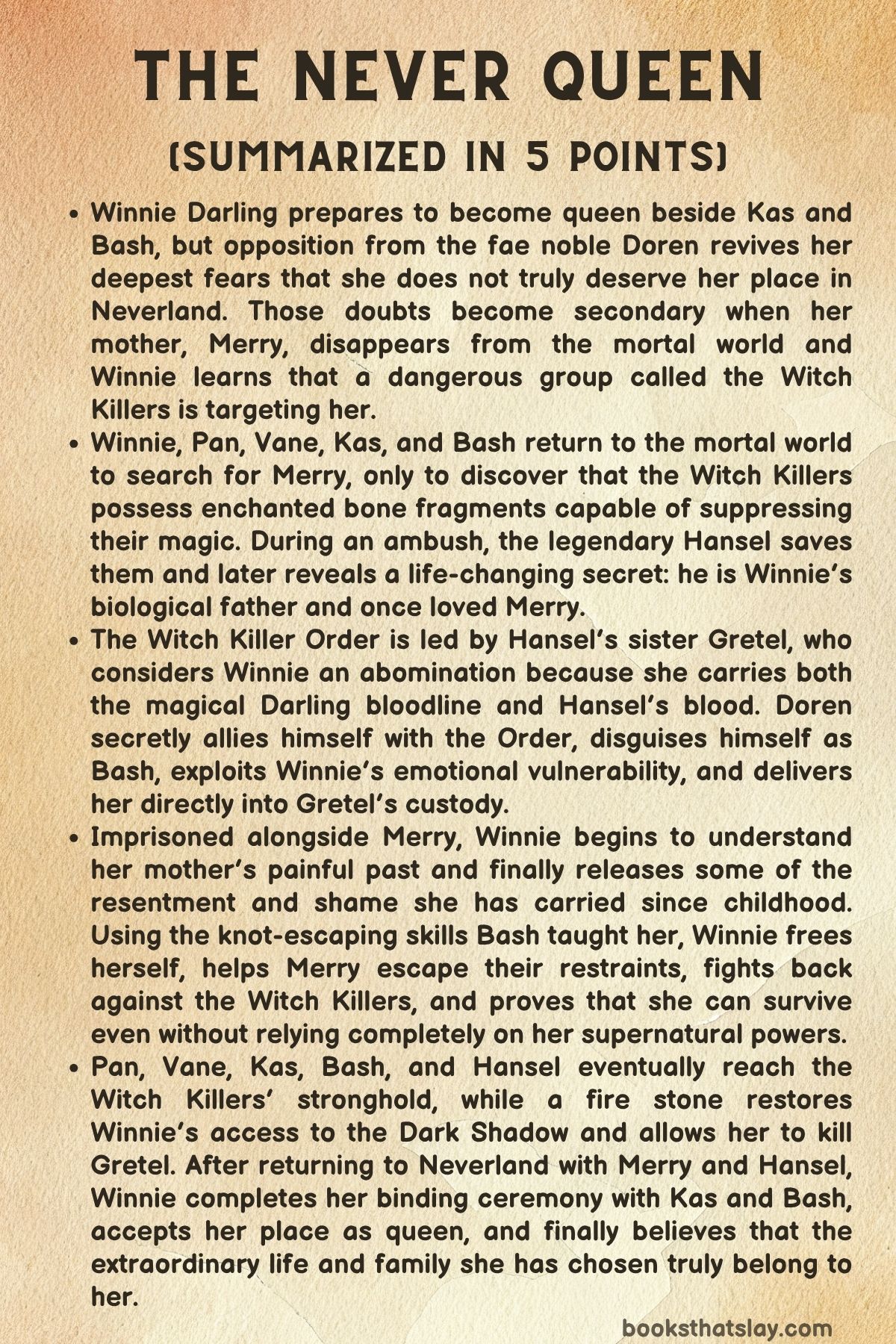
Summary
Winnie Darling has finally built the life she once believed was impossible. She lives in Neverland with Peter Pan, Vane, Kas, and Bash, and Kas and Bash have reclaimed their positions as the Fae Kings.
Their coming binding ceremony will formally make Winnie their queen, yet the prospect awakens insecurities that she has never fully escaped. A powerful fae noble named Doren openly objects to a mortal woman becoming queen, and although Winnie insists she does not need a title, his rejection strikes directly at the shame she has carried since childhood.
Kas and Bash refuse to allow Doren to dictate their choice. They consider Winnie their rightful partner and have no intention of diminishing her place beside them.
Still, Winnie struggles privately. She remembers the poverty, instability, and judgment that shaped her childhood and adolescence, and she begins wondering whether Doren is merely saying aloud what others secretly believe.
Pan and Vane recognize that something is troubling her, but Winnie avoids explaining the full extent of her self-doubt. She instead seeks distraction in the intense relationships she has developed with the four men.
Meanwhile, Kas and Bash encounter Doren at Marooner’s Rock. To their surprise, he abruptly apologizes for opposing Winnie and claims he has changed his position.
The apology makes them more suspicious rather than less. His carefully chosen words imply that their authority may soon be challenged, convincing the twins that something larger is taking place.
They return to the treehouse and conceal the details from Winnie, not wanting to increase her anxiety. Pan quickly recognizes their concern, and the group holds a party partly to strengthen alliances and partly to create a temporary sense of normality.
The gathering ends abruptly when Leo arrives from the mortal world. Leo was responsible for protecting Merry Darling, Winnie’s mother, but he announces that Merry has disappeared.
He remembers accompanying her on their regular trip to a coffee shop and through a nearby park before suddenly losing awareness. When he recovered, Merry was gone.
Pan, Vane, Kas, and Bash immediately suspect supernatural interference. The timing becomes especially troubling because Merry vanished just as Doren unexpectedly reversed his position regarding Winnie.
Pan travels with the twins to the fae palace while Vane remains with Winnie. They confront Doren, but he denies taking Merry.
Kas believes the denial itself is truthful, although Doren is clearly concealing something. Pan searches the palace and finds no evidence that Merry is being held there.
With no useful lead in Neverland, the group decides to enter the mortal realm.
Returning home is difficult for Winnie. The places connected to her childhood remind her of years spent moving from one hiding place to another while Merry tried desperately to escape Peter Pan and the Darling family’s supernatural legacy.
Merry’s present cottage creates an especially complicated reaction. It is peaceful and comfortable, resembling the kind of home Winnie desperately wished for as a child.
Before Winnie can fully process those emotions, the group is attacked outside the cottage. Their enemies carry glowing fragments that suppress magical abilities, leaving Pan, Vane, Kas, Bash, and Winnie suddenly dependent on ordinary physical strength.
The attackers attempt to abduct Winnie. A mysterious older man unexpectedly intervenes and helps defeat them.
Pan recognizes him as Hansel, the legendary figure from the story of Hansel and Gretel. Hansel identifies the attackers as members of the Witch Killer Order and warns that Winnie, not Merry, is their true target.
Winnie is confused because she does not consider herself a witch. Her companions explain that the Darling bloodline carries Myth Maker power inherited from Captain Hook and that Merry entered Neverland’s magical Lagoon while pregnant with Winnie.
The Witch Killers therefore see Winnie as a magical being regardless of the terminology she uses for herself.
The group seeks information at the Lost Knife, a supernatural diner operated by a gnome named Kody. Kody is evasive about Merry but offers fire stones capable of counteracting the magic-suppressing bone fragments used by the Witch Killers.
Those fragments originate from the bones of an ancient witch defeated by Hansel and Gretel. Vane uses an old debt to force Kody into promising five stones.
Until they receive them, the group takes shelter in the Victorian house where Winnie once lived. The property is protected by wards Merry created years earlier, making it one of the few places where they may temporarily remain hidden.
Being inside the house reawakens Winnie’s memories and anxiety. Pan notices how uncomfortable she becomes and begins to understand that the crisis is attacking much more than her physical safety.
Winnie is terrified of losing the new life she has built. Neverland has become her first genuine home, and the possibility that enemies in both worlds reject her reinforces the fear that her happiness may be temporary.
An encounter with former school acquaintances produces similar emotions. Winnie sees people who remember the reckless, defensive teenager she once was and is forced to compare that version of herself with the woman she has become.
One acquaintance, Tad, unexpectedly acknowledges that Winnie had a difficult childhood. His comment affects her because she had assumed no one noticed or cared.
The emotional uncertainty grows when Kody arranges a meeting in an isolated parking lot. The group expects to receive the promised fire stones but instead walks into an ambush.
Kody has betrayed them to the Witch Killers. Their bone fragments again suppress magic, and the attackers immediately concentrate on capturing Winnie.
Hansel unexpectedly arrives and fights beside her companions. A Witch Killer named Payla captures Winnie and demands that Hansel explain why one of the Order’s most famous figures is protecting a magical woman.
Hansel finally reveals the truth: he is Winnie’s biological father.
Before Winnie can process the revelation, Payla drives a knife into her heart.
Hansel kills Payla, while Pan and Vane desperately try to save Winnie. Hansel explains that water can neutralize the power of the magical bone fragments.
The Dark Shadow reconnects with Winnie and begins repairing the fatal wound. Her companions rush her back to safety, but the revelation about Hansel fundamentally changes what they understand about the Witch Killers’ motives.
Winnie is not simply part of the Darling magical bloodline. She is also the daughter of Hansel, one of the most celebrated figures in the Witch Killer Order.
Hansel eventually explains his history with Merry. Years earlier, he investigated the Darling bloodline because the Order had heard that Myth Maker power had survived.
He met Merry when she was a young college student and discovered that she possessed subtle magical abilities. Rather than treating her as an enemy, he fell in love with her.
Hansel created wards to hide Merry from Peter Pan, but pressure from the Witch Killer Order eventually forced him to leave. He believed disappearing would protect her.
He did not know that Merry was pregnant with Winnie.
His sister Gretel eventually discovered the truth. Unlike Hansel, Gretel has transformed the Order’s original mission into an uncompromising war against nearly every form of magic.
To Gretel, Winnie represents both magical contamination and Hansel’s betrayal.
Winnie awakens while these truths are being discussed and hears herself described as a disgrace in the eyes of the Order. Combined with Doren’s rejection, the word reinforces every insecurity she already carries.
She flees into the woods, where Bash appears to find her. His cold behavior seems to confirm her worst fears.
Winnie soon realizes the man is not Bash at all. Doren has used illusion magic to impersonate him.
Doren has secretly allied himself with the Witch Killers and delivers Winnie directly to Gretel. Winnie is drugged and taken away.
Doren soon discovers that his alliance was never one of equals. Gretel despises him because he is fae and considers his magic as objectionable as Winnie’s.
She has merely used him because his powers were convenient.
Pan, Vane, Kas, Bash, and Hansel discover Winnie’s disappearance and quickly identify Doren as the traitor. Kas and Bash track him down, and Vane brutally forces him to reveal where the Witch Killers have taken Winnie.
Doren gives them the location of an old warehouse beside the Nettle River. Knowing his betrayal could never be trusted again, Kas kills him.
Inside the warehouse, Winnie discovers Merry imprisoned beside her.
The reunion gives mother and daughter an opportunity to confront years of pain. Winnie begins seeing her mother’s past differently after learning about Hansel, the Witch Killers, and the fear that surrounded Merry’s attempts to protect her daughter.
Winnie does not erase the harm caused by Merry’s actions, but she recognizes that her mother spent much of her life responding to threats she could barely understand. Winnie finally tells her that she no longer blames her for trying to protect them.
That act of forgiveness changes Winnie as well. She begins recognizing that she is not simply the product of a damaged childhood or an inherited curse.
She escaped the pattern that defined generations of Darling women. More importantly, she created relationships and a home that genuinely belong to her.
Bash’s knot lessons now become unexpectedly valuable. Winnie frees herself from her restraints and releases Merry.
She kills a guard and tries to escape through the warehouse, discovering an operations center filled with photographs and information showing how carefully the Witch Killers have studied her and the men she loves.
Gretel catches Winnie and Merry before they reach freedom.
Rather than immediately killing Winnie, Gretel intends to use her as bait. Her plans extend beyond Winnie: she wants to eliminate Wendy Darling and destroy the entire remaining magical bloodline.
Winnie refuses to cooperate. Even without access to her Shadow, she attacks Gretel and fights with whatever weapons she can obtain.
At the same time, Pan and Vane force Kody to hand over the fire stones he originally promised. They join Kas, Bash, and Hansel outside the warehouse and prepare an assault.
Hansel acknowledges that fighting Gretel means opposing the person who has been closest to him for most of his life. Yet his loyalty finally shifts.
The Order was supposedly created to stop dangerous witches, not to murder people simply because they possess magic. Hansel chooses Merry and Winnie over the ideology his sister now represents.
The rescuers storm the warehouse and fight their way toward Winnie.
When Pan reaches her, he throws her a fire stone.
The Shadow instantly returns.
With her powers restored, Winnie faces Gretel without the disadvantage that previously kept her vulnerable. She calls a dagger into her hand through the Shadow and drives it into Gretel’s throat.
Hansel arrives in time to see his sister die. Although he knows she intended to murder his daughter and Merry, he still mourns the sister who once shared nearly everything with him.
With the Witch Killer threat defeated, Winnie chooses a new direction for her family. She brings both Merry and Hansel back to Neverland.
Winnie is finally ready to rebuild her relationship with Merry rather than remaining defined by resentment. She also tells Hansel that she is willing to know him, though she makes clear that he must respect the men she loves.
Hansel reveals that he knows a powerful witch in Summerland who may be able to help repair some of the damage to Merry’s fractured mind, giving their family another possibility for healing.
Two weeks later, Winnie stands before the fae court for her binding ceremony with Kas and Bash.
A ceremonial tradition requires anyone joining the ruling family to descend from a balcony by flying. The ritual could have been designed to expose Winnie’s lack of wings and emphasize her mortal origins.
Instead, Winnie uses the Shadow to carry herself through the air.
The fae court cheers.
She greets Pan and Vane, embraces Merry and Hansel, and joins Kas and Bash before the gathered court. Their hands are bound together, vows are exchanged, and Winnie is formally recognized as queen.
The importance of the ceremony is not simply that other people finally accept her. Winnie has begun accepting herself.
Later, she celebrates privately with Pan, Vane, Kas, and Bash in the glowing grotto beneath Marooner’s Rock. Her life may still appear extraordinary for someone who once believed herself cursed and unwanted, but she no longer sees that difference as evidence that she is occupying a place meant for somebody else.
She has chosen Neverland, and Neverland has become hers.
For the first time, Winnie accepts her relationships, her abilities, her history, and her crown without apologizing for them. She finally understands herself as the Never Queen.
Characters
Winnie Darling
Winnie is the emotional and narrative center of The Never Queen, and her main struggle concerns the gap between the extraordinary life she possesses and the damaged self-image she developed long before reaching Neverland. She may be loved by kings, supernatural beings, and a god, yet part of her still thinks like the impoverished girl who grew up expecting abandonment, humiliation, and disappointment.
Doren’s objection to her becoming queen therefore hurts far more than Winnie initially admits. His political resistance confirms an accusation she has already directed at herself: that she is not sufficiently powerful, refined, magical, or worthy to occupy the position she has been given.
Her tendency to seek physical distraction whenever she becomes emotionally overwhelmed demonstrates both strength and avoidance. Winnie understands her desires and refuses to feel ashamed of the unconventional relationships that give her security, but she initially uses those relationships to avoid confronting deeper fears about identity and belonging.
Her return to the mortal world forces those fears into the open. Merry’s comfortable cottage, Winnie’s old school acquaintances, the Victorian house, and memories of adolescence all remind her of the person she once expected to become.
The revelation that Hansel is her father complicates her identity even further. Winnie suddenly discovers that the absent parent she never knew belongs to the same organization that now wants her dead, turning her family history into another source of contradiction.
Her lowest emotional moment comes when she overhears herself described as a disgrace. Doren’s opposition, Gretel’s hatred, and the wounds of her childhood merge into one belief that perhaps every world eventually decides she does not belong.
Her development becomes clearest after she is imprisoned with Merry. Winnie stops waiting for Pan, Vane, Kas, or Bash to rescue her and begins using what she has learned from them.
Bash’s knot lessons allow her to free herself, while her own determination enables her to overpower a guard and attempt an escape without magic. The scene shows that the relationships surrounding Winnie have strengthened rather than erased her independence.
Killing Gretel becomes the final violent expression of that transformation. Once her Shadow returns, Winnie no longer acts like someone asking permission to survive.
By the binding ceremony, her greatest victory is internal rather than political. She does not simply receive a crown in The Never Queen; she reaches the point where she believes she can wear it.
Peter Pan
Peter Pan remains dangerous, possessive, powerful, and frequently ruthless, but this book emphasizes the extent to which loving Winnie has changed how he understands himself. He is a primordial star god who spent much of his existence disconnected from the full meaning of his nature, yet his relationship with Winnie gives that enormous identity an unexpectedly personal center.
His reactions to the Witch Killers reveal the limits of his usual confidence. Pan is accustomed to being one of the most dangerous beings in any confrontation, but the magic-suppressing bone fragments take away the advantage on which he normally relies.
That experience exposes one of his deepest fears: powerlessness when Winnie is in danger. He can tolerate threats against himself far more easily than situations in which he cannot guarantee her safety.
Pan’s protective instincts sometimes become controlling. He excludes Winnie from certain investigations, decides when she should remain behind, and often assumes that danger can be solved through intimidation or force.
Yet the novel gradually shows him realizing that Winnie’s greatest struggle cannot simply be killed. Her belief that she is unworthy demands reassurance, patience, and emotional understanding rather than violence.
The contrast becomes especially significant after Winnie runs away from the Victorian. Pan initially sees her departure as a security failure, but he later understands that the conversation about her parentage and supposed disgrace struck directly at wounds he had underestimated.
His desire for revenge after her stabbing and kidnapping demonstrates how completely she has become the center of his emotional existence. The old Pan used violence because destruction relieved his restlessness; the Pan of The Never Queen still possesses that capacity for brutality, but now violence is primarily activated by threats to the family he has chosen.
His role at the end is therefore quieter than Winnie’s. He does not need to defeat Gretel on her behalf.
Instead, he gets the fire stone into Winnie’s hands and allows her to use her own power. That moment reflects his growing recognition that protecting Winnie also means trusting what she can do.
Vane
Vane’s connection with Winnie is defined by darkness, physical intensity, trust, and the supernatural Shadow they share. He is often the harshest and most intimidating of her partners, but the book repeatedly shows that Winnie understands the emotional boundaries beneath their aggressive dynamic.
Their games and confrontations function as a private language. When Winnie is overwhelmed, Vane gives her a kind of certainty that allows her to temporarily escape thoughts she cannot yet manage.
The shared Shadow also gives Vane an unusual awareness of Winnie’s emotional state. He can sense that her fear is not simply about death and gradually recognizes that she is more frightened of losing Neverland, her relationships, and her sense of belonging.
This emotional sensitivity complicates his outwardly brutal personality. Vane rarely expresses care through conventional tenderness, yet he understands Winnie with remarkable accuracy.
His refusal to surrender the Shadow is especially revealing. Giving it up might restore a tactical advantage against the Witch Killers, but doing so would weaken the connection that could help him locate or protect Winnie if they were separated.
Vane’s violence toward Doren demonstrates another side of his loyalty. Once Doren’s betrayal is confirmed, Vane has no interest in political compromise or mercy and begins physically destroying him until he gives up Winnie’s location.
Within The Never Queen, Vane represents the idea that darkness and devotion are not automatically opposites. His affection is possessive and dangerous, yet Winnie does not experience it as imprisonment because the relationship is grounded in mutual understanding and voluntary trust.
By the conclusion, Vane remains essentially himself rather than becoming softer in any conventional sense. What changes is the clarity with which his brutality is connected to love, loyalty, and the home he has built with Winnie and the others.
Kas
Kas combines the authority of a restored Fae King with a calmer and more reflective temperament than several of the other men surrounding Winnie. His relationship with her has evolved dramatically from their earlier interactions, becoming affectionate, emotionally secure, and deeply integrated into the life he shares with Bash.
His restored wings and crown matter because they represent everything previously taken from him. Yet Kas does not treat reclaiming his position as the end of his journey.
The binding ceremony with Winnie allows him to redefine kingship as something shared rather than possessed alone. He refuses to accept Doren’s argument that Winnie’s mortality makes her unsuitable, demonstrating that his concept of legitimacy is based on loyalty and chosen partnership rather than tradition.
Kas’s response to Doren’s betrayal is especially significant. He is capable of restraint and understands the value of mercy, but he does not confuse mercy with passivity.
Once Doren endangers Winnie, betrays the crowns, and allies himself with people committed to killing magical beings, Kas concludes that allowing him to survive would merely invite another attack. His decision to kill Doren is calm rather than impulsive, making it more revealing of his moral framework.
Kas also represents stability within Winnie’s romantic relationships. He remembers how their original attraction contained manipulation and defiance but recognizes that those beginnings have become genuine intimacy.
In The Never Queen, his love for Winnie reinforces rather than competes with his bond with Bash. The twins are not divided by loving the same woman; their existing connection allows them to build a shared relationship around mutual loyalty.
Kas ultimately helps create the political structure that gives Winnie’s internal transformation an external form. When she stands beside him and Bash during the binding ceremony, she is not being granted temporary access to their authority.
She is joining them as an equal member of the ruling family.
Bash
Bash is playful, affectionate, sexually confident, and frequently humorous, but beneath that lighter surface is someone shaped by his own history of restriction and loss. His restored wings and position as king give him new freedom, yet he has not forgotten what it feels like to be trapped.
That history gives his knot lessons with Winnie unexpected symbolic importance. What appears to be a teasing activity becomes one of the skills that later saves her life.
Bash teaches Winnie how to escape physical restraints because he understands that freedom is not simply the absence of bonds. It is the ability to recognize how something holds you and find the point where pressure can be released.
His emotional support works similarly. At the Victorian house, Bash recognizes that Winnie’s return to her hometown is affecting her more deeply than she admits.
He reassures her through attention, humor, intimacy, and familiarity rather than demanding that she immediately explain everything she feels. His warmth helps counterbalance the more severe personalities of Pan and Vane.
Doren’s illusion therefore succeeds precisely because impersonating Bash allows him to exploit one of Winnie’s safest relationships. The cruelty of the deception is not merely that Doren resembles him; it is that Winnie has learned to associate Bash with emotional safety.
Bash’s commitment to Winnie is also inseparable from his restored identity as king. He has no interest in allowing the fae court to decide that she is inferior because she lacks wings or traditional royal blood.
His presence in The Never Queen reinforces one of the book’s central ideas: the people who help Winnie claim her strength do so not by keeping her dependent but by giving her knowledge, affection, and confidence that she eventually uses for herself.
Merry Darling
Merry enters the story primarily as the missing person whose disappearance begins the mortal-world conflict, but the later revelations transform her from an object of rescue into a much more complicated figure. Much of Winnie’s childhood pain is connected to Merry’s instability, fear, secrecy, and desperate attempts to hide her daughter from Peter Pan.
The book does not erase the consequences of those choices. Winnie genuinely suffered because of the environment in which she was raised, and Merry’s intentions cannot undo that damage.
However, Hansel’s history provides context that Winnie never possessed. Merry was once ambitious, intelligent, and hopeful, with an emerging magical ability she barely understood.
She fell in love with Hansel and then lost him without knowing why. Afterward, she faced the Darling legacy, supernatural threats, and the responsibility of protecting a child while becoming increasingly frightened and unstable herself.
Her imprisonment beside Winnie becomes the emotional turning point in their relationship. For perhaps the first time, Winnie can see her mother as a young woman whose life was altered by forces larger than either of them.
Forgiveness does not mean pretending their past was harmless. Instead, Winnie stops viewing Merry’s failures as proof that she herself was unwanted.
Merry’s return to Neverland therefore represents the possibility of building a different mother-daughter relationship in adulthood. Their sunrise conversation at the Lagoon gives Winnie a moment of maternal closeness she rarely experienced growing up.
Hansel’s offer to seek magical help for Merry also creates cautious hope. Her future remains uncertain, but she is no longer isolated inside the history that damaged her.
Hansel
Hansel initially appears as an unsettling contradiction: one of the most famous Witch Killers in history suddenly protecting the very woman his Order wants dead. His true importance becomes clear when he reveals that he is Winnie’s biological father.
That revelation reorganizes much of the family’s past. Hansel originally approached Merry because of her connection to the Darling magical bloodline, but observation became fascination and eventually love.
His decision to leave Merry represents both sacrifice and failure. He believed disappearing would protect her from the Order, yet he made that choice without knowing she was pregnant.
The result was that Merry faced the coming threats alone while Winnie grew up without knowing her father.
Hansel does not attempt to excuse the consequences when he finally meets Winnie. He asks for nothing and allows her to decide what kind of relationship, if any, she wants with him.
His conflict with Gretel gives his character another layer. She is not merely his sister but the person who survived childhood horror alongside him and remained his closest bond for most of his life.
Choosing Winnie and Merry therefore requires Hansel to reject both family loyalty and the ideological institution that shaped his identity. He ultimately decides that protecting innocent magical people is more faithful to the original purpose of the Witch Killers than obeying Gretel’s increasingly absolute doctrine.
His grief after Gretel dies is important because the story does not require him to stop loving her in order to oppose her. He can recognize that she must be stopped while still mourning the sister she once was.
Gretel
Gretel is the principal antagonist and the ideological extreme against which Hansel’s changing beliefs are measured. She has transformed a childhood trauma involving a murderous witch into a worldview in which magic itself is treated as corruption.
That distinction matters because her hatred is no longer based on what magical beings do. It is based on what they are.
Winnie becomes especially offensive to Gretel because she combines two legacies Gretel despises. She carries Darling Myth Maker power while also being Hansel’s daughter, making her living evidence that her brother crossed the boundary between hunter and magical bloodline.
Gretel therefore interprets Winnie’s existence as contamination and betrayal rather than simply another target.
Her alliance with Doren demonstrates the hypocrisy of her absolutism. She willingly benefits from his fae illusion magic when it helps capture Winnie, then immediately reminds him that she considers him an unnatural creature as well.
She does not seek a principled alliance; she uses whatever tools are temporarily convenient while maintaining her intention to destroy those same tools later.
Her plan to eliminate Wendy and the wider Darling line shows how far her mission has expanded. The Order is no longer responding to individual threats but pursuing hereditary extermination.
Gretel’s death at Winnie’s hands reverses the power relationship that has defined their encounters. Once Winnie’s magic can no longer be suppressed, Gretel loses the control she gained through specialized weapons and captivity.
Doren
Doren begins as a political opponent but gradually reveals himself as a personal and institutional traitor. His objection to Winnie appears rooted in the belief that a mortal woman has no legitimate place at the top of fae society.
The danger of his prejudice becomes clear when he stops relying on court resistance and begins cooperating with the Witch Killer Order.
His sudden apology to Kas and Bash is therefore calculated misdirection. Rather than accepting their decision, he attempts to appear compliant while arranging circumstances that could remove Winnie entirely.
His greatest strength is illusion magic, and he uses it in the cruelest possible way by impersonating Bash at the exact moment when Winnie is most emotionally vulnerable. He understands that simply attacking her may fail, so he borrows the appearance of someone she trusts.
Doren nevertheless badly misunderstands both sides of his alliance. He assumes Gretel will reward his usefulness, only to learn that she despises fae magic as intensely as Winnie’s powers.
He also seems to believe Kas and Bash may ultimately privilege fae kinship over Winnie. Their response proves precisely the opposite.
His death is therefore the consequence not simply of prejudice but of repeated betrayals. He attacks the legitimacy of his kings, endangers their chosen queen, cooperates with enemies of magical beings, and mistakes shared blood for guaranteed protection.
Payla
Payla serves as one of the clearest representatives of the Witch Killer Order’s operational cruelty. During Kody’s betrayal, she captures Winnie and uses her as leverage against Hansel.
Her confrontation forces the secret of Winnie’s parentage into the open under the worst possible circumstances. Hansel must identify himself as Winnie’s father while Payla holds a blade against Winnie’s chest.
Payla then immediately stabs Winnie through the heart, demonstrating how completely the Order has abandoned any distinction between investigation and execution. Her willingness to kill Winnie despite knowing Hansel is her father also shows that ideological loyalty has become more important within the Order than personal bonds.
Hansel’s immediate killing of Payla marks his definitive break from the organization he once helped define.
Leo
Leo plays a smaller but important role because his failure to protect Merry initially alerts everyone to the wider conspiracy. His condition upon returning to Neverland makes clear that Merry did not simply wander away or choose to disappear.
He is physically ill, confused, and deeply ashamed that he failed in the responsibility entrusted to him. The investigation later establishes that his memory loss was almost certainly produced deliberately, meaning his failure was engineered rather than careless.
Leo’s loyalty is evident in how quickly he returns to report what happened despite knowing that Pan and Vane may react badly. His testimony provides the first solid indication that the crisis in the mortal world is connected to organized supernatural enemies.
Kody
Kody represents opportunism rather than ideological hatred. As the owner of the Lost Knife, he possesses valuable supernatural contacts, information, and magical resources, but almost every relationship he maintains is transactional.
His willingness to obtain the fire stones initially makes him useful. Yet he later betrays Winnie and her companions when the Witch Killers make another arrangement with him.
Unlike Gretel or Doren, Kody does not appear motivated by a deep belief about Winnie. His motivation is advantage.
That makes him dangerous in a different way because loyalty has little meaning when a more profitable agreement becomes available. Pan and Vane eventually force him to surrender the fire stones, and his survival depends on convincing them that his usefulness outweighs the satisfaction of revenge.
Themes
Belonging and the Right to Claim a Place
Winnie’s central conflict is not whether she can physically occupy Neverland but whether she can believe that she has the right to remain there. She already possesses love, magical power, loyalty, and a place beside Kas and Bash, yet the emotional habits created during childhood continually tell her that such security must eventually be taken away.
Doren’s opposition is powerful because it gives an external voice to Winnie’s internal fear. When he says that a mortal woman should not rule the fae, Winnie hears much more than a political argument; she hears confirmation that everything she has gained may belong to someone more worthy.
The mortal world intensifies that conflict. Returning to her old neighborhood places Winnie among the homes, people, and memories connected to a version of herself who expected very little from life.
Her former classmates remember a troubled young woman, while Merry’s peaceful cottage reminds Winnie of the stable childhood she never received. These encounters make Neverland appear almost impossibly distant from the person she used to be.
The Never Queen gradually separates belonging from permission. Winnie does not become legitimate because every fae approves of her or because all her enemies disappear.
She becomes secure when she stops allowing rejection to determine how she sees herself. The binding ceremony makes that change visible: the challenge involving flight could humiliate a wingless mortal, yet Winnie simply uses the Shadow and descends on her own terms.
The cheering court matters, but it is secondary to Winnie’s changed reaction to being seen. She finally occupies the center without automatically assuming that attention will expose her as an impostor.
Inherited Trauma and the Possibility of Breaking Cycles
The Darling family history initially appears to Winnie as a curse that determines the lives of its women. Her childhood was dominated by Merry’s fear, secrecy, instability, and attempts to protect her from Peter Pan, leaving Winnie convinced that suffering was simply something passed from mother to daughter.
The discovery of Hansel’s history reveals that inherited trauma extends even farther. Merry herself once possessed ambitions and hopes that were transformed by supernatural danger, romantic loss, and the pressure of protecting her daughter.
Understanding this context does not require Winnie to deny what happened to her. Instead, it allows her to distinguish explanation from absolution.
Merry hurt Winnie, but those failures did not originate in a belief that her daughter was worthless. Much of the damage came from terrified attempts at protection made by someone who was herself psychologically damaged and increasingly isolated.
The reunion in captivity becomes crucial because Winnie finally sees both sides of that history at once. She can acknowledge the frightened child she once was while also recognizing the frightened young mother Merry once became.
That insight allows forgiveness to function as liberation rather than surrender. Winnie stops carrying her mother’s failures as evidence about her own value.
The broader arc of The Never Queen shows Winnie breaking the cycle by creating relationships based on choice, communication, and mutual loyalty. She refuses to continue living as though the Darling legacy has already written her future.
Her willingness to bring Merry back to Neverland is especially important. Instead of permanently rejecting the damaged family she inherited, she attempts to build something healthier without abandoning the family she chose.
Power, Vulnerability, and Self-Reliance
Nearly every major supernatural figure in the story possesses extraordinary power, yet the Witch Killers create danger by temporarily making that power useless. Their enchanted bone fragments reduce Pan, Vane, Kas, Bash, and Winnie to physical vulnerability and force them to confront what remains when magic disappears.
For Pan, vulnerability is especially frightening because his identity has long depended on being almost impossible to overpower. The attacks reveal that his greatest fear is not personal injury but being unable to protect Winnie.
Winnie faces the same question from another direction. Because she is surrounded by immensely powerful men, outsiders could easily assume that her safety and status depend entirely on them.
Her captivity proves otherwise. Without the Shadow, she still remembers Bash’s knot lessons, frees herself, kills a guard, releases Merry, studies the warehouse, searches for an exit, and fights Gretel with improvised weapons.
Her magical abilities make her formidable, but they are not the source of her courage. When Pan finally throws her the fire stone, he is not transforming a helpless prisoner into a capable person.
He is returning a weapon to someone who has already demonstrated that she can survive without it.
The theme also changes the meaning of protection. Healthy protection in the story is not presented simply as keeping Winnie away from every danger.
The strongest relationships are the ones that give her skills, confidence, information, and the freedom to act. Her partners may desperately want to protect her, but her final development requires them to understand that loving a powerful woman also means allowing her to exercise that power herself.
Chosen Family, Loyalty, and Love
Family in the story is repeatedly separated from biology. Winnie is connected by blood to Merry, Hansel, Gretel, and the larger Darling line, but those relationships produce radically different forms of loyalty.
Gretel shares blood with Hansel and Winnie yet chooses ideology over both. Doren shares fae identity and kinship with Kas and Bash but betrays them when their choices conflict with his beliefs.
By contrast, Pan, Vane, Kas, and Bash have no conventional claim on one another as a single family unit, yet their loyalty survives danger, jealousy, political pressure, and supernatural attack.
Their devotion to Winnie is not identical. Each relationship offers something different: Pan combines authority with growing emotional tenderness, Vane offers dark understanding and instinctive connection, Kas provides steadiness and shared leadership, and Bash brings warmth, freedom, and reassurance.
The relationships work because Winnie does not have to reduce one bond to validate another. Her home is created through accumulation rather than exclusion.
Hansel eventually faces the clearest test of competing loyalties. Gretel has been his closest companion since childhood, and their shared trauma formed the foundation of the Witch Killer Order.
Yet family loyalty cannot justify allowing Gretel to murder innocent people. Hansel chooses Winnie and Merry because preserving an old bond would require abandoning what he now knows is morally defensible.
The final family arrangement therefore contains both biological reconciliation and chosen attachment. Winnie brings Merry and Hansel to Neverland while keeping Pan, Vane, Kas, and Bash at the center of her life.
Love does not repair every past injury immediately, but it creates the possibility of a family defined less by inherited obligation and more by deliberate commitment.