The Phone Swap Summary, Characters and Themes
The Phone Swap by Lia Louis is a contemporary romantic novel about privacy, trust, grief, celebrity, and the frightening risk of allowing another person to truly know you.
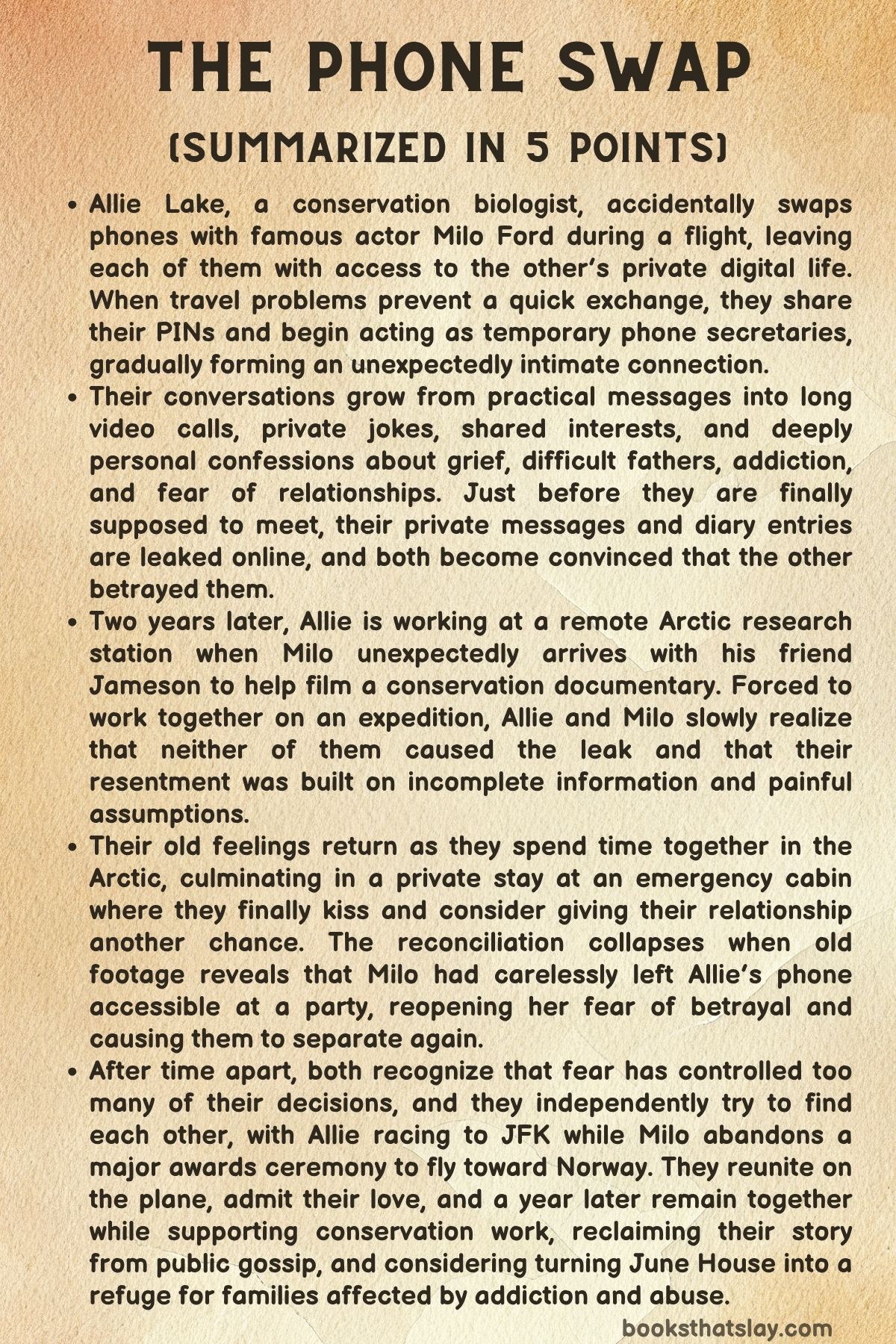
An accidental phone exchange between conservation biologist Allie Lake and actor Milo Ford creates an unusual intimacy before the two have even met properly. Their connection is then shattered when their private communications become public, leaving each convinced the other betrayed them. Two years later, an unexpected Arctic reunion forces them to confront what really happened, what they still feel, and whether love can survive misunderstanding, distance, public scrutiny, and their own deeply rooted fears.
Summary
Allie Lake returns to England after conducting seabird research in Bermuda and discovers that the phone in her possession belongs to someone else. Her own device contains essential scientific material, financial access, photographs, and precious voice recordings connected to her late mother, making the loss both professionally serious and personally distressing.
She eventually establishes contact through TeamSync with the man who has her phone. He introduces himself as Milo and explains that he is in Romania, making an immediate exchange impossible.
Their attempts to return the phones are disrupted when widespread flight cancellations ruin a plan to have Milo’s assistant carry Allie’s phone back to England. Because both urgently need information stored on their devices, they reluctantly consider sharing their PINs and temporarily managing each other’s phones.
Before taking such an extraordinary step, they confirm each other’s identities. Allie discovers that Milo is Milo Ford, a famous American actor known for the Day Falls franchise and the television series Brothers, while Milo learns that Allie is a legitimate conservation biologist whose work focuses heavily on seabirds.
They agree to become temporary “phone secretaries” until Milo passes through London several weeks later. Milo retrieves Allie’s research files and helps restore her access to cloud services, while Allie sends him material he needs for acting work.
The practical arrangement quickly becomes personal. They begin forwarding ordinary notifications, discussing their interests, joking about Milo’s terrible-sounding coffee order, and sharing details that would normally emerge much later in a friendship.
Milo becomes interested in Count Your Chicks, Allie’s citizen-science project that allows volunteers to monitor seabirds. Allie learns about Milo’s reading habits, cooking, motorsport interests, crafts, unusual vocabulary collection, and attempts to maintain healthier routines.
The phones become accidental windows into each other’s lives. Milo sends Allie an old photograph of her celebrating her Bermuda grant with her mother, while Allie sees notifications that reveal Milo’s friendships and romantic attention from other women.
Their video calls grow longer. Allie’s friend Iris recognizes immediately that Allie is attracted to Milo, even though Allie dismisses the possibility that a globally famous actor could seriously care about her.
A message from Milo’s friend Ben suggests otherwise. Ben accidentally reveals that Milo has been talking repeatedly about Allie and is emotionally affected by their connection.
Their conversations deepen as they discuss difficult childhood experiences. Milo tells Allie about losing his mother to cancer and his complicated relationship with a father whose affection he still seeks, while Allie describes growing up with an alcoholic and abusive father before her mother escaped with Allie and her younger sister Sian.
Milo eventually discloses an even more vulnerable part of his history. He explains that he left Day Falls after developing a dependence on benzodiazepines originally prescribed for insomnia and entering rehabilitation, a truth that complicates Allie’s feelings because addiction is inseparable from painful memories of her father.
Rather than withdrawing completely, Allie listens. Their conversations continue, including an extended evening in which they watch Roman Holiday together while living in different countries, creating a strange approximation of a date.
Milo and Allie create a shared vocabulary list, turning words into private signals between them. Their teasing becomes increasingly flirtatious, and Milo openly admits that he wishes their calls lasted longer.
As their planned meeting approaches, both become aware that returning the phones might also end the unusual situation that allowed them to become so close. Milo eventually tells Allie that seeing a beautiful sunset made him think only of her and wish that he could show it to her.
Allie then receives devastating professional news when Terrarium cancels funding for her Bermuda conservation work. The project was closely associated with her mother, making its loss feel like another severed connection to someone she loved.
During her distress, Allie recognizes something unexpected about Milo. Her lifelong instinct has been to withdraw whenever emotional dependence becomes possible because she watched her mother lose freedom and identity inside a destructive marriage, yet with Milo she wants to move toward someone rather than away.
She calls him late at night. Milo comforts her until she falls asleep, reads aloud to her, and speaks about how much he wishes he could physically be there.
Their discussion turns toward love. Allie says love is demonstrated through action, while Milo describes it as something private and intimate, like a whisper that matters without requiring an audience.
On the final day before they are meant to meet, disaster destroys everything they have built. Their private messages, diary entries, and phone exchanges appear online, where celebrity fan accounts and gossip sites transform their developing relationship into entertainment for millions of strangers.
Allie experiences the leak as an unbearable violation. Milo responds publicly with humor, jokes, and even a meme shirt, behavior that Allie interprets as proof that he either caused the leak or willingly exploited it to improve his reputation.
She publicly declares that she will neither see nor speak to Milo again. Instead of meeting him herself, she arranges for someone else to retrieve her phone, blocks him, and removes herself from his life.
Two years later, Allie is working at a remote Arctic research station in Norway. The location has become both an important scientific workplace and a refuge from the publicity that followed the phone scandal.
Her carefully controlled world is disrupted when Milo arrives with his close friend Jameson, who is making a conservation documentary. Milo and Allie are shocked to see each other, and both initially pretend their shared history means nothing.
Their resentment is built on opposite beliefs. Allie thinks Milo exploited or arranged the leak, while Milo has spent two years believing Allie sold or released their conversations.
Circumstances force them together when Jameson and Milo accompany Allie, Iris, and other researchers on a field expedition to Cote Rock. What begins as strained professional cooperation gradually forces Allie and Milo to address the past.
During a dinghy journey, Milo finally accuses Allie of leaking their messages. He explains that the screenshots appeared to come from her side, that she once joked about selling information, and that funding appeared for her work soon afterward.
Allie is horrified and insists she did nothing of the kind. Milo makes the same denial about himself, leaving both confronted with an unsettling possibility: each may have spent two years hating an innocent person.
As they work together, old familiarity returns. Allie sees that Milo’s public humor after the scandal may have been a defensive performance rather than proof of indifference, while Milo begins to understand why his behavior looked like betrayal from her perspective.
Their professional collaboration also changes Milo’s view of Allie’s life. He sees how physically difficult her fieldwork is, how seriously she takes conservation, and how capable she is in dangerous Arctic conditions.
They begin joking again, recreating some of the easy communication that defined their original phone relationship. Milo eventually admits that he has missed Allie every day since they stopped speaking.
Allie later admits the same. Their mutual confession makes clear that neither relationship, fame, distance, nor anger erased what they had felt.
Bad weather then forces Allie and Milo into an emergency cabin after Allie injures her ankle. Milo makes the shelter comfortable, cooks for her, keeps her warm, and looks after her without turning his care into a performance.
His actions matter particularly to Allie because they match her definition of love. In the privacy of the cabin, away from cameras and public expectations, she begins trusting the man she once believed existed only through a screen.
Allie asks Milo to kiss her, and their long-delayed first kiss transforms their renewed emotional intimacy into a romantic relationship. Soon afterward, they visit a puffin colony and discover that Lucky and Mart, a bonded pair of birds who had been separated, have reunited after two years.
The resemblance to their own lives is impossible to ignore. Allie and Milo begin considering whether they can build something lasting despite her fear of celebrity culture and his very public existence.
Their reconciliation is threatened when Jameson and Iris reveal that the Arctic reunion was never accidental. The two secretly arranged the documentary project partly to force their friends into the same place and investigate the original leak.
Old footage from Milo’s Romanian film set reveals that Allie’s phone had been left accessible during a social gathering. The evidence strongly suggests someone else could have taken information from it.
For Allie, the discovery does not immediately bring relief. Milo may not have deliberately betrayed her, but he failed to protect the device after promising he would, reopening the wound of the original privacy violation.
Terrified of trusting him completely and being hurt again, Allie ends the relationship. Milo leaves the Arctic station devastated, and both recognize that they came close to choosing love before fear once again separated them.
Away from Milo, Allie finally understands that retreat has never truly protected her. She has spent her life associating dependence with danger because of her parents’ marriage, but losing Milo hurts because avoiding vulnerability cannot eliminate emotional pain.
Milo reaches a similar realization in Brooklyn. Jameson challenges him to stop performing versions of himself designed to earn approval from his father, audiences, critics, and strangers.
Milo then discovers that Allie has continued adding words to their shared vocabulary list throughout their two-year separation. The list proves that she preserved a private part of their connection even while publicly insisting that she had moved on.
Allie experiences her own revelation when she returns to Norfolk and speaks honestly with Sian. Letters from their mother illuminate the damage caused by their father’s addiction and help Allie understand why she has spent adulthood preparing to escape relationships before anyone can trap or abandon her.
She realizes that she loves Milo and decides to travel to New York for his major awards ceremony. When she arrives, however, she learns that Milo has skipped the ceremony and boarded a flight to Norway because he believes she is still there.
The decision carries enormous meaning because Allie has always said love should be proved through action. Milo is willing to miss one of the most important professional events of his career simply for the possibility of reaching her.
Allie also discovers that Milo has spent two years anonymously volunteering on Count Your Chicks under the username acer_spark. His quiet commitment to something important to her mirrors her continuing additions to his vocabulary list.
She races to JFK, buys the final available seat, and convinces airline employees to help her reach Milo’s plane. Her willingness to explain the situation publicly marks a major change from the woman who once fled any situation that threatened unwanted attention.
Allie reaches the aircraft just before departure and finds Milo. He tells her he was traveling to Norway to find her, while she explains that she came to New York looking for him.
They finally speak without defensive assumptions between them. Allie tells Milo that the man she is falling in love with is on the plane, and Milo answers that the woman he loves is there too.
While they kiss, the ceremony they have both abandoned announces Milo as the winner of Best Male Lead. Jameson accepts on his behalf and explains that Milo is absent because he has chosen to pursue the person he loves.
Allie finally completes the definition of love that began during their original phone calls. Milo has shown her what he feels through action, and she gives him the private words he once described as a whisper by telling him she loves him.
A year later, Allie and Milo remain together and attend the London premiere of Two Birds, One Stone, a documentary combining conservation work with their experience of privacy, publicity, and reconciliation. Investigation suggests that Helene, a writer on Milo’s Romanian production, probably gained access to information on Allie’s phone and discussed it with journalist Laura-Lee, although definitive legal proof remains unavailable.
Allie and Milo decide not to let revenge determine their future. Their relationship is built more carefully now, with both accepting that trust cannot depend on eliminating every possible uncertainty.
Sian is beginning a new life of her own, Iris and Jameson have developed a relationship, and Allie and Milo consider buying June House. They hope to transform it into the refuge Allie’s mother once imagined for families affected by addiction and abuse.
The reunited seabirds Lucky and Mart provide a final reflection of Allie and Milo. Separation changed them, but it did not erase their attachment, and their reunion succeeds because both eventually stop allowing fear, assumptions, and other people’s versions of their story to decide their future.
Characters
Allie Lake
Allie is the emotional center of The Phone Swap, a conservation biologist whose scientific confidence contrasts sharply with her fear of emotional dependence. She is observant, practical, private, and highly competent in her professional world, yet relationships make her anxious because childhood taught her that loving someone can mean surrendering safety, independence, and control.
Her father’s alcoholism and abusive behavior shaped nearly every emotional defense she carries into adulthood. Watching her mother struggle inside that marriage convinced Allie that becoming part of a couple could mean disappearing into someone else’s needs, so she protects herself by withdrawing before attachment becomes too powerful.
Her mother’s death adds another layer to this guarded personality. Allie keeps photographs, recordings, memories, and scientific achievements closely associated with her mother, which explains why losing her phone feels like far more than a technological inconvenience.
Milo challenges Allie because her normal methods of emotional avoidance do not work with him. Their distance initially gives her safety, allowing intimacy to develop through messages and video calls without the physical reality of a conventional relationship.
The leak confirms Allie’s deepest fears by turning vulnerability into public exposure. Her decision to cut Milo off is therefore understandable even when it is based on a false conclusion, because she experiences the scandal as proof that trusting someone can result in losing control over her own life.
Her Arctic life demonstrates both strength and avoidance. She becomes even more accomplished professionally, but the remoteness also gives her a place where celebrity culture, romance, and the humiliation of the leak seem unlikely to reach her.
Allie’s growth depends on recognizing the difference between healthy vulnerability and destructive self-erasure. Her mother’s marriage taught her a genuine lesson about danger, but Allie mistakenly expands that lesson until every serious relationship begins to look like a threat.
By the end, she does not become reckless or suddenly comfortable with publicity. Instead, she accepts that uncertainty is unavoidable and that protecting herself from every possible wound would also require refusing the people and experiences she values most.
Milo Ford
Milo is the romantic counterpart in The Phone Swap, a famous actor whose outgoing humor hides insecurity, shame, and a lifelong hunger for approval. He appears spontaneous, playful, confident, and socially effortless, but much of that personality functions as a protective performance.
His career has taught him to manage public perception constantly. Fame magnifies every failure, particularly his decision to leave Day Falls and his rehabilitation for benzodiazepine dependence, leaving him accustomed to turning discomfort into jokes before someone else can use it against him.
Milo’s relationship with his father helps explain why external validation matters so much to him. Even after becoming financially successful enough to support his father, he continues longing for approval that never seems secure.
His recovery is important because it reveals both vulnerability and discipline. Milo carries shame about addiction and fears being reduced to that period of his life, yet telling Allie about it becomes one of his earliest attempts to let another person see him without controlling the reaction.
Milo’s behavior after the leak creates one of the central misunderstandings of the novel. His jokes, interviews, and willingness to acknowledge memes appear cruel from Allie’s perspective, while he understands them as a survival mechanism after believing she betrayed and abandoned him.
The Arctic reunion gradually forces Milo to separate genuine identity from public performance. He becomes increasingly willing to admit that he crochets, loves unusual vocabulary, cares deeply about bird conservation because Allie cares about it, and would rather pursue meaningful relationships than preserve a perfect celebrity image.
His greatest transformation appears when he abandons the awards ceremony. For a man who spent much of his life believing professional recognition would prove his worth, choosing an uncertain flight toward Allie represents a major reordering of his priorities.
Milo ultimately becomes capable of loving without demanding that love repair every insecurity. His relationship with Allie succeeds when he stops treating achievement, humor, fame, and performance as substitutes for being honestly known.
Sian Lake
Sian, Allie’s younger sister, represents a different response to the same difficult childhood in The Phone Swap. Where Allie protects memories and seeks stability through work, Sian copes by changing environments, creating new projects, and refusing to preserve the family home exactly as it existed.
Her transformation of June House into a colorful bed-and-breakfast initially angers Allie because Allie interprets every alteration as another loss of their mother. Sian’s actions, however, reveal that grief does not always look like preservation; sometimes survival requires remaking a place that carries painful memories.
The sisters have spent years avoiding direct conversations about their father, their mother, and the unequal responsibilities they carried as children. Allie often sees herself as the protective older sister without fully recognizing that Sian also experienced the family chaos through her own emotional perspective.
Sian can appear insensitive when Allie is distressed, particularly when practical B&B concerns take priority over emotional comfort. Yet her later conversations with Allie show that this apparent hardness partly comes from unresolved grief and a different way of managing pain.
Their eventual discussion about their mother’s letters allows both sisters to reconsider the past. Sian becomes essential to Allie’s emotional growth because family understanding helps Allie distinguish her parents’ destructive marriage from the kind of partnership she could create with Milo.
Iris
Iris serves as Allie’s closest friend and one of the strongest sources of emotional honesty in The Phone Swap. She understands Allie well enough to notice romantic interest long before Allie is ready to admit it and repeatedly challenges the defenses Allie uses to dismiss Milo.
Her humor keeps many difficult situations from becoming emotionally overwhelming, but Iris is not merely comic support. She recognizes when Allie is avoiding pain, understands the lasting effects of her childhood, and refuses to pretend that isolation is automatically healthier than vulnerability.
Iris also respects Allie’s scientific identity. She accompanies her in the Arctic environment and understands that conservation is not simply a job but a central part of how Allie understands herself and her connection with her mother.
Her decision to cooperate with Jameson in arranging the reunion is ethically questionable. Iris knowingly manipulates Allie into proximity with Milo, believing that unresolved misunderstanding has trapped both of them for two years.
The plan risks damaging Allie’s trust, yet it comes from Iris’s conviction that avoidance has prevented any genuine resolution. Her later relationship with Jameson also reflects one of the novel’s quieter romantic developments, connecting two friends who become deeply involved in helping Allie and Milo confront the past.
Jameson Merritt
Jameson is Milo’s longtime friend and one of the characters who understands the gap between Milo’s public personality and private emotional life. In The Phone Swap, he functions both as loyal companion and as someone willing to interfere when he believes Milo is incapable of helping himself.
He recognizes that Milo has not genuinely moved on from Allie, even when Milo insists their connection belonged to the past. Jameson also sees how Milo uses humor, celebrity confidence, and professional ambition to avoid confronting feelings of inadequacy.
His documentary gives him a believable reason to enter Allie’s Arctic world while secretly creating the conditions for reconciliation. Working with Iris, Jameson deliberately manipulates both friends, and the novel does not completely erase the troubling nature of that choice simply because good eventually comes from it.
Jameson’s strongest quality is loyalty, although that loyalty can become intrusive. He wants Milo to stop living according to approval, appearances, and unresolved resentment, and he eventually pushes him to examine the parts of himself he continually hides.
His willingness to accept Milo’s award and explain his absence also shows his understanding of Milo’s final choice. Jameson recognizes that the missed ceremony represents growth rather than irresponsibility because Milo is finally pursuing something for personal truth rather than public validation.
Allie and Sian’s Mother
Allie’s mother is dead before the main events of the story, yet her influence remains powerful. Her photographs, recordings, dreams, letters, and memories shape both daughters’ decisions, making her an important emotional presence even without appearing directly in the central timeline.
She escaped an abusive marriage and attempted to build safety for Allie and Sian, but her experience also unintentionally shaped Allie’s fear of romantic commitment. Allie remembers a woman whose independent ambitions became constrained by addiction, instability, and the demands of survival.
The later letters reveal greater complexity. They show a mother trying to protect her daughters under extremely difficult circumstances and clarify how much responsibility Allie carried while still young.
Her dream for June House eventually gains new life when Allie and Milo consider turning the property into a refuge for families dealing with addiction and abuse. The plan transforms the house from a monument to painful memory into something capable of helping others.
Allie and Sian’s Father
Allie’s father is another largely off-page figure whose behavior has enormous consequences. His alcoholism and abuse create the emotional conditions from which Allie’s adult fear of dependence develops.
He teaches Allie, through negative example, that intimate relationships can become dangerous systems in which one person’s needs consume everyone around them. As a result, Allie becomes determined never to repeat her mother’s experience.
His influence persists long after physical separation. Even when Allie is dealing with Milo, a man whose behavior is fundamentally different from her father’s, memories of addiction and instability can trigger fear.
The novel gradually shows that escaping a harmful parent does not automatically erase the beliefs created by that childhood. Allie must consciously reconsider those beliefs before she can distinguish past danger from present possibility.
Polly
Polly is an important professional authority within the Arctic research environment. She values the documentary because she understands that conservation projects require public attention and support, even when Allie is uncomfortable with the people involved.
Her decision to include Milo and Jameson in the Cote Rock expedition forces Allie to separate personal resentment from professional responsibility. Polly expects her to function as a scientist even while confronting someone connected to one of the most painful experiences of her life.
She also provides Allie with valuable perspective about risk. Rather than promising that relationships or ambitious choices will be safe, Polly suggests that eliminating risk entirely can also eliminate opportunities for fulfillment.
This advice matters because Allie’s central problem is not an inability to recognize danger but an increasing tendency to treat every uncertain emotional situation as something to escape. Polly helps challenge that instinct without minimizing what Allie previously suffered.
Andrew Gaines
Andrew is Allie’s former friend and brief romantic partner whose reappearance initially introduces jealousy into her developing relationship with Milo. His invitation to discuss Allie’s funding situation looks potentially romantic when seen through the limited information Milo receives from her phone.
He mainly functions as a reminder that digital information lacks context. A restaurant booking or message can suggest one story while the actual situation is much more ordinary.
Andrew also reflects Allie’s previous approach to romance. Their limited past relationship contrasts with the emotional intensity she develops with Milo, helping emphasize how unusual her willingness to open herself to someone has become.
Helene
Helene becomes significant only when the truth surrounding the leak begins to emerge. Old footage suggests that she had an opportunity to access Allie’s phone while Milo was working in Romania.
Later investigation indicates that she likely obtained information from the device and discussed it with journalist Laura-Lee. The evidence remains insufficient for a definitive legal accusation, leaving an element of uncertainty around exactly how every piece of private material reached the public.
Helene therefore represents the third-party intrusion that Allie and Milo failed to imagine. Their greatest mistake was assuming that because the leak harmed both of them, one must have betrayed the other.
Her possible involvement also reinforces the broader danger created when private information is left accessible in environments where attention, celebrity, and gossip have commercial value. Intentional betrayal was not necessary for immense damage to occur.
Lars
Lars is an experienced Arctic captain trusted by Allie during the Cote Rock expedition. His competence helps establish the seriousness of the environment and the degree to which Arctic fieldwork depends on practical knowledge, preparation, and respect for unpredictable conditions.
He also helps place Milo outside his familiar world. Around Lars and the scientific team, celebrity status carries little importance compared with weather, boats, safety, equipment, and the ability to cooperate.
Although Lars is not central to the romantic conflict, his presence strengthens the professional credibility of Allie’s world. He represents the community of people whose expertise supports research that outsiders may never fully understand.
Ben
Ben is one of Milo’s friends and becomes important through an accidental message that reveals Milo’s feelings before Milo is ready to state them directly. His comment that Milo is emotionally affected by the woman who likes his unusual coffee order gives Allie evidence that their attraction is not one-sided.
The humor of Ben realizing that Allie may be reading the notification also highlights the unusual consequences of the phone swap. Messages that would normally remain private between friends become indirect romantic disclosures because another person temporarily controls Milo’s device.
Sierra
Sierra is Milo’s assistant and initially appears as the practical solution to the phone problem. She is supposed to carry Allie’s device back to England before widespread flight disruption ruins the plan.
Although she has a relatively small role, Sierra helps establish the logistical reality of Milo’s celebrity life. He travels with professional support and must protect information about secret productions, which initially makes his reluctance to reveal his location look more suspicious to Allie than it really is.
Laura-Lee
Laura-Lee is the journalist later connected to information allegedly obtained from Allie’s phone. Her role is mainly associated with the transformation of private communication into material with public and commercial value.
She represents the media machinery surrounding celebrity culture. Once intimate information becomes available, personal context and emotional consequences can become secondary to attention, traffic, and public curiosity.
The character therefore contributes to the novel’s criticism of an environment in which someone else’s vulnerability can rapidly become entertainment. Even without being a major presence in Allie and Milo’s daily lives, that media system profoundly changes both of them.
Themes
Trust, Misunderstanding, and the Stories People Create
Trust in The Phone Swap begins with an apparently irrational act: two strangers give each other access to devices containing enormous amounts of personal information. Allie and Milo initially approach that decision carefully, confirming identities, establishing rules, and consciously deciding that cooperation requires vulnerability.
Their trust grows because both repeatedly behave in ways that justify it. Milo retrieves Allie’s research, Allie handles his private material responsibly, and neither deliberately exploits the remarkable access they possess.
The leak destroys that trust because both immediately construct explanations from incomplete evidence. Allie sees Milo joking publicly, participating in interviews, and benefiting from a more sympathetic public image, so she creates a coherent story in which he exploited their relationship.
Milo develops an equally convincing interpretation. Evidence appears to suggest that the screenshots came from Allie’s side, she had once joked about selling his information, and her research later received support, allowing him to believe she traded privacy for money or professional advantage.
Neither version is foolish when viewed from the limited information available to that person. The tragedy comes from their certainty that explanation and proof are the same thing.
Their Arctic reunion forces both to compare assumptions with actual testimony. When Allie says she did not leak the messages and Milo says the same, trust becomes a choice made before complete evidence exists.
The later footage demonstrates that certainty was always impossible. Someone else appears to have accessed Allie’s phone, but even the final investigation stops short of absolute legal proof.
The novel therefore treats trust not as perfect knowledge but as a willingness to live without perfect knowledge. Allie and Milo can finally build a relationship only when they stop demanding a world in which the other person can guarantee that nothing uncertain, embarrassing, or painful will ever happen again.
Privacy, Celebrity, and Ownership of Personal Life
The phone exchange makes privacy unusually concrete because each character literally carries the other person’s digital life. Messages, photographs, apps, banking tools, memories, friendships, habits, and work information are compressed into devices small enough to be accidentally exchanged on an airplane.
At first, Allie and Milo demonstrate that access does not have to become exploitation. They see notifications and learn private facts, but they develop rules and respect boundaries.
Their relationship becomes intimate partly because each is trusted with information ordinary acquaintances would not possess. The unusual arrangement creates closeness, but it also demonstrates how fragile digital privacy can be.
The leak changes private affection into mass entertainment. Conversations meaningful because they belonged only to Allie and Milo are reposted, interpreted, memed, monetized, and transformed into a public narrative neither controls.
For Milo, publicity is already part of everyday existence. He has learned to cope by joking, performing confidence, and participating in the spectacle before others can define him completely.
Allie experiences publicity very differently. Her identity is based on scientific work, and she is horrified that strangers suddenly know her primarily as a woman connected romantically to an actor.
Their conflict shows that public attention does not affect everyone equally. Milo may possess greater experience navigating it, but that experience initially prevents him from recognizing how deeply Allie experiences exposure as a violation.
The documentary near the end becomes a different form of public storytelling. This time they participate deliberately and use attention partly to support conservation rather than allowing strangers to dictate the meaning of their experience.
Privacy is therefore not presented as total secrecy. What matters is consent: the right to choose what is shared, why it is shared, and who gets to tell the story.
Love as Action Rather Than Performance
Allie’s definition of love becomes one of the central emotional ideas of the novel. Because she grew up watching promises coexist with addiction, instability, and harm, she distrusts declarations that are not supported by behavior.
Milo initially exists for her mainly through words. Their intimacy develops through texts, video calls, jokes, shared films, vocabulary, and conversations that stretch deep into the night.
Yet even during this remote stage, actions give those words meaning. Milo retrieves her scientific files, watches her bird cameras, remembers what matters to her, and stays with her through the night when her funding disappears.
The Arctic reunion pushes this idea further. Milo cares for Allie’s injured ankle, makes coffee for her, prepares food, builds warmth in an emergency cabin, learns about her research, and continues helping Count Your Chicks without seeking recognition.
His anonymous participation in the bird-monitoring project is especially meaningful because it cannot improve his public image. Allie does not even know he is doing it.
Milo’s most decisive act occurs when he skips the awards ceremony and travels toward Norway. The professional recognition he once believed would prove his worth becomes secondary to the possibility of repairing the relationship.
Allie answers through action as well. Rather than waiting safely in England, she crosses the Atlantic, races to the airport, risks public embarrassment, and boards his flight because she finally understands that choosing someone requires more than privately acknowledging love.
Their reunion works because words and actions finally agree. Milo once described love as something whispered privately, while Allie insisted that love must be shown; the ending combines both definitions.
Fear, Vulnerability, and Choosing a Different Future
The Phone Swap repeatedly connects adult behavior with emotional lessons learned much earlier. Allie’s fear of commitment is not simple coldness but a survival strategy built during a childhood dominated by alcoholism, abuse, instability, and watching her mother struggle inside a damaging marriage.
She learns to associate independence with safety. Work, geographical distance, emotional restraint, and the ability to leave become methods of ensuring that nobody can gain enough power to destroy her life.
Milo develops a different defense. Rather than withdrawing, he performs.
His father’s limited approval and the constant judgment surrounding celebrity encourage Milo to anticipate criticism, make jokes at his own expense, and convert vulnerable parts of himself into entertainment before others can reject them. Even his response to the leaked messages follows this pattern.
Both characters therefore fear being fully known, although their behavior looks different. Allie runs, while Milo hides in plain sight behind charm, humor, and professional success.
Their relationship cannot become secure merely by discovering who probably leaked the messages. The real obstacle is their habit of preparing for betrayal even while claiming to trust each other.
Allie’s conversation with Sian and their mother’s letters help her understand that refusing every emotional risk would allow her father’s destructive behavior to continue shaping her future. Choosing Milo does not mean repeating her mother’s marriage because love does not require abandoning independence.
Milo similarly realizes that awards, celebrity, paternal approval, and professional success cannot provide the acceptance he has spent years seeking. He must allow another person to see interests, insecurities, mistakes, and hopes that cannot be polished into a public persona.
Their final reunion is meaningful because neither suddenly becomes fearless. They act while still knowing that publicity, distance, misunderstanding, career pressures, and uncertainty remain possible.
Growth comes from refusing to let fear make every important decision. Allie and Milo cannot guarantee that love will never hurt them, but they finally understand that constantly preparing to escape can become its own form of loss.