Dangerous Haven Summary, Characters and Themes
Dangerous Haven by Luna Pierce is a dark romantic suspense novel centered on survival, autonomy, trauma, and the difficult process of trusting another person after years of control.
London Gardella escapes an abusive criminal father and a forced marriage arrangement, only to seek refuge with Archer Sin, an isolated hacker from a feared New York family. Their relationship begins with suspicion and constant conflict but gradually becomes a source of safety for both of them. As threats from London’s past return, the story asks whether love can exist without possession, whether trauma can be faced without surrendering independence, and whether damaged people can build a home together.
Summary
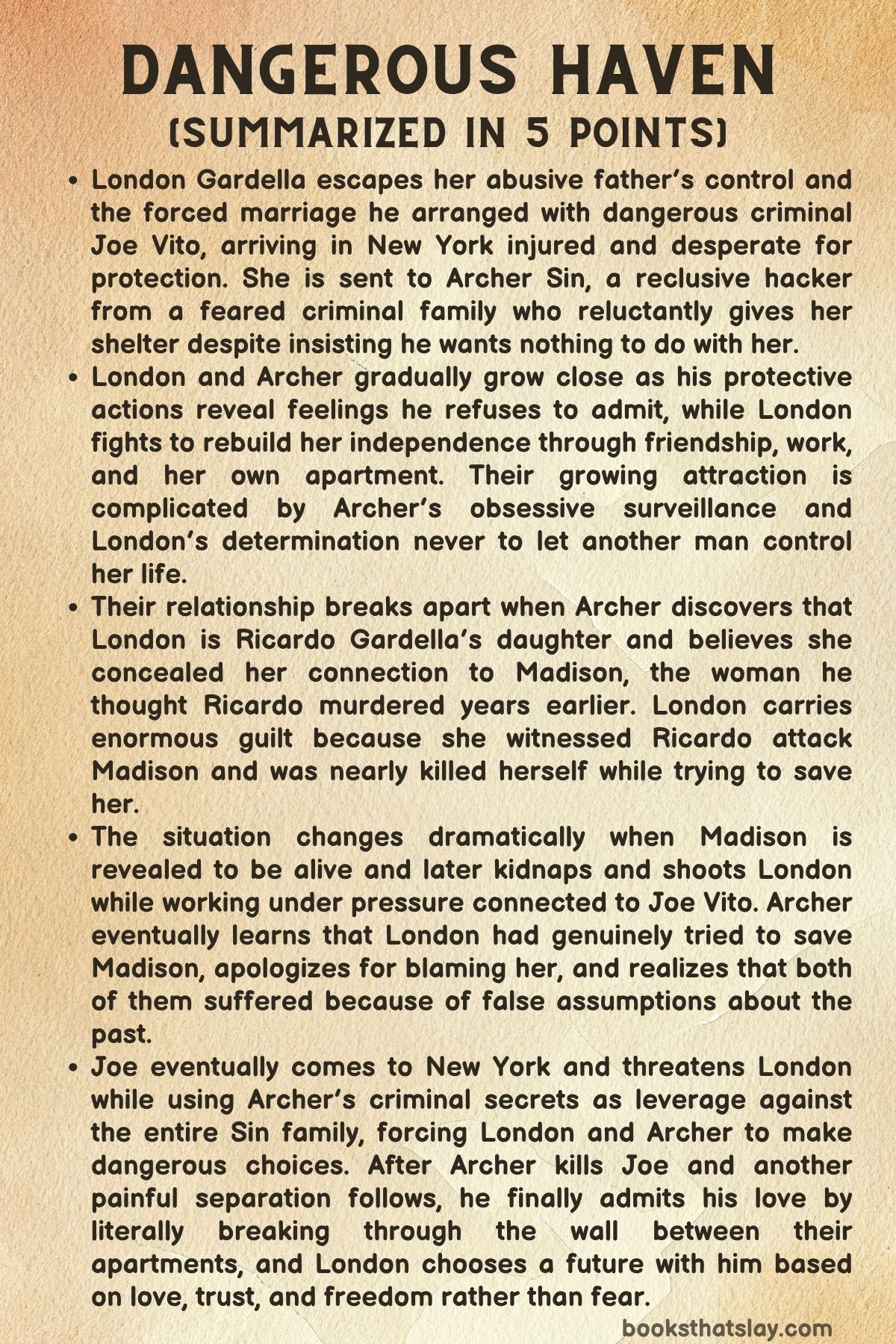
London Gardella reaches New York after an exhausting seven-day escape from California, badly injured and carrying almost nothing. Her father, Ricardo Gardella, controlled and abused her throughout her life and had arranged for her to marry Joe Vito, a dangerous criminal who viewed the agreement as binding even after Ricardo’s death.
Her only destination is an address given to her by Silver, who promised that the man living there could protect her. When Archer answers the door, London discovers an enormous, tattooed, hostile man who knows nothing about her arrival and initially refuses responsibility for a stranger standing injured outside his apartment.
Archer Sin has spent years deliberately withdrawing from his violent family and the criminal world connected to them. He continues handling finances and technological work because his hacking abilities are valuable, but emotionally he has constructed a life based on isolation, routine, cleanliness, and the belief that caring about other people will eventually lead to loss.
Despite his protests, he lets London stay. Their personalities clash immediately because London is stubborn, sarcastic, chaotic, and determined to make her own decisions, while Archer is intensely controlling about his environment and repeatedly insists that she is not his responsibility.
Archer’s actions soon contradict his words. He shops in the middle of the night for vegetarian food after hearing London casually mention what she eats, cleans up after her, washes her clothes, gives her his bedroom, and worries constantly about her injuries while continuing to claim that he wants her gone.
When Silver finally contacts him, Archer learns the seriousness of London’s situation and the danger represented by Joe Vito. Archer agrees to protect her, and the two establish rules for living together, including London’s promise not to touch his computers and the far less realistic condition that neither of them will fall in love.
Archer begins secretly investigating Joe through his computer systems and confirms that Joe remains in California. He simultaneously becomes increasingly protective of London, even using surveillance cameras to follow her when she ventures into New York alone, an invasion of privacy that reveals how strongly his fear of losing control already influences the way he protects her.
London, meanwhile, begins creating pieces of an ordinary life. She befriends Grace, attempts to manage her own money, searches for clothing and necessities, and insists that she intends to support herself rather than trade dependence on her father for dependence on Archer.
Her determination challenges Archer because he wants her safe but frequently confuses safety with supervision. When London collapses from exhaustion, however, their emotional connection becomes harder to deny, especially when she allows herself to sleep beside him and experiences his presence as something comforting rather than threatening.
The more time they spend together, the more London’s independence and Archer’s protectiveness come into conflict. Archer gives her access to his money without demanding anything in return, while London reluctantly begins distinguishing his generosity from the financial domination she experienced under Ricardo.
London also begins learning about Archer’s family. His siblings August, Leo, Ivy, and Seven force their way into his carefully controlled apartment, introducing London to the violent, volatile family Archer has spent years avoiding despite his obvious attachment to them.
A disastrous family gathering ends with Seven and Archer fighting so violently that Grace eventually knocks Seven unconscious with a chair. London also discovers that Archer is not simply an antisocial technology expert but one of the Sin brothers, members of an infamous criminal family whose reputation is built on danger, power, and loyalty.
By this point, attraction between London and Archer has become impossible to dismiss. Archer initially insists that kissing her was a mistake, but his jealousy becomes extreme when London agrees to date Drew Kingsley, causing him to interfere through surveillance and eventually confront her himself.
London is attracted to Archer but furious about the way he watches her. She also learns the full truth about his identity as a hacker and Sin brother, yet instead of becoming frightened she tells him that his reputation does not change her decision to remain near him.
Their connection deepens through shared trauma. London reveals that Ricardo murdered her mother when she was a child, while Archer gradually reveals that the Sin siblings formed a family from damaged children who survived difficult circumstances together rather than simply sharing ordinary biological bonds.
A far more dangerous secret emerges when Archer shows London a photograph of Madison, the woman he believes Ricardo killed years earlier. London recognizes Madison as the woman she tried to protect during one of Ricardo’s violent attacks, an intervention that left London nearly dead and permanently scarred.
London does not immediately tell Archer that she witnessed the attack. Her silence becomes increasingly painful as their relationship turns openly romantic, because Archer considers Madison’s death the defining tragedy of his life while London believes she failed to save her.
Archer eventually stops pretending his jealousy means nothing and asks London on a genuine date. Their physical relationship develops alongside a much deeper emotional bond, and Archer repeatedly gives London the reassurance that she is safe with him, something she has rarely experienced without conditions.
Their happiness collapses when Ivy discovers London’s full identity and Archer learns that she is Ricardo Gardella’s daughter. Because London concealed her connection to the man Archer believes murdered Madison, he interprets her silence as betrayal and orders her out of his apartment immediately.
The separation devastates both of them. Archer returns to emotional isolation while secretly continuing to watch over London, and London stays with Grace, works at a bakery, struggles financially, and accepts that although Archer treated her harshly, she should have told him the truth before he discovered it through someone else.
Archer quietly pays a year’s rent so London can move into Camille’s apartment next to his own and secretly buys her extravagant gifts. He insists they are finished while continuing to protect her, proving that emotional separation is far more difficult than simply closing a door between them.
Their attraction brings them together again after Archer crashes into London’s apartment because he mistakes her scream about a spider for an attack. London then asks for something more important than gifts or physical affection: she wants Archer to stop monitoring her constantly and begin respecting her right to privacy.
Archer makes a genuine effort to honor that boundary, but the timing becomes disastrous. London is abducted, drugged, and taken captive by Madison, who is shockingly alive and connected to Joe Vito; Madison shoots London in the stomach and leaves her bleeding while London struggles to use her phone to call Archer.
Archer finds London and gets her to the hospital, but Madison’s survival transforms everything they believed about the past. Soon afterward Joe arrives in New York and reveals that he knows Archer secretly hacked the Manor family, an offense capable of destroying the fragile peace between the Sins and Manors and placing Archer’s siblings in danger.
Joe uses this knowledge to demand London’s surrender. London believes giving herself to him may be the only way to protect Archer’s family, while Archer absolutely refuses to exchange her freedom for his own safety.
Archer confronts Madison and finally learns what truly happened years earlier. Madison survived Ricardo’s attack and deliberately disappeared, while London had genuinely tried to save her and was almost killed for doing so; Archer therefore realizes that he blamed London for an event in which she was actually another victim.
He apologizes to London and promises that Joe will never own her. At the same time, however, both London and Archer secretly develop their own solutions to the crisis because neither entirely trusts the other to make the final decision.
London obtains a gun from Seven and goes to meet Joe without Archer’s knowledge, intending to kill Joe if necessary. Archer independently reaches the same hotel, disguised as an employee, and arrives just as London prepares to confront the man who still speaks about marrying her as though she were property.
London ultimately cannot shoot Joe because she knows his death could expose Archer’s secret and bring retaliation against the Sin family. Archer takes the gun from her and kills Joe himself, choosing immediate protection of London over the uncertain consequences that may follow.
Rather than producing instant reconciliation, Joe’s death creates another rupture. Archer feels London betrayed him by secretly involving Seven and going alone, while London argues that she was trying to reclaim control of her own fate instead of waiting for another man to decide what should happen to her.
London eventually apologizes, but Archer initially refuses to forgive her. Only after days apart does he finally destroy the physical barrier between them by taking a sledgehammer to the wall separating their apartments, an exaggerated but fitting expression of his decision to stop using distance as protection.
Archer admits that he loves London despite everything about her that disrupts his carefully controlled existence, and London tells him she loves him as well. Their reconciliation does not erase their problems, but it establishes that both are choosing the relationship freely rather than remaining together through fear, obligation, or ownership.
In the closing events, London and Archer begin building a shared life while remaining recognizably themselves. Archer helps London recover millions connected to her past, and London tries to help repair divisions within the Sin family, although Leo’s anger after Archer refuses to assist with a casino robbery leaves another family conflict unresolved.
Characters
London Gardella
London is the emotional center of Dangerous Haven, and nearly every major conflict grows from her determination to control her own life after spending years under her father’s authority. She begins the novel physically injured and financially vulnerable, but her most important quality is that she does not interpret vulnerability as permission for someone else to make decisions for her.
Her stubbornness sometimes creates genuine danger, yet it also represents the survival instinct that allowed her to escape Ricardo and reject the marriage he arranged with Joe. Even when Archer’s protection is useful, London constantly tests whether his concern respects her autonomy or simply replaces one form of male control with another.
Her relationship with money shows this clearly. London comes from wealth, but because Ricardo controlled that wealth, earning wages at a bakery and trying to pay for her own apartment gives her a freedom that luxury never provided.
London is also deeply shaped by guilt. She believes she failed Madison and carries physical scars from trying to protect her, which makes Archer’s eventual rejection especially painful because he initially judges her through the identity of her father rather than through her own actions.
Her growth is not a simple movement from weakness to strength because she is strong from the beginning. Instead, she learns that independence does not have to mean refusing every form of help and that loving someone does not automatically require surrendering personal freedom.
Archer Sin
Archer begins Dangerous Haven as a man who has turned isolation into a personal defense system. His apartment, routines, computer systems, and obsessive cleanliness give him a controlled environment in which emotional surprises can be minimized, while his withdrawal from his siblings protects him from the possibility of repeating an earlier devastating loss.
London destroys that arrangement almost immediately. Archer says he does not want responsibility for her, yet his behavior repeatedly exposes how quickly he becomes invested in her safety, comfort, food, finances, medical condition, and emotional well-being.
His greatest strength and greatest flaw come from the same instinct: he wants to protect people. Because Archer has extraordinary technological abilities, that instinct turns into surveillance, tracking, hacking, and interference, meaning he can easily violate London’s privacy while convincing himself that he is merely preventing danger.
His development depends on understanding that love cannot be reduced to constant supervision. When London asks him to stop watching her, he faces one of his hardest choices because respecting her requires accepting uncertainty, something Archer has spent years trying to eliminate.
Archer’s emotional arc also involves responsibility. His willingness to confess his violation of the Manor treaty shows movement away from avoiding painful consequences, while his apology after learning the truth about Madison demonstrates that he can admit when grief caused him to judge another person unfairly.
Grace
Grace provides London with one of her first relationships in New York that is not based on protection, criminal obligation, money, or family history. She treats London with ordinary friendliness, giving her companionship at a moment when London desperately needs evidence that a normal life might still be possible.
Her presence also prevents London’s world from becoming entirely centered on Archer. Grace offers conversation, humor, social experiences, and emotional support, but she carries her own problem in the form of a controlling father who treats her future as something he can manage for political benefit.
London’s decision to show Grace her scars reverses their usual emotional roles. Instead of being the person rescued by others, London uses her experience to help Grace recognize abusive control and understand that obedience is not the same as loyalty.
Seven Sin
Seven is one of the most volatile figures in Dangerous Haven, combining humor, violence, unpredictability, loyalty, and emotional instability. His early conflict with Archer becomes so severe that he nearly chokes his brother before Grace ends the fight, showing that the Sin family’s love for one another does not prevent them from causing serious harm.
Yet Seven is not presented only as a threat. He forms an unusual friendship with London, shows surprising understanding of her desperation, and eventually gives her the gun she requests even though doing so places him directly against Archer’s wishes.
His fascination with Grace adds another dimension because it hints at his desire for connection beneath the chaos. Seven repeatedly turns emotion into provocation or violence, making him an extreme example of the Sin family’s larger difficulty with expressing fear, loyalty, and affection directly.
Ivy Sin
Ivy acts as one of the strongest forces trying to hold the Sin family together. She repeatedly pressures Archer to attend family events, challenges his isolation, and refuses to accept his claim that withdrawing from everyone is a reasonable long-term solution.
Her initial caution toward London reflects the dangerous world in which the family operates rather than simple hostility. Once London proves capable of handling the family’s reality, Ivy becomes more accepting and eventually treats her as someone who has already seen enough to remain present during private discussions.
Ivy also helps reveal Archer’s identity to London indirectly through the family’s presence and later uncovers London’s true connection to Ricardo. Her actions can create conflict, but they usually arise from loyalty and a belief that concealed truths eventually become more dangerous than uncomfortable honesty.
Leo Sin
Leo initially appears more relaxed than several of his siblings, but his storyline gradually exposes tensions involving loyalty, business, and resentment. His growing connection with Grace creates friction within the family, particularly because Seven is also strongly interested in her.
The closing conflict at Leo’s casino suggests that he shares the family’s tendency to mix dangerous business with personal loyalty. Archer’s refusal to help after repeatedly warning him about risky dealings humiliates Leo, whose promise to remember the rejection leaves their brotherhood in a much less secure position.
August Sin
August functions as one of the more authoritative members of the Sin family. During the chaotic gatherings, he represents an effort to maintain order among siblings who are frequently driven by anger, rivalry, impulsiveness, and unresolved emotional wounds.
His presence also helps establish that the Sins operate as a structured family rather than simply a collection of dangerous individuals. Although he receives less personal development than Archer or Seven, he contributes to the sense that each sibling occupies a particular role in keeping the family functioning.
Silver
Silver is one of the quiet catalysts of Dangerous Haven because he sends London to Archer knowing that Archer would probably refuse if given advance warning. He understands both London’s vulnerability and Archer’s abilities well enough to decide that placing them together is worth the conflict that will follow.
His trust in Archer is significant. When Archer tries to send London elsewhere, Silver refuses to release him from the responsibility and insists that Archer is precisely the person capable of keeping her alive.
Silver therefore serves as an external judge of Archer’s character before Archer is willing to believe the same things about himself. He recognizes that the isolated hacker still possesses loyalty, competence, and a strong protective instinct even if Archer prefers to define himself by distance.
Joe Vito
Joe represents possession without love. His central belief is that Ricardo’s agreement gives him a permanent claim over London, meaning he treats marriage, wealth, reproduction, and partnership as arrangements in which London’s consent is irrelevant.
Unlike Archer, who sometimes becomes controlling because of fear, Joe embraces control as entitlement. He does not need London to choose him because her desires have no value within his understanding of power.
His leverage over Archer makes him more dangerous than a simple physical threat. By using Archer’s violation of the Manor treaty, Joe transforms London into a bargaining object whose surrender could supposedly save an entire family, recreating the exact logic London has spent the story resisting.
Madison
Madison becomes one of the most disruptive figures in Dangerous Haven because her survival changes the meaning of years of guilt, grief, and blame. Archer has built much of his emotional isolation around mourning her, while London has carried the belief that she failed to prevent her death.
Her later behavior demonstrates how suffering does not automatically make someone compassionate. Madison survives Ricardo, but eventually becomes willing to hurt London, works under an obligation to Joe, and even imagines that removing London might create another opportunity with Archer.
At the same time, Madison provides the truth needed to free London from misplaced guilt and Archer from an incomplete version of the past. By confirming that London risked her life trying to save her, Madison unintentionally destroys the accusation that had separated Archer and London.
Ricardo Gardella
Ricardo remains powerful even after his death because much of London’s behavior is shaped by surviving him. His abuse damaged her body, distorted her understanding of money and safety, and taught her that dependence can become a weapon in the hands of someone who claims authority over another person.
His treatment of both London and her mother establishes violence as the foundation of his power. The arranged marriage with Joe extends that control beyond his own life, showing how thoroughly he regarded his daughter as something that could be transferred rather than an independent adult.
Ricardo is also the source of the central misunderstanding involving Madison. Because his violence was so extreme, both London and Archer easily believe he killed her, allowing his actions to damage their relationship years after he is gone.
Drew Kingsley
Drew mainly functions as a contrast to Archer and as a catalyst for Archer’s jealousy. He is polite, attractive, and apparently capable of offering London the kind of ordinary date she believes she should experience while rebuilding her life.
London’s reaction to him reveals that normality by itself is not enough to create emotional intimacy. Even when Drew behaves reasonably, she compares the interaction with the unusual sense of safety and intensity she experiences around Archer.
Camille
Camille initially appears through a potential romantic misunderstanding with Archer, but her more important function is practical. Her plan to leave New York creates the apartment opportunity that eventually allows London to establish a home physically separate from Archer’s.
That apartment becomes symbolically important because London desperately wants proof that she can survive independently. Ironically, Archer secretly pays the rent, complicating the distinction between London’s independence and his continuing desire to protect her.
Blake Manor
Blake represents the dangerous political boundary between the Sin and Manor families. London’s innocent decision to dance with him at the charity gala becomes serious because Archer understands the history and rivalry behind the interaction in a way she does not.
His question about whether Archer is London’s boyfriend forces Archer into an instinctive admission before he is emotionally prepared to make it. Blake therefore becomes an accidental trigger for Archer publicly acknowledging a relationship he had repeatedly tried to define as temporary.
Ruth
Ruth gives London another small connection to ordinary neighborhood life. London’s immediate friendliness toward the elderly shop owner demonstrates her tendency to build relationships easily even while living within the dangerous orbit of the Sins.
The robbery in Ruth’s store also exposes one of the sharpest differences between London and an ordinary outsider. Archer expects his lethal response to terrify her, but London reacts with unsettling calm because violence has been present throughout so much of her life.
Austin
Austin appears briefly during London’s evening with Grace, but his unwanted attention activates both London’s defensive instincts and Archer’s possessiveness. London quietly prepares to defend herself rather than waiting for rescue, reinforcing that even when she accepts protection she does not consider herself helpless.
Archer’s extreme reaction to Austin also pushes him toward greater honesty. Instead of continuing to interfere with every man London meets while denying his feelings, he finally tells her that if she wants a date, she should go on one with him.
Cora
Cora has only a limited presence in the provided story material, but London’s thoughts about her show that London continues worrying about people connected to the violence she escaped. She remembers that Cora’s circumstances contributed to the events surrounding Ricardo’s death and hopes that she is safe.
Her brief mention nevertheless reinforces an important quality in London. Even while injured, displaced, and threatened, she remains capable of thinking about whether someone else survived the same dangerous world.
Grace’s Father
Grace’s father mirrors certain aspects of Ricardo because he treats his daughter as someone whose choices can be subordinated to his ambitions. His violence and political pressure help London recognize abusive patterns from the outside that she spent years enduring herself.
His role also allows London to become a source of strength rather than only a survivor receiving help. By encouraging Grace to claim ownership of her body and future, London turns painful experience into insight that may help another person resist control.
Themes
Freedom, Control, and Personal Autonomy
Freedom in Dangerous Haven is presented as more complicated than physically escaping an abusive person. London successfully leaves California, Ricardo is dead, and she is no longer trapped in his house, yet other people continue trying to determine where she lives, whom she marries, how she spends money, and what risks she is permitted to take.
Joe represents the most extreme version of this problem because he treats Ricardo’s agreement as sufficient authority to claim London as his wife. Her opinion is irrelevant to him, making his idea of marriage an extension of ownership rather than partnership.
Archer occupies a more complicated position. His desire to protect London is genuine, but surveillance, hacking, tracking, and interference repeatedly show how easily protection can become another form of control when the person being protected has no opportunity to consent.
London therefore has to defend her independence even from someone she loves. Her demand that Archer stop monitoring her is crucial because it requires him to recognize that keeping her safe cannot justify eliminating her privacy.
The novel does not suggest that independence means rejecting every form of support. London’s development comes from learning that freely accepting help differs from being forced into dependence, just as Archer’s development comes from understanding that loving someone does not grant authority over every decision they make.
Trauma, Guilt, and the Persistence of the Past
Nearly every important character carries some form of unresolved trauma, and the past repeatedly enters present relationships through fear, secrecy, guilt, or destructive behavior. London carries physical scars from Ricardo’s abuse, memories of her murdered mother, and guilt over believing she failed Madison.
Archer responds to his own trauma differently. Rather than constantly confronting painful memories, he structures his entire life around avoiding circumstances that might create another devastating emotional attachment.
Their relationship becomes possible because each gradually recognizes pain in the other without requiring perfect emotional recovery first. London understands why Archer uses control to manage fear, while Archer slowly realizes that London’s defiance and refusal to surrender decisions are responses to a lifetime in which other people made choices for her.
Madison’s return demonstrates how unreliable trauma-based guilt can become. London believes she failed a dead woman, while Archer believes he failed the woman he loved, yet both have built years of suffering around a death that never occurred.
Learning the truth does not erase what happened, but it changes what responsibility means. London can finally understand that attempting to save Madison was an act of courage rather than failure, and Archer can begin separating genuine grief from blame that was never deserved.
Love, Trust, and the Fear of Vulnerability
Dangerous Haven repeatedly separates attraction from trust. London and Archer become physically drawn to each other long before either is capable of genuine emotional openness, and their strongest conflicts occur whenever desire develops faster than their willingness to share difficult truths.
Their original rule against falling in love is therefore less humorous than it first appears. Both understand attachment as dangerous because London associates relationships with domination while Archer associates them with catastrophic loss.
Secrecy repeatedly damages their bond. London hides her connection to Madison, Archer hides important parts of his criminal life, and both later create separate plans for dealing with Joe rather than trusting the other with the full truth.
The story therefore treats trust as something more demanding than affection. Loving another person requires accepting that the other individual may make choices one dislikes and that preventing every possible mistake is neither realistic nor respectful.
The broken wall between their apartments becomes an effective physical representation of this change. Archer spent years using boundaries and isolation to feel safe, but his eventual decision to destroy the wall reflects a willingness to accept emotional exposure rather than continuing to treat separation as protection.
Chosen Family, Loyalty, and Responsibility
The Sin family challenges conventional ideas of family because its members are not simply connected by biology. Archer explains that they came together as damaged children who survived difficult circumstances and created their own system of loyalty, giving family the meaning of commitment rather than merely blood relation.
Their loyalty, however, is deeply imperfect. Archer and Seven physically attack each other, Leo ends the story furious with Archer, and Ivy repeatedly struggles to stop the siblings from retreating into anger or isolation.
This tension shows that loyalty without communication can become destructive. The Sins are willing to protect one another violently, yet they often have much greater difficulty admitting fear, asking for help, apologizing, or accepting disagreement.
London gradually becomes part of this family structure because she does not merely accept their protection. She challenges them, forms individual relationships with them, and eventually tries to repair conflicts among siblings whose love for one another is obvious even when their behavior suggests the opposite.
Archer’s journey also changes his understanding of responsibility within the family. Instead of believing isolation protects everyone, he begins recognizing that withdrawal can injure people just as seriously as confrontation, while the unresolved conflict with Leo shows that chosen family requires continuous work rather than automatic loyalty.