Doomsdate Summary, Characters and Themes
Doomsdate by Laura Piper Lee is an apocalyptic romantic comedy about two people who have spent years living at a distance from ordinary life for very different reasons.
Maisie Bennett has been conditioned to prepare for catastrophe, while Everett Greer has remained emotionally suspended after the death of his wife. A disastrous first date coincides with the beginning of a zombie outbreak, forcing them into a road trip where survival skills, trust, intimacy, grief, family, and personal freedom become inseparable. Beneath the humor and horror, the novel is ultimately concerned with the difference between staying alive and actually choosing to live.
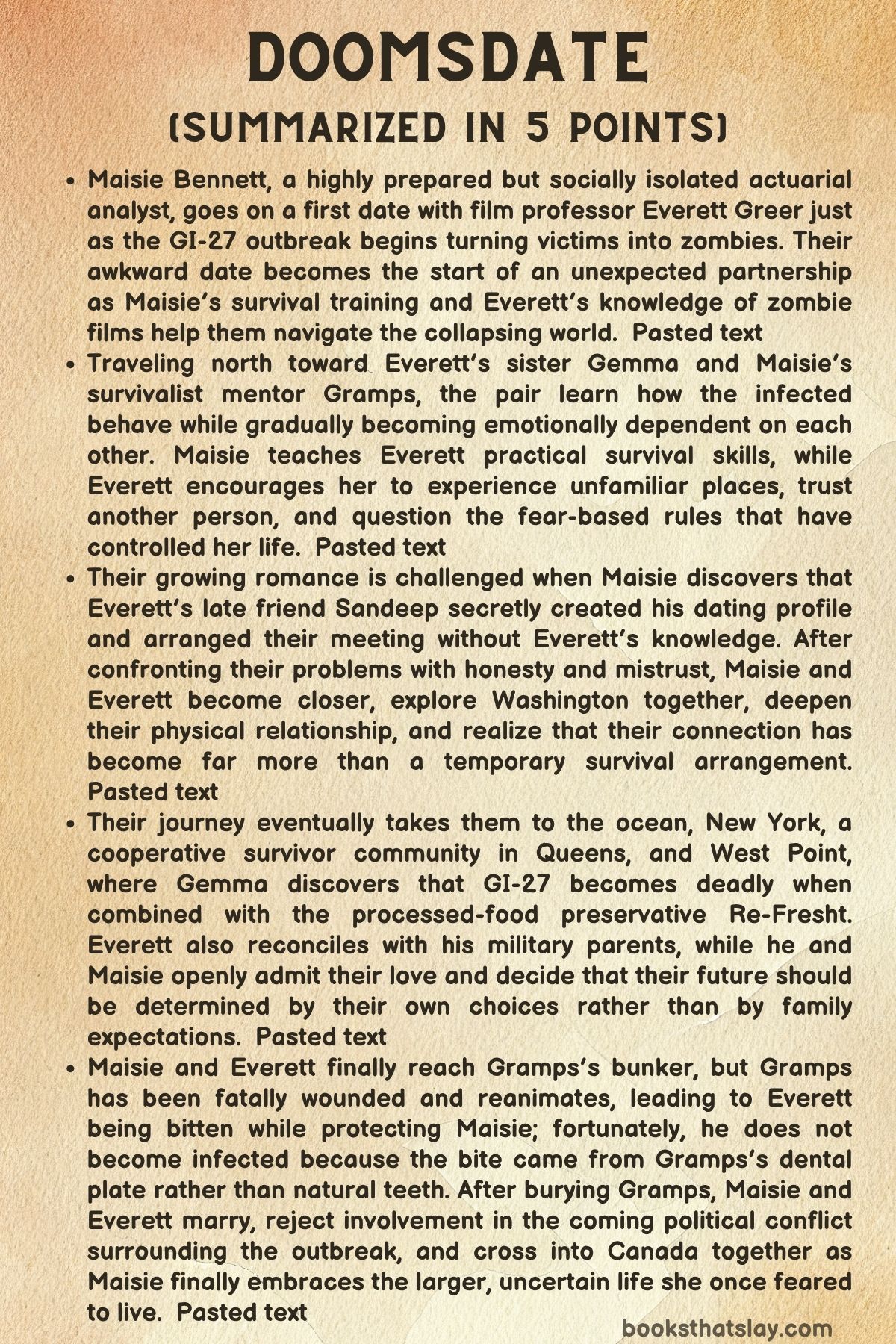
Summary
Maisie Bennett has spent most of her life preparing for disaster. Raised by an intensely paranoid mother and later supported by her survivalist friend Gramps, she knows how to stock supplies, defend herself, communicate by radio, and plan for scenarios that most people would consider absurd, yet she has very little experience with ordinary friendship, romance, travel, or intimacy.
At twenty-nine, Maisie is determined to change that. With her thirtieth birthday approaching and a mysterious illness called GI-27 spreading rapidly, she refuses to cancel a first date with Everett Greer, believing she has already allowed fear to control too much of her life.
Everett is equally unprepared for the date, though for an entirely different reason. His best friend Sandeep secretly created his online dating profile and arranged the meeting because Everett has spent three years emotionally withdrawn following the death of his wife, Louise.
Their meeting begins badly because Maisie relies on memorized dialogue from a dating television program, while Everett has no idea what Sandeep has promised on his behalf. Once they abandon the performance, however, they discover a genuine attraction and an unexpected ability to make each other laugh.
The situation outside deteriorates rapidly. Sick people become violent, the dead begin reanimating, and Maisie and Everett flee the restaurant as society begins collapsing around them.
Maisie impulsively invites Everett home because she has decided that she wants to experience sex before turning thirty. Their attraction develops quickly, but Everett discovers her enormous collection of emergency supplies and overhears Gramps discussing whether he is suitable for Maisie’s bunker, leading him to believe that Maisie intends to keep him as some kind of apocalypse breeding partner. Terrified, he leaves before she can explain.
The misunderstanding soon becomes irrelevant compared with the disaster around them. Maisie is attacked by her infected neighbor and recognizes that her lifelong preparations finally have a real purpose, while Everett reaches Sandeep’s house and discovers that his apparently dead friend has become one of the infected.
Maisie begins driving toward Gramps’s Pennsylvania bunker but unexpectedly discovers Everett trapped in a tree after fleeing a group of zombies. She rescues him, and despite their earlier humiliation, they slowly establish a practical partnership based on combining her survival training with his extensive knowledge of zombie films and horror conventions.
Their partnership deepens after Maisie saves Everett again at his home. There she learns about Louise and realizes that Everett’s apparent emotional distance comes from grief rather than dishonesty, while Everett begins to understand that Maisie’s extreme preparedness developed from a childhood dominated by fear.
Everett wants to reach his toxicologist sister Gemma in Washington, D.C., and Maisie’s route allows him to travel with her. As they move north, they begin studying the infected, noticing that sunlight weakens them, electrical attacks can be effective, and their behavior changes dramatically after dark.
Maisie teaches Everett wilderness skills, combat techniques, and basic survival practices, while Everett gradually teaches Maisie that unfamiliar experiences do not automatically need to be feared. Their attraction continues growing, and Maisie proposes an unusual exchange in which she will teach him survival while he teaches her about sex.
Everett initially hesitates, partly because he is still uncertain about his ability to move beyond Louise and partly because he fears complicating their partnership. After successfully helping Maisie defend their campsite from infected park rangers, however, he begins to recover confidence in himself and agrees that their intimacy lessons can begin.
A temporary refuge in an isolated vacation house allows them to become physically closer, but their relationship is shaken when Everett reveals that Sandeep created the dating profile and communicated with Maisie before their first meeting. Maisie feels deceived because the person she believed had chosen her online never actually existed, even though Everett insists that everything he felt after meeting her was genuine.
Their conflict becomes more significant when Maisie briefly believes Everett is stealing her car after discovering her keys missing. He was merely preparing the vehicle and breakfast, and the resulting argument exposes the deeper problem between them: Maisie expects betrayal because she has been taught that trust is dangerous, while Everett feels ashamed whenever he depends on someone else. They eventually apologize and accept that friendship and partnership require vulnerability as well as caution.
Maisie chooses to accompany Everett into Washington rather than leave him outside the city. They find that Gemma has already departed, so the pair spend another day together visiting museums and exploring the nearly empty capital.
The surreal freedom of wandering through abandoned national landmarks gives Maisie experiences she once believed were beyond her reach. Everett also confronts his painful memories of growing up with demanding military parents who expected him to follow a career path he could not and did not want to pursue.
They eventually shelter in the White House, where their physical relationship grows more intimate and emotionally serious. While searching for useful information, they discover classified materials suggesting that the government knew much more about the outbreak than the public had been told.
Maisie even encounters and kills the zombified president before she and Everett are suddenly captured by another group of survivors. Their captor, Coach Connor, leads a strict community that measures people according to physical usefulness, valuing Maisie while treating Everett as disposable. Maisie initially understands the appeal of such rigid organization because it resembles the survival doctrine of her childhood, but she soon recognizes how quickly preparation can become authoritarian control.
After escaping Connor’s group, Maisie has a painful argument with Gramps. For the first time, she openly rejects the idea that avoiding danger should be the highest purpose of her existence, explaining that Everett has encouraged her to do things she once considered impossible.
Rather than immediately continue toward their destinations, Maisie and Everett delay separation. Everett takes her to the ocean, where the sheer scale and unfamiliarity of the experience becomes symbolic of the larger life Maisie has denied herself, and the two finally consummate their relationship after speaking openly about what intimacy means to each of them.
Their journey then takes them to New York on Maisie’s thirtieth birthday. Although she originally wanted to investigate the grandparents who left her a valuable brownstone, she ultimately chooses not to enter the house because she realizes that discovering her family history cannot determine her identity for her.
After a dangerous encounter with infected animals, they are rescued by Julio Acevedo’s subway train and taken to a survivor community in Queens. There they discover a society built not around suspicion but around cooperation, and Maisie receives the first real birthday celebration of her life.
The Queens survivors also provide a crucial scientific clue. Many of them avoided processed American foods, leading community members to suspect that GI-27 becomes deadly only when combined with a substance present in the food supply.
At West Point, Gemma confirms the theory after examining the White House documents. The catalyst is Re-Fresht, a preservative that transforms the engineered virus into the condition responsible for reanimation, and the evidence proves that powerful officials knew about the danger while concealing it from the public.
Everett also reunites with his parents, Hank and Irene, expecting criticism but receiving an emotional apology instead. He learns that they have secretly tried to understand his academic interests and passion for horror cinema, forcing him to reconsider the belief that they completely rejected the person he became.
Maisie and Everett are offered positions in the emerging military government but refuse because Maisie still intends to reach Gramps. Before leaving, they finally admit that they love each other, transforming their once temporary alliance into a relationship both consciously choose.
Their departure becomes urgent when Gramps contacts Maisie and appears to be under attack. Everett’s family helps the couple escape West Point through massive nighttime zombie swarms by exploiting another discovered weakness: loud sound repels the infected.
When Maisie and Everett finally reach the bunker, they find Gramps mortally wounded after an attack by bandits and zombies. He has been bitten and has attempted to prevent himself from becoming a danger to Maisie, leaving a message asking her to live fully enough for both of them.
Gramps nevertheless reanimates, and Maisie freezes when forced to confront the infected body of someone she loves. Everett protects her and is bitten, apparently condemning himself to the same fate.
Maisie confines Everett inside a cage while they wait for the transformation. Hours pass, and a frightening misunderstanding caused by the reflection from Everett’s glasses briefly convinces Maisie that he has turned, but he remains completely human because Gramps’s dental plate rather than natural teeth caused the wound. Gemma theorizes that infection through a bite depends on biological material associated with natural teeth, giving the survivors a valuable new insight.
Two weeks later, Maisie and Everett prepare to cross into Canada with other American survivors. They have buried Gramps, considered what they want from the future, and married in a small ceremony surrounded by the people who have become their chosen family.
A final revelation suggests that Re-Fresht, Gatherers, and radical homesteader Talitha Bones may all be connected to a deliberate attempt to destroy modern society and create a supposedly purified replacement. Rather than join the coming military conflict, Maisie and Everett choose exploration, companionship, and an uncertain future together, and Doomsdate ends with Maisie using the passport she once feared would never matter as she crosses the Canadian border and enters the larger world she has finally decided to experience.
Characters
Maisie Bennett
Maisie Bennett is the emotional center of Doomsdate, and her development depends on the distinction between preparedness and genuine freedom. She begins as an extremely competent woman who can fight, plan, calculate risk, maintain emergency supplies, and survive conditions that overwhelm almost everyone around her, yet those abilities exist beside a profound inability to trust ordinary human experience.
Her mother’s paranoia has convinced her that safety comes from minimizing dependence on other people, so even romance becomes something Maisie approaches through scripts, deadlines, rules, and measurable objectives. Her desire to lose her virginity before thirty initially resembles another task on a checklist rather than an expression of emotional readiness.
The apocalypse ironically becomes the setting in which Maisie learns to stop organizing her entire life around avoiding danger. Everett, the ocean, Washington, New York, the Queens community, and eventually Canada all represent experiences that the earlier Maisie would have considered unnecessarily risky.
Her greatest transformation occurs when she understands that vulnerability is not simply a weakness that survival training failed to eliminate. Loving Everett, trusting strangers, grieving Gramps, and entering an unknown country all require a kind of courage different from physical combat, and by the ending she becomes someone willing to accept uncertainty because a meaningful life cannot be completely controlled.
Everett Greer
Everett Greer’s development in Doomsdate moves from emotional suspension toward active participation in his own future. When the story begins, Louise’s death has left him physically alive but psychologically detached, and Sandeep’s decision to create a dating profile for him reflects how little initiative Everett has shown in rebuilding his personal life.
He initially appears far less capable than Maisie because he cannot drive, lacks wilderness knowledge, possesses almost no useful supplies, and repeatedly needs her assistance. That practical helplessness reinforces a deeper insecurity created by his parents’ expectations and by years of believing that his work in film and horror has little real value.
The outbreak gradually reverses this belief. Everett’s knowledge of zombie stories helps identify patterns in infected behavior, while his willingness to learn allows him to become increasingly capable in combat, planning, and observation.
His romantic growth is equally important because loving Maisie does not erase Louise or reduce the importance of his first marriage. Instead, his developing relationship proves that grief does not require permanent emotional withdrawal, and his final commitment to Maisie represents a choice to preserve his past without allowing it to consume his future.
Gramps
Gramps is both Maisie’s protector and one of the strongest forces preserving the fearful worldview she must eventually challenge. He genuinely loves her, worries about her safety, investigates Everett, teaches her to remain suspicious, and provides the bunker that appears to promise protection from the collapsing outside world.
His importance in Doomsdate comes from the fact that he is not simply wrong. Much of his survival advice proves valuable, and the catastrophe repeatedly confirms that preparation, caution, weapons, supplies, and secure shelter matter enormously.
The conflict arises because Gramps treats survival as the highest value rather than one value among many. When Maisie chooses Everett, travel, trust, and experience, Gramps sees dangerous distraction, whereas Maisie increasingly understands that constant safety can become another form of confinement.
His death completes this conflict in a painful but meaningful way. His final request that Maisie live fully enough for both of them reveals that, at the end, he understands what she has been trying to tell him: survival only matters because it preserves the possibility of living.
Gemma Greer
Gemma Greer provides the scientific intelligence that helps transform scattered observations into a coherent explanation of the outbreak. In Doomsdate, she also functions as a contrast to Everett because she has long appeared to represent the kind of practical, prestigious achievement their parents understood and respected.
Her expertise allows her to identify the laboratory-engineered nature of GI-27, evaluate possible weaknesses in the infected, interpret evidence from the White House, and connect the virus with Re-Fresht. She therefore turns the protagonists’ improvised survival knowledge into information that can potentially shape a larger human response.
Gemma is also more emotionally significant than her scientific role alone suggests. Everett has spent years measuring himself against her accomplishments, but their reunion shows that she is not responsible for the family expectations he internalized.
Rather than functioning as his rival, Gemma becomes part of a restored family relationship. Her presence helps Everett recognize that his old belief that everyone saw him as the unsuccessful Greer child was partly shaped by his own hurt and isolation.
Sandeep
Sandeep’s role is brief in physical terms but enormous in narrative consequence. His decision to create Everett’s dating profile, communicate with Maisie, and arrange the first date initiates the relationship that eventually transforms both protagonists.
His interference is ethically complicated because it violates Everett’s autonomy and unintentionally deceives Maisie. The later revelation almost destroys the trust that has developed between them because Maisie learns that the online version of Everett who appeared to choose her was partly Sandeep’s construction.
At the same time, Sandeep acts because he believes his friend has stopped living after Louise’s death. His choice is intrusive, but it comes from an accurate recognition that Everett has withdrawn so completely that he may never voluntarily take the first step toward another relationship.
His death early in the outbreak therefore carries an additional sadness. Sandeep never learns that the reckless act through which he tried to return Everett to life eventually succeeds far beyond anything he could have expected.
Louise
Louise is dead before the central action begins, yet she remains one of the most influential people in Everett’s emotional life. His home still contains her possessions and photographs, and his inability to change that environment reflects how completely grief has frozen him.
Her importance is not based on rivalry with Maisie. Doomsdate instead presents Louise as part of Everett’s permanent history, allowing his love for Maisie to emerge without requiring him to diminish what his first marriage meant.
Everett initially treats moving forward almost as a betrayal of the dead. His growing desire for Maisie challenges that belief because attraction, intimacy, humor, and hope begin returning despite his assumption that these parts of himself disappeared with Louise.
The later reconciliation with his parents, who openly mourn Louise alongside him, further validates that grief does not need to be erased. Everett’s development depends on carrying love and loss forward rather than turning either into a permanent barrier against future happiness.
Hank Greer
Hank initially exists in Everett’s mind as one half of an intimidating parental unit whose military values made their son feel inadequate. Everett believes that his father judged his poor eyesight, unconventional profession, and lack of interest in a military career as evidence that he had failed to become the person his family expected.
The reunion at West Point significantly complicates this interpretation. Hank admits that he and Irene handled Everett badly, but he also reveals that they have spent years reading their son’s academic work and watching the films connected with his interests because they genuinely wanted to understand him.
That revelation makes Hank important to Doomsdate because his character demonstrates how estrangement can be sustained by real parental mistakes and incomplete assumptions at the same time. The apology does not erase the damage, but it creates the possibility of a relationship no longer controlled by old expectations.
Hank’s willingness to help Maisie and Everett escape West Point also shows that his military discipline can function as support rather than domination. By the end, he accepts Everett’s decisions even when they lead away from the future Hank might personally choose.
Irene Greer
Irene shares much of Hank’s history with Everett, but her emotional reunion with him helps reveal how much affection existed beneath years of conflict. Everett has interpreted his parents primarily through memories of pressure, disappointment, and emotional distance, so their immediate embrace at West Point directly challenges the version of them he has carried for years.
Her apology is important because she does not simply insist that Everett misunderstood everything. Irene accepts responsibility for trying to control his future while also revealing the private effort she and Hank made to understand the adult their son became.
She also participates in the emerging military response to the outbreak, demonstrating that authority itself is not presented as inherently corrupt. The contrast between Irene and Connor is especially useful: both value order and discipline, but Irene eventually respects Everett’s autonomy, while Connor reduces people to their usefulness.
Her eventual acceptance of Maisie completes another part of Everett’s emotional repair. He is no longer forced to choose between the person he loves and the family whose approval once seemed permanently unavailable.
Coach Connor
Coach Connor represents the dangerous side of survivalism when efficiency becomes more important than individual dignity. His settlement appears organized, disciplined, and potentially secure, which explains why Maisie initially sees a certain logic in his methods.
The problem is that Connor evaluates people almost entirely according to physical usefulness. Maisie’s strength earns her status, while Everett’s perceived weakness makes him disposable enough to assign to dangerous patrols.
His community therefore mirrors the harsh worldview Maisie inherited while removing the personal affection that softened Gramps’s version of it. Connor demonstrates what happens when survival becomes a moral system in which stronger or more useful people deserve protection while others can be sacrificed.
Maisie’s rejection of Connor marks another stage in her development because she stops confusing rigid control with genuine safety. Escaping his settlement teaches her that surviving with other people requires cooperation, consent, and mutual respect rather than unquestioned obedience to whoever claims to know best.
Ellie
Ellie represents the kind of social openness Maisie has rarely experienced. As a romance podcaster who transforms her platform into an information network during the apocalypse, she demonstrates that communication and community can become survival tools just as important as weapons or stored food.
Her personality also allows her to recognize immediately that Maisie and Everett’s supposedly practical arrangement has become romantic. The observation is humorous, but it also highlights how obvious their emotional connection has become to outsiders even while they continue struggling to define it themselves.
Maisie’s decision to offer Ellie transportation to West Point is especially important. Earlier in the story, allowing a near stranger into her vehicle would have violated nearly every rule she had been taught.
By trusting Ellie partly because trusted members of the Queens community trust her, Maisie demonstrates that she has begun accepting social relationships built through networks of confidence rather than direct control.
Julio Acevedo
Julio appears at one of Maisie and Everett’s most desperate moments, rescuing them from the infected rats in the subway and bringing them aboard the Survivor Express. As the final MTA employee still operating a train through Manhattan, he represents persistence without isolation.
Unlike the survivalists who protect resources by excluding outsiders, Julio is willing to help strangers as long as they respect the safety of the larger community. His single major rule is therefore based on responsibility rather than suspicion.
Through Julio, the story presents infrastructure itself as something that can be repurposed for collective survival. The subway system, once part of ordinary urban life, becomes a pathway connecting scattered survivors.
His presence also helps move Maisie toward an important realization: strangers are not automatically threats. Sometimes survival depends on allowing an unknown person to open a door and choosing to step through it.
Corinne
Corinne is significant because she helps identify the connection between the outbreak and processed food before Gemma can scientifically confirm the mechanism. Her observation that many Queens survivors avoided conventional processed American foods allows the community to recognize a pattern hidden within the disaster.
She represents practical intelligence built through collective comparison rather than formal authority. The survivors notice what they have in common, share information, and develop a theory from lived experience.
Corinne therefore contributes to one of the story’s broader arguments about knowledge. Experts such as Gemma are essential, but ordinary people comparing observations can discover important truths when official institutions have failed or deliberately concealed information.
The fact that the Queens community shares its findings freely also contrasts sharply with the secrecy surrounding the government documents. Information becomes another resource that can either protect power or protect people.
Talitha Bones
Talitha Bones enters the story late and remains largely outside the immediate action, but the information connected to her radically changes the meaning of the catastrophe. Links between her homesteading movement, Re-Fresht, Gatherers, and the corporations behind the preservative suggest that the outbreak may have been intentionally created rather than merely caused by scientific negligence.
Her ideology also represents an extreme version of the purification mentality already encountered elsewhere. The proposed “Great Reset” treats the destruction of existing society as acceptable if it produces a world supposedly purified of people and systems judged undesirable.
Because Maisie has spent her life around survivalist thinking, Talitha’s possible conspiracy gives that philosophy its darkest political form. Preparation becomes dangerous when it stops being about protecting life and becomes a justification for deciding which lives deserve to remain.
The ending leaves her role unresolved, transforming the personal road story into the beginning of a larger conflict that Maisie and Everett consciously choose not to make the center of their marriage.
Chicken
Chicken, Everett’s cat, has a modest but recurring role that adds warmth to an increasingly dangerous journey. Maisie rescues Chicken shortly after saving Everett, and the animal becomes part of the improvised household that develops around the couple.
Chicken also contributes practically, most notably by reacting to danger when Everett appears to be turning after the bite. The cat’s presence makes the apocalypse feel less abstract because survival is not limited to preserving one’s own body; it includes protecting vulnerable creatures and maintaining small forms of ordinary attachment.
By the time Maisie and Everett prepare to enter Canada, Chicken travels with them as part of their new family. That continuity matters because their future is not imagined as heroic warfare or permanent emergency but as a life containing companionship, possessions, animals, memories, and everyday responsibilities.
Themes
Survival Versus Living
Survival is never treated as meaningless; Maisie’s training repeatedly saves lives, and many of the habits she learned from her mother and Gramps become essential once civilization collapses. The central question in Doomsdate, however, is whether remaining physically alive is enough when fear has eliminated travel, intimacy, friendship, curiosity, trust, and personal choice from the life being preserved.
Maisie begins with an enormous capacity for surviving hypothetical disasters but comparatively little experience of ordinary adulthood. The irony of the apocalypse is that when the disaster finally arrives, she starts doing the things she had always postponed: dating, traveling beyond familiar territory, sleeping outdoors with another person, visiting museums, seeing the ocean, entering New York, accepting hospitality from strangers, falling in love, and crossing an international border.
Gramps embodies the conflict most directly because his advice is useful but incomplete. He can teach Maisie how to minimize danger, yet that philosophy cannot teach her what makes safety worth preserving.
His final message resolves the contradiction by asking Maisie to live fully enough for both of them. The story therefore does not reject preparedness; it rejects preparedness as a substitute for existence, arguing that survival has value because it creates opportunities for experience rather than because indefinite self-protection is meaningful by itself.
Trust, Vulnerability, and Human Connection
Maisie’s deepest difficulty is not fighting zombies but allowing another person enough emotional access to hurt her. Her mother’s worldview taught her that dependence creates danger, so Maisie initially handles relationships through research, rehearsed dialogue, contingency plans, rules, equipment, and controlled exchanges.
Everett repeatedly forces her to confront situations in which certainty is impossible. The dating-profile deception damages her because it confirms her belief that trusting people leads to humiliation, while the misunderstanding over the missing car keys reveals how quickly she assumes betrayal even after Everett has repeatedly protected and supported her.
Their relationship can progress only when both accept that trust cannot be proven in advance. Everett must admit the truth about Sandeep, Maisie must acknowledge how her suspicion affects him, and each must choose the other without possessing guarantees about what will happen next.
The Queens community extends this idea beyond romance. Maisie encounters strangers who share food, information, shelter, and celebration without demanding absolute proof that every newcomer is harmless.
Her development therefore moves from isolated self-sufficiency toward interdependence. The story presents vulnerability not as the opposite of survival but as one of the conditions that makes community, love, and long-term human survival possible.
Grief, Memory, and Moving Forward
Everett’s grief over Louise initially functions like an emotional bunker. He has preserved her belongings, withdrawn from dating, and accepted a life in which continuing to exist seems possible but wanting anything new feels almost disloyal to the person he lost.
Maisie carries a different version of the same burden. Her dead mother remains psychologically present through the rules, fears, and habits that still govern Maisie’s behavior, meaning that both protagonists begin the story allowing absent loved ones enormous influence over their current lives.
Their relationship gradually teaches them that moving forward does not require erasing the dead. Everett can love Maisie without making Louise insignificant, while Maisie can recognize the damage caused by her mother’s fear without denying that those lessons also helped her survive.
Gramps’s death brings this idea into its most painful form. Maisie must physically confront his reanimated body while emotionally accepting that the man she loved is gone, and her hesitation almost costs Everett his life.
The story therefore distinguishes memory from imprisonment. Remembering people who have died can remain an act of love, but allowing grief to dictate every future choice turns memory into another form of confinement.
Choice, Identity, and Self-Determination
Much of Doomsdate concerns characters deciding whether identities assigned by families, institutions, trauma, or social expectations must determine who they become. Maisie has been defined as the daughter of a paranoid survivalist, while Everett has defined himself as the disappointing son, grieving widower, impractical academic, and person who cannot meet the standards represented by his parents and sister.
The road journey repeatedly gives them opportunities to revise these identities through action. Maisie becomes a traveler, lover, friend, community member, and eventually wife, while Everett becomes a capable survivor whose knowledge and empathy repeatedly contribute to keeping them alive.
The abandoned brownstone in New York becomes particularly important because Maisie refuses the idea that discovering her grandparents’ history will automatically reveal who she is. She chooses not to enter, demonstrating that identity does not have to be recovered from family secrets before it can be consciously created.
Everett reaches a similar conclusion when he reconciles with his parents without returning to the future they once imagined for him. Their apology matters, but his life no longer requires parental approval.
Their eventual decision to reject positions in the new military government reinforces the same principle. Even during civilization’s collapse, Maisie and Everett refuse to surrender the right to decide what kind of life they want, choosing marriage, travel, uncertainty, and one another over identities other people have prepared for them.