Cards on the Table Summary, Characters and Themes
Cards on the Table by Lana Harper and Jilly Gagnon is a mystery built around two witchy sisters whose very different relationships with belief, intuition, money, and family are tested inside the isolated home of a wealthy occult collector.
What begins as an unusually lucrative spiritualist job gradually becomes a story about inheritance, deception, surveillance, emotional manipulation, and the danger of trusting appearances too quickly. Cassie and Tori enter Berwyn House thinking their main challenge will be helping an elderly woman reconcile with her dead son, but they soon discover that nearly everyone around Rose Berwyn is hiding something.
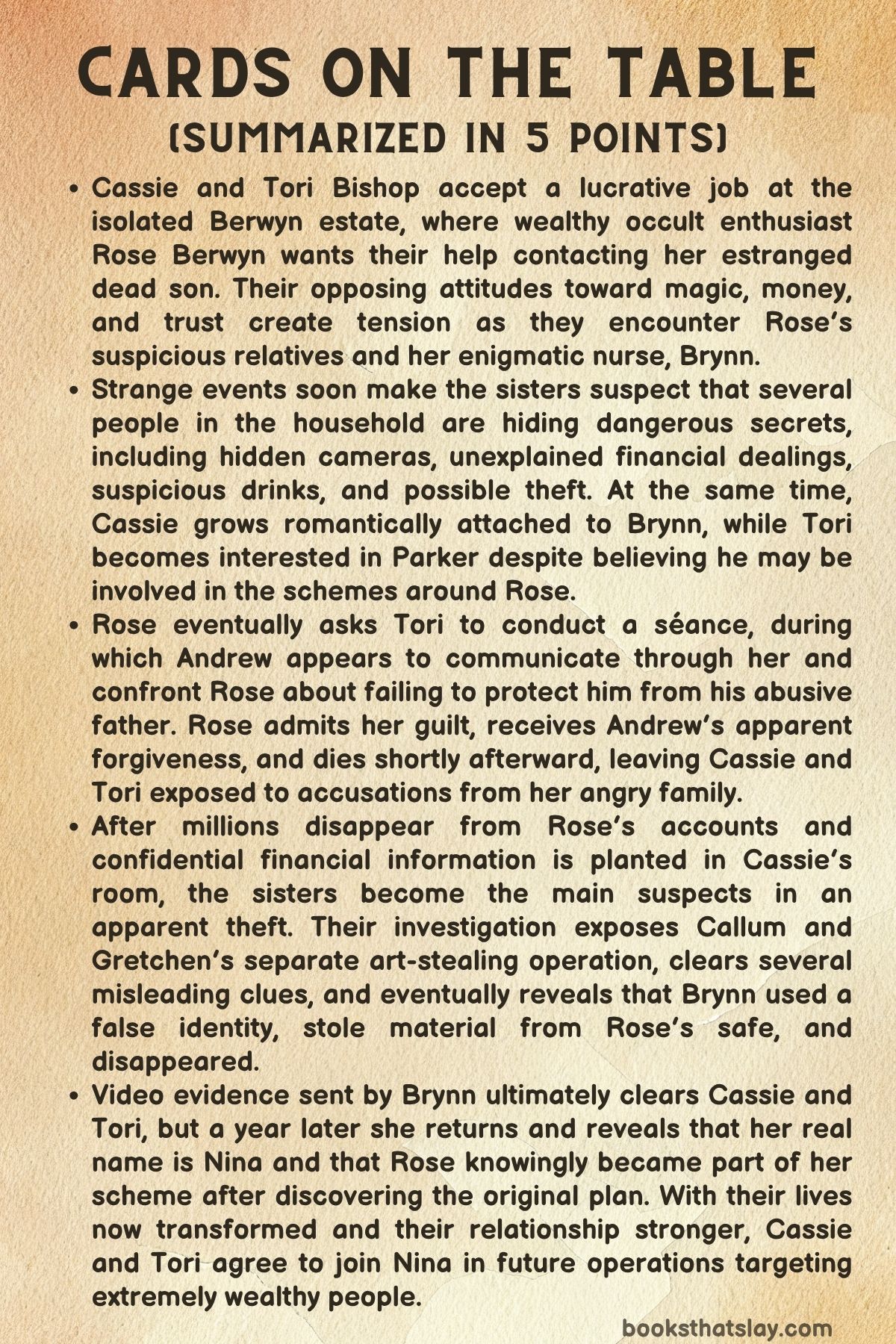
Summary
Cassie and Tori Bishop are sisters running a witchcraft booth at Salem’s Faire of Darkness, but their shared profession conceals a fundamental difference between them. Cassie sincerely believes that their family possesses magical gifts, while Tori treats their work more practically and worries constantly about the financial instability that has followed them for years.
Their lives change when Brynn Chilton approaches their booth and asks Cassie to create a powerful protection spell against a supposedly dangerous coworker. After Cassie completes it, Brynn admits that the story was an audition and explains that she works as a nurse for Rose Berwyn, an extremely wealthy elderly woman with a fascination for occult history who wants resident spiritualists to stay at her Berkshire estate.
Rose hopes the sisters can eventually help her communicate with Andrew, her deceased and estranged son, and she is willing to pay them twenty-five thousand dollars for the work. Tori initially refuses because the offer sounds suspicious, but she changes her mind after discovering that she and Cassie are behind on rent and face losing their home.
At Berwyn House, the sisters encounter Rose’s tense and deeply divided family circle. Linda, Callum, Parker, and other members of the household all seem to have their own opinions about Rose’s money, her health, and the strange newcomers she has invited into the mansion.
Cassie is immediately forced to demonstrate her abilities by giving Rose a tarot reading in front of the family. Her cards seem to describe Rose’s grief, isolation, and the greed surrounding her with unsettling accuracy, delighting Rose but angering Callum, who openly accuses the sisters of manipulating an old woman for money.
At the same time, Cassie becomes increasingly attracted to Brynn, who comforts her after the humiliating confrontation and appears to respect both her beliefs and her intelligence. Tori, meanwhile, remains suspicious of nearly everyone and begins noticing signs that something inside the mansion is not what it appears to be.
The situation becomes more disturbing when Cassie overhears Linda telling the housekeeper, Marta, to put something into Rose’s gin. Tori separately discovers a hidden camera in Rose’s occult collection and later sees Callum behaving secretly around Gretchen, a younger woman who turns out to have connections to the family’s legal affairs.
Tori also sees Parker placing cameras around the property, which appears to confirm that someone is monitoring the estate. Because she is becoming attracted to Parker, however, her suspicions become personally uncomfortable, just as Cassie’s feelings for Brynn complicate her own ability to judge the nurse objectively.
The sisters’ personal tension grows alongside the mystery. Tori continues withholding the truth about their financial problems until Cassie finally forces her to reveal that eviction proceedings have begun and that they may return from the Berwyn job with nowhere to live.
That argument exposes a much older wound involving their mother, Brittany Bishop. Cassie remembers Brittany as the source of their magical heritage, while Tori remembers the woman who abandoned them and left twelve-year-old Tori responsible for raising six-year-old Cassie, forcing both sisters to confront how differently they have interpreted the same childhood.
Cassie’s trust in Brynn begins to weaken when she discovers a private-investigator report on herself and Tori hidden among Rose’s legal papers. The report was prepared six months earlier, even though Brynn had claimed she only recently began searching for witches, suggesting that the sisters were selected long before they knew anything about Rose.
Before Cassie can understand what this means, Rose’s health rapidly worsens. After an emotionally intense healing ritual in which even skeptical Tori senses something unusual, Rose summons the sisters during the night and asks them to conduct a séance so she can communicate with Andrew.
Unexpectedly, Rose insists that Tori act as the medium because she trusts the skeptical sister not to manufacture a comforting answer. During the séance, Tori seems to become a channel for Andrew, speaking in a manner unlike herself and physically experiencing the abuse he suffered from his father, Pierce.
Through Tori, Andrew confronts Rose for failing to protect him when Pierce abused him. Rose finally admits her failure, expresses remorse, and appears to receive forgiveness from her son before suffering a fatal medical crisis moments later.
Rose’s death immediately turns the sisters’ already dangerous situation into something worse. Linda and Callum become suspicious when they discover that Rose gave Tori an expensive toadstone ring and Cassie a valuable Gardnerian necklace, and Callum demands that their rooms be searched for other missing property.
The search produces apparently devastating evidence when papers containing Rose’s passwords, financial information, and security answers are found beneath Cassie’s mattress. The family then discovers that millions of dollars have disappeared from Rose’s accounts, making it look as though the sisters entered the mansion, gained Rose’s confidence, stole from her, and were preparing to escape with her fortune.
Brynn offers information that partially helps them, explaining that the password document was still in Rose’s safe after the séance and confirming that Rose deliberately gave Cassie and Tori their valuable gifts. Her statement proves that someone must have taken the document from the safe after Rose’s death and deliberately planted it in Cassie’s room.
Police questioning places further pressure on the sisters because their financial desperation provides an obvious motive. Detective Brian Hillary learns that the stolen millions were transferred into a concealed Swiss account, while Cassie and Tori can offer suspicions about almost everyone but no single explanation that connects all the strange events.
The sisters finally stop keeping secrets from one another and compare everything they have learned. The hidden cameras, Callum’s conversations with Gretchen, Linda and Marta’s suspicious discussion about the gin, the oysters around the property, Brynn’s contradictory story, and Rose’s private investigation all appear sinister, but they seem to belong to several different schemes rather than one unified conspiracy.
Parker eventually explains that his outdoor cameras were installed for wildlife research rather than surveillance. His genuine confusion about the hidden indoor camera shifts attention elsewhere, especially toward Brynn, who controlled the medical monitor in Rose’s bedroom and therefore had access to recordings of Rose’s private activities.
Then Brynn suddenly disappears. Her belongings are gone, the bedroom monitor has vanished with her, and the key to Rose’s safe-deposit box is also missing, forcing Cassie to accept that the woman she trusted most may have manipulated both her romantic feelings and her spiritual confidence.
Cassie and Tori continue investigating instead of allowing the family’s secrets to distract them. By observing Callum’s reaction to the hidden camera in Rose’s collection room, they expose him as its owner, but his scheme turns out to involve a separate crime rather than Rose’s missing fortune.
Callum admits that Gretchen was helping him alter records and secretly sell pieces from Rose’s valuable collection. Gretchen, who is revealed to be Marta’s daughter, had used her legal access to assist him because Callum believed that property he expected eventually to inherit was effectively already his.
Other mysteries also collapse into much less murderous explanations. Linda wanted Marta to mix collagen supplements into Rose’s gin rather than poison her, while Marta had secretly been eating oysters despite Rose’s severe shellfish allergy; Cassie’s earlier illness was caused because she herself is allergic to shellfish.
Rose’s will creates further frustration for the family because her estate is placed in a restrictive trust divided among Linda, Callum, and Parker. The arrangements prevent the heirs from simply selling Berwyn House, demonstrating that even after death Rose has structured her fortune to control what happens to the property and to the relatives who expected to inherit it freely.
Attention finally returns to Brynn. Linda discovers that the nurse’s background has effectively disappeared: her social-media presence is gone, her supposed staffing agency has little genuine existence, and the identity she used cannot be connected securely to the woman who lived at Berwyn House.
Cassie realizes that Brynn had a perfect opportunity to plant Rose’s password sheet while everyone was distracted immediately after the séance. It becomes clear that “Brynn Chilton” was a constructed identity and that Cassie had been deliberately positioned as a believable suspect because of her financial problems, unconventional profession, and emotional attachment to the woman manipulating her.
The proof arrives when Tori receives a message directing her to an email from Brynn. Attached footage from Rose’s bedroom monitor shows Brynn opening Rose’s safe after the séance and removing its contents, while investigators discover that the real woman whose identity she used had died years earlier.
The evidence clears Cassie and Tori, although it leaves Cassie struggling with the knowledge that much of her relationship with Brynn was based on lies. Tori offers a more complicated interpretation, pointing out that the impostor voluntarily sent evidence that exonerated the sisters and therefore may not have been entirely indifferent to them or to Rose.
A year later, Cassie and Tori have transformed their lives. Rose’s payment and the valuable stone Cassie retained allowed them to move into a waterfront apartment and establish a successful Salem business called the Bishop Sisters’ Book of Shadows, while Tori remains connected with Parker and his efforts to give the Berwyn property a sustainable future.
At the Faire of Darkness, however, Cassie encounters Brynn again beneath a changed appearance. The woman reveals that her real name is Nina and finally explains that the apparent theft was far more complicated than either sister understood.
Nina originally intended to steal valuable objects from Rose, but she eventually grew genuinely attached to her and confessed the plan. Rather than turning Nina in, Rose became fascinated by the scheme and decided to participate, using her knowledge, fortune, and long-established investigation of Cassie and Tori to design a final operation of her own.
Rose had therefore known about the Bishop sisters months before they arrived, explaining the early investigative report. What looked like a straightforward theft becomes Rose’s final act of control and rebellion, allowing her to redirect wealth while frustrating relatives whose entitlement and behavior she resented.
Nina then proposes that Cassie and Tori join her in future schemes aimed at extraordinarily wealthy targets. Cassie refuses to participate without her sister, and Tori enthusiastically agrees, ending Cards on the Table with the sisters finally operating as genuine partners rather than opposites who conceal their fears and doubts from each other.
Characters
Cassie Bishop
Cassie is the emotional and spiritual center of Cards on the Table, defined by her desire to believe that the world contains meanings that cannot always be proven through ordinary evidence. Her faith in tarot, ritual, inherited witchcraft, and intuition gives her confidence and compassion, but it also creates one of her greatest vulnerabilities: she sometimes treats emotional conviction as evidence.
Her relationship with Brynn exposes this weakness most clearly because Cassie wants their connection to be genuine so badly that she repeatedly explains away signs that should trouble her. Discovering the private-investigator report, the suspicious cameras, and Brynn’s contradictory timeline gradually forces Cassie to understand that intuition becomes dangerous when it is separated from critical judgment.
Cassie’s development is therefore not a rejection of magic but a refinement of belief. By the end, she still values spiritual experience, but she has learned that faith should not require blindness and that loving someone does not remove the need to question them.
Her relationship with Tori is equally important because Cassie initially experiences her sister’s protectiveness as mistrust and control. Once she understands how much of Tori’s behavior developed from being abandoned and forced to become Cassie’s caretaker as a child, she begins seeing that their conflict is rooted in love distorted by fear rather than simple incompatibility.
Tori Bishop
Tori functions as the practical and skeptical counterweight in Cards on the Table, approaching nearly every situation through evidence, financial reality, and risk. Her skepticism is partly intellectual, but it is also a survival mechanism formed by a childhood in which trusting their mother repeatedly led to disappointment.
Because Tori became responsible for Cassie while still a child herself, she has developed a habit of protecting her sister through secrecy and control. She hides the eviction crisis because she believes carrying the burden alone will spare Cassie pain, yet this decision repeats the very pattern that damages their relationship: Tori decides what Cassie can handle instead of allowing her to participate as an equal.
The séance represents the greatest challenge to Tori’s worldview. She cannot easily explain away what happens when she appears to channel Andrew and physically experiences his suffering, leaving her with evidence that does not fit comfortably inside her established understanding of reality.
Her growth comes from accepting uncertainty without abandoning reason. By the ending, Tori has not simply become Cassie’s kind of believer; instead, both sisters move toward one another, with Tori allowing room for unexplained experiences while Cassie becomes more careful about what belief can and cannot prove.
Rose Berwyn
Rose is the architect of much of the chaos in Cards on the Table, even though for most of the story she appears to be the vulnerable person everyone else is manipulating. Wealthy, intelligent, theatrical, suspicious, and fascinated by the occult, she understands her relatives far better than they understand her and deliberately uses uncertainty to expose their motives.
Her deepest emotional wound concerns Andrew. Rose knows that her failure to protect him from Pierce damaged their relationship beyond repair, and her desire for a séance is not mere curiosity about the supernatural but an attempt to confront guilt she has carried for years.
Her reconciliation with Andrew shortly before her death gives her emotional closure, but the final revelation shows that Rose remained strategic until the end. Rather than passively allowing Nina to rob her, she learned the truth and chose to transform the attempted crime into an elaborate plan of redistribution and revenge.
Rose is therefore both victim and manipulator. She was harmed by her husband, abandoned emotionally by her son for understandable reasons, exploited by relatives, and targeted by a thief, yet she also turns almost everyone around her into participants in a final game whose full rules only she understands.
Brynn Chilton / Nina
Brynn, eventually revealed as Nina, is the most deliberately deceptive figure in Cards on the Table because even her name and professional history are manufactured. She constructs an identity convincing enough to survive reference checks and embeds herself in Rose’s household, where her access as a caregiver gives her knowledge of Rose’s routines, valuables, safe, health, and family conflicts.
Her manipulation of Cassie is especially effective because she recognizes exactly what Cassie wants emotionally. She offers validation, attraction, respect for Cassie’s spiritual beliefs, and apparent vulnerability, creating a relationship that makes suspicion feel almost like betrayal.
Yet Nina is not presented as emotionally empty. Her eventual confession to Rose, the care she seems to show during Rose’s illness, her decision to send evidence clearing Cassie and Tori, and her return a year later suggest that some of her attachments became genuine even though they began inside a fraudulent plan.
That contradiction makes her more complicated than a conventional thief. Nina is capable of deception and exploitation, but she is also capable of loyalty on her own unconventional terms, making it difficult to separate where the performance ends and authentic affection begins.
Parker
Parker becomes one of the more grounded figures in Cards on the Table, although the sisters initially have strong reasons to distrust him. Tori sees him installing cameras around the estate and later notices his familiarity with Gretchen, making him appear connected to the various secret schemes unfolding around Rose.
His supposed surveillance eventually receives an innocent explanation: the cameras are part of his interest in wildlife rather than a plot against Rose. This revelation is important because it illustrates one of the novel’s central mechanisms, in which suspicious behavior may be real without being connected to the crime the sisters are trying to solve.
Parker’s relationship with Tori develops through the same process. Attraction makes her wary of being fooled, but unlike Cassie’s experience with Nina, Tori eventually discovers that her strongest suspicions about Parker were largely incorrect.
His proposal to use the Berwyn property for wildlife and nature retreats also reveals his relationship to inheritance. Where Callum largely sees the estate as wealth to be extracted, Parker imagines a way for the property to remain useful and financially sustainable without simply being sold.
Callum
Callum is openly hostile from the sisters’ arrival, making him one of the easiest people to suspect. His contempt for Cassie and Tori’s work, his obsession with Rose’s assets, and his aggressive conduct after her death all reveal a man who believes his expected inheritance gives him a claim over Rose’s decisions while she is still alive.
He does turn out to be committing a serious crime, but not the crime that frames the sisters. Working with Gretchen, Callum secretly alters collection records and arranges the sale of valuable artworks because he believes the wealth will eventually belong to him anyway.
His behavior illustrates entitlement more than desperation. Rather than accepting Rose’s ownership of her possessions, he mentally converts future inheritance into present ownership and uses that belief to justify theft.
Callum also demonstrates how a guilty person can still be innocent of another crime. His involvement in art theft makes him deceptive and exploitative, but it does not make him responsible for the missing millions, showing why Cassie and Tori repeatedly struggle when trying to turn suspicious behavior into reliable conclusions.
Linda
Linda initially appears controlling, financially motivated, and potentially dangerous. Cassie’s overheard conversation about adding something to Rose’s gin makes Linda seem capable of poisoning her, while Linda’s hostility toward the Bishop sisters after Rose’s death strengthens the impression that she has something to hide.
The truth is considerably less sinister. The substance intended for Rose’s drink is a collagen supplement, and Linda’s concerns about Rose contain a mixture of self-interest, frustration, and genuine family anxiety rather than a simple desire to harm her.
Linda’s eagerness to accuse Cassie and Tori is still revealing because she quickly accepts a narrative that places blame on outsiders. The jewelry, the passwords, their financial difficulties, and their unusual profession make the sisters convenient suspects, and Linda prefers that straightforward explanation until evidence forces the family to reconsider.
Marta
Marta occupies a quieter but important place in the household because her actions produce several misleading clues. Her conversations with Linda and her secret handling of oysters make her look potentially involved in an attempt on Rose’s life.
The explanation reveals ordinary rule-breaking rather than murder. Marta has been secretly using shellfish despite Rose’s dangerous allergy, and her carelessness inadvertently makes Cassie ill because Cassie shares a shellfish allergy.
Her connection to Gretchen also gives the family mystery another layer. Marta is horrified rather than complicit when she learns that her daughter has been helping Callum manipulate Rose’s collection records, demonstrating that family connections in the house do not automatically mean shared motives.
Gretchen Bergstrom
Gretchen appears first as a suspicious outsider whose secret meetings with Callum directly contradict the professional neutrality she later performs as Rose’s attorney. Her role gives Callum access to legal and administrative mechanisms that make his theft scheme easier to conceal.
Her participation is particularly serious because she abuses a position associated with trust. Rather than merely helping Callum move physical objects, she assists in falsifying the records that determine what Rose actually owns.
The revelation that Gretchen is Marta’s daughter further complicates the household’s relationships without making Marta responsible for her choices. Gretchen represents one of several examples of individuals independently exploiting Rose, creating an environment in which almost every hidden act looks connected even when the motives are separate.
Andrew Berwyn
Andrew is physically absent from the main events but emotionally central to Rose’s life. His childhood under Pierce was marked by abuse, and Rose’s failure to protect him created a wound that eventually destroyed his relationship with his mother.
The séance gives Andrew a form of presence through Tori. Whether interpreted literally as supernatural communication or as an unexplained psychological event, the encounter forces Rose to face the truth she has spent years avoiding.
Andrew’s forgiveness does not erase what happened to him. Instead, it allows the story to distinguish forgiveness from denial, because Rose must first acknowledge that she failed him before any reconciliation becomes possible.
Pierce Berwyn
Pierce represents the destructive force behind Rose and Andrew’s estrangement. Accounts of his cruelty and physical violence establish him as a husband and father whose behavior damaged the family long after his direct presence ended.
His importance lies largely in the consequences other people carry. Andrew grows up knowing that one parent harmed him while the other failed to intervene, and Rose spends the later part of her life burdened by what her fear, complicity, or inaction allowed.
Pierce therefore remains influential even after death. The family mystery concerns money and inheritance on the surface, but the emotional history of Berwyn House cannot be understood without recognizing the damage he introduced into it.
Brittany Bishop
Brittany is another absent parent whose choices continue shaping her daughters. Cassie romanticizes her as the source of their magical inheritance, while Tori remembers the instability, neglect, criminal behavior, and eventual abandonment that forced her to become responsible for Cassie.
The sisters’ conflicting memories demonstrate how children can preserve different versions of the same parent. Cassie needs a meaningful story about what Brittany gave them, whereas Tori has survived by refusing to disguise abandonment as something noble.
Their conflict over Brittany is therefore more than a disagreement about magic. It is a disagreement over how pain should be remembered, and their eventual reconciliation requires accepting that Cassie’s need for meaning and Tori’s anger can coexist without either sister controlling the other’s interpretation.
Detective Brian Hillary
Detective Hillary represents the pressure of conventional evidence once the sisters become criminal suspects. From his perspective, the case against them initially appears strong: they desperately need money, they were present when Rose died, expensive objects belonging to Rose are in their possession, and confidential financial documents are found in Cassie’s room.
His skepticism frustrates Tori because he does not immediately treat the many strange behaviors around Berwyn House as equally significant. Yet his approach also reflects the problem the sisters themselves must learn to solve: suspicion is not proof, and an investigator cannot replace direct evidence with intuition simply because another theory feels more convincing.
When the bedroom footage finally establishes Nina’s actions, the investigation can shift away from Cassie and Tori. Hillary therefore functions less as an antagonist than as a reminder that clearing their names requires evidence capable of surviving outside the sisters’ personal interpretations.
Sonya
Sonya, Rose’s previous caregiver, appears only indirectly but plays an important role in explaining how Nina entered the household. Her departure after unexpectedly obtaining money makes her part of the chain that allowed the false Brynn identity to appear legitimate.
Because Linda believes Nina came through a trusted recommendation, Sonya helps demonstrate how carefully the infiltration was prepared. A convincing deception does not depend on one lie alone; it depends on creating enough supporting details that each individual verification appears reasonable.
Mrs. DiRenza
Mrs. DiRenza has a small role but creates one of the practical pressures that sends the sisters to Berwyn House. By revealing that their rent is overdue and that their lease will not be renewed, she transforms Brynn’s strange offer from an optional adventure into something Tori feels they cannot afford to reject.
Her role also establishes the sisters’ financial vulnerability before the later theft accusations. Their genuine need for money eventually becomes part of the circumstantial case against them, making the eviction crisis both a personal problem and an important element in how easily they can be framed.
Themes
Belief, Skepticism, and the Search for Truth
Belief and skepticism are not treated as simple opposites in Cards on the Table; instead, Cassie and Tori gradually discover that both become dangerous when pushed too far. Cassie’s faith gives her emotional openness, creativity, and confidence in forms of knowledge that cannot easily be measured, but her desire to believe in Brynn causes her to ignore evidence that conflicts with what she wants to be true.
Tori faces the opposite limitation. Her skepticism protects her from manipulation and encourages her to notice practical inconsistencies, yet her certainty that everything must have a rational explanation is shaken by the séance, when she experiences something she cannot comfortably explain through performance or coincidence.
The sisters eventually move toward a more balanced understanding. Cassie learns that intuition should lead to questions rather than automatically provide answers, while Tori learns that refusing to accept uncertainty can become as limiting as blind faith.
Truth therefore emerges through cooperation between different ways of seeing. Observation, emotion, evidence, intuition, memory, and doubt all contribute useful information, but none of them is reliable enough to stand alone.
Sisterhood, Protection, and Equality
Cassie and Tori love each other deeply, but much of their conflict comes from a relationship that has never fully escaped the roles created during childhood. When Brittany disappeared, Tori became responsible for Cassie, turning an older sister into a substitute parent long before she was emotionally prepared for that responsibility.
As adults, Tori continues protecting Cassie by controlling information. Hiding the eviction crisis seems compassionate from her perspective, but Cassie experiences the secrecy as proof that Tori does not respect her ability to participate in difficult decisions.
Cassie creates a different problem by interpreting Tori’s caution as simple negativity. Because Cassie wants greater independence, she sometimes rejects valid warnings precisely because they come from the sister whose protectiveness she finds suffocating.
Their experience at Berwyn House gradually forces a healthier partnership. Once they stop withholding evidence and begin comparing what each has observed, they become far more effective at understanding the overlapping schemes surrounding Rose.
Their emotional reconciliation follows the same pattern. Sisterhood becomes strongest when neither woman acts as the unquestioned protector or the protected younger sister, but when both recognize the other as an equal whose perspective can correct their own blind spots.
Deception, Performance, and Manipulation
Nearly every major mystery depends on the difference between what something appears to mean and what it actually means. Cameras suggest surveillance but may be used for wildlife research, secret substances placed in drinks suggest poisoning but turn out to be supplements, oysters appear connected to an assassination attempt but instead reveal careless rule-breaking, and secret legal meetings hide art theft rather than the disappearance of Rose’s millions.
Nina represents the most sophisticated form of performance. She creates a professional identity, builds a believable online history, adopts the role of a devoted caregiver, and establishes emotional intimacy with Cassie while pursuing a hidden plan.
Yet Cards on the Table refuses to make performance identical to complete falseness. Nina begins as a deceiver but apparently develops genuine affection for Rose and possibly Cassie, while Rose herself turns deception into a deliberate instrument once she decides to cooperate with Nina.
The theme therefore raises a difficult question about whether authentic emotion can exist inside dishonest circumstances. The novel suggests that it can, but authenticity does not erase responsibility for manipulation.
Cassie’s eventual maturity comes from understanding this distinction. Nina may have genuinely cared about her, but genuine feeling cannot transform lies into truth or make the consequences of those lies insignificant.
Family, Inheritance, and the Burden of the Past
Family inheritance in the story is never limited to money or property. Rose’s relatives expect to inherit wealth, Cassie believes Brittany passed down magical gifts, Tori believes their mother passed down abandonment and instability, and Andrew carries the emotional consequences of abuse that originated inside his family home.
Rose’s estate makes material inheritance especially complicated. Callum treats expected wealth as though it already belongs to him, while Rose responds by designing legal restrictions that prevent her heirs from using Berwyn House exactly as they please.
The Bishop sisters face a different form of inheritance because they must decide what parts of Brittany’s legacy deserve to remain important. Cassie does not have to abandon witchcraft merely because her idealized image of their mother was inaccurate, just as Tori does not have to deny every unexplained experience simply because she rejects Brittany’s mythology.
Cards on the Table ultimately presents inheritance as something that must be interpreted rather than simply received. Money, property, trauma, stories, beliefs, and family roles arrive from the past, but each character decides whether to preserve them, exploit them, challenge them, or transform them.
Rose’s final scheme captures that idea in extreme form. Even in death, she refuses to let inheritance operate automatically, turning her fortune into one last attempt to reshape the futures of everyone connected to her.