Murder at the Grand Alpine Hotel Summary, Characters and Themes
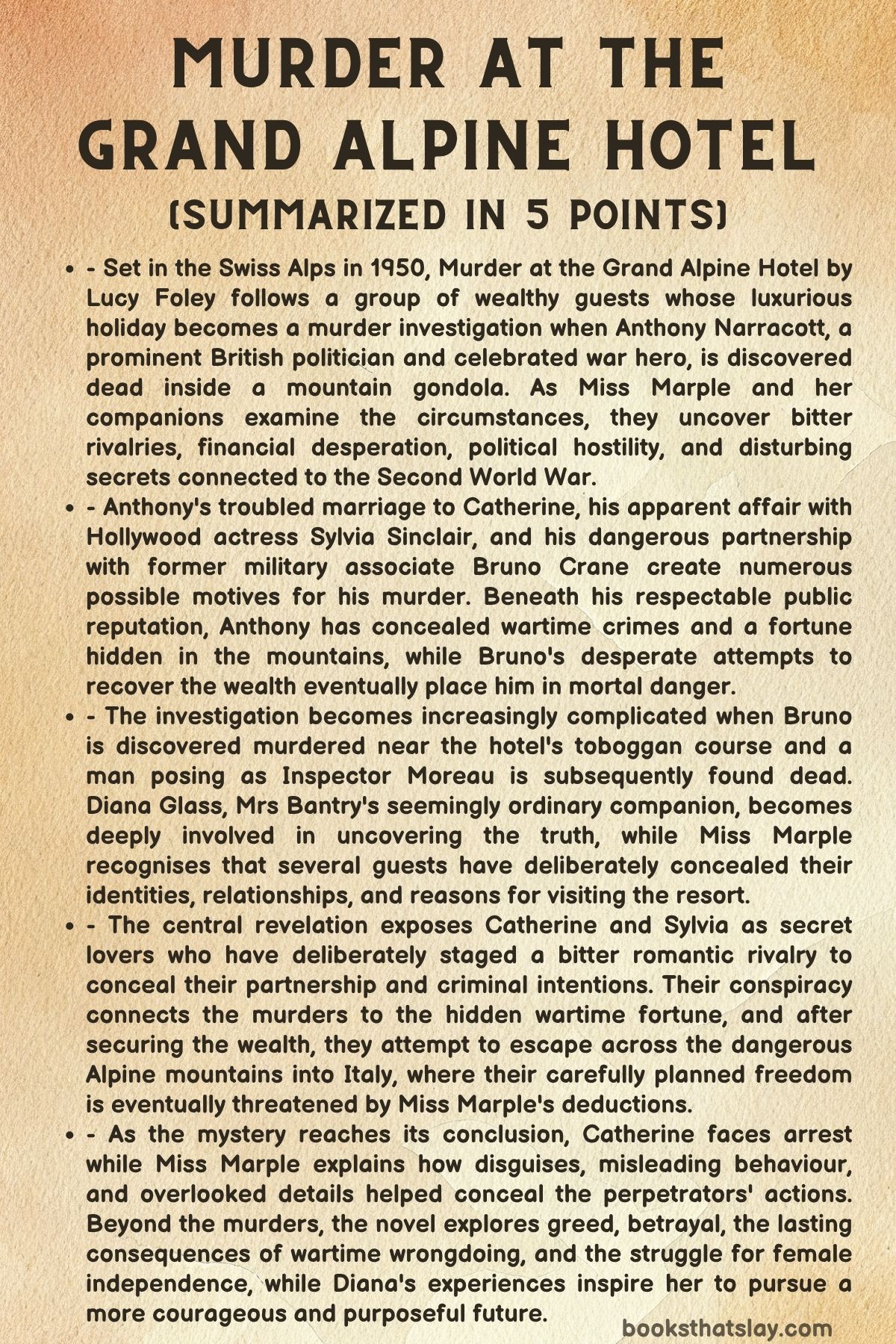
Murder at the Grand Alpine Hotel by Lucy Foley is a historical murder mystery set in the Swiss Alps in 1950, combining the elegance of an exclusive mountain resort with the dangerous secrets left behind by the Second World War.
The novel follows several guests whose relationships are shaped by ambition, betrayal, money, and concealed identities. When a prominent British politician is found dead in a mountain gondola, Miss Marple becomes involved in an investigation that exposes connections between wartime crimes and present-day violence. Through shifting perspectives and carefully constructed deceptions, the story examines the difference between public appearances and private intentions, questioning whether justice always arrives in the form people expect.
Summary
The story begins in the Swiss Alps in 1950, where a gondola approaches the highest station of the Grand Alpine resort. A lift attendant notices that its solitary passenger is sitting unnaturally still, and when the cabin stops, the passenger collapses onto the floor, revealing that a death has occurred.
The narrative then returns to the events preceding this discovery, introducing Diana Glass, a former War Office secretary who is accompanying her employer, Mrs Dolly Bantry, and the elderly Miss Jane Marple on a luxurious Swiss holiday.
Their destination is the Grand Alpine Hotel, an exclusive establishment surrounded by glaciers, snow-covered forests, and dangerous mountain slopes. Although the surroundings offer a welcome escape from postwar Britain, the hotel’s isolation creates an underlying sense of vulnerability.
Miss Marple appears content to knit and observe the other guests, while Diana takes an active interest in the resort’s surroundings. Mrs Bantry, recently widowed, is eager to enjoy the holiday, although she occasionally worries about the dangers associated with such a remote location.
Among the guests are Anthony Narracott, a celebrated wartime hero and ambitious Conservative politician, and his wife, Catherine. Their marriage appears respectable, but Catherine privately struggles with her husband’s coldness, dishonesty, and financial irresponsibility.
Anthony has exhausted much of Catherine’s inheritance through unsuccessful investments, leaving their apparently privileged existence increasingly insecure. Catherine becomes particularly alarmed when she discovers a container of rat poison among the drinks equipment in their suite.
Anthony dismisses the poison as a practical joke, but the incident introduces the possibility that someone intends to harm him. His political activities have also attracted enemies, including a hostile young man who repeatedly appears near him.
Another important arrival is Bruno Crane, a dishevelled former military associate of Anthony’s. The two men share a dangerous secret from the Second World War, although Anthony publicly presents Bruno as an old friend visiting for mountain climbing.
Bruno is financially desperate and resentful of Anthony’s success. Their conversations reveal that they were involved in wartime crimes and concealed a valuable fortune on the glacier.
Anthony arranges a dangerous climb to discuss recovering their hidden wealth away from possible witnesses. During the excursion, Diana and Miss Marple observe the men through binoculars and notice hostility suggesting that one might be considering pushing the other from the mountain.
Their suspicion grows when Anthony and Bruno undertake a secret nighttime expedition across the glacier. Anthony has ensured that Catherine will remain asleep through medication, allowing him to pursue the concealed fortune without questions.
Meanwhile, Hollywood actress Sylvia Sinclair becomes another important figure at the hotel. Glamorous and apparently confident, Sylvia privately suffers from insecurity, depression, and loneliness, despite her fame and wealth.
She has travelled to Switzerland because of a complicated romantic relationship, and her behaviour gradually reveals an apparent involvement with Anthony. When Catherine discovers their intimacy, she becomes deeply distressed.
The conflict between the women intensifies during a public confrontation in the dining room. Catherine accuses Sylvia of interfering in her marriage, while Anthony humiliates his wife by ordering her to return to their room.
A later encounter between Catherine and Sylvia in the bathroom makes their supposed hostility even more obvious. Sylvia insists that Anthony belongs to her, and their exchange is overheard, establishing a seemingly convincing romantic rivalry.
Other threatening incidents complicate the situation. Sylvia survives an attack in her bathtub, while Catherine narrowly avoids serious injury during a skiing excursion with Anthony.
Bruno’s circumstances also deteriorate after a gambling episode in which he risks a large sum of money. His desperation increases as he comes to believe that Anthony intends to cheat him out of their recovered fortune.
The opening mystery is eventually explained when Anthony’s body is discovered in a mountain gondola. His death transforms the hotel into the centre of a murder investigation, with numerous guests possessing plausible motives.
Catherine collapses after learning that her husband has died, while Sylvia appears overwhelmed by the destruction of her romantic hopes. Bruno experiences both relief and fear, recognising that Anthony’s death has freed him from a domineering companion but also endangered his access to the hidden gold.
Diana and Miss Marple begin examining the circumstances. Suspicion falls upon Catherine because of her unhappy marriage, Sylvia because of her relationship with Anthony, Bruno because of their financial conflict, and the hostile young man because of his apparent political resentment.
Bruno becomes especially suspicious when he violently searches Catherine’s bedroom for the missing fortune. Alarmed that the approaching police may arrest him, he attempts to escape by taking control of a mountain railway train.
Diana pursues him and manages to board the moving vehicle despite considerable danger. Their reckless journey ends inside an unstable tunnel, where they narrowly avoid disaster.
A man presenting himself as Inspector Moreau subsequently questions the guests. Diana assists him and finds herself increasingly attracted to his intelligence and apparent sensitivity.
The interviews expose Anthony’s many enemies. The hostile young man reveals that his hatred is connected not merely with political disagreement but also with a deeply personal family grievance.
Bruno attempts to conceal the truth about his wartime activities by invoking official secrecy. Catherine emphasises political threats against Anthony, while Sylvia encourages suspicion of the betrayed widow.
As the investigation continues, Bruno begins to suspect that another guest possesses the missing gold. Instead of revealing his discovery, he attempts blackmail, demanding a portion of the fortune in exchange for his silence.
He receives an apparently cooperative reply arranging a secret meeting near the hotel’s famous toboggan run. Believing that his financial troubles are finally ending, Bruno goes to the secluded location while the other guests attend a competition.
Diana participates in the dangerous toboggan race and notices Bruno heading toward the trees. Shortly afterward, his body is discovered in the woodland, establishing that the threat has not ended with Anthony’s death.
The second killing suggests that someone is deliberately eliminating people connected with the wartime fortune. Bruno’s knowledge has made him dangerous, and his attempt to profit from another person’s secret has resulted in his death.
Diana continues working with Moreau, and their growing attraction becomes complicated by the secrets both are keeping. Their conversations suggest that the apparent detective may be investigating matters beyond the immediate murders.
The situation becomes more disturbing when Moreau is also found dead. Miss Marple subsequently reveals that he was not a genuine French police inspector and had been using a false professional identity.
His deception forces Diana to reconsider their relationship and his purpose at the resort. It also demonstrates that the murder investigation itself has been influenced by people concealing their true identities.
Miss Marple then confronts Diana about inconsistencies in her own behaviour. She has noticed that Diana sometimes speaks French with native fluency despite ordinarily presenting herself as an Englishwoman with imperfect command of the language.
Diana admits that her background is connected with wartime resistance activities and Anthony’s concealed crimes. She came to Switzerland seeking evidence that would expose his betrayal and destroy his celebrated reputation.
Although Diana wanted Anthony punished and prosecuted, she insists that she did not intend to kill him. Her objective was to establish the truth about his wartime conduct and secure justice through public exposure.
Miss Marple meanwhile begins recognising the significance of seemingly minor details involving altered hair, disguises, dogs, and the movements of particular guests. These observations lead her toward a completely different interpretation of the relationships surrounding Anthony.
The decisive revelation concerns Catherine and Sylvia. The two women were never genuinely competing for Anthony’s affection; they were secretly lovers who deliberately performed hostility to disguise their relationship.
Their public arguments created an apparently convincing explanation for their behaviour while preventing others from imagining that they were cooperating. Together, they sought to obtain the hidden gold and remove those who threatened their plans.
The deaths of Anthony and Bruno, along with the killing of the false inspector, are connected to this larger conspiracy. The women’s carefully constructed appearances allowed them to direct suspicion toward other guests while preparing their escape.
When Miss Marple recognises their deception, Catherine and Sylvia have already disappeared from the hotel. Rather than attempting to descend toward the village through the obstructed railway, they have taken their fortune across the dangerous Black Bear Pass.
Their mountain crossing reveals Catherine’s exceptional skiing abilities and determination. The woman previously presented as a submissive society wife proves capable of extraordinary physical endurance and calculated risk.
Catherine experiences the journey as a liberation from her oppressive marriage and the social expectations that have governed her life. Sylvia similarly imagines abandoning her Hollywood identity and beginning an independent future with the woman she loves.
The two successfully reach Italy and disguise themselves as nuns to continue travelling without attracting suspicion. For a moment, they believe that they have escaped both the authorities and their former lives.
However, their train is unexpectedly delayed, and someone approaches their compartment. Catherine begins crying as the door opens, suggesting that their carefully arranged escape has been discovered.
The narrative later confirms that Catherine has been arrested in Italy and faces proceedings connected with Anthony’s murder. Miss Marple’s deductions about the women’s disguises, movements, and secret partnership have helped bring the authorities to them.
Miss Marple also explains that she deliberately avoided confronting the dangerous women inside the hotel because doing so might have endangered innocent people. Her priority was preventing further violence rather than forcing an immediate arrest.
Diana survives the dangers surrounding the investigation and returns to St Mary Mead with Miss Marple and Mrs Bantry. The experience changes her understanding of the kind of life she wishes to lead.
Instead of seeking only comfort and security, Diana recognises that she wants to use her abilities for a meaningful purpose. Her final conversation with Miss Marple establishes a shared belief that intelligence, courage, and usefulness matter more than conforming to the limited roles society assigns women.
Characters
Diana Glass
Diana Glass is one of the central characters in Murder at the Grand Alpine Hotel, serving as an important observer of the mystery while gradually emerging as a woman with a complicated personal history. Initially introduced as Mrs Bantry’s competent and unassuming companion, Diana appears to be a respectable Englishwoman whose primary responsibility is ensuring her employer’s comfort.
However, her behaviour repeatedly suggests that she possesses abilities far beyond those required for domestic companionship. Her confidence on skis, remarkable physical courage, command of languages, and willingness to investigate dangerous situations all indicate that her outward appearance conceals a more adventurous personality.
Diana’s association with the War Office and wartime resistance activities provides the foundation for her personal connection to Anthony Narracott. She has travelled to Switzerland with a purpose that extends beyond an ordinary holiday: she wants to expose the crimes concealed behind Anthony’s reputation as a national hero.
Her commitment to uncovering the truth distinguishes her from characters primarily motivated by money or personal revenge. Although she wants Anthony punished, she seeks public accountability rather than murder, revealing her belief that justice requires evidence and recognition of wrongdoing.
Diana’s relationship with the man calling himself Inspector Moreau also exposes her emotional vulnerability. Despite her intelligence and cautious nature, she develops genuine feelings for him and struggles with the knowledge that their connection is shaped by secrecy.
Her physical bravery becomes particularly evident when she boards Bruno’s runaway mountain train and later participates in the dangerous toboggan competition. These episodes challenge the expectation that a respectable female companion should remain passive and avoid danger.
By the conclusion, Diana has undergone a significant transformation. She no longer wishes to organise her life entirely around safety and social respectability, instead recognising that her courage, intelligence, and experience can serve a greater purpose.
Catherine Narracott
Catherine Narracott is among the most psychologically complex characters in Murder at the Grand Alpine Hotel, initially appearing as the neglected wife of an ambitious British politician. Her upbringing has prepared her to perform the role of a perfect society woman, teaching her obedience, elegance, and the importance of maintaining respectable appearances.
Her marriage to Anthony represents the limitations of this upbringing. He controls their relationship, spends her inheritance, humiliates her publicly, and expects her to accept his authority without question.
Catherine’s early behaviour encourages sympathy because she appears trapped in a marriage that offers neither affection nor freedom. Her distress over Anthony’s apparent infidelity and her fear during their dangerous skiing excursion strengthen the impression that she is a vulnerable woman threatened by her husband.
The revelation of her relationship with Sylvia Sinclair dramatically changes the reader’s understanding of her character. Catherine is not simply the helpless wife she has appeared to be, but an intelligent and determined conspirator who has manipulated the assumptions of those around her.
Her public confrontations with Sylvia are deliberate performances intended to hide their romantic attachment. By presenting themselves as rivals, the women take advantage of society’s expectation that two women connected with the same man must necessarily be enemies.
Catherine’s physical abilities further undermine her submissive public identity. Her excellence at skiing, familiarity with Alpine conditions, and ability to handle firearms demonstrate that she possesses considerable independence and competence.
Her involvement in murder complicates any interpretation of her liberation as an entirely admirable achievement. Although her desire to escape an oppressive marriage is understandable, she becomes willing to participate in violence to secure her freedom and financial future.
Catherine ultimately represents the disturbing intersection of genuine suffering and deliberate cruelty. Her transformation from apparently obedient wife to calculating fugitive illustrates how a person can simultaneously be a victim of injustice and responsible for serious wrongdoing.
Sylvia Sinclair
Sylvia Sinclair brings glamour, theatricality, and emotional complexity to Murder at the Grand Alpine Hotel. A celebrated Hollywood actress, she appears confident, glamorous, and comfortable commanding attention, but her private reflections reveal deep insecurities about ageing, desirability, and the approaching decline of her career.
Her dependence on carefully maintained appearances is central to her personality. Clothing, cosmetics, sunglasses, and dramatic behaviour allow her to control how others perceive her, concealing her natural shyness and periods of emotional suffering.
Sylvia’s attachment to her dog, Herb, provides a revealing contrast to her public image. The affection she shows him suggests a longing for uncomplicated companionship and emotional security that her professional success has never fully satisfied.
Her apparent involvement with Anthony Narracott initially places her within a familiar narrative of adultery and romantic jealousy. Her confrontations with Catherine reinforce the impression that she is a glamorous mistress determined to replace an inconvenient wife.
The later revelation that Sylvia and Catherine are lovers transforms those earlier interactions. Sylvia’s professional experience as an actress has helped her construct an elaborate deception in which the performance of romantic rivalry conceals genuine emotional intimacy.
Her love for Catherine appears sincere, and their imagined future together offers a possible escape from the limitations of her public identity. Nevertheless, Sylvia’s participation in the conspiracy shows that powerful emotional attachment does not necessarily produce moral responsibility.
She can be affectionate, frightened, lonely, and compassionate in one situation while capable of deception and violence in another. Her character resists simple classification because her emotional vulnerability exists alongside her willingness to cause suffering.
Sylvia also illustrates the burden of living through an identity shaped by public expectation. Even when she attempts to leave her glamorous persona behind, she continues relying on performance and disguise to achieve her objectives.
Anthony Narracott
Anthony Narracott is the central murder victim in Murder at the Grand Alpine Hotel, but his importance extends far beyond the circumstances of his death. His political prominence, celebrated wartime reputation, and attractive public personality initially establish him as an influential figure whose success appears to reflect courage and ability.
Behind this carefully maintained image, Anthony is controlling, dishonest, and profoundly self-interested. His treatment of Catherine reveals his contempt for women who fail to satisfy his expectations, while his interactions with Bruno expose an even more threatening capacity for domination.
Anthony’s financial troubles are particularly significant because they expose the fragility of his apparent success. Having squandered much of his wife’s inheritance, he becomes increasingly dependent upon recovering the wealth concealed during the war.
His relationship with Bruno provides a disturbing account of his true character. Although he describes Bruno as an old military friend, he consistently intimidates and humiliates him, treating their partnership as an arrangement in which only Anthony deserves authority.
The revelation of Anthony’s wartime crimes destroys the moral foundation of his celebrated public reputation. His achievements have been presented as heroic despite the betrayal and suffering connected with his actual conduct.
Anthony’s political influence also demonstrates how easily social standing can protect a corrupt individual from scrutiny. His charm enables him to manage public impressions, while his authority discourages those closest to him from challenging his behaviour.
His death becomes the event that exposes the consequences of his actions. The many motives surrounding his murder arise from the destructive relationships, financial exploitation, and historical crimes he has accumulated.
Although Anthony is killed early in the investigation, his influence continues shaping nearly every important development. His character illustrates how a powerful individual can leave behind a network of resentment and danger that persists after his death.
Bruno Crane
Bruno Crane is a deeply flawed and ultimately tragic figure whose life has been shaped by greed, guilt, poverty, and his destructive relationship with Anthony Narracott. Unlike Anthony, Bruno cannot conceal his deterioration beneath wealth, elegance, or political success.
His shabby appearance, drinking, gambling, and frequent emotional outbursts immediately distinguish him from the prosperous guests at the hotel. However, his unpleasant behaviour conceals a more complicated mixture of humiliation, fear, and desperation.
Bruno’s wartime association with Anthony has left him psychologically dependent upon a man he both hates and fears. He knows that Anthony is capable of violence, yet continues cooperating with him because the hidden fortune represents his best opportunity to escape financial ruin.
His gambling episode reveals an important weakness in his personality. Even when he unexpectedly obtains enough money to improve his circumstances, he cannot resist risking everything in pursuit of greater wealth.
This inability to recognise limits repeatedly places him in danger. His desperate attempt to escape the hotel by operating a mountain train demonstrates the same impulsiveness that governs his financial decisions.
Bruno’s relationship with Catherine becomes threatening when he searches her belongings for the missing gold. Although he is frightened and vulnerable himself, he readily intimidates others when his own interests are threatened.
His decision to blackmail the person he suspects of possessing the fortune ultimately proves fatal. Believing that information will protect him, he fails to recognise that threatening a murderer may make him another target.
Bruno is neither an innocent victim nor a purely malicious figure. His involvement in wartime wrongdoing establishes his moral responsibility, while his suffering under Anthony’s domination reveals how fear and dependency can gradually destroy a person’s judgment.
His death completes a destructive progression in which the pursuit of wealth prevents him from recognising the danger surrounding him. The fortune that he imagines will provide freedom instead becomes the central cause of his downfall.
Miss Jane Marple
Miss Jane Marple is the intellectual and moral centre of Murder at the Grand Alpine Hotel, demonstrating that extraordinary investigative ability can exist behind an apparently ordinary exterior. Her age, knitting, gentle conversation, and preference for quiet observation encourage other characters to underestimate her.
Unlike investigators who depend primarily upon formal authority or dramatic interrogation, Miss Marple studies human behaviour. She notices inconsistencies between what people say, how they behave, and the impressions they deliberately attempt to create.
Her understanding of character allows her to recognise that apparently convincing emotional displays may be performances. This ability becomes essential when Catherine and Sylvia construct their false rivalry.
Miss Marple understands that public arguments do not necessarily establish genuine hostility. Her observations enable her to question whether the women’s conspicuous resentment might serve a purpose beyond expressing their feelings.
Her attention to small physical details is equally important. Changes in appearance, discarded hair dye, the behaviour of dogs, and seemingly unremarkable movements around the hotel help her reconstruct the deception.
She also recognises inconsistencies in Diana’s identity and notices that Moreau’s professional claims do not withstand careful examination. These discoveries demonstrate her refusal to accept outward appearances simply because they seem socially credible.
Miss Marple’s moral judgment becomes particularly significant when she chooses not to confront Catherine and Sylvia immediately. She understands that desperate murderers may react violently if trapped, and she prefers protecting innocent lives to achieving a dramatic resolution.
Her decision illustrates the distinction between solving a crime and acting responsibly upon that knowledge. She recognises that the timing and consequences of an arrest matter alongside the identification of the guilty.
Miss Marple’s final connection with Diana also demonstrates her ability to recognise potential in others. She understands Diana’s desire for a meaningful life and quietly encourages an independence that conventional society might discourage.
Mrs Dolly Bantry
Mrs Dolly Bantry provides warmth, humour, and emotional stability throughout the novel. Recently widowed, she has travelled to Switzerland hoping to enjoy a pleasant holiday with Miss Marple and Diana, away from the difficulties of ordinary life.
Her generous nature becomes apparent through her relationship with Diana. Although she employs her as a companion, she treats her with genuine affection and frequently encourages her to enjoy activities independently.
Mrs Bantry’s social position gives her access to the exclusive world of the Grand Alpine Hotel, but she lacks the arrogance displayed by Anthony Narracott. She is approachable, conversational, and interested in the people around her.
Her responses to the murders are those of a relatively ordinary person confronted with extraordinary circumstances. She becomes frightened, impatient, and sometimes frustrated, particularly when the investigation seems to make little progress.
This emotional openness contrasts with Miss Marple’s calm analytical manner. Mrs Bantry frequently voices questions or concerns that allow Miss Marple to explain her observations and reconsider the available evidence.
Her compassion toward Catherine also reveals her tendency to trust conventional emotional appearances. Having experienced widowhood herself, she initially identifies with Catherine’s apparent suffering.
Mrs Bantry’s frustration when the suspected murderers seem to escape reflects her strong belief that wrongdoing should receive punishment. Nevertheless, she gradually accepts Miss Marple’s explanation that protecting innocent people may require delaying direct action.
Her presence prevents the story from becoming entirely dominated by suspicion and violence. Through her loyalty and affection, Mrs Bantry represents ordinary human kindness in a setting where many relationships are governed by manipulation.
Inspector Moreau
The man presenting himself as Inspector Moreau is an especially intriguing figure because his apparent professional authority becomes an important part of the novel’s deception. He enters the investigation as an intelligent and observant French detective whose confidence encourages the other guests to cooperate.
His questioning appears methodical and persuasive. By interviewing those closest to Anthony, he helps reveal the politician’s political enemies, financial troubles, unhappy marriage, and concealed wartime associations.
Moreau also becomes important through his relationship with Diana Glass. Their growing attraction introduces emotional uncertainty into a situation already dominated by suspicion and secrecy.
Diana is drawn to his intelligence and apparent sensitivity, but she recognises that he may be withholding information. Their conversations suggest that both individuals possess private motivations that complicate the possibility of genuine intimacy.
The discovery that Moreau is not an authentic police inspector radically alters the significance of his earlier behaviour. His apparent authority was itself a constructed identity, allowing him to question suspects while concealing his own objectives.
His interest in Anthony may have involved the politician’s wartime past and the missing fortune, although the supplied account does not completely establish every aspect of his personal mission.
Moreau’s murder suggests that his investigation had brought him dangerously close to information someone wanted concealed. His death also demonstrates the risks faced by individuals who attempt to enter a dangerous conspiracy while relying on secrecy.
As a character, he reinforces the novel’s central concern with deceptive appearances. His intelligence and apparent professionalism are real enough to convince others, yet the identity supporting his authority is false.
The Hostile Young Man
The unnamed young man who repeatedly appears near Anthony Narracott initially seems to represent the political hostility surrounding the ambitious Conservative politician. His agitated behaviour and threatening gestures encourage Catherine and others to regard him as a possible extremist.
However, the investigation reveals that his anger involves a personal family connection with Anthony. He believes that Anthony has treated him cruelly, denied him financial assistance, and deliberately endangered his life.
This revelation changes his position within the mystery. What first appears to be ideological resentment becomes part of the wider pattern of personal damage caused by Anthony’s selfishness.
His emotional instability makes him an understandable suspect, especially because he openly expresses satisfaction at Anthony’s death. Nevertheless, his uncontrolled anger differs from the careful planning demonstrated by the actual conspirators.
The young man is important because he exposes another dimension of Anthony’s private character. His experiences suggest that the politician’s cruelty extends beyond his marriage and wartime partnership.
He also functions as an effective distraction within the investigation. By appearing openly threatening, he attracts suspicion away from individuals whose more controlled behaviour conceals greater danger.
His role illustrates how easily visible anger can be mistaken for evidence of murderous intent. The story distinguishes between possessing a motive and actually carrying out a calculated crime.
Themes
Deception, Identity, and the Difference Between Appearance and Reality
Public identity becomes a powerful instrument of concealment throughout Murder at the Grand Alpine Hotel, as characters repeatedly construct appearances designed to influence how others understand their actions. The exclusive resort provides an environment in which wealth, clothing, reputation, and social position often determine whether a person is trusted.
Anthony Narracott benefits enormously from this tendency. His reputation as a courageous wartime hero and successful politician conceals financial dishonesty, personal cruelty, and a history of betrayal that contradicts his celebrated public identity.
Catherine and Sylvia demonstrate an even more calculated understanding of appearances. By deliberately presenting themselves as romantic enemies, they persuade witnesses to interpret their relationship through jealousy while concealing their genuine emotional attachment and criminal cooperation.
Their deception succeeds partly because it exploits familiar social assumptions. Observers readily believe that a neglected wife and an apparent mistress must hate each other, making the possibility of their partnership seem almost unimaginable.
Diana’s apparently modest position as a companion similarly conceals her intelligence, wartime experience, and personal objectives. Moreau’s false professional identity further establishes that even apparent investigative authority may be manipulated.
Miss Marple’s methods challenge the tendency to accept these performances without question. Rather than judging individuals according to their social standing or visible emotions, she examines inconsistencies, motivations, and patterns of behaviour.
The novel therefore presents identity as something that can be deliberately constructed for protection, ambition, or exploitation. It also suggests that uncovering truth requires recognising the difference between genuine human character and the roles people choose to perform.
Greed, Power, and the Corrupting Influence of Wealth
The hidden wartime fortune transforms money from a source of security into an instrument of control, betrayal, and violence. Anthony and Bruno’s shared involvement in concealing the gold establishes a relationship in which financial dependence becomes inseparable from fear.
Anthony’s political success does not protect him from financial desperation. Having spent much of Catherine’s inheritance, he becomes increasingly determined to recover the concealed wealth and preserve his privileged existence.
His treatment of Bruno demonstrates the relationship between money and domination. Anthony repeatedly humiliates his former associate, exploiting Bruno’s poverty to maintain control over their partnership.
Bruno’s own actions illustrate how economic desperation can undermine judgment. Even after winning a substantial amount at the casino, he cannot resist the possibility of obtaining more and ultimately jeopardises his opportunity for independence.
His later blackmail attempt follows the same destructive pattern. He mistakes possession of information for genuine power, failing to recognise that greed has placed him in direct conflict with people prepared to kill.
Catherine and Sylvia also regard the fortune as the means to transform their lives. Their desire for financial independence is connected with their longing to escape restrictive social identities and build a future together.
Yet the violence surrounding their acquisition of wealth complicates the apparent legitimacy of their ambitions. Their circumstances may inspire sympathy, but their willingness to sacrifice others demonstrates how the pursuit of freedom can become morally corrupted.
The novel ultimately presents money as a force that magnifies existing weaknesses rather than creating security by itself. Those who treat wealth as the solution to every difficulty become increasingly vulnerable to fear, manipulation, and destructive choices.
The Legacy of War, Betrayal, and Unresolved Justice
The Second World War remains a powerful presence in the lives of characters who outwardly appear to have returned to ordinary civilian existence. The conflict has ended, but its consequences continue shaping reputations, relationships, financial circumstances, and personal identities.
Anthony’s celebrated military history represents the danger of accepting public accounts of heroism without examining the actions concealed behind them. His reputation has provided political opportunities and social authority, even though his wartime behaviour involved serious betrayal.
Bruno’s deterioration suggests another kind of continuing damage. His dependence upon Anthony, fear of exposure, and desperate attempts to recover the hidden fortune reveal how unresolved wrongdoing can dominate a person’s later life.
Diana’s experience offers a contrasting response to the war. Her connection with resistance activities motivates her to expose the crimes committed against people who risked their lives opposing the enemy.
Unlike characters seeking personal enrichment, Diana is concerned with recovering the truth and challenging a false account of national service. Her determination reflects the importance of remembering victims whose suffering has been overshadowed by powerful individuals.
The hidden gold acts as a material reminder of these unresolved crimes. It has remained concealed in the mountains, just as the truth about Anthony’s actions has remained buried beneath his public reputation.
When the fortune is recovered, the past returns with deadly consequences. Attempts to secure or conceal the wealth lead to new betrayals, showing that crimes left unpunished can generate further violence.
The story also questions whether exposure automatically produces justice. Although Anthony’s wrongdoing eventually becomes known, the deaths surrounding the investigation demonstrate that delayed accountability cannot restore everything that has been lost.
Female Independence, Social Expectations, and the Moral Complexity of Freedom
The experiences of Diana, Catherine, Sylvia, and Miss Marple reveal the restrictions imposed upon women by class expectations, marriage, professional identity, and conventional assumptions about acceptable behaviour. Each woman responds differently to those limitations, creating a complex examination of independence and responsibility.
Catherine has been educated to become an accomplished society wife, but her marriage reduces her to a subordinate position. Her intelligence and physical abilities receive little recognition because Anthony expects obedience rather than partnership.
Her relationship with Sylvia offers an alternative future in which affection and personal choice can replace the restrictions of her marriage. Nevertheless, the methods they employ to secure this freedom reveal that liberation cannot automatically justify violence.
Sylvia faces different pressures through her career as a Hollywood actress. Her public identity depends heavily upon beauty, youth, desirability, and performance, leaving her fearful of losing her professional value as she grows older.
Her desire to begin a new life with Catherine reflects a longing to escape both emotional isolation and the expectations attached to celebrity. Yet her dependence upon deception demonstrates how difficult it is for her to separate authentic freedom from the performance of another role.
Diana offers a contrasting possibility. She rejects the assumption that a respectable companion should remain passive, proving through her actions that intelligence and courage need not be limited by conventional feminine expectations.
Miss Marple similarly challenges judgments based on age and gender. Her apparent harmlessness becomes an advantage because others fail to recognise the depth of her understanding.
In Murder at the Grand Alpine Hotel, female independence is therefore presented not as a single moral achievement but as a collection of choices with different consequences. Diana and Miss Marple use their abilities to pursue truth and protect others, while Catherine and Sylvia allow their desire for personal freedom to become entangled with exploitation and murder.
The contrast establishes that meaningful independence requires more than escaping restrictions. It also demands responsibility for the consequences of one’s actions, particularly when the pursuit of personal happiness threatens the lives and freedoms of others.