Nightjars by Michael Wehunt Summary, Characters and Themes
Nightjars by Michael Wehunt is a supernatural horror novel that explores childhood trauma, inherited violence, addiction, and the terrifying possibility of becoming something monstrous.
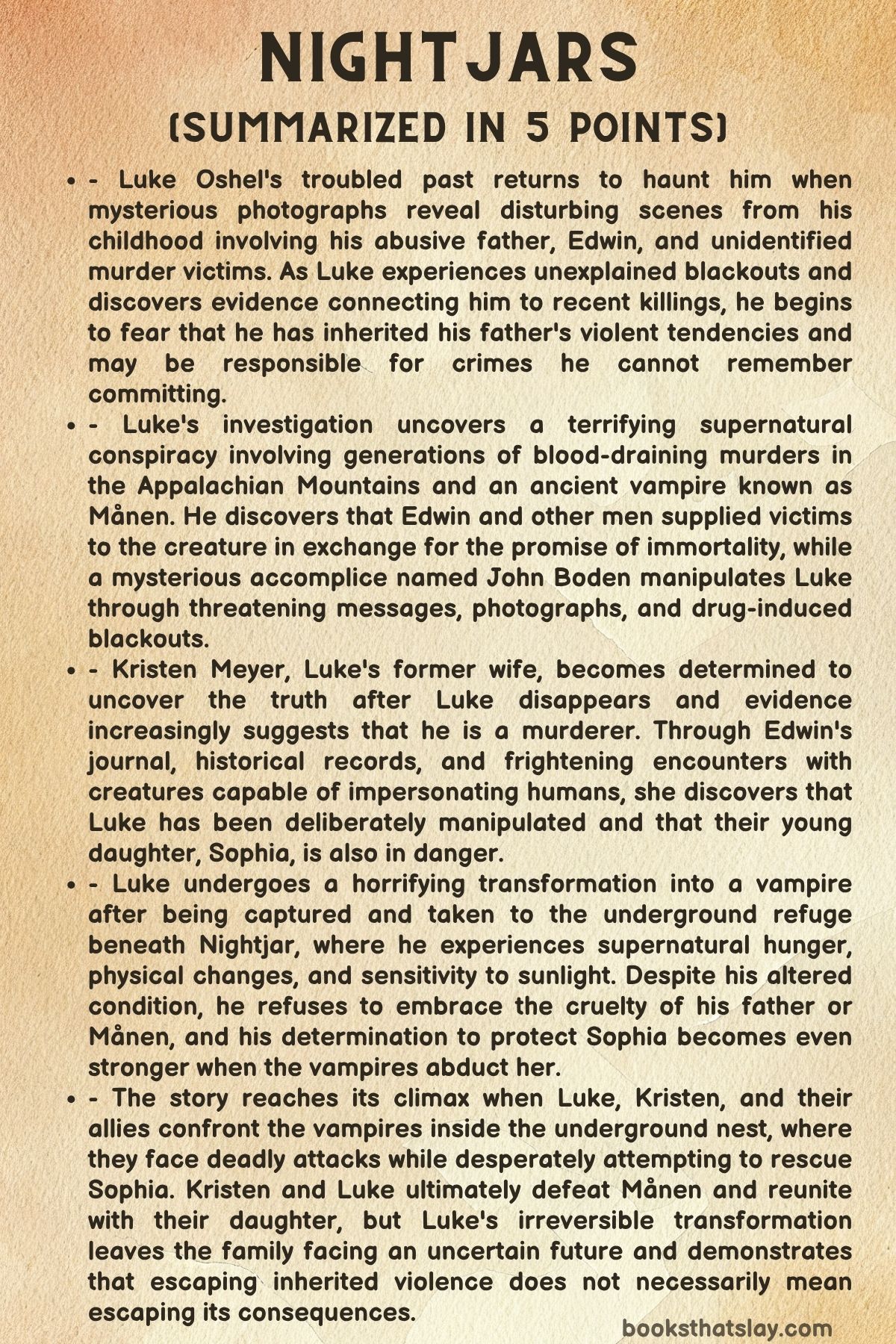
The story follows Luke Oshel, a divorced bookstore owner whose carefully constructed life begins to collapse when mysterious photographs reveal disturbing scenes from his childhood. His investigation leads him into the Appalachian Mountains, where a history of blood-draining murders conceals an ancient supernatural presence. As Luke struggles to understand his father’s crimes and his own missing memories, the danger spreads to his former wife and young daughter. The novel combines psychological uncertainty with vampire horror, examining how love and personal choices can challenge a destructive family legacy.
Summary
Luke Oshel has spent much of his adult life trying to separate himself from his father, Edwin Oshel, an alcoholic truck driver whose cruelty dominated his childhood. Now approaching forty, Luke owns a bookstore called Portable Books, has divorced his wife Kristen Meyer, and shares custody of their young daughter, Sophia.
His fragile stability collapses during a date with Colette Rosenau, a mysterious woman who disappears from their restaurant table and leaves behind an old Polaroid photograph. The image depicts a terrified child on a bloodstained mattress beside a grotesque white figure, and Luke recognizes the boy as himself.
The photograph awakens memories of his father standing over a bloodied woman in the woods and calling them both nightjars. Luke remembers Edwin’s strange nighttime excursions but cannot determine whether he witnessed murders or participated in them.
With help from his closest friend, Alice Coen, Luke begins investigating the photograph. A second picture appears at his bookstore, showing his younger self smiling while helping Edwin drag a woman’s body through the forest.
The discovery raises a terrible possibility: Luke may have been involved in his father’s crimes rather than simply witnessing them. His earlier hypnotherapy sessions with Dr. Mirjam had produced similar memories, but he abandoned treatment before understanding their significance.
Colette unexpectedly visits Luke’s home, bringing whiskey and behaving strangely. The following morning, Luke awakens with scratches, dirty fingernails, missing memories, and evidence suggesting that something violent happened during the night.
Security recordings show him leaving home and returning hours later, although the footage provides little explanation. His increasing blackouts make him fear that the violent behavior associated with Edwin has somehow resurfaced within him.
Seeking answers, Luke visits his mother, Luann, who reluctantly acknowledges that Edwin regularly took him into the mountains. She provides an extract from an old historical account titled On the Appalachian Nightjar, describing generations of disappearances and murders involving victims drained of blood.
Luke subsequently visits Edwin’s grave, where he encounters a threatening stranger who directs him toward another clue before attacking him. The stranger is eventually identified as John Boden, a man connected to the photographs and the forces manipulating Luke.
As Luke investigates, additional women are murdered under circumstances resembling the historical killings. He discovers evidence of bloodshed inside his own bookstore and begins fearing that he might be responsible for the deaths during periods he cannot remember.
His research in Ellijay reveals that the murders continued throughout the twentieth century. The victims include Katherine Ruthnum, a nineteen-year-old woman killed in 1996, whose death appears connected to the activities Luke remembers from childhood.
Luke returns to Dr. Mirjam, hoping hypnosis will restore his missing memories. During treatment, he recalls Edwin transporting women to a secluded mountain location where an unnatural female figure received them.
The memories suggest that his father was supplying victims to something living in the mountains. They also reveal that Luke encountered this being as a child and experienced sensations suggesting that it possessed extraordinary powers.
Meanwhile, detectives Jo Sunderson and Winn Markham investigate the recent murders. Evidence increasingly implicates Luke, and his inability to account for his movements makes him a compelling suspect.
Boden continues tormenting Luke through threats, unexplained appearances, and injections that produce unconsciousness. During one frightening encounter, Luke sees a figure resembling himself, suggesting that someone may be deliberately impersonating him.
Realizing that his family could become endangered, Luke writes an account of his experiences for Kristen. He eventually disappears after encountering evidence associated with Alice’s murder, fearing that the police will hold him responsible.
The narrative then shifts toward Kristen, who is living with her fiancé Wes and expecting their child. Although her marriage to Luke ended because of addiction, emotional distance, and unresolved trauma, she remains concerned about his deteriorating condition.
Kristen discovers Luke’s manuscript and begins investigating his claims. Initially, she suspects that his descriptions of supernatural creatures reflect psychological instability, but the mysterious threats surrounding her home soon challenge that interpretation.
Detective Sunderson informs Kristen that Alice has been murdered. The news intensifies suspicions about Luke while strengthening Kristen’s determination to discover whether he is a murderer or a victim of deliberate manipulation.
The danger becomes undeniable when a figure resembling Luke appears outside Kristen’s upstairs window. Its movements are unnatural, its influence over her resembles hypnosis, and it displays a predatory fascination with Sophia.
When the creature approaches the child, Kristen desperately intervenes. The intruder escapes with supernatural speed, leaving Kristen convinced that she has encountered a vampire.
Following the death of her neighbor Francis Roslin, Kristen arranges for Sophia to stay with trusted relatives. She recognizes that protecting her daughter requires understanding the creatures responsible for the murders.
Kristen visits Luann and obtains Edwin’s old journal. Its entries reveal that Edwin and his associate Sparhawk supplied victims to a supernatural being residing at a place called Nightjar.
Edwin believed that serving this creature would eventually grant him immortality. He drank blood, participated in ritualized violence, and attempted to introduce Luke to the same existence.
The journal also reveals that Edwin angered the creature by attempting to initiate Luke through an unauthorized killing. This incident helps explain the violent childhood memories that have haunted Luke.
Kristen confronts Sparhawk, who confirms aspects of Edwin’s involvement but becomes threatening when questioned. She escapes their confrontation and continues investigating the hidden location.
Historical writings by Reed Lingerfelt reveal that the region’s disappearances extend across generations. Lingerfelt’s own son, Ellery, vanished in 1967, transforming his research into a personal investigation of the mysterious predator.
Kristen eventually finds Luke hiding in a neglected trailer. Although his appearance has changed dramatically, intimate details from their shared history convince her that he is genuine.
Luke confirms that the vampires can imitate human appearances, explaining how someone might have committed crimes while looking exactly like him. He also reveals that he has encountered a false version of Kristen.
Their reunion allows them to compare discoveries and recognize the scale of the deception. Nevertheless, Luke’s increasingly abnormal hunger and physical condition suggest that he is undergoing a supernatural transformation.
Kristen encounters another vampire named Olivia inside Luke’s house. She manages to escape when sunlight forces the creature to retreat, revealing an important vulnerability.
As Luke and Kristen prepare to confront the vampires, Boden captures Luke using another injection. Luke awakens underground, where he experiences intense hunger, physical changes, and sensitivity to sunlight.
His escape brings him face-to-face with Boden. Overwhelmed by his new predatory instincts, Luke attacks the man before recognizing the terrifying nature of his transformation.
Exposure to daylight causes Luke extreme suffering, and he apparently dies. However, he eventually awakens again and encounters Edwin, whom he believed had died years earlier.
Edwin explains that the vampire known as Månen, or the Moon, has been interested in Luke since childhood. Edwin originally wanted both himself and his son to become immortal, but Luke resisted the early transformation.
The connection between Luke and Månen remained unresolved for decades. Edwin eventually attempted to protect his son from the creature, although his earlier decisions were responsible for exposing Luke to it.
Meanwhile, Kristen follows the accumulated clues to an abandoned mountain cabin. Detective Sunderson and other investigators search the property, but the underground vampire refuge remains difficult to locate.
Kristen encounters Månen inside the cabin, confirming that the ancient predator occupies the hidden complex. As darkness approaches, the danger becomes increasingly urgent.
Luke subsequently discovers that Sophia has been taken into the vampire nest. His desire to understand his transformation immediately becomes secondary to rescuing his daughter.
Kristen and Wes return to Nightjar with weapons, stakes, lights, and protective objects. Despite her pregnancy, asthma, and lack of experience with violence, Kristen descends into the underground passages to save Sophia.
The tunnels contain evidence of the vampires’ long existence and their dependence on human victims. Kristen is attacked by Olivia, who threatens her and her unborn child.
Detective Sunderson and Markham arrive, temporarily interrupting the attack. However, Olivia kills Markham with devastating violence, demonstrating the limitations of conventional weapons.
Luke confronts Månen, who explains that his childhood transformation failed because his body resisted the process. The ancient vampire remains fascinated by Luke’s blood and considers Sophia another valuable source of nourishment.
Luke refuses to accept Månen’s belief that supernatural power should replace human attachment. His devotion to Kristen and Sophia gives him the determination to oppose the creature despite his altered nature.
During the final confrontation, Luke and Kristen fight together against Månen. Luke restrains the creature while Kristen repeatedly drives wooden stakes into its body, ultimately overcoming the ancient predator.
The destruction of Månen allows the family to escape the immediate threat. Kristen and Luke find Sophia near the entrance, protected by Wes, who has survived his injuries.
Their reunion is overshadowed by Luke’s irreversible transformation. Although his love for Sophia remains unchanged, his body no longer functions like an ordinary human body, and sunlight threatens his continued existence.
Kristen gives Luke a small wooden figure representing Sophia, preserving a physical connection to the daughter he risked everything to protect.
Nightjars ends with the immediate threat defeated but the family’s future permanently altered. Luke has broken with his father’s values, yet he must now confront the consequences of living as one of the supernatural beings he once feared.
Characters
Luke Oshel
Luke Oshel is the central protagonist of Nightjars, a man whose adult identity has been constructed around his determination not to resemble his father. His experiences expose the psychological consequences of childhood abuse and the difficulty of separating personal responsibility from inherited trauma.
As a divorced bookstore owner approaching forty, Luke initially appears to have established a reasonably ordinary existence. Beneath that appearance, however, he struggles with alcoholism, damaged relationships, unresolved memories, and persistent guilt.
His relationship with Edwin shapes nearly every aspect of his personality. Luke fears that his father’s brutality may have left more than emotional scars, particularly when photographs appear to show him participating in childhood murders.
The uncertainty surrounding these memories becomes one of his greatest psychological burdens. He cannot distinguish clearly between actions he committed willingly, things he was forced to do, and experiences that his childhood mind could not understand.
His blackouts intensify this uncertainty by making his present behavior seem as frightening and unfamiliar as his past. Discovering blood on his clothing and evidence connecting him to murders gradually undermines his trust in himself.
Luke’s alcoholism also reflects his struggle with painful emotions. Drinking offers temporary relief from fear and guilt, but it further compromises his judgment and threatens the stability he has attempted to create.
His relationship with Kristen reveals another dimension of his character. Although their marriage ended, he continues to love her and recognizes the emotional damage caused by his addiction and inability to confront the past.
His strongest emotional attachment is to Sophia. She represents the possibility of creating a different family history, one defined by affection rather than fear.
Luke’s transformation into a vampire gives physical form to his lifelong anxiety about inheriting his father’s violence. His new hunger forces him to confront whether monstrous instincts necessarily produce monstrous choices.
Ultimately, he rejects Edwin’s obsession with immortality and Månen’s contempt for human attachment. His willingness to risk himself for Sophia demonstrates that his identity is determined not simply by his origins or physical nature, but also by the values he continues to defend.
Kristen Meyer
Kristen Meyer becomes the second major protagonist of Nightjars, gradually moving from a supporting presence in Luke’s life to the driving force behind the investigation and final confrontation.
As Luke’s former wife, Kristen understands both his capacity for affection and the destructive consequences of his unresolved trauma. Her decision to end their marriage reflects an effort to protect herself and Sophia from instability rather than a complete rejection of Luke as a person.
She is a poet, a mother, and an expectant mother living with her fiancé Wes. These responsibilities make her involvement in the supernatural investigation particularly dangerous, since her choices affect several people who depend upon her.
Initially, Kristen interprets Luke’s manuscript through the framework of psychological distress. She knows his history of addiction and emotional withdrawal, making it difficult to accept his extraordinary claims without evidence.
Her skepticism gradually changes when she experiences the same threats Luke described. Encountering a creature that imitates her former husband forces her to reconsider the boundaries of what she believes possible.
Kristen’s greatest strength is her determination to act despite uncertainty. She investigates Edwin’s journal, confronts Sparhawk, searches for the vampire refuge, and repeatedly challenges the assumptions of police investigators.
Her asthma and pregnancy emphasize that she is physically vulnerable. She is not a conventional supernatural warrior but an ordinary person who develops courage through necessity.
Her relationship with Wes introduces emotional complications. Although he worries about her safety, Kristen refuses to ignore Luke’s situation when the evidence suggests that her daughter’s father may have been manipulated.
Kristen’s role culminates in her confrontation with Månen. By helping destroy the creature, she rejects the helplessness that characterized much of Luke’s childhood.
Her character ultimately represents practical courage, maternal determination, and the ability to reassess deeply held assumptions. She also demonstrates that compassion does not require denying the harm someone has previously caused.
Edwin Oshel
Edwin Oshel is one of the most morally complicated figures in Nightjars, functioning simultaneously as an abusive father, willing participant in supernatural violence, and eventual opponent of the creature he once worshipped.
During Luke’s childhood, Edwin was an alcoholic truck driver whose frightening behavior shaped his son’s understanding of family and authority. His nighttime journeys into the mountains concealed participation in murders committed for a supernatural purpose.
Edwin becomes fascinated with Månen because he believes the creature can provide immortality. His willingness to supply human victims demonstrates how thoroughly his desire for power has displaced ordinary moral restraints.
His relationship with Luke is particularly disturbing because he treats his son as someone who should share his ambitions. Rather than allowing the child independence, Edwin attempts to introduce him to blood consumption and supernatural transformation.
The photographs of Luke helping move bodies reveal the extent to which Edwin involved his son in violence. Even when Luke appears willing, the imbalance of power between father and child raises serious questions about responsibility.
Edwin’s later attempt to protect Luke complicates his characterization. When Månen’s plans threaten his son, Edwin eventually resists the creature and manages to injure it.
This resistance suggests that paternal attachment survives beneath his brutality. However, his protective behavior cannot erase the murders he committed or the suffering he inflicted upon Luke.
Edwin therefore represents the contradictions of possessive parenthood. He wants his son to share his existence while simultaneously attempting to prevent the creature from taking complete control of him.
His legacy forces Luke to confront an uncomfortable truth: people can possess genuine emotional attachments while remaining responsible for terrible actions.
Sophia Oshel
Sophia Oshel is Luke and Kristen’s four-year-old daughter, whose innocence provides the emotional center of the novel. Although she cannot comprehend the full nature of the supernatural danger, she becomes the person most directly threatened by its continuation.
For Luke, Sophia represents the possibility of escaping his father’s destructive influence. His determination to be a loving parent contrasts with Edwin’s attempt to shape his son through violence and fear.
Their conversations about everyday activities, including plans for a dollhouse, briefly restore the ordinary world that Luke desperately wishes to preserve. These moments reveal a tenderness otherwise obscured by his growing terror.
Sophia’s vulnerability becomes increasingly significant when the vampires discover her importance to Luke. Her kidnapping transforms the conflict into a direct struggle over whether the next generation will suffer the same exploitation.
She is not merely someone requiring rescue. Her existence influences Luke’s moral decisions and gives him a reason to resist his supernatural hunger.
The small wooden figure representing Sophia becomes an important symbol of continuing family attachment. Through this object, the story emphasizes that love can survive even when ordinary physical closeness becomes impossible.
John Boden
John Boden is a central human antagonist whose manipulation of Luke demonstrates how supernatural violence depends upon ordinary people willing to serve it. Unlike the vampires, he can move through human environments without the same physical restrictions.
Boden orchestrates much of the psychological campaign against Luke. He uses photographs, cryptic messages, threatening encounters, and injections to destabilize his victim and draw him toward Nightjar.
His behavior is calculated rather than impulsive. By exposing fragments of Luke’s past while withholding explanations, Boden ensures that Luke becomes increasingly frightened of his own memories and actions.
His willingness to impersonate ordinary authority and exploit personal vulnerability reveals a deeply predatory intelligence. He understands that uncertainty can weaken someone as effectively as physical force.
Boden’s role also highlights the importance of human collaboration in maintaining the vampires’ secrecy. The creatures possess extraordinary powers, but their operations depend upon people who transport victims, manipulate evidence, and perform dangerous tasks.
His confrontation with the transformed Luke eventually reverses their relationship. The man who repeatedly rendered Luke helpless becomes vulnerable to the supernatural hunger he helped create.
Boden represents exploitation pursued through obedience to a greater evil. His humanity offers no guarantee of compassion or ethical restraint.
Månen
Månen, whose name means the Moon, is the principal supernatural antagonist and the ancient presence responsible for much of the suffering in Nightjars. Its existence connects the contemporary murders to generations of disappearances throughout the Appalachian region.
The creature possesses extraordinary strength, speed, longevity, and the ability to imitate familiar human appearances. These abilities allow it to deceive victims while maintaining an atmosphere of uncertainty around its existence.
Månen’s relationship with humanity is fundamentally exploitative. It views people primarily as sources of nourishment, servants, or instruments through which its continued existence can be secured.
Its involvement with Edwin demonstrates how it cultivates human ambition. By encouraging the promise of immortality, it obtains willing participants in violent acts that serve its own interests.
Luke becomes particularly important because his childhood body resisted an attempted supernatural transformation. Månen’s continuing interest in his blood reflects a mixture of predatory hunger, curiosity, and desire for control.
The creature’s inability to understand Luke’s attachment to Sophia reveals its central limitation. Although it possesses tremendous physical power, it cannot comprehend why someone might sacrifice personal advantage for another person.
Its use of impersonation also makes it a symbol of corrupted identity. By assuming familiar appearances, Månen transforms relationships of trust into opportunities for manipulation.
The final confrontation exposes the difference between supernatural power and moral strength. Månen ultimately falls because Luke and Kristen cooperate in defense of someone they love.
Alice Coen
Alice Coen is Luke’s closest friend and an important source of emotional support during the early stages of his investigation. Her presence establishes that Luke possesses meaningful relationships outside the family history that has dominated his life.
When Luke first reveals the disturbing photographs, Alice considers practical explanations such as stalking, blackmail, and criminal evidence. She attempts to approach the situation rationally without dismissing his distress.
Her loyalty becomes especially significant when detectives question Luke about the murders. Alice intervenes to prevent him from making statements that could incriminate him while he remains uncertain about his memories.
Although she is supportive, Alice is not entirely free from doubt. The increasingly disturbing evidence forces her to consider possibilities that conflict with her understanding of Luke’s character.
Her murder represents a devastating escalation of the supernatural conspiracy. The threat is no longer limited to people associated with Edwin’s past but extends to anyone closely connected with Luke.
Alice’s death also illustrates the emotional cost of the antagonists’ campaign. By destroying one of Luke’s strongest sources of reassurance, they increase his isolation and vulnerability.
Luann Oshel
Luann Oshel, Luke’s mother, represents the complicated role of silence within an abusive family. She possesses knowledge about Edwin’s activities but initially refuses to discuss their full significance.
When Luke confronts her, Luann acknowledges that his father regularly took him into the mountains. However, she remains reluctant to confirm his worst suspicions.
Her decision to provide historical material about the Appalachian nightjar suggests that she understands the connection between Edwin and the region’s unexplained violence.
Later, Kristen obtains Edwin’s journal through her investigation of Luann’s knowledge. This material becomes essential to understanding the murders and the creature’s influence.
Luann’s secrecy raises questions about complicity, fear, and survival. The story does not present her silence as equivalent to Edwin’s active violence, but it demonstrates how withholding information can allow harmful circumstances to persist.
Her character illustrates the painful consequences of living near wrongdoing without fully confronting it.
Dr. Mirjam
Dr. Mirjam is the therapist who assists Luke in examining his fragmented childhood memories. Her professional perspective provides an important contrast to the supernatural explanations that gradually dominate the narrative.
She recognizes that Luke’s distress is genuine while cautioning him against treating recovered memories as unquestionable evidence. This distinction is especially important because Luke fears he may have committed murders.
Her hypnotic sessions reveal disturbing images involving Edwin, isolated mountain locations, and mysterious figures. However, she remains aware that remembering an event does not automatically establish its precise meaning.
Dr. Mirjam also attempts to protect Luke from increasingly dangerous decisions. She advises him to cooperate with the authorities rather than confront Boden independently.
Her character represents the limitations and value of psychological interpretation. Therapy helps Luke approach suppressed experiences, but it cannot alone explain the supernatural forces involved.
Through her, the novel explores how trauma, memory, and objective evidence can produce conflicting understandings of the past.
Detective Jo Sunderson
Detective Jo Sunderson is the principal investigator pursuing the murders linked to Luke. She represents institutional authority confronted with crimes that do not conform to ordinary assumptions.
Initially, Sunderson evaluates Luke through conventional investigative methods. His missing time, suspicious movements, and connection to physical evidence make him a legitimate subject of inquiry.
Unlike her partner Markham, however, she is comparatively measured in her interactions. She listens to Kristen’s concerns even when their supernatural implications are difficult to accept.
Her willingness to continue investigating eventually brings her into direct conflict with the vampires. She becomes an active participant in the effort to rescue Kristen and uncover the truth.
Sunderson’s development demonstrates the importance of allowing evidence to challenge established explanations. Her professionalism becomes most valuable when she acknowledges that the case exceeds her original understanding.
Detective Winn Markham
Detective Winn Markham serves as Sunderson’s investigative partner and initially takes a more openly suspicious approach toward Luke. His attitude reflects the apparent strength of the physical evidence connecting Luke to the killings.
Markham is less receptive to interpretations suggesting that Luke has been deliberately framed. From his perspective, ordinary criminal explanations remain more plausible than supernatural deception.
His skepticism creates tension with Kristen, who gradually becomes convinced that the murderer can assume Luke’s appearance.
Despite these limitations, Markham ultimately enters the underground nest alongside Sunderson. His participation places him directly in the path of the creatures he has been investigating.
His violent death at Olivia’s hands demonstrates the inadequacy of conventional assumptions when confronting an extraordinary threat. The scene also reinforces the physical danger faced by investigators who lack reliable knowledge about their opponents.
Wes
Wes is Kristen’s fiancé and the father of her unborn child. His role introduces the perspective of a man attempting to protect his household while his partner becomes increasingly involved in her former husband’s dangerous circumstances.
He is initially distrustful of Luke, particularly after learning about the murders and the disturbing material discovered at Luke’s house.
Wes’s concern is understandable because Kristen’s investigation exposes both her and their unborn child to serious danger. However, his insistence on distancing their family from Luke creates conflict with Kristen’s determination to discover the truth.
His character gradually becomes more active as supernatural danger becomes impossible to ignore. He accompanies Kristen into the mountains and carries a shotgun during their attempt to rescue Sophia.
Although he is injured during the confrontation, Wes survives and helps protect Sophia near the entrance to the vampire refuge.
His actions reveal that parental responsibility can extend beyond biological relationships. Despite his reservations about Luke, he risks himself to protect Kristen’s daughter.
Colette Rosenau
Colette Rosenau is the mysterious woman whose appearance initiates Luke’s confrontation with his childhood. Her role is defined by deception, uncertainty, and her connection to the psychological campaign organized against him.
During their first date, Colette asks questions that force Luke to consider how childhood experiences influence adult identity. These subjects appear conversational at first but become disturbing when she disappears.
The photograph left beneath her napkin demonstrates that the encounter was deliberately arranged. Someone possesses intimate knowledge of Luke’s childhood and is using it to provoke him.
Her later appearance at Luke’s house precedes another unexplained blackout and evidence of possible violence. These events make her participation central to his growing distrust of his perceptions.
Colette represents the manipulation of ordinary intimacy. What begins as a potential romantic connection becomes another means through which Luke’s vulnerabilities are exploited.
Olivia
Olivia is a vampire associated with the colony beneath Nightjar. She embodies the predators’ capacity to combine familiar human appearances with extreme physical violence.
When Kristen encounters Olivia inside Luke’s house, the creature appears capable of ordinary conversation but quickly reveals unnatural movement, strength, and aggression.
Its ability to exploit an invitation into the house demonstrates the importance of supernatural rules governing the vampires’ activities.
Olivia’s retreat from sunlight provides Kristen with practical knowledge that later influences her preparations.
During the underground confrontation, Olivia threatens Kristen and her unborn child, demonstrating how the creatures treat human reproduction and family relationships as opportunities for predation.
Her killing of Detective Markham establishes her as one of the most immediately dangerous members of the colony.
Olivia functions as an extension of Månen’s predatory world, reinforcing the contrast between the vampires’ hunger and the humans’ efforts to preserve their families.
Sparhawk
Sparhawk is a surviving associate of Edwin Oshel who participated in activities connected to the Nightjar murders. His character demonstrates that the supernatural conspiracy depended upon ordinary individuals willing to commit violence.
Like Edwin, Sparhawk became involved with the creature through a combination of ambition, fear, and complicity. His knowledge of the hidden mountain location makes him a valuable source of information.
When Kristen confronts him, his evasiveness reveals his reluctance to acknowledge past actions. He attempts to intimidate her rather than cooperate fully.
Their physical confrontation exposes the continuing danger posed by the human participants even before the vampires themselves appear.
Sparhawk’s surviving involvement illustrates how criminal partnerships can persist through secrecy long after their original activities have changed.
Reed Lingerfelt
Reed Lingerfelt is the historical researcher whose writings provide crucial background about the Appalachian nightjar. His investigation connects isolated murders across generations and challenges the assumption that the violence originated with Edwin.
Initially interested in regional history, Lingerfelt becomes increasingly absorbed by reports of disappearances and blood-draining killings.
His son’s disappearance in 1967 transforms this scholarly curiosity into a personal search for answers. His inability to locate Ellery leaves him suffering from grief and uncertainty.
Lingerfelt eventually suspects that a supernatural predator inhabits the mountains. However, the dangers surrounding his investigation lead him to abandon the search.
His decision reflects the terrible conflict between seeking truth and protecting surviving family members.
Through his written accounts, Lingerfelt becomes an indirect guide for Kristen and Luke. Although he cannot defeat the creature himself, his research helps later generations uncover its existence.
Themes
The Inheritance of Trauma and Violence
The psychological damage passed between generations shapes nearly every major conflict in Nightjars. Luke grows up under the authority of an abusive father whose cruelty becomes inseparable from his understanding of family, identity, and personal responsibility.
Edwin does not merely expose his son to violence. He attempts to make Luke an active participant in the practices he believes will secure supernatural immortality, treating the child’s future as an extension of his own ambitions.
This creates an especially destructive form of inheritance. Luke carries memories of bloodshed and possible participation in murder without possessing the emotional maturity or freedom that would have allowed him to understand those experiences.
As an adult, he fears that his father’s behavior has become part of his own nature. His alcoholism, blackouts, and troubling photographs encourage the belief that he may eventually repeat Edwin’s crimes.
The supernatural transformation intensifies this concern by giving inherited violence a physical expression. Luke develops the same predatory hunger associated with the creatures his father admired, seemingly confirming his deepest fears.
However, the novel distinguishes between inheriting destructive impulses and choosing to act upon them. Luke’s determination to protect Sophia reveals that a person can resist the values imposed during childhood.
Kristen’s role strengthens this interpretation because she recognizes the harm Edwin caused without treating Luke as permanently defined by it.
The story ultimately presents trauma as a powerful influence rather than an unavoidable destiny. Breaking a destructive family pattern requires conscious resistance, accountability, and the willingness to protect the next generation from suffering.
Identity, Memory, and the Fear of Losing Control
Luke’s inability to trust his own memories creates a persistent crisis of identity. His understanding of himself depends upon recollections that are incomplete, emotionally overwhelming, and increasingly contradicted by physical evidence.
The childhood photographs are particularly disturbing because they appear to document actions he cannot remember performing. The image of his younger self smiling beside a corpse challenges his belief that he was only an innocent witness to Edwin’s crimes.
His experiences of missing time continue into adulthood, making the uncertainty impossible to confine to the past. Waking with bloodstained clothing or discovering evidence of unexplained activity forces him to question what he might do when he is not consciously aware of his actions.
Dr. Mirjam’s treatment introduces an important distinction between psychological experience and historical truth. Recovered memories can provide valuable insight, but they may also be incomplete or distorted.
The vampires’ ability to imitate human appearances complicates the problem further. Someone who looks exactly like Luke may perform actions for which he is later blamed, turning identity itself into an unreliable form of evidence.
This uncertainty also affects Kristen, who must decide whether she has encountered her former husband or a creature wearing his appearance.
The story therefore examines identity as something more complex than memory, appearance, or even physical nature. Luke’s transformation changes his body, but it does not automatically erase his attachments or values.
His resistance to Månen suggests that moral identity depends significantly upon deliberate choices. Even when memory and bodily control become unstable, his commitment to protecting Sophia remains a defining element of who he is.
Parenthood, Love, and the Responsibility to Protect
Parental responsibility creates one of the clearest moral contrasts in Nightjars. Edwin approaches fatherhood through possession and control, while Luke increasingly understands it through sacrifice, protection, and respect for his daughter’s future.
Edwin believes that offering Luke supernatural immortality is a form of paternal generosity. Yet his actions expose the child to murder, coercion, and terrifying experiences that permanently damage his psychological development.
His desire to share power with his son is therefore inseparable from selfishness. He values Luke partly because he imagines the boy continuing his own ambitions.
Luke approaches Sophia differently. Although his addiction and unresolved trauma have already damaged his family relationships, he wants his daughter to experience the safety and affection he lacked.
His conversations with Sophia provide emotional relief during the investigation. Their ordinary discussions about toys and family activities reveal the existence he wishes to preserve despite the violence surrounding him.
Kristen expresses parental responsibility through direct action. She organizes Sophia’s temporary protection, investigates the supernatural danger, and eventually enters the vampire nest while pregnant.
Her actions demonstrate that courage does not require physical superiority. She faces creatures stronger than herself because abandoning her daughter is not an acceptable option.
Wes further expands this theme by risking his safety for Sophia despite his difficult relationship with Luke.
The final rescue brings these different expressions of parenthood together. Luke’s supernatural strength, Kristen’s determination, and Wes’s protective involvement help secure Sophia’s survival.
The novel presents love not merely as an emotion but as an obligation expressed through difficult choices. Genuine parental care requires recognizing a child’s independent needs rather than treating that child as an extension of personal desires.
The Seduction of Immortality and the Corruption of Power
The promise of immortality provides the foundation for the violence associated with Nightjar. Edwin and his associates become involved with the supernatural creature because they believe it can free them from ordinary human limitations.
For Edwin, eternal life represents an opportunity to escape weakness, mortality, and the restrictions of his existing circumstances. His pursuit of this power gradually replaces ordinary ethical considerations.
Human victims become instruments through which he hopes to achieve transformation. Their suffering matters less to him than the possibility of securing a permanent supernatural existence.
Månen exploits this ambition by encouraging human servants to perform violent tasks. Its longevity and extraordinary abilities make it appear superior to ordinary people, yet its conduct reveals a profound absence of compassion.
The creature’s existence is sustained through predation. Its power does not create genuine independence because it remains dependent upon blood, secrecy, and the exploitation of others.
Luke’s transformation challenges the assumption that immortality is inherently desirable. Rather than experiencing supernatural existence as liberation, he encounters overwhelming hunger, physical suffering, sensitivity to sunlight, and the possibility of permanent separation from his daughter.
His altered condition exposes the terrible price concealed within Edwin’s ambitions. Surviving death does not necessarily mean preserving the life, relationships, or freedom that made existence meaningful.
The final confrontation presents a rejection of power pursued for its own sake. Luke opposes Månen not because he wishes to replace the ancient creature but because its existence threatens Sophia.
Even after Månen’s destruction, Luke cannot return to his former condition. His survival remains complicated by the transformation that has permanently changed him.
The novel ultimately questions the value of endless life when that existence requires abandoning empathy, responsibility, and human connection. Through Luke’s choices, it suggests that preserving one’s moral identity matters more than overcoming mortality.