Grim Tidings Summary, Characters and Themes
Grim Tidings by B. K. Borison is a supernatural romance about death, purpose, second chances, and learning how to want a life that feels personally meaningful.
Darcy, a Grim Reaper who died young and has spent a century guiding souls away from the mortal world, has grown tired of being defined by endings, while Gabriel, a Guardian Angel, has spent thousands of years believing his worth depends entirely on protecting others. Their unexpected attraction challenges everything they understand about their opposing roles and gradually forces both of them to reconsider whether duty must always come before desire. It’s the 2nd book in the Ghosted series.
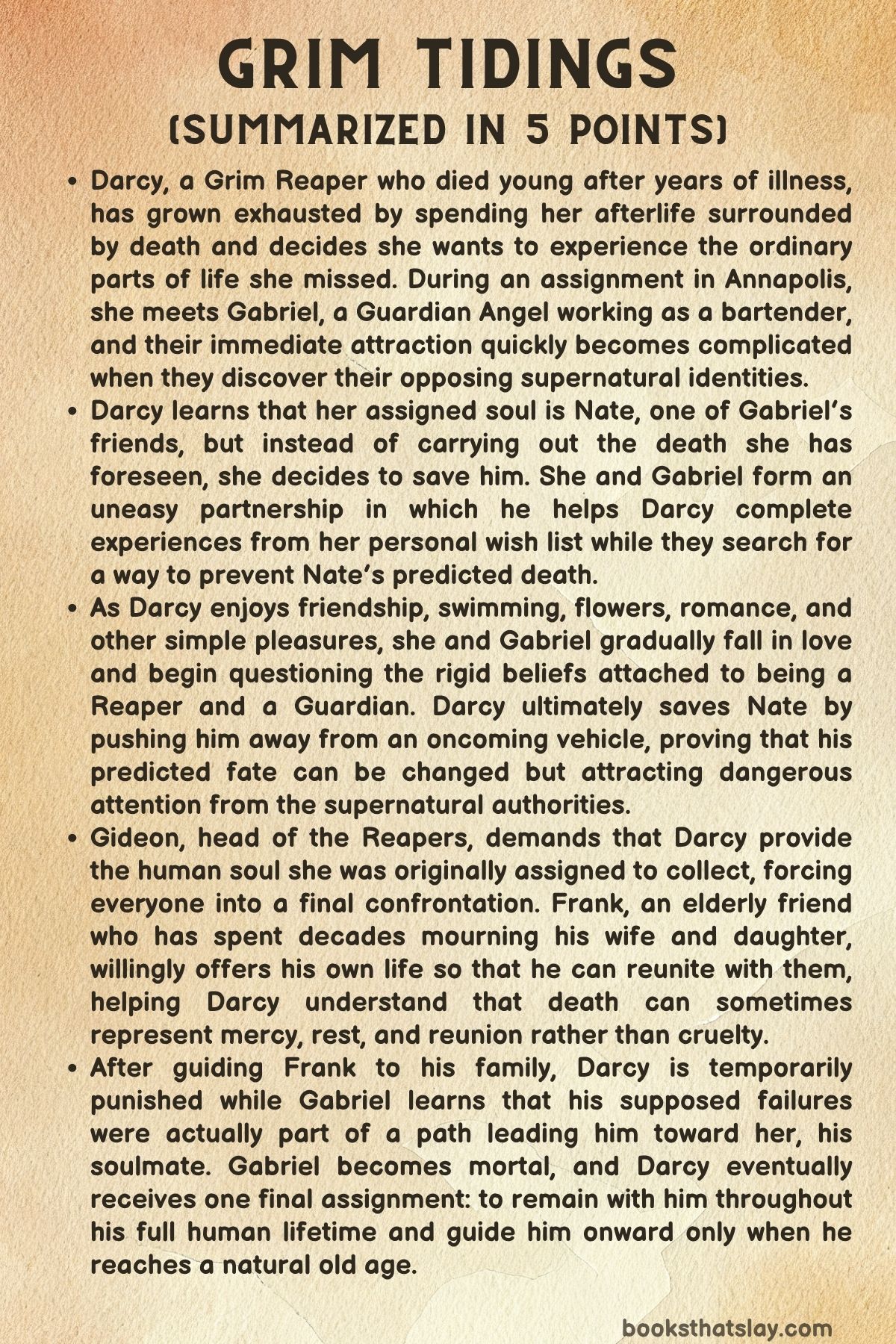
Summary
Darcy died at twenty-seven after spending much of her mortal life sick and confined by illness. Instead of simply passing into whatever came next, she was recruited into the Department of Hauntings and Spirits and eventually became a Grim Reaper, a position that has kept her surrounded by death for roughly a century.
Her work has exhausted her emotionally because every assignment requires her to witness fear, grief, regret, and final moments without being able to offer people the continued life they often beg for. Darcy longs for the ordinary experiences she missed while alive and quietly asks the ancient yew tree that chooses Reaper assignments to give her something different.
The resulting vision sends her to Annapolis, where she enters an old bar while waiting for the predicted death to occur. There she meets Gabriel, the handsome bartender whose teasing confidence makes Darcy feel noticed instead of feared, and their immediate attraction gives her a rare chance to experience flirtation as though she were simply another woman enjoying an evening out.
Their first kiss changes everything when Darcy’s death magic reacts and Gabriel reveals luminous wings. He is a Guardian Angel, part of an order historically opposed to Reapers, and he immediately suspects that Darcy has arrived to take someone under his protection.
Darcy is deeply hurt by Gabriel’s assumption that she used supernatural influence to attract him. She explains that she never wanted to become an embodiment of death and confesses that she desperately wants to experience belonging, pleasure, friendship, and the ordinary middle portions of existence rather than constantly standing at its end.
Her rebellion becomes more serious when she finds a badly injured German shepherd and collects his soul even though he is not her assigned target. Rather than surrendering the dog, whom she names Tater Tot, Darcy begins questioning why she should keep obeying rules that have given her so little agency.
When Gabriel discovers what she has done, Darcy reveals an even larger plan: she intends to save the human being she was sent to reap. She proposes that Gabriel help her complete some items from a private list of experiences she missed during her mortal life, and in exchange she will gradually share clues from her death vision so they can prevent the predicted death together.
Their uneasy alliance slowly changes their relationship. Gabriel remains suspicious of Darcy’s motives, but his protectiveness begins turning into jealousy, while Darcy starts enjoying conversations, friendship, swimming, flowers, drinking, and other experiences that seem trivial to Gabriel until he understands how much they represent to someone whose youth was dominated by illness.
Darcy eventually recognizes Nate, Gabriel’s younger friend, as the person from her vision. She hides this discovery because she wants the chance to save him herself rather than allowing Gabriel to take control of the situation, creating a secret that will become increasingly difficult to carry.
Meanwhile, Darcy grows close to Frank, an elderly florist who treats her with easy kindness. His willingness to spend time with her gives Darcy something she rarely receives from mortals: companionship without instinctive fear of the death magic surrounding her.
Her bond with Gabriel also deepens as they reveal painful truths about themselves. Gabriel admits that he believes the scars across his chest mark two occasions when he failed to protect souls from Reapers and that one more failure may cost him his wings, making Darcy even more determined to ensure that Nate survives.
Their attraction becomes impossible to dismiss. During a trip to a lighthouse, Gabriel assures Darcy that she has not magically compelled him to desire her and admits that what he wants is not merely physical intimacy but the ordinary pleasure of having her present in his daily life.
On the journey back, the details of Darcy’s death vision suddenly align around Nate. Wet pavement, music, traffic, and the surrounding atmosphere convince Darcy that his predicted death has arrived, and when a vehicle loses control, she throws herself into its path and pushes Nate to safety.
Nate survives, proving that Darcy can alter an assigned death, but the collision leaves her injured and emotionally overwhelmed. Gabriel cares for her with great tenderness, refusing to accept her belief that she is fundamentally harmful and assuring her that goodness is demonstrated through what she chooses to do rather than through the supernatural office she belongs to.
Their growing intimacy eventually becomes physical, but it also transforms them emotionally. Gabriel gives Darcy a safe space to experience desire without shame, while Darcy encourages Gabriel to recognize that goodness does not require denying himself every personal need.
Their magical powers even respond harmoniously to one another. Guardian light and Reaper darkness coexist instead of destroying each other, weakening the assumption that their supernatural identities are naturally incompatible.
Darcy’s happiness is disrupted when she loses control of her magic in Frank’s flower shop. The display restores Frank’s suppressed memory of the automobile accident that killed his wife and young daughter, and he recognizes Darcy as the Reaper who collected them while he remained trapped and helpless nearby.
His anger devastates Darcy because she interprets his suffering as confirmation of everything she has always feared about herself. Gabriel eventually finds her surrounded by uncontrolled death magic and helps her stop treating her own power as something evil, allowing the darkness to flow freely without hurting him.
The larger supernatural consequences soon arrive through Gideon, the ancient head of the Grim Reapers. He tells Darcy that preventing Nate’s death does not erase the obligation attached to her assignment and orders her to bring Nate to him, warning that otherwise he will collect the young man’s soul himself.
Darcy begins distancing herself from Gabriel because she fears he will sacrifice his wings trying to defend her and Nate. Gabriel refuses to accept being protected through exclusion and asks her to let him choose what risks he is willing to take, but Darcy privately remains determined to keep him from paying for her rebellion.
Before confronting Gideon, she visits Frank and finally explains what happened to his wife and daughter after their deaths. Darcy remembers seeing them move toward a beach that held special meaning for their family, and this knowledge gives Frank comfort by showing him that the people he lost did not disappear into nothingness.
Darcy then brings Nate to a graveyard, where Gabriel, Aelia, Frank, Tater Tot, and eventually Gideon converge. When Gideon insists that a human life is still owed, Darcy offers herself, her powers, and even her memories, while Gabriel offers his wings, but none of these sacrifices satisfy the requirement because neither of them is a living human.
Frank finally chooses to offer his own life. He is elderly, has lived fully, and wants Darcy to guide him toward the wife and daughter he has mourned for decades, transforming the moment into Darcy’s first true understanding of what her work can mean.
Death is not always something stolen from an unwilling person. For someone who is ready, it can provide release, rest, closure, and reunion, and Darcy’s magic changes as she accepts that truth, becoming something far richer than the darkness she has always associated with herself.
Darcy guides Frank through the department and watches him return to the younger version of himself before reuniting with his daughter and wife on the beach. The experience changes her understanding of the Reaper’s purpose, although Gideon temporarily suspends her and sends her to customer service as punishment for everything she has done.
Gabriel meanwhile expects punishment of his own, but Rafael reveals that Gabriel’s understanding of his Guardian service has also been wrong. His scars were not marks of failure, and the long path of lives he protected was ultimately directing him toward Darcy, whom departmental records identify as his soulmate.
Gabriel is honorably discharged and becomes mortal, discovering that losing his wings brings relief rather than emptiness. He experiences hunger, cold, fatigue, dreams, and a human heartbeat while waiting without knowing whether Darcy will ever return.
After twenty-eight days of punishment, Gideon restores Darcy to Reaper service because she finally understands that Reapers are not merely agents who terminate life. They guide frightened people, offer mercy when the moment is right, and help souls move somewhere beyond the fear of death.
Gideon then gives Darcy one final assignment. When she follows the vision back to Gabriel, its clues describe not the man standing before her but the elderly version of Gabriel he will become after living an ordinary mortal lifetime filled with years, habits, memories, and aging.
Darcy understands that she is assigned to remain until Gabriel eventually reaches the natural end of that life. Instead of being separated by their supernatural duties, they have finally been given exactly what Darcy wanted from the beginning: the chance to share the long middle of a life before facing its ending together.
Characters
Darcy
Darcy is the emotional center of Grim Tidings, and her development is built around the conflict between what she does and what she believes that role says about who she is. Dying young after years of illness deprived her of many formative experiences, so becoming a Reaper extends an old pattern in which circumstances continue deciding what her existence will look like.
Her deepest problem is not simply that she dislikes collecting souls. Darcy has internalized the fear and grief mortals direct toward her until she begins interpreting her own power as evidence that she is dangerous, undesirable, and perhaps incapable of being genuinely good.
This explains why ordinary pleasures matter so much to her. Swimming from a dock, learning about flowers, drinking too much, flirting, sharing cigarettes, making friends, adopting Tater Tot, and falling in love become acts through which she constructs an identity that exists beyond death.
Her decision to save Nate represents the first major assertion of personal agency in her supernatural existence. Yet the book does not leave Darcy with the simplistic conclusion that saving everyone from death is automatically moral; her experience with Frank eventually teaches her that compassion sometimes means preventing death and sometimes means helping someone accept it.
Darcy’s relationship with Gabriel is therefore important because he does not rescue her from her nature. Instead, he helps her stop dividing herself into supposedly good and bad parts, while she gradually learns that her death magic can coexist with tenderness, attraction, friendship, and love.
By the end, Darcy has not escaped being a Reaper. She has reclaimed the meaning of the role, understanding that guiding someone through death can be an act of care rather than an act of cruelty.
Gabriel
Gabriel begins Grim Tidings convinced that goodness is measured by successful protection and constant self-denial. His identity as a Guardian Angel has existed for so long that he barely distinguishes between his supernatural occupation and his personal worth.
His immediate suspicion of Darcy reveals how thoroughly institutional assumptions have shaped him. He initially sees a Reaper before he sees Darcy as an individual, which makes his eventual transformation especially meaningful because he must learn to judge her through her choices rather than her category.
Gabriel’s greatest weakness is his belief that wanting anything for himself is selfish in a morally unacceptable way. Even his work at the bar and his relationships with Frank and Nate retain a protective quality, allowing him to care for people while avoiding the vulnerability of admitting that he needs them.
Darcy changes this by repeatedly challenging him to identify his own desires. Their physical and emotional relationship becomes significant because she insists that Gabriel stop turning every interaction into another opportunity to serve someone else.
His willingness to surrender his wings demonstrates how radically his priorities change, but the later revelation about his scars deepens that development. Gabriel eventually discovers that what he interpreted as proof of failure was part of a path toward a different destination, allowing him to become mortal without feeling that he has become lesser.
Frank
Frank provides Grim Tidings with one of its most important perspectives on grief, aging, and voluntary acceptance of death. At first, he appears mainly as a warm older man who gives Darcy uncomplicated friendship and teaches her about flowers, creating a comforting connection to ordinary human life.
His history transforms that relationship when he remembers Darcy from the accident that killed his wife and daughter. Frank’s anger is understandable because his last image of Darcy is connected to the moment his entire family was taken from him while he was powerless to stop it.
The later reconciliation does not erase those decades of grief. Instead, Darcy gives Frank knowledge that changes how he understands the loss, assuring him that his wife and child reached a place meaningful to them and that she fulfilled her promise to care for them.
His voluntary decision to die is central to Darcy’s growth because Frank is neither deceived nor defeated. He has lived into old age and consciously chooses reunion when the opportunity becomes available, forcing Darcy to recognize that extending existence indefinitely is not always the most compassionate outcome.
Nate
Nate functions as the human life around which much of the central supernatural conflict develops. His importance comes partly from how ordinary he is: he is young, social, teasing, and largely unaware that Guardian and Reaper forces are arguing over whether he should live.
Darcy’s decision to save him is initially driven by the conviction that someone so young deserves more time. The fact that she physically throws herself in front of the vehicle meant to kill him proves that her rebellion is not theoretical; she is willing to endure real consequences to protect the future she believes Nate should have.
Nate also gives Gabriel a relationship that reveals his naturally protective instincts. His presence at the bar and his playful observations about Gabriel’s feelings for Darcy keep the supernatural romance connected to ordinary friendship and everyday life.
Aelia
Aelia is one of the most unusual supporting figures in Grim Tidings because her intimidating power contrasts sharply with her permanent appearance as an eight-year-old girl. That contradiction reflects the larger book’s refusal to assume that outward appearance reveals supernatural identity or emotional maturity.
Her friendship with Darcy is especially important because she understands the realities of Reaper work without needing Darcy to explain why it is exhausting. When she discovers that Darcy has broken departmental rules, Aelia warns her about the danger but chooses loyalty rather than immediate obedience.
She later joins Gabriel in searching for Darcy and is willing to stand against Gideon if necessary. Beneath her harsh manner, Aelia represents dependable friendship, proving that Darcy’s growing sense of belonging does not depend entirely on romance.
Gideon
Gideon initially appears in Grim Tidings as the frightening embodiment of institutional authority. His calmness makes him more intimidating because he does not need theatrical anger to establish that Darcy has violated rules with consequences far beyond her personal wishes.
His confrontation with Darcy is essential because he refuses her assumption that death is inherently unjust. By demanding that she explain why saving Nate automatically represents victory, Gideon exposes the weakness in Darcy’s belief that compassion always means keeping someone alive.
Frank’s choice eventually demonstrates what Gideon has been trying to make Darcy understand. The Reaper’s purpose is not simply to collect a required number of souls but to recognize death as one stage within a larger process.
Gideon is not emotionally untouched by that lesson himself. His interest in the name Isabella and the neglected state of his office suggest that his long absence may also be connected to grief, making him another supernatural being whose understanding of duty has been shaped by personal loss.
Brad
Brad provides comic irritation while also representing ambition within the supernatural bureaucracy. As a Ferryman eager to become a Reaper, he views the position Darcy finds emotionally exhausting as something desirable and prestigious.
That contrast reinforces how differently supernatural work can appear depending on whether someone has actually carried its burden. Brad’s willingness to assist Gideon’s investigation shows that his ambition can override loyalty, though his behavior remains more self-interested than truly malicious.
Rafael
Rafael, or Rafe, first appears to represent the Guardian authority Gabriel fears. His arrival after Darcy’s rebellion creates tension because Gabriel assumes another supernatural superior has come to expose or punish them.
His later role completely changes Gabriel’s understanding of himself. Rafe explains that Gabriel’s scars were never punishments and that his Guardian career was not a sequence of failures but part of a path leading him toward the life he was eventually meant to choose.
Rafe therefore functions as the figure who releases Gabriel from a false interpretation of duty. By granting him an honorable discharge and mortality, he allows Gabriel to understand that finishing one purpose can be the beginning of another rather than evidence of failure.
Tater Tot
Tater Tot begins as an injured dog Darcy refuses to abandon, making him one of the earliest outward signs of her rebellion against passive obedience. Her decision to collect and keep his soul proves that her instinct toward compassion existed before she fully understood what she wanted to become.
He soon develops into a source of humor, companionship, and practical help. His immediate dislike of Gabriel complicates their early encounters, while his loyalty later helps Gabriel locate Darcy when her magic becomes unstable and again when she disappears before the graveyard confrontation.
Tater Tot also represents the home Darcy begins constructing almost accidentally. Caring for him allows her to behave not as a Reaper fulfilling a supernatural assignment but as someone responsible for another creature because she personally chooses to love it.
Maverick
Maverick manages the department’s enormous records system and appears when Darcy arrives with Tater Tot’s soul. His frustration with her unauthorized collection reinforces the rigid administrative structure surrounding death and shows how unusual her behavior has become.
Although his role is comparatively small, Maverick helps establish that the supernatural world operates through procedures, assignments, intake systems, and paperwork. That bureaucratic normality creates a humorous contrast with the enormous emotional weight carried by the souls moving through it.
Nolan
Nolan is the Ghost of Christmas Past whose abandoned townhouse becomes Darcy’s temporary home. Although he remains absent during most of her time in Annapolis, the borrowed house gives her a private place where her new relationships and choices can develop outside official supervision.
His eventual return also marks the end of that temporary stage. By reclaiming the house while Gabriel waits for Darcy, Nolan indirectly emphasizes that the improvised life she created cannot remain suspended forever and must eventually become something more permanent.
Casey
Casey has only a brief role, but his conversation with Darcy exposes Gabriel’s jealousy before Gabriel is willing to admit the depth of his attraction. Darcy’s pleasure at being approached by an ordinary mortal also makes the encounter meaningful because friendly attention still feels extraordinary to her.
Gabriel’s decision to use Guardian influence to send Casey away becomes an early example of his possessiveness and his tendency to justify emotional reactions as protective behavior. Darcy’s anger forces him to confront the fact that his suspicion is hurting someone he has already begun to care about.
Siobhan
Siobhan is mentioned as the supervisor whom the Poltergeist at the bed-and-breakfast has been trying unsuccessfully to contact. Her limited presence mainly expands the sense of a much larger supernatural administration operating around Darcy’s personal crisis.
The reference also contributes to the novel’s mixture of mystical roles with mundane workplace problems. Even ghosts, Reapers, Ferrymen, and other supernatural beings must deal with supervisors, missing communications, housing problems, and organizational confusion.
Harriet
Harriet is associated with the antiques shop Frank mentions while showing Darcy around Annapolis. Although she does not become central to the immediate conflict, the antiques shop later gains greater relevance when Gideon asks Darcy to deliver a mysterious music box there.
Her presence therefore helps make Annapolis feel like a connected community rather than merely a backdrop. Small businesses, familiar names, flowers, bars, and antiques all contribute to the ordinary social world Darcy desperately wants to join.
Isabella
Isabella appears only through the name Gideon quietly speaks while searching departmental records, yet the moment implies considerable emotional significance. His reaction suggests that someone connected to that name may explain his prolonged distance from the department and his own complicated relationship with death.
The lack of explanation preserves mystery around Gideon’s personal history. More importantly, the moment prevents him from functioning only as an impersonal authority figure by suggesting that he, too, carries unresolved attachment and loss.
Frank’s Wife and Daughter
Frank’s wife and daughter remain unnamed, but their absence shapes decades of his life and eventually becomes essential to Darcy’s understanding of death. Their loss initially represents the kind of suffering that makes Darcy believe Reapers are cruel, because she remembers Frank begging her not to take them.
The later vision of their reunion changes the meaning of that memory. They have not been erased from existence, and Frank’s eventual movement toward them turns what once seemed like permanent separation into a delayed reunion, giving the book one of its clearest demonstrations that death can hold meanings other than loss.
Themes
Life Is Defined by the Middle, Not Only the Ending
Grim Tidings repeatedly contrasts Darcy’s obsession with death against her growing discovery of everything that happens before it. Because she died young and then spent a century appearing only at other people’s endings, Darcy has almost no emotional relationship with the ordinary routines through which most people actually experience life.
Her list therefore contains experiences that might seem insignificant to someone who has always possessed them. Swimming recklessly, arranging flowers, drinking with someone she likes, visiting a lighthouse, sharing cigarettes, owning a dog, having sex, laughing with friends, and sitting in a familiar bar become meaningful because they represent participation rather than observation.
Gabriel’s transformation develops the same idea from another direction. He has existed for thousands of years, yet immortality has not automatically given him a full life because he has spent so much of that time defining himself through service.
The ending resolves both characters’ problems by giving them something less dramatic than eternal supernatural power: an ordinary mortal lifetime. Gabriel will age, Darcy will eventually reap him, and both know the relationship ends in death, but that knowledge no longer reduces the value of everything that comes before it.
The story therefore treats mortality not as the enemy of meaningful existence but as part of what gives time emotional weight. Darcy’s greatest reward is not escaping death forever; it is finally being allowed to inhabit the long stretch between beginning and ending.
Death, Mercy, and the Meaning of a Reaper
Darcy begins with a deeply moralized understanding of death. Life represents goodness, while taking a soul represents harm, so she gradually convinces herself that her occupation must reveal something cruel about her own nature.
Nate initially seems to prove this belief because saving him is unquestionably compassionate. He is young, wants to continue living, and survives because Darcy refuses to accept the death shown in her vision.
Frank complicates the same principle. By the time Gideon demands a human soul, Frank is old, has lived for decades after terrible loss, understands what he is choosing, and willingly asks Darcy to guide him toward the people he has missed for most of his life.
The contrast teaches Darcy that compassion cannot be reduced to keeping every person alive for as long as possible. Respecting life also requires respecting the person who has reached its natural completion and is ready to move forward.
Her changing magic reflects this realization. The darkness she once feared reveals unexpected beauty when she stops interpreting death only as destruction, suggesting that the Reaper’s power itself was never inherently evil.
Darcy’s real task is therefore not to defeat death. It is to meet people at the boundary between existence and whatever comes afterward and help them cross it with dignity, understanding, and as little fear as possible.
Identity Beyond Duty
Both central characters initially confuse occupation with identity. In Grim Tidings, Darcy believes that being a Reaper means she must be frightening and destructive, while Gabriel believes that being a Guardian means he must endlessly sacrifice his own desires.
Their romance becomes possible only when each begins separating moral worth from professional function. Darcy can possess death magic and still protect people, while Gabriel can want love, sex, companionship, and mortality without becoming selfish or unworthy.
This theme is reinforced by the supernatural departments themselves. Their titles suggest clear opposition—Reapers take souls while Guardians protect them—but Darcy and Gabriel’s powers coexist peacefully once they stop approaching one another as enemies.
Even the scars Gabriel considers punishments are eventually reinterpreted. His entire understanding of himself has been built around the belief that they prove his failures, only for Rafael to reveal that Gabriel assigned that meaning to them incorrectly.
Darcy faces the same problem with her magic. She has treated darkness as proof of corruption because mortals fear it, but Gabriel’s willingness to stand inside that power without being harmed helps her reconsider the assumptions she has accepted.
The novel ultimately argues that roles can provide purpose without containing the whole self. Darcy remains a Reaper and Gabriel once was a Guardian, but neither character becomes emotionally free until they recognize that duty is something they perform rather than the complete definition of who they are.
Love as Recognition, Choice, and Mutual Change
The relationship between Darcy and Gabriel begins with immediate attraction, but the story carefully develops love as something more demanding than supernatural destiny. Their eventual designation as soulmates explains the unusual strength of their initial recognition, yet everything meaningful between them still depends on repeated choices.
Gabriel must choose to reconsider his prejudice toward Reapers. Darcy must choose to trust someone from an order she has been taught to distrust, and both must repeatedly decide whether fear of future loss is enough reason to reject present happiness.
Their relationship also works because neither character remains unchanged. Darcy teaches Gabriel that wanting something for himself does not make him morally weak, while Gabriel teaches Darcy that being loved does not require suppressing or apologizing for every difficult part of herself.
Physical intimacy develops the same principle through communication and consent. Gabriel gives Darcy control in experiences she was denied while sick and young, while Darcy asks Gabriel to acknowledge his own needs rather than hiding permanently behind the role of caretaker.
The later soulmate revelation therefore does not remove personal responsibility from the romance. Destiny may explain why they recognized one another, but it does not make Gabriel abandon his assumptions, make Darcy save Nate, reconcile Darcy with her magic, or force either of them to risk sacrifice.
Their eventual shared future matters because they actively choose it after seeing each other’s fear, anger, power, grief, and flaws. Love becomes not an escape from mortality or duty but the reason both characters finally become willing to live fully within the time they are given.