Heart Of A Goon II Summary, Characters and Themes
Heart Of A Goon II by JAHQUEL J. is a crime-family drama centered on loyalty, romantic commitment, buried family history, addiction, revenge, and the consequences of protecting the people one loves through dangerous means.
The story follows several interconnected families, but much of its emotional focus rests on Menace, his sister Zoya, and Gerald “Goon” as their relationships are tested by assassination attempts, criminal conspiracies, painful revelations, and old wounds. Alongside the violence runs a strong concern with parenthood, mental health, recovery, and inherited trauma, creating a story in which surviving an enemy often proves easier than confronting the damage within one’s own family.
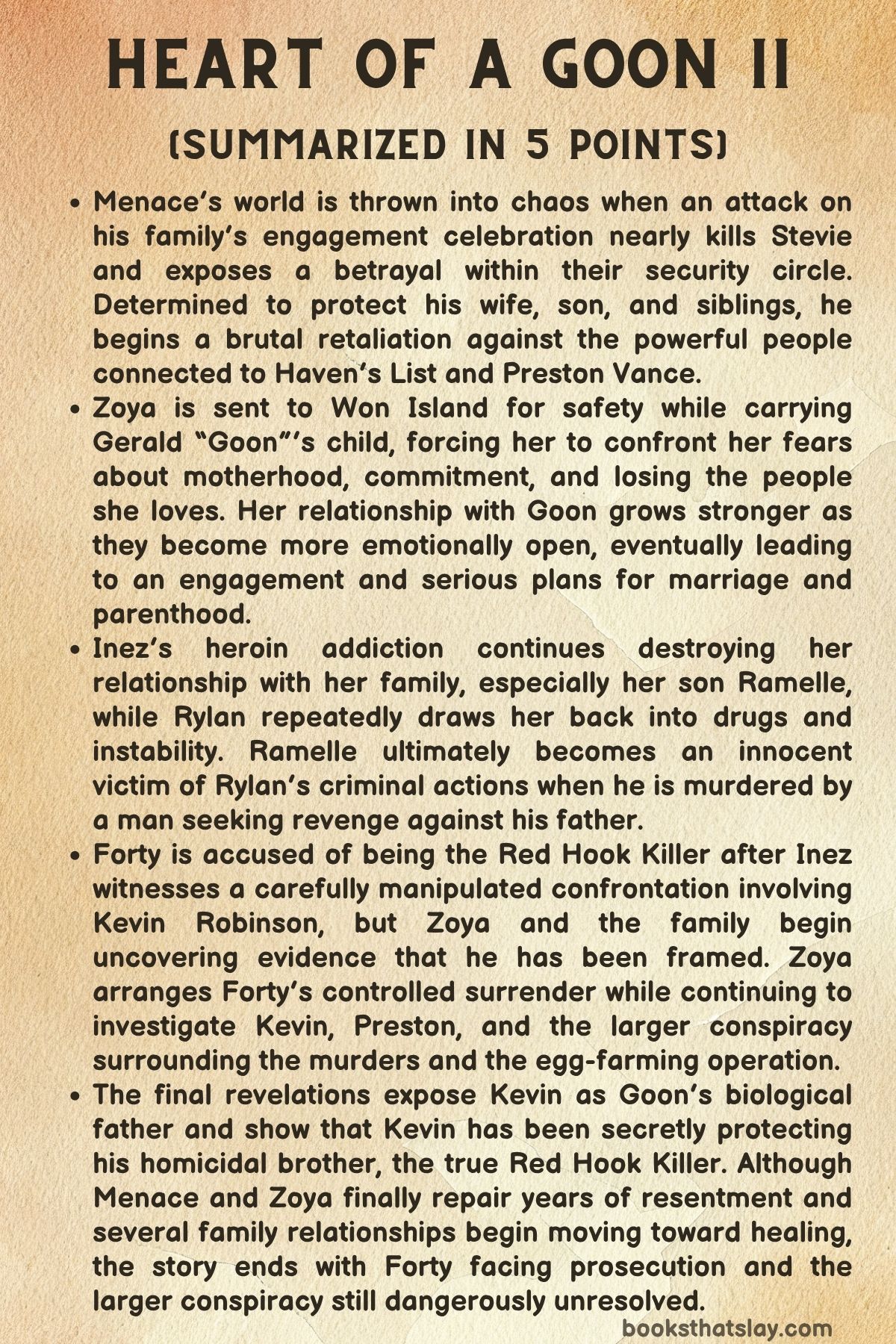
Summary
Heart Of A Goon II opens with Menace trapped inside a horrifying vision of Stevie’s funeral. In his mind, he stands before the body of the woman he loves while imagining the future he and their son Dennis will never have, only for Zoya’s voice to break through and reveal that he has entered a trauma-driven dissociative state during an attack on the family’s engagement celebration.
Stevie has survived, but the sight of her covered in blood sends Menace into a violent state. Evidence quickly suggests the attackers possessed inside information, and suspicion falls on Ollie, the security guard assigned to Zoya, whose failures have already troubled Goon.
Menace sends the women and children away while he, Goon, Corleon, and their allies remain behind to identify the conspirators. Zoya, secretly pregnant with Goon’s child, leaves for Won Island with Stevie, Dennis, and the others, while Goon promises both her and Menace that he intends to survive.
The investigation soon uncovers Ollie’s betrayal. Corleon discovers that Ollie has secretly communicated with Judge Castello and Sigel while developing an obsessive sexual fixation on Zoya, turning his position as her protector into a means of surveillance and access.
Corleon also learns that Castello has connections to Haven’s List, an operation seeking to compete with Menace’s Case House. Menace realizes the attack is part of something far larger than one violent incident and begins preparing retaliation.
Running beside the present-day conflict is Inez’s deteriorating life. Flashbacks show how Rylan, the father of her son Ramelle, helped introduce her to heroin, using her emotional vulnerability and attachment to him to draw her deeper into dependence.
Her addiction gradually damages her relationship with Ramelle. Although Inez recognizes that Sharon, Goon, Khaos, and other relatives provide her son with the stability she cannot consistently offer, she remains trapped in a cycle in which she attempts to improve, only for Rylan and drugs to pull her backward.
Inez later becomes central to the mystery surrounding the Red Hook Killer. While staying with Kevin Robinson, she witnesses what appears to be Forty attacking Kevin with a bloody knife, and Kevin encourages her to believe Forty is the murderer.
Because Inez is frightened and intoxicated, she accepts the scene exactly as Kevin intends. She escapes convinced that Forty tried to kill both Kevin and possibly her, creating testimony that becomes extremely dangerous for Forty.
Meanwhile, Menace launches his retaliation. Judge Castello is confronted and killed after Menace makes clear that placing Stevie, Dennis, Zoya, and the family in danger has made forgiveness impossible.
Menace then targets the larger network behind Haven’s List. Powerful allies caution him that Preston Vance and the people surrounding him possess connections capable of turning the conflict into something much larger, but Menace is unwilling to retreat after his family has been attacked.
New York is thrown into darkness while Menace’s network prepares to move. Mina Inferno enters a Haven’s List establishment to gather intelligence on Preston and uses Blair’s presence to attract his attention, creating a potential route into an exclusive society ball connected to the organization.
At the same time, Goon and Khaos confront Ollie. They discover that his corruption extends beyond betraying Zoya, as he is also abusive toward Montana and manipulates her desperation over her missing sister.
Goon kills Ollie after beating him, viewing the betrayal as especially unforgivable because Ollie had been trusted with Zoya’s safety. The larger operation escalates into an armed attack against people connected to Castello and the conspiracy, with multiple allied families fighting together through the city.
While Menace pursues his enemies, Zoya experiences a quieter but equally important transformation on Won Island. Pregnancy forces her to confront fears she had hidden behind the claim that she never wanted children, and an ultrasound allowing her to see and hear her unborn child finally makes the future feel real.
Her relationship with Goon also becomes more emotionally open. He tells her that he can remain patient with the defensive habits created by previous relationships, but he needs reassurance that he is not loving her alone, leading Zoya to express her dependence on and love for him more directly.
The story also returns to Zoya’s adolescence. At seventeen, crushed by grief over her parents and overwhelmed by emotional pain, she attempted to end her life.
Menace, then still known within the family as Maverick, stayed beside her and made her promise to survive. The memory complicates Zoya’s anger toward her brother by showing that even when his controlling behavior hurt her, his fear of losing her was genuine.
Menace eventually attacks the society ball with Lucipher, Duke, and his allies. Rather than simply eliminating the people involved, he deliberately humiliates those who believed they could threaten his family and replace Case House without consequences.
The operation ends in a violent escape. Menace becomes particularly concerned when Goon remains behind because Zoya is waiting for him and because Goon has increasingly become part of the Caselli family.
On Won Island, Menace finally reunites with Stevie. His desperate reaction to seeing her alive reveals how severely the original attack affected him and how completely his identity has become connected to his wife and son.
Goon, however, delays his return because he and Khaos are searching for Inez. They find her intoxicated in a drug house while Lyle is sexually exploiting her, causing Goon to kill him in rage.
Police arrive almost immediately. Goon fears that he has destroyed the future he promised Zoya and their unborn child, imagining another prison sentence and the possibility of leaving her to raise their baby without him.
He ultimately makes it back to Won Island, where he and Zoya reunite emotionally and physically. Inez is also brought to the island, beginning severe withdrawal while the family argues over whether repeatedly rescuing her represents love or merely allows her addiction to continue.
Elsewhere, the motives behind the conspiracy become clearer through Preston Vance Eaton. Preston considers himself the discarded firstborn son of the man whose criminal legacy later became associated with Case House and believes Menace possesses an inheritance that should have belonged to him.
Preston resurrected Haven’s List from old records and used political, religious, and criminal contacts to expand it. His resentment of Menace eventually became personal enough that he deliberately used Zoya as a pressure point, with the engagement-party attack designed to hurt Menace through his sister.
Menace and Zoya finally confront the secrecy that has damaged their relationship for years. Menace explains that their uncle Nash was responsible for arranging the deaths of the parents Zoya believed were hers because Nash wanted control of Case House.
Menace changed the siblings’ surname and concealed information because he believed secrecy would protect them. He also admits that Zoya’s teenage mental-health crisis made him afraid that exposing additional painful truths might destroy her.
For the first time, Zoya fully considers what Menace endured as a young man suddenly responsible for raising Kora, Zoya, and Landon while grieving the same parents they had lost. She apologizes for telling him years earlier that she wished he were dead, while he apologizes for the harm his controlling methods caused.
Their reconciliation does not erase the past, but it allows them to recognize that both love and damage existed inside the same relationship. Menace assures her that whatever secrets remain concerning her biological mother, Constance raised her as her daughter and Zoya will always be his sister.
Forty then reaches Won Island and explains how Kevin manipulated Inez into believing he was the Red Hook Killer. Zoya, Capri, Corleon, and the others begin assembling evidence showing that Kevin is connected to Preston and that the case against Forty may have been deliberately manufactured.
Zoya decides Forty should surrender under controlled conditions rather than remain a fugitive. She believes appearing voluntarily with legal representation gives them a stronger position than allowing federal authorities to portray him as a killer fleeing justice.
Before the surrender occurs, Goon takes Zoya to Jamaica to introduce her to the place and relatives who shaped his early life. There, he receives a devastating revelation: Kevin Robinson, the man involved in framing Forty, is his biological father.
Even more family history surfaces during a gathering involving Sharon, Maxine, Inez, Khaos, and other relatives. Sharon reveals that Maxine once slept with Sharon’s fiancé Kevin while Sharon was pregnant, while the family also learns that Chef is actually Inez’s biological father.
These revelations force Goon to confront a family history filled with betrayal, hidden parentage, illness, resentment, and silence. Yet the Jamaica trip also moves his life with Zoya forward when he proposes and she accepts.
Another tragedy already hangs over the family through Ramelle. After confronting Rylan and becoming exhausted by his mother’s repeated choice of drugs and his father over stability, Ramelle encounters a man seeking revenge against Rylan for stealing from him.
Ramelle refuses to participate in his father’s dealings, but the man decides to punish Rylan through his child and shoots Ramelle repeatedly. His final thoughts concern ordinary dreams, including basketball camp, emphasizing how completely someone else’s choices robbed him of a future.
Zoya ultimately manages Forty’s surrender. He returns through Mexico so Won Island cannot easily be connected to his escape, then arrives at JFK knowing federal agents are waiting.
Zoya stands beside him as his attorney and instructs him not to appear defeated. Forty walks into arrest with his head raised, publicly refusing to accept the identity the authorities have prepared for him.
The final revelation confirms that Forty is innocent of the Red Hook murders. Kevin has a homicidal brother whom he has protected for years, eventually using him to abduct women connected to the egg-farming operation.
Kevin’s brother began killing victims despite instructions not to do so, creating the Red Hook Killer investigation. Kevin protected him, manipulated evidence, and helped frame Forty so that suspicion would move away from the real murderer.
The danger turns personal when Kevin discovers his brother holding Jo’s dead body. She apparently entered a forbidden basement and uncovered what Kevin had been hiding, only to be killed before she could expose it.
The novel therefore closes without fully resolving the conspiracy. Forty has surrendered for crimes he did not commit, Kevin and Preston’s network remains dangerous, and the real Red Hook Killer has now murdered someone Kevin loved, leaving the families facing another conflict even as several damaged relationships have finally begun to heal.
Characters
Menace
Menace is one of the central emotional and strategic forces in Heart Of A Goon II, a man whose frightening capacity for violence exists beside an equally powerful devotion to his family. The opening vision of Stevie’s death immediately establishes his deepest fear: not prison, enemies, or death, but surviving the woman who taught him to imagine a future beyond merely staying alive.
His relationship with Zoya reveals the contradictions in his personality. He has spent years controlling information, relationships, and decisions because he equates knowledge with danger, yet the secrecy he uses to protect his sister becomes one of the main reasons she resents him.
Menace’s past explains why this behavior became instinctive. After losing his parents, he became responsible for younger siblings while still trying to manage his own grief, creating a man who learned to solve emotional problems through control, money, secrecy, intimidation, and relentless preparation.
His eventual conversation with Zoya represents significant emotional growth. By acknowledging that his methods caused damage even when his motives were protective, Menace begins shifting from demanding that his sister accept his decisions to allowing her to understand the frightened young man beneath the authority he projects.
Zoya
Zoya is the emotional center of Heart Of A Goon II because several of its largest conflicts converge through her: family secrecy, pregnancy, depression, romantic trust, professional responsibility, and the struggle to define herself separately from Menace. She is intelligent and confrontational, but much of her sharpness functions as protection against abandonment and disappointment.
Her pregnancy with Gerald forces her to confront a future she once claimed not to want. Seeing the baby during the ultrasound breaks through her emotional defenses because motherhood transforms from an abstract possibility into a living relationship she already fears losing.
Her history of depression adds important depth to that fear. The revelation that she once attempted to end her life explains both Menace’s extreme protectiveness and Zoya’s habit of guarding her emotional independence so aggressively.
Professionally, Zoya is also decisive and principled. Her willingness to represent Forty despite Inez’s accusation demonstrates that she can respect Inez’s experience without automatically accepting a conclusion unsupported by evidence.
Gerald “Goon” / Goo
Goon serves as one of the strongest examples of loyalty becoming both a virtue and a burden in Heart Of A Goon II. From childhood, Chef taught him to see protecting Sharon, Khaos, Maxine, and especially Inez as an obligation, and that promise continues shaping his decisions long after the responsibility becomes dangerous.
His relationship with Zoya reveals a more emotionally patient side. Rather than demanding that she immediately abandon the defensive behaviors developed through earlier relationships, he accepts that reassurance may have to be repeated while still asking her to participate openly in their emotional partnership.
Fatherhood begins changing his understanding of responsibility. His decision to kill Lyle after finding Inez being exploited is emotionally understandable within his moral code, yet he immediately recognizes that protecting one relative may cost him the ability to remain present for Zoya and their child.
The Jamaica trip completes another stage of his development. Learning that Kevin is his biological father forces him to confront the fact that blood does not automatically create loyalty, while his engagement to Zoya confirms that he is consciously building the family he wants rather than simply inheriting the obligations of the one into which he was born.
Inez
Inez is one of the most tragic figures in Heart Of A Goon II because her choices repeatedly hurt the people who love her while the story also shows the manipulation, dependency, and emotional weakness behind those choices. Rylan introduces her to heroin while exploiting her need for affection, linking romantic dependency with chemical dependency from the beginning.
Her relationship with Ramelle exposes the true cost of her addiction. Inez understands that other relatives have effectively helped raise him and recognizes his disappointment, but awareness alone is not enough to break the cycle that repeatedly draws her back toward Rylan and drugs.
Her accusation against Forty demonstrates another consequence of her condition without suggesting that everything she says should automatically be dismissed. She genuinely believes what Kevin arranges for her to see, making her both an unreliable witness and a manipulated victim rather than a deliberate liar.
Ramelle’s death becomes the worst consequence of the environment surrounding her relationship with Rylan. Her later withdrawal and family confrontations suggest that recovery will require more than rescue; she must eventually confront responsibility, grief, and the patterns that have allowed addiction to dominate her relationships.
Forty
Forty becomes one of the major victims of institutional and personal manipulation in Heart Of A Goon II. Although Inez sincerely believes she saw him attacking Kevin, the evidence gradually shows that Kevin engineered the encounter so that Forty would appear to be the Red Hook Killer.
His importance is strengthened by the loyalty he has previously shown Goon and the wider family. Goon, Capone, and Cappadonna struggle to reconcile the accusation with the man they know, demonstrating that Forty has established trust through actions rather than merely through words.
Forty’s decision to surrender is especially revealing. He knows federal authorities are prepared to present him publicly as a murderer, yet he accepts Zoya’s strategy because continuing to flee would strengthen the image Kevin wants to create.
His behavior at JFK becomes an act of resistance. When Zoya tells him to raise his head, Forty refuses to let arrest become emotional surrender, maintaining his dignity even while entering a system already positioned against him.
Stevie
Stevie is Menace’s emotional anchor and one of the clearest representations of what he believes he must protect. His imagined experience of losing her exposes an emotional dependency far deeper than the intimidating public identity he presents to enemies.
She is not passive about the risks surrounding him. After the violence, Stevie openly challenges Menace’s determination to continue fighting because she understands that retaliation may eventually leave Dennis without his father and her without her husband.
Won Island symbolizes the life Menace wants to preserve with her. Stevie therefore represents not only romance but also peace, parenthood, domestic stability, and the possibility that Menace might someday live for something other than conflict.
Kevin Robinson
Kevin initially appears positioned as someone with authority and credibility, allowing Inez to trust his version of events when she witnesses the confrontation with Forty. That perceived legitimacy makes his manipulation especially effective because he understands how frightened witnesses, investigators, and institutions can be directed toward the conclusion he wants.
His connection to Preston reveals that his actions are part of a broader conspiracy rather than an isolated attempt to eliminate Forty. He is willing to arrange deaths, manipulate evidence, and sacrifice innocent people in order to protect the operation.
The revelation concerning his brother exposes Kevin’s deepest moral corruption. Instead of stopping a man whose homicidal tendencies have existed for years, Kevin protects and eventually uses him for kidnappings, creating conditions that allow multiple murders to occur.
Kevin’s discovery of Jo’s body gives his choices a brutal consequence. The killer he protected finally destroys someone Kevin himself loves, forcing him to experience personally the devastation he helped inflict on other families.
Preston Vance Eaton
Preston is driven by resentment, entitlement, and a belief that Menace possesses a criminal inheritance that should have belonged to him. His sense of exclusion originates in being the unrecognized son of a man whose legitimate family received status and recognition that Preston never received.
Finding records connected to Haven’s List gives that resentment a practical direction. Rather than building something entirely independent of his father’s legacy, Preston revives an abandoned operation and turns it into a vehicle for challenging Case House.
His targeting of Zoya demonstrates how personal the conflict becomes. He understands that Menace’s greatest weakness is family and deliberately attempts to reach him through the sister Menace has spent much of his life protecting.
Sharon
Sharon functions as one of the family’s stabilizing figures. She repeatedly appears as a caretaker, mediator, and source of emotional security, particularly for relatives whose biological parents fail to provide consistency.
Her response to Inez shows the difficulty of unconditional family love. Even after addiction has caused repeated crises, Sharon instinctively comforts Inez during withdrawal, reflecting a maternal loyalty that Khaos increasingly believes has become enabling.
The revelations involving Kevin and Maxine expose Sharon’s own buried pain. Her caregiving identity exists beside an old betrayal involving her sister and the man she loved, proving that the person who holds a family together may also carry wounds that were never properly addressed.
Khaos
Khaos represents the harsher side of accountability within the family. While Goon repeatedly returns to the promise of protecting Inez, Khaos becomes increasingly convinced that rescuing her from every consequence prevents meaningful change.
His anger is therefore not simply cruelty. Ramelle’s death gives that anger a moral foundation because he believes the family has watched Inez and Rylan create destructive situations for years without forcing either of them to confront the full consequences.
Khaos nevertheless remains deeply loyal. He accompanies Goon during dangerous confrontations and participates in rescuing Inez even while openly questioning whether doing so is actually helping her.
Ramelle
Ramelle embodies the innocent cost of adult dysfunction. He grows up aware that his mother is addicted, his father is unreliable, and relatives such as Goon, Khaos, and Sharon provide the stability his parents cannot consistently offer.
His confrontation with Rylan shows that he has reached the point where he can no longer quietly tolerate manipulation. When Inez chooses Rylan and tells him to leave, Ramelle recognizes a painful reality: love for his mother cannot force her to choose recovery.
His murder is deliberately senseless. He is killed not for something he has done but because a criminal wants to punish Rylan, turning a teenager with ordinary hopes into collateral damage for his father’s decisions.
Corleon
Corleon is valuable because his intelligence, surveillance abilities, and caution provide a counterweight to Menace’s emotional impulsiveness. He identifies Ollie’s betrayal, uncovers connections among the conspirators, and repeatedly supplies the information the family needs before acting.
His treatment of Inez also reveals empathy. Rather than humiliating her because of addiction, he recognizes her vulnerability and later volunteers to assist with withdrawal so that Sharon and the pregnant Zoya do not have to manage everything themselves.
Corleon’s relationship with Menace is rooted in old family loyalty. Linda Bruster’s earlier support of the Caselli siblings helps explain why Menace treats Corleon as far more than a useful associate.
Rylan
Rylan is one of the clearest destructive influences in Inez’s life. He avoids consistent responsibility as a father while maintaining enough emotional control over Inez to repeatedly draw her back whenever she begins moving toward stability.
His introduction of heroin is especially revealing because he presents the drug as relief from stress. Instead of helping Inez confront her problems, he gives her a method of escaping them and then becomes associated with the escape itself.
Ramelle’s eventual death extends the consequences of Rylan’s behavior beyond Inez. His theft from dangerous people brings violence directly to his son, making his irresponsibility fatal for someone who had no involvement in his crimes.
Maxine
Maxine’s history reflects instability, secrecy, and unresolved family resentment. Chef criticizes the succession of men she brings around Inez, believing that her relationships expose her daughter to environments a child should not have to navigate.
Her conflict with Sharon adds another layer to the family’s history. The revelation that she slept with Sharon’s fiancé Kevin while Sharon was pregnant shows how betrayal existed within the family long before the present conflicts.
Maxine’s HIV diagnosis, connected to Kevin, also demonstrates how one destructive relationship can leave consequences that continue for decades. Her past helps explain why Inez grew up surrounded by emotional instability before developing problems of her own.
Chef
Chef plays a formative role in Goon’s understanding of masculinity and family duty. Although his own repeated imprisonment makes his reliability imperfect, he strongly believes relatives must protect one another and asks young Goon to extend that responsibility specifically toward Inez.
His criticism of Maxine is partly rooted in concern for Inez. He sees the instability surrounding his niece and worries that adults are exposing her to situations she cannot control.
The later revelation that Chef is actually Inez’s biological father changes the meaning of his concern. What initially appears to be the protectiveness of an uncle is revealed as the complicated attachment of a father whose true relationship to her remained hidden.
Kora
Kora forms part of the Caselli sibling bond and appears particularly important in memories of the family after their parents’ deaths. She challenges Menace when his drinking becomes destructive, refusing to let his role as provider excuse his refusal to address his grief.
Her presence during Zoya’s hospitalization also shows tenderness beneath the family’s harder exterior. Kora helps create one of the rare moments when the siblings acknowledge suffering together instead of isolating themselves within it.
Don
Don stands beside Menace during major operations and shares the complicated Caselli history that continues influencing the family’s present. Conversations about their childhood home reveal that the same physical place can represent comfort to one sibling and pain to another.
Through Don, the novel demonstrates that shared trauma does not produce identical memories. Members of the same family may survive the same events while carrying very different emotional versions of what happened.
Lazarus “Lucipher” Caselli
Lucipher expands Menace’s understanding of the Caselli bloodline. As the son of Cyrus, he belongs to a branch of the family that Menace did not initially know existed.
Menace’s hesitation to trust him shows how thoroughly experience has taught him that blood alone is insufficient evidence of loyalty. Luci eventually proves willing to stand beside the family during the society-ball attack, earning greater inclusion through action.
Mina Inferno
Mina is strategic, observant, and comfortable operating inside dangerous social environments. Her visit to Tironi Lounge demonstrates her ability to assess Preston, understand the nature of Haven’s List, and manipulate attention without revealing her true objective.
Her relationship with Blair is particularly important. Mina sees Blair not simply as someone who must be protected but as a woman who has earned the right to function as Queen Inferno and participate in decisions affecting the family.
Blair
Blair’s development centers on agency. The men surrounding her naturally want to protect her because of what she has survived, but Blair increasingly insists that protection should not become another way of removing her choices.
Her participation in the plan involving Preston confirms that change. She knowingly allows herself to become bait because she wants her title and place in the family to involve responsibility as well as privilege.
Quasim
Quasim is intensely protective of Blair while gradually learning that love cannot mean denying her the right to participate in dangerous decisions. His acceptance of her role in the operation reflects respect for the strength she has developed.
His reaction to Magnolia reveals a similarly powerful protective instinct toward children. He is devastated by Elijah’s inability to keep his sister immediately, yet he understands that emotional urgency does not erase legal realities.
Cappadonna
Cappadonna’s response to Forty’s accusation is shaped by friendship and history. He finds it difficult to accept that a man he trusts could secretly be the Red Hook Killer, yet Inez’s certainty prevents him from simply dismissing the allegation.
His reunion with Forty on Won Island reinforces the importance of loyalty. Even before every piece of evidence is understood, Forty is reminded that he will not have to confront the accusations without people willing to stand beside him.
Capone
Capone belongs to the wider circle that repeatedly supports Goon and Menace during dangerous situations. His trust in Forty contributes to the family’s initial skepticism toward the accusation that Forty is a serial murderer.
The violence following Castello’s funeral also shows the physical risks these alliances require. Goon’s decision to rescue Capone after his vehicle is disabled reflects the reciprocal loyalty that holds the larger network together.
Ollie
Ollie represents betrayal disguised as protection. Because he has access to Zoya through his security position, he possesses exactly the kind of trust that makes his secret cooperation with enemies especially dangerous.
His sexual obsession with Zoya makes the betrayal even more disturbing. He does not merely fail professionally; he turns surveillance, proximity, and privileged access into tools serving his own fixation.
His abuse of Montana further confirms that exploitation is part of his broader personality. Goon’s killing of him therefore becomes both revenge for the attack and punishment for violating the trust attached to his role.
Montana
Montana appears primarily through her relationship with Ollie, but her situation illustrates how he manipulates vulnerable people. Her desperate search for her missing sister gives Ollie emotional leverage that he uses to control and abuse her.
Her presence also links personal exploitation to the wider pattern of women disappearing and being harmed. Even characters outside the central family structure are affected by the systems of violence surrounding the conspiracy.
Dennis
Dennis represents the future Menace fears losing. In Menace’s imagined funeral for Stevie, his son becomes part of the unbearable future in which father and child must continue without her.
His behavior on Won Island also demonstrates how closely attached he is to Menace. Zoya notices his uneasiness during his father’s absence, challenging any assumption that Menace’s violent public identity prevents him from being an affectionate and involved parent.
Alaia
Alaia provides warmth during Zoya’s pregnancy. After accidentally learning about the baby, she reacts with excitement while still respecting Zoya’s request that the news remain private.
She also assists Zoya when fear pushes her to seek medical reassurance away from the larger group. Her presence demonstrates how friendship can provide practical support without taking control away from the person who is frightened.
Kobe
Kobe’s conversation with Zoya broadens the story’s treatment of depression. His outgoing personality does not protect him from serious emotional struggles, and his history challenges the assumption that visibly cheerful people cannot be deeply unwell.
His willingness to speak openly helps Zoya recognize similarities in their experiences. Their “low battery besties” joke allows humor to create connection without dismissing the seriousness of depression.
Havoc
Havoc is important mainly through Kobe’s account of his depressive period. He noticed that Kobe’s behavior signaled something more serious than ordinary sadness and intervened when his friend was struggling.
That responsiveness demonstrates the importance of people who pay attention rather than waiting for someone in crisis to ask clearly for help. His actions provide a quiet contrast to families in the story where warning signs are repeatedly ignored.
Navy
Navy is part of the community surrounding Zoya and Stevie on Won Island. Her conversations with the women help create brief moments in which marriage, love, family, and the strange realities of their partners can be discussed outside the immediate pressure of violence.
These lighter exchanges serve an emotional function. The women are frightened about what is happening in New York, and conversation becomes a way of managing uncertainty while they wait.
Danny
Danny represents one of the earliest sources of resentment between Zoya and Menace. As a teenager, Zoya imagined marriage, children, and a future with him before Menace violently attacked him and effectively destroyed the relationship.
What matters most about Danny is therefore what he represents to Zoya: a future Menace removed without allowing her to understand why. The incident strengthens her belief that her brother believes he has the right to make life-changing decisions on her behalf.
Lyle
Lyle appears briefly but plays an important role in Goon’s moral crisis. When Goon finds him sexually exploiting an intoxicated Inez, the situation activates every promise Goon has carried since childhood about protecting her.
Killing Lyle also forces Goon to confront the conflict between old obligations and new ones. Saving Inez may cost him his freedom and therefore his ability to be present for Zoya and their unborn child.
Judge Castello
Castello represents institutional power cooperating with criminal interests. His involvement in the attack demonstrates that Menace’s enemies possess influence beyond ordinary street networks.
His death also shows the scale of Menace’s retaliation. Once his family has been placed in danger, professional titles and official status no longer protect the people he holds responsible.
Sigel
Sigel uses his relationship with Zoya as a route toward Menace. His connection to Ollie helps confirm that the security breach surrounding the engagement attack was deliberate rather than accidental.
His role therefore reinforces one of the story’s central dangers: enemies do not always approach openly. Romantic, professional, or personal access can become a weapon when trust is exploited.
Alex Dass
Alex Dass belongs to the powerful circle connected with Haven’s List and the wider conspiracy. His presence at the society ball places him among those benefiting from the alternative power structure Preston is attempting to build.
His later injuries and connection to Kennedy provide Preston with another opportunity to take something associated with Menace’s world. Alex therefore remains useful to Preston even after the society-ball attack leaves him badly hurt.
Kennedy
Kennedy once worked for Case House and is engaged to Alex Dass before Preston decides to claim her for himself. Her history makes her symbolically valuable to Preston because possessing someone associated with Case House fits his obsession with appropriating what he believes Menace has unfairly inherited.
Her role reveals that Preston’s rivalry is not simply commercial. He repeatedly turns people into symbols within his competition with Menace.
Pastor Ruben Ester
Pastor Ruben Ester connects Preston to influential people outside ordinary criminal circles. Through his relationship with Preston’s mother, he helps provide access to networks that eventually become useful to the egg-farming conspiracy.
His presence illustrates how respectable institutions and public authority can exist close to hidden exploitation. The conspiracy survives partly because criminal activity is supported by people with social legitimacy.
Linda Bruster
Linda Bruster provides Menace with one of the most important lessons of his youth. When he is grieving, drinking, and trying to support his siblings alone, she refuses to allow pride to convince him that accepting assistance equals weakness.
Her kindness also strengthens the foundation of Menace’s bond with Corleon. By supporting the Caselli children when other relatives have disappeared, Linda demonstrates the difference between biological connection and chosen family.
Elijah
Elijah’s relationship with Magnolia introduces another devastating consequence of the egg-farming operation. When he recognizes Maggie as his sister, his desperation to keep her exposes how institutional procedures can feel unbearable even when authorities are attempting to follow legal requirements.
His grief also demonstrates that trafficking does not harm only direct victims. Families are separated, identities are disrupted, and siblings may spend years without knowing whether someone they love is alive.
Magnolia “Maggie”
Maggie is one of the clearest examples of children being reduced to biological resources by the conspiracy. Evidence suggests she was conceived as a “savior sibling,” repeatedly subjected to medical procedures for someone else’s benefit and later discarded into foster care.
Her reunion and forced separation from Elijah make the abuse emotionally immediate. She is not merely evidence of a criminal operation but a child desperate to remain with the brother she recognizes as family.
Avril
Avril occupies the painful position between compassion and legal responsibility in Maggie’s situation. She understands Elijah’s desire to keep his sister but cannot simply ignore the procedures governing a child in foster care.
Her role shows that not every painful separation in the story is caused by cruelty. Sometimes people attempting to act responsibly are still forced to participate in situations that cause immediate emotional suffering.
Ghost and Rahmeek
Ghost and Rahmeek function as experienced voices capable of seeing consequences beyond Menace’s immediate anger. They do not deny his right to retaliate, but they understand that attacking Preston’s network could create repercussions far beyond a normal conflict.
Their eventual support demonstrates the authority Menace has within the larger alliance. They attempt to impose strategic boundaries without pretending they can erase the personal stakes created by the attack on his family.
Duke
Duke is one of Menace’s trusted participants during the society-ball operation. His presence reflects the degree to which Menace relies on a disciplined network rather than acting entirely alone.
After the attack, Duke becomes part of Menace’s return to Won Island. That transition from violence back toward Stevie emphasizes the two worlds Menace constantly attempts to hold together.
Quameer
Quameer participates in the retaliatory network surrounding Menace and is prepared to destroy Castello’s property after the judge is killed. His role illustrates the organized nature of the family’s response.
Menace does not merely attack individuals personally. He can mobilize others to erase property, disrupt infrastructure, provide transport, conduct surveillance, and remove evidence.
Themes
Family Loyalty and the Cost of Protection
Family loyalty in Heart Of A Goon II is powerful enough to preserve lives, but it also repeatedly creates new dangers. Menace protects Zoya by hiding information, Goon repeatedly rescues Inez because of a childhood promise, Sharon continues caring for relatives despite betrayal, and the wider families mobilize almost instantly when one of their own is threatened.
The story repeatedly questions whether protection remains loving when it removes another person’s ability to make informed choices. Menace believes secrecy keeps Zoya alive, but she experiences that secrecy as control because decisions about her relationships, identity, and family history are made without her consent.
Goon faces a similar conflict through Inez. Protecting her has been part of his identity since childhood, yet every rescue exposes him to violence, criminal charges, and the possibility of abandoning Zoya and their unborn child through imprisonment.
The strongest relationships begin improving only when protection becomes more balanced with honesty and personal agency. Menace finally explains the past instead of ordering Zoya to accept it, Goon asks Zoya for emotional reciprocity rather than simply providing endless reassurance, and Quasim begins respecting Blair’s right to participate in decisions involving danger.
Family therefore operates as both sanctuary and obligation. Loyalty keeps these characters alive, but the story suggests that loyalty without boundaries can become control, enabling, or self-destruction.
Addiction, Accountability, and Generational Damage
Inez’s addiction is presented as both an illness of dependency and a source of devastating consequences for everyone around her. Her path toward heroin begins through Rylan, who associates drugs with relief from emotional pressure and uses her intoxication to strengthen his control over her.
The story nevertheless refuses to treat manipulation as a complete removal of responsibility. Inez knows Ramelle is suffering, recognizes that her relatives are raising him when she cannot, and repeatedly promises herself that she will change, yet she continues returning to the relationship and substances destroying her household.
Khaos embodies the argument for accountability. His anger comes from seeing the same cycle repeated until Ramelle ultimately pays the highest price for circumstances created by adults.
Ramelle’s murder makes the generational impact impossible to ignore. He has no involvement in Rylan’s theft, but criminals punish the father through the son, while Inez is too consumed by addiction to protect Ramelle from the environment surrounding Rylan.
The family’s debate over rescue versus enabling therefore becomes central. Sharon responds with unconditional comfort, Goon feels obligated to save Inez, and Khaos insists that love without consequences can preserve the very patterns destroying her.
Recovery, the story implies, cannot be achieved through rescue alone. Inez must eventually face grief, responsibility, withdrawal, and the damage done to people who could not escape the effects of her addiction.
Trauma, Mental Health, and Emotional Survival
Heart Of A Goon II repeatedly shows characters whose strongest public identities conceal serious psychological wounds. Menace’s dissociative vision after believing Stevie has been shot demonstrates that even a man accustomed to extreme violence can become psychologically overwhelmed when the person representing his emotional security appears to be lost.
Zoya’s history makes this theme even more explicit. Her teenage suicide attempt grows from unresolved grief, depression, and the unbearable awareness that important moments in her future will occur without the parents she lost.
Her later conversation with Kobe broadens the treatment of depression beyond one personality type. Kobe explains that being sociable and outwardly energetic did not prevent him from reaching a dangerous emotional low, while Zoya recognizes how easily people can mistake personality for psychological health.
The story also connects trauma with behavior that may otherwise appear controlling or self-destructive. Menace’s obsession with protecting his siblings is shaped by losing his parents and being forced into adult responsibility too early, while Zoya’s defensiveness is connected to bereavement, secrecy, romantic disappointment, and fear of depending on anyone.
Healing begins when characters speak about experiences they previously carried alone. Zoya talks openly with Kobe, Menace finally explains his past to his sister, and Goon tells Zoya that love requires communication from both partners.
The novel therefore treats survival as more than remaining physically alive. Emotional survival requires acknowledging pain instead of converting every wound into silence, rage, control, addiction, or avoidance.
Love, Trust, and Building a Different Future
Romantic love throughout the story is repeatedly measured through consistency rather than attraction alone. Zoya’s history has taught her to expect instability, which is why Gerald’s reliability affects her more deeply than dramatic declarations could.
Their relationship develops because he does not demand immediate emotional perfection. He understands that she may need repeated reassurance while also insisting that a sustainable partnership requires her to verbalize love, need, and vulnerability instead of making him guess whether his commitment is returned.
Pregnancy gives their relationship an additional dimension. Zoya’s ultrasound transforms the baby from something she intellectually knows exists into someone she already loves, while hearing the heartbeat gives Goon another reason to survive the violence surrounding him.
Their trip to Jamaica also forces them to discuss religion, upbringing, marriage, holidays, and the traditions they want their child to inherit. Love therefore becomes practical negotiation rather than simply emotional intensity.
Menace and Stevie represent another version of commitment. Menace’s terror after believing she has died demonstrates how completely she has changed his understanding of what his future can contain, while Stevie’s anger over his continued retaliation shows that loving him does not mean accepting every dangerous choice he makes.
Across these relationships, the future becomes something the characters actively construct. Marriage, parenthood, reconciliation, faith, honesty, and emotional openness offer alternatives to the violence and secrecy inherited from earlier generations, even though none of those alternatives can immediately erase the world in which they still live.