Philippa Flynn’s Year of Panic and Piracy Summary, Characters and Themes
Philippa Flynn’s Year of Panic and Piracy by Jacqueline Firkins is a contemporary romantic comedy about a woman who abandons a seemingly successful career to discover what truly makes her happy.
After a frightening accident prompts her to reconsider her life, history professor Philippa Flynn moves into her late grandmother’s deteriorating seaside home in Maine. There, she meets Dylan Sterling, a withdrawn writer with an unexpected connection to her grandmother’s bestselling pirate romances. As they attempt to restore the property and complete an unfinished novel, their growing affection challenges their assumptions about success, love, independence, and the courage required to begin again.
Summary
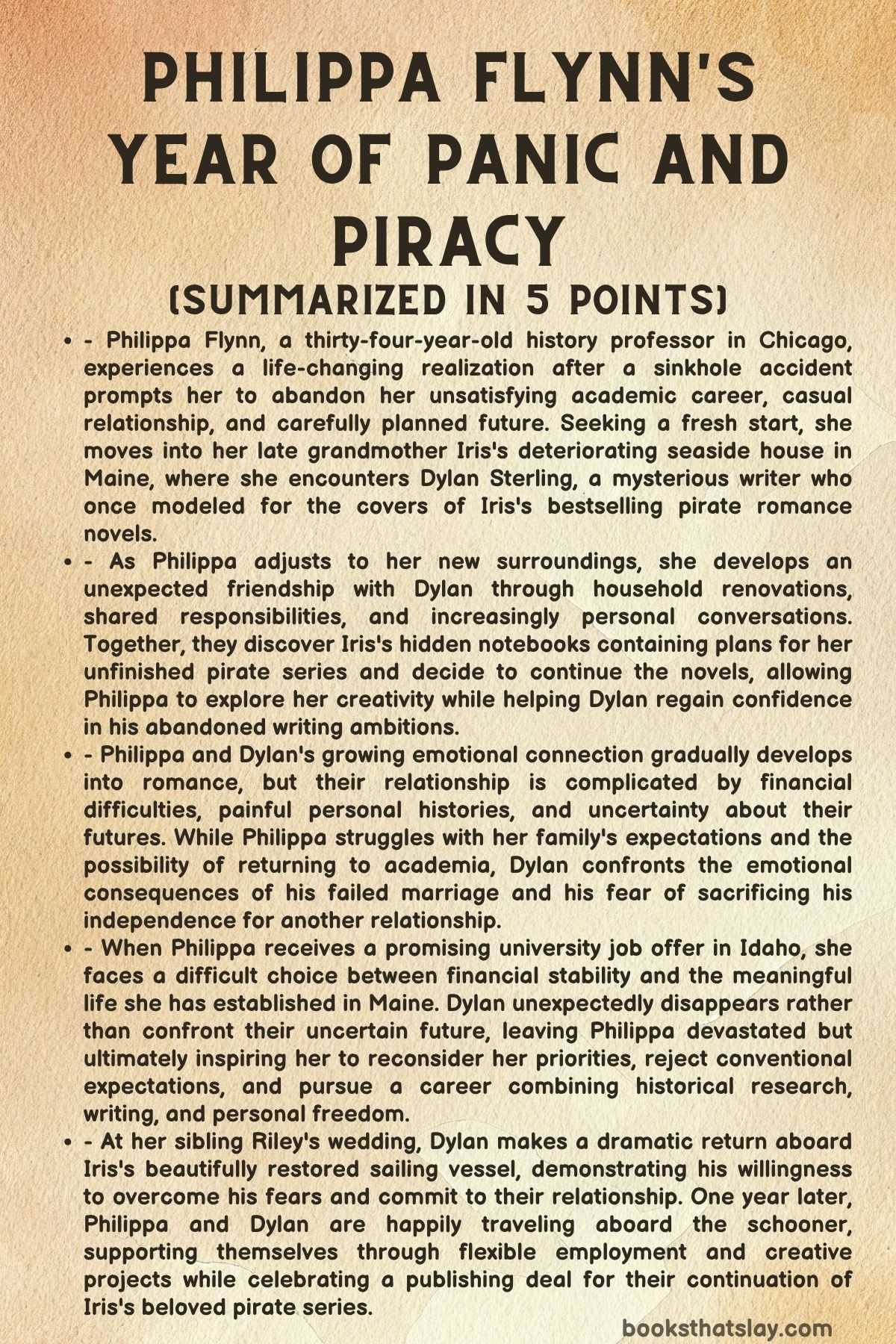
Philippa Flynn is a thirty-four-year-old history professor living in Chicago whose carefully organized life begins to unravel after a sinkhole unexpectedly opens beneath her bicycle during her morning commute. Although she escapes without serious injury, the incident forces her to recognize how dissatisfied she has become with her career, relationships, and everyday existence.
For years, Philippa has worked hard to establish herself in academia, only to encounter professional discrimination, limited recognition, and an unsupportive department chair named Carl. Her romantic relationship with Noah provides little emotional satisfaction, and she increasingly feels that her life reflects expectations rather than personal happiness.
In an extraordinary departure from her cautious personality, Philippa resigns from her university position, ends her relationship, and gives up her apartment. Her impulsive decisions astonish her family and friends, particularly her colleague Amelia Leung, who has always known her as a meticulous planner.
With limited employment prospects and dwindling savings, Philippa considers moving into the coastal Maine house inherited from her beloved grandmother, Iris Flynn. The property holds precious childhood memories, although its deteriorating condition and unusual living arrangements make the decision complicated.
Iris’s will allows a mysterious writer named Dylan Sterling to occupy the property. Philippa knows little about him and initially imagines an elderly literary figure who has remained in the house since her grandmother’s death.
When she arrives in Maine, however, she discovers that Dylan is an attractive middle-aged man who bears an extraordinary resemblance to Zane Scarlett, the fictional pirate hero featured in Iris’s bestselling romance series. Dylan explains that he once modeled for the novels’ covers before becoming Iris’s assistant and collaborator.
Their first interactions are awkward. Philippa is talkative when nervous, while Dylan is reserved, socially uncomfortable, and reluctant to discuss his personal life.
Nevertheless, his decision to prepare her childhood bedroom for her arrival demonstrates an unexpected thoughtfulness. Philippa gradually recognizes that his silence does not necessarily indicate hostility.
As she explores the neglected house, familiar furniture, photographs, and possessions remind her of summers spent with Iris. Her grandmother offered the encouragement and acceptance that Philippa often struggled to find within her achievement-oriented family.
The house requires extensive repairs, including damaged windows, an aging roof, and neglected exterior structures. Philippa begins cleaning, organizing, and selling valuable collectibles to generate money, while Dylan quietly helps with practical difficulties.
Their relationship develops through shared household projects, small gestures of consideration, and a playful truth-or-dare arrangement. Philippa discovers that Dylan once possessed considerable literary ambition but has become unable to pursue writing with confidence.
Meanwhile, her family continues questioning her decisions. At her sister Louisa’s engagement party, Philippa feels uncomfortable amid conversations about marriage, professional advancement, and financial security.
Her four siblings appear to have achieved conventional success, intensifying her impression that she is the family’s unsuccessful exception. However, their conversations also remind her of Iris’s unfinished pirate romance series.
The books follow Zane Scarlett through dangerous voyages, romantic entanglements, supernatural adventures, and extraordinary discoveries. Iris died before completing the series, leaving readers without a conclusion to the characters’ stories.
Philippa remembers that her grandmother mentioned creating outlines for future installments. She and Dylan begin searching the house, hoping that these materials might have survived.
Their investigation initially proves unsuccessful. Eventually, however, Philippa notices a passage in one of Iris’s novels describing a hidden compartment within an antique chest.
Recognizing that her grandmother owned a similar piece of furniture, Philippa and Dylan examine it more carefully. They discover concealed notebooks containing detailed plans, character descriptions, and storylines for the unfinished series.
The discovery transforms Philippa’s understanding of her inheritance. Beyond preserving her grandmother’s possessions, she may have an opportunity to continue Iris’s creative legacy.
The notebooks describe adventures involving dangerous sea creatures, cursed women, mysterious islands, and complicated romantic choices. Although Philippa has never written fiction, she becomes fascinated by the possibility of completing the novels with Dylan.
Their shared enthusiasm creates a stronger personal connection. Philippa admires Dylan’s understanding of storytelling, while he respects her intelligence, historical knowledge, and organizational abilities.
As autumn approaches, Philippa continues applying for academic positions because she needs financial stability. Yet her growing attachment to Maine makes the prospect of leaving increasingly troubling.
A severe coastal storm exposes the dangerous condition of the house’s roof. Philippa and Dylan work together to contain extensive water damage, and the emergency strengthens their developing partnership.
Their evenings become more intimate through conversations about books, music, and personal experiences. One particularly meaningful encounter occurs when Dylan plays the Goo Goo Dolls song “Iris” and holds Philippa’s hand.
Although neither openly declares romantic feelings, their affection becomes increasingly apparent. Philippa begins appreciating the emotional warmth Dylan offers, while he gradually becomes more comfortable expressing himself.
They establish a writing schedule for their planned novel, A Siren Calls, combining Philippa’s historical research with Dylan’s creative experience. Philippa initially struggles to accept the historical liberties and supernatural elements characteristic of Iris’s romances.
Dylan helps her understand that compelling fiction depends upon believable emotions rather than strict factual accuracy. Their collaboration becomes an unexpected source of professional satisfaction for both.
Dylan also begins organizing a promotional campaign to restore Iris’s deteriorating sailing vessel. With assistance from his former modeling contacts, Trish and Naomi, he participates in a pirate-themed photo shoot intended to raise money for the project.
When Philippa questions how well she truly knows him, Dylan withdraws. He eventually explains that his marriage to a woman named Vivian left him emotionally damaged and uncertain of his abilities.
Vivian was ambitious and decisive, whereas Dylan frequently surrendered his preferences to accommodate hers. After their marriage collapsed following her involvement with another man, he abandoned much of his former life, including his writing aspirations.
Philippa responds with patience and affection rather than judgment. Their conversation creates a deeper trust, allowing Dylan to begin confronting the insecurities that have governed his behavior.
Their growing attraction eventually becomes physical after Philippa returns from an exhausting family gathering. Dylan’s thoughtful preparations for her arrival remind her how much he values her, and she initiates their first kiss.
Their relationship develops into a loving partnership, although financial difficulties remain unresolved. Repairs become increasingly expensive, particularly after additional roofing damage and black mold are discovered.
Philippa’s parents continue urging her to sell the house and return to stable employment. Her father even sends a realtor to evaluate the property.
Philippa resists because the house represents her connection to Iris. She fears that losing it would mean surrendering the last tangible reminder of the person who understood her best.
Meanwhile, literary agent Kate Sharpe responds positively to the opening chapters of A Siren Calls. Although she cannot promise publication, her encouragement convinces Philippa and Dylan that their manuscript has commercial potential.
However, continuing Iris’s series requires authorization from her literary estate, which Philippa’s mother partly controls.
At a family gathering, Philippa discovers that her siblings also conceal important struggles and decisions from their parents. Some have experienced employment difficulties, while others have made unconventional romantic or personal choices.
The revelations help Philippa recognize that she is not uniquely unsuccessful. Her siblings have simply learned to conceal the differences between their actual lives and their parents’ expectations.
When Philippa announces her intention to continue Iris’s books, her mother reacts negatively. Their subsequent confrontation reveals years of misunderstanding.
Her mother worries about Philippa’s financial future and social isolation, while Philippa feels that her parents value conventional achievement more than her happiness.
Eventually, her mother agrees to authorize the writing project if Iris’s publishing team approves the completed manuscript. However, Philippa also commits to pursuing a traditional academic position and reconsidering whether keeping the house is financially realistic.
A promising university in Idaho invites Philippa for an interview. Unlike her former workplace, the institution appears welcoming, organized, and professionally supportive.
Philippa can imagine succeeding there, but accepting the opportunity would require leaving Maine. When she discusses the possibility with Dylan, he explains that he cannot return to a life organized entirely around another person’s ambitions.
Their disagreement forces Philippa to confront her unresolved grief over Iris’s death. She finally admits that selling the house feels like losing her grandmother again.
Dylan comforts her, and they continue writing together. Philippa also discovers an alternative professional direction through temporary archival work for a Boston museum.
Researching historical photographs and personal records reminds her why she originally loved history. She begins realizing that meaningful intellectual work does not necessarily require a university appointment.
After a disappointing interview in Kansas, Philippa receives an offer for the Idaho position. The job promises financial security, benefits, and professional recognition, but threatens the relationships and creative life she has established.
She struggles to determine whether accepting the position would represent genuine ambition or another surrender to expectations.
When she explains her dilemma to Dylan, he questions whether the opportunity reflects what she truly wants. Their disagreement remains unresolved, although they spend a romantic evening together.
The following morning, Philippa discovers that Dylan has disappeared with his belongings and motorcycle. He leaves behind his unpublished novel, The Curious Tale of Bartholomew Kilderkin, and a message encouraging her to demonstrate more courage than he possesses.
His departure devastates Philippa. She repeatedly attempts to contact him, struggles with anger and abandonment, and questions whether their relationship was as meaningful to him as it was to her.
Reading his manuscript provides insight into his fears, but it does not excuse his inability to communicate.
During this painful period, Philippa begins reconsidering the relationship between memory and physical possessions. She realizes that Iris’s influence exists in her knowledge, values, relationships, and memories, regardless of whether she continues owning the house.
She also recognizes that her professional future should reflect her own interests rather than her family’s definition of success.
With support from her sisters Haley and Eleanor, Philippa decides to reject the Idaho position and explore archival research, writing, and other flexible employment opportunities.
She also accepts the possibility of selling the house if preserving it would prevent her from building a sustainable future.
Although she continues loving Dylan, she refuses to organize her life around someone unwilling to remain and communicate.
At Riley’s wedding, Philippa arrives with a stronger sense of independence. She no longer regards her unmarried status or unconventional ambitions as evidence of failure.
The celebration takes an extraordinary turn when Iris’s beautifully restored sailing vessel approaches the venue. Dylan has returned aboard the ship, now transformed into a magnificent schooner with striking black sails.
His restoration of the vessel demonstrates that he has finally found the determination to pursue something meaningful rather than retreat from emotional uncertainty.
Philippa and Dylan confront the pain caused by his departure and begin rebuilding their relationship through honesty and renewed commitment. Her mother also shows greater willingness to accept Philippa’s independence.
The couple leaves the celebration aboard the schooner, embracing a future that neither can fully predict.
A year after Philippa’s arrival in Maine, she and Dylan are traveling together aboard their restored vessel. They support themselves through archival research, curriculum development, modeling, copywriting, and sunset cruises.
Dylan is revising his unpublished novel with Kate Sharpe’s assistance, while Philippa continues researching her family history.
Their greatest professional achievement arrives when a publisher purchases A Siren Calls and five additional planned installments of Iris’s pirate series.
By combining their individual talents, they establish a creative career that honors Iris’s imagination while allowing them to build an independent life together.
Philippa ultimately discovers that happiness does not require abandoning ambition, love, or personal responsibility. It requires defining success according to her own values and accepting that an uncertain future can offer greater fulfillment than a carefully controlled existence.
Characters
Philippa Flynn
Philippa Flynn is the central character of Philippa Flynn’s Year of Panic and Piracy, a thirty-four-year-old historian whose journey from professional dissatisfaction to personal independence drives the novel. Intelligent, conscientious, and deeply organized, she has spent most of her adult life pursuing the conventional measures of success that she believes will earn her family’s approval.
Her decision to abandon a tenured university position after a frightening bicycle accident reveals a dissatisfaction that has been building for years. Although her actions initially appear impulsive, they represent a desperate attempt to escape a life that no longer reflects her interests or emotional needs.
Philippa’s greatest internal struggle concerns the difference between achievement and fulfillment. She has established herself as an accomplished academic, yet professional discrimination, inadequate recognition, and institutional dysfunction have gradually diminished her enthusiasm for work she once loved.
Her family relationships contribute significantly to her insecurity. Surrounded by successful siblings and parents who value stability, she frequently interprets her unconventional circumstances as evidence that she has failed to become the person everyone expected.
Philippa’s attachment to her grandmother’s Maine property reveals another important aspect of her personality. She treasures emotional connections and memories, particularly those associated with Iris, who offered her a sense of acceptance that she rarely experienced elsewhere.
Her relationship with Dylan Sterling challenges her instinct to analyze every situation before acting. Through their growing friendship and romance, Philippa learns to express affection, accept uncertainty, and recognize that emotional vulnerability does not necessarily undermine independence.
Her development as a writer is equally important. Initially determined to apply historical accuracy and academic discipline to Iris’s fantasy romances, she gradually understands that imaginative storytelling requires emotional authenticity and creative freedom.
The conclusion demonstrates Philippa’s transformation from someone seeking permission to live differently into someone capable of deciding what happiness means for herself. By rejecting the Idaho position, reconsidering her attachment to the house, and pursuing a flexible creative career, she establishes an identity based on personal conviction rather than external approval.
Dylan Sterling
Dylan Sterling is the male romantic lead of Philippa Flynn’s Year of Panic and Piracy, a talented but emotionally withdrawn writer whose quiet personality conceals considerable vulnerability. His unusual background as a romance cover model and former collaborator of Iris Flynn makes him both an intriguing presence and an important link to Philippa’s grandmother.
When Philippa first encounters him, Dylan appears distant, socially uncomfortable, and unwilling to discuss his past. However, his thoughtful actions reveal a compassionate nature that contrasts with his apparent indifference.
His emotional difficulties originate partly in his failed marriage to Vivian. Having spent years accommodating her ambitions and suppressing his own desires, Dylan eventually lost confidence in his ability to make meaningful decisions.
Following their separation, he withdrew from friendships, creative work, and romantic relationships. His isolation reflects an attempt to protect himself from further disappointment, even though it also prevents him from experiencing happiness.
His relationship with Philippa gradually challenges these habits. Her willingness to respect his boundaries while encouraging his creative interests allows him to rediscover aspects of himself that he believed were permanently lost.
Dylan’s literary abilities become especially significant during their collaboration on Iris’s unfinished series. He understands emotional storytelling, romantic tension, and characterization, providing a creative balance to Philippa’s analytical approach.
Nevertheless, his greatest weakness is his tendency to retreat when confronted with difficult emotional choices. His sudden disappearance after Philippa receives the Idaho job offer demonstrates that affection alone cannot overcome his fear of rejection.
His eventual return aboard the restored schooner marks an important development. By completing an ambitious project and confronting the relationship he nearly abandoned, Dylan demonstrates a newfound willingness to act with purpose.
His character illustrates the distinction between avoiding pain and developing genuine emotional strength. His ultimate achievement is not simply winning Philippa’s affection but reclaiming the confidence to pursue love, creative work, and an independent future.
Iris Flynn
Iris Flynn, Philippa’s deceased grandmother, remains one of the most influential figures in the novel despite never appearing as an active participant in the present-day events. Her personality survives through her seaside home, extensive possessions, successful romance novels, and the affectionate memories of those who knew her.
As a bestselling author of pirate romances, Iris possessed a lively imagination and an understanding of the emotional desires that attract readers to fictional adventures. Her stories demonstrate her ability to combine danger, humor, fantasy, and romantic longing.
Her relationship with Philippa reveals a generous and accepting personality. Unlike relatives who emphasize professional achievement and conventional success, Iris encouraged Philippa to appreciate her individuality.
The Maine house symbolizes this relationship. Its familiar rooms and treasured objects preserve memories of a childhood in which Philippa felt understood and appreciated without having to prove herself.
Iris’s professional relationship with Dylan further demonstrates her ability to recognize potential in unconventional circumstances. By offering him opportunities beyond modeling, she helped nurture his literary ambitions.
Her hidden notebooks become a decisive force in the plot. They reconnect Philippa and Dylan with creative possibilities that both had neglected and provide a foundation for their eventual collaboration.
Iris also represents the complicated relationship between grief and remembrance. Philippa initially believes that preserving every aspect of the property is necessary to maintain her grandmother’s presence.
Over time, however, Iris’s legacy becomes something more expansive than a physical inheritance. Her influence survives through the stories Philippa continues, the courage she inspires, and the life her granddaughter finally chooses.
Philippa’s Mother
Philippa’s mother is an important source of emotional conflict in Philippa Flynn’s Year of Panic and Piracy, representing the pressure that family expectations can place upon individual independence. Concerned with professional success, financial security, and socially recognizable achievements, she frequently struggles to understand Philippa’s unconventional decisions.
Her criticism of Philippa’s resignation and continued attachment to the Maine property reflects a practical worldview. She considers stable employment and responsible financial planning essential protections against future hardship.
However, her controlling behavior often prevents her from recognizing the emotional consequences of her expectations. Philippa consequently experiences family gatherings as occasions for judgment rather than reassurance.
The revelation that her other children have concealed important personal decisions exposes the limitations of her parenting approach. Her desire to guide them has unintentionally encouraged secrecy and anxiety.
Her confrontation with Philippa reveals that her behavior is not motivated simply by a desire for authority. She genuinely fears that her daughter may become financially insecure, socially isolated, or professionally unsuccessful.
Although these concerns are understandable, her difficulty respecting Philippa’s independence creates lasting resentment.
Her eventual willingness to approve the continuation of Iris’s novels marks a limited but meaningful change. By the conclusion, she begins recognizing that loving her children requires accepting choices she might never make herself.
Philippa’s Father
Philippa’s father represents the practical and financially conservative perspective within her family. He believes that professional stability, economic independence, and sensible property management provide the foundation for a successful adult life.
His concerns intensify after Philippa resigns from her university position without another job secured. From his perspective, abandoning a tenured academic career seems unnecessarily risky, particularly when she has inherited a property requiring expensive repairs.
His refusal to finance the deteriorating roof demonstrates how his practical instincts sometimes conflict with Philippa’s emotional priorities. He views the house primarily as a financial responsibility, while she considers it an irreplaceable connection to Iris.
By sending a realtor to evaluate the property, he attempts to resolve what he sees as an unsustainable situation. However, this intervention also reveals his difficulty accepting that Philippa has the right to make decisions he considers unwise.
His conversation with Philippa following the family conflict provides insight into her mother’s feelings. He helps explain that her controlling behavior arises partly from a fear of becoming unnecessary as her children establish independent lives.
Although he remains less emotionally expressive than Philippa desires, he is not portrayed as indifferent to her welfare. His limitations arise from an inability to recognize that material security and personal fulfillment do not always require identical choices.
Amelia Leung
Amelia Leung is Philippa’s friend and former academic colleague, providing an important connection to the professional world Philippa abandons. Her initial astonishment at Philippa’s resignation establishes just how unusual the decision is for someone known for careful planning and intellectual discipline.
Amelia understands the frustrations surrounding Philippa’s academic career, although she also recognizes the considerable risks associated with leaving a stable position.
Her suggestion that Philippa move into her grandmother’s Maine house becomes an important turning point. What initially appears to be a temporary practical solution eventually provides the environment in which Philippa reconstructs her life.
Amelia continues supporting Philippa through information about university opportunities and professional concerns. She also alerts her to troubling institutional controversies, helping her assess potential employers more carefully.
Unlike relatives who interpret success primarily through conventional achievements, Amelia offers a more informed understanding of Philippa’s professional difficulties. Her presence reinforces the value of friendships grounded in shared experiences and practical support.
Haley Flynn
Haley is one of Philippa’s sisters, whose family life provides an important contrast to Philippa’s uncertain circumstances. Her long struggle to become pregnant gives particular significance to the approaching birth celebrated at her baby shower.
Although Philippa sometimes feels inadequate beside her siblings’ apparent achievements, her relationship with Haley reveals genuine affection beneath these insecurities. Philippa’s thoughtful gift demonstrates her ability to recognize and celebrate her sister’s happiness despite her own difficulties.
Haley also contributes to the gradual improvement of Philippa’s family relationships. As the siblings become more honest about their individual struggles, their connections develop beyond comparisons and parental expectations.
Her emotional support becomes especially important following Dylan’s disappearance. Rather than criticizing Philippa’s decisions, Haley provides reassurance and helps her consider alternative possibilities.
By supporting Philippa’s determination to reject the Idaho position, Haley demonstrates that family loyalty can involve respecting independence rather than demanding conformity.
Eleanor Flynn
Eleanor is another of Philippa’s sisters and an important member of the family support system that becomes increasingly significant as the novel progresses. Her presence helps reveal the difference between Philippa’s assumptions about her siblings and their actual feelings toward her.
Philippa initially regards her siblings as people whose achievements reinforce her own perceived shortcomings. However, conversations with Eleanor and the others gradually demonstrate that each family member faces difficulties that are not always visible.
Eleanor becomes particularly important when Philippa must decide whether to accept the Idaho position and continue pursuing conventional academic success.
Following Dylan’s departure, she offers companionship and understanding rather than treating Philippa’s emotional difficulties as evidence of poor judgment.
Her support helps Philippa recognize that she can maintain close family relationships without abandoning her personal ambitions. Eleanor thus represents the possibility of transforming sibling comparison into genuine solidarity.
Louisa Flynn
Louisa is Philippa’s youngest sister, whose engagement celebration exposes the social pressures that have shaped Philippa’s self-image. Surrounded by relatives discussing marriage, professional success, and family milestones, Philippa becomes especially conscious of how different her life appears.
Louisa’s engagement represents the conventional progression toward marriage and family life that their parents value. This contrast initially intensifies Philippa’s insecurity about being unmarried and professionally unsettled.
However, Louisa is not presented simply as a source of comparison. The sisters share affection, humor, and family experiences that become more meaningful as Philippa develops confidence.
Her engagement also contributes to the novel’s broader examination of how public celebrations can conceal private anxieties. Through Philippa’s changing perspective, Louisa becomes part of a family that is more complicated and supportive than its outward appearance suggests.
Riley Flynn
Riley is one of Philippa’s siblings, whose wedding provides the setting for the novel’s decisive romantic reunion. The celebration initially represents another conventional milestone that Philippa might previously have experienced with discomfort.
By the time Riley’s wedding arrives, however, Philippa has developed a stronger sense of personal independence. She no longer interprets another sibling’s marriage as evidence that her own life is deficient.
The wedding becomes particularly significant when Dylan arrives aboard Iris’s restored sailing vessel. His dramatic return transforms the family celebration into a moment of reconciliation and emotional renewal.
Riley’s role is therefore closely connected to the conclusion’s emphasis on family belonging. The wedding provides a setting in which Philippa can celebrate another person’s happiness while remaining confident in her own unconventional future.
Vivian
Vivian is Dylan’s former wife, whose influence remains central to his emotional difficulties long after their marriage has ended. Confident, ambitious, and decisive, she possessed qualities that initially attracted Dylan but eventually contributed to an unequal relationship.
Dylan frequently subordinated his personal preferences to Vivian’s plans, gradually becoming less certain of his own desires and professional ambitions. Their marriage developed into a situation in which he responded to her decisions rather than actively shaping their shared future.
Vivian’s involvement with another man contributed to the marriage’s collapse. Dylan’s response was not confrontation but withdrawal, a pattern that continued to define his behavior.
Although Vivian appears primarily through Dylan’s recollections, her character helps explain his reluctance to accept affection and make commitments.
She also provides an important contrast to Philippa. Whereas Vivian’s relationship with Dylan encouraged his dependence, Philippa increasingly seeks a partnership in which both individuals can pursue meaningful ambitions.
Vivian’s role demonstrates that unhealthy relationship patterns can continue influencing a person’s decisions long after the original relationship has ended.
Kate Sharpe
Kate Sharpe is the literary agent who recognizes the commercial possibilities of Philippa and Dylan’s collaborative manuscript. Her professional judgment provides important encouragement during a period when both writers remain uncertain about their abilities.
Kate responds positively to the opening chapters of A Siren Calls while also identifying improvements that could strengthen the work. Her feedback encourages Philippa to reconsider excessive historical explanations and develop more effective pacing and characterization.
Importantly, Kate does not offer unrealistic guarantees of publishing success. She acknowledges the manuscript’s potential while explaining the practical obstacles involved in continuing Iris’s established series.
Her insistence on securing authorization from the literary estate introduces a significant challenge for Philippa. Nevertheless, this requirement reinforces the importance of approaching creative ambitions with professional responsibility.
Kate also supports Dylan’s return to his earlier literary work, helping him revise The Curious Tale of Bartholomew Kilderkin.
Her character represents professional mentorship that encourages creativity without dismissing practical concerns.
Michael
Michael is an academic whom Philippa meets during a family gathering, apparently through an introduction encouraged by their mothers. Although she initially suspects an unwanted matchmaking arrangement, their conversation proves unexpectedly comfortable.
Their shared professional background allows them to discuss academic institutions, difficult working environments, and family expectations without the misunderstandings Philippa often encounters elsewhere.
Michael acknowledges that leaving an unhealthy workplace can be a reasonable decision. His understanding helps Philippa recognize that her dissatisfaction with academia is not simply a personal weakness.
He also introduces her to possible remote employment opportunities, expanding her understanding of how historical knowledge might be used outside conventional university positions.
Michael’s importance lies less in romantic possibility than in intellectual validation and practical support. He helps Philippa imagine professional alternatives that she had previously overlooked.
Trish and Naomi
Trish and Naomi are women connected to Dylan’s former modeling career who assist with his ambitious plans to restore Iris’s sailing vessel. Their arrival surprises Philippa because Dylan has kept the project largely secret.
They help organize a promotional photo shoot featuring Dylan in his recognizable pirate persona. The campaign is intended to attract attention and raise funds for the vessel’s restoration.
Their involvement reveals that Dylan possesses professional connections and practical abilities that Philippa has not fully appreciated.
The resulting tension between Philippa and Dylan also creates an opportunity for greater honesty about his past.
Although their individual backgrounds are not developed extensively, Trish and Naomi contribute to the restoration project that eventually becomes central to the couple’s shared future.
Noah
Noah is Philippa’s casual romantic partner at the beginning of the novel. Their relationship forms part of the unsatisfying life she abandons after her bicycle accident.
Philippa’s decision to end their relationship demonstrates that she has become unwilling to maintain personal arrangements merely because they are familiar or convenient.
Noah’s limited role is important because the relationship lacks the emotional depth and mutual investment that Philippa later discovers with Dylan.
His presence establishes a contrast between companionship maintained through habit and affection built upon genuine understanding.
Carl
Carl is Philippa’s unsupportive university department chair, representing the professional frustrations that contribute to her resignation. His position gives him influence over the academic environment in which Philippa has struggled for recognition.
The discrimination and institutional difficulties associated with her former workplace reveal the limitations of a system that does not always reward competence or dedication fairly.
Carl’s role helps explain why Philippa’s resignation is not simply an irrational reaction to a frightening accident.
Although he is not extensively developed as an individual, he symbolizes the professional culture that Philippa eventually decides she no longer wishes to tolerate.
Zane Scarlett
Zane Scarlett is the fictional pirate hero created by Iris Flynn and featured throughout her bestselling romance series. Within Philippa Flynn’s Year of Panic and Piracy, he occupies an unusual position as a character whose adventures influence the lives of the novel’s real protagonists.
Presented as an adventurous and romantically compelling pirate king, Zane becomes involved in dangerous voyages, supernatural encounters, and complicated relationships.
His fictional adventures offer Philippa and Dylan the creative material they need to continue Iris’s unfinished literary project.
Zane’s resemblance to Dylan, who modeled for the original book covers, also establishes an amusing connection between romantic fantasy and Philippa’s developing attraction.
As Philippa works on his story, she gradually learns that his appeal depends on emotional complexity rather than adventurous exploits alone.
His character consequently becomes a vehicle through which she discovers the craft of romantic fiction and develops confidence in her imaginative abilities.
Amorosa
Amorosa is a character connected to the unfinished pirate adventure that Philippa and Dylan reconstruct from Iris’s notebooks. Her involvement contributes to the supernatural and romantic complications surrounding Zane Scarlett.
The surviving outlines describe a dangerous sea creature associated with extraordinary healing powers and a beautiful cursed woman, creating a conflict between personal desire and moral responsibility.
As Philippa and Dylan develop Amorosa’s storyline, they must consider how fantasy characters can make emotionally believable choices within extraordinary circumstances.
Her role becomes important to Philippa’s creative development because it encourages her to look beyond historical realism and focus on characterization, emotional motivation, and romantic conflict.
Amorosa therefore serves as part of the fictional world through which Philippa learns to appreciate her grandmother’s storytelling methods.
Themes
Personal Reinvention and the Courage to Embrace Change
In Philippa Flynn’s Year of Panic and Piracy, personal reinvention begins when an unexpected accident forces Philippa to confront the dissatisfaction she has spent years ignoring. Her decision to abandon a stable academic career appears reckless, but it also represents her first meaningful attempt to challenge the expectations governing her life.
Philippa’s initial understanding of success depends upon professional advancement, financial security, and external recognition. Despite achieving an apparently respectable position, she feels increasingly disconnected from the intellectual curiosity and enthusiasm that originally motivated her academic ambitions.
Her move to Maine introduces a different understanding of personal achievement. Household repairs, archival research, creative writing, and developing relationships begin providing satisfaction that her university career no longer offers.
However, reinvention does not occur through a single dramatic decision. Philippa repeatedly confronts uncertainty, financial limitations, professional disappointments, and the fear that she has damaged her future.
The Idaho job offer creates the clearest test of her developing independence. Accepting the position would provide conventional security, but it would also require sacrificing important aspects of her newly established life.
Her eventual decision to reject the offer demonstrates that courage involves more than abandoning an unsatisfying situation. It also requires accepting responsibility for an uncertain alternative.
Dylan undergoes a parallel transformation as he confronts the emotional withdrawal that followed his failed marriage. His restoration of the schooner and renewed commitment to writing reflect his rediscovery of personal agency.
Together, their experiences suggest that changing one’s life requires an ongoing willingness to challenge familiar assumptions. Reinvention becomes meaningful when individuals develop the confidence to pursue choices consistent with their values rather than simply escaping their previous circumstances.
Love, Emotional Vulnerability, and Mutual Independence
The relationship between Philippa and Dylan develops through ordinary acts of consideration rather than immediate declarations of affection. Their early interactions are marked by awkwardness, hesitation, and uncertainty because both have learned to protect themselves from emotional disappointment.
Philippa approaches relationships with the same analytical instincts that characterize her professional life. She frequently questions other people’s intentions and struggles to accept affection without searching for explanations.
Dylan’s difficulties arise from his failed marriage and his tendency to suppress his own needs. Having spent years accommodating another person’s ambitions, he fears entering a relationship that might once again require him to abandon his identity.
Their growing friendship creates an environment in which emotional honesty becomes possible. Shared domestic responsibilities, conversations about writing, and small gestures of kindness gradually establish trust.
The novel emphasizes that intimacy depends upon feeling understood rather than simply experiencing romantic attraction. Philippa’s willingness to listen to Dylan’s painful experiences allows him to express vulnerability without fearing immediate rejection.
However, their romance also exposes the limitations of affection when communication remains inadequate. Dylan’s disappearance after Philippa receives the Idaho offer demonstrates that unresolved insecurities can undermine even a loving relationship.
Philippa’s response becomes an important expression of personal growth. Although she loves him, she refuses to sacrifice her self-respect by continually pursuing someone unwilling to communicate.
Their eventual reconciliation depends upon Dylan’s willingness to act differently. Restoring the ship becomes evidence that he can make meaningful commitments rather than retreat from difficult circumstances.
The relationship ultimately presents love as a partnership between independent individuals. Its success depends not on one person surrendering personal ambitions but on both finding ways to support each other’s development.
Family Expectations, Individual Identity, and the Meaning of Success
Philippa’s family initially appears to represent an orderly world of professional achievement, marriage, financial responsibility, and clearly defined life milestones. Against this background, her decision to abandon academia makes her feel like an outsider who has failed to meet the standards established for her.
Her parents measure success primarily through stability and recognizable accomplishments. Their repeated questioning of her employment, romantic status, and inheritance reflects an inability to understand choices that fall outside their expectations.
This pressure has profound consequences for Philippa’s self-image. Although she possesses considerable intelligence and professional experience, she frequently compares herself unfavorably with her siblings.
The family gatherings illustrate how even well-intentioned concern can become emotionally exhausting when individuals feel constantly evaluated. Philippa’s discomfort arises less from a lack of affection than from her belief that acceptance depends upon satisfying specific expectations.
However, the revelation that her siblings also conceal personal difficulties challenges her assumptions about their supposedly perfect lives. Employment problems, unconventional relationships, and hidden decisions demonstrate that outward success does not necessarily reflect private satisfaction.
These discoveries allow Philippa to recognize that her siblings are not competitors in a family contest. They are individuals struggling with many of the same pressures she experiences.
Her confrontation with her mother further complicates the conflict. Philippa recognizes that parental control can originate in genuine concern, even when its consequences are damaging.
By the conclusion, she begins establishing boundaries without rejecting her family entirely. Her siblings’ support and her mother’s gradual acceptance suggest that family relationships can improve when affection becomes less dependent upon conformity.
The novel ultimately distinguishes personal fulfillment from social approval. Success becomes an individual judgment shaped by meaningful work, emotional connection, independence, and the freedom to pursue an unconventional future.
Grief, Memory, and the Preservation of Legacy
The deteriorating Maine house occupies an emotional position far greater than its physical condition would suggest. For Philippa, the property preserves childhood memories of Iris Flynn, whose affection and acceptance provided an important refuge from the expectations surrounding her family life.
Returning to the house initially allows Philippa to reconnect with a happier period of her life. Familiar rooms, photographs, furniture, and cherished possessions remind her of experiences that helped shape her identity.
Yet these memories also reveal how thoroughly she has avoided confronting her grandmother’s death. Her determination to preserve the property reflects a fear that allowing it to change would mean losing Iris again.
The expensive repairs intensify this conflict. Financial reality repeatedly challenges Philippa’s emotional attachment, forcing her to consider whether maintaining the house is practical or necessary.
Dylan’s presence provides an important connection to Iris’s later life. Through his memories and their shared discovery of her unfinished manuscripts, Philippa encounters aspects of her grandmother that extend beyond childhood recollections.
The hidden notebooks transform legacy from something preserved through possessions into something maintained through creative participation. By continuing Iris’s pirate romances, Philippa and Dylan help extend the imaginative work that mattered deeply to her.
The restoration of the sailing vessel reinforces this transformation. Rather than remaining an abandoned object associated with the past, the ship becomes a functioning home and a source of new experiences.
Philippa eventually understands that memory does not depend entirely upon protecting physical objects from change. Her grandmother’s influence survives through stories, relationships, personal values, and the courage to pursue meaningful ambitions.
In Philippa Flynn’s Year of Panic and Piracy, grief gradually develops into a more accepting relationship with the past. By honoring Iris’s creative legacy while embracing her own future, Philippa discovers that remembrance can encourage new beginnings rather than prevent them.