Styx – The River by Nikita Gill Summary, Characters and Themes
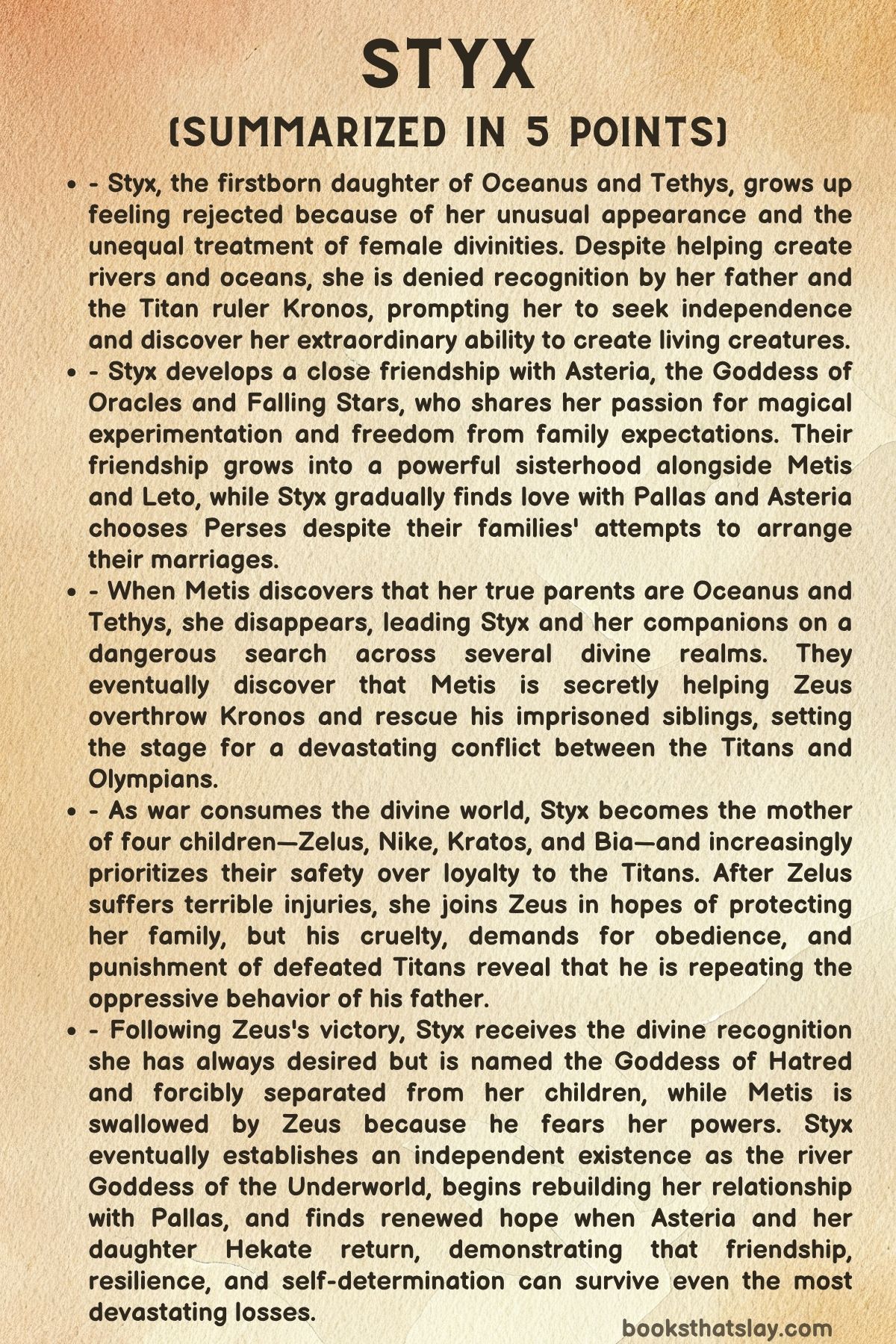
Styx – The River by Nikita Gill is a mythological fantasy novel that reimagines Greek mythology through the experiences of two powerful women struggling against divine authority, family expectations, and predetermined destinies.
At its center is Styx, an overlooked daughter of the Titans who longs for recognition in a world governed by powerful male Gods. Alongside her closest friend, Asteria, she discovers extraordinary abilities, experiences love and motherhood, and confronts the destructive consequences of a war between generations of immortals. Through their interconnected lives, the novel explores female independence, loyalty, betrayal, identity, and the difficult choices involved in surviving oppressive systems. It’s the 2nd book in the Goddesses of the Underworld series.
Summary
Styx is born as the first daughter of Oceanus and Tethys, two powerful Titans whose union produces thousands of divine children. Her arrival initially brings celebration, but her unusual appearance quickly becomes a source of judgment within her family.
With green hair, differently colored eyes, and serpentlike fangs, Styx does not resemble the conventionally beautiful Goddesses surrounding her. Her grandmother Gaia predicts that her appearance will eventually bring her misfortune, establishing an expectation that follows her throughout her early life.
As her parents continue having children, Styx watches her brothers receive impressive powers and authority over rivers. Her sisters, meanwhile, are assigned nurturing responsibilities as Oceanids, expected to serve the natural world without enjoying the same independence as their brothers.
Although Styx possesses remarkable creativity and helps Oceanus design rivers and oceans, her father refuses to recognize her contributions. Her resentment grows when Kronos, the ruler of the Titans, formally denies the Oceanids full divine status.
Styx publicly challenges this injustice, hoping that Oceanus will defend her. Instead, he humiliates her by ordering her to leave, confirming that her devotion to her family will not guarantee its acceptance.
Seeking refuge, Styx escapes to a secluded sea cave, where she unexpectedly discovers an extraordinary ability. Through the force of her emotions, she creates a living eel and gives it the ability to generate electricity.
Her discovery suggests that she possesses divine gifts far greater than anyone has acknowledged. For the first time, Styx begins imagining a future in which her abilities might allow her to establish an identity independent of her father’s authority.
Elsewhere, Asteria, the daughter of Coeus and Phoebe, faces a different form of confinement. As the Goddess of Oracles and Falling Stars, she has recognized divine powers, yet her parents still expect her to behave according to established conventions.
Asteria secretly experiments with magical creation, transforming ordinary objects into living creatures. When she discovers Styx occupying her hidden sea cave, their meeting immediately becomes confrontational.
Their argument escalates after Styx’s eel devours Asteria’s magical creatures. However, when Asteria nearly becomes trapped underwater, Styx rescues her, revealing a compassion that contradicts her defensive behavior.
The two eventually establish a friendship and agree to share the cave. Their secret experiments allow them to develop their abilities while building a relationship based on mutual understanding rather than competition.
Asteria gradually recognizes how deeply Styx has suffered because of her family’s treatment. Their friendship becomes increasingly important as political tensions grow among the Titans, particularly concerning Kronos’s unstable leadership.
Their lives become more complicated when Tethys secretly gives birth to another daughter, despite Kronos having prohibited further children. Styx helps deliver the infant, whom she names Metis.
To protect the child, Phoebe agrees to raise Metis as her own. Although Styx understands the necessity of concealing her sister’s identity, she resents the circumstances that force another daughter away from her biological family.
Metis grows up alongside Asteria and Leto, forming a close relationship with Styx. Together, the four young women establish a sisterhood that gradually changes Styx’s understanding of female companionship.
The arrival of Pallas and Perses at Oceanus’s palace introduces new possibilities. The brothers have come to train the River Gods in warfare, and Styx finds herself unexpectedly attracted to Pallas, the powerful God of Weaponry.
However, their developing connection becomes complicated when Oceanus announces that a prophecy requires Styx to marry Pallas and bear four powerful children. Furious that her future has been arranged without her permission, Styx refuses the marriage publicly.
A disturbing prophetic dream subsequently makes her reconsider the forces shaping her destiny. When Pallas approaches her privately, his patience and respect begin challenging her assumptions about marriage and masculine authority.
Styx eventually agrees to marry him, although she remains determined to preserve her independence. Pallas gradually proves that he values her intelligence, unusual beauty, and creative abilities rather than simply regarding her as an instrument of prophecy.
Meanwhile, Asteria and Perses develop their own romantic relationship while attempting to bring Styx and Pallas closer together. Their happiness is threatened when Coeus promises Asteria’s hand to Achelous, Oceanus’s eldest son.
Asteria refuses the proposed marriage and declares her love for Perses. Unlike Oceanus, Coeus eventually accepts his daughter’s wishes, although his decision creates a serious disagreement between the brothers.
The two couples subsequently find warmth and acceptance within the household of Crius and Eurybia. For Styx and Asteria, this environment offers an encouraging contrast to the restrictive families in which they were raised.
Their happiness is disrupted when Metis disappears after learning the truth about her parentage. Discovering that Oceanus and Tethys are her biological parents leaves her feeling deceived by the people she trusted.
Styx, Asteria, Leto, Pallas, and Perses organize a search, fearing that Metis has encountered danger. Before leaving, Styx and Asteria return to their childhood sanctuary and release the magical creatures they created together.
Their actions symbolize the conclusion of a relatively sheltered period of their lives. Assisted by the wind deities, the companions travel through extraordinary divine territories while following clues about Metis’s movements.
They visit Tartarus, who reveals that Metis obtained a mysterious volcanic stone, and then reach Atlas’s celestial orchard. Further encounters with Nyx and Hyperion indicate that Metis has been collecting unusual materials for an important magical undertaking.
Throughout the journey, Styx struggles with a pregnancy she has concealed from Pallas. When he discovers her condition, their disagreement exposes the lingering effects of her childhood, particularly her fear that revealing vulnerability will result in losing control over her life.
The search eventually leads the companions to a mountain cavern, where Metis is working alongside Zeus, the surviving son of Kronos and Rhea. Hidden from his father, Zeus has been preparing to overthrow the Titan ruler.
Metis explains that she has been helping Zeus develop the means to rescue his siblings, whom Kronos swallowed because he feared being overthrown by his own children.
Before the confrontation can continue, Styx goes into labor. With assistance from Metis and Asteria, she gives birth to a son named Zelus, whom Pallas blesses as the God of Zeal.
The child’s arrival temporarily restores affection among the women. Metis explains her reasons for helping Zeus, insisting that she wishes to protect innocent lives and end Kronos’s cruelty.
Asteria nevertheless fears that replacing one powerful ruler with another might simply perpetuate the same injustices. Metis promises to advise Zeus against unnecessary violence, believing she can influence the emerging political order.
After returning home, Asteria begins creating a peaceful married life with Perses. He provides her with a beautiful palace where she can pursue her interests in prophecy, astronomy, and magical experimentation.
However, the divine world soon descends into conflict when Zeus publicly confronts the Titans alongside the siblings he has liberated. He demands their surrender and threatens punishment if they refuse.
Metis announces that she has become Zeus’s consort and is carrying his child, deepening the divisions within her family. When the Titans refuse Zeus’s demands, war erupts between the older Gods and the Olympians.
As the fighting continues, Styx becomes the mother of four children: Zelus, Nike, Kratos, and Bia. Although she has always wanted divine recognition, her responsibility toward her children increasingly reshapes her priorities.
Metis approaches Styx with an offer from Zeus, promising recognition and protection if she joins the Olympian cause. Styx initially refuses because she cannot bear the thought of betraying Asteria, Perses, and her remaining family.
The conflict becomes progressively more destructive. Oceanus eventually withdraws his River Gods after witnessing their terrible injuries, weakening the Titan armies.
Styx’s relationship with Pallas deteriorates as their loyalties and fears become increasingly difficult to reconcile. When Zelus suffers devastating injuries in battle, Styx uses the healing abilities she secretly developed with Asteria to save him.
The experience convinces her that protecting her children must take precedence over political allegiance. She accepts Zeus’s offer and brings Pallas and their children into the Olympian ranks.
However, her hopes of finding security under Zeus are quickly disappointed. He demands military service from her children and threatens imprisonment if she refuses, exposing the cruelty beneath his promises.
Asteria secretly visits Styx, but their reunion becomes painful when she discovers her friend’s decision to change sides. Although neither woman entirely rejects the other’s reasoning, their opposing loyalties create an emotional separation.
Eventually, the Titans are defeated. Zeus imprisons many of the older Gods, condemns Atlas to carry the heavens, and inflicts a terrible punishment upon Perses.
During the Olympian victory ceremony, Styx witnesses Zeus using public suffering to demonstrate his supremacy. When he threatens the Titanides, she challenges him openly, refusing to remain silent before another abusive ruler.
Zeus grants Styx the divine recognition she has sought throughout her life, but his gift is deliberately cruel. He names her the Goddess of Hatred and separates her from her children, requiring them to remain on Olympus.
Her devastation deepens when she learns that Zeus has swallowed Metis because he fears her extraordinary abilities. His actions reveal that he has become disturbingly similar to Kronos.
Despite these losses, Styx gradually discovers a new purpose. Under Hades’s authority, she becomes associated with the river of the dead, guiding souls through the Underworld.
Before embracing her new existence, she secretly sends a warning to Asteria and Hekate, hoping they can escape Zeus’s vengeance. Pallas remains devoted to her, and their relationship begins recovering from the damage caused by war.
Living within her river, Styx finally possesses an independent domain and authority that cannot be taken away through her father’s disapproval. Yet her achievement carries the painful cost of separation from her children and the destruction of relationships she once considered permanent.
Looking back upon her life, Styx recognizes that Gaia’s prophecy never fully determined her destiny. The qualities that made her an outsider ultimately became inseparable from the strength that allowed her to survive.
The novel ends when Asteria and her daughter Hekate arrive at Styx’s river. Their reunion suggests that even after betrayal, violence, and separation, the bonds between powerful women can offer the possibility of healing and a different future.
Characters
Styx
Styx is the central character of Styx, a Goddess whose journey from rejection to independence forms the emotional and political foundation of the novel. As the firstborn daughter of Oceanus and Tethys, she begins life with the expectation that she will occupy a special place within her family.
However, her unusual physical appearance and her society’s unequal treatment of female divinities gradually destroy that expectation. Her father’s refusal to acknowledge her contributions leaves her feeling unwanted, powerless, and deeply resentful.
Styx possesses a fiercely independent personality, characterized by intelligence, creativity, stubbornness, and a strong sense of justice. Her willingness to challenge Kronos and Oceanus demonstrates extraordinary courage, although her confrontational behavior sometimes creates difficulties in her relationships.
Her discovery of magical creation becomes essential to her development because it establishes that her identity extends beyond the limitations imposed upon her. The creatures she brings into existence demonstrate powers that her family has failed to recognize or understand.
Her friendship with Asteria represents one of the earliest experiences of genuine acceptance in her life. Through this relationship, Styx gradually learns that trusting another person does not necessarily mean surrendering her independence.
Her marriage to Pallas further challenges her defensive understanding of intimacy. Although she initially fears becoming subordinate to another God, Pallas’s affection allows her to experience love without completely abandoning her individuality.
Motherhood introduces a different kind of vulnerability. Her children become the center of her emotional world, and her willingness to change political allegiances for their protection demonstrates the increasing complexity of her priorities.
Styx’s most difficult decisions emerge during the war, when personal loyalty conflicts with maternal responsibility. Her decision to support Zeus is neither an uncomplicated betrayal nor a complete triumph, but an attempt to preserve the lives of those she loves.
By the conclusion, she has achieved divine recognition, yet her power comes with profound personal losses. Her transformation into the Goddess of Hatred exposes the irony of a woman who has spent her life seeking acceptance being assigned a divine identity associated with hostility.
Nevertheless, her independent existence within the Underworld suggests that identity can be reclaimed even after others attempt to define it. Styx becomes a character whose strength emerges not from avoiding suffering, but from refusing to let suffering determine the limits of her existence.
Asteria
Asteria is the second major protagonist of Styx, serving as both Styx’s closest friend and an independent example of female resistance within the divine hierarchy. As the daughter of Coeus and Phoebe, she enjoys official recognition as the Goddess of Oracles and Falling Stars, giving her advantages that Styx initially lacks.
Despite these privileges, Asteria experiences restrictions imposed by family expectations and established traditions. Her position demonstrates that possessing divine authority does not automatically guarantee personal freedom.
Her ability to manipulate stars, receive prophetic messages, and transform objects into living creatures establishes her as exceptionally talented. However, her private magical experiments reveal a desire to discover abilities beyond those assigned to her.
Asteria’s friendship with Styx begins through conflict, making their eventual closeness particularly meaningful. What initially appears to be a rivalry becomes a relationship built upon shared secrets, intellectual curiosity, and mutual emotional support.
Unlike Styx, whose responses to injustice are frequently confrontational, Asteria often demonstrates greater patience and diplomatic understanding. Nevertheless, she possesses considerable determination and refuses to surrender control over her personal future.
Her resistance to an arranged marriage with Achelous becomes a defining expression of independence. By declaring her love for Perses, she establishes that romantic commitment should arise from personal choice rather than political convenience.
Asteria’s prophetic abilities create an additional burden because she recognizes dangers that others cannot fully comprehend. Her concerns about Zeus demonstrate an understanding that overthrowing a cruel ruler does not necessarily guarantee a more just society.
During the Titanomachy, her devotion to Perses and the Titan family brings her into conflict with Styx’s changing priorities. Their separation illustrates how political violence can damage even relationships founded upon extraordinary affection.
Her eventual arrival at the Underworld with Hekate provides an encouraging conclusion to her development. Asteria survives the destruction of the Titan order while preserving the possibility of rebuilding the female relationships that once gave her life meaning.
Metis
Metis occupies a central position in the political and emotional conflicts of Styx, representing the extraordinary potential of intelligence, magical creativity, and female ambition. Born secretly to Oceanus and Tethys, she is separated from her biological parents because Kronos has forbidden further children.
Her upbringing under Phoebe’s protection allows her to survive, but the deception surrounding her identity eventually becomes a source of profound emotional distress. Discovering that the people closest to her have concealed the truth causes her to question the reliability of their affection.
As a young Goddess, Metis displays remarkable intelligence and unusual magical abilities. Her resourcefulness distinguishes her from many of the other divine characters, particularly through her capacity to formulate complicated plans and pursue them independently.
Her relationship with Styx is especially significant because it combines sisterly affection with the pain of inherited family secrets. Styx helps bring Metis into the world, yet she also participates in maintaining the deception that eventually drives them apart.
Metis’s decision to assist Zeus demonstrates her willingness to act upon her convictions rather than simply accept the political order established by her relatives. She believes that freeing Kronos’s imprisoned children represents a necessary step toward ending injustice.
However, her confidence in Zeus becomes tragically misplaced. Despite Asteria’s warnings, Metis believes her intelligence and influence can help prevent the new ruler from repeating his father’s mistakes.
Her marriage to Zeus and pregnancy initially appear to establish her importance within the emerging Olympian order. Instead, Zeus eventually swallows her because he fears her abilities, revealing how threatening an intelligent and powerful woman can become to a ruler obsessed with control.
Metis’s fate exposes the limits of influence within relationships defined by unequal power. Her intelligence enables her to challenge an oppressive system, but it cannot protect her from the ambitions of the man she helps elevate.
Pallas
Pallas is an important character in Styx because his relationship with the protagonist challenges the restrictive assumptions that govern marriage and masculine authority among the Titans. As the God of Weaponry, he possesses exceptional martial abilities and initially appears closely associated with the traditions of divine warfare.
His arrival at Oceanus’s palace introduces him to Styx, whose unusual appearance and independent personality capture his attention. Unlike the family members who judge her according to established standards of beauty, Pallas demonstrates genuine admiration for her individuality.
Although their marriage originates in prophecy rather than mutual choice, Pallas works to establish a relationship grounded in affection and respect. His patience helps Styx reconsider her belief that marriage necessarily involves surrendering personal freedom.
His willingness to appreciate her intelligence and creative talents distinguishes him from the controlling male figures surrounding her. Through thoughtful gestures and conversations, he gradually earns a place within the emotional defenses she has constructed.
Nevertheless, Pallas is not untouched by the political obligations of his world. His association with warfare places him in circumstances where loyalty, family responsibilities, and military expectations become increasingly difficult to reconcile.
The conflict between the Titans and Olympians exposes vulnerabilities within his marriage. Styx’s concealed pregnancy, their disagreements over political loyalties, and their children’s participation in warfare place extraordinary pressure on their relationship.
His response to Zelus’s birth demonstrates his paternal attachment, while the suffering of his children exposes the destructive consequences of divine politics. His eventual transition to the Olympian side reflects the complicated choices required to preserve his family.
Pallas remains devoted to Styx even after Zeus separates her from their children and assigns her a feared divine identity. His commitment suggests that love can survive political defeat, emotional conflict, and painful transformations.
Perses
Perses serves as a significant romantic and political figure in Styx, embodying the conflict between personal happiness and loyalty to an increasingly unstable political order. As Pallas’s brother, he enters the story through the military preparations taking place among the River Gods.
His early interactions with Asteria establish a relationship characterized by affection, shared purpose, and admiration. Their efforts to encourage romance between Styx and Pallas bring them closer together and create the foundation for their own partnership.
Perses demonstrates courage when he publicly requests Asteria’s hand despite the marriage arrangement made by her father. His determination supports her right to choose her own partner, contrasting with the controlling behavior of several other male characters.
Their marriage initially offers both of them happiness and emotional security. Perses’s willingness to provide Asteria with a beautiful home suited to her interests demonstrates his appreciation of her abilities and individuality.
However, his political commitments eventually overshadow their domestic happiness. As a military leader serving the Titans, he assumes responsibility for defending the established divine order against Zeus’s rebellion.
This loyalty exposes him to the devastating consequences of the war, particularly after the Olympians gain the advantage. His eventual punishment following the Titan defeat demonstrates the ruthlessness of Zeus’s new regime.
Perses’s story emphasizes how political allegiance can determine personal destiny regardless of an individual’s virtues. His love for Asteria does not protect him from the consequences of serving the defeated side.
Zeus
Zeus emerges as one of the most consequential antagonistic figures in the novel, despite initially appearing to represent the possibility of liberation. As the surviving son of Kronos and Rhea, he grows up hidden from his father, who has swallowed his other children to prevent his overthrow.
His early ambitions appear justified by Kronos’s cruelty. With Metis’s assistance, Zeus develops a strategy to rescue his siblings and challenge the oppressive authority of the older Titan generation.
However, his determination to establish a new political order gradually reveals an uncompromising desire for personal supremacy. Rather than seeking meaningful equality among the Gods, he demands obedience and threatens punishment for resistance.
His treatment of Metis exposes the most disturbing contradiction within his character. Although he depends upon her intelligence and magical abilities to achieve his initial victories, he eventually regards those same qualities as threats to his authority.
By swallowing her, Zeus repeats the very behavior that originally justified his rebellion against Kronos. The parallel establishes him as a ruler who reproduces the violence he once opposed.
His dealings with Styx similarly reveal a willingness to manipulate vulnerability for political advantage. He promises her recognition and protection, only to demand military service from her children and threaten their imprisonment.
When Styx openly challenges him, Zeus grants her goddesshood in a manner designed to punish rather than honor her. By naming her the Goddess of Hatred and separating her from her children, he demonstrates that his generosity depends entirely upon obedience.
Zeus represents the danger of allowing political liberation to become indistinguishable from personal domination. His victory changes the identity of the ruler, but does not fundamentally eliminate the injustice governing the divine world.
Oceanus
Oceanus is one of the primary sources of Styx’s emotional suffering and a major representative of patriarchal authority. As her father and a powerful Titan associated with the world’s waters, he possesses considerable influence over the status and responsibilities of his children.
His relationship with Styx is characterized by unequal recognition. Although she contributes to the creation of rivers and oceans, he refuses to grant her the same authority enjoyed by her brothers.
His failure to support her challenge against Kronos becomes a defining moment in her development. Rather than defending his daughter, Oceanus publicly dismisses her, reinforcing the idea that preserving established authority matters more to him than acknowledging injustice.
His decision to arrange her marriage to Pallas without obtaining her consent further illustrates his belief that a daughter’s destiny belongs to her family rather than to herself. Even when his intentions appear connected to prophecy, he neglects her emotional needs.
Oceanus also participates in the secrecy surrounding Metis’s birth, contributing to another daughter’s suffering. The concealment reflects a political environment in which protecting children frequently requires deception.
During the war, his decision to withdraw the River Gods after witnessing their injuries introduces complexity to his character. Although he has repeatedly failed Styx, he eventually recognizes the terrible cost of sacrificing his children to preserve political power.
Oceanus therefore represents both the cruelty of inherited authority and the possibility that even powerful patriarchs may reconsider their priorities when confronted with devastating consequences.
Tethys
Tethys, the wife of Oceanus and mother of Styx, occupies an important position within the complicated family structure of the Titans. Her role is strongly associated with motherhood, reproduction, and the expectations imposed upon divine women.
Her enormous family reflects the way female identity is frequently connected to producing and nurturing children. Within this environment, individual daughters can struggle to receive recognition beyond their assigned responsibilities.
Tethys’s secret pregnancy and the birth of Metis reveal how deeply Kronos’s restrictions affect the lives of female divinities. Even a powerful Titaness cannot openly make decisions concerning her own children without considering the threat of political punishment.
Her decision to conceal Metis’s parentage becomes part of a larger conflict between maternal protection and emotional honesty. Although secrecy helps preserve the child’s life, it also creates the conditions for Metis’s later sense of betrayal.
Tethys illustrates the limitations experienced by women who occupy influential positions within an unequal system. Her maternal responsibilities are immense, but her freedom to protect and acknowledge her children remains restricted by male authority.
Kronos
Kronos is the original ruling antagonist whose oppressive government establishes the conditions for the divine conflict. As the king of the Titans, he maintains authority through restrictions, intimidation, and an increasing fear of losing power.
His refusal to recognize the Oceanids as full divinities demonstrates the unequal political structure governing the younger generations. By controlling divine status, he determines which individuals can exercise recognized authority.
His prohibition against further children reveals a more extreme form of domination. Rather than accepting the possibility that future generations might challenge him, Kronos attempts to prevent their emergence entirely.
His decision to swallow his own children represents the ultimate expression of political fear overcoming familial affection. In attempting to preserve his throne, he transforms fatherhood into an instrument of violence.
Kronos’s cruelty directly motivates Zeus’s rebellion, making him responsible for creating the opposition that eventually destroys his rule. His actions demonstrate the instability of a political system sustained primarily through fear.
His significance continues beyond his defeat because Zeus repeats many of his behaviors. The novel uses this resemblance to suggest that replacing a tyrant does not necessarily eliminate tyranny.
Gaia
Gaia is an influential ancestral figure whose prophecy establishes one of the earliest conflicts surrounding Styx’s identity. As her grandmother, she possesses the authority of an ancient divine being whose judgments carry considerable weight.
Her prediction that Styx’s unusual appearance will lead to misfortune contributes to the protagonist’s insecurity and alienation. Rather than celebrating her granddaughter’s individuality, Gaia reinforces the standards of beauty and worth accepted by their society.
Her words become especially damaging because they appear to provide divine justification for prejudice. The prophecy encourages the belief that Styx’s physical differences are evidence of an unfortunate destiny rather than expressions of uniqueness.
However, Styx’s eventual transformation complicates the meaning of Gaia’s prediction. Although the younger Goddess experiences suffering, her appearance does not prevent her from acquiring immense power and independence.
Gaia therefore represents the authority of inherited expectations and the damaging consequences of allowing predictions to shape another person’s understanding of themselves.
The conclusion challenges the assumption that even an ancient divine figure can completely determine the possibilities of an individual life.
Coeus
Coeus is Asteria’s father and an influential member of the Titan family whose decisions reveal the tension between traditional authority and paternal affection. Like Oceanus, he initially assumes that arranging his daughter’s marriage falls within his responsibilities.
His decision to promise Asteria to Achelous demonstrates his acceptance of marriage as a means of strengthening family connections. However, Asteria’s refusal forces him to confront the difference between protecting his daughter and controlling her destiny.
When Perses requests Asteria’s hand, Coeus eventually chooses to respect her wishes. This decision distinguishes him from Oceanus, whose treatment of Styx remains far more rigid and dismissive.
His disagreement with Oceanus reveals that even influential male Gods can interpret their responsibilities toward women differently. Coeus represents the possibility of change within an established patriarchal structure.
Phoebe
Phoebe, the mother of Asteria and wife of Coeus, demonstrates an important form of female solidarity through her willingness to protect Metis. When Tethys gives birth in secret, Phoebe agrees to raise the infant as her own daughter.
Her decision requires considerable personal responsibility because the discovery of Metis’s true parentage could expose the family to Kronos’s punishment. By accepting this risk, Phoebe places the child’s survival above political convenience.
Her household becomes an important environment for the development of Asteria, Leto, and Metis. Their relationships help establish the female community that eventually includes Styx.
However, the secrecy surrounding Metis also demonstrates the emotional complications of protective deception. Phoebe’s intentions may be compassionate, but her participation in concealing the truth contributes to the younger Goddess’s eventual distress.
Phoebe represents the complicated relationship between maternal care, sacrifice, and honesty within a society governed by fear.
Leto
Leto is an important member of the younger generation of Titanides and contributes to the close sisterhood shared by Asteria, Styx, and Metis. Her presence helps challenge Styx’s belief that relationships with other women inevitably involve judgment or competition.
Unlike the Oceanid sisters who frequently make Styx feel excluded, Leto demonstrates loyalty and acceptance. Her friendship contributes to the protagonist’s gradual willingness to trust female companionship.
Leto also participates in the search for Metis after the younger Goddess disappears. Her involvement demonstrates that the bonds among the women extend beyond childhood affection into practical responsibility during moments of danger.
Although she does not dominate the central political conflict, Leto contributes to the novel’s representation of solidarity as a form of emotional strength. Her importance lies in the stability and acceptance she offers within an increasingly divided divine family.
Rhea
Rhea is the mother of Zeus and his siblings, whose suffering under Kronos provides an essential reason for the rebellion against the Titan king. Her husband swallows their children because he fears that one of them will eventually overthrow him.
This violence transforms motherhood into an experience shaped by helplessness and loss. Rhea’s desire to rescue her children establishes a personal dimension to the political struggle between the Titans and Olympians.
Her connection to Zeus and Metis’s plans demonstrates the importance of maternal protection in motivating resistance against oppressive authority. The effort to free her imprisoned children initially presents the Olympian rebellion as a struggle for justice.
However, Zeus’s eventual resemblance to Kronos complicates the significance of this victory. Rhea’s family history reveals how violence can persist across generations, even when rebellion begins with the intention of ending it.
Zelus
Zelus is the firstborn son of Styx and Pallas and one of the four children whose existence transforms their mother’s priorities. Born during the search for Metis, his arrival occurs at a moment when the family is confronting dangerous political revelations.
Pallas blesses him as the God of Zeal, connecting his divine identity to determination and passionate commitment. His birth also briefly reunites Styx with Metis, creating an opportunity for reconciliation between the sisters.
Zelus becomes especially significant during the war when he suffers devastating injuries in battle. His suffering forces Styx to recognize the terrible personal consequences of remaining loyal to the Titan cause.
By using her concealed healing abilities to save him, Styx demonstrates the extraordinary extent of her maternal devotion. Zelus’s experience becomes a decisive influence upon her eventual decision to join Zeus.
Nike
Nike is one of the four children born to Styx and Pallas, traditionally associated with victory in Greek mythology. Within the novel’s central family conflict, her importance arises from her position as one of the children whose safety shapes Styx’s decisions.
Nike belongs to a generation whose lives become entangled in a war initiated by older Gods. Her existence emphasizes that political conflict affects individuals who have little control over the circumstances into which they are born.
For Styx, protecting Nike and her siblings becomes more important than receiving divine recognition or preserving allegiance to the Titans. Zeus’s demand that the children remain on Olympus eventually turns Nike’s separation from her mother into part of the emotional cost of the Olympian victory.
Kratos
Kratos is another child of Styx and Pallas, traditionally associated with strength and power. His membership in the family connects him to the novel’s examination of how divine children inherit responsibilities shaped by the ambitions of previous generations.
Although the supplied account does not describe an extensive independent storyline for Kratos, his presence contributes to the mounting pressure upon Styx during the Titanomachy. Like his siblings, he becomes vulnerable to military demands and political manipulation.
Zeus’s insistence upon controlling the children’s service reveals how the new regime treats powerful younger Gods as instruments of its authority. Kratos therefore contributes to the conflict between the responsibilities of parenthood and the demands of divine government.
Bia
Bia is the fourth child of Styx and Pallas and is traditionally associated with force. Her position within the family emphasizes the extraordinary power carried by the younger generation of divinities.
Despite this divine potential, Bia and her siblings are not protected from the authority of Zeus. Their mother’s efforts to secure their futures become increasingly difficult as the Olympian ruler establishes his control.
Bia’s significance rests primarily in her contribution to Styx’s emotional development. Alongside Zelus, Nike, and Kratos, she transforms the protagonist’s understanding of what truly deserves protection.
The separation of all four children from their mother reinforces the painful contradiction of Styx’s eventual success: she receives the divine identity she has always desired but loses the freedom to remain with her children.
Hekate
Hekate is Asteria’s daughter and an important representative of the generation that survives the destruction of the Titan order. Although her independent experiences are not explored extensively in the supplied narrative, her presence becomes significant near the conclusion.
When Styx learns of Zeus’s cruelty toward the defeated Titanides, she secretly warns Asteria and Hekate of the danger. This warning demonstrates that her affection for her friend continues despite their political separation.
Hekate’s eventual arrival at Styx’s river alongside her mother represents the possibility of preserving female power beyond the collapse of an established political system.
Her presence also suggests that the stories of the Goddesses will continue after the events of the war. As a younger divine figure, Hekate embodies the potential for future relationships and identities that are not completely determined by the conflicts of previous generations.
Atlas
Atlas is a powerful Titan whose celestial orchard becomes an important destination during the search for Metis. His involvement demonstrates the extensive network of divine beings connected to the mysterious preparations taking place before Zeus’s rebellion.
When Styx and her companions visit him, Atlas agrees to provide assistance while warning them not to interfere with Metis’s undertaking. His response suggests an awareness that the younger Goddess is engaged in something larger than an ordinary family dispute.
Atlas later becomes one of the victims of Zeus’s victory. His punishment, which requires him to carry the heavens, demonstrates the severity of the new Olympian ruler’s treatment of defeated enemies.
His fate also reinforces the contrast between the initial promises of liberation and the harsh consequences of the emerging political order. Atlas becomes an example of the suffering experienced by those who find themselves on the losing side of divine warfare.
Hades
Hades becomes important during the final transformation of Styx’s identity. As the divine ruler associated with the Underworld, he occupies the realm in which she eventually discovers a new purpose.
After Zeus grants Styx the title of Goddess of Hatred and separates her from her children, she assumes responsibilities connected to the river of the dead. Under Hades’s authority, her existence becomes associated with guiding souls through the Underworld.
Although the supplied account does not develop Hades’s personality extensively, his realm provides the setting for Styx’s eventual independence. The Underworld, commonly associated with death and separation, unexpectedly becomes the place where she acquires lasting authority.
His importance therefore lies primarily in the new order of existence that becomes available to Styx after the destruction of her previous life.
Achelous
Achelous is the eldest River God and the prospective husband selected for Asteria by her father. His role centers upon the conflict between arranged marriage and female autonomy.
The marriage arrangement represents the expectation that powerful families can determine the romantic futures of their daughters without securing their agreement. Achelous consequently becomes associated with a system that values political suitability over personal affection.
Asteria’s refusal to marry him provides an important opportunity for her to assert control over her future. Her decision to choose Perses instead establishes one of the novel’s clearest expressions of romantic independence.
The supplied account does not provide sufficient detail to establish Achelous’s personal feelings about the arrangement. His significance is primarily connected to the traditions that Asteria challenges.
Crius
Crius is a member of the older Titan generation whose household offers Styx and Asteria an alternative model of family life. When the two women visit him with their partners, they encounter acceptance rather than the judgment and restriction they have experienced elsewhere.
His welcoming behavior distinguishes his family environment from the more authoritarian households associated with Oceanus and the political expectations of the Titans.
Although Crius does not receive an extensive independent storyline in the supplied account, his role demonstrates that belonging to the older generation does not necessarily require endorsing every oppressive convention.
Through his hospitality, the novel establishes that family authority can coexist with respect, kindness, and emotional support.
Eurybia
Eurybia is associated with Crius’s welcoming household and contributes to the sense of acceptance experienced by the younger couples. Her presence helps create an atmosphere in which Styx and Asteria can enjoy relationships without constantly defending their choices.
This domestic environment contrasts with the controlling structures that dominate much of their earlier lives. For Styx especially, acceptance within another family becomes significant after repeated rejection by her own relatives.
Although Eurybia’s individual motivations are not explored in great depth, her role supports the novel’s emphasis on the value of compassionate family relationships.
Her hospitality demonstrates that familial belonging can arise through emotional generosity rather than obligation or obedience.
Tartarus
Tartarus appears as an ancient divine figure encountered during the search for Metis. His role is to provide important information about her movements and the materials she has collected.
He reveals that Metis obtained a special volcanic stone before continuing her mysterious journey. This clue allows Styx and her companions to follow her trail toward other divine locations.
Tartarus contributes to the story’s sense of an ancient and extensive supernatural world whose inhabitants possess knowledge beyond that available to the younger Gods.
His appearance also helps establish the scale of Metis’s preparations, which eventually become connected to Zeus’s rebellion against Kronos.
Nyx
Nyx is an ancient divine being encountered during the search for Metis. Her involvement forms part of the investigation into the unusual materials the younger Goddess has been gathering.
Although the supplied account does not describe Nyx’s personality or personal history in detail, her presence expands the journey beyond the immediate households of the Titans.
Her connection to Metis’s movements illustrates how the impending political upheaval reaches powerful beings associated with different aspects of the divine universe.
Nyx functions primarily as a source of information within the larger mystery surrounding Zeus’s preparations.
Hyperion
Hyperion is another important divine figure whom the search party encounters while following Metis’s movements. His role helps establish that her activities extend across several supernatural territories.
The information obtained during this part of the journey contributes to the gradual revelation that Metis is assembling materials for a significant magical purpose.
Although Hyperion’s independent characterization is limited in the supplied account, his presence reinforces the interconnected nature of the Titan family and the wider divine world.
His involvement also supports the gradual transition from a personal search for a missing sister to the discovery of a rebellion that will transform the political structure of Olympus.
Themes
Patriarchal Authority and the Struggle for Recognition
The divine society depicted in Styx is governed by a hierarchy in which male authority determines the opportunities, identities, and responsibilities available to women. Despite possessing extraordinary supernatural abilities, female divinities frequently find themselves excluded from positions of genuine power.
The unequal treatment of Oceanus’s children provides one of the clearest examples of this discrimination. His sons receive authority over rivers, while his daughters are expected to perform nurturing duties without enjoying equivalent independence.
This injustice becomes particularly apparent when the protagonist contributes to the creation of rivers and oceans but receives no recognition for her achievements. Her father’s refusal to acknowledge her abilities establishes a painful distinction between possessing talent and being permitted to exercise authority.
The restrictions imposed upon marriage further demonstrate how patriarchal expectations shape female lives. Both central heroines encounter arrangements designed by powerful male relatives who initially regard their daughters’ personal preferences as secondary considerations.
Their resistance reveals different methods of confronting inequality. One responds through open defiance and a determination to establish her own authority, while the other combines persistence with an appeal to her father’s capacity for understanding.
The eventual behavior of Zeus demonstrates that the problem extends beyond individual fathers or political rulers. Even after the Titans lose power, the new Olympian king continues using control, intimidation, and punishment to limit female independence.
The protagonist’s eventual goddesshood offers a complicated resolution to this struggle. Although she receives the recognition denied throughout her early life, the title assigned to her becomes another attempt by a powerful man to define her identity.
Her independence emerges only when she begins understanding authority as something connected to her own abilities and choices rather than the approval of others.
Female Friendship, Sisterhood, and Solidarity
Female companionship becomes an essential source of strength for women living within a society that frequently encourages judgment, obedience, and competition. The relationship between the two central heroines demonstrates how friendship can challenge the emotional isolation created by oppressive family structures.
Their connection begins through an argument involving their magical creations, but the conflict eventually reveals shared frustrations and aspirations. Their decision to share a secluded sea cave establishes a private environment where both can explore abilities that their families might reject or misunderstand.
The cave becomes more than a refuge from criticism. It represents an alternative community founded upon curiosity, mutual encouragement, and the freedom to exist without constantly seeking approval.
Their friendship also changes the protagonist’s understanding of other women. After experiencing rejection from her sisters, she initially approaches female relationships with distrust, assuming that vulnerability will expose her to further humiliation.
The arrival of Metis and the growing closeness of Leto gradually challenge these assumptions. Together, the women form a supportive community in which affection and loyalty matter more than the expectations imposed by their divine families.
However, the novel refuses to suggest that sisterhood eliminates disagreement or betrayal. Metis’s decision to conceal her involvement with Zeus creates emotional conflict, while the war eventually forces the two central friends to support opposing political factions.
Their separation demonstrates how even meaningful relationships can suffer when survival requires incompatible decisions. Neither woman’s suffering completely invalidates the other’s perspective, making their disagreement especially painful.
The eventual reunion at the Underworld offers an important expression of hope. Despite political defeat, separation, and personal loss, their relationship retains the potential for renewal.
Female solidarity therefore emerges not as an absence of conflict, but as a connection capable of surviving difficult choices and allowing forgiveness after extraordinary suffering.
Motherhood, Sacrifice, and Divided Loyalties
Motherhood transforms the meaning of power and responsibility throughout the novel, particularly when women must protect their children within political systems that treat younger generations as threats or instruments of warfare.
Tethys’s secret pregnancy demonstrates how even powerful divine mothers lack complete authority over their reproductive lives. Kronos’s prohibition against further children forces her to conceal Metis’s birth and surrender the opportunity to raise her openly.
The decision protects the infant from immediate danger but creates lasting emotional consequences. Metis eventually discovers the deception and interprets it as a betrayal, revealing that protective sacrifices can cause suffering even when motivated by love.
Rhea experiences an even more extreme violation of motherhood when Kronos swallows her children to prevent his overthrow. Her desire to recover them contributes to the rebellion that eventually destroys his reign.
These experiences establish a world in which powerful men repeatedly subordinate the safety of children to their own political survival. Mothers are consequently forced to make decisions that cannot provide complete protection against the dangers surrounding their families.
The central heroine’s transformation into a mother introduces this conflict into the emotional center of the story. Initially, she seeks recognition and authority because she wants to overcome the humiliation inflicted by her relatives.
After the births of her children, however, her ambitions become inseparable from concern for their futures. The devastating injuries suffered by her eldest son force her to confront the possibility that remaining loyal to the Titans may cost her everything she loves.
Her decision to join Zeus illustrates the painful distinction between political loyalty and maternal responsibility. Although she risks alienating her closest friend and other relatives, she cannot continue supporting a conflict that endangers her children.
Tragically, her sacrifice does not guarantee their safety or preserve their closeness. Zeus eventually separates her from them, exposing the limitations of negotiating with a ruler who considers family relationships subordinate to his authority.
Motherhood therefore emerges as both an extraordinary source of strength and a profound vulnerability. The women’s determination to protect their children gives them courage, but it also exposes them to manipulation by those who control the political world.
Power, Prophecy, and the Repetition of Tyranny
Power repeatedly changes hands without eliminating the structures of oppression that originally made rebellion necessary. The conflict between the Titans and Olympians demonstrates how a struggle that begins with legitimate demands for justice can eventually produce another authoritarian regime.
Kronos governs through fear, restricting the freedoms of younger Gods and attempting to prevent the emergence of anyone capable of challenging him. His decision to swallow his children represents an extreme effort to control the future by destroying those who might replace him.
Zeus initially appears to offer an alternative. His determination to rescue his siblings and overthrow their father creates the possibility of ending a government founded upon intimidation and violence.
However, his methods gradually reveal the same desire for unquestioned authority that characterized Kronos. Once victorious, he punishes defeated opponents, demands obedience, and uses the suffering of others to demonstrate his supremacy.
His treatment of Metis establishes the clearest connection between the two rulers. Despite depending upon her intelligence and magical abilities during his rebellion, Zeus eventually swallows her because he fears that her power may threaten his own.
Prophecy contributes another dimension to this struggle because divine predictions repeatedly influence the decisions of powerful characters. Rather than responding to uncertainty with wisdom, rulers frequently attempt to manipulate or prevent predicted outcomes through coercion.
The protagonist experiences this pressure when her marriage is arranged according to prophecy and when her appearance becomes associated with an unfavorable destiny. Both predictions threaten to define her future before she has the opportunity to shape it herself.
Yet her development challenges the belief that prophecy must dictate every aspect of an individual’s existence. Although she cannot escape all the consequences of divine power, she gradually establishes an identity that exceeds the expectations imposed upon her.
The ending of Styx presents independence as something more meaningful than acquiring a prestigious title or defeating a political opponent. Lasting freedom requires resisting the belief that authority grants one person the right to control the lives, relationships, and destinies of others.
Through the contrast between successive divine rulers and the protagonist’s eventual independence, the novel questions whether genuine change can occur without transforming the underlying values that allow oppression to survive.