Thank You for Remembering Summary, Characters and Themes
Thank You for Remembering by Emily Harding is a contemporary romance novel about memory loss, second chances, personal growth, and the unexpected ways people find happiness.
The story follows Marnie Stephens, a young woman who wakes up in a Boston hospital after a traumatic brain injury and discovers that an entire year of her life has disappeared from her memory. As she attempts to reconstruct her forgotten experiences, she encounters surprising truths about her relationships, career, and identity. Through Marnie’s evolving connection with her mysterious neighbor Ben Morgan, the novel explores whether love depends on remembering the past or choosing someone in the present.
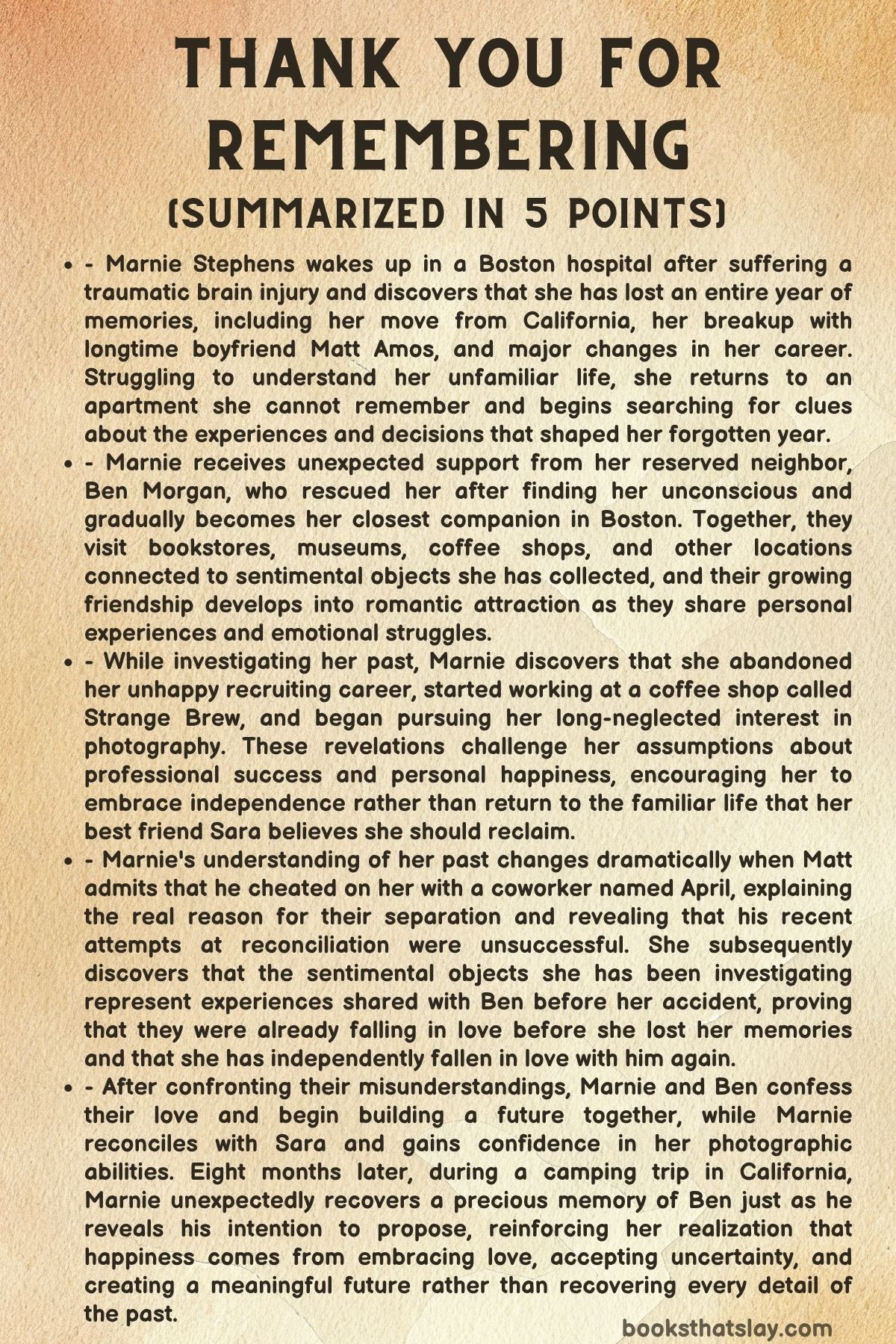
Summary
Marnie Stephens wakes up in a hospital at Massachusetts General Hospital, confused about her surroundings and unable to understand what has happened to her. She remembers living in Los Angeles with her boyfriend, Matt Amos, and preparing to move to Boston, but the doctors soon reveal that her understanding of her life is a year out of date.
Marnie has suffered two head injuries, the first causing bleeding around her brain and the second occurring when she collapsed. Although her physical condition is improving, she has developed retrograde amnesia that has erased approximately twelve months of memories.
Her confusion becomes more distressing when she speaks to Matt and discovers that they moved to Boston a year earlier but separated six months ago. The relationship she remembers as happy and stable no longer exists, and Matt offers little explanation for their breakup.
Discharged from the hospital, Marnie returns to an unfamiliar apartment in Boston’s North End. She discovers that her phone is inaccessible, her surroundings are strange, and she has almost no understanding of the decisions that brought her there.
An encounter with a mouse sends her running into the hallway, where she meets Ben Morgan, the handsome neighbor she vaguely remembers seeing at the hospital. Ben explains that he found her unconscious in their building and took her to the emergency room.
Although Ben appears reserved and somewhat intimidating, he offers practical assistance when Marnie struggles to buy groceries and navigate the neighborhood. He accompanies her to a store, helps her regain access to basic necessities, and gives her directions that allow her to return home independently.
Marnie contacts her best friend, Sara, who lives in California, hoping to understand what happened during the missing year. Sara explains that Marnie became increasingly unhappy after moving to Boston, especially as Matt devoted more time to his demanding cybersecurity career.
Their relationship deteriorated, and Marnie eventually moved into her own apartment and left her recruiting job. Sara believes she subsequently accepted a position in beverage sales, although Marnie cannot remember anything about this supposed career change.
When Marnie finally meets Matt for coffee, their conversation is uncomfortable and emotionally distant. He acknowledges that they struggled with communication and growing dissatisfaction but remains evasive about the precise circumstances of their separation.
Meanwhile, Marnie begins attending appointments with neuropsychologist Dr. Janine Herman, who explains that her missing memories may eventually return but offers no guarantees. Janine encourages her to revisit familiar places and experiences without allowing frustration to overwhelm her recovery.
This suggestion inspires Marnie to examine a collection of sentimental objects in her apartment, including a bookstore receipt, museum map, movie tickets, a coffee shop napkin, a Monopoly token, and a length of colored string. Believing these keepsakes represent meaningful experiences from her forgotten year, she decides to investigate their origins.
Ben becomes her companion during this investigation, accompanying her to the Brattle Book Shop, where she hopes a receipt connected to her favorite novel, Jane Eyre, will trigger a memory. The visit produces no breakthrough, leaving Marnie disappointed and questioning whether her efforts are worthwhile.
Recognizing her distress, Ben takes her to Modern Pastry and buys her a lobster-tail pastry before leading her to Copp’s Hill Terrace. Their conversation about childhood bullying, family experiences, and emotional hardship establishes a friendship that feels increasingly natural.
Marnie’s next clue leads her to Strange Brew, a coffee shop where she discovers that she suffered her first head injury after falling inside the establishment. Even more surprisingly, she learns that she works there as a barista rather than in the beverage-sales position Sara described.
Although returning to work proves difficult, Marnie begins discovering that her forgotten life involved choices very different from those she once imagined making. She had abandoned a financially secure recruiting career and apparently started exploring photography, an artistic ambition she had neglected while supporting her grandmother.
Her growing independence creates tension with Sara, who believes she should return to California and resume her old career. Marnie gradually realizes that the life she no longer remembers may have been happier and more authentic than the life she once considered successful.
Ben continues accompanying her around Boston, including a visit to the Isabella Stewart Gardner Museum. There, an empty frame left after a famous art theft becomes a powerful reminder that something absent can remain meaningful even when its return is uncertain.
As their friendship deepens, Marnie learns that Ben works in historical restoration and teaches carpentry. He once pursued medicine but ultimately rejected that career in favor of work that brought him genuine satisfaction.
Ben also reveals that his father struggled with alcoholism and abandoned the family during his childhood. Marnie shares her grief over losing her parents and watching her grandmother gradually disappear into dementia.
Their conversations reveal similarities beneath their different personalities. Both have experienced significant loss, questioned expectations imposed by others, and struggled to determine what happiness should mean.
Marnie initially assumes that Lauren, a woman frequently seen visiting Ben, is his girlfriend. Her relief when she discovers that Lauren is actually his married sister forces her to acknowledge the romantic feelings developing between them.
Their relationship becomes increasingly affectionate through shared books, playful arguments, text messages, and outings around Boston. Ben introduces Marnie to aspects of the city that transform it from an unfamiliar place into somewhere she can imagine belonging.
During a Boston Red Sox game with Ben and Lauren’s husband, Pete, Marnie experiences an important change in perspective. Instead of concentrating on everything she cannot remember, she enjoys an ordinary evening and recognizes that her present happiness has value.
Later, at a crowded bar, Ben and Marnie finally kiss. Their attraction becomes unmistakable, although Marnie remains uncertain about Ben’s intentions because he previously suggested that he avoids romantic commitments.
Her confusion intensifies when an unfamiliar woman named April visits Strange Brew and appears distressed by their encounter. Marnie cannot remember April but senses that the woman belongs to a part of her life that remains hidden.
At a subsequent medical appointment, Janine warns Marnie that some memories might never return. The possibility devastates her because she has treated recovering her past as the essential condition for rebuilding her future.
A difficult day grows worse when Marnie accidentally breaks a cherished mug associated with her grandmother. Ben comforts her, and their romantic feelings surface again, leading to another passionate encounter.
However, a message from Matt changes the atmosphere. Ben discovers that Marnie is preparing to have dinner with her former boyfriend and that she has suspected some of her cherished keepsakes might represent romantic experiences with Matt.
Visibly hurt, Ben withdraws, telling Marnie that she deserves the freedom to understand her feelings without pressure from him. His departure leaves her questioning both their relationship and her determination to recover memories that may never return.
Deciding that she must stop allowing the past to control her, Marnie discards her collection of clues. She then attends dinner with Sara, Sara’s husband Garrett, and Matt, hoping to reconnect with the familiar friendships she once valued.
During the meal, Sara announces that she is pregnant and has received a promotion. The celebration deteriorates when she begins encouraging Marnie to return to California and reunite with Matt.
Marnie rejects the suggestion, insisting that she is happy building a different life in Boston. Their disagreement exposes Sara’s difficulty accepting that her best friend has changed and no longer shares the same ambitions.
The evening also produces a startling revelation: Matt has recently ended a relationship with April. When Marnie questions him afterward, he admits that he was unfaithful with April while they were still together.
Matt explains that he confessed the affair, which led to their separation. Although Marnie cannot remember discovering his betrayal, she recognizes that their relationship had already become emotionally unsatisfying.
Matt also admits that he attempted reconciliation shortly before her accident, but Marnie refused because she understood that neither of them could manufacture happiness. Their conversation finally allows her to see the relationship without the idealized expectations created by her missing memories.
When she asks Matt about the bookstore receipt, museum visit, and other keepsakes, he recognizes none of them. This realization changes everything: the objects might not represent her past relationship with Matt but experiences she shared with Ben.
Marnie retrieves her discarded collection and identifies the colored string as the packaging used by Modern Pastry. She confronts Ben, demanding to know why he never revealed that they already knew each other before her accident.
Ben admits that they had become close friends and were developing romantic feelings before Marnie lost her memory. He explains that he feared influencing her recovery and believed she might have reconciled with Matt, particularly after hospital staff identified Matt as her boyfriend.
He also assumed that her investigations meant she was gradually remembering their earlier friendship. Rather than force her to confront experiences she could not recall, he allowed their connection to develop naturally.
Ben explains that the keepsakes commemorate their time together: the museum map, bookstore receipt, movie tickets, pastry string, Monopoly token, and coffee shop napkin all carry memories of their growing affection.
Marnie finally understands that she was falling in love with Ben before the accident. More remarkably, despite losing every memory of their relationship, she has independently fallen in love with him again.
She explains that she rejected Matt’s reconciliation attempt before her injury because she had already chosen a different future. Marnie and Ben confess their love, reconcile, and begin their relationship with renewed certainty.
Their happiness continues as Marnie resolves her disagreement with Sara, who admits that her controlling behavior partly resulted from fears about their changing friendship. Both women recognize that their relationship can survive without requiring their lives to remain identical.
Shortly afterward, Marnie discovers developed photographs from her old camera, showing Boston, her coworkers, and numerous moments spent with Ben before the accident. Although the pictures do not immediately restore her memories, they confirm the happiness she experienced and encourage her to pursue photography seriously.
Eight months later, Marnie and Ben are camping on a California beach while visiting to celebrate Sara and Garrett’s new baby and honor Marnie’s grandmother. Marnie has embraced photography, maintained her friendships, and built a fulfilling life despite her incomplete memory recovery.
As they discuss their hopes beneath the stars, Marnie suddenly remembers playing Monopoly with Ben before her injury and recognizing her love for him. Ben then announces his intention to ask her to marry him.
The story concludes with Marnie understanding that destiny need not depend on supernatural intervention or recovering every missing experience. Love, happiness, and identity can emerge through the choices people make, the difficulties they survive, and the futures they consciously build together.
Characters
Marnie Stephens
Marnie Stephens is the protagonist of Thank You for Remembering, a woman whose sudden memory loss forces her to reconsider everything she believes about herself. At the beginning of the novel, she is frightened, confused, and emotionally dependent on a past that no longer reflects her circumstances.
Marnie’s greatest challenge is not simply losing a year of memories but discovering that her forgotten self made significant decisions without the knowledge of the person she now believes herself to be. Her separation from Matt, resignation from recruiting, move into a new apartment, and rediscovery of photography suggest that she had already begun transforming her life before the accident.
Her personality combines kindness, nervous humor, emotional sensitivity, and a tendency to prioritize other people’s comfort over her own. She frequently apologizes for needing assistance, even when her medical condition makes that assistance necessary.
Much of this behavior develops from her earlier experiences of loss and responsibility. Having lost her parents during childhood, Marnie was raised by her grandmother and later sacrificed personal ambitions to provide financial support during her grandmother’s illness.
Her relationship with Ben gradually changes her understanding of love and independence. Unlike her relationship with Matt, where difficult conversations were frequently avoided, her connection with Ben encourages honesty, vulnerability, and an appreciation for ordinary happiness.
Marnie’s professional development is equally significant because she begins recognizing that a successful life does not necessarily require a prestigious career. Her renewed interest in photography represents the recovery of aspirations she previously abandoned.
By the novel’s conclusion, Marnie accepts that her missing memories may never return completely. Her growth comes from understanding that personal identity is not confined to remembered experiences but can continually develop through decisions, relationships, and new possibilities.
Ben Morgan
Ben Morgan is the central romantic character in Thank You for Remembering, initially appearing as a reserved neighbor who rescues Marnie after finding her unconscious. His quiet manner conceals a deeply compassionate personality shaped by family difficulties, emotional restraint, and an enduring fear of abandonment.
Ben expresses affection primarily through practical actions rather than dramatic declarations. He accompanies Marnie through unfamiliar neighborhoods, helps her navigate financial difficulties, lends her books, and supports her efforts to understand her forgotten experiences.
His career as a carpenter specializing in historical preservation reveals his commitment to meaningful work. Although he once attended medical school, he abandoned that path because it did not provide the satisfaction he discovered through craftsmanship.
His complicated feelings about carpentry arise from his relationship with his father, who struggled with alcoholism and abandoned the family. Ben initially resisted following his father’s profession because he associated it with painful childhood experiences.
His reluctance to pursue romantic relationships reflects a similar emotional conflict. Having witnessed the suffering caused by his father’s departure, Ben fears becoming responsible for another person’s disappointment or pain.
His connection with Marnie challenges those protective habits. Her openness, humor, and determination gradually encourage him to accept emotional intimacy despite the risks involved.
Ben’s decision not to reveal their previous friendship demonstrates both sensitivity and imperfect judgment. Although he intends to protect Marnie’s recovery, his silence creates misunderstandings that threaten their developing relationship.
Ultimately, Ben learns that love cannot be made safe through emotional distance. By choosing honesty and accepting Marnie’s love, he moves beyond the limitations imposed by his childhood experiences.
Matt Amos
Matt Amos plays a complicated role in Thank You for Remembering because he represents the familiar life Marnie initially believes she has lost. As her former boyfriend, he occupies a central position in her remembered identity, even though their relationship had already ended before her accident.
Matt is professionally ambitious and works in cybersecurity, a career that increasingly consumes his attention after their move to Boston. His demanding schedule contributes to the emotional distance between him and Marnie, although their difficulties also originate from longstanding communication problems.
His greatest weakness is his inability to confront dissatisfaction directly. Instead of addressing the problems in their relationship, he becomes increasingly detached and eventually betrays Marnie’s trust through an affair with April.
Matt’s treatment of Marnie after her injury reflects both guilt and uncertainty. He offers incomplete explanations about their separation, leaving her struggling to understand why the relationship she remembers no longer exists.
His later desire to reconcile arises partly from loneliness rather than a genuine transformation in his ability to maintain a relationship. This realization demonstrates that he has often expected romantic partners to provide the emotional fulfillment he cannot create independently.
Nevertheless, Matt is not portrayed as entirely malicious. He eventually acknowledges his infidelity, accepts responsibility for his behavior, and admits that their partnership lacked the emotional friendship necessary for lasting happiness.
His final conversation with Marnie gives both characters the opportunity to understand their separation honestly. Matt ultimately represents a relationship that once served an important purpose but no longer belongs in Marnie’s future.
Sara
Sara is Marnie’s longtime best friend and an important supporting character in Thank You for Remembering, representing the familiarity, security, and expectations associated with Marnie’s former life in California. Although she genuinely loves Marnie, her desire to help frequently becomes an attempt to control her friend’s decisions.
Sara values professional success, financial stability, and predictable relationships. These priorities explain why she struggles to understand Marnie’s decision to abandon recruiting and accept a position at a coffee shop.
Her concern becomes particularly apparent when she encourages Marnie to return to California. Rather than acknowledging that her friend may have discovered a fulfilling life in Boston, Sara assumes that the safest option must also be the happiest.
Sara’s determination to reunite Marnie with Matt exposes another limitation in their friendship. She focuses on restoring familiar social arrangements without recognizing that the relationship ended for serious reasons.
Her pregnancy adds emotional complexity to her behavior. Facing a major transition in her own life, Sara worries that changes in Marnie’s circumstances will weaken the friendship that has supported her for years.
Their confrontation eventually forces Sara to acknowledge these fears. She recognizes that her attempts to influence Marnie’s choices have been motivated partly by selfishness and an inability to accept change.
Sara’s development shows that enduring friendship requires flexibility and respect. By accepting Marnie’s independence, she discovers that their connection does not depend on living in the same city or following identical life plans.
Marnie’s Grandmother
Marnie’s grandmother is one of the novel’s most influential characters despite having died before the central events. Her beliefs, affection, and eventual illness shape Marnie’s personality and provide much of the emotional foundation of Thank You for Remembering.
After Marnie’s parents die in a car accident, her grandmother becomes her primary caregiver. She offers security and affection while encouraging a distinctive understanding of the world based on destiny, magic, and the possibility that the universe guides human lives.
These beliefs provide comfort during Marnie’s childhood. However, as Marnie experiences additional suffering, she begins questioning whether life truly follows a benevolent plan.
Her grandmother’s dementia creates an especially painful contradiction. The woman who provided Marnie with her earliest understanding of love gradually loses the ability to recognize and connect with her.
This experience also influences Marnie’s career decisions because she remains in recruiting partly to afford her grandmother’s medical expenses. Her sense of responsibility causes her to postpone the creative aspirations she once hoped to pursue.
The grandmother continues influencing Marnie through personal possessions, familiar music, childhood memories, and annual rituals. These reminders connect Marnie’s emerging independence with the values that shaped her upbringing.
By the ending, Marnie develops a more mature interpretation of her grandmother’s philosophy. Rather than expecting the universe to arrange happiness, she recognizes that meaning can emerge from deliberate choices and the relationships people nurture.
Dr. Janine Herman
Dr. Janine Herman is Marnie’s neuropsychologist and an important source of medical guidance throughout her recovery. Her compassionate approach provides a contrast to the more clinical manner of the neurologist who initially explains Marnie’s condition.
Janine recognizes that Marnie’s difficulties extend beyond neurological symptoms. She understands that memory loss has damaged her patient’s confidence, sense of continuity, and ability to trust her own decisions.
Her willingness to consider Marnie’s idea of investigating sentimental objects demonstrates professional flexibility. Rather than dismissing the plan, she encourages Marnie to revisit meaningful experiences while avoiding unrealistic expectations.
Janine also delivers one of the novel’s most difficult truths: neurological recovery cannot be guaranteed. She explains that some missing memories may remain inaccessible and that Marnie might need to adapt to lasting changes.
Although this information initially devastates Marnie, it becomes essential to her eventual acceptance of uncertainty. Janine’s role illustrates the importance of supportive medical care that balances empathy with realistic expectations.
Dr. Buterman
Dr. Buterman is the neurologist responsible for explaining Marnie’s injuries and memory loss during her hospitalization. His role establishes the seriousness of her medical condition and the uncertainty surrounding her recovery.
He identifies the consequences of Marnie’s two head injuries and explains that the bleeding around her brain has stopped. However, he also recognizes that her inability to recall recent experiences presents a significant neurological concern.
His communication is comparatively direct and clinical, making his explanations especially difficult for Marnie to absorb. While he provides necessary medical information, he cannot offer the emotional reassurance or certainty she desperately wants.
Dr. Buterman represents the limits of medical intervention in the face of a complicated neurological injury. His involvement emphasizes that physical stabilization does not automatically resolve the psychological consequences of trauma.
Bobbi
Bobbi is one of Marnie’s coworkers at Strange Brew and becomes an important source of practical encouragement. Her appearance helps Marnie discover that she abandoned recruiting and began working as a barista during her forgotten year.
Bobbi responds to Marnie’s memory difficulties with understanding rather than criticism. When Marnie struggles to prepare complicated coffee orders, she suggests simpler responsibilities that allow her to contribute without becoming overwhelmed.
Her support is particularly valuable because Marnie worries that other people consider her incapable. By adjusting expectations without humiliating her, Bobbi helps restore her confidence.
Bobbi also reminds Marnie about their plans to attend a photography course. This revelation connects the coffee shop with Marnie’s larger journey toward discovering creative interests and building a more satisfying life.
Lauren Morgan
Lauren Morgan is Ben’s sister and a supporting character who provides insight into his family history and emotional behavior. Marnie initially mistakes her for Ben’s girlfriend, creating a misunderstanding that briefly discourages her romantic feelings.
Lauren is married to Pete and maintains a close relationship with her brother. Their interactions reveal that Ben has meaningful family connections despite his reluctance to pursue romantic intimacy.
Her understanding of their childhood allows her to explain how their father’s abandonment affected Ben. She recognizes that his emotional distance results partly from fear rather than indifference.
Lauren also notices the attraction developing between Ben and Marnie before either openly acknowledges its significance. Her encouragement helps Marnie understand that Ben’s apparent resistance to relationships does not necessarily mean he lacks romantic feelings.
She represents the importance of family members who understand emotional vulnerabilities without allowing those vulnerabilities to define a person permanently.
Pete
Pete is Lauren’s husband and Ben’s brother-in-law, contributing humor and warmth to several important scenes. His friendly, talkative personality contrasts with Ben’s reserve and helps Marnie feel included in their social circle.
Pete enthusiastically invites Marnie into conversations and explains baseball traditions during their outing to Fenway Park. His presence allows her to enjoy an ordinary social experience without constantly concentrating on her memory loss.
His energetic behavior also produces comic interruptions, particularly when his urgent need for assistance disrupts an intimate moment between Ben and Marnie. These scenes provide relief from the more emotionally demanding elements of the novel.
Although Pete receives less individual development than the central characters, he helps demonstrate the welcoming relationships Marnie gradually establishes in Boston.
April
April is a secondary character whose importance becomes clear only when Marnie discovers the truth about her breakup with Matt. Initially appearing as an unfamiliar woman at Strange Brew, she recognizes Marnie and reacts with visible discomfort.
Her remarks suggest that she possesses knowledge about Marnie’s forgotten past. Because Marnie cannot identify her, the encounter reinforces the unsettling possibility that significant personal events remain completely inaccessible.
April is eventually revealed to be Matt’s coworker and former romantic partner. Matt admits that he slept with her while still involved with Marnie, making April central to the circumstances that ended their relationship.
Although April’s personal perspective is not explored extensively, her appearance raises important questions about betrayal, guilt, and emotional responsibility. She also demonstrates that Marnie’s forgotten year contains painful experiences as well as meaningful discoveries.
Garrett
Garrett is Sara’s husband and part of the friendship group that once included Marnie and Matt. His presence represents the stable social connections Marnie remembers from her life before the move to Boston.
He accompanies Sara during their visit and participates in the dinner intended to reunite the four friends. His relationship with Sara provides a contrast to the unsuccessful partnership between Marnie and Matt.
The announcement that Garrett and Sara are expecting a baby signals an important transition in their lives. Their growing family eventually becomes another reason for Marnie to reconnect with California without abandoning the independence she has established in Boston.
Garrett receives limited individual development, but his character helps establish the changing circumstances that require the friendship group to adapt.
Brian
Brian is Marnie’s downstairs neighbor, initially characterized by his habit of playing ABBA music at an irritating volume. His behavior creates repeated tension because Marnie is already struggling with neurological symptoms and emotional stress.
Their conflict becomes more complicated when Brian reveals that Marnie previously promised to take professional photographs for his theatrical headshots. Because she cannot remember the arrangement, he initially interprets her failure to fulfill it as irresponsibility.
When Marnie finally explains her injury and emotional difficulties, Brian responds with greater understanding. His decision to stop playing ABBA and replace it with her grandmother’s favorite Fleetwood Mac song becomes a meaningful act of consideration.
Brian demonstrates how honest communication can transform an apparently unpleasant relationship. His small gesture also reinforces the novel’s suggestion that ordinary kindness can provide comfort during difficult circumstances.
Gino
Gino is the elderly superintendent responsible for maintaining Marnie’s apartment building. His most memorable involvement concerns the mouse that repeatedly appears in her apartment.
He approaches the problem practically and recommends traps, but Marnie refuses solutions that might harm the animal. Their disagreement highlights her compassionate personality, even when that compassion creates inconvenience for herself.
Gino’s role also emphasizes the ordinary problems Marnie must manage while dealing with a serious medical condition. His presence contributes to the realistic details of apartment living and Marnie’s gradual adjustment to independent life in Boston.
Claire
Claire is one of Marnie’s coworkers at Strange Brew and belongs to the social environment Marnie gradually rediscovers after her injury. Alongside Bobbi, she helps make the coffee shop a place of familiarity and personal connection.
Claire takes an interest in Marnie’s developing relationship with Ben, particularly after Marnie describes their first kisses. Her conversations with Marnie provide a relaxed atmosphere in which romantic anxieties can be expressed openly.
Although her role is relatively small, Claire contributes to the sense that Marnie’s life in Boston contains friendships beyond her relationships with Ben, Matt, and Sara. She represents the everyday social support that helps Marnie feel less isolated.
Themes
Memory, Identity, and the Meaning of Self
The relationship between memory and personal identity forms the emotional foundation of Thank You for Remembering. Marnie’s injury creates a division between the person she remembers being and the person she apparently became during the year she can no longer recall.
Her missing memories contain major decisions about her romantic relationship, professional life, friendships, and personal ambitions. Because she cannot remember making those decisions, she initially struggles to recognize them as legitimate expressions of her identity.
This uncertainty raises a fundamental question about whether people remain the same when they lose access to significant portions of their personal history. Marnie assumes that recovering her memories is necessary before she can understand who she truly is.
However, the novel gradually challenges that belief. As Marnie becomes comfortable working at Strange Brew, exploring photography, and spending time with Ben, she discovers that her present preferences often align with decisions her forgotten self already made.
The photographs she eventually discovers provide an especially meaningful illustration of this idea. They document experiences she cannot consciously remember, yet the happiness visible in them remains connected to the person she continues to be.
The return of her Monopoly memory near the ending provides emotional satisfaction without suggesting that complete recovery is required for happiness. Her transformation has already occurred because she has learned to trust her choices despite the absence of certainty.
Through Marnie’s experiences, the story presents identity as something broader than a collection of remembered events. People are also shaped by their values, habits, relationships, desires, and continuing ability to make meaningful decisions.
Love, Emotional Vulnerability, and Second Chances
Marnie’s relationships with Matt and Ben demonstrate how love can be affected by communication, emotional honesty, and the willingness to accept uncertainty. Her forgotten year allows the novel to examine the difference between remaining attached to a familiar relationship and recognizing a connection that genuinely supports personal growth.
At first, Matt represents security because Marnie remembers loving him and planning a shared future. She interprets their breakup as an inexplicable loss, largely because she cannot recall the dissatisfaction and betrayal that caused their separation.
As she discovers more about their relationship, she realizes that familiarity does not necessarily indicate compatibility. Their inability to communicate openly prevented them from addressing problems before those problems became destructive.
Ben offers a different emotional experience through his patience, attentiveness, and practical kindness. Their affection develops through ordinary conversations, shared interests, difficult disclosures, and the gradual establishment of trust.
Nevertheless, Ben also struggles with emotional vulnerability. His father’s abandonment has taught him to associate intimate commitments with suffering, making him reluctant to acknowledge his own romantic desires.
Their relationship becomes possible only when both characters confront these fears. Marnie must release her attachment to an idealized past, while Ben must accept that protecting himself from emotional pain also prevents him from experiencing love.
The revelation that they were falling in love before her accident gives their relationship an unusual second chance. Marnie’s decision to love Ben again demonstrates that affection can arise from enduring compatibility rather than conscious recollection alone.
Their eventual commitment suggests that lasting love depends less on a perfect history than on mutual understanding, emotional courage, and the continuing choice to remain together.
Personal Freedom, Career Choices, and Authentic Happiness
Professional expectations play a significant role in Marnie’s development because her previous career represents a life organized around obligation rather than personal fulfillment. In Thank You for Remembering, her changing relationship with work becomes an essential part of her search for independence.
Marnie originally entered recruiting because it offered financial stability and allowed her to support her grandmother during a prolonged illness. Although the decision reflected love and responsibility, it also required her to postpone ambitions connected to photography and creative expression.
After her grandmother’s death, Marnie remained uncertain about what she wanted for herself. Her move to Boston initially appeared to be another decision shaped by someone else’s priorities, particularly Matt’s professional advancement.
The discovery that she resigned from recruiting and began working at Strange Brew initially creates embarrassment and confusion. Sara reinforces these feelings by treating the career change as a step backward rather than considering whether Marnie might have chosen it deliberately.
Ben’s professional history provides an important parallel. He abandoned medical school to pursue carpentry, despite the expectations commonly associated with a medical career, because restoration work offered genuine satisfaction.
Both characters demonstrate that meaningful employment cannot be judged solely through salary, prestige, or social approval. Their choices suggest that professional fulfillment requires individuals to understand their interests and accept responsibility for pursuing them.
Marnie’s rediscovery of photography develops this argument further. As she recognizes her creative abilities, she begins imagining a future that reflects her personal values rather than the expectations of other people.
The novel ultimately presents independence as the freedom to make imperfect but authentic choices. Marnie’s happiness develops when she stops asking whether her life appears successful to others and begins considering whether it genuinely satisfies her.
Grief, Healing, and the Search for Destiny
Loss shapes the emotional experiences of both Marnie and Ben long before the accident brings them together. Their developing relationship is influenced by childhood suffering, family separation, and the difficult process of building meaningful lives after experiences they cannot reverse.
Marnie loses her parents at an early age and later witnesses her grandmother’s deterioration through dementia. These experiences challenge the comforting beliefs about destiny and universal guidance that her grandmother encouraged during childhood.
Her traumatic memory loss intensifies this conflict because it creates another situation in which she cannot control what happens to her. She desperately searches for a meaningful explanation, hoping that recovering the right memories will restore order to her life.
Ben approaches suffering from a different perspective. His father’s alcoholism and abandonment leave him fearful of intimate relationships, yet his eventual decision to pursue carpentry also demonstrates his ability to find satisfaction within circumstances shaped by painful memories.
Their conversations gradually reveal that healing does not require every loss to be explained or reversed. Instead, recovery can involve accepting uncertainty while continuing to develop relationships, pursue ambitions, and experience ordinary happiness.
The museum’s empty frames provide a particularly effective symbol of this understanding. The missing paintings remain important despite their absence, suggesting that memories and relationships can retain meaning even when something essential has disappeared.
Marnie’s later return to the California beach connects this developing philosophy with her grandmother’s rituals. By announcing personal intentions beneath the stars, she preserves her grandmother’s hopeful outlook without surrendering responsibility for her future.
The unexpected return of a memory and Ben’s marriage proposal allow the ending to retain an element of wonder. However, the deeper resolution comes from Marnie’s recognition that destiny may emerge through perseverance, love, and personal decisions rather than supernatural intervention.
Ultimately, the novel suggests that healing is not a return to an untouched past. It is the continuing ability to create happiness while carrying experiences of grief, uncertainty, and change.